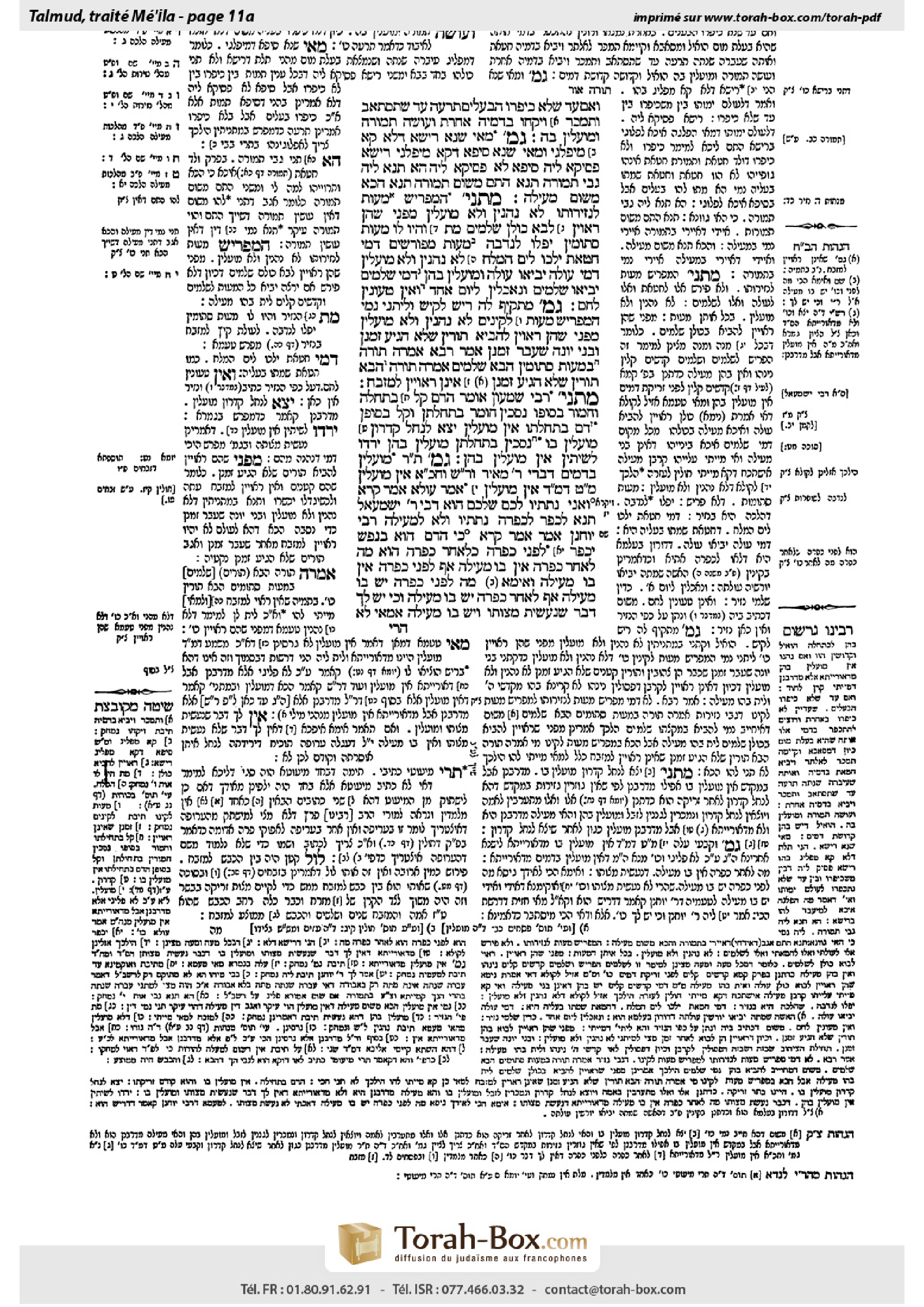
Meilah 11a: Talmud study for Daf Yomi
Daf Yomi is the daily study of one Talmud folio. Explore 37 tractates with scans, Hebrew text, Sefaria English and AI-generated French translations where annotated.
Passage selection and English or AI-generated French translation are available where the scan has annotations. Daf Study is independent of Torah-Box and Sefaria.
Browse Meilah · מעילה · All tractatesMeilah 11a text and translations
This page of Meilah includes the Aramaic text, an English translation and an AI-generated French translation, alongside the scan above.
מעילה י״א א · Aramaic and Hebrew text
וְאִם עַד שֶׁלֹּא כִּיפְּרוּ הַבְּעָלִים – תִּרְעֶה עַד שֶׁתִּסְתָּאֵב, וְתִמָּכֵר וְיִקְחוּ בְּדָמֶיהָ אַחֶרֶת. וְעוֹשֶׂה תְּמוּרָה, וּמוֹעֲלִין בָּהּ.
גְּמָ׳ מַאי שְׁנָא רֵישָׁא דְּלָא קָא מִיפַּלְגִי, וּמַאי שְׁנָא סֵיפָא דְּקָא מִיפַּלְגִי?
רֵישָׁא – פְּסִיקָא לֵיהּ, סֵיפָא – לָא פְּסִיקָא לֵיהּ.
הָא תְּנָא לֵיהּ גַּבֵּי תְּמוּרָה! תְּנָא הָתָם מִשּׁוּם תְּמוּרָה, תְּנָא הָכָא מִשּׁוּם מְעִילָה.
מַתְנִי׳ הַמַּפְרִישׁ מָעוֹת לִנְזִירוּתוֹ – לֹא נֶהֱנִין וְלֹא מוֹעֲלִין, מִפְּנֵי שֶׁהֵן רְאוּיִן לָבֹא כּוּלָּן שְׁלָמִים.
מֵת וְהָיוּ לוֹ מָעוֹת סְתוּמִין – יִפְּלוּ לִנְדָבָה. מָעוֹת מְפוֹרָשִׁים, דְּמֵי חַטָּאת – יֵלְכוּ לְיָם הַמֶּלַח, לֹא נֶהֱנִין וְלֹא מוֹעֲלִין.
דְּמֵי עוֹלָה – יָבִיאוּ עוֹלָה, וּמוֹעֲלִין בָּהֶן. דְּמֵי שְׁלָמִים – יָבִיאוּ שְׁלָמִים, וְנֶאֱכָלִין לְיוֹם אֶחָד. וְאֵין טְעוּנִין לֶחֶם.
גְּמָ׳ מַתְקֵיף לַהּ רֵישׁ לָקִישׁ: וְלִיתְנֵי נָמֵי: הַמַּפְרִישׁ מָעוֹת לְקִינִּים –
לֹא נֶהֱנִין וְלֹא מוֹעֲלִין, מִפְּנֵי שֶׁהֵן רְאוּיִן לְהָבִיא תּוֹרִין שֶׁלֹּא הִגִּיעַ זְמַנָּן וּבְנֵי יוֹנָה שֶׁעָבַר זְמַנָּן!
אָמַר רָבָא: אָמְרָה תּוֹרָה בְּמָעוֹת סְתוּמִין: הָבֵא שְׁלָמִים, אָמְרָה תּוֹרָה: הָבֵא תּוֹרִין שֶׁלֹּא הִגִּיעַ זְמַנָּן? אֵינָן רְאוּיִין לַמִּזְבֵּחַ!
מַתְנִי׳ רַבִּי שִׁמְעוֹן אוֹמֵר: הַדָּם – קַל בַּתְּחִלָּה וְחָמוּר בְּסוֹפוֹ. נְסָכִין – חוֹמֶר בִּתְחִלָּתָן וְקַל בְּסוֹפָן.
דָּם, בִּתְחִלָּתוֹ – אֵין מוֹעֲלִין. יָצָא לְנַחַל קִדְרוֹן – מוֹעֲלִין בּוֹ. נְסָכִין בִּתְחִלָּתָן – מוֹעֲלִין בָּהֶן. יָרְדוּ לַשִּׁיתִין – אֵין מוֹעֲלִין בָּהֶן.
גְּמָ׳ תָּנוּ רַבָּנַן: מוֹעֲלִין בְּדָמִים, דִּבְרֵי רַבִּי מֵאִיר וְרַבִּי שִׁמְעוֹן. וַחֲכָמִים אוֹמְרִים: אֵין מוֹעֲלִין.
מַאי טַעְמָא דְּמַאן דְּאָמַר אֵין מוֹעֲלִין? אָמַר עוּלָּא: אָמַר קְרָא: ״וַאֲנִי נְתַתִּיו לָכֶם״ – שֶׁלָּכֶם הוּא. דְּבֵי רַבִּי יִשְׁמָעֵאל תָּנָא: ״לְכַפֵּר״ – לְכַפָּרָה נְתַתִּיו, וְלֹא לִמְעִילָה.
רַבִּי יוֹחָנָן אָמַר, אָמַר קְרָא: ״כִּי הַדָּם הוּא בַּנֶּפֶשׁ יְכַפֵּר״ – לִפְנֵי כַפָּרָה כִּלְאַחַר כַּפָּרָה הוּא. מָה לְאַחַר כַּפָּרָה אֵין בּוֹ מְעִילָה, אַף לִפְנֵי כַפָּרָה אֵין בּוֹ מְעִילָה.
וְאֵימָא: מַה לִפְנֵי כַפָּרָה – יֵשׁ בּוֹ מְעִילָה, אַף לְאַחַר כַּפָּרָה – יֵשׁ בּוֹ מְעִילָה!
וְכִי יֵשׁ לְךָ דָּבָר שֶׁנַּעֲשֵׂית מִצְוָתוֹ וְיֵשׁ בּוֹ מְעִילָה? אַמַּאי לָא?!
Meilah 11a · English translation
And if the animal whose year passed was found before the owner achieved atonement, the found animal shall graze until it becomes blemished [shetista’ev], at which point it may not be sacrificed; and it shall be sold and the owner shall purchase another animal with the money received from its sale. The animal that was found blemished may be sold immediately, and the owner shall purchase another animal with the money received from its sale. In both cases, the animal renders a non-sacred animal exchanged for it a substitute, and one who derives benefit from it is liable for misusing it.
GEMARA: The mishna first groups together three cases of sin offerings that are left to die, after which it discusses the other two as another group. The Gemara asks: What is different about the three cases in the first clause that the mishna does not distinguish between whether or not the owner has achieved atonement, and what is different about the latter clause that the mishna does distinguish between cases where the owner has and has not achieved atonement?
The Gemara answers: The three cases of sin offerings discussed in the first clause are absolute, i.e., the halakha is the same whether or not the owner has achieved atonement. By contrast, the cases of the other two sin offerings discussed in the latter clause are not absolute, as their status depends on whether or not their owner achieved atonement by means of another offering.
The Gemara asks: Didn’t the Mishna teach this same halakha verbatim in connection with the topic of substitution, in tractate Temura (21b)? Why is it repeated here? The Gemara answers: It is taught there, in Temura, because it discusses the halakhot of substitution, and it is taught again here in tractate Me’ila because it discusses the halakhot of misuse.
MISHNA: In the case of a nazirite who designated money for the three offerings he is obligated to bring upon completion of his naziriteship, a sin offering, a burnt offering, and a peace offering, but he did not specify which money was designated for which offering, since it is not clear what the money is intended for, one may not derive benefit from the money ab initio, but if he derived benefit from the money he is not liable for its misuse. This is due to the fact that all the money is fit for purchase of the peace offering, for which one is liable for misuse only after its blood is sprinkled, and therefore there is no liability for its misuse.
If the nazirite died and he had undesignated funds, meaning he did not specify which money was for each of the three offerings, all the money will be allocated for purchase of communal gift offerings. If the nazirite died and he had specified money, the money specified for purchase of the sin offering shall go to the Dead Sea for disposal, because one may not derive benefit ab initio from the money of a sin offering whose owner has died. But if it was not disposed of, and one derived benefit from the money, he is not liable for its misuse.
With the money specified for purchase of the burnt offering, one shall bring a gift burnt offering, and one is liable for misusing the funds. With the money specified for purchase of the peace offering, one shall bring a gift peace offering. Although it is a gift offering, the restrictions of the peace offering of the naziriteship apply, and therefore it is eaten for one day and that same night, not the standard two days and one night of a regular peace offering. And nevertheless the peace offering does not require the bringing of the loaves that accompany the peace offering of naziriteship, as it is written with regard to the loaves: “And shall place them on the hands of the nazirite” (Numbers 6:19), and in this case the nazirite is dead.
GEMARA: The mishna teaches that if a nazirite designated money for the three offerings that he is obligated to bring upon completion of his naziriteship but did not specify which money was designated for which offering, one who derived benefit from the money is not liable for its misuse, as all the money is fit for purchase of the peace offering. Reish Lakish objects to this: And let the tanna of the mishna also teach a similar halakha with regard to one who was obligated to bring a pair of birds as an offering in a purification ritual, e.g., for a leper or a woman who gave birth, and he designated money for those nests, i.e., the bird offerings, but did not specify which money was for the burnt offering and which was for the sin offering.
Reish Lakish elaborates: Here too, the tanna could have stated that one may not derive benefit from the money ab initio, but if he derived benefit from it he is not liable for its misuse. This is due to the fact that that all the money is fit for purchase of doves whose time of fitness for sacrifice has not yet arrived, as they are fit for sacrifice only when they are older; or pigeons whose time of fitness has passed, which are fit only when they are young. Since these are not fit to be sacrificed, one is not liable for misuse.
Rava says in response: This halakha is not included in the mishna because the two cases are not comparable: In the case of the undesignated money, the Torah said to bring a peace offering as one of the obligatory offerings of a nazirite. Since any part of the money may be used to purchase the peace offering, there is no liability for its misuse. By contrast, in the case of one who designated money for bird offerings, did the Torah say to use this money to bring specifically doves whose time of fitness has not arrived? Such birds are not fit to be sacrificed on the altar. Therefore, it cannot be said this money is intended for a purpose that does not entail liability for misuse.
MISHNA: Rabbi Shimon says: With regard to misuse of the blood of offerings that is to be sprinkled on the altar, the halakha is lenient with regard to the status of the blood at the outset and stringent at its conclusion. With regard to misuse of the wine of the libations that accompany the offerings, the halakha is stringent with regard to the status of the wine at their outset and lenient at their conclusion.
The mishna explains: With regard to blood, at its outset, before it is sprinkled on the altar, one is not liable for misusing it; but once its remainder has been poured on the base of the altar and it emerges via the canal that runs through the Temple to the Kidron Valley at the foot of the Temple Mount, one is liable for misusing it. With regard to libations, at their outset, from the moment they were consecrated, one is liable for misusing them, but once they have descended to the drainpipes built into the altar and which extend beneath it, through which the libations flowed out of the Temple, one is no longer liable for misusing them, as their mitzva was fulfilled and therefore their sanctity has ceased.
GEMARA: The Gemara cites a baraita relating to the mishna’s ruling that once the remainder of the blood emerged via the canal that runs through the Temple one is liable for its misuse. The Sages taught in a baraita: One is liable for misusing the blood of the offerings after it has emerged via the canal that runs through the Temple to the Kidron Valley. This is the statement of Rabbi Meir and Rabbi Shimon. And the Rabbis say: One is not liable for misusing the blood.
The Gemara asks: What is the reason of the one who says that one is not liable for misusing the blood, despite the fact that it comes from a consecrated offering? Ulla said that blood is not consecrated, because the verse states: “For the life of the flesh is in the blood, and I have given it to you upon the altar to atone for your souls” (Leviticus 17:11). “To you” indicates that it shall be yours, and it is not the property of the Temple. A Sage of the school of Rabbi Yishmael likewise taught that the term “to atone” teaches that God says: I gave it for atonement, and not for the prohibition against misuse of consecrated property.
Rabbi Yoḥanan says this halakha is derived from a different phrase, as the verse states: “For it is the blood that atones by reason of the life” (Leviticus 17:11). The word “is” teaches that the blood remains as it is, retaining the same status before atonement as after atonement: Just as after atonement it is not subject to the prohibition against misuse of consecrated property, as the mitzva has been performed, so too, before atonement it is not subject to misuse of consecrated property.
The Gemara asks: But if the basis for this halakha is that the status of blood remains the same before and after atonement, one can say the opposite, that its status after atonement should be like its status before atonement: Just as before atonement it is subject to misuse of consecrated property, so too, after atonement it is subject to misuse of consecrated property.
The Gemara rejects this contention with a rhetorical question: Is there anything whose mitzva has been performed and it is still subject to misuse of consecrated property? The Gemara challenges this assumption: Why not? Why not say this; is there really no precedent for such a suggestion?
Meilah 11a · Traduction française (IA)
Et si l’animal dont l’année était révolue fut retrouvé avant que le propriétaire n’ait obtenu l’expiation, l’animal retrouvé paîtra jusqu’à ce qu’il devienne impropre [shetista’ev] ; il ne pourra alors pas être offert en sacrifice, mais sera vendu, et le propriétaire achètera un autre animal avec le produit de la vente. L’animal retrouvé déjà atteint d’un défaut peut être vendu immédiatement, et le propriétaire achètera un autre animal avec le produit de la vente. Dans les deux cas, l’animal confère le statut de substitut à l’animal non consacré échangé contre lui, et celui qui en tire profit est passible pour détournement d’un bien consacré.
GUEMARA : La Michna regroupe d’abord trois cas de sacrifices expiatoires qui doivent être laissés à mourir, puis traite les deux autres comme un second groupe. La Guemara demande : En quoi les trois cas de la première partie diffèrent-ils, puisque la Michna ne distingue pas selon que le propriétaire a ou non obtenu l’expiation, et en quoi les cas de la dernière partie diffèrent-ils, puisque la Michna distingue ceux où le propriétaire a obtenu l’expiation de ceux où il ne l’a pas obtenue ?
La Guemara répond : Les trois cas de sacrifices expiatoires traités dans la première partie sont absolus, c’est-à-dire que la halakha est la même, que le propriétaire ait ou non obtenu l’expiation. En revanche, les deux autres cas de sacrifices expiatoires traités dans la dernière partie ne sont pas absolus, car leur statut dépend du fait que leur propriétaire ait ou non obtenu l’expiation au moyen d’un autre sacrifice.
La Guemara demande : La Michna n’a-t-elle pas déjà enseigné exactement la même halakha à propos de la substitution, dans le traité Temoura (21b) ? Pourquoi la répéter ici ? La Guemara répond : Cette halakha est enseignée là-bas, dans Temoura, parce que ce traité traite des lois de la substitution, et elle est enseignée de nouveau ici, dans le traité Meïla, parce que celui-ci traite des lois du détournement d’un bien consacré.
MICHNA : Dans le cas d’un nazir qui a affecté de l’argent aux trois sacrifices qu’il est tenu d’apporter à l’achèvement de son naziréat — un sacrifice expiatoire, un holocauste et un sacrifice de paix — mais n’a pas précisé quelle somme était destinée à quel sacrifice, de sorte qu’on ne sait pas à quoi l’argent est destiné, il est interdit d’en tirer profit a priori ; toutefois, s’il en a tiré profit, il n’est pas passible pour détournement d’un bien consacré. En effet, tout cet argent peut servir à acheter le sacrifice de paix, dont le détournement n’engage la responsabilité qu’après l’aspersion de son sang ; il n’y a donc pas de responsabilité pour détournement.
Si le nazir est mort et qu’il avait des fonds non affectés, c’est-à-dire qu’il n’avait pas précisé quelle somme était destinée à chacun des trois sacrifices, tout l’argent sera affecté à l’achat de sacrifices volontaires communautaires. Si le nazir est mort et qu’il avait précisé l’affectation de ses fonds, l’argent destiné à l’achat du sacrifice expiatoire doit être envoyé à la mer Morte pour y être éliminé, car il est interdit a priori de tirer profit de l’argent d’un sacrifice expiatoire dont le propriétaire est mort. Toutefois, si l’argent n’a pas été éliminé et que quelqu’un en a tiré profit, celui-ci n’est pas passible pour détournement d’un bien consacré.
Avec l’argent destiné à l’achat de l’holocauste, on apportera un holocauste volontaire, et l’on est passible pour détournement de ces fonds. Avec l’argent destiné à l’achat du sacrifice de paix, on apportera un sacrifice de paix volontaire. Bien qu’il s’agisse d’un sacrifice volontaire, les restrictions du sacrifice de paix du naziréat s’appliquent : il est donc consommé pendant un jour et la nuit qui suit, et non pendant les deux jours et la nuit habituels d’un sacrifice de paix ordinaire. Néanmoins, ce sacrifice de paix n’exige pas l’offrande des pains qui accompagnent le sacrifice de paix du naziréat, car il est écrit au sujet des pains : « Il les placera sur les mains du nazir » (Nombres 6:19), or, dans ce cas, le nazir est mort.
GUEMARA : La Michna enseigne que si un nazir a affecté de l’argent aux trois sacrifices qu’il est tenu d’apporter à l’achèvement de son naziréat, mais n’a pas précisé quelle somme était destinée à quel sacrifice, celui qui en a tiré profit n’est pas passible pour détournement d’un bien consacré, car tout l’argent peut servir à acheter le sacrifice de paix. Reish Lakish objecte : Le tanna de la Michna aurait également pu enseigner une halakha semblable à propos de celui qui était tenu d’apporter une paire d’oiseaux dans le cadre d’un rite de purification, par exemple un lépreux ou une femme ayant accouché, et qui avait affecté de l’argent à ces nids, c’est-à-dire aux offrandes d’oiseaux, sans préciser quelle somme était destinée à l’holocauste et laquelle au sacrifice expiatoire.
Reish Lakish développe : Ici aussi, le tanna aurait pu enseigner qu’il est interdit a priori de tirer profit de l’argent, mais que, s’il en a tiré profit, on n’est pas passible pour détournement d’un bien consacré. En effet, tout cet argent peut servir à acheter des tourterelles qui ne sont pas encore en âge d’être offertes, puisqu’elles ne conviennent au sacrifice que lorsqu’elles sont plus âgées, ou des pigeons dont l’âge requis est dépassé, et qui ne conviennent au sacrifice que lorsqu’ils sont jeunes. Puisque ces oiseaux ne peuvent pas être offerts en sacrifice, on n’est pas passible pour détournement.
Rava répond : Cette halakha n’est pas incluse dans la Michna, car les deux cas ne sont pas comparables. Dans le cas de l’argent non affecté, la Torah a prescrit d’apporter un sacrifice de paix parmi les sacrifices obligatoires du nazir. Puisque n’importe quelle partie de l’argent peut servir à acheter le sacrifice de paix, il n’y a pas de responsabilité pour détournement. En revanche, dans le cas de celui qui a affecté de l’argent aux offrandes d’oiseaux, la Torah a-t-elle prescrit d’utiliser cet argent précisément pour apporter des tourterelles qui ne sont pas encore en âge d’être offertes ? De tels oiseaux ne peuvent pas être offerts sur l’autel. On ne peut donc pas dire que cet argent est destiné à un usage qui n’engage pas la responsabilité pour détournement.
MICHNA : Rabbi Shimon dit : En ce qui concerne le détournement du sang des sacrifices destiné à être aspergé sur l’autel, la halakha est indulgente quant au statut du sang au début, et rigoureuse à la fin. En ce qui concerne le détournement du vin des libations qui accompagnent les sacrifices, la halakha est rigoureuse quant au statut du vin au début, et indulgente à la fin.
La Michna explique : Pour le sang, au début, avant qu’il ne soit aspergé sur l’autel, on n’est pas passible pour détournement ; mais une fois que le reste a été versé à la base de l’autel et qu’il s’est écoulé par le canal qui traverse le Temple jusqu’à la vallée du Cédron, au pied du mont du Temple, on est passible pour détournement. Pour les libations, dès le début, à partir du moment où elles ont été consacrées, on est passible pour détournement ; mais une fois qu’elles sont descendues dans les conduits d’évacuation aménagés dans l’autel et qui se prolongent sous celui-ci, par lesquels les libations s’écoulaient hors du Temple, on n’est plus passible pour détournement, car leur mitsva a été accomplie et leur sainteté a donc pris fin.
GUEMARA : La Guemara cite une baraïta relative à la décision de la Michna selon laquelle, une fois que le reste du sang s’est écoulé par le canal qui traverse le Temple, on est passible pour son détournement. Les Sages ont enseigné dans une baraïta : On est passible pour détournement du sang des sacrifices après qu’il s’est écoulé par le canal qui traverse le Temple jusqu’à la vallée du Cédron. Telle est l’opinion de Rabbi Meïr et de Rabbi Shimon. Mais les Sages disent : On n’est pas passible pour détournement du sang.
La Guemara demande : Quelle est la raison de celui qui dit qu’on n’est pas passible pour détournement du sang, bien qu’il provienne d’un sacrifice consacré ? Oulla dit que le sang n’est pas consacré, car le verset dit : « Car la vie de la chair est dans le sang, et je vous l’ai donné sur l’autel pour faire expiation pour vos âmes » (Lévitique 17:11). L’expression « je vous l’ai donné » indique que le sang vous appartient et qu’il n’est pas la propriété du Temple. Un sage de l’école de Rabbi Yishmaël a enseigné de même que l’expression « pour faire expiation » enseigne que Dieu dit : Je l’ai donné pour l’expiation, et non pour qu’il soit soumis à l’interdiction de détourner un bien consacré.
Rabbi Yoḥanan dit que cette halakha se déduit d’une autre expression, car le verset dit : « Car c’est le sang qui fait expiation en raison de la vie » (Lévitique 17:11). Le mot « c’est » enseigne que le sang conserve le même statut avant et après l’expiation : de même qu’après l’expiation, il n’est pas soumis à l’interdiction de détourner un bien consacré, puisque la mitsva a été accomplie, de même, avant l’expiation, il n’est pas soumis à cette interdiction.
La Guemara demande : Mais si le fondement de cette halakha est que le statut du sang demeure identique avant et après l’expiation, on peut soutenir l’inverse : son statut après l’expiation devrait être semblable à son statut avant l’expiation. De même qu’avant l’expiation il est soumis à l’interdiction de détourner un bien consacré, de même, après l’expiation, il devrait y être soumis.
La Guemara rejette cette affirmation au moyen d’une question rhétorique : Existe-t-il quelque chose dont la mitsva a été accomplie et qui reste soumis à l’interdiction de détourner un bien consacré ? La Guemara conteste cette supposition : Pourquoi pas ? Pourquoi ne pas dire cela ? N’y a-t-il vraiment aucun précédent à une telle affirmation ?
Traduction française générée par IA à partir de l’édition anglaise de Sefaria. Vérifie toujours un passage avec le texte source.
Text from Sefaria: William Davidson Edition - Vocalized Aramaic (CC BY NC); William Davidson Edition - English (CC BY NC).