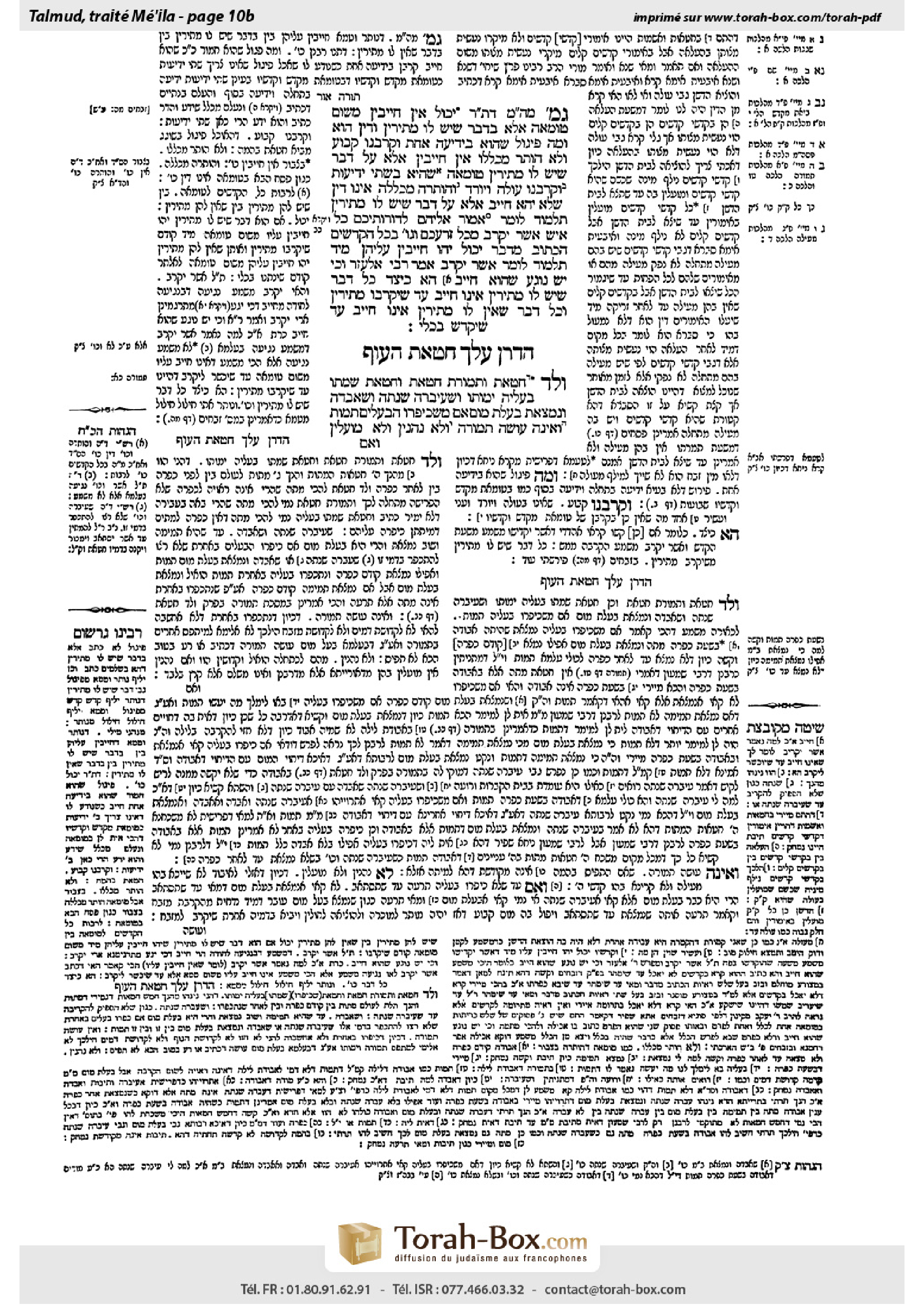
Meilah 10b: Talmud study for Daf Yomi
Daf Yomi is the daily study of one Talmud folio. Explore 37 tractates with scans, Hebrew text, Sefaria English and AI-generated French translations where annotated.
Passage selection and English or AI-generated French translation are available where the scan has annotations. Daf Study is independent of Torah-Box and Sefaria.
Browse Meilah · מעילה · All tractatesMeilah 10b text and translations
This page of Meilah includes the Aramaic text, an English translation and an AI-generated French translation, alongside the scan above.
מעילה י׳ ב · Aramaic and Hebrew text
גְּמָ׳ מְנָא הָנֵי מִילֵּי? דְּתָנוּ רַבָּנַן: יָכוֹל אֵין חַיָּיבִין מִשּׁוּם טוּמְאָה אֶלָּא בְּדָבָר שֶׁיֵּשׁ לוֹ מַתִּירִין?
וְדִין הוּא: וּמָה פִּיגּוּל שֶׁהוּא בִּידִיעָה אַחַת, וְקׇרְבָּנוֹ קָבוּעַ, וְלֹא הוּתַּר מִכְּלָלוֹ – אֵין חַיָּיבִין אֶלָּא עַל דָּבָר שֶׁיֵּשׁ לוֹ מַתִּירִין,
טוּמְאָה, שֶׁהִיא בִּשְׁתֵּי יְדִיעוֹת, וְקׇרְבָּנוֹ עוֹלֶה וְיוֹרֵד, וְהוּתְּרָה מִכְּלָלָהּ – אֵינוֹ דִּין שֶׁלֹּא יְהֵא חַיָּיב אֶלָּא עַל דָּבָר שֶׁיֵּשׁ לוֹ מַתִּירִין?!
תַּלְמוּד לוֹמַר: ״אֱמֹר אֲלֵהֶם לְדֹרֹתֵיכֶם כׇּל אִישׁ אֲשֶׁר יִקְרַב מִכׇּל זַרְעֲכֶם וְגוֹ׳״ – בְּכׇל הַקֳּדָשִׁים הַכָּתוּב מְדַבֵּר. יָכוֹל יְהוּ חַיָּיבִין עֲלֵיהֶן מִיָּד? תַּלְמוּד לוֹמַר: ״אֲשֶׁר יִקְרַב״.
אָמַר רַבִּי אֶלְעָזָר: וְכִי יֵשׁ נוֹגֵעַ שֶׁהוּא חַיָּיב?! הָא כֵּיצַד? כׇּל דָּבָר שֶׁיֵּשׁ לוֹ מַתִּירִין – אֵינוֹ חַיָּיב עַד שֶׁיִּקְרְבוּ מַתִּירִין, וְכׇל דָּבָר שֶׁאֵין לוֹ מַתִּירִין – אֵינוֹ חַיָּיב עַד שֶׁיִּקְדַּשׁ בִּכְלִי.
הַדְרָן עֲלָךְ חַטַּאת הָעוֹף
.
וְלַד חַטָּאת, וּתְמוּרַת חַטָּאת, וְחַטָּאת שֶׁמֵּתוּ בְּעָלֶיהָ – יָמוּתוּ,
וְשֶׁעִיבְּרָה שְׁנָתָהּ, וְשֶׁאָבְדָה וְנִמְצֵאת בַּעֲלַת מוּם, אִם מִשֶּׁכִּיפְּרוּ הַבְּעָלִים – תָּמוּת. וְאֵינָהּ עוֹשָׂה תְּמוּרָה, וְלֹא נֶהֱנִין וְלֹא מוֹעֲלִין.
Meilah 10b · English translation
GEMARA: The mishna teaches that one is liable for the prohibition of notar and the prohibition of eating an item while ritually impure, both with regard to items that have permitting factors and items that do not have permitting factors. The Gemara asks: From where are these matters derived? The Gemara answers that this is as the Sages taught in a baraita: One might have thought that one is liable due to partaking of sacrificial food in a state of ritual impurity only with regard to an item that has permitting factors.
The baraita continues: And this is a logical inference: If with regard to piggul, which renders one who eats it unwittingly liable through one awareness, i.e., for one to be liable to bring a sin offering it is enough for him to become aware after the fact that he had sinned unwittingly, and its offering for one who eats it unwittingly is fixed, and there are no circumstances in which its general prohibition was permitted, i.e., it is never permitted to eat piggul, and yet one is liable due to the prohibition of partaking of piggul only for an item that has permitting factors, the same should certainly apply to ritual impurity.
The Gemara elaborates: Then with regard to ritual impurity, where one is liable only in a case of two awarenesses, i.e., one is liable only if he was aware of his impurity before eating the meat, and then forgot and ate, and afterward again became aware of his impurity; and its offering to atone for this transgression is a sliding-scale offering, which varies according to the offender’s financial status; and there are circumstances in which its general prohibition was permitted to the community, as communal offerings are sacrificed in the Temple in a state of impurity, under certain circumstances; is it not right that one should be liable for violating the prohibition of partaking of the meat while ritually impure only for an item that has permitting factors?
Therefore, the verse states: “Say to them: Anyone of all your seed throughout your generations, that approaches the sacred items, which the children of Israel consecrate to the Lord, while his impurity is on him, that soul shall be cut off from before Me: I am the Lord” (Leviticus 22:3). The verse, which deals with eating while ritually impure, is speaking of all the sacred items, whether or not they have a permitting factor. One might have thought that they should be liable for eating them immediately, as soon as they have been verbally consecrated, even before they have been placed into a service vessel. The verse states: “That approaches the sacred items.” This clause is puzzling, as it apparently leads to the unlikely conclusion that liability applies after one has touched the item.
The baraita explains that Rabbi Elazar said: But is there a case of one who touches an item who is liable? Rather, how is this possible? The answer is that the phrase “approaches [yikrav] the sacred items” can also be understood as: The sacred items that are fit to be sacrificed [yikarev], and therefore with regard to any item that has permitting factors, one is not liable until the permitting factors have been sacrificed. And in the case of any item that does not have permitting factors, one is not liable until it is sanctified in a service vessel.
MISHNA: This mishna, which also appears in tractate Temura, deals with the five sin offerings left to die. It is cited here because of its relevance to the halakhot of misuse. The mishna first mentions three of those offerings: The offspring of a sin offering, and an animal that is the substitute for a sin offering, whether or not the owners achieved atonement by means of another offering, and a sin offering whose owners have died before the offering was sacrificed, shall die.
And the other two sin offerings left to die are the sin offering whose year since birth passed and is therefore unfit for sacrifice, and a sin offering that was lost and when it was found it was blemished, with regard to which the halakhot are as follows: If the sin offering was found after the owner achieved atonement through the sacrifice of another animal as a sin offering, then the blemished animal shall die, and it does not render a non-sacred animal exchanged for it a substitute, as it is has neither inherent sanctity, which would make it fit for sacrifice on the altar, nor sanctity that inheres in its value. And one may not derive benefit from the found animal ab initio, but if he derived benefit from the animal he is not liable for its misuse.
Meilah 10b · Traduction française (IA)
GUEMARA : La Michna enseigne que l’on est passible au titre de l’interdit de notar et de l’interdit de consommer un aliment en état d’impureté rituelle, aussi bien pour les aliments qui ont des facteurs permettant leur consommation que pour ceux qui n’en ont pas. La Guemara demande : D’où tire-t-on ces règles ? La Guemara répond que c’est ce qu’enseignent les Sages dans une baraïta : On aurait pu penser que l’on n’est passible pour avoir consommé un aliment consacré en état d’impureté rituelle que dans le cas d’un aliment qui a des facteurs permettant sa consommation.
La baraïta poursuit : Et voici le raisonnement : si, dans le cas du piggoul, celui qui en consomme par inadvertance est passible sur la base d’une seule prise de conscience — c’est-à-dire qu’il lui suffit, pour être passible d’apporter un sacrifice expiatoire, de prendre conscience après coup qu’il a péché par inadvertance —, si le sacrifice expiatoire requis pour celui qui en consomme par inadvertance est fixe, et si l’interdit général n’a jamais été levé — autrement dit, il n’est jamais permis de consommer du piggoul —, et que pourtant on n’est passible de l’interdit de consommer du piggoul que lorsqu’il s’agit d’un aliment qui a des facteurs permettant sa consommation, à plus forte raison en est-il ainsi dans le cas de l’impureté rituelle.
La Guemara développe : Alors, dans le cas de l’impureté rituelle, où l’on n’est passible qu’après deux prises de conscience — c’est-à-dire que l’on n’est passible que si l’on avait conscience de son impureté avant de manger la viande, qu’on l’a ensuite oubliée et qu’on a mangé, puis qu’on a de nouveau pris conscience de son impureté —, où le sacrifice apporté pour expier cette transgression est un sacrifice à échelle variable, qui dépend de la situation financière du fautif, et où, dans certaines circonstances, l’interdit général a été levé pour la communauté, puisque les sacrifices communautaires sont offerts dans le Temple en état d’impureté dans certaines circonstances, n’est-il pas juste que l’on ne soit passible d’avoir transgressé l’interdit de consommer la viande en état d’impureté rituelle que pour un aliment qui a des facteurs permettant sa consommation ?
C’est pourquoi le verset déclare : « Dis-leur : Quiconque, parmi toute votre descendance, dans toutes vos générations, s’approche des choses saintes que les enfants d’Israël consacrent à l’Éternel, alors que son impureté est sur lui, cette personne sera retranchée de devant Moi : Je suis l’Éternel » (Lévitique 22:3). Le verset, qui traite de la consommation en état d’impureté rituelle, parle de toutes les choses saintes, qu’elles aient ou non un facteur permettant leur consommation. On aurait pu penser que l’on est passible de les consommer dès qu’elles ont été consacrées verbalement, avant même d’avoir été placées dans un ustensile de service. Le verset déclare : « S’approche des choses saintes. » Cette formule est énigmatique, car elle semble conduire à la conclusion peu plausible que l’on est passible après avoir touché l’aliment.
La baraïta explique que Rabbi Elazar a dit : Mais existe-t-il un cas où celui qui touche un aliment est passible ? Comment cela serait-il possible ? La réponse est que l’expression « s’approche [yikrav] des choses saintes » peut aussi s’entendre ainsi : « les choses saintes qui sont aptes à être offertes en sacrifice [yikarev] » ; par conséquent, pour tout aliment qui a des facteurs permettant sa consommation, on n’est passible qu’après que ces facteurs ont été offerts en sacrifice. Et, dans le cas de tout aliment qui n’a pas de facteurs permettant sa consommation, on n’est passible qu’après qu’il a été sanctifié dans un ustensile de service.
MICHNA : Cette Michna, qui figure également dans le traité Temoura, traite des cinq sacrifices expiatoires laissés à mourir. Elle est citée ici en raison de son rapport avec les halakhot du détournement d’un bien consacré. La Michna mentionne d’abord trois de ces sacrifices : le petit d’un sacrifice expiatoire, un animal qui est le substitut d’un sacrifice expiatoire, que ses propriétaires aient ou non obtenu l’expiation au moyen d’un autre sacrifice, et un sacrifice expiatoire dont les propriétaires sont morts avant qu’il soit offert : ces animaux doivent mourir.
Les deux autres sacrifices expiatoires laissés à mourir sont le sacrifice expiatoire dont l’animal a dépassé l’âge d’un an et est donc impropre au sacrifice, et un sacrifice expiatoire qui avait été perdu et qui, lorsqu’il a été retrouvé, était atteint d’un défaut. Les règles à ce sujet sont les suivantes : si le sacrifice expiatoire a été retrouvé après que son propriétaire a obtenu l’expiation par l’offrande d’un autre animal en sacrifice expiatoire, l’animal atteint d’un défaut doit mourir et ne rend pas substitut l’animal non consacré échangé contre lui, car il ne possède ni sainteté intrinsèque, qui le rendrait apte à être offert sur l’autel, ni sainteté attachée à sa valeur. On ne peut pas non plus tirer profit de l’animal retrouvé a priori ; mais si l’on en a tiré profit, on n’est pas passible pour le détournement de ce bien consacré.
Traduction française générée par IA à partir de l’édition anglaise de Sefaria. Vérifie toujours un passage avec le texte source.
Text from Sefaria: William Davidson Edition - Vocalized Aramaic (CC BY NC); William Davidson Edition - English (CC BY NC).