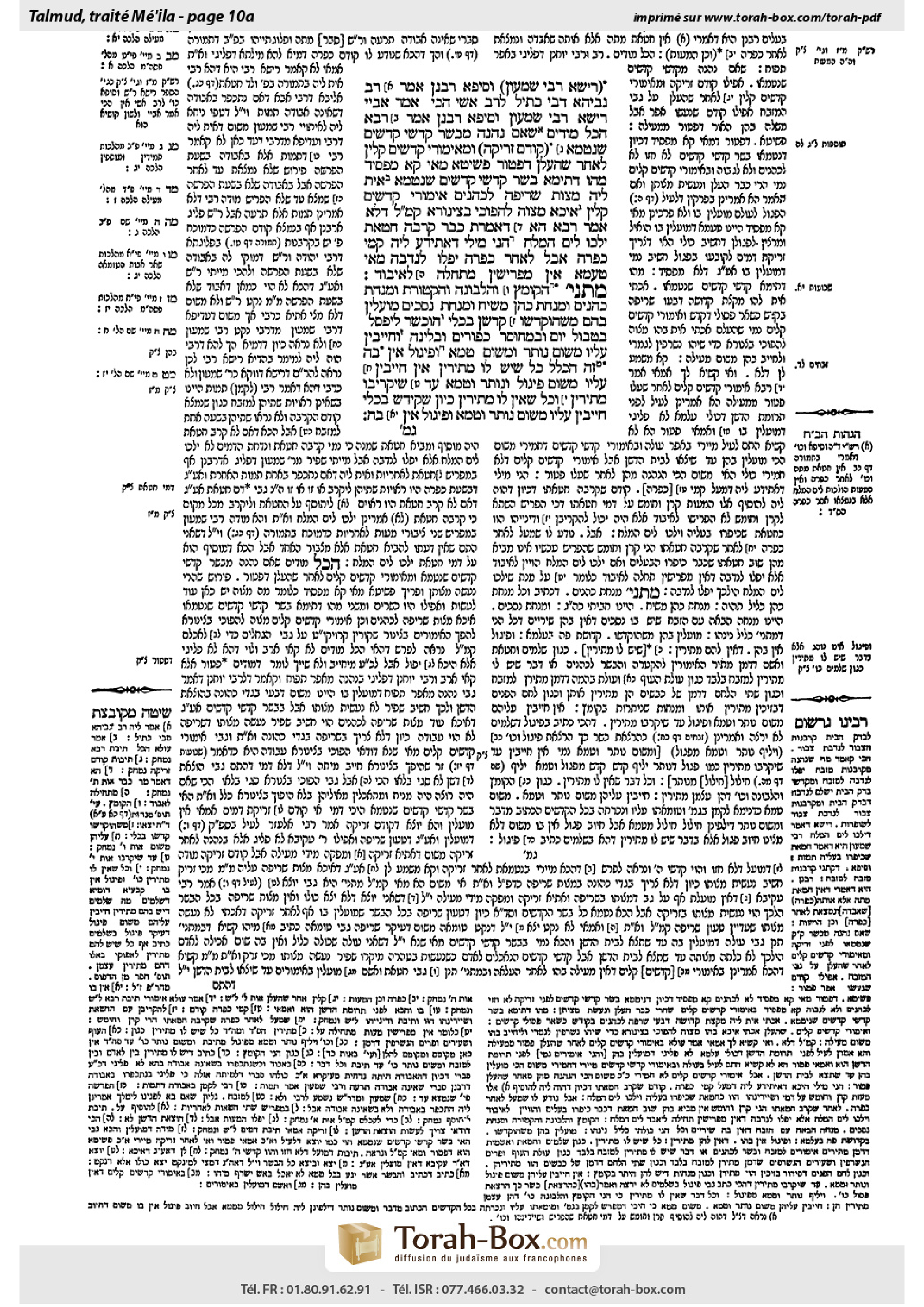
Meilah 10a: Talmud study for Daf Yomi
Daf Yomi is the daily study of one Talmud folio. Explore 37 tractates with scans, Hebrew text, Sefaria English and AI-generated French translations where annotated.
Passage selection and English or AI-generated French translation are available where the scan has annotations. Daf Study is independent of Torah-Box and Sefaria.
Browse Meilah · מעילה · All tractatesMeilah 10a text and translations
This page of Meilah includes the Aramaic text, an English translation and an AI-generated French translation, alongside the scan above.
מעילה י׳ א · Aramaic and Hebrew text
וְסֵיפָא רַבָּנַן?! אָמַר רַב גְּבִיהָא דְּבֵי כְתִיל לְרַב אָשֵׁי, הָכִי אָמַר אַבָּיֵי: רֵישָׁא רַבִּי שִׁמְעוֹן וְסֵיפָא רַבָּנַן.
אָמַר רָבָא: הַכֹּל מוֹדִים שֶׁאִם נֶהֱנָה מִבְּשַׂר קׇדְשֵׁי קָדָשִׁים שֶׁנִּטְמָא קוֹדֶם זְרִיקָה, וּמֵאֵימוּרַי קָדָשִׁים קַלִּין לְאַחַר שֶׁהֶעֱלָן, דְּפָטוּר.
פְּשִׁיטָא, מַאי קָא מַפְסֵיד?
מַהוּ דְּתֵימָא בְּשַׂר קׇדְשֵׁי קָדָשִׁים שֶׁנִּטְמָא – אִית לֵיהּ מִצְוַת שְׂרֵיפָה לְכֹהֲנִים, אֵימוּרֵי קָדָשִׁים קַלִּין – אִיכָּא מִצְוָה לְהַפּוֹכֵי בְּצִינּוֹרָא, קָא מַשְׁמַע לַן דְּלָא.
אָמַר רָבָא: הָא דְּאָמְרַתְּ ״כְּבָר קָרְבָה חַטָּאת יֵלְכוּ לְיָם הַמֶּלַח״, הָנֵי מִילֵּי דְּאִתְיְדַע לֵיהּ קַמֵּי כַּפָּרָה, אֲבָל לְאַחַר כַּפָּרָה – יִפְּלוּ לִנְדָבָה. מַאי טַעְמָא? אֵין מַפְרִישִׁין מִתְּחִלָּה לְאִיבּוּד.
מַתְנִי׳, הַקּוֹמֶץ, וְהַלְּבוֹנָה, וְהַקְּטוֹרֶת, וּמִנְחַת כֹּהֲנִים, וּמִנְחַת כֹּהֵן מָשִׁיחַ, וּמִנְחַת נְסָכִים – מוֹעֲלִין בָּהֶם מִשֶּׁהוּקְדְּשׁוּ.
קִדְּשָׁן בִּכְלִי – הוּכְשַׁר לִיפָּסֵל בִּטְבוּל יוֹם, וּבִמְחוּסַּר כִּפּוּרִים, וּבְלִינָה, וְחַיָּיבִין עָלָיו מִשּׁוּם נוֹתָר, וּמִשּׁוּם טָמֵא וּפִיגּוּל אֵין בָּהּ.
זֶה הַכְּלָל: כׇּל שֶׁיֵּשׁ לוֹ מַתִּירִין – אֵין חַיָּיבִין עָלָיו מִשּׁוּם פִּיגּוּל וְנוֹתָר וְטָמֵא עַד שֶׁיַּקְרִיבוּ מַתִּירִין.
וְכֹל שֶׁאֵין לוֹ מַתִּירִין, כֵּיוָן שֶׁקִּידֵּשׁ בִּכְלִי – חַיָּיבִין עָלָיו מִשּׁוּם נוֹתָר וְטָמֵא, וּפִיגּוּל אֵין בָּהּ.
Meilah 10a · English translation
And the latter clause of the baraita is in accordance with the opinion of the Rabbis, who maintain that a sin offering that became lost is left to die only if it was found after its replacement had already been sacrificed. Rav Geviha of Bei Katil likewise said to Rav Ashi that this is what Abaye said: The first clause of that baraita is in accordance with the opinion of Rabbi Shimon and the latter clause is in accordance with the opinion of the Rabbis.
§ Rava says: With regard to the dispute between Rav and Rabbi Yoḥanan, everyone concedes that if one derived benefit from meat of an offering of the most sacred order that had become ritually impure before the sprinkling of the blood on the altar, or from the sacrificial portions, such as the fats of offerings of lesser sanctity, after they have been brought up to the altar, that he is not liable for misuse of consecrated property, and is exempt from repayment or bringing an offering. The reason is that although in both cases the meat must be burned, this burning is not considered part of the Temple service.
The Gemara asks: Isn’t this ruling obvious? What loss did the one who derived benefit cause to Temple property? The impure meat of an offering of the most sacred order is unfit for the altar and may not be eaten by the priests, and once the portions of offerings of lesser sanctity have been placed on the altar no further service is performed with them.
The Gemara answers that Rava’s statement is necessary, lest you say with regard to meat of an offering of the most sacred order that had become ritually impure: There is a mitzva for the priests to burn it; and lest you say with regard to the sacrificial portions from the fats of offerings of lesser sanctity: There is a mitzva to turn them with a fork [betzinnora] while they are on the altar, so that they will burn more evenly and quickly. Consequently, one who derives benefit from them should be liable for misuse. Rava therefore teaches us that there is no liability for misuse, as the mitzva to burn them or turn them is not considered part of the sacrificial rite.
Rava said, in explanation of the above baraita: This halakha that you say, that if his sin offering has already been sacrificed, then the money is cast into the Dead Sea, this statement applies only if his prohibited benefit was made known to him before the atonement, i.e., before the sacrifice of the animal. In such a case, he could have added his money to the value and purchased a better animal for his offering. But if it became known to him only after the atonement, i.e., the sacrifice of the animal, the money is not cast into the Dead Sea. Instead, it is allocated for communal gift offerings. What is the reason? There is a principle that one does not separate money or an offering from the outset in order for it to be lost or destroyed by being cast into the Dead Sea.
MISHNA: The mishna lists sacrificial items that are consumed in their entirety on the altar and of which the priests have no share. One is liable for misuse of the handful taken from the meal offering, and the frankincense burned with the handful on the altar, and the incense burned each day on the golden altar in the Sanctuary, and the meal offering of priests, from which a handful is not taken but which is burned in its entirety, and the meal offering of the anointed priest, i.e., the High Priest, and the meal offering sacrificed with the libations that accompany offerings. In all these cases, one is liable for misuse from the moment that they were consecrated through declaration.
Once one consecrated them by placing them in the appropriate service vessel, each was rendered susceptible to disqualification for sacrifice through contact with one who immersed in a ritual bath that day, and through contact with one who has not yet brought an atonement offering, and through its blood being left overnight, and one is liable to receive karet for eating it, due to violation of the prohibition of notar, and due to the prohibition of partaking of it while ritually impure; but there is no liability for piggul in each of these cases.
This is the principle that applies to piggul: With regard to any consecrated item that has permitting factors, i.e., there is another item whose sacrifice renders it permitted for consumption by the altar or by an individual, one is not liable due to violation of the prohibition of piggul, and the prohibition of notar, and the prohibition of partaking of it while ritually impure, until they sacrifice the permitting factors.
And with regard to any item that does not have permitting factors, e.g., the handful and the frankincense, as they render other items permitted whereas no other items are needed to render them permitted, once one sanctified them in the appropriate service vessel, one is liable to receive karet for eating it, due to violation of the prohibition of notar, and the prohibition of partaking of it while ritually impure; but there is no liability for piggul in those cases.
Meilah 10a · Traduction française (IA)
Et la dernière clause de la baraïta est conforme à l’opinion des Sages, qui soutiennent qu’un sacrifice expiatoire égaré n’est laissé à mourir que s’il est retrouvé après que l’animal qui l’a remplacé a déjà été sacrifié. Rav Geviha de Bei Katil dit également à Rav Ashi qu’Abaye a dit ceci : la première clause de cette baraïta est conforme à l’opinion de Rabbi Shimon, et la dernière clause à celle des Sages.
§ Rava dit : au sujet de la controverse entre Rav et Rabbi Yoḥanan, tous reconnaissent que si quelqu’un a tiré profit de la viande d’une offrande de sainteté suprême devenue rituellement impure avant l’aspersion du sang sur l’autel, ou des portions sacrificielles — comme les graisses d’offrandes de moindre sainteté — après qu’elles ont été déposées sur l’autel, il n’est pas passible pour détournement de biens consacrés et est dispensé de rembourser ou d’apporter une offrande. En effet, bien que, dans les deux cas, la viande doive être brûlée, cette combustion n’est pas considérée comme faisant partie du service du Temple.
La Guemara demande : cette décision n’est-elle pas évidente ? Quel préjudice celui qui a tiré profit a-t-il causé aux biens du Temple ? La viande impure d’une offrande de sainteté suprême est impropre à être déposée sur l’autel et ne peut être consommée par les prêtres ; de même, une fois que les portions des offrandes de moindre sainteté ont été déposées sur l’autel, aucun autre service n’est accompli avec elles.
La Guemara répond que la déclaration de Rava est nécessaire, de peur que l’on dise, au sujet de la viande d’une offrande de sainteté suprême devenue rituellement impure : les prêtres ont la mitsva de la brûler ; et, au sujet des portions sacrificielles provenant des graisses d’offrandes de moindre sainteté, de peur que l’on dise : il y a une mitsva de les remuer avec une fourche [betzinnora] alors qu’elles se trouvent sur l’autel, afin qu’elles brûlent plus uniformément et plus rapidement. Par conséquent, celui qui en tire profit devrait être passible de détournement de biens consacrés. Rava nous enseigne donc qu’il n’y a pas de responsabilité pour détournement, car la mitsva de les brûler ou de les remuer n’est pas considérée comme faisant partie du rite sacrificiel.
Rava dit, pour expliquer la baraïta ci-dessus : la halakha que tu énonces — si son sacrifice expiatoire a déjà été sacrifié, l’argent est jeté dans la mer Morte — ne s’applique que si la découverte de son bénéfice interdit lui a été révélée avant l’expiation, c’est-à-dire avant le sacrifice de l’animal. Dans un tel cas, il aurait pu ajouter de l’argent à la somme et acheter un meilleur animal pour son offrande. Mais si cela ne lui a été révélé qu’après l’expiation, c’est-à-dire après le sacrifice de l’animal, l’argent n’est pas jeté dans la mer Morte. Il est plutôt affecté aux offrandes volontaires de la communauté. Pour quelle raison ? Un principe veut que l’on ne mette pas d’emblée de côté de l’argent ou une offrande dans le but de les perdre ou de les détruire en les jetant dans la mer Morte.
Michna : la Michna énumère les éléments sacrificiels qui sont entièrement consumés sur l’autel et dont les prêtres ne reçoivent aucune part. On est passible de détournement de biens consacrés pour la poignée prélevée sur l’offrande de farine, pour l’encens brûlé avec cette poignée sur l’autel, pour l’encens brûlé chaque jour sur l’autel d’or du Sanctuaire, pour l’offrande de farine des prêtres — dont on ne prélève pas de poignée, mais qui est brûlée tout entière —, pour l’offrande de farine du prêtre oint, c’est-à-dire le grand prêtre, et pour l’offrande de farine sacrifiée avec les libations qui accompagnent les offrandes. Dans tous ces cas, on est passible de détournement de biens consacrés dès leur consécration par déclaration.
Dès qu’on les a consacrés en les plaçant dans le récipient de service approprié, chacun peut être disqualifié pour le sacrifice par le contact d’une personne qui s’est immergée dans un bain rituel ce jour-là ou d’une personne qui n’a pas encore apporté son offrande expiatoire, ainsi que si son sang a passé la nuit. On est passible de karet si on le consomme, en raison de la transgression de l’interdit de notar ou de l’interdit d’en consommer en état d’impureté rituelle ; mais, dans aucun de ces cas, on n’est passible pour piggul.
Voici le principe qui s’applique au piggul : pour tout élément consacré qui possède des facteurs permissifs — c’est-à-dire lorsqu’un autre élément doit être sacrifié pour qu’il puisse être consommé sur l’autel ou par une personne —, on n’est passible ni pour la transgression de l’interdit de piggul, ni pour celle de l’interdit de notar, ni pour celle de l’interdit d’en consommer en état d’impureté rituelle, tant que les facteurs permissifs n’ont pas été sacrifiés.
Et pour tout élément qui ne possède pas de facteurs permissifs, comme la poignée et l’encens, puisqu’ils rendent d’autres éléments permis tandis qu’aucun autre élément n’est nécessaire pour les rendre eux-mêmes permis, dès qu’on les a consacrés dans le récipient de service approprié, on est passible de karet si on les consomme, en raison de la transgression de l’interdit de notar ou de l’interdit d’en consommer en état d’impureté rituelle ; mais, dans ces cas, on n’est pas passible pour piggul.
Traduction française générée par IA à partir de l’édition anglaise de Sefaria. Vérifie toujours un passage avec le texte source.
Text from Sefaria: William Davidson Edition - Vocalized Aramaic (CC BY NC); William Davidson Edition - English (CC BY NC).