Meilah 22a: Talmud study for Daf Yomi
Daf Yomi is the daily study of one Talmud folio. Explore 37 tractates with scans, Hebrew text, Sefaria English and AI-generated French translations where annotated.
Passage selection and English or AI-generated French translation are available where the scan has annotations. Daf Study is independent of Torah-Box and Sefaria.
Browse Meilah · מעילה · All tractatesMeilah 22a text and translations
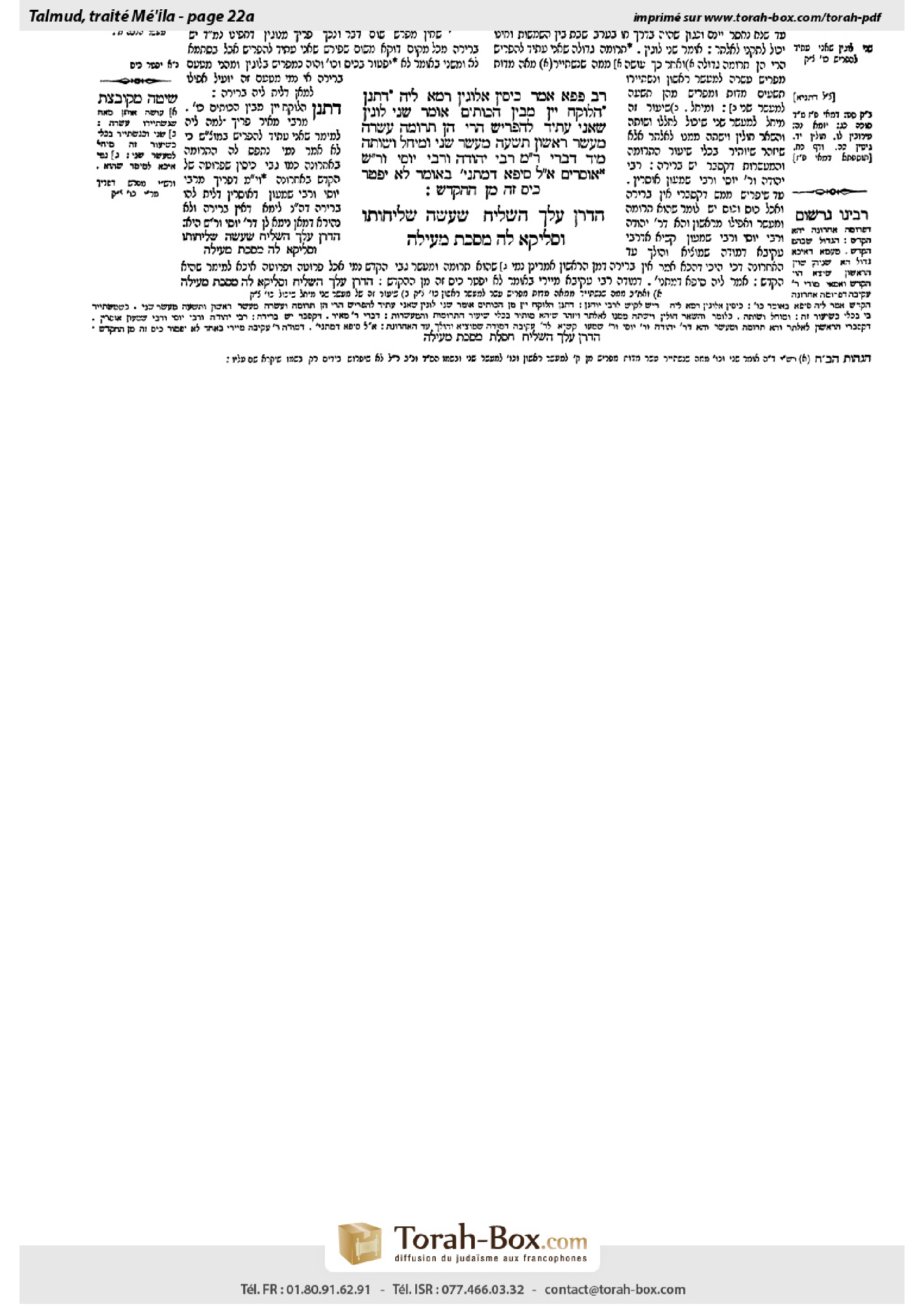
This page of Meilah includes the Aramaic text, an English translation and an AI-generated French translation, alongside the scan above.
מעילה כ״ב א · Aramaic and Hebrew text
רַב פָּפָּא אָמַר: כִּיסִין אַלּוּגִּין רְמָא לֵיהּ, דִּתְנַן: הַלּוֹקֵחַ יַיִן מִבֵּין הַכּוּתִים
אוֹמֵר: ״שְׁנֵי לוּגִּין שֶׁאֲנִי עָתִיד לְהַפְרִישׁ – הֲרֵי הֵן תְּרוּמָה, עֲשָׂרָה – מַעֲשֵׂר רִאשׁוֹן, תִּשְׁעָה – מַעֲשֵׂר שֵׁנִי״, וּמֵיחֵל וְשׁוֹתֶה מִיָּד, דִּבְרֵי רַבִּי מֵאִיר.
רַבִּי יְהוּדָה וְרַבִּי יוֹסֵי וְרַבִּי שִׁמְעוֹן אוֹסְרִים! אֲמַר לֵיהּ: סֵיפָא דְּמַתְנִיתִין בְּאוֹמֵר ״לֹא יִפָּטֵר כִּיס זֶה מִן הַהֶקְדֵּשׁ״.
הַדְרָן עֲלָךְ הַשָּׁלִיחַ שֶׁעָשָׂה שְׁלִיחוּתוֹ וּסְלִיקָא לַהּ מַסֶּכֶת מְעִילָה
Meilah 22a · English translation
Rav Pappa said yet another version of Reish Lakish’s question. He raised a contradiction between the mishna here involving purses and another mishna referring to a log measure. As we learned in a mishna (Demai 7:4): In the case of one who purchases wine from among the Samaritans [Kutim] and there is reason to suspect that teruma and tithes were not separated, and he cannot separate them before the start of Shabbat, what should he do?
The mishna explains that he proceeds as follows. If, for example, there are one hundred log of wine in the barrels, he says: Two log that I will separate in the future are teruma, as the established average measure of teruma is one-fiftieth; ten log are first tithe; and one-tenth of the remainder, which is nine log, are second tithe. And he desacralizes the second tithe that he will separate in the future, transferring its sanctity to money, and he may drink the wine in the barrel immediately, relying on the separation that he will perform later. This is the statement of Rabbi Meir.
Rabbi Yehuda and Rabbi Yosei and Rabbi Shimon prohibit one from doing so. These three Sages reject the principle of retroactive designation, upon which this method relies, as at the time of the declaration the identity of the particular portions of wine that will be teruma and tithes is unknown. Even according to Rabbi Meir, one can rely on retroactive designation only in a case where he says: That I will separate in the future. In the case of the mishna here, each peruta might be the consecrated one, and one cannot rely on the last one. Rabbi Yoḥanan said to him: The latter clause of the mishna is referring to a situation where one said: This purse will not be exempt from consecration, in which case he is understood as referring to the last peruta left in the purse.
Meilah 22a · Traduction française (IA)
Rav Pappa proposa une autre version de la question de Reish Lakish. Il souleva une contradiction entre la Michna ici, qui traite de bourses, et une autre Michna, qui fait référence à une mesure de log. En effet, nous avons appris dans une Michna (Demai 7:4) : « Dans le cas de quelqu’un qui achète du vin à des Samaritains [Kutim], alors qu’il y a lieu de craindre que la terouma et les dîmes n’aient pas été prélevées, et qu’il ne puisse pas les prélever avant le début du Chabbat, que doit-il faire ? »
La Michna explique qu’il procède comme suit. Si, par exemple, les tonneaux contiennent cent log de vin, il dit : « Les deux log que je prélèverai ultérieurement sont de la terouma, car la mesure moyenne établie pour la terouma est d’un cinquantième ; les dix log sont la première dîme ; et un dixième du reste, soit neuf log, est la seconde dîme. » Il désacralise ensuite la seconde dîme qu’il prélèvera ultérieurement en transférant sa sainteté à de l’argent, et il peut boire immédiatement le vin du tonneau, en s’appuyant sur le prélèvement qu’il effectuera plus tard. Telle est la déclaration de Rabbi Meïr.
Rabbi Yehuda, Rabbi Yosei et Rabbi Shimon interdisent d’agir ainsi. Ces trois Sages rejettent le principe de la désignation rétroactive, sur lequel repose cette méthode, car, au moment de la déclaration, on ne sait pas quelles portions précises de vin constitueront la terouma et les dîmes. Même selon Rabbi Meïr, on ne peut s’appuyer sur la désignation rétroactive que si l’on dit : « Ce que je prélèverai ultérieurement. » Dans le cas de la Michna ici, chaque perouta pourrait être celle qui est consacrée, et on ne peut s’appuyer sur la dernière. Rabbi Yoḥanan lui dit : « La dernière clause de la Michna parle d’une situation où l’on a dit : “Cette bourse ne sera pas entièrement libérée de la consécration”, ce qui signifie qu’on fait référence à la dernière perouta restant dans la bourse. »
Traduction française générée par IA à partir de l’édition anglaise de Sefaria. Vérifie toujours un passage avec le texte source.
Text from Sefaria: William Davidson Edition - Vocalized Aramaic (CC BY NC); William Davidson Edition - English (CC BY NC).