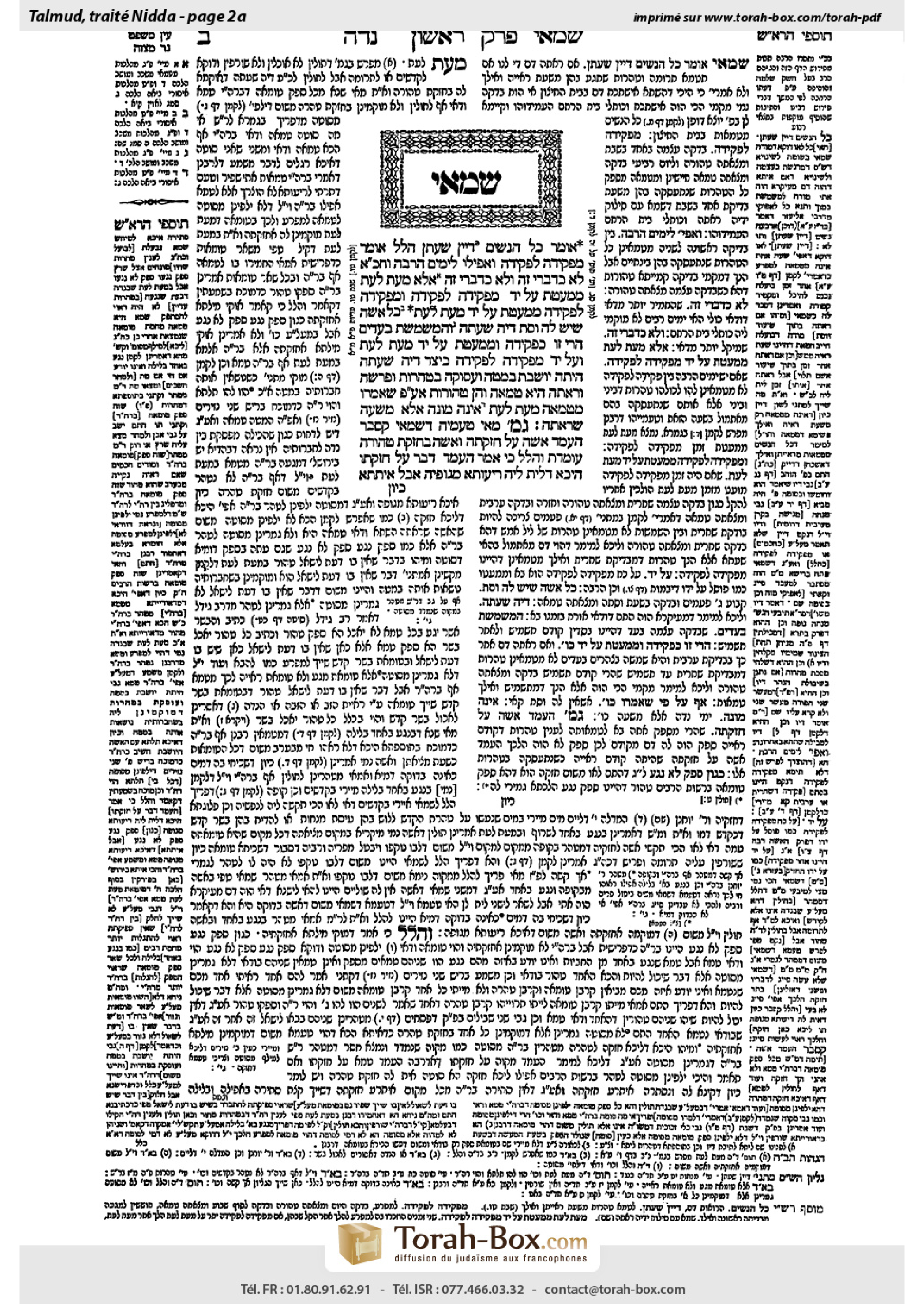
Niddah 2a: Talmud study for Daf Yomi
Daf Yomi is the daily study of one Talmud folio. Explore 37 tractates with scans, Hebrew text, Sefaria English and AI-generated French translations where annotated.
Passage selection and English or AI-generated French translation are available where the scan has annotations. Daf Study is independent of Torah-Box and Sefaria.
Browse Niddah · נידה · All tractatesNiddah 2a text and translations
This page of Niddah includes the Aramaic text, an English translation and an AI-generated French translation, alongside the scan above.
נידה ב׳ א · Aramaic and Hebrew text
מַתְנִי' שַׁמַּאי אוֹמֵר: כׇּל הַנָּשִׁים דַּיָּין שְׁעָתָן. הִלֵּל אוֹמֵר: מִפְּקִידָה לִפְקִידָה, וַאֲפִילּוּ לְיָמִים הַרְבֵּה.
וַחֲכָמִים אוֹמְרִים: לֹא כְּדִבְרֵי זֶה, וְלֹא כְּדִבְרֵי זֶה, אֶלָּא מֵעֵת לְעֵת מְמַעֶטֶת עַל יָד מִפְּקִידָה לִפְקִידָה, וּמִפְּקִידָה לִפְקִידָה מְמַעֶטֶת עַל יָד מֵעֵת לְעֵת.
כׇּל אִשָּׁה שֶׁיֵּשׁ לָהּ וֶסֶת — דַּיָּה שְׁעָתָהּ, וְהַמְשַׁמֶּשֶׁת בְּעֵדִים — הֲרֵי זוֹ כִּפְקִידָה, וּמְמַעֶטֶת עַל יָד מֵעֵת לְעֵת וְעַל יָד מִפְּקִידָה לִפְקִידָה.
כֵּיצַד דַּיָּה שְׁעָתָהּ? הָיְתָה יוֹשֶׁבֶת בַּמִּטָּה וַעֲסוּקָה בִּטְהָרוֹת, וּפָרְשָׁה וְרָאֲתָה — הִיא טְמֵאָה וְהֵן טְהוֹרוֹת.
אַף עַל פִּי שֶׁאָמְרוּ, מְטַמְּאָה מֵעֵת לְעֵת, אֵינָהּ מוֹנָה אֶלָּא מִשָּׁעָה שֶׁרָאֲתָה.
גְּמָ' מַאי טַעְמֵיהּ דְּשַׁמַּאי? קָסָבַר: הַעֲמֵד אִשָּׁה עַל חֶזְקָתָהּ, וְאִשָּׁה בְּחֶזְקַת טְהוֹרָה עוֹמֶדֶת. וְהִלֵּל? כִּי אָמַר: הַעֲמֵד דָּבָר עַל חֶזְקָתוֹ — הֵיכָא דְּלֵית לֵיהּ רֵיעוּתָא מִגּוּפֵיהּ, אֲבָל אִיתְּתָא
Niddah 2a · English translation
MISHNA: Shammai says: For all women who do not have a fixed menstrual cycle, their time is sufficient. Women who discern that menstrual blood emerged do not need to be concerned that perhaps the flow of blood began before they noticed it. Rather, they assume their ritual impurity status begins at that moment, in terms of rendering impure teruma and ritually pure items with which they come in contact. Hillel says: From examination [mipekida] to examination, i.e., she assumes ritual impurity status retroactive to the last time she examined herself and determined that she was ritually pure, and this is the halakha even if her examination took place several days earlier. Any ritually pure item with which she came in contact in the interim becomes ritually impure.
And the Rabbis say: The halakha is neither in accordance with the statement of this tanna nor in accordance with the statement of that tanna; rather, the principle is: A twenty-four-hour period reduces the time from examination to examination. In other words, if her final self-examination took place more than twenty-four hours earlier, she need only concern herself with ritual impurity for the twenty-four-hour period prior to discerning the blood. And from examination to examination reduces the time from a twenty-four-hour period. In other words, if she examined herself in the course of the previous day and discovered no blood, she was certainly ritually pure prior to the examination.
For any woman who has a fixed menstrual cycle [veset], and she examined herself at that time and discovered blood, her time is sufficient, and it is only from that time that she transmits ritual impurity. And with regard to a woman who engages in intercourse while using examination cloths [be’edim] before and after intercourse, with which she ascertains whether her menstrual flow began, the halakhic status of such an action is like that of an examination, and therefore it reduces the time from a twenty-four-hour period, and reduces the time from examination to examination.
Her time is sufficient, how so? If the woman was sitting in the bed and engaged in handling ritually pure items, and she left the bed and saw blood, she is ritually impure and those items are ritually pure.
Although the Rabbis said that a woman without a fixed menstrual cycle transmits ritual impurity retroactively for a twenty-four-hour period, a woman with a fixed cycle counts her menstrual days only from the moment that she saw blood.
GEMARA: The mishna teaches that when a woman discerns that her menstrual blood emerged, Shammai holds that her impurity status starts from that moment, while Hillel maintains that it begins from the time of her most recent self-examination. The Gemara asks: What is the reason for the opinion of Shammai? The Gemara answers: Shammai holds that as there is a principle that when the status of an item is uncertain it retains its presumptive status, here too: Establish the woman in her presumptive status, and a woman remains with the presumptive status of being ritually pure. And what is the reasoning of Hillel? He claims that when one states the principle: Establish an item in its presumptive status, that applies only where there is no weakening in the presumptive status that is a result of the item itself. But in the case of a woman,
Niddah 2a · Traduction française (IA)
MICHNA : Chammaï dit : Pour toutes les femmes qui n’ont pas de cycle menstruel fixe, leur heure suffit. Les femmes qui constatent l’apparition de sang menstruel n’ont pas à craindre que l’écoulement ait commencé avant qu’elles ne le remarquent. Elles considèrent plutôt que leur statut d’impureté rituelle commence à cet instant, en ce qui concerne la transmission de l’impureté à la terouma et aux objets rituellement purs qu’elles touchent. Hillel dit : De l’examen [mipekida] à l’examen, c’est-à-dire qu’elle est considérée comme impure rétroactivement depuis le dernier moment où elle s’est examinée et a constaté qu’elle était rituellement pure ; telle est la halakha, même si cet examen a eu lieu plusieurs jours auparavant. Tout objet rituellement pur qu’elle a touché entre-temps devient rituellement impur.
Et les Sages disent : La halakha ne suit ni l’opinion de ce tanna ni celle de cet autre tanna ; le principe est plutôt le suivant : une période de vingt-quatre heures réduit l’intervalle entre deux examens. Autrement dit, si son dernier auto-examen a eu lieu plus de vingt-quatre heures auparavant, elle ne doit se préoccuper de l’impureté rituelle que pour les vingt-quatre heures précédant le moment où elle a constaté la présence de sang. Et l’intervalle entre deux examens réduit la période de vingt-quatre heures. Autrement dit, si elle s’est examinée au cours de la journée précédente et n’a découvert aucun sang, elle était certainement rituellement pure avant cet examen.
Pour toute femme qui a un cycle menstruel fixe [veset], si elle s’est examinée au moment prévu et a découvert du sang, son heure suffit, et elle ne transmet l’impureté rituelle qu’à partir de cet instant. Quant à une femme qui a des rapports en utilisant des linges d’examen [be’edim] avant et après les rapports, afin de vérifier si son écoulement menstruel a commencé, cet acte a le statut halakhique d’un examen ; il réduit donc la période de vingt-quatre heures et réduit l’intervalle entre deux examens.
Son heure suffit : qu’est-ce que cela signifie ? Si la femme était assise sur le lit et manipulait des objets rituellement purs, puis qu’elle se levait du lit et voyait du sang, elle est rituellement impure, tandis que ces objets restent rituellement purs.
Bien que les Sages aient dit qu’une femme sans cycle menstruel fixe transmet rétroactivement l’impureté rituelle pour une période de vingt-quatre heures, une femme qui a un cycle fixe ne compte les jours de ses règles qu’à partir du moment où elle a vu du sang.
GUEMARA : La Michna enseigne que lorsqu’une femme constate l’apparition de sang menstruel, Chammaï estime que son statut d’impureté commence à cet instant, tandis que Hillel soutient qu’il commence au moment de son dernier auto-examen. La Guemara demande : Quelle est la raison de l’opinion de Chammaï ? La Guemara répond : Chammaï estime que, puisqu’il existe un principe selon lequel, lorsque le statut d’un objet est incertain, celui-ci conserve son statut présumé, il en va de même ici : maintiens la femme dans son statut présumé, car elle conserve le statut présumé d’être rituellement pure. Et quel est le raisonnement de Hillel ? Il affirme que le principe « maintiens un objet dans son statut présumé » ne s’applique que lorsqu’aucun élément propre à l’objet n’affaiblit ce statut présumé. Mais dans le cas d’une femme,
Traduction française générée par IA à partir de l’édition anglaise de Sefaria. Vérifie toujours un passage avec le texte source.
Text from Sefaria: William Davidson Edition - Vocalized Aramaic (CC BY NC); William Davidson Edition - English (CC BY NC).