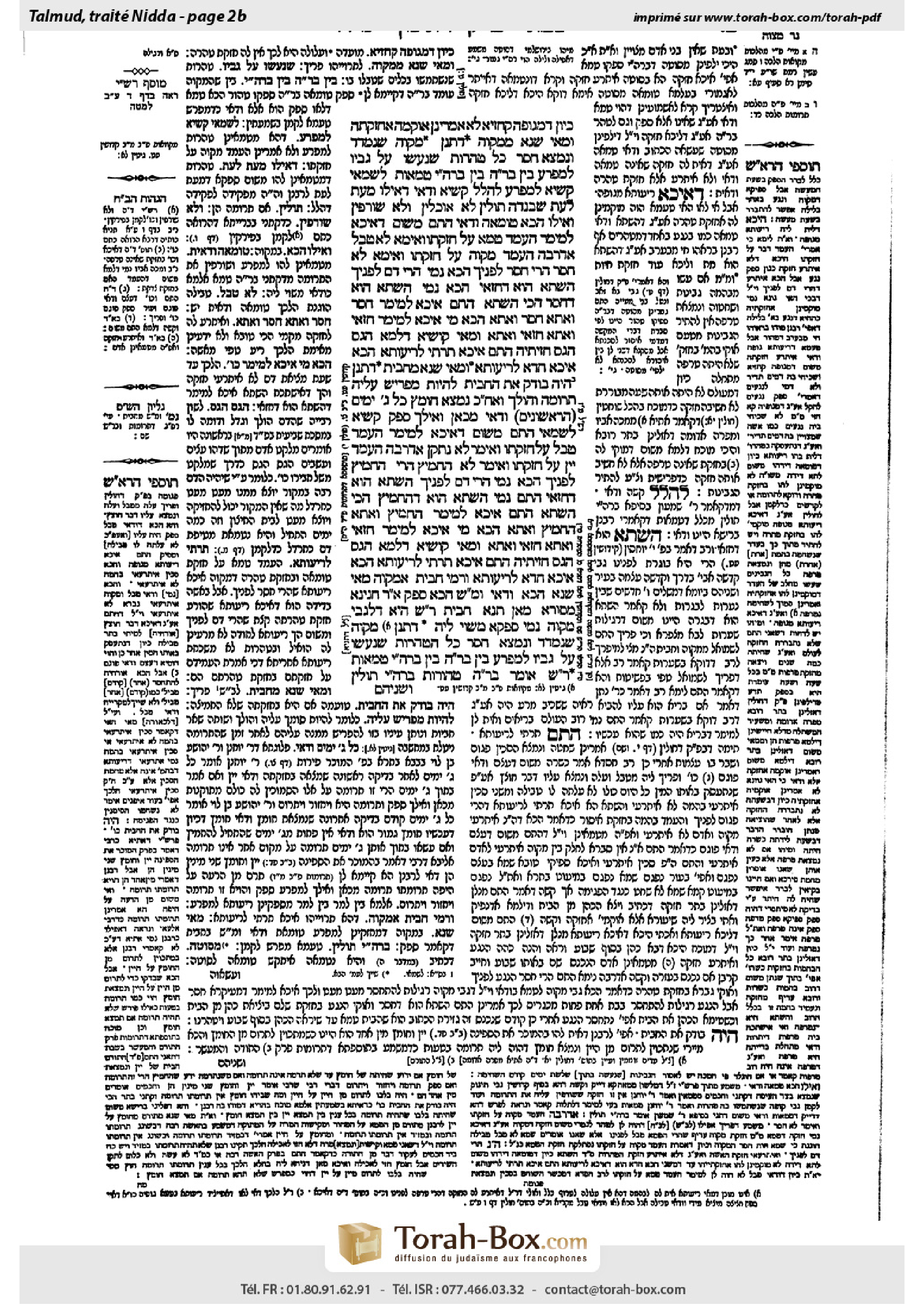
Niddah 2b: Talmud study for Daf Yomi
Daf Yomi is the daily study of one Talmud folio. Explore 37 tractates with scans, Hebrew text, Sefaria English and AI-generated French translations where annotated.
Passage selection and English or AI-generated French translation are available where the scan has annotations. Daf Study is independent of Torah-Box and Sefaria.
Browse Niddah · נידה · All tractatesNiddah 2b text and translations
This page of Niddah includes the Aramaic text, an English translation and an AI-generated French translation, alongside the scan above.
נידה ב׳ ב · Aramaic and Hebrew text
כֵּיוָן דְּמִגּוּפַהּ קָחָזְיָא — לָא אָמְרִינַן אוֹקְמַהּ אַחֶזְקָתַהּ.
וּמַאי שְׁנָא מִמִּקְוֶה? דִּתְנַן: מִקְוֶה שֶׁנִּמְדַּד וְנִמְצָא חָסֵר — כׇּל טְהָרוֹת שֶׁנַּעֲשׂוּ עַל גַּבָּיו לְמַפְרֵעַ, בֵּין בִּרְשׁוּת הָרַבִּים בֵּין בִּרְשׁוּת הַיָּחִיד — טְמֵאוֹת.
לְשַׁמַּאי קַשְׁיָא לְמַפְרֵעַ.
לְהִלֵּל קַשְׁיָא וַדַּאי, דְּאִילּוּ מֵעֵת לְעֵת שֶׁבְּנִדָּה תּוֹלִין — לֹא אוֹכְלִין וְלֹא שׂוֹרְפִין, וְאִילּוּ הָכָא טוּמְאָה וַדַּאי!
הָתָם, מִשּׁוּם דְּאִיכָּא לְמֵימַר: הַעֲמֵד טָמֵא עַל חֶזְקָתוֹ, וְאֵימָא לֹא טָבַל. אַדְּרַבָּה, הַעֲמֵד מִקְוֶה עַל חֶזְקָתוֹ, וְאֵימָא לֹא חָסַר! הֲרֵי חָסֵר לְפָנֶיךָ!
הָכָא נָמֵי, הֲרֵי דָּם לְפָנֶיךָ! הַשְׁתָּא הוּא דַּחֲזַאי. הָכָא נָמֵי, הַשְׁתָּא הוּא דַּחֲסַר!
הָכִי הַשְׁתָּא? הָתָם אִיכָּא לְמֵימַר: חֲסַר וַאֲתָא, חֲסַר וַאֲתָא. הָכָא מִי אִיכָּא לְמֵימַר: חֲזַאי וַאֲתָא, חֲזַאי וַאֲתָא? וּמַאי קוּשְׁיָא?! דִּלְמָא הַגַּס הַגַּס חֲזֵיתֵיהּ!
הָתָם אִיכָּא תַּרְתֵּי לְרֵיעוּתָא, הָכָא אִיכָּא חֲדָא לְרֵיעוּתָא.
וּמַאי שְׁנָא מֵחָבִית? דִּתְנַן: הָיָה בּוֹדֵק אֶת הֶחָבִית לִהְיוֹת מַפְרִישׁ עָלֶיהָ תְּרוּמָה וְהוֹלֵךְ, וְאַחַר כָּךְ נִמְצָא חוֹמֶץ — כׇּל שְׁלֹשָׁה יָמִים (הָרִאשׁוֹנִים) וַדַּאי,
מִכָּאן וְאֵילָךְ — סָפֵק. קַשְׁיָא לְשַׁמַּאי!
הָתָם, מִשּׁוּם דְּאִיכָּא לְמֵימַר: הַעֲמֵד טֶבֶל עַל חֶזְקָתוֹ, וְאֵימַר לֹא נִתְקַן. אַדְּרַבָּה, הַעֲמֵד יַיִן עַל חֶזְקָתוֹ, וְאֵימַר לֹא הֶחְמִיץ!
הֲרֵי הֶחְמִיץ לְפָנֶיךָ! הָכָא נָמֵי, הֲרֵי דָּם לְפָנֶיךָ! הַשְׁתָּא הוּא דַּחֲזַאי. הָתָם נָמֵי, הַשְׁתָּא הוּא דְּהֶחְמִיץ!
הָכִי הַשְׁתָּא? הָתָם אִיכָּא לְמֵימַר: הֶחְמִיץ וַאֲתָא, הֶחְמִיץ וַאֲתָא. הָכָא מִי אִיכָּא לְמֵימַר: חֲזַאי וַאֲתָא, חֲזַאי וַאֲתָא? וּמַאי קוּשְׁיָא?! דִּלְמָא הַגַּס הַגַּס חֲזֵיתֵיהּ!
הָתָם אִיכָּא תַּרְתֵּי לְרֵיעוּתָא, הָכָא אִיכָּא חֲדָא לְרֵיעוּתָא.
וּרְמִי חָבִית אַמִּקְוֶה: מַאי שְׁנָא הָכָא וַדַּאי, וּמַאי שְׁנָא הָכָא סָפֵק?
אָמַר רַבִּי חֲנִינָא מִסּוּרָא: מַאן תְּנָא חָבִית? רַבִּי שִׁמְעוֹן הִיא, דִּלְגַבֵּי מִקְוֶה נָמֵי סְפֵקָא מְשַׁוֵּי לֵיהּ.
דִּתְנַן: מִקְוֶה שֶׁנִּמְדַּד וְנִמְצָא חָסֵר — כָּל הַטְּהָרוֹת שֶׁנַּעֲשׂוּ עַל גַּבָּיו לְמַפְרֵעַ, בֵּין בִּרְשׁוּת הָרַבִּים בֵּין בִּרְשׁוּת הַיָּחִיד, טְמֵאוֹת.
רַבִּי שִׁמְעוֹן אוֹמֵר: בִּרְשׁוּת הָרַבִּים טְהוֹרוֹת, בִּרְשׁוּת הַיָּחִיד תּוֹלִין.
Niddah 2b · English translation
since it is her nature to see blood flow from her body at regular intervals, we do not say: Establish her in her presumptive status of ritual purity. Her body is constantly changing, and therefore she has no such presumptive status.
With regard to the opinions of both Shammai and Hillel, the Gemara asks: And in what way is this case different from that of a ritual bath? As we learned in a mishna (Mikvaot 2:2): In the case of a ritual bath that was known to have contained the requisite forty se’a, which was then measured and found lacking in its quantity of water, all pure items that had been rendered pure in it, i.e., any impure items that had been purified through immersion in this ritual bath, retroactive to when the ritual bath was last measured, whether this ritual bath is found in the private domain or in the public domain, are impure.
The Gemara explains: According to the opinion of Shammai, the mishna poses a difficulty from its statement that the change in the ritual bath’s status is assumed retroactive to the time when it was last measured, as he maintains that a menstruating woman’s status changes only at the present moment, not retroactive to the last time she examined herself.
According to the opinion of Hillel, the mishna also poses a difficulty with regard to its ruling that the items purified in the ritual bath are deemed impure with certainty, whereas a menstruating women does not assume retroactive impurity with certainty. In other words, although according to the Rabbis there is a twenty-four-hour period of retroactive ritual impurity in the case of a menstruating woman, and according to Hillel the retroactive impurity extends back to her most recent examination, nevertheless any teruma that she touched during that period is not deemed definitely impure to the extent that it must be burned. Rather, the impure status of the items she touched is uncertain and the status of the teruma is suspended, i.e., one may neither eat it nor burn it. Whereas here, in the case of the ritual bath, any item purified in it is retroactively deemed definitely impure.
The Gemara answers: There, in the case of a ritual bath, it is different, since it can be said: Establish the impure item in its presumptive status and say that it was not properly immersed. In other words, the presumptive status of the item as ritually impure is in keeping with the current deficient state of the ritual bath. The Gemara raises a difficulty: On the contrary, one should establish the ritual bath in its presumptive state of validity and say that the ritual bath was not previously lacking the requisite measure of water. The Gemara responds: There is no presumptive state of validity, as the ritual bath is lacking before you, i.e., at present, and this offsets the presumptive status that it was full.
The Gemara raises a difficulty: Here too, in the case of a menstruating woman, she is one who has experienced a discharge of blood before you, i.e., at present. Just as the ritual bath’s presumptive status of validity is offset by its present lack of the requisite measure of water, so too the woman’s previous presumptive status of ritual purity is offset by her present state of impurity due to menstruation. The Gemara answers: In the case of the menstruating woman, it is possible that it is only now that she saw the first emission of her menstrual blood. The Gemara retorts: One can say the same with regard to the ritual bath: Here too, it is only now that it became lacking in the requisite measure of water.
The Gemara answers: How can these cases be compared? There, in the case of the ritual bath, it can be said that the water slowly trickled out and consequently the amount of water was continuously diminishing. Therefore, it is possible that the ritual bath lost its valid status long ago without anyone realizing. By contrast, here, with regard to a menstruating woman, can it be said that she was continuously seeing menstrual blood? The Gemara responds: And what is the difficulty? The same possibility does in fact exist in the case of a menstruating woman, as perhaps she saw the blood depart bit [hagas] by bit.
The Gemara states a different answer: There, in the case of the ritual bath, there are two factors that weaken the suggestion that the items are ritually pure: First, the ritual bath is lacking at present; second, the item has a presumptive status of impurity. Here, by contrast, there is only one factor that weakens the possibility that the items touched by the currently menstruating woman were rendered ritually impure, i.e., that she is currently experiencing a menstrual flow. Therefore, according to Shammai she assumes impurity status only from that moment onward, and according to Hillel her retroactive impurity status applies only as an uncertainty.
§ The Gemara asks: And according to Shammai, who holds that her time is sufficient and there is no retroactive impurity, what is different in the case of a barrel? As it is taught in a baraita (Tosefta, Terumot 2:8): If someone would inspect the contents of a barrel to see if it still contained enough wine to continually mentally separate teruma from it, i.e., to exempt other untithed wine of his until all the wine in this barrel will be teruma, and afterward the contents of the barrel were found to have turned to vinegar, which cannot be set aside as teruma for untithed wine, then for all of the first three days following his most recent inspection, it is definitely considered to have been wine. Therefore, any of the untithed wine for which teruma was separated during those days is tithed.
The baraita continues: From that point forward, i.e., more than three days after the most recent inspection, it is uncertain whether it had already turned to vinegar, and consequently any untithed wine for which teruma was separated during those days remains uncertainly tithed. This poses a difficulty for Shammai, who maintains that there is no such retroactive consideration in the case of a menstruating woman.
The Gemara answers: There, in the case of the barrel, it is different, since it can be said: Establish the untithed produce in its presumptive status, as when it first grew it was definitely untithed, and say it was not amended, i.e., exempted, and its status continues to be untithed produce. The Gemara asks: On the contrary, one should establish the wine in its presumptive status, and say that it had not turned to vinegar.
The Gemara rejects this suggestion: This is impossible, as it is turned to vinegar before you, i.e., at present. The Gemara replies: Here too, in the case of a menstruating woman, one who has experienced a discharge of blood is before you, at present, so what is the difference? The Gemara explains: With regard to the woman, it is possible that it is only now that she saw the beginning of her menstrual blood. The Gemara responds: There too, it is possible that it is only now that it turned to vinegar, but not earlier.
The Gemara again answers: How can these cases be compared? There, in the case of the wine, it can be said that it was continuously turning to vinegar. Therefore, it is possible that the wine turned to vinegar much earlier without anyone realizing. By contrast, in the case of the menstruating woman, can it be said that she was continuously seeing menstrual blood? Once again, the Gemara responds: And what is the difficulty? The same possibility does in fact exist in the case of a menstruating woman, as perhaps she saw the blood depart bit by bit.
The Gemara provides a different answer: There, in the case of the barrel, there are two factors that weaken the suggestion that the wine is tithed: First, it is vinegar at present; second, the wine has a presumptive status that it is untithed. Here, by contrast, there is only one factor that weakens the possibility that the items touched by the menstruating woman were rendered ritually impure, i.e., that she is currently experiencing a menstrual flow.
§ And the Gemara raises a contradiction between the halakha of the barrel and that of the ritual bath: What is different here, in the case of the ritual bath, where the items are definitely impure, and what is different there, with regard to the barrel, where it is only uncertain that the produce remains untithed? In both cases the current situation, that the ritual bath is deficient and the contents of the barrel have turned to vinegar, should lead to a definite status.
The Gemara answers: Rabbi Ḥanina of Sura says: Who is the tanna who taught the halakha of the barrel? It is Rabbi Shimon, who, with regard to a ritual bath also considers it as a matter of uncertainty, rather than as definitely impure. Therefore, there is no contradiction between the two halakhot.
As we learned in a mishna (Mikvaot 2:2): In the case of a ritual bath that was known to have contained the requisite forty se’a, which was then measured and found lacking in its quantity of water, all pure items that had been rendered pure in it, i.e., any impure items that had been purified through immersion in this ritual bath, retroactive to when the ritual bath was last measured, whether this ritual bath is located in the private domain or in the public domain, are impure.
The mishna continues: Rabbi Shimon says: If the impure items were immersed in a ritual bath that was in the public domain, they are deemed pure. But if they were immersed in a ritual bath that was in a private domain, the status of any teruma that touched them is suspended, i.e., it is neither consumed nor burned. Rabbi Shimon holds that even in the case of a ritual bath, the items are not retroactively deemed definitely impure. Rather the status is uncertain, just as in the case of the barrel.
Niddah 2b · Traduction française (IA)
Puisqu’il est dans sa nature de voir du sang s’écouler de son corps à intervalles réguliers, nous ne disons pas : « Maintenons-la dans son statut présumé de pureté rituelle. » Son corps change constamment et elle ne bénéficie donc pas d’un tel statut présumé.
À propos des opinions de Chammaï et de Hillel, la Guemara demande : En quoi ce cas diffère-t-il de celui d’un mikvé ? Comme nous l’avons appris dans une Michna (Mikvaot 2:2) : si l’on savait qu’un mikvé contenait les quarante séa requises, mais qu’après l’avoir mesuré, on constate qu’il ne contient plus la quantité d’eau requise, tous les objets purs qui y avaient été rendus purs — c’est-à-dire tous les objets impurs qui avaient été purifiés par immersion dans ce mikvé — depuis la dernière fois où il avait été mesuré sont impurs, que le mikvé se trouve dans un domaine privé ou dans un domaine public.
La Guemara explique : Selon l’opinion de Chammaï, la Michna soulève une difficulté en affirmant que le changement de statut du mikvé est considéré comme remontant à la dernière fois où il a été mesuré, car Chammaï soutient que le statut d’une femme menstruée ne change qu’au moment présent, et non rétroactivement jusqu’à la dernière fois où elle s’est examinée.
Selon l’opinion de Hillel, la Michna soulève également une difficulté par sa décision selon laquelle les objets purifiés dans le mikvé sont considérés comme certainement impurs, alors qu’une femme menstruée n’est pas considérée comme rétroactivement impure avec certitude. Autrement dit, bien que, selon les Sages, une période de vingt-quatre heures d’impureté rituelle rétroactive s’applique à une femme menstruée et que, selon Hillel, cette impureté rétroactive remonte à son examen le plus récent, toute terouma qu’elle a touchée durant cette période n’est néanmoins pas considérée comme certainement impure au point de devoir être brûlée. Au contraire, l’impureté des objets qu’elle a touchés est incertaine et le statut de la terouma est suspendu : on ne peut ni la consommer ni la brûler. En revanche, dans le cas du mikvé, tout objet qui y a été purifié est considéré rétroactivement comme certainement impur.
La Guemara répond : Là-bas, dans le cas du mikvé, c’est différent, car on peut dire : « Maintiens l’objet impur dans son statut présumé et dis qu’il n’a pas été immergé comme il convient. » Autrement dit, le statut présumé de l’objet comme rituellement impur correspond à l’état actuellement insuffisant du mikvé. La Guemara soulève une difficulté : Au contraire, il faudrait maintenir le mikvé dans son statut présumé de validité et dire qu’il ne lui manquait pas auparavant la quantité d’eau requise. La Guemara répond : Il n’a pas de statut présumé de validité, car le mikvé est insuffisant devant toi, c’est-à-dire à présent, ce qui contrebalance le statut présumé selon lequel il était plein.
La Guemara soulève une difficulté : Ici aussi, dans le cas d’une femme menstruée, tu as devant toi une femme qui a eu un écoulement de sang, c’est-à-dire à présent. De même que l’état actuel du mikvé, qui ne contient plus la quantité d’eau requise, contrebalance son statut présumé de validité, l’état actuel d’impureté de la femme dû à ses menstruations contrebalance lui aussi son statut antérieur présumé de pureté rituelle. La Guemara répond : Dans le cas de la femme menstruée, il est possible qu’elle n’ait vu sa première émission de sang menstruel que maintenant. La Guemara rétorque : On peut dire la même chose du mikvé : ici aussi, il se peut qu’il ne soit devenu insuffisant qu’à présent.
La Guemara répond : Comment comparer ces cas ? Là-bas, dans le cas du mikvé, on peut dire que l’eau s’est écoulée goutte à goutte et que sa quantité diminuait donc continuellement. Il est par conséquent possible que le mikvé ait perdu sa validité depuis longtemps, sans que personne ne s’en aperçoive. En revanche, ici, à propos d’une femme menstruée, peut-on dire qu’elle voyait continuellement du sang menstruel ? La Guemara répond : Où est la difficulté ? La même possibilité existe bel et bien dans le cas d’une femme menstruée, car peut-être a-t-elle vu le sang s’écouler petit à petit [hagas].
La Guemara donne une autre réponse : Là-bas, dans le cas du mikvé, deux facteurs vont à l’encontre de l’hypothèse selon laquelle les objets seraient rituellement purs : premièrement, le mikvé est actuellement insuffisant ; deuxièmement, l’objet a un statut présumé d’impureté. Ici, en revanche, un seul facteur va à l’encontre de la possibilité que les objets touchés par la femme actuellement menstruée aient été rendus rituellement impurs : le fait qu’elle ait actuellement un écoulement menstruel. Par conséquent, selon Chammaï, elle ne prend le statut d’impureté qu’à partir de ce moment-là, tandis que, selon Hillel, son statut d’impureté rétroactive ne s’applique qu’à titre d’incertitude.
§ La Guemara demande : Et selon Chammaï, qui soutient que le moment présent suffit et qu’il n’y a pas d’impureté rétroactive, en quoi le cas d’un tonneau est-il différent ? Car il est enseigné dans une baraïta (Tosefta, Terumot 2:8) : si quelqu’un vérifiait le contenu d’un tonneau pour s’assurer qu’il contenait encore assez de vin afin de continuer à en prélever mentalement de la terouma — c’est-à-dire afin d’exempter de la terouma ses autres vins non prélevés, jusqu’à ce que tout le vin de ce tonneau soit considéré comme terouma —, puis que l’on constatait que le contenu du tonneau s’était transformé en vinaigre, qui ne peut pas être désigné comme terouma pour du vin non prélevé, alors, pendant les trois premiers jours suivant sa dernière vérification, on le considère avec certitude comme ayant été du vin. Par conséquent, tout vin non prélevé pour lequel de la terouma a été prélevée durant ces jours est considéré comme ayant été prélevé.
La baraïta poursuit : À partir de ce moment-là, c’est-à-dire plus de trois jours après la dernière vérification, il est incertain qu’il se soit déjà transformé en vinaigre ; par conséquent, tout vin non prélevé pour lequel de la terouma a été prélevée durant ces jours est considéré comme ayant été prélevé, mais de manière incertaine. Cela soulève une difficulté pour Chammaï, qui soutient qu’il n’existe pas de telle rétroactivité dans le cas d’une femme menstruée.
La Guemara répond : Là-bas, dans le cas du tonneau, c’est différent, car on peut dire : « Maintiens le produit non prélevé dans son statut présumé : lorsqu’il a poussé, il était certainement non prélevé. Dis qu’il n’a pas été rectifié, c’est-à-dire que la terouma n’en a pas été prélevée, et que son statut demeure celui d’un produit non prélevé. » La Guemara demande : Au contraire, il faudrait maintenir le vin dans son statut présumé et dire qu’il ne s’était pas transformé en vinaigre.
La Guemara rejette cette suggestion : C’est impossible, car il est transformé en vinaigre devant toi, c’est-à-dire à présent. La Guemara réplique : Ici aussi, dans le cas d’une femme menstruée, une femme qui a eu un écoulement de sang se trouve devant toi, à présent ; quelle est donc la différence ? La Guemara explique : Pour la femme, il est possible qu’elle n’ait vu le début de son sang menstruel que maintenant. La Guemara répond : Là aussi, il est possible qu’il ne se soit transformé en vinaigre qu’à présent, et non auparavant.
La Guemara répond de nouveau : Comment comparer ces cas ? Là-bas, dans le cas du vin, on peut dire qu’il se transformait continuellement en vinaigre. Il est donc possible qu’il se soit transformé en vinaigre bien plus tôt, sans que personne ne s’en aperçoive. En revanche, dans le cas de la femme menstruée, peut-on dire qu’elle voyait continuellement du sang menstruel ? La Guemara répond une fois encore : Où est la difficulté ? La même possibilité existe bel et bien dans le cas d’une femme menstruée, car peut-être a-t-elle vu le sang s’écouler petit à petit.
La Guemara donne une autre réponse : Là-bas, dans le cas du tonneau, deux facteurs vont à l’encontre de l’hypothèse selon laquelle le vin a été prélevé : premièrement, il s’agit actuellement de vinaigre ; deuxièmement, le vin a un statut présumé de produit non prélevé. Ici, en revanche, un seul facteur va à l’encontre de la possibilité que les objets touchés par la femme menstruée aient été rendus rituellement impurs : le fait qu’elle ait actuellement un écoulement menstruel.
§ La Guemara soulève une contradiction entre la halakha du tonneau et celle du mikvé : En quoi le cas d’ici, celui du mikvé, où les objets sont certainement impurs, diffère-t-il du cas de là-bas, celui du tonneau, où il n’est qu’incertain que le produit demeure non prélevé ? Dans les deux cas, la situation actuelle — le mikvé étant insuffisant et le contenu du tonneau s’étant transformé en vinaigre — devrait entraîner un statut certain.
La Guemara répond : Rabbi Ḥanina de Sura dit : Qui est le tanna qui a enseigné la halakha du tonneau ? C’est Rabbi Shimon, qui, même dans le cas d’un mikvé, considère que le statut est incertain plutôt que les objets certainement impurs. Il n’y a donc pas de contradiction entre ces deux halakhot.
Comme nous l’avons appris dans une Michna (Mikvaot 2:2) : si l’on savait qu’un mikvé contenait les quarante séa requises, mais qu’après l’avoir mesuré, on constate qu’il ne contient plus la quantité d’eau requise, tous les objets purs qui y avaient été rendus purs — c’est-à-dire tous les objets impurs qui avaient été purifiés par immersion dans ce mikvé — depuis la dernière fois où il avait été mesuré sont impurs, que le mikvé se trouve dans un domaine privé ou dans un domaine public.
La Michna poursuit : Rabbi Shimon dit : Si les objets impurs ont été immergés dans un mikvé situé dans un domaine public, ils sont considérés comme purs. Mais s’ils ont été immergés dans un mikvé situé dans un domaine privé, le statut de toute terouma qui les a touchés est suspendu : elle ne peut être ni consommée ni brûlée. Rabbi Shimon soutient que, même dans le cas d’un mikvé, les objets ne sont pas considérés rétroactivement comme certainement impurs. Leur statut est plutôt incertain, comme dans le cas du tonneau.
Traduction française générée par IA à partir de l’édition anglaise de Sefaria. Vérifie toujours un passage avec le texte source.
Text from Sefaria: William Davidson Edition - Vocalized Aramaic (CC BY NC); William Davidson Edition - English (CC BY NC).