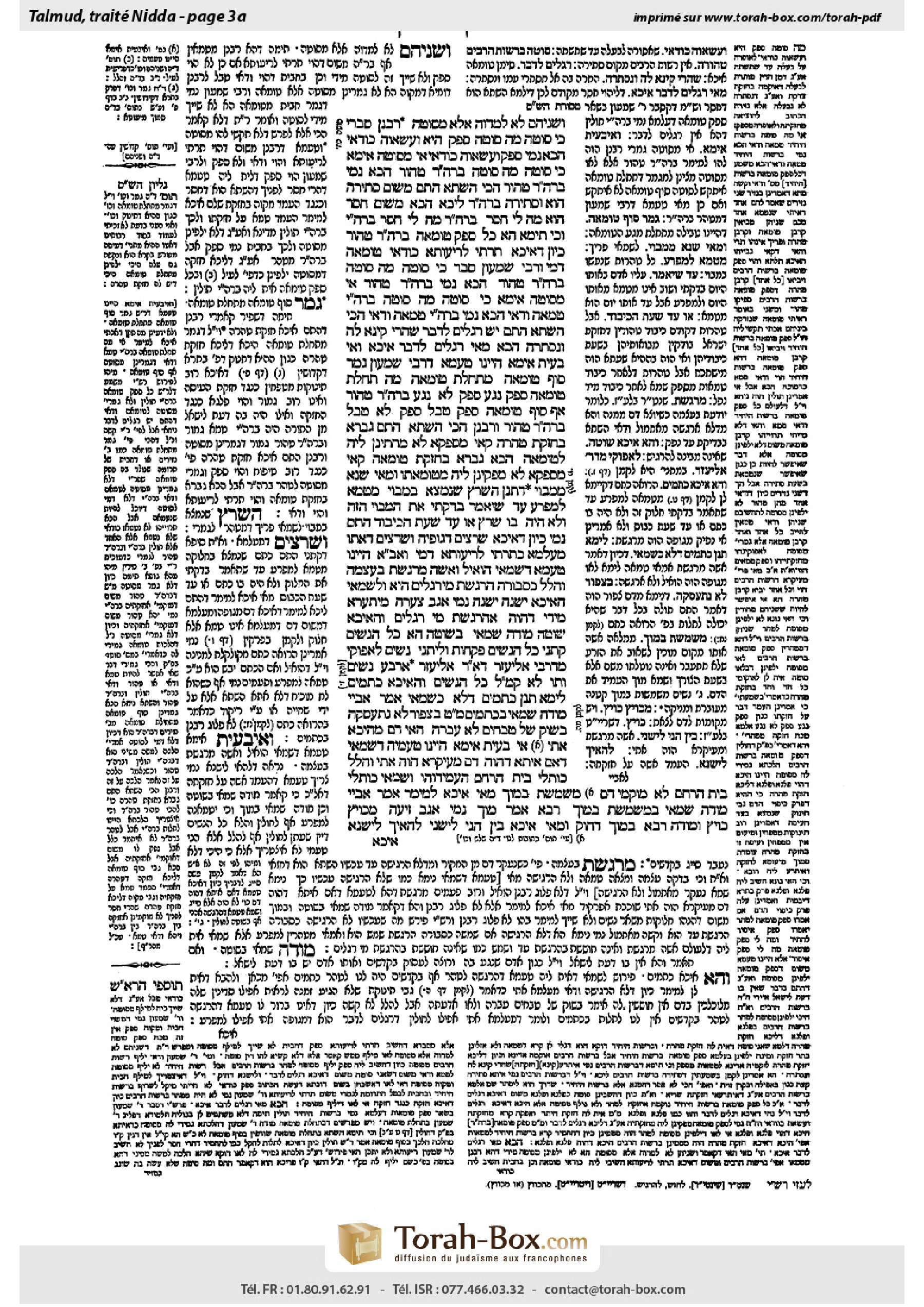
Niddah 3a: Talmud study for Daf Yomi
Daf Yomi is the daily study of one Talmud folio. Explore 37 tractates with scans, Hebrew text, Sefaria English and AI-generated French translations where annotated.
Passage selection and English or AI-generated French translation are available where the scan has annotations. Daf Study is independent of Torah-Box and Sefaria.
Browse Niddah · נידה · All tractatesNiddah 3a text and translations
This page of Niddah includes the Aramaic text, an English translation and an AI-generated French translation, alongside the scan above.
נידה ג׳ א · Aramaic and Hebrew text
וּשְׁנֵיהֶם לֹא לְמָדוּהָ אֶלָּא מִסּוֹטָה.
רַבָּנַן סָבְרִי: כִּי סוֹטָה, מָה סוֹטָה סָפֵק הִיא, וַעֲשָׂאוּהָ כְּוַדַּאי — הָכָא נָמֵי סָפֵק, וַעֲשָׂאוּהָ כְּוַדַּאי.
אִי מִסּוֹטָה, אֵימָא כִּי סוֹטָה: מָה סוֹטָה בִּרְשׁוּת הָרַבִּים טָהוֹר, הָכָא נָמֵי בִּרְשׁוּת הָרַבִּים טָהוֹר!
הָכִי הַשְׁתָּא? הָתָם מִשּׁוּם סְתִירָה הוּא, וּסְתִירָה בִּרְשׁוּת הָרַבִּים לֵיכָּא. הָכָא מִשּׁוּם חָסֵר הוּא, מָה לִי חָסֵר בִּרְשׁוּת הָרַבִּים, מָה לִי חָסֵר בִּרְשׁוּת הַיָּחִיד.
וְכִי תֵּימָא, הָא כׇּל סְפֵק טוּמְאָה בִּרְשׁוּת הָרַבִּים טָהוֹר! כֵּיוָן דְּאִיכָּא תַּרְתֵּי לְרֵיעוּתָא — כְּוַדַּאי טוּמְאָה דָּמֵי.
וְרַבִּי שִׁמְעוֹן סָבַר: כִּי סוֹטָה, מָה סוֹטָה בִּרְשׁוּת הָרַבִּים — טָהוֹר, הָכָא נָמֵי בִּרְשׁוּת הָרַבִּים — טָהוֹר.
אִי מִסּוֹטָה, אֵימָא כִּי סוֹטָה: מָה סוֹטָה בִּרְשׁוּת הַיָּחִיד — טְמֵאָה וַדַּאי, הָכָא נָמֵי בִּרְשׁוּת הַיָּחִיד — טְמֵאָה וַדַּאי!
הָכִי הַשְׁתָּא?! הָתָם יֵשׁ רַגְלַיִם לַדָּבָר, שֶׁהֲרֵי קִינֵּא לָהּ וְנִסְתְּרָה. הָכָא מַאי רַגְלַיִם לַדָּבָר אִיכָּא?
וְאִי בָּעֵית אֵימָא, הַיְינוּ טַעְמָא דְּרַבִּי שִׁמְעוֹן: גָּמַר סוֹף טוּמְאָה מִתְּחִלַּת טוּמְאָה.
מָה תְּחִלַּת טוּמְאָה, סָפֵק נָגַע סָפֵק לֹא נָגַע — בִּרְשׁוּת הָרַבִּים טָהוֹר, אַף סוֹף טוּמְאָה, סָפֵק טָבַל סָפֵק לֹא טָבַל — בִּרְשׁוּת הָרַבִּים טָהוֹר.
וְרַבָּנַן? הָכִי הַשְׁתָּא?! הָתָם גַּבְרָא בְּחֶזְקַת טׇהֳרָה קָאֵי, מִסְּפֵקָא לָא מַחֲתִינַן לֵיהּ לְטוּמְאָה. הָכָא גַּבְרָא בְּחֶזְקַת טוּמְאָה קָאֵי, מִסְּפֵקָא לָא מַפְּקִינַן לֵיהּ מִטּוּמְאָתוֹ.
וּמַאי שְׁנָא מִמָּבוֹי? דִּתְנַן: הַשֶּׁרֶץ שֶׁנִּמְצָא בַּמָּבוֹי — מְטַמֵּא לְמַפְרֵעַ, עַד שֶׁיֹּאמַר: ״בָּדַקְתִּי אֶת הַמָּבוֹי הַזֶּה וְלֹא הָיָה בּוֹ שֶׁרֶץ״, אוֹ עַד שְׁעַת הַכִּיבּוּד!
הָתָם נָמֵי, כֵּיוָן דְּאִיכָּא שְׁרָצִים דְּגוּפֵיהּ, וּשְׁרָצִים דְּאָתוּ מֵעָלְמָא — כְּתַרְתֵּי לְרֵיעוּתָא דָּמֵי.
וְאִי בָּעֵית אֵימָא, הַיְינוּ טַעְמָא דְּשַׁמַּאי: הוֹאִיל וְאִשָּׁה מַרְגֶּשֶׁת בְּעַצְמָהּ, וְהִלֵּל — כִּסְבוּרָה הַרְגָּשַׁת מֵי רַגְלַיִם הִיא.
וּלְשַׁמַּאי, הָאִיכָּא יְשֵׁנָה? יְשֵׁנָה נָמֵי, אַגַּב צַעֲרַהּ מִיתַּעְרָא, מִידֵּי דְּהָוֵה אַהַרְגָּשַׁת מֵי רַגְלַיִם.
וְהָאִיכָּא שׁוֹטָה! מוֹדֶה שַׁמַּאי בְּשׁוֹטָה. הָא ״כׇּל הַנָּשִׁים״ קָתָנֵי! ״כׇּל הַנָּשִׁים״ — פִּקְּחוֹת.
וְלִיתְנֵי ״נָשִׁים״! לְאַפּוֹקֵי מִדְּרַבִּי אֱלִיעֶזֶר, דְּאָמַר רַבִּי אֱלִיעֶזֶר: ״אַרְבַּע נָשִׁים״ וְתוּ לָא, קָא מַשְׁמַע לַן: כׇּל הַנָּשִׁים.
וְהָאִיכָּא כְּתָמִים! לֵימָא תְּנַן כְּתָמִים דְּלָא כְּשַׁמַּאי? אָמַר אַבָּיֵי: מוֹדֶה שַׁמַּאי בִּכְתָמִים. מַאי טַעְמָא? בְּצִפּוֹר לֹא נִתְעַסְּקָה, בְּשׁוּק שֶׁל טַבָּחִים לֹא עָבְרָה, הַאי דָּם מֵהֵיכָא אָתֵי?
אִי בָּעֵית אֵימָא, הַיְינוּ טַעְמֵיהּ דְּשַׁמַּאי: דְּאִם אִיתָא דַּהֲוָה דָּם מֵעִיקָּרָא — הֲוָה אָתֵי. וְהִלֵּל — כּוֹתְלֵי בֵּית הָרֶחֶם הֶעֱמִידוּהוּ, וְשַׁמַּאי — כּוֹתְלֵי בֵּית הָרֶחֶם לָא מוֹקְמִי דָּם.
מְשַׁמֶּשֶׁת בְּמוֹךְ, מַאי אִיכָּא לְמֵימַר? אָמַר אַבָּיֵי: מוֹדֶה שַׁמַּאי בִּמְשַׁמֶּשֶׁת בְּמוֹךְ.
רָבָא אָמַר: מוֹךְ נָמֵי, אַגַּב זֵיעָה מִכְוָיץ כָּוֵיץ, וּמוֹדֶה רָבָא בְּמוֹךְ דָּחוּק.
וּמַאי אִיכָּא בֵּין הָנֵי לִישָּׁנֵי לְהַאיְךְ לִישָּׁנָא?
Niddah 3a · English translation
The Gemara explains their reasoning: And both tanna’im derived their respective opinions only from the case of a woman suspected by her husband of having been unfaithful [sota], who is forbidden to engage in intercourse with her husband just like a definite adulteress.
The Rabbis hold: This case of a ritual bath is like the case of a sota. Just as in the case of a sota it is uncertain whether she was actually unfaithful, and nevertheless the Torah rendered her like one who definitely committed adultery in that she is forbidden to her husband until she drinks the water of a sota; here too, in the case of a ritual bath, it is uncertain whether it was lacking the requisite measure of water and yet the Torah rendered it as though it was definitely lacking water, to the extent that teruma that touched an item that had been immersed in it must be burned.
The Gemara raises a difficulty: If the halakhot of the ritual bath are derived from those of a sota, then one can say that it should be like the halakha of a sota in another respect: Just as a sota who is suspected of having been unfaithful in a public domain is considered pure, i.e., she does not undergo to rite of a sota, here too, any impure item that was immersed in a currently deficient ritual bath that is situated in a public domain should be considered pure.
The Gemara answers: How can these cases be compared? One cannot apply the halakha of a sota in a public domain to any other case. There, the reason why a sota is treated as having definitely been unfaithful is due to her seclusion with another man. And as a proper seclusion in the public domain is not possible, she does not assume the status of a sota. By contrast, here, in the case of the ritual bath, the uncertainty is due to the lack of the requisite measure of water in the ritual bath. If so, what difference is it to me if the ritual bath is lacking in a public domain or if it is lacking in a private domain?
The Gemara comments: And if you would say that the guiding principle in any case of uncertainty involving impurity in a public domain is that it is ritually pure, and therefore all items immersed in a ritual bath situated in the public domain should be pure even if there is uncertainty about its status of purity, that suggestion can be rejected, as follows: Since there are two factors that weaken the possibility that the items are ritually pure: First, the ritual bath is currently lacking, and second, the item has a presumptive status of impurity, it is therefore considered as an item of definite impurity.
After analyzing the reasoning of the Rabbis, the Gemara turns to the opinion of Rabbi Shimon. And Rabbi Shimon holds: This case of a ritual bath is just like the case of a sota. Just as a sota who is suspected of having been unfaithful in a public domain is considered pure, here too, any impure item that was immersed in a currently deficient ritual bath that is situated in a public domain is considered pure.
The Gemara asks: If the halakhot of the ritual bath are derived from those of a sota, then one can say that it should be like the halakha of a sota in another respect: Just as a sota who secluded herself with the man in a private domain is deemed definitely impure, i.e., she is forbidden to her husband until she undergoes the rite of the sota, here too, any ritually impure item that was immersed in a currently deficient ritual bath situated in a private domain should be considered definitely impure. If so, any teruma that comes in contact with the immersed vessel should be burned. Why, then, does Rabbi Shimon rule that its status is suspended and it is neither consumed nor burned?
The Gemara answers: How can these cases be compared? There, in the case of a sota, there is a basis for the matter. She is considered definitely impure, as her husband issued a warning to her about this particular man and she then secluded herself with him. By contrast, here, in the case of a ritual bath, what basis for the matter is there? Why should one assume impurity with certainty?
And if you wish, say instead that this is the reason for the opinion of Rabbi Shimon: He does not base his ruling on the case of a sota; rather, he derives the end of impurity from the beginning of impurity, i.e., he derives the halakha of the immersion of an impure item into a ritual bath from the halakha of the initial contraction of ritual impurity.
The Gemara explains: Just as with regard to the beginning of impurity, if there is uncertainty whether or not a pure item came into contact with a source of impurity, if this occurred in the public domain it is considered ritually pure; so too in the case of the end of impurity, if there is uncertainty whether or not the impure item was immersed in a ritual bath with the requisite amount of water, the halakha is that if the ritual bath is located in the public domain, the item is considered pure.
The Gemara asks: And how would the Rabbis respond to this claim? They would respond: How can these cases be compared? There, with regard to the beginning of impurity, the man who might have touched an impure item remains with the presumptive status of ritual purity. Consequently, we do not lower his status to one who has contracted ritual impurity merely due to uncertainty. Here, in the case of the ritual bath, the man who immerses in that ritual bath has the presumptive status of ritual impurity. Therefore, we do not remove him from his status of ritual impurity due to uncertainty.
§ The Gemara returns to its analysis of the mishna. Shammai said: For all women, their time is sufficient, i.e., women who discern that menstrual blood emerged do not need to be concerned that perhaps the flow of blood began before they noticed it. The Gemara asks: In what way is this case different from that of an alleyway? As we learned in a mishna (66a): With regard to the carcass of a creeping animal that is found in an alleyway, it renders any item in the alleyway ritually impure retroactively to the time that a person can say: I examined this alleyway and there was no carcass of a creeping animal in it, or until the time of the last sweeping of the alleyway.
The Gemara answers: There too, one can explain: Since there are two types of carcasses of creeping animals that are likely to be found in the alleyway, creeping animals from the alleyway itself and creeping animals that came from the world at large, it is compared to a case where there are two factors that weaken the possibility that the items are ritually pure. Therefore, even Shammai agrees that in such a case the impurity extends retroactively back in time.
And if you wish, say instead that this is the reason for the opinion of Shammai: Since a women senses within herself if she is experiencing a flow of blood, if she felt the flow only at present, it is certain that she did not experience a flow previously. And Hillel holds that she might have experienced a flow earlier while she was urinating and she thought it was all the sensation of her flow of urine.
The Gemara asks: And according to Shammai, isn’t there the case of a sleeping woman, who would not sense her flow of menstrual blood? The Gemara answers: A sleeping woman would also sense her flow, and due to her discomfort she would awaken, just as it is with the sensation of the need to urinate.
The Gemara raises another difficulty with regard to the opinion of Shammai: But there is the case of a mentally incompetent woman, who does not properly understand what she is sensing. She might have previously experienced a flow of menstrual blood that she did not notice. The Gemara answers: Shammai concedes in the case of a mentally incompetent woman that she is impure retroactively. The Gemara asks: But the mishna explicitly teaches that Shammai mentioned all women, which apparently includes even the mentally incompetent. The Gemara answers: When the mishna teaches: All women, it is referring to all mentally competent women.
The Gemara raises a difficulty: But if so, let the mishna teach that Shammai’s opinion applies to: Women, rather than referring to all women. The Gemara answers: The inclusive statement: All women, serves to exclude the opinion of Rabbi Eliezer. As Rabbi Eliezer said in a mishna (7a): There are four women with regard to whom the halakha is that their time is sufficient. This indicates that there are only four, and no more. Therefore, the mishna teaches us: All women, to include all mentally competent women, not only the four mentioned by Rabbi Eliezer.
The Gemara raises yet another difficulty against the opinion of Shammai: But there is the case of blood stains. The mishna teaches (66a) that a woman who finds a blood stain is impure retroactive to the last time she examined her clothing and found them clean. Shall we say that we learned the mishna with regard to stains not in accordance with the opinion of Shammai? Abaye said: Shammai concedes in the case of stains. The Gemara asks: What is the reason? The reason is that she neither engaged in handling a slaughtered bird nor did she pass through a marketplace of butchers. If so, from where could this blood stain on her clothing have come? Since it must be from her last menstrual flow, Shammai agrees that she is impure retroactively.
The Gemara suggests another analysis: Or if you wish, say that this is the reason for the opinion of Shammai: She is impure only from that point onward, as, if it is so that there was any menstrual blood previously, it would have come out at the outset, i.e., at the earlier time. The Gemara explains why Hillel maintains that there is ritual impurity retroactively, in light of this analysis: And as for Hillel, he holds that the walls of the womb, i.e., the walls of the vaginal canal, held back the menstrual blood from leaving the body entirely, and therefore there might have been a previous emission from the uterus into the vaginal canal that was not visible on the outside. The Gemara asks: And how does Shammai respond to this claim? The Gemara answers: Shammai maintains that the walls of the womb do not hold back blood.
The Gemara asks: With regard to a woman who engages in intercourse while using a contraceptive absorbent cloth in the form of a wad that she inserts in her vagina at the opening of her womb so as not to become pregnant, what is there to say? In other words, how does Shammai explain why there is no retroactive impurity status in such a case, as it cannot be claimed that any previous menstrual blood would have flowed out earlier. Abaye says: Shammai concedes with regard to a woman who engages in intercourse while using a contraceptive cloth that she is impure retroactively.
Rava says: Here as well, in a case where a woman engages in intercourse while using a contraceptive absorbent cloth, any previous menstrual blood would have flowed out, as the absorbent cloth does not hermetically seal the womb. The reason is that the cloth wrinkles due to perspiration, leaving space for blood to pass through. The Gemara adds: And nevertheless Rava concedes to Abaye that Shammai agrees that she is retroactively impure in a case where a woman engages in intercourse while using a tightly packed absorbent cloth.
§ The Gemara suggested that the reasoning for Shammai’s opinion is that the woman would have felt any previous menstrual flow, or that any prior menstrual blood would have flowed out previously. Yet, earlier the Gemara suggested that his reason was that the woman retains her presumptive status of ritual purity. With regard to the explanations given for the opinion of Shammai, the Gemara asks: What difference is there between these versions and that version suggested earlier?
Niddah 3a · Traduction française (IA)
La Guemara explique leur raisonnement : les deux tannaïm ont chacun déduit leur opinion uniquement du cas d’une femme que son mari soupçonne d’infidélité [sota], à qui il est interdit d’avoir des relations avec son mari, tout comme une adultère avérée.
Les Sages soutiennent que le cas du mikvé est comparable à celui d’une sota. De même que, dans le cas d’une sota, on ne sait pas avec certitude si elle a réellement été infidèle, mais que la Torah la considère néanmoins comme ayant certainement commis l’adultère, en ce sens qu’il lui est interdit d’avoir des relations avec son mari jusqu’à ce qu’elle boive l’eau de la sota, de même ici, dans le cas du mikvé, on ne sait pas avec certitude s’il lui manquait la quantité d’eau requise, mais la Torah le considère comme s’il manquait certainement d’eau, au point que la terouma ayant touché un objet qui y a été immergé doit être brûlée.
La Guemara soulève une difficulté : si les halakhot du mikvé sont déduites de celles de la sota, on pourrait dire qu’elles devraient suivre la halakha de la sota sous un autre rapport : de même qu’une sota soupçonnée d’infidélité dans le domaine public est considérée comme pure, c’est-à-dire qu’elle ne subit pas le rite de la sota, de même ici, tout objet impur immergé dans un mikvé actuellement insuffisant situé dans le domaine public devrait être considéré comme pur.
La Guemara répond : comment peut-on comparer ces cas ? On ne peut pas appliquer la halakha d’une sota dans le domaine public à un autre cas. Là, si une sota est considérée comme ayant certainement été infidèle, c’est parce qu’elle s’est isolée avec un autre homme. Or, un isolement véritable dans le domaine public n’est pas possible ; elle n’acquiert donc pas le statut de sota. En revanche, ici, dans le cas du mikvé, l’incertitude tient au fait que le mikvé ne contient peut-être pas la quantité d’eau requise. Dès lors, quelle différence cela fait-il que le mikvé soit insuffisant dans le domaine public ou dans le domaine privé ?
La Guemara fait remarquer : et si tu dis que, dans tout cas d’incertitude concernant l’impureté dans le domaine public, l’objet est considéré comme pur rituellement et que, par conséquent, tous les objets immergés dans un mikvé situé dans le domaine public devraient être purs, même si son statut de pureté est incertain, cette proposition peut être rejetée ainsi : deux facteurs affaiblissent la possibilité que les objets soient purs rituellement. Premièrement, le mikvé est actuellement insuffisant ; deuxièmement, l’objet a un statut présomptif d’impureté. Il est donc considéré comme certainement impur.
Après avoir analysé le raisonnement des Sages, la Guemara examine l’opinion de Rabbi Shimon. Rabbi Shimon soutient que le cas du mikvé est tout à fait comparable à celui de la sota. De même qu’une sota soupçonnée d’infidélité dans le domaine public est considérée comme pure, de même ici, tout objet impur immergé dans un mikvé actuellement insuffisant situé dans le domaine public est considéré comme pur.
La Guemara demande : si les halakhot du mikvé sont déduites de celles de la sota, on pourrait dire qu’elles devraient suivre la halakha de la sota sous un autre rapport : de même qu’une sota qui s’est isolée avec l’homme dans un domaine privé est déclarée certainement impure, c’est-à-dire qu’il lui est interdit d’avoir des relations avec son mari jusqu’à ce qu’elle subisse le rite de la sota, de même ici, tout objet rituellement impur immergé dans un mikvé actuellement insuffisant situé dans un domaine privé devrait être considéré comme certainement impur. Dans ce cas, toute terouma entrant en contact avec l’ustensile immergé devrait être brûlée. Pourquoi Rabbi Shimon statue-t-il alors que son statut est suspendu et qu’elle ne doit être ni consommée ni brûlée ?
La Guemara répond : comment peut-on comparer ces cas ? Là, dans le cas de la sota, il existe un fondement à la chose : elle est considérée comme certainement impure, car son mari l’a mise en garde au sujet de cet homme en particulier, puis elle s’est isolée avec lui. En revanche, ici, dans le cas du mikvé, quel fondement y a-t-il à la chose ? Pourquoi présumer une impureté certaine ?
Et si tu préfères, dis plutôt que voici la raison de l’opinion de Rabbi Shimon : il ne fonde pas sa décision sur le cas de la sota ; il déduit la fin de l’impureté de son commencement, c’est-à-dire qu’il déduit la halakha de l’immersion d’un objet impur dans un mikvé de la halakha concernant l’apparition initiale de l’impureté rituelle.
La Guemara explique : de même que, s’agissant du commencement de l’impureté, lorsqu’il y a incertitude quant au fait qu’un objet pur ait touché ou non une source d’impureté, si cela s’est produit dans le domaine public, l’objet est considéré comme pur rituellement, de même, s’agissant de la fin de l’impureté, lorsqu’il y a incertitude quant au fait que l’objet impur ait été immergé ou non dans un mikvé contenant la quantité d’eau requise, la halakha est que, si le mikvé se trouve dans le domaine public, l’objet est considéré comme pur.
La Guemara demande : et que répondraient les Sages à cette argumentation ? Ils répondraient : comment peut-on comparer ces cas ? Là, s’agissant du commencement de l’impureté, l’homme qui a peut-être touché un objet impur conserve son statut présomptif de pureté rituelle. Par conséquent, nous ne le faisons pas passer au statut de personne ayant contracté une impureté rituelle sur la seule base d’une incertitude. Ici, dans le cas du mikvé, l’homme qui s’y immerge a le statut présomptif d’impureté rituelle. Nous ne le faisons donc pas sortir de son statut d’impureté rituelle sur la seule base d’une incertitude.
§ La Guemara revient à son analyse de la Michna. Shammaï a dit : « Pour toutes les femmes, leur moment suffit », c’est-à-dire que les femmes qui constatent l’écoulement de sang menstruel n’ont pas à craindre que le flux ait peut-être commencé avant qu’elles ne s’en aperçoivent. La Guemara demande : en quoi ce cas diffère-t-il de celui d’une ruelle ? Car nous avons appris dans une Michna (66a) : lorsqu’on trouve la carcasse d’un animal rampant dans une ruelle, elle rend rituellement impurs les objets qui s’y trouvent rétroactivement, jusqu’au moment où quelqu’un peut dire : « J’ai inspecté cette ruelle et il n’y avait pas de carcasse d’animal rampant », ou jusqu’au dernier balayage de la ruelle.
La Guemara répond : là aussi, on peut expliquer que, puisqu’il existe deux sortes de carcasses d’animaux rampants susceptibles de se trouver dans la ruelle — celles d’animaux rampants provenant de la ruelle elle-même et celles d’animaux rampants provenant du monde extérieur —, le cas est comparable à une situation où deux facteurs affaiblissent la possibilité que les objets soient purs rituellement. Par conséquent, même Shammaï convient que, dans un tel cas, l’impureté remonte rétroactivement dans le temps.
Et si tu préfères, dis plutôt que voici la raison de l’opinion de Shammaï : une femme perçoit en elle-même qu’un flux de sang se produit. Si elle n’a ressenti le flux que maintenant, il est certain qu’elle n’en a pas eu auparavant. Hillel soutient, quant à lui, qu’elle a peut-être eu un flux plus tôt, alors qu’elle urinait, et qu’elle a attribué toutes les sensations à l’écoulement de son urine.
La Guemara demande : mais, selon Shammaï, qu’en est-il du cas d’une femme endormie, qui ne percevrait pas son flux de sang menstruel ? La Guemara répond : une femme endormie percevrait également son flux et se réveillerait à cause de l’inconfort, comme elle se réveille lorsqu’elle ressent le besoin d’uriner.
La Guemara soulève une autre difficulté concernant l’opinion de Shammaï : mais qu’en est-il du cas d’une femme atteinte d’une déficience mentale, qui ne comprend pas correctement ce qu’elle ressent ? Elle a peut-être eu auparavant un flux de sang menstruel sans s’en apercevoir. La Guemara répond : Shammaï reconnaît que, dans le cas d’une telle femme, elle est impure rétroactivement. La Guemara demande : mais la Michna enseigne explicitement que Shammaï a parlé de toutes les femmes, ce qui semble inclure même celles qui sont atteintes d’une déficience mentale. La Guemara répond : lorsque la Michna enseigne « toutes les femmes », elle désigne toutes les femmes mentalement compétentes.
La Guemara soulève une difficulté : dans ce cas, que la Michna enseigne que l’opinion de Shammaï s’applique aux « femmes », au lieu de dire « toutes les femmes ». La Guemara répond : la formule inclusive « toutes les femmes » sert à exclure l’opinion de Rabbi Eliezer. En effet, Rabbi Eliezer a dit dans une Michna (7a) : « Il y a quatre femmes pour lesquelles leur moment suffit. » Cela indique qu’il n’y en a que quatre, et pas davantage. La Michna nous enseigne donc « toutes les femmes » afin d’inclure toutes les femmes mentalement compétentes, et pas seulement les quatre mentionnées par Rabbi Eliezer.
La Guemara soulève encore une difficulté contre l’opinion de Shammaï : mais qu’en est-il des taches de sang ? La Michna enseigne (66a) qu’une femme qui trouve une tache de sang est impure rétroactivement jusqu’au dernier moment où elle a inspecté ses vêtements et les a trouvés propres. Faut-il en conclure que la Michna concernant les taches n’est pas conforme à l’opinion de Shammaï ? Abayé a dit : Shammaï reconnaît la règle dans le cas des taches. La Guemara demande : pour quelle raison ? Parce qu’elle n’a ni manipulé une volaille abattue ni traversé un marché de bouchers. D’où cette tache de sang sur ses vêtements pourrait-elle donc provenir ? Puisqu’elle doit provenir de ses dernières menstruations, Shammaï convient qu’elle est impure rétroactivement.
La Guemara propose une autre analyse : ou, si tu préfères, dis que voici la raison de l’opinion de Shammaï : elle n’est impure qu’à partir de ce moment, car, s’il y avait eu du sang menstruel auparavant, il serait sorti dès le début, c’est-à-dire au moment antérieur. La Guemara explique pourquoi Hillel considère qu’il y a impureté rituelle rétroactive, à la lumière de cette analyse : Hillel soutient que les parois de l’utérus, c’est-à-dire les parois du canal vaginal, ont retenu le sang menstruel et l’ont empêché de quitter entièrement le corps ; il a donc pu y avoir auparavant un écoulement de l’utérus vers le canal vaginal, sans que le sang soit visible à l’extérieur. La Guemara demande : que répond Shammaï à cette argumentation ? La Guemara répond : Shammaï soutient que les parois de l’utérus ne retiennent pas le sang.
La Guemara demande : que dire du cas d’une femme qui a des relations sexuelles en utilisant un tampon contraceptif absorbant, sous forme de boule qu’elle introduit dans son vagin, à l’entrée de l’utérus, afin de ne pas tomber enceinte ? En d’autres termes, comment Shammaï explique-t-il l’absence de statut d’impureté rétroactive dans un tel cas, puisqu’on ne peut prétendre que du sang menstruel antérieur serait sorti plus tôt ? Abayé dit : Shammaï reconnaît que la femme qui a des relations sexuelles en utilisant un tampon contraceptif est impure rétroactivement.
Rava dit : ici aussi, dans le cas d’une femme qui a des relations sexuelles en utilisant un tampon contraceptif absorbant, tout sang menstruel antérieur serait sorti, car le tampon n’obture pas hermétiquement l’utérus. En effet, le tampon se plisse sous l’effet de la transpiration, laissant un espace par lequel le sang peut passer. La Guemara ajoute : néanmoins, Rava reconnaît le bien-fondé de la remarque d’Abayé : Shammaï convient qu’elle est impure rétroactivement lorsqu’une femme a des relations sexuelles en utilisant un tampon absorbant tassé serré.
§ La Guemara a proposé que le raisonnement de Shammaï soit que la femme aurait senti tout flux menstruel antérieur, ou que tout sang menstruel antérieur serait sorti plus tôt. Pourtant, la Guemara avait suggéré auparavant que sa raison était que la femme conserve son statut présomptif de pureté rituelle. À propos des explications données de l’opinion de Shammaï, la Guemara demande : quelle différence y a-t-il entre ces versions et celle proposée auparavant ?
Traduction française générée par IA à partir de l’édition anglaise de Sefaria. Vérifie toujours un passage avec le texte source.
Text from Sefaria: William Davidson Edition - Vocalized Aramaic (CC BY NC); William Davidson Edition - English (CC BY NC).