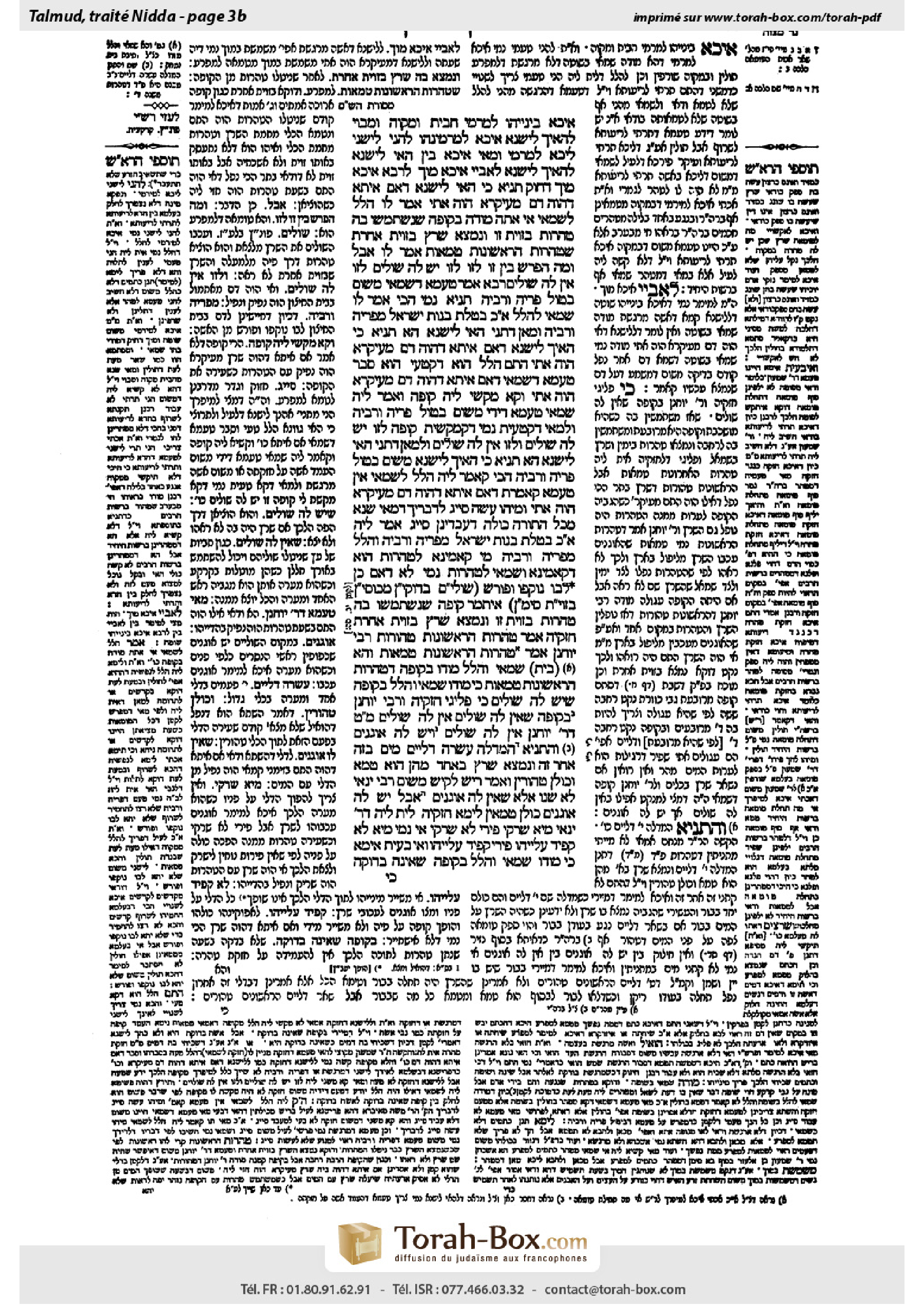
Niddah 3b: Talmud study for Daf Yomi
Daf Yomi is the daily study of one Talmud folio. Explore 37 tractates with scans, Hebrew text, Sefaria English and AI-generated French translations where annotated.
Passage selection and English or AI-generated French translation are available where the scan has annotations. Daf Study is independent of Torah-Box and Sefaria.
Browse Niddah · נידה · All tractatesNiddah 3b text and translations
This page of Niddah includes the Aramaic text, an English translation and an AI-generated French translation, alongside the scan above.
נידה ג׳ ב · Aramaic and Hebrew text
אִיכָּא בֵּינַיְיהוּ לְמִרְמֵי חָבִית וּמִקְוֶה וּמָבוֹי — לְהַאיְךְ לִישָּׁנָא אִיכָּא לְמִרְמִינְהוּ, לְהָנֵי לִישָּׁנֵי לֵיכָּא לְמִרְמֵי.
וּמַאי אִיכָּא בֵּין הַאי לִישָּׁנָא לְהַאיְךְ לִישָּׁנָא? לְאַבָּיֵי אִיכָּא מוֹךְ,
לְרָבָא אִיכָּא מוֹךְ דָּחוּק.
תַּנְיָא כִּי הַאי לִישָּׁנָא, דְּאִם אִיתָא דַּהֲוָה דָּם מֵעִיקָּרָא הֲוָה אָתֵי. אָמַר לוֹ הִלֵּל לְשַׁמַּאי: אִי אַתָּה מוֹדֶה בְּקוּפָּה שֶׁנִּשְׁתַּמְּשׁוּ בָּהּ טְהָרוֹת בְּזָוִית זוֹ, וְנִמְצָא שֶׁרֶץ בְּזָוִית אַחֶרֶת, שֶׁטְּהָרוֹת הָרִאשׁוֹנוֹת טְמֵאוֹת? אָמַר לוֹ: אֲבָל!
וּמָה הֶפְרֵשׁ בֵּין זוֹ לָזוֹ? לָזוֹ יֵשׁ לָהּ שׁוּלַיִם, לְזוֹ אֵין לָהּ שׁוּלַיִם.
רָבָא אָמַר: טַעְמָא דְשַׁמַּאי מִשּׁוּם בִּטּוּל פְּרִיָּה וּרְבִיָּה. תַּנְיָא נָמֵי הָכִי: אָמַר לוֹ שַׁמַּאי לְהִלֵּל: אִם כֵּן, בִּטַּלְתָּ בְּנוֹת יִשְׂרָאֵל מִפְּרִיָּה וּרְבִיָּה.
וּמַאן דְּתָנֵי הַאי לִישָּׁנָא, הָא תַּנְיָא כִּי הַאיְךְ לִישָּׁנָא, דְּאִם אִיתָא דַּהֲוָה דָּם מֵעִיקָּרָא הֲוָה אָתֵי. הָתָם, הִלֵּל הוּא דְּקָטָעֵי, הוּא סָבַר טַעְמָא דְּשַׁמַּאי דְּאִם אִיתָא דַּהֲוָה דָּם מֵעִיקָּרָא הֲוָה אָתֵי, וְקָא מַקְשֵׁי לֵיהּ קוּפָּה.
וְאָמַר לֵיהּ שַׁמַּאי: טַעְמָא דִּידִי מִשּׁוּם בִּטּוּל פְּרִיָּה וּרְבִיָּה, וּלְמַאי דְּקָטָעֵית נָמֵי דְּקָמַקְשֵׁית קוּפָּה — לָזוֹ יֵשׁ לָהּ שׁוּלַיִם, וּלָזוֹ אֵין לָהּ שׁוּלַיִם.
וּלְמַאן דְּתָנֵי הַאי לִישָּׁנָא, הָא תַּנְיָא כִּי הַאיְךְ לִישָּׁנָא, מִשּׁוּם בִּטּוּל פְּרִיָּה וּרְבִיָּה!
הָכִי קָאָמַר לֵיהּ הִלֵּל לְשַׁמַּאי: אִין, טַעְמָא קָאָמְרַתְּ, דְּאִם אִיתָא דַּהֲוָה דָּם מֵעִיקָּרָא הֲוָה אָתֵי, וּמִיהוּ עֲשֵׂה סְיָיג לִדְבָרֶיךָ, דְּמַאי שְׁנָא מִכׇּל הַתּוֹרָה כּוּלָּהּ דְּעָבְדִינַן סְיָיג?
אֲמַר לֵיהּ: אִם כֵּן, בִּטַּלְתָּ בְּנוֹת יִשְׂרָאֵל מִפְּרִיָּה וּרְבִיָּה! וְהִלֵּל — מִפְּרִיָּה וּרְבִיָּה מִי קָאָמֵינָא? לִטְהָרוֹת הוּא דְּקָאָמֵינָא!
וְשַׁמַּאי — לִטְהָרוֹת נָמֵי לָא, דְּאִם כֵּן לִבּוֹ נוֹקְפוֹ וּפוֹרֵשׁ.
(שׁוּלַיִם, בְּדוּקִין, מְכוּסִּין בְּזָוִית — סִימָן). אִיתְּמַר: קוּפָּה שֶׁנִּשְׁתַּמְּשׁוּ בָּהּ טְהָרוֹת בְּזָוִית זוֹ, וְנִמְצָא שֶׁרֶץ בְּזָוִית אַחֶרֶת — חִזְקִיָּה אָמַר: טְהָרוֹת הָרִאשׁוֹנוֹת טְהוֹרוֹת, רַבִּי יוֹחָנָן אָמַר: טְהָרוֹת הָרִאשׁוֹנוֹת טְמֵאוֹת. וְהָא (בֵּית) שַׁמַּאי וְהִלֵּל מוֹדוּ בְּקוּפָּה דִּטְהָרוֹת הָרִאשׁוֹנוֹת טְמֵאוֹת!
כִּי מוֹדוּ שַׁמַּאי וְהִלֵּל בְּקוּפָּה שֶׁיֵּשׁ לָהּ שׁוּלַיִם, כִּי פְּלִיגִי חִזְקִיָּה וְרַבִּי יוֹחָנָן בְּקוּפָּה שֶׁאֵין לָהּ שׁוּלַיִם.
אֵין לָהּ שׁוּלַיִם, מַאי טַעְמָא דְּרַבִּי יוֹחָנָן? אֵין לָהּ שׁוּלַיִם, וְיֵשׁ לָהּ אֳוגָנִים.
וְהָתַנְיָא: הַמַּדְלֶה עֲשָׂרָה דְּלָיִים מַיִם בְּזֶה אַחַר זֶה, וְנִמְצָא שֶׁרֶץ בְּאֶחָד מֵהֶן — הוּא טָמֵא, וְכוּלָּן טְהוֹרִין. וְאָמַר רֵישׁ לָקִישׁ מִשּׁוּם רַבִּי יַנַּאי: לֹא שָׁנוּ אֶלָּא שֶׁאֵין לָהּ אֳוגָנִים, אֲבָל יֵשׁ לָהּ אֳוגָנִים — כּוּלָּן טְמֵאִין.
לֵימָא חִזְקִיָּה לֵית לֵיהּ דְּרַבִּי יַנַּאי? מַיָּא שָׁרְקִי, פֵּירֵי לָא שָׁרְקִי.
אִי נָמֵי: מַיָּא לָא קָפֵיד עֲלַיְיהוּ, פֵּירֵי קָפֵיד עֲלַיְיהוּ.
וְאִי בָּעֵית אֵימָא: כִּי מוֹדוּ שַׁמַּאי וְהִלֵּל בְּקוּפָּה שֶׁאֵינָהּ בְּדוּקָה,
Niddah 3b · English translation
The Gemara answers: The difference between them is with regard to the possibility of raising a contradiction between Shammai’s ruling here and the cases of a barrel, a ritual bath, and an alleyway. According to that version, that Shammai’s reasoning is based upon the principle that an item retains its presumptive status, there is room to raise these contradictions, as the Gemara explained. By contrast, according to these other versions, that the woman would have felt any previous menstrual flow or that any prior menstrual blood would have flowed out previously, there is no room to raise such contradictions, as those rulings do not contradict the halakha here, where a unique factor is relevant.
The Gemara further asks: And what difference is there between this version, that any prior menstrual blood would have flowed out, and that version, that she would have felt any previous menstrual flow? The Gemara answers: According to Abaye, who maintains that Shammai agrees that a woman who engages in intercourse while using a contraceptive cloth is impure retroactively, there is a difference in a case where the woman engages in intercourse while using a contraceptive cloth. If Shammai’s reasoning is that a woman senses the emission of blood, in this case too it is assumed that she did not emit blood earlier. By contrast, if his reasoning is that any prior menstrual blood would have come out at the outset, it is possible that the cloth blocked the emission of blood, and she already emitted blood. Consequently, she is impure retroactively.
According to Rava, who maintains that blood can emerge even if the woman engages in intercourse while using a contraceptive absorbent cloth, there is a difference between the two interpretations in a case where she engages in intercourse while using a tightly packed absorbent cloth, as such a cloth will prevent the blood from flowing out, but it does not affect her ability to sense an emission.
It is taught in a mishna (Teharot 4:4) in accordance with this version, i.e., that Shammai’s reasoning is that if it is so, that there was menstrual blood previously, it would have come out at the outset: Hillel said to Shammai: Don’t you concede to the following halakha: In the case of a basket that was used as a container for ritually pure items, and those items were placed in one corner, and subsequently the carcass of a creeping animal was found in a different corner of the basket, the halakha is that the items initially considered ritually pure are now retroactively considered impure? Shammai said to him: Indeed, that is correct.
Hillel continues: And if so, what difference is there between this case of the pure items stored in the basket, which are now considered retroactively impure, and that case of the ritually pure woman who experiences a menstrual flow, who is impure only from that point onward? Shammai answers: This one, the basket, has a base on which it rests, and therefore the creeping animal might have been there earlier unseen. That one, the menstruating woman, has no base, i.e., there is nothing to impede her menstrual blood from flowing out. Shammai’s response indicates that she is not retroactively impure because if she had experienced a previous menstruation it would have flowed at that stage.
§ Rava says: The reason for the opinion of Shammai that a woman who experiences menstruation is not deemed ritually impure retroactively is due to the dereliction of the mitzva to be fruitful and multiply. If woman is always deemed retroactively impure, she and her husband might abstain from engaging in sexual intercourse out of fear that she is already impure even if she has not yet experienced bleeding. The Gemara adds that this explanation is also taught in a baraita: Shammai said to Hillel: If it is so, that a woman is rendered retroactively impure as you claim, you will have caused the Jewish women to be derelict in the mitzva to be fruitful and multiply.
The Gemara asks: But according to the one who taught this version, i.e., Rava, there is a difficulty: Isn’t it taught in the aforementioned mishna in accordance with that other version, that Shammai’s reasoning is that if it is so, that there was any menstrual blood previously, it would have come out at the outset? The Gemara answers: There, in that mishna, it is Hillel who erred. He thought the reason of Shammai is that if it is so, that there was any menstrual blood previously, it would have come out at the outset. And therefore, he raises a difficulty against Shammai’s opinion from the case of the basket.
And Shammai said to Hillel: You are mistaken. My reasoning is actually due to the dereliction of the mitzva to be fruitful and multiply. But even according to your erroneous reasoning that led you to raise a difficulty from the case of the basket, I have an answer for that as well: This basket has a base, and therefore the creeping animal could have been there earlier, unseen; but that menstruating woman has no base.
The Gemara asks the reverse question: And according to the one who teaches this other version, that Shammai’s reasoning is that if there was previous menstrual blood it would have come out at the outset, isn’t it taught in a baraita in accordance with that other version, that Shammai’s reasoning is due to the dereliction of the mitzva to be fruitful and multiply?
The Gemara answers: That baraita was recorded at a later point in their discussion, as this is what Hillel is saying to Shammai: Yes, the reason that you say for your opinion has merit, that if it is so, that there was any menstrual blood previously, it would have come out at the outset. Nevertheless, you should enact a safeguard for your statement and render her retroactively impure, as in what way is this case different from the rest of the entire Torah, where the Sages enact safeguards?
Shammai said to Hillel: If so, i.e., if she is considered impure retroactively as a safeguard, you will have caused the Jewish women to be derelict in the mitzva to be fruitful and multiply. The Gemara asks: And how does Hillel respond to Shammai’s reasoning with regard to the mitzva to be fruitful and multiply? The Gemara explains that Hillel would answer: Although I rule that she is retroactively impure, did I say that she is forbidden to her husband and must therefore abstain from the mitzva to be fruitful and multiply? I said only that she renders impure any ritually pure items that she touched.
The Gemara asks: And how would Shammai reply to this? The Gemara answers: Shammai maintains that even a safeguard that renders ritually pure items impure should not be imposed. The reason is that if it were so, the heart of a scrupulous husband might strike him with pangs of conscience over sins that he could transgress and he would separate from his wife, out of fear that she is impure.
The Gemara provides a mnemonic for the ensuing discussions: A base; examined; covered; in a corner. It was stated: If one has a basket that was used as a container for holding ritually pure produce, and those items were placed in one corner of the basket, and subsequently the carcass of a creeping animal was found in a different corner of the basket, Ḥizkiyya says: That produce initially considered ritually pure is still pure. Rabbi Yoḥanan says: The produce initially considered ritually pure is now retroactively deemed impure. The Gemara asks: But how can Ḥizkiyya rule that it is pure? After all, don’t Shammai and Hillel agree in the case of the basket that the produce initially considered pure is now retroactively impure?
The Gemara answers: When do Shammai and Hillel agree that all the produce is retroactively impure? With regard to a basket that has a base. In such a case, the carcass of the creeping animal might have previously been in the basket and it went unnoticed when one removed the pure produce items. When Ḥizkiyya and Rabbi Yoḥanan disagree, it is with regard to a basket that has no base, i.e., both ends were open and the basket was used while it was lying on its side. In that situation, the contents of the basket are emptied by raising one end, which causes all items inside to fall out. Consequently, any creeping animal that was found subsequently must have entered the basket only after that produce was removed, which is why Ḥizkiyya rules that the produce remains pure.
The Gemara asks: If this is referring to a case where the basket has no base, what is the reasoning of Rabbi Yoḥanan for ruling that the produce is ritually impure? The Gemara answers: The basket has no base but it does have an inward-curved rim. Therefore, it is possible that the carcass of a small creeping animal might have been held back by the rim and remained inside the basket even after it was turned over. Rabbi Yoḥanan rules that the produce is retroactively impure, due to the possibility that the creeping animal might have been in the basket previously together with the initially pure produce.
The Gemara raises a difficulty: But isn’t it taught in a baraita: With regard to one who draws ten pails of water one after another, i.e., he draws out water in one pail and from it he fills another ten pails with water, and the carcass of a creeping animal is found in one of them, that pail of water is ritually impure but all the rest of them are pure. And Reish Lakish says in the name of Rabbi Yannai: This halakha was taught only in a case where the pail has no inward-curved rim. Consequently, its contents are entirely emptied each time it is overturned, which means that the creeping animal must have entered only this pail. But if the pail has a rim, all of the water that had been drawn is impure, as the creeping animal might have entered the pail earlier and the rim held it back each time the pail was overturned.
The Gemara explains the difficulty: Shall we say that Ḥizkiyya, who is not concerned that the rim of the basket might have held back the creeping animal, does not agree with the opinion of Rabbi Yannai? The Gemara answers that there is a difference between the two cases: Water is slippery, whereas produce is not slippery. In order to pour water out of the pail it is not necessary to turn it over completely. Therefore, the rim might hold back a creeping animal. By contrast, a basket must have one end fully raised in order to empty out all the produce it contains. In such a case Rabbi Yannai would agree that nothing could have been held back, and therefore the emptied produce remains pure.
Alternatively, there is a different reason why one does not overturn a pail of water entirely: In the case of water, one is not particular about it, i.e., he does not mind if some is left over. Therefore he does not overturn the pail completely. By contrast, in the case of produce one is particular about it, so he raises one end of the basket entirely to ensure that every last piece of produce is emptied. Consequently, in the case of produce Rabbi Yannai would agree that even if the basket has a rim, all the produce remains pure.
As an alternative to its previous resolution that Ḥizkiyya is discussing the case of a rimmed receptacle, the Gemara suggests another resolution of the apparent contradiction between Ḥizkiyya’s ruling and the opinions of Hillel and Shammai. And if you wish, say: When do Shammai and Hillel agree? In the case of a basket that was not examined. Since he did not examine the basket when he placed the pure produce there, a creeping animal might have already been inside. Consequently, they agree that the produce does not retain its presumptive state of purity but is considered retroactively impure.
Niddah 3b · Traduction française (IA)
La Guemara répond : La différence entre ces versions concerne la possibilité de soulever une contradiction entre la décision de Chammaï ici et les cas du tonneau, du mikvé et de la ruelle. Selon cette version, d’après laquelle le raisonnement de Chammaï repose sur le principe qu’un élément conserve son statut présumé, il y a lieu de soulever ces contradictions, comme la Guemara l’a expliqué. En revanche, selon les autres versions, d’après lesquelles la femme aurait senti tout écoulement menstruel antérieur ou tout sang menstruel antérieur aurait déjà coulé, il n’y a pas lieu de soulever de telles contradictions, car ces décisions ne contredisent pas la halakha ici, où un facteur particulier entre en jeu.
La Guemara demande encore : Quelle différence y a-t-il entre cette version, selon laquelle tout sang menstruel antérieur aurait déjà coulé, et l’autre version, selon laquelle elle aurait senti tout écoulement menstruel antérieur ? La Guemara répond : Selon Abayé, qui soutient que Chammaï reconnaît qu’une femme qui a des rapports sexuels en utilisant un linge contraceptif est impure rétroactivement, la différence apparaît dans le cas où la femme a des rapports sexuels en utilisant un tel linge. Si le raisonnement de Chammaï est qu’une femme sent l’écoulement du sang, dans ce cas aussi on suppose qu’elle n’a pas perdu de sang auparavant. En revanche, si son raisonnement est que tout sang menstruel antérieur aurait coulé dès le début, il est possible que le linge ait bloqué l’écoulement du sang et qu’elle ait déjà perdu du sang. Par conséquent, elle est impure rétroactivement.
Selon Rava, qui soutient que du sang peut s’écouler même si la femme a des rapports sexuels en utilisant un linge absorbant contraceptif, il existe une différence entre les deux interprétations dans le cas où elle a des rapports sexuels en utilisant un linge absorbant bien tassé : un tel linge empêchera le sang de s’écouler, mais n’affectera pas sa capacité à sentir un écoulement.
Une Michna (Teharot 4:4) enseigne conformément à cette version, c’est-à-dire que le raisonnement de Chammaï est que, s’il y avait eu du sang menstruel auparavant, il aurait coulé dès le début : Hillel dit à Chammaï : Ne reconnais-tu pas la halakha suivante ? Dans le cas d’un panier qui servait de récipient pour des objets rituellement purs, déposés dans un coin, si l’on trouve ensuite la carcasse d’un animal rampant dans un autre coin du panier, la halakha est que les objets initialement considérés comme rituellement purs sont désormais considérés comme impurs rétroactivement. Chammaï lui dit : En effet, c’est exact.
Hillel poursuit : Et si c’est le cas, quelle différence y a-t-il entre ce cas des objets purs rangés dans le panier, qui sont désormais considérés comme impurs rétroactivement, et celui de la femme rituellement pure qui a un écoulement menstruel, laquelle n’est impure qu’à partir de ce moment ? Chammaï répond : Celui-ci, le panier, a un fond sur lequel il repose ; l’animal rampant a donc pu s’y trouver auparavant sans être remarqué. Celle-là, la femme menstruée, n’a pas de fond, c’est-à-dire que rien n’empêche son sang menstruel de s’écouler. La réponse de Chammaï indique qu’elle n’est pas impure rétroactivement, car si elle avait eu ses règles auparavant, le sang aurait alors coulé.
§ Rava dit : La raison de l’opinion de Chammaï, selon laquelle une femme qui a un écoulement menstruel n’est pas considérée comme rituellement impure rétroactivement, tient au risque de négliger la mitsva de procréer. Si une femme était toujours considérée comme impure rétroactivement, elle et son mari pourraient s’abstenir d’avoir des rapports sexuels, par crainte qu’elle soit déjà impure même si elle n’a pas encore saigné. La Guemara ajoute que cette explication est également enseignée dans une baraïta : Chammaï dit à Hillel : S’il en est ainsi, si une femme devient impure rétroactivement comme tu le prétends, tu auras conduit les femmes juives à négliger la mitsva de procréer.
La Guemara demande : Mais selon celui qui a transmis cette version, c’est-à-dire Rava, il y a une difficulté : la Michna précitée n’enseigne-t-elle pas conformément à l’autre version, selon laquelle le raisonnement de Chammaï est que, s’il y avait eu du sang menstruel auparavant, il aurait coulé dès le début ? La Guemara répond : Dans cette Michna, c’est Hillel qui s’est trompé. Il pensait que la raison de Chammaï était que, s’il y avait eu du sang menstruel auparavant, il aurait coulé dès le début. C’est pourquoi il soulève une difficulté contre l’opinion de Chammaï à partir du cas du panier.
Chammaï dit à Hillel : Tu te trompes. En réalité, mon raisonnement tient au risque de négliger la mitsva de procréer. Mais même selon ton raisonnement erroné, qui t’a conduit à soulever une difficulté à partir du cas du panier, j’ai aussi une réponse à cela : ce panier a un fond, et l’animal rampant a donc pu s’y trouver auparavant sans être remarqué ; mais cette femme menstruée n’a pas de fond.
La Guemara pose la question inverse : Et selon celui qui enseigne cette autre version, à savoir que le raisonnement de Chammaï est que, s’il y avait eu du sang menstruel auparavant, il aurait coulé dès le début, une baraïta n’enseigne-t-elle pas conformément à l’autre version, selon laquelle le raisonnement de Chammaï tient au risque de négliger la mitsva de procréer ?
La Guemara répond : Cette baraïta rapporte une étape ultérieure de leur discussion, car voici ce que Hillel dit à Chammaï : Oui, la raison que tu donnes à ton opinion est valable : s’il y avait eu du sang menstruel auparavant, il aurait coulé dès le début. Néanmoins, tu devrais instituer une mesure de précaution à l’appui de ta position et la rendre impure rétroactivement, car en quoi ce cas diffère-t-il des autres cas de toute la Torah, où les Sages instituent des mesures de précaution ?
Chammaï dit à Hillel : Dans ce cas, c’est-à-dire si elle est considérée comme impure rétroactivement à titre de mesure de précaution, tu auras conduit les femmes juives à négliger la mitsva de procréer. La Guemara demande : Et que répond Hillel au raisonnement de Chammaï concernant la mitsva de procréer ? La Guemara explique que Hillel répondrait : Bien que je décide qu’elle est impure rétroactivement, ai-je dit qu’elle est interdite à son mari et qu’elle doit donc s’abstenir d’accomplir la mitsva de procréer ? J’ai seulement dit qu’elle rend impurs les objets rituellement purs qu’elle a touchés.
La Guemara demande : Et que répondrait Chammaï à cela ? La Guemara répond : Chammaï soutient qu’il ne faut même pas imposer une mesure de précaution qui rendrait impurs des objets rituellement purs. En effet, dans ce cas, la conscience d’un mari scrupuleux pourrait le tourmenter au sujet des fautes qu’il risquerait de commettre, et il s’éloignerait de sa femme par crainte qu’elle soit impure.
La Guemara donne un moyen mnémotechnique pour les discussions qui suivent : un fond ; vérifié ; couvert ; dans un coin. Il a été enseigné : Si quelqu’un a un panier qui servait de récipient pour des produits rituellement purs, déposés dans un coin du panier, puis que l’on trouve la carcasse d’un animal rampant dans un autre coin, Ḥizkiyya dit : Ces produits, initialement considérés comme rituellement purs, restent purs. Rabbi Yoḥanan dit : Les produits initialement considérés comme rituellement purs sont désormais considérés comme impurs rétroactivement. La Guemara demande : Mais comment Ḥizkiyya peut-il décider qu’ils sont purs ? Chammaï et Hillel ne conviennent-ils pas, dans le cas du panier, que les produits initialement considérés comme purs sont désormais impurs rétroactivement ?
La Guemara répond : Dans quel cas Chammaï et Hillel conviennent-ils que tous les produits sont impurs rétroactivement ? Dans le cas d’un panier qui a un fond. Dans un tel cas, la carcasse de l’animal rampant a pu se trouver auparavant dans le panier et passer inaperçue lorsqu’on en a retiré les objets purs. Le désaccord entre Ḥizkiyya et Rabbi Yoḥanan concerne un panier sans fond, c’est-à-dire ouvert aux deux extrémités et utilisé couché sur le côté. Dans cette situation, on vide le panier en soulevant une extrémité, ce qui fait tomber tous les objets qu’il contient. Par conséquent, tout animal rampant découvert par la suite n’a pu pénétrer dans le panier qu’après que les produits en ont été retirés ; c’est pourquoi Ḥizkiyya décide que les produits restent purs.
La Guemara demande : S’il s’agit d’un cas où le panier n’a pas de fond, quelle est la raison de la décision de Rabbi Yoḥanan, selon laquelle les produits sont rituellement impurs ? La Guemara répond : Le panier n’a pas de fond, mais il a un rebord incurvé vers l’intérieur. Il est donc possible que la carcasse d’un petit animal rampant ait été retenue par le rebord et soit restée dans le panier même après qu’on l’a retourné. Rabbi Yoḥanan décide que les produits sont impurs rétroactivement, car l’animal rampant a pu se trouver auparavant dans le panier avec les produits initialement purs.
La Guemara soulève une difficulté : N’est-il pas enseigné dans une baraïta que, si quelqu’un puise dix seaux d’eau l’un après l’autre, c’est-à-dire qu’il puise de l’eau dans un seau puis s’en sert pour remplir dix autres seaux, et que l’on trouve la carcasse d’un animal rampant dans l’un d’eux, l’eau de ce seau est rituellement impure, tandis que celle de tous les autres est pure ? Et Rech Lakich dit au nom de Rabbi Yannai : Cette halakha n’a été enseignée que dans le cas où le seau n’a pas de rebord incurvé vers l’intérieur. Son contenu est donc entièrement vidé chaque fois qu’on le retourne, ce qui signifie que l’animal rampant n’a pu pénétrer que dans ce seau-là. Mais si le seau a un rebord, toute l’eau qui a été puisée est impure, car l’animal rampant a pu pénétrer dans le seau auparavant, et le rebord l’a retenu chaque fois que le seau a été retourné.
La Guemara explicite la difficulté : Faut-il en conclure que Ḥizkiyya, qui ne tient pas compte de la possibilité que le rebord du panier ait retenu l’animal rampant, ne partage pas l’opinion de Rabbi Yannai ? La Guemara répond qu’il y a une différence entre les deux cas : l’eau est glissante, contrairement aux produits. Pour verser l’eau du seau, il n’est pas nécessaire de le retourner complètement. Le rebord peut donc retenir un animal rampant. En revanche, il faut soulever entièrement une extrémité du panier pour en vider tous les produits. Dans un tel cas, Rabbi Yannai conviendrait que rien n’a pu être retenu et que les produits vidés restent donc purs.
Autre explication : il existe une autre raison pour laquelle on ne retourne pas complètement un seau d’eau : on ne tient pas particulièrement à récupérer toute l’eau, c’est-à-dire que cela ne dérange pas celui qui la verse s’il en reste un peu. Il ne retourne donc pas complètement le seau. En revanche, on tient à récupérer tous les produits ; on soulève donc entièrement une extrémité du panier afin de s’assurer que chaque dernier morceau en soit vidé. Par conséquent, dans le cas des produits, Rabbi Yannai conviendrait que, même si le panier a un rebord, tous les produits restent purs.
Comme autre solution, au lieu de la réponse précédente selon laquelle Ḥizkiyya parle du cas d’un récipient muni d’un rebord, la Guemara propose une autre manière de résoudre la contradiction apparente entre la décision de Ḥizkiyya et les opinions de Hillel et de Chammaï. Et si tu veux, dis : Dans quel cas Chammaï et Hillel sont-ils d’accord ? Dans le cas d’un panier qui n’a pas été vérifié. Puisqu’il n’a pas vérifié le panier lorsqu’il y a déposé les produits purs, un animal rampant a pu s’y trouver déjà. Par conséquent, ils conviennent que les produits ne conservent pas leur statut présumé de pureté et sont considérés comme impurs rétroactivement.
Traduction française générée par IA à partir de l’édition anglaise de Sefaria. Vérifie toujours un passage avec le texte source.
Text from Sefaria: William Davidson Edition - Vocalized Aramaic (CC BY NC); William Davidson Edition - English (CC BY NC).