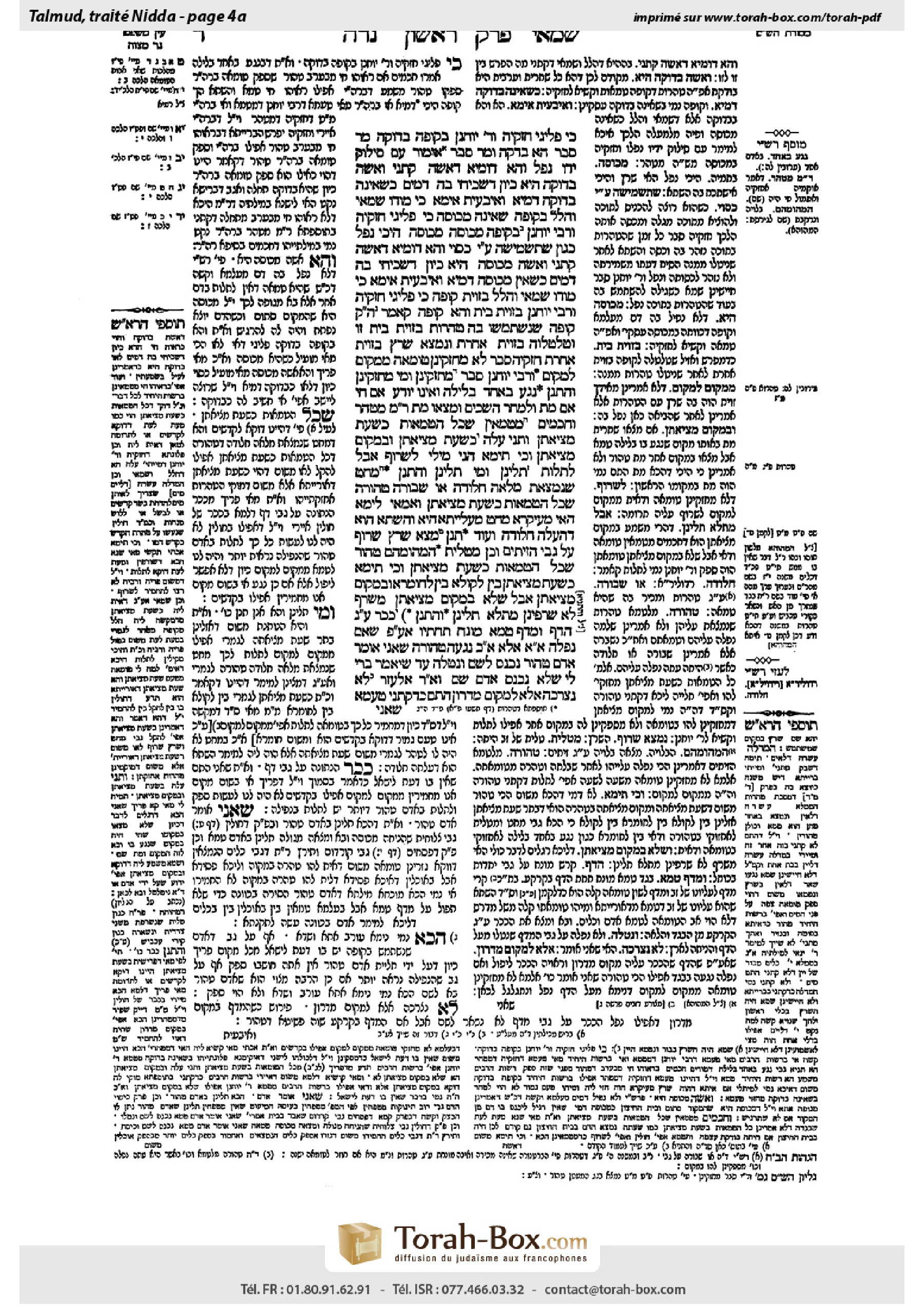
Niddah 4a: Talmud study for Daf Yomi
Daf Yomi is the daily study of one Talmud folio. Explore 37 tractates with scans, Hebrew text, Sefaria English and AI-generated French translations where annotated.
Passage selection and English or AI-generated French translation are available where the scan has annotations. Daf Study is independent of Torah-Box and Sefaria.
Browse Niddah · נידה · All tractatesNiddah 4a text and translations
This page of Niddah includes the Aramaic text, an English translation and an AI-generated French translation, alongside the scan above.
נידה ד׳ א · Aramaic and Hebrew text
כִּי פְּלִיגִי חִזְקִיָּה וְרַבִּי יוֹחָנָן בְּקוּפָּה בְּדוּקָה, מָר סָבַר: הָא בַּדְקַהּ, וּמָר סָבַר: אֵימוֹר עִם סִילּוּק יָדוֹ נָפַל.
וְהָא דּוּמְיָא דְּאִשָּׁה קָתָנֵי, וְאִשָּׁה בְּדוּקָה הִיא! כֵּיוָן דִּשְׁכִיחִי בָּהּ דָּמִים — כְּשֶׁאֵינָהּ בְּדוּקָה דָּמְיָא.
וְאִיבָּעֵית אֵימָא: כִּי מוֹדוּ שַׁמַּאי וְהִלֵּל בְּקוּפָּה שֶׁאֵינָהּ מְכוּסָּה, כִּי פְּלִיגִי חִזְקִיָּה וְרַבִּי יוֹחָנָן בְּקוּפָּה מְכוּסָּה. מְכוּסָּה — הֵיכִי נְפַל? כְּגוֹן שֶׁתַּשְׁמִישָׁהּ עַל יְדֵי כִּסּוּי.
וְהָא דּוּמְיָא דְאִשָּׁה קָתָנֵי, וְאִשָּׁה מְכוּסָּה הִיא, כֵּיוָן דִּשְׁכִיחִי בַּהּ דָּמִים — כְּשֶׁאֵין מְכוּסָּה דָּמְיָא.
וְאִיבָּעֵית אֵימָא: כִּי מוֹדוּ שַׁמַּאי וְהִלֵּל בְּזָוִית קוּפָּה, כִּי פְּלִיגִי חִזְקִיָּה וְרַבִּי יוֹחָנָן בְּזָוִית בַּיִת, וְהָא ״קוּפָּה״ קָאָמַר!
הָכִי קָאָמַר: קוּפָּה שֶׁנִּשְׁתַּמְּשׁוּ בָּהּ טְהָרוֹת בְּזָוִית בַּיִת זוֹ, וְטִלְטְלוּהָ בְּזָוִית אַחֶרֶת, וְנִמְצָא שֶׁרֶץ בְּזָוִית אַחֶרֶת. חִזְקִיָּה סָבַר: לָא מַחְזְקִינַן טוּמְאָה מִמָּקוֹם לְמָקוֹם, וְרַבִּי יוֹחָנָן סָבַר: מַחְזְקִינַן.
וּמִי מַחְזְקִינַן? וְהָתְנַן: נָגַע בְּאֶחָד בַּלַּיְלָה, וְאֵינוֹ יוֹדֵעַ אִם חַי אִם מֵת, וּלְמָחָר הִשְׁכִּים וּמְצָאוֹ מֵת — רַבִּי מֵאִיר מְטַהֵר.
וַחֲכָמִים מְטַמְּאִין, שֶׁכׇּל הַטֻּמְאוֹת כִּשְׁעַת מְצִיאָתָן.
וְתָנֵי עֲלַהּ: כִּשְׁעַת מְצִיאָתָן, וּבִמְקוֹם מְצִיאָתָן!
וְכִי תֵּימָא: הָנֵי מִילֵּי לִשְׂרוֹף, אֲבָל לִתְלוֹת — תָּלֵינַן? וּמִי תָּלֵינַן?!
וְהָתְנַן: מַחַט שֶׁנִּמְצֵאת מְלֵאָה חֲלוּדָּה אוֹ שְׁבוּרָה — טְהוֹרָה, שֶׁכׇּל הַטֻּמְאוֹת כִּשְׁעַת מְצִיאָתָן. וְאַמַּאי? לֵימָא: הַאי מֵעִיקָּרָא מַחַט מְעַלַּיְיתָא הִיא, וְהַשְׁתָּא הוּא דְּהֶעֱלָה חֲלוּדָּה.
וְעוֹד תְּנַן: מָצָא שֶׁרֶץ שָׂרוּף עַל גַּבֵּי הַזֵּיתִים, וְכֵן מַטְלִית הַמְהוּמְהָם — טָהוֹר, שֶׁכׇּל הַטֻּמְאוֹת כִּשְׁעַת מְצִיאָתָן!
וְכִי תֵּימָא, כִּשְׁעַת מְצִיאָתָן בֵּין לְקוּלָּא בֵּין לְחוּמְרָא, וּבִמְקוֹם מְצִיאָתָן, אֲבָל שֶׁלֹּא בִּמְקוֹם מְצִיאָתָן — מִשְׂרָף לָא שָׂרְפִינַן, מִתְלֵא תָּלֵינַן.
וְהָתְנַן: כִּכָּר עַל גַּבֵּי הַדַּף, וּמַדָּף טָמֵא מוּנָּח תַּחְתָּיו, אַף עַל פִּי שֶׁאִם נָפְלָה אִי אֶפְשָׁר אֶלָּא אִם כֵּן נָגְעָה — טְהוֹרָה, שֶׁאֲנִי אוֹמֵר: אָדָם טָהוֹר נִכְנַס לְשָׁם וּנְטָלָהּ,
עַד שֶׁיֹּאמַר: ״בָּרִי לִי שֶׁלֹּא נִכְנַס אָדָם שָׁם״. וְאָמַר רַבִּי אֶלְעָזָר: לֹא נִצְרְכָה אֶלָּא לִמְקוֹם מִדְרוֹן!
הָתָם כִּדְקָתָנֵי טַעְמָא,
Niddah 4a · English translation
When Ḥizkiyya and Rabbi Yoḥanan disagree, it is with regard to a basket that was examined. One Sage, Ḥizkiyya, holds that since it was examined before the produce was placed inside and was found to be clean of creeping animals, it is reasonable to assume that the creeping animal entered only after the ritually pure produce was removed. And one Sage, Rabbi Yoḥanan, holds that one can say that it is possible that when he removed his hand after feeling around to examine the basket, the creeping animal fell in.
The Gemara asks: But isn’t the case of a basket taught as being similar to the case of a menstruating woman? Hillel had cited the case of the basket as a difficulty with regard to Shammai’s opinion in the case of a menstruating woman. And since a woman is considered fully examined, since she examines herself with examination cloths twice a day, the other case must also be referring to a basket that had been examined. The Gemara answers: Since blood is commonly found flowing from her, as women regularly experience menstrual flows, it is considered as though she were not examined.
The Gemara suggests another resolution of the apparent contradiction between the ruling of Ḥizkiyya and the opinions of Hillel and Shammai. And if you wish, say: When Shammai and Hillel agree, it is with regard to a basket that is not covered. When do Ḥizkiyya and Rabbi Yoḥanan disagree? With regard to a basket that is covered. The Gemara asks: If the basket is covered, how did the creeping animal fall inside? The Gemara answers: For example, if the basket is used by removing its lid. Ḥizkiyya holds that the creeping animal must have fallen in after the produce was removed, because as long as the produce was inside one would be careful not to allow anything else inside. Rabbi Yoḥanan is concerned that perhaps while the basket was uncovered a creeping animal could have fallen inside without one noticing.
The Gemara raises a difficulty: But isn’t the case of a basket taught as being similar to the case of a menstruating woman? And just as a woman is considered covered, since no outside blood can enter her, so too in the case of a basket, it must be one where it is constantly covered. The Gemara explains: Since blood is commonly found flowing from her, as women regularly experience menstrual flows, it is considered as though she is not always covered.
The Gemara suggests another resolution. And if you wish, say: When do Shammai and Hillel agree? In a case where the produce was stored in the corner of a basket. By contrast, when Ḥizkiyya and Rabbi Yoḥanan disagree, it is in a case where the produce was stored in the corner of a house. The Gemara expresses puzzlement at this suggestion: But the Gemara on 3b explicitly states that they are referring to a case of a basket.
The Gemara explains that this is what the Gemara on 3b is saying: If one has a basket that was used as a container for ritually pure produce in this corner of the house, and after the produce was removed it was subsequently carried to another corner, and the carcass of a creeping animal was found in the basket while it was in that other corner, Ḥizkiyya holds: The produce remains ritually pure, as we do not presume that ritual impurity moved from place to place. In other words, the impure creeping animal is not assumed to have moved from the first corner where the produce was kept. Instead, it fell inside while the basket was in the second corner, and therefore the produce that it previously contained remains pure. And Rabbi Yoḥanan holds: The produce is retroactively considered impure, as we do presume that ritual impurity, i.e., the carcass of the creeping animal in the basket, moved from place to place.
The Gemara asks a question with regard to the opinion of Rabbi Yoḥanan: And do we presume that ritual impurity moved from place to place? But didn’t we learn in a mishna (Teharot 5:7): If someone touched one other person at night, and he does not know whether the person he touched was alive or dead, and on the following day he arose and found him dead, and he is uncertain whether or not he contracted ritual impurity from contact with a corpse, Rabbi Meir deems him ritually pure. It is assumed that the deceased was still alive until the point that it is known with certainty that he was dead.
And the Rabbis deem him ritually impure, as it is presumed that all ritually impure items had already been in the same state as they were at the time they were discovered. Just as the deceased was found dead in the morning, so too, it is presumed that he was dead when he was touched in the middle of the night.
The Gemara concludes its question: And it is taught with regard to this mishna: It is presumed that ritually impure items had been in the same state as they were at the time they were discovered, but only in the place in which they were discovered. In other words, if the corpse had been found in a different spot than he was at night, it is not presumed that he was already dead in the first spot, and the man who touched him remains ritually pure. If so, how can Rabbi Yoḥanan maintain that we presume impurity moved from place to place?
And if you would say in response: This statement, that impurity is presumed only in the place in which it was discovered, applies specifically with regard to definite impure status, i.e., to burn teruma, but with regard to uncertain impurity, i.e., to suspend the status of teruma, we do in fact suspend its status and it may be neither burned nor eaten; is this distinction correct? Do we in fact suspend the status of ritually pure items in such a case, due to the concern that the dead man whom this individual touched might have already been dead in the first location?
But didn’t we learn in a mishna (Teharot 3:5): With regard to a previously impure needle that is found on top of teruma and it is full of rust or broken, and therefore no longer contracts or transmit ritual impurity, the teruma remains pure, as it is presumed that in all cases of impurity, the items in question had already been in the same state as they were at the time they were discovered? But why should that be the case? Let us say that initially, when it had fallen onto the teruma, this needle was a proper, non-rusty and unbroken, needle, capable of contracting and transmitting ritual impurity, and it is only now that rust had formed on it. The status of the teruma should at least be held in suspension. Rather, it is evident that the teruma is considered definitely pure and is not held in suspension due to the possibility that it might have become impure from the nail at a previous time or, presumably, in a previous place.
And furthermore, we learned in a mishna (Teharot 9:9): If one found the carcass of a burned creeping animal on top of a pile of olives, and that animal no longer transmits impurity as it is burned, and similarly if one finds a tattered rag of a zav, which likewise no longer transmits impurity, on top of a pile of olives, the olives are pure. The reason is that it is presumed in all cases of impurity, the items in question had already been in the same state as they were at the time they were discovered. Once again, this demonstrates that when this presumption is applied, the item is considered definitely pure, and is not held in suspension due to uncertainty.
And if you would say that there is a difference between these last cases, where the items did not move, and the case of the basket that moved, this distinction is not correct. The suggestion is that in the last cases the items are treated entirely as if they had always been as they were at the time they were discovered, whether this leads to a leniency, as in the cases of the needle and the rag, and whether it leads to a stringency, in the case of one who touched someone at night, when he is considered to be definitely impure, but this is the halakha only with regard to the place where they were discovered, i.e., if they did not move. But with regard to a location that is not the place where they were discovered, we do suspect that ritual impurity moved from place to place, and therefore although we do not burn the teruma in question, we hold it in suspension.
The Gemara refutes this suggestion: But didn’t we learn in a baraita (Tosefta, Teharot 4:3): There was a loaf resting on top of a shelf, and there was an item of light impurity, e.g., a garment of a zav, which transmits impurity to food but not to people or vessels, lying underneath it, and the loaf was later found on the ground. Even though the situation was such that if the loaf fell to the ground it would be impossible for it to have done anything other than touch the impure garment on its way down, nevertheless the loaf is pure. The reason is that I say that a ritually pure man entered there and took it off the shelf and placed it onto the ground without it touching the impure garment.
The baraita concludes: This ruling applies unless someone says: It is clear to me that no person entered there. And Rabbi Elazar says: This principle is necessary only when the top shelf is an inclined surface. In other words, even if it is very likely that the loaf rolled off the shelf and touched the garment on its way down to the ground, nevertheless it is assumed to be pure. This indicates that one does not presume that the loaf contracted impurity and then fell to the ground where it was found. Since such a possibility is not even entertained to the extent that the teruma is held in suspension, this demonstrates that in a case involving a movement from one place to another there is no presumption of ritual impurity at all.
The Gemara explains that no proof can be cited from there, as that baraita explicitly teaches the reason for its ruling:
Niddah 4a · Traduction française (IA)
Lorsque Ḥizkiyya et Rabbi Yoḥanan sont en désaccord, il s’agit d’un panier qui a été examiné. Un Sage, Ḥizkiyya, estime que, puisqu’il a été examiné avant qu’on y place les produits et qu’on l’a trouvé exempt de bestioles rampantes, il est raisonnable de supposer que la bestiole rampante n’y est entrée qu’après qu’on en a retiré les produits rituellement purs. L’autre Sage, Rabbi Yoḥanan, estime qu’il est possible que la bestiole rampante soit tombée dans le panier lorsque, après y avoir tâtonné pour l’examiner, on en a retiré la main.
La Guemara demande : Mais le cas du panier n’est-il pas enseigné comme analogue à celui d’une femme menstruée ? Hillel avait cité le cas du panier pour soulever une difficulté à propos de l’opinion de Chammaï concernant une femme menstruée. Or, puisqu’une femme est considérée comme ayant été entièrement examinée, car elle s’examine à l’aide de linges d’inspection deux fois par jour, l’autre cas doit lui aussi concerner un panier qui a été examiné. La Guemara répond : Comme du sang s’écoule couramment d’elle, les femmes ayant régulièrement des écoulements menstruels, c’est comme si elle n’avait pas été examinée.
La Guemara propose une autre manière de résoudre la contradiction apparente entre la décision de Ḥizkiyya et les opinions de Hillel et de Chammaï. Et si tu le souhaites, dis plutôt : lorsque Chammaï et Hillel sont d’accord, il s’agit d’un panier découvert. Le désaccord entre Ḥizkiyya et Rabbi Yoḥanan porte, lui, sur un panier couvert. La Guemara demande : Si le panier est couvert, comment la bestiole rampante a-t-elle pu tomber dedans ? La Guemara répond : par exemple, lorsqu’on se sert dans le panier en retirant son couvercle. Ḥizkiyya estime que la bestiole rampante a nécessairement dû y tomber après qu’on en a retiré les produits, car tant que ceux-ci s’y trouvaient, on veillait à ne rien laisser entrer d’autre. Rabbi Yoḥanan craint qu’une bestiole rampante ait pu tomber dans le panier sans qu’on s’en aperçoive pendant qu’il était découvert.
La Guemara soulève une difficulté : Mais le cas du panier n’est-il pas enseigné comme analogue à celui d’une femme menstruée ? Et de même qu’une femme est considérée comme couverte, puisqu’aucun sang extérieur ne peut pénétrer en elle, de même, dans le cas du panier, il doit s’agir d’un panier constamment couvert. La Guemara explique : Comme du sang s’écoule couramment d’elle, les femmes ayant régulièrement des écoulements menstruels, c’est comme si elle n’était pas toujours couverte.
La Guemara propose une autre résolution. Et si tu le souhaites, dis plutôt : lorsque Chammaï et Hillel sont d’accord, il s’agit d’un cas où les produits étaient entreposés dans un coin du panier. En revanche, le désaccord entre Ḥizkiyya et Rabbi Yoḥanan porte sur un cas où les produits étaient entreposés dans un coin de la pièce. La Guemara exprime son étonnement face à cette proposition : Mais la Guemara, en 3b, précise explicitement qu’il s’agit d’un panier.
La Guemara explique que voici ce que dit la Guemara en 3b : si l’on a un panier qui servait de récipient pour des produits rituellement purs dans un coin de la pièce, puis qu’après en avoir retiré les produits, on l’a transporté dans un autre coin et qu’on a trouvé la carcasse d’une bestiole rampante dans le panier alors qu’il se trouvait dans cet autre coin, Ḥizkiyya estime que les produits restent rituellement purs, car nous ne présumons pas que l’impureté rituelle se soit déplacée d’un endroit à un autre. Autrement dit, on ne suppose pas que la bestiole rampante impure ait quitté le premier coin où les produits étaient entreposés. Elle est plutôt tombée dans le panier alors qu’il se trouvait dans le second coin ; les produits qu’il avait auparavant contenus restent donc purs. Rabbi Yoḥanan estime que les produits sont considérés rétroactivement comme impurs, car nous présumons que l’impureté rituelle, c’est-à-dire la carcasse de la bestiole rampante dans le panier, s’est déplacée d’un endroit à un autre.
La Guemara pose une question à propos de l’opinion de Rabbi Yoḥanan : Présume-t-on que l’impureté rituelle se soit déplacée d’un endroit à un autre ? Mais n’avons-nous pas appris dans une Michna (Teharot 5:7) : si quelqu’un a touché une autre personne pendant la nuit et ignore si la personne qu’il a touchée était vivante ou morte, puis qu’il se lève le lendemain et la trouve morte, et qu’il ne sait pas s’il a contracté ou non l’impureté rituelle par contact avec un cadavre, Rabbi Meïr le déclare rituellement pur. On suppose que le défunt était encore vivant jusqu’au moment où il est établi avec certitude qu’il était mort.
Et les Sages le déclarent rituellement impur, car on présume que tout élément impur se trouvait déjà dans l’état où il a été découvert. De même que le défunt a été trouvé mort le matin, on présume qu’il était mort au moment où on l’a touché au milieu de la nuit.
La Guemara achève sa question : Or, il est enseigné à propos de cette Michna que l’on présume que les éléments impurs se trouvaient dans l’état où ils ont été découverts, mais uniquement à l’endroit où ils ont été découverts. Autrement dit, si le cadavre avait été trouvé à un endroit différent de celui où il se trouvait pendant la nuit, on ne présume pas qu’il était déjà mort au premier endroit, et l’homme qui l’a touché reste rituellement pur. Si tel est le cas, comment Rabbi Yoḥanan peut-il soutenir que nous présumons que l’impureté s’est déplacée d’un endroit à un autre ?
Et si tu répondais que cette règle, selon laquelle l’impureté n’est présumée qu’à l’endroit où elle a été découverte, s’applique spécifiquement à un statut d’impureté certain, c’est-à-dire lorsqu’il faut brûler la terouma, tandis que, lorsqu’il s’agit d’une impureté incertaine, on suspend le statut de la terouma, de sorte qu’elle ne peut être ni brûlée ni consommée : cette distinction est-elle juste ? Suspend-on effectivement le statut des éléments rituellement purs dans un tel cas, par crainte que l’homme mort que cette personne a touché ait déjà été mort au premier endroit ?
Mais n’avons-nous pas appris dans une Michna (Teharot 3:5) : au sujet d’une aiguille qui était auparavant impure, trouvée sur de la terouma et entièrement rouillée ou brisée, et qui, par conséquent, ne contracte ni ne transmet plus l’impureté rituelle, la terouma reste pure, car on présume que, dans tous les cas d’impureté, les éléments concernés se trouvaient déjà dans l’état où ils ont été découverts ? Mais pourquoi en serait-il ainsi ? Disons qu’au départ, lorsqu’elle est tombée sur la terouma, cette aiguille était intacte, non rouillée et non brisée, et qu’elle était donc capable de contracter et de transmettre l’impureté rituelle ; ce n’est que par la suite qu’elle a rouillé. Le statut de la terouma devrait au moins être suspendu. Il est donc évident que la terouma est considérée comme certainement pure et que son statut n’est pas suspendu par crainte qu’elle ait pu être rendue impure auparavant par l’aiguille ou, semble-t-il, à un endroit antérieur.
De plus, nous avons appris dans une Michna (Teharot 9:9) : si l’on trouve la carcasse d’une bestiole rampante brûlée sur un tas d’olives, cet animal ne transmet plus l’impureté parce qu’il est brûlé. De même, si l’on trouve sur un tas d’olives un chiffon déchiré appartenant à un zav, qui, lui non plus, ne transmet plus l’impureté, les olives sont pures. La raison en est que, dans tous les cas d’impureté, on présume que les éléments concernés se trouvaient déjà dans l’état où ils ont été découverts. Cela démontre une fois encore que, lorsque cette présomption s’applique, l’objet est considéré comme certainement pur et que son statut n’est pas suspendu en raison d’une incertitude.
Et si tu disais qu’il existe une différence entre ces derniers cas, où les éléments n’ont pas bougé, et celui du panier qui a été déplacé, cette distinction n’est pas juste. L’argument est que, dans les derniers cas, les éléments sont traités exactement comme s’ils avaient toujours été dans l’état où ils ont été découverts, que cela conduise à une indulgence, comme dans les cas de l’aiguille et du chiffon, ou à une rigueur, comme dans le cas de celui qui a touché quelqu’un pendant la nuit, où il est considéré comme certainement impur. Mais cette halakha ne vaut que pour l’endroit où les éléments ont été découverts, c’est-à-dire lorsqu’ils n’ont pas bougé. En revanche, pour un endroit qui n’est pas celui où ils ont été découverts, nous craignons effectivement que l’impureté rituelle se soit déplacée d’un endroit à un autre ; par conséquent, même si nous ne brûlons pas la terouma concernée, nous en suspendons le statut.
La Guemara réfute cette proposition : Mais n’avons-nous pas appris dans une baraïta (Tosefta, Teharot 4:3) : un pain reposait sur une étagère, et un élément transmettant une impureté légère — par exemple, un vêtement d’un zav, qui transmet l’impureté aux aliments, mais pas aux personnes ni aux ustensiles — se trouvait en dessous ; plus tard, on a retrouvé le pain par terre. Même si, dans ces circonstances, il aurait été impossible, si le pain était tombé à terre, qu’il ne touche pas le vêtement impur en descendant, le pain est néanmoins pur. La raison en est que je dis qu’un homme rituellement pur est entré, l’a pris sur l’étagère et l’a posé par terre sans qu’il touche le vêtement impur.
La baraïta conclut : cette décision s’applique à moins que quelqu’un ne dise : « Je sais avec certitude qu’aucune personne n’est entrée là. » Rabbi Elazar dit : ce principe n’est nécessaire que lorsque l’étagère du haut est une surface inclinée. Autrement dit, même s’il est très probable que le pain ait roulé de l’étagère et touché le vêtement en tombant au sol, on le présume néanmoins pur. Cela indique qu’on ne présume pas que le pain a contracté l’impureté avant de tomber à l’endroit où on l’a trouvé. Puisqu’on n’envisage même pas cette possibilité au point de suspendre le statut de la terouma, cela démontre que, dans un cas de déplacement d’un endroit à un autre, on ne présume pas du tout d’impureté rituelle.
La Guemara explique qu’on ne peut tirer aucune preuve de là, car cette baraïta enseigne explicitement la raison de sa décision :
Traduction française générée par IA à partir de l’édition anglaise de Sefaria. Vérifie toujours un passage avec le texte source.
Text from Sefaria: William Davidson Edition - Vocalized Aramaic (CC BY NC); William Davidson Edition - English (CC BY NC).