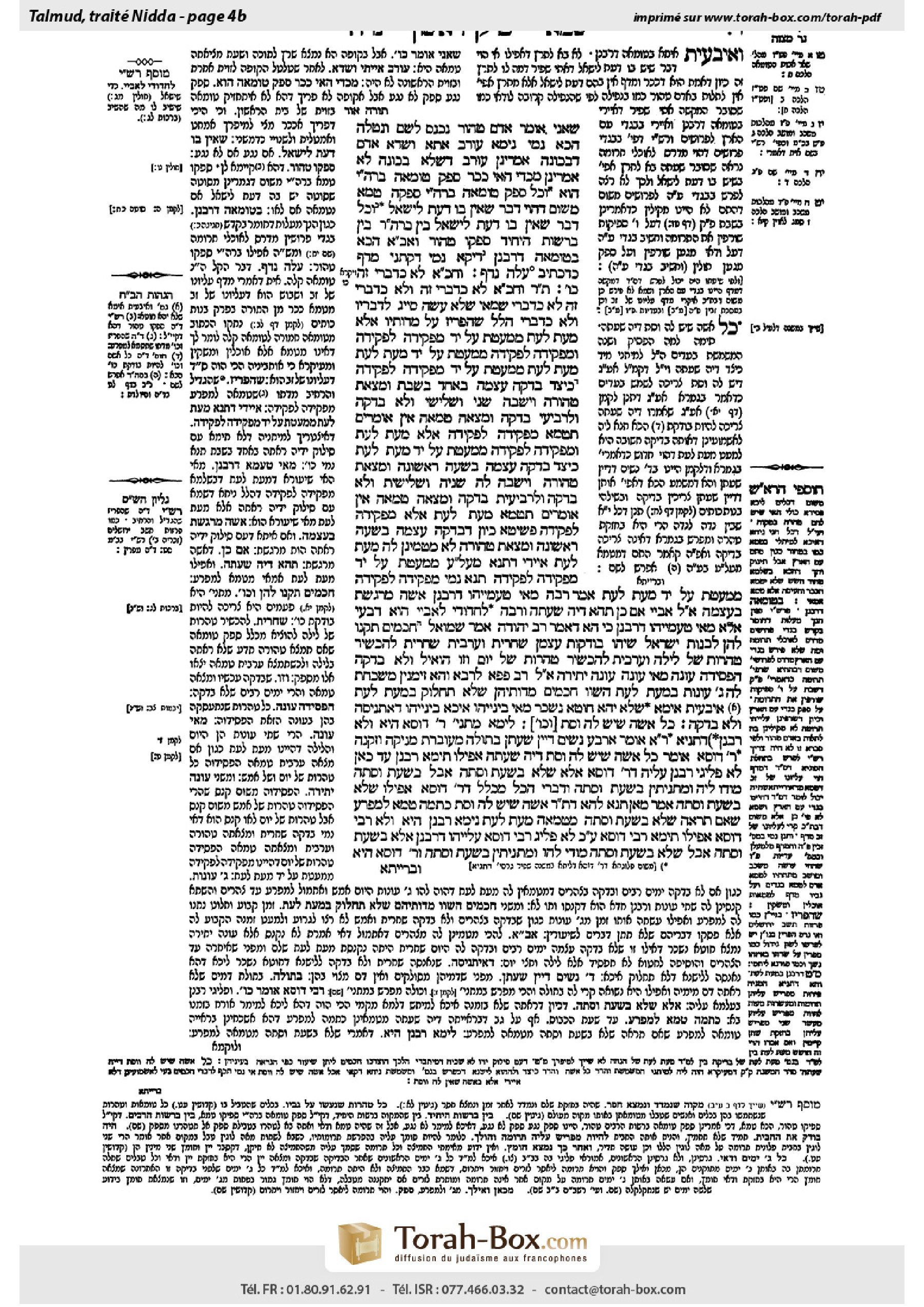
Niddah 4b: Talmud study for Daf Yomi
Daf Yomi is the daily study of one Talmud folio. Explore 37 tractates with scans, Hebrew text, Sefaria English and AI-generated French translations where annotated.
Passage selection and English or AI-generated French translation are available where the scan has annotations. Daf Study is independent of Torah-Box and Sefaria.
Browse Niddah · נידה · All tractatesNiddah 4b text and translations
This page of Niddah includes the Aramaic text, an English translation and an AI-generated French translation, alongside the scan above.
נידה ד׳ ב · Aramaic and Hebrew text
שֶׁאֲנִי אוֹמֵר: אָדָם טָהוֹר נִכְנַס לְשָׁם וּנְטָלָהּ.
הָכָא נָמֵי נֵימָא: עוֹרֵב אֲתָא וּשְׁדָא! אָדָם דִּבְכַוָּנָה — אָמְרִינַן, עוֹרֵב דְּשֶׁלֹּא בְּכַוָּנָה — לָא אָמְרִינַן.
מִכְּדִי הַאי כִּכָּר סְפֵק טוּמְאָה בִּרְשׁוּת הַיָּחִיד הוּא, וְכֹל סְפֵק טוּמְאָה בִּרְשׁוּת הַיָּחִיד — סְפֵקָהּ טָמֵא, מִשּׁוּם דְּהָוֵי דָּבָר שֶׁאֵין בּוֹ דַּעַת לִישָּׁאֵל, וְכׇל דָּבָר שֶׁאֵין בּוֹ דַּעַת לִישָּׁאֵל, בֵּין בִּרְשׁוּת הָרַבִּים בֵּין בִּרְשׁוּת הַיָּחִיד — סְפֵקוֹ טָהוֹר.
וְאִי בָּעֵית אֵימָא: הָכָא בְּטוּמְאָה דְרַבָּנַן. דַּיְקָא נָמֵי דְּקָתָנֵי ״מַדָּף״, כְּדִכְתִיב ״עָלֶה נִדָּף״.
וַחֲכָמִים אוֹמְרִים: לֹא כְּדִבְרֵי זֶה כּוּ׳. תָּנוּ רַבָּנַן: וַחֲכָמִים אוֹמְרִים: לֹא כְּדִבְרֵי זֶה וְלֹא כְּדִבְרֵי זֶה, לֹא כְּדִבְרֵי שַׁמַּאי — שֶׁלֹּא עָשָׂה סְיָיג לִדְבָרָיו, וְלֹא כְּדִבְרֵי הִלֵּל — שֶׁהִפְרִיז עַל מִדּוֹתָיו.
אֶלָּא, מֵעֵת לְעֵת מְמַעֶטֶת עַל יָד מִפְּקִידָה לִפְקִידָה, וּמִפְּקִידָה לִפְקִידָה מְמַעֶטֶת עַל יָד מֵעֵת לְעֵת.
מֵעֵת לְעֵת מְמַעֶטֶת עַל יָד מִפְּקִידָה לִפְקִידָה, כֵּיצַד? בָּדְקָה עַצְמָהּ בְּאֶחָד בַּשַּׁבָּת וּמָצָאת טְהוֹרָה, וְיָשְׁבָה שֵׁנִי וּשְׁלִישִׁי וְלֹא בָּדְקָה, וְלִרְבִיעִי בָּדְקָה וּמָצְאָה טְמֵאָה — אֵין אוֹמְרִים תְּטַמֵּא מִפְּקִידָה לִפְקִידָה, אֶלָּא מֵעֵת לְעֵת.
וּמִפְּקִידָה לִפְקִידָה מְמַעֶטֶת עַל יָד מֵעֵת לְעֵת, כֵּיצַד? בָּדְקָה עַצְמָהּ בְּשָׁעָה רִאשׁוֹנָה וּמָצָאת טְהוֹרָה, וְיָשְׁבָה לָהּ שְׁנִיָּה וּשְׁלִישִׁית וְלֹא בָּדְקָה, וְלִרְבִיעִית בָּדְקָה וּמָצְאָה טְמֵאָה — אֵין אוֹמְרִים תְּטַמֵּא מֵעֵת לְעֵת, אֶלָּא מִפְּקִידָה לִפְקִידָה.
פְּשִׁיטָא! כֵּיוָן דְּבָדְקָה עַצְמָהּ בְּשָׁעָה רִאשׁוֹנָה וּמָצָאת טְהוֹרָה, לָא מְטַמֵּינַן לַהּ מֵעֵת לְעֵת. אַיְּידֵי דִּתְנָא מֵעֵת לְעֵת מְמַעֶטֶת עַל יָד מִפְּקִידָה לִפְקִידָה, תְּנָא נָמֵי מִפְּקִידָה לִפְקִידָה מְמַעֶטֶת עַל יָד מֵעֵת לְעֵת.
אָמַר רַבָּה: מַאי טַעְמַיְיהוּ דְּרַבָּנַן? אִשָּׁה מַרְגֶּשֶׁת בְּעַצְמָהּ. אֲמַר לֵיהּ אַבָּיֵי: אִם כֵּן, תְּהֵא דַּיָּה שְׁעָתָהּ! וְרַבָּה לְחַדּוֹדֵי לְאַבָּיֵי הוּא דְּבָעֵי. אֶלָּא מַאי טַעְמַיְיהוּ דְּרַבָּנַן?
כִּי הָא דְּאָמַר רַב יְהוּדָה, אָמַר שְׁמוּאֵל: חֲכָמִים תִּקְּנוּ לָהֶן לִבְנוֹת יִשְׂרָאֵל שֶׁיְּהוּ בּוֹדְקוֹת עַצְמָן שַׁחֲרִית וְעַרְבִית, שַׁחֲרִית — לְהַכְשִׁיר טְהָרוֹת שֶׁל לַיְלָה, וְעַרְבִית — לְהַכְשִׁיר טְהָרוֹת שֶׁל יוֹם.
וְזוֹ הוֹאִיל וְלֹא בָּדְקָה — הִפְסִידָה עוֹנָה. מַאי ״עוֹנָה״? עוֹנָה יְתֵירָה.
אֲמַר לֵיהּ רַב פָּפָּא לְרָבָא: וְהָא זִימְנִין מַשְׁכַּחַתְּ לַהּ שָׁלֹשׁ עוֹנוֹת בְּמֵעֵת לְעֵת! הִשְׁווּ חֲכָמִים מִדּוֹתֵיהֶן, שֶׁלֹּא תַּחְלוֹק בְּמֵעֵת לְעֵת.
אִיבָּעֵית אֵימָא, שֶׁלֹּא יְהֵא חוֹטֵא נִשְׂכָּר.
מַאי בֵּינַיְיהוּ? אִיכָּא בֵּינַיְיהוּ דְּאִתְּנִיסָה, וְלָא בְּדַקָה.
כׇּל אִשָּׁה שֶׁיֵּשׁ לָהּ וֶסֶת [וְכוּ׳]. לֵימָא מַתְנִיתִין רַבִּי דּוֹסָא הִיא, וְלָא רַבָּנַן? דְּתַנְיָא: רַבִּי אֱלִיעֶזֶר אוֹמֵר: אַרְבַּע נָשִׁים דַּיָּין שְׁעָתָן — בְּתוּלָה, מְעוּבֶּרֶת, מְנִיקָה, וּזְקֵנָה. רַבִּי דּוֹסָא אוֹמֵר: כׇּל אִשָּׁה שֶׁיֵּשׁ לָהּ וֶסֶת דַּיָּה שְׁעָתָהּ.
אֲפִילּוּ תֵּימָא רַבָּנַן, עַד כָּאן לָא פְּלִיגִי רַבָּנַן עֲלֵיהּ דְּרַבִּי דּוֹסָא אֶלָּא שֶׁלֹּא בִּשְׁעַת וִסְתָּהּ, אֲבָל בִּשְׁעַת וִסְתָּהּ מוֹדוּ לֵיהּ, וּמַתְנִיתִין בִּשְׁעַת וִסְתָּהּ, וְדִבְרֵי הַכֹּל.
מִכְּלָל דְּרַבִּי דּוֹסָא אֲפִילּוּ שֶׁלֹּא בִּשְׁעַת וִסְתָּהּ אֲמַר? מַאן תְּנָא לְהָא דְּתָנוּ רַבָּנַן: אִשָּׁה שֶׁיֵּשׁ לָהּ וֶסֶת — כִּתְמָהּ טָמֵא לְמַפְרֵעַ, שֶׁאִם תִּרְאֶה שֶׁלֹּא בִּשְׁעַת וִסְתָּהּ — מְטַמְּאָה מֵעֵת לְעֵת.
נֵימָא רַבָּנַן הִיא, וְלָא רַבִּי דּוֹסָא? אֲפִילּוּ תֵּימָא רַבִּי דּוֹסָא, עַד כָּאן לָא פְּלִיג רַבִּי דּוֹסָא עֲלַיְיהוּ דְּרַבָּנַן אֶלָּא בִּשְׁעַת וִסְתָּהּ, אֲבָל שֶׁלֹּא בִּשְׁעַת וִסְתָּהּ מוֹדֵי לְהוּ, וּמַתְנִיתִין בִּשְׁעַת וִסְתָּהּ וְרַבִּי דּוֹסָא הִיא,
Niddah 4b · English translation
The reason is not that one does not presume that ritual impurity moved from place to place, but because I say that a ritually pure man entered there and took it off the shelf and placed it onto the ground, avoiding the impure garment it would have hit had it fallen. When there is no such explanation, the principle that one presumes impurity moved from place to place does apply, e.g., in the case of the basket where the carcass of a creeping animal was found inside.
The Gemara raises a difficulty: Here, too, let us say that a raven, which often touches creeping animals, came and threw the creeping animal into the basket when it was in the second corner, after the produce had been emptied from it. The Gemara rejects this claim: In the case of a person, who acts with intent, we can say that perhaps a person moved the loaf from the shelf onto the ground. By contrast, with regard to a raven, which does not act with intent, we do not say that perhaps it committed such a purposeful act.
The Gemara raises a difficulty with regard to the ruling of the Tosefta: Now the status of this loaf found on the ground is one of uncertain impurity found in a private domain, and the guiding principle in any case of uncertainty involving impurity in a private domain is that the item with uncertain status is deemed impure. If so, shouldn’t the loaf be deemed impure? The Gemara answers: No, as this is an entity that lacks consciousness in order for it to be asked, and the guiding principle is that with regard to any entity that lacks consciousness in order for it to be asked, whether it is found in a public domain or in a private domain, the item with uncertain status is deemed pure.
And if you wish, say instead: That principle, that in any case of uncertainty involving impurity in a private domain the item with uncertain status is deemed impure, applies to a case of impurity by Torah law, whereas here we are dealing with ritual impurity by rabbinic law. The Gemara adds: The language of the Tosefta is also precise, as it teaches: There was a loaf resting on top of a shelf, and there was an item of light impurity [madaf ] lying underneath it. The term madaf is similar to that which is written: “A driven leaf [niddaf ]” (Leviticus 26:36), i.e., a light item. Likewise, the Tosefta is referring to a light, or rabbinic, impurity.
§ The mishna teaches: And the Rabbis say: The halakha is neither in accordance with the statement of this tanna nor in accordance with the statement of that tanna. The Sages taught in a baraita: And the Rabbis say: The halakha is neither in accordance with the statement of this tanna nor in accordance with the statement of that tanna. It is not accordance with the statement of Shammai, who rules that her time is sufficient and she does not need to be concerned that her menstrual flow started earlier, as he did not enact any safeguard for his statement. And is it not in accordance with the statement of Hillel, who rules that she assumes ritual impurity status retroactive to the time of her most recent examination, as he went beyond [hifriz] his bounds with his safeguard.
The Rabbis continue: Rather, a twenty-four-hour period reduces the time from examination to examination, i.e., if her most recent self-examination took place more than twenty-four hours earlier, she need concern herself with ritual impurity only for the twenty-four-hour period prior to discerning the blood. And from examination to examination reduces the time from a twenty-four-hour period, i.e., if she examined herself in the course of the previous day and discovered no blood, she was definitely pure prior to the examination.
The baraita elaborates: A twenty-four-hour period reduces the time from examination to examination, how so? A woman examined herself on Sunday and found that she was ritually pure, and then she sat through Monday and Tuesday and did not examine herself. And then on Wednesday she examined herself and found that she was impure. In such a case we do not say that she should be impure retroactively from the time of this examination extending back until the time of her most recent examination. Rather, she is impure retroactively for a twenty-four-hour period.
The baraita continues: And from examination to examination reduces the time from a twenty-four-hour period, how so? A woman examined herself in the first hour of a day and found that she was ritually pure, and then she sat through the second and third hours of the day and did not examine herself. And then at the fourth hour she examined herself and found that she was impure. In such a case we do not say that she should be impure retroactively for a twenty-four-hour period. Rather, she is impure retroactively from the time of this examination extending back until the time of her most recent examination, three hours earlier.
The Gemara raises a difficulty: This halakha is obvious. Since she examined herself at the first hour and found that she was pure, there is no reason to render her impure retroactively for a twenty-four-hour period. Why does the baraita state such an obvious halakha? The Gemara answers: Since the baraita taught that according to the Rabbis a twenty-four-hour period reduces the time from examination to examination, it also taught the parallel case, that from examination to examination reduces the time from a twenty-four-hour period, despite the fact that this halakha is obvious.
Rabba says: What is the reason for the opinion of the Rabbis? A woman can sense within herself if she is experiencing a flow of blood. Abaye said to Rabba: If so, her time should be sufficient, as there should be no concern that her flow began earlier. The Gemara explains: And Rabba did not in fact mean this explanation seriously; rather, he wanted to hone the mind of Abaye. The Gemara asks: But if so, what is the real reason for the opinion of the Rabbis?
The Gemara answers: It is in accordance with that which Rav Yehuda said that Shmuel says: The Sages instituted that the Jewish women should examine themselves twice each day, morning and evening. The morning examination is in order to render fit the ritually pure items of the night, i.e., any items that she touched the night before. And the evening examination is in order to render fit the pure items that she touched during the day.
The Gemara continues its explanation: And this woman, since she did not examine herself in accordance with the rabbinic enactment, she loses the status of the ritually pure items she touched over the period [ona] of a day or a night. The Gemara asks: What is meant by: Period of a day or a night? Doesn’t her retroactive impurity status extend back for a twenty-four-hour period? The Gemara answers: It means an additional period of a day or a night, i.e., twenty-four hours in total.
Rav Pappa says to Rava: But occasionally you find three periods of day or night within a twenty-four-hour period. For example, if she examined herself on Monday afternoon and finds blood, then the twenty-four-hour period extending back to Sunday afternoon includes three periods of day or night: Monday day, Sunday night and Sunday day from the time of her most recent examination, as these twenty-four hours do not fit precisely into two such periods. The Gemara answers: The Sages rendered their measures equal, so that one should not differentiate between cases. In other words, they wanted to issue a uniform ruling that applies universally and therefore they established a set twenty-four-hour period of retroactive impurity, regardless of the circumstances.
And if you wish, say instead that they established the set twenty-four-hour period so that the sinner should not profit from his transgression. If the extent of retroactive impurity would be fixed at one additional period of day or night, a woman who remembers and examines herself in the early morning would be impure retroactively for a full twenty-four hours, back to early morning the previous day, whereas one who waits until noon would be impure only for the period of the morning and the previous night.
The Gemara asks: What is the difference between these two answers? The Gemara answers: The difference between them is in a case where she was prevented by outside circumstances and did not perform an examination. According to the second answer she would not be considered a sinner and therefore she would be impure only for an additional period of a day or night. By contrast, according to the first answer her impure status would span twenty-four hours regardless of the circumstances.
§ The mishna teaches: For any woman who has a fixed menstrual cycle, and she examined herself at that time and discovered blood, her time is sufficient, and she transmits impurity only from that time onward. The Gemara asks: Shall we say that the mishna is in accordance with the opinion of Rabbi Dosa, and not in accordance with the opinion of the Rabbis? As it is taught in a baraita that Rabbi Eliezer says: There are four categories of women for whom the halakha is that their time is sufficient: A virgin, i.e., a girl who has never experienced menstruation, a pregnant woman, a nursing mother, and an elderly woman. Rabbi Dosa says: For every woman who has a fixed menstrual cycle, and she examined herself at that time and discovered blood, her time is sufficient, and it is only from that stage that she transmits ritual impurity.
The Gemara answers: You may even say that the mishna is in accordance with the opinion of the Rabbis. The Rabbis disagree with Rabbi Dosa only in the case of a woman who discovers blood at an irregular time, not at the fixed time of her menstrual cycle. But if she discovers blood at the fixed time of her menstrual cycle, they agree with him that her time is sufficient and there is no retroactive impurity. And the mishna is referring to a woman who discovers blood at the fixed time of her menstrual cycle, and therefore everyone agrees that her time is sufficient.
The Gemara raises a difficulty: By inference, one can conclude that Rabbi Dosa says that her time is sufficient even if she discovers blood not at the fixed time of her menstrual cycle. If so, who is the tanna who taught the following baraita? As the Sages taught in a baraita: With regard to a woman who has a fixed menstrual cycle who finds a blood stain, her blood stain is impure retroactively from when the garment in question was laundered. The reason is that if she sees a flow of menstrual blood not at the fixed time of her menstrual cycle, it renders her impure retroactively for a twenty-four-hour period. Therefore, the blood stain likewise renders her retroactively impure.
The Gemara concludes its question: Shall we say that this baraita is in accordance with the opinion of the Rabbis and not in accordance with the opinion of Rabbi Dosa? The Gemara answers: You may even say that it is in accordance with the opinion of Rabbi Dosa, as one can claim that Rabbi Dosa disagrees with the Rabbis only in a case where a woman sees menstrual blood at the fixed time of her menstrual cycle. But if she sees blood not at the fixed time of her menstrual cycle, he agrees with them that she is impure retroactively. And according to this answer the mishna, which deals with a woman who discovers blood at the fixed time of her menstrual cycle, is only in accordance with the opinion of Rabbi Dosa, in contrast to the earlier claim.
Niddah 4b · Traduction française (IA)
La raison n’est pas qu’on ne présume pas que l’impureté rituelle s’est déplacée d’un endroit à un autre, mais que je considère qu’un homme rituellement pur est entré là, a pris le pain sur l’étagère et l’a posé au sol, évitant ainsi le vêtement impur qu’il aurait heurté en tombant. Lorsqu’une telle explication n’est pas possible, le principe selon lequel on présume que l’impureté s’est déplacée d’un endroit à un autre s’applique, par exemple dans le cas du panier dans lequel on a trouvé la carcasse d’un animal rampant.
La Guemara soulève une difficulté : ici aussi, disons qu’un corbeau, qui touche souvent des animaux rampants, est venu jeter l’animal rampant dans le panier alors que celui-ci se trouvait dans le deuxième coin, après qu’on en eut vidé les produits. La Guemara rejette cette hypothèse : dans le cas d’un être humain, qui agit intentionnellement, nous pouvons dire qu’il est possible qu’une personne ait déplacé le pain de l’étagère au sol. En revanche, s’agissant d’un corbeau, qui n’agit pas intentionnellement, nous ne disons pas qu’il a pu accomplir un tel acte délibéré.
La Guemara soulève une difficulté concernant la décision de la Tosefta : or, le statut de ce pain trouvé au sol est celui d’un doute d’impureté dans un domaine privé, et le principe directeur, dans tout cas de doute concernant l’impureté dans un domaine privé, est que l’objet au statut incertain est considéré comme impur. Dans ce cas, le pain ne devrait-il pas être considéré comme impur ? La Guemara répond : non, car il s’agit d’une entité dépourvue de conscience, à laquelle il est donc impossible de poser la question. Or, le principe directeur est que, pour toute entité dépourvue de conscience à laquelle il est impossible de poser la question, qu’elle soit trouvée dans un domaine public ou dans un domaine privé, l’objet au statut incertain est considéré comme pur.
Et si tu le souhaites, tu peux plutôt dire que ce principe — selon lequel, dans tout cas de doute concernant l’impureté dans un domaine privé, l’objet au statut incertain est considéré comme impur — s’applique à un cas d’impureté selon la Torah, tandis qu’ici, nous avons affaire à une impureté rituelle d’origine rabbinique. La Guemara ajoute que le texte de la Tosefta est lui aussi précis, puisqu’elle enseigne : il y avait un pain posé sur une étagère, et un objet affecté d’une impureté légère [madaf] se trouvait en dessous. Le terme madaf est semblable à celui qui apparaît dans le verset : « Une feuille chassée par le vent [niddaf] » (Lévitique 26:36), c’est-à-dire un objet léger. De même, la Tosefta parle d’une impureté légère, autrement dit rabbinique.
§ La Michna enseigne : Et les Sages disent : la halakha n’est conforme ni à l’avis de ce tanna ni à celui de cet autre tanna. Les Sages ont enseigné dans une baraïta : Et les Sages disent : la halakha n’est conforme ni à l’avis de ce tanna ni à celui de cet autre tanna. Elle n’est pas conforme à l’avis de Chammaï, qui statue que son heure suffit et qu’elle n’a pas à craindre que son écoulement ait commencé plus tôt, car il n’a assorti son avis d’aucune mesure de précaution. Et elle n’est pas non plus conforme à l’avis de Hillel, qui statue qu’elle est considérée comme rituellement impure rétroactivement depuis le moment de son dernier examen, puisqu’il a dépassé [hifriz] les limites de sa mesure de précaution.
Les Sages poursuivent : Au contraire, la période de vingt-quatre heures réduit l’intervalle entre deux examens, c’est-à-dire que, si son dernier examen a eu lieu plus de vingt-quatre heures auparavant, elle ne doit se considérer comme rituellement impure que pendant les vingt-quatre heures précédant la découverte du sang. Et l’intervalle entre deux examens réduit la période de vingt-quatre heures, c’est-à-dire que, si elle s’est examinée au cours de la journée précédente et n’a découvert aucun sang, elle était certainement pure avant l’examen.
La baraïta précise : En quoi la période de vingt-quatre heures réduit-elle l’intervalle entre deux examens ? Une femme s’est examinée dimanche et a constaté qu’elle était rituellement pure, puis elle a passé lundi et mardi sans s’examiner. Ensuite, mercredi, elle s’est examinée et a constaté qu’elle était impure. Dans un tel cas, nous ne disons pas qu’elle doit être considérée comme impure rétroactivement depuis le moment de cet examen jusqu’à celui de son dernier examen. Elle est plutôt impure rétroactivement pendant vingt-quatre heures.
La baraïta poursuit : En quoi l’intervalle entre deux examens réduit-il la période de vingt-quatre heures ? Une femme s’est examinée à la première heure d’une journée et a constaté qu’elle était rituellement pure, puis elle a passé les deuxième et troisième heures sans s’examiner. Ensuite, à la quatrième heure, elle s’est examinée et a constaté qu’elle était impure. Dans un tel cas, nous ne disons pas qu’elle doit être considérée comme impure rétroactivement pendant vingt-quatre heures. Elle est plutôt impure rétroactivement depuis le moment de cet examen jusqu’à celui de son dernier examen, trois heures auparavant.
La Guemara soulève une difficulté : cette halakha est évidente. Puisqu’elle s’est examinée à la première heure et a constaté qu’elle était pure, il n’y a aucune raison de la considérer comme impure rétroactivement pendant vingt-quatre heures. Pourquoi la baraïta énonce-t-elle une halakha aussi évidente ? La Guemara répond : puisque la baraïta a enseigné que, selon les Sages, la période de vingt-quatre heures réduit l’intervalle entre deux examens, elle a également enseigné le cas parallèle : l’intervalle entre deux examens réduit la période de vingt-quatre heures, bien que cette halakha soit évidente.
Rabba dit : Quelle est la raison de l’avis des Sages ? Une femme peut sentir en elle-même si elle est en train de perdre du sang. Abayé dit à Rabba : dans ce cas, son heure devrait suffire, puisqu’il ne devrait pas y avoir lieu de craindre que son écoulement ait commencé plus tôt. La Guemara explique : en réalité, Rabba ne voulait pas sérieusement donner cette explication ; il cherchait plutôt à aiguiser l’esprit d’Abayé. La Guemara demande : Mais alors, quelle est la véritable raison de l’avis des Sages ?
La Guemara répond : cela correspond à ce que Rav Yehouda a dit au nom de Chmouel : les Sages ont institué que les femmes juives s’examinent deux fois par jour, le matin et le soir. L’examen du matin sert à rendre purs les objets de la nuit, c’est-à-dire tous les objets qu’elle a touchés la veille au soir. Et l’examen du soir sert à rendre purs les objets qu’elle a touchés pendant la journée.
La Guemara poursuit son explication : cette femme, puisqu’elle ne s’est pas examinée conformément à l’institution rabbinique, fait perdre leur statut d’objets rituellement purs à ceux qu’elle a touchés pendant une période [ona] d’un jour ou d’une nuit. La Guemara demande : Que signifie « période d’un jour ou d’une nuit » ? Son statut d’impureté rétroactive ne remonte-t-il pas déjà à vingt-quatre heures ? La Guemara répond : cela désigne une période supplémentaire d’un jour ou d’une nuit, soit vingt-quatre heures en tout.
Rav Pappa dit à Rava : mais il arrive que trois périodes d’un jour ou d’une nuit soient comprises dans une période de vingt-quatre heures. Par exemple, si elle s’est examinée lundi après-midi et a trouvé du sang, la période de vingt-quatre heures remontant jusqu’au dimanche après-midi comprend trois périodes d’un jour ou d’une nuit : le jour de lundi, la nuit de dimanche et le jour de dimanche depuis le moment de son dernier examen, car ces vingt-quatre heures ne correspondent pas exactement à deux périodes de ce type. La Guemara répond : les Sages ont uniformisé leurs mesures afin qu’on ne fasse pas de distinction entre les cas. Autrement dit, ils ont voulu édicter une décision uniforme, applicable à tous, et ont donc fixé une période d’impureté rétroactive de vingt-quatre heures, quelles que soient les circonstances.
Et si tu le souhaites, tu peux plutôt dire qu’ils ont fixé cette période de vingt-quatre heures afin que la pécheresse ne tire pas profit de sa transgression. Si la durée de l’impureté rétroactive était fixée à une période supplémentaire d’un jour ou d’une nuit, une femme qui se souvient et s’examine tôt le matin serait impure rétroactivement pendant vingt-quatre heures entières, jusqu’au petit matin de la veille, tandis que celle qui attend midi ne serait impure que pendant la période du matin et la nuit précédente.
La Guemara demande : Quelle est la différence entre ces deux réponses ? La Guemara répond : la différence porte sur le cas où des circonstances extérieures l’ont empêchée de procéder à un examen. Selon la deuxième réponse, elle ne serait pas considérée comme une pécheresse et ne serait donc impure que pendant une période supplémentaire d’un jour ou d’une nuit. En revanche, selon la première réponse, son statut d’impureté s’étendrait sur vingt-quatre heures, quelles que soient les circonstances.
§ La Michna enseigne : Pour toute femme qui a un cycle menstruel régulier et qui s’est examinée au moment prévu et a découvert du sang, son heure suffit et elle ne transmet l’impureté qu’à partir de ce moment-là. La Guemara demande : faut-il en conclure que la Michna suit l’avis de Rabbi Dosa, et non celui des Sages ? Car il est enseigné dans une baraïta que Rabbi Eliézer dit : Il existe quatre catégories de femmes pour lesquelles la halakha est que leur heure suffit : une vierge, c’est-à-dire une jeune fille qui n’a jamais eu ses règles, une femme enceinte, une femme qui allaite et une femme âgée. Rabbi Dosa dit : Pour toute femme qui a un cycle menstruel régulier et qui s’est examinée au moment prévu et a découvert du sang, son heure suffit, et elle ne transmet l’impureté rituelle qu’à partir de ce moment-là.
La Guemara répond : On peut même dire que la Michna suit l’avis des Sages. Les Sages ne sont en désaccord avec Rabbi Dosa que dans le cas d’une femme qui découvre du sang à un moment irrégulier, et non au moment prévu de son cycle menstruel. Mais si elle découvre du sang au moment prévu de son cycle menstruel, ils conviennent avec lui que son heure suffit et qu’il n’y a pas d’impureté rétroactive. La Michna parle d’une femme qui découvre du sang au moment prévu de son cycle menstruel ; tout le monde convient donc que son heure suffit.
La Guemara soulève une difficulté : on peut en déduire que, selon Rabbi Dosa, son heure suffit même si elle découvre du sang en dehors du moment prévu de son cycle menstruel. Dans ce cas, quel est le tanna qui a enseigné la baraïta suivante ? Les Sages ont enseigné dans une baraïta : concernant une femme qui a un cycle menstruel régulier et qui trouve une tache de sang, cette tache est considérée comme impure rétroactivement à partir du moment où le vêtement concerné a été lavé. En effet, si elle voit un écoulement de sang menstruel en dehors du moment prévu de son cycle menstruel, elle est considérée comme impure rétroactivement pendant vingt-quatre heures. La tache de sang la rend donc, elle aussi, impure rétroactivement.
La Guemara conclut sa question : faut-il dire que cette baraïta suit l’avis des Sages et non celui de Rabbi Dosa ? La Guemara répond : on peut même dire qu’elle suit l’avis de Rabbi Dosa, car on peut soutenir que Rabbi Dosa n’est en désaccord avec les Sages que lorsqu’une femme voit du sang menstruel au moment prévu de son cycle menstruel. Mais si elle voit du sang en dehors de ce moment, il convient avec eux qu’elle est impure rétroactivement. Selon cette réponse, la Michna, qui traite d’une femme découvrant du sang au moment prévu de son cycle menstruel, ne suit que l’avis de Rabbi Dosa, contrairement à l’affirmation faite précédemment.
Traduction française générée par IA à partir de l’édition anglaise de Sefaria. Vérifie toujours un passage avec le texte source.
Text from Sefaria: William Davidson Edition - Vocalized Aramaic (CC BY NC); William Davidson Edition - English (CC BY NC).