Niddah 5a: Talmud study for Daf Yomi
Daf Yomi is the daily study of one Talmud folio. Explore 37 tractates with scans, Hebrew text, Sefaria English and AI-generated French translations where annotated.
Passage selection and English or AI-generated French translation are available where the scan has annotations. Daf Study is independent of Torah-Box and Sefaria.
Browse Niddah · נידה · All tractatesNiddah 5a text and translations
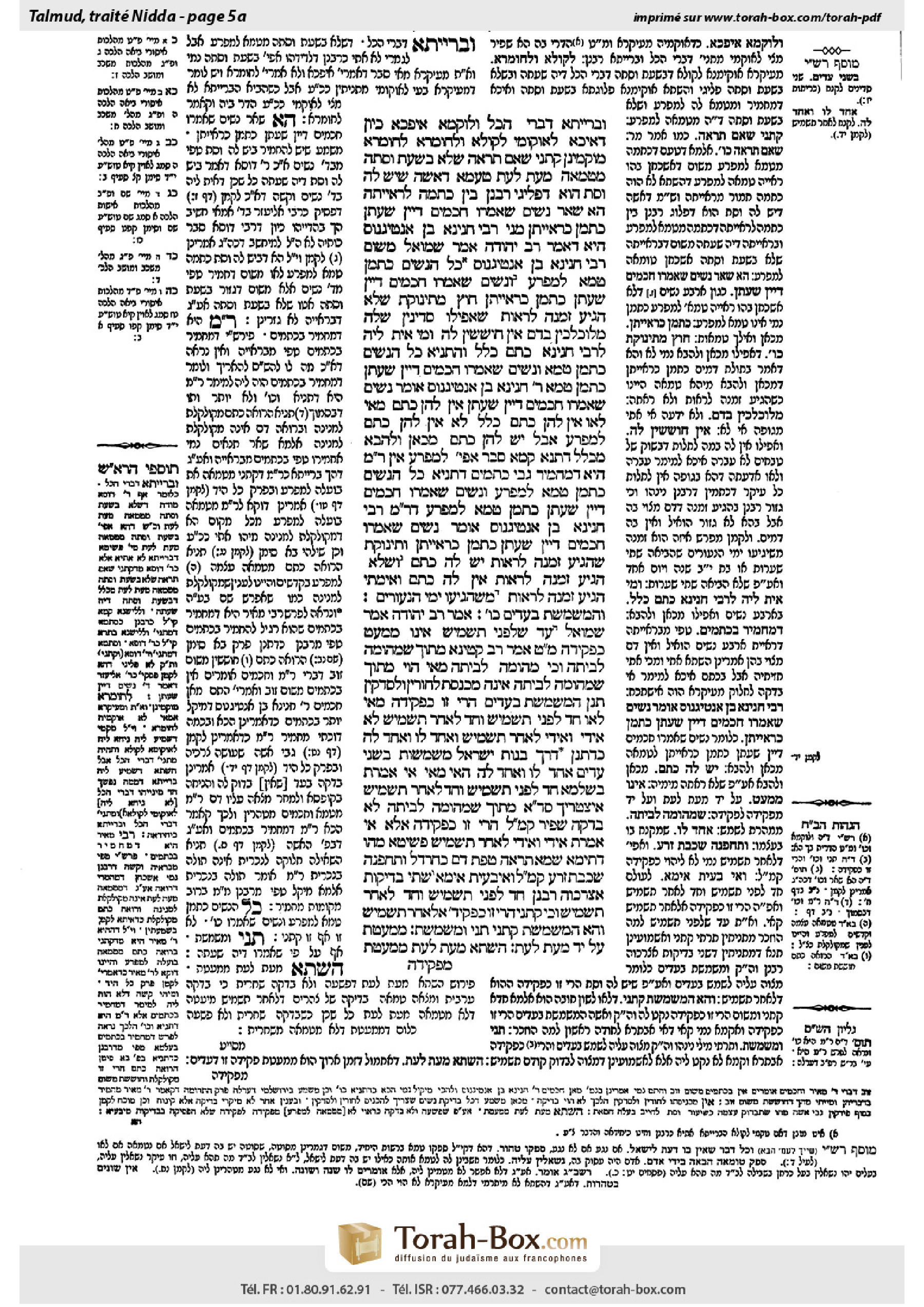
This page of Niddah includes the Aramaic text, an English translation and an AI-generated French translation, alongside the scan above.
נידה ה׳ א · Aramaic and Hebrew text
וּבָרַיְיתָא דִּבְרֵי הַכֹּל.
וְלוֹקְמָא אִיפְּכָא!
כֵּיוָן דְּאִיכָּא לְאוֹקוֹמֵי לְקוּלָּא וּלְחוּמְרָא — לְחוּמְרָא מוֹקְמִינַן.
קָתָנֵי: שֶׁאִם תִּרְאֶה שֶׁלֹּא בִּשְׁעַת וִסְתָּהּ מְטַמְּאָה מֵעֵת לְעֵת. טַעְמָא דְּאִשָּׁה שֶׁיֵּשׁ לָהּ וֶסֶת הוּא, דִּפְלִיגִי רַבָּנַן בֵּין כִּתְמָהּ לִרְאִיָּיתָהּ,
הָא שְׁאָר נָשִׁים שֶׁאָמְרוּ חֲכָמִים דַּיָּין שְׁעָתָן — כִּתְמָן כִּרְאִיָּיתָן.
מַנִּי? רַבִּי חֲנִינָא בֶּן אַנְטִיגְנוֹס הִיא, דְּאָמַר רַב יְהוּדָה אָמַר שְׁמוּאֵל מִשּׁוּם רַבִּי חֲנִינָא בֶּן אַנְטִיגְנוֹס: כׇּל הַנָּשִׁים כִּתְמָן טָמֵא לְמַפְרֵעַ, וְנָשִׁים שֶׁאָמְרוּ חֲכָמִים דַּיָּין שְׁעָתָן — כִּתְמָן כִּרְאִיָּיתָן, חוּץ מִתִּינוֹקֶת שֶׁלֹּא הִגִּיעַ זְמַנָּהּ לִרְאוֹת, שֶׁאֲפִילּוּ סְדִינִין שֶׁלָּהּ מְלוּכְלָכִין בְּדָם — אֵין חוֹשְׁשִׁין לָהּ.
וּמִי אִית לֵיהּ לְרַבִּי חֲנִינָא כֶּתֶם כְּלָל? וְהָתַנְיָא: כׇּל הַנָּשִׁים כִּתְמָן טָמֵא, וְנָשִׁים שֶׁאָמְרוּ חֲכָמִים דַּיָּין שְׁעָתָן — כִּתְמָן טָמֵא. רַבִּי חֲנִינָא בֶּן אַנְטִיגְנוֹס אוֹמֵר: נָשִׁים שֶׁאָמְרוּ חֲכָמִים דַּיָּין שְׁעָתָן — אֵין לָהֶן כֶּתֶם. מַאי לָאו אֵין לָהֶן כֶּתֶם כְּלָל? לָא, אֵין לָהֶן כֶּתֶם לְמַפְרֵעַ, אֲבָל יֵשׁ לָהֶן כֶּתֶם מִכָּאן וּלְהַבָּא.
מִכְּלָל דְּתַנָּא קַמָּא סָבַר אֲפִילּוּ לְמַפְרֵעַ? אִין, רַבִּי מֵאִיר הִיא, דְּמַחְמֵיר גַּבֵּי כְתָמִים. דְּתַנְיָא: כׇּל הַנָּשִׁים — כִּתְמָן טָמֵא לְמַפְרֵעַ, וְנָשִׁים שֶׁאָמְרוּ חֲכָמִים דַּיָּין שְׁעָתָן — כִּתְמָן טָמֵא לְמַפְרֵעַ, דִּבְרֵי רַבִּי מֵאִיר.
רַבִּי חֲנִינָא בֶּן אַנְטִיגְנוֹס אוֹמֵר: נָשִׁים שֶׁאָמְרוּ חֲכָמִים דַּיָּין שְׁעָתָן, כִּתְמָן כִּרְאִיָּיתָן, וְתִינוֹקֶת שֶׁהִגִּיעַ זְמַנָּהּ לִרְאוֹת — יֵשׁ לָהּ כֶּתֶם, וְשֶׁלֹּא הִגִּיעַ זְמַנָּהּ לִרְאוֹת — אֵין לָהּ כֶּתֶם. וְאֵימָתַי הִגִּיעַ זְמַנָּהּ לִרְאוֹת? מִשֶּׁהִגִּיעוּ יְמֵי הַנְּעוּרִים.
וְהַמְשַׁמֶּשֶׁת בְּעֵדִים כּוּ׳. אָמַר רַב יְהוּדָה אָמַר שְׁמוּאֵל: עֵד שֶׁלִּפְנֵי תַשְׁמִישׁ אֵינוֹ מְמַעֵט כִּפְקִידָה.
מַאי טַעְמָא? אָמַר רַב קַטִּינָא: מִתּוֹךְ שֶׁמְּהוּמָּה לְבֵיתָהּ. וְכִי מְהוּמָּה לְבֵיתָהּ מַאי הָוֵי? מִתּוֹךְ שֶׁמְּהוּמָּה לְבֵיתָהּ — אֵינָהּ מַכְנֶסֶת לְחוֹרִין וְלִסְדָקִין.
תְּנַן: הַמְשַׁמֶּשֶׁת בְּעֵדִים, הֲרֵי זוֹ כִּפְקִידָה. מַאי לָאו חַד לִפְנֵי תַשְׁמִישׁ וְחַד לְאַחַר תַּשְׁמִישׁ? לָא, אִידֵּי וְאִידֵּי לְאַחַר תַּשְׁמִישׁ, וְאֶחָד לוֹ וְאֶחָד לָהּ. כְּדִתְנַן: דֶּרֶךְ בְּנוֹת יִשְׂרָאֵל מְשַׁמְּשׁוֹת בִּשְׁנֵי עֵדִים, אֶחָד לוֹ וְאֶחָד לָהּ.
הַאי מַאי? אִי אָמְרַתְּ בִּשְׁלָמָא חַד לִפְנֵי תַשְׁמִישׁ וְחַד לְאַחַר תַּשְׁמִישׁ — אִיצְטְרִיךְ, סָלְקָא דַּעְתָּךְ אָמֵינָא: מִתּוֹךְ שֶׁמְּהוּמָּה לְבֵיתָהּ לָא בָּדְקָה שַׁפִּיר, קָא מַשְׁמַע לַן הֲרֵי זוֹ כִּפְקִידָה. אֶלָּא אִי אָמְרַתְּ אִידֵּי וְאִידֵּי לְאַחַר תַּשְׁמִישׁ — פְּשִׁיטָא!
מַהוּ דְּתֵימָא, שֶׁמָּא תִּרְאֶה טִפַּת דָּם כְּחַרְדָּל וּתְחַפֶּנָּה שִׁכְבַת זֶרַע, קָא מַשְׁמַע לַן.
וְאִיבָּעֵית אֵימָא: שְׁתֵּי בְדִיקוֹת אַצְרְכוּהָ רַבָּנַן, חַד לִפְנֵי תַשְׁמִישׁ וְחַד לְאַחַר תַּשְׁמִישׁ, וְכִי קָתָנֵי ״הֲרֵי זוֹ כִּפְקִידָה״ — אַלְּאַחַר תַּשְׁמִישׁ, וְהָא ״הַמְשַׁמֶּשֶׁת״ קָתָנֵי! תְּנִי: ״וּמְשַׁמֶּשֶׁת״.
מְמַעֶטֶת עַל יָד מֵעֵת לְעֵת, הַשְׁתָּא מֵעֵת לְעֵת מְמַעֶטֶת,
Niddah 5a · English translation
And as for the ruling of the baraita, that a woman who discovers menstrual blood not at her fixed time for menstruation is impure retroactively, this is a halakha with which everyone agrees.
The Gemara raises a difficulty: But let us interpret the mishna in the opposite manner. Why interpret the mishna in accordance with the opinion of Rabbi Dosa and the baraita in accordance with everyone, when we can give precedence to the mishna, which is more authoritative, by interpreting it in accordance with all opinions, as was first explained, and the baraita only in accordance with the opinion of the Rabbis.
The Gemara answers: Since there is a way to interpret it as a leniency, i.e., that all agree that blood discovered at the fixed time of menstruation renders items impure only from that point onward, and it can also be interpreted in a manner that leads to a stringency, i.e., everyone agrees that blood discovered not at her fixed time for menstruation causes retroactive impurity, and furthermore the Rabbis hold that this is the halakha even when blood is discovered at her fixed time of menstruation, we interpret it the way that leads to a stringency.
§ It is taught in the baraita: If a woman who has a fixed menstrual cycle finds a blood stain, her blood stain is retroactively impure. The reason is that if she sees a flow of menstrual blood not at the fixed time of her menstrual cycle, it renders her ritually impure retroactively for a twenty-four-hour period. The Gemara analyzes this statement: The reason for this ruling is that she is a woman who has a fixed menstrual cycle; therefore, the Rabbis distinguish between her blood stain, which causes retroactive impurity like a sighting not at her fixed time, and her sighting of her menstrual flow at its fixed time, which does not cause retroactive impurity.
It can be inferred from here that in the case of those other women, e.g., a pregnant or elderly woman, with regard to whom the Sages stated: Their time is sufficient and their menstrual flow never causes retroactive impurity, the same halakha applies to their blood stains as to their sighting of their menstrual flow, i.e., the stains do not cause retroactive impurity.
The Gemara asks: In accordance with whose opinion is this baraita taught? The Gemara answers: It is in accordance with the opinion of Rabbi Ḥanina ben Antigonus, as Rav Yehuda said that Shmuel says in the name of Rabbi Ḥanina ben Antigonus: The halakha with regard to all women is that their blood stains are impure retroactively. But any women with regard to whom the Sages stated: Their time is sufficient, their blood stains share the same ruling as their sighting of their menstrual flow, i.e., they do not cause retroactive impurity. This is the halakha except for the case of a young girl whose time to see the flow of menstrual blood has not arrived. With regard to her, even if her sheets are soiled with blood one need not be concerned for it, i.e., her blood stains do not cause any impurity at all, even from that point onward.
The Gemara asks: And does Rabbi Ḥanina ben Antigonus hold that a blood stain causes ritual impurity at all? But isn’t it taught in a baraita: The halakha with regard to all women is that their blood stains are impure. And similarly, women with regard to whom the Sages stated: Their time is sufficient, their blood stains are also impure. Rabbi Ḥanina ben Antigonus says: The halakha of women with regard to whom the Sages stated: Their time is sufficient, is that they do not have the ritual impurity of a blood stain. What, is it not correct to say that this means they have no impurity caused by a blood stain at all? The Gemara answers: No, it means that they do not have impurity caused by a blood stain retroactively, but they do have the impurity caused by a blood stain from here onward.
The Gemara asks: From the fact that Rabbi Ḥanina ben Antigonus holds that a blood stain imparts ritual impurity from that point onward, does this not indicate that the first tanna holds that it causes ritual impurity even retroactively? The Gemara answers: Yes, the ruling of the first tanna is in accordance with the opinion of Rabbi Meir, who is stringent with regard to blood stains. As it is taught in a baraita: The halakha with regard to all women is that their blood stains are impure retroactively. And similarly, women with regard to whom the Sages stated: Their time is sufficient, their blood stains are also impure retroactively. This is the statement of Rabbi Meir.
The baraita continues: Rabbi Ḥanina ben Antigonus says: The halakha of women with regard to whom the Sages stated: Their time is sufficient, is that their blood stains share the same ruling as their sighting of their menstrual flow, i.e., they cause ritual impurity from that point onward. And in the case of a young girl, if her time to see the flow of menstrual blood has arrived, then she has impurity status when she finds a blood stain. But if her time to see the flow of menstrual blood has not yet arrived, she does not have impurity status when she finds a blood stain. The Gemara asks: And when does a young girl arrive at her time to see the flow of menstrual blood? The Gemara answers: When the days of her young womanhood have arrived.
§ The mishna teaches: And with regard to a woman who engages in intercourse while using examination cloths, with which she ascertains whether the menstrual flow began, since the halakhic status of that act is like that of an examination, it reduces the time from a twenty-four-hour period and reduces the time from examination to examination. Rav Yehuda says that Shmuel says: The examination cloth with which she examined herself before intercourse does not reduce the time from a twenty-four-hour period like a regular examination.
The Gemara asks: What is the reason for the opinion of Shmuel? Rav Ketina says: Since she is excited [shemehuma] and hurried for intercourse with her husband, it is not considered a proper examination. The Gemara asks: And even if she is excited for intercourse with her husband, what of it? Why does that invalidate her examination? The Gemara answers: Since she is excited and hurried for intercourse with her husband, she does not insert the examination cloth into her recesses and folds.
The Gemara raises a difficulty: We learned in the mishna: And a woman who engages in intercourse while using examination cloths, the halakhic status of that act is like that of an examination. The mishna refers to examination cloths in the plural. What, is it not speaking of one cloth used before intercourse and one cloth used after intercourse? The Gemara answers: No, this cloth and that cloth are both used after intercourse; and the reason why the mishna uses the plural is that one cloth is for his use and one is for her use. As we learned in a mishna (14a): It is the custom of Jewish women to engage in intercourse with their husbands with two examination cloths, one for his use and one for her use.
The Gemara asks: What is this? Granted, if you say that the mishna is referring to one cloth used before intercourse and one used after intercourse, it was necessary for the mishna to mention both examinations, as it might enter your mind to say that since she is excited and hurried for intercourse with her husband, she did not examine herself properly. Therefore, the mishna teaches us that her examination with a cloth before intercourse is considered as a halakhically valid examination. But if you say that this cloth and that cloth are his and her cloths used after intercourse, isn’t it obvious that they are treated as halakhic examinations? Why is this ruling necessary?
The Gemara answers: The halakha that the examinations performed after intercourse count as valid examinations is necessary, lest you say that perhaps she might see a drop of blood corresponding to the size of a mustard seed and a drop of semen covered it. In other words, it is possible that she discharged a tiny amount of menstrual blood that went undetected, as it was covered by a drop of semen. Therefore, the mishna teaches us that one does not need to be concerned for this possibility.
And if you wish, say instead: The mishna is referring only to her examinations, but the reason the mishna mentions two examinations is not to give them the status of valid examinations, but to teach that they are both obligatory. As the Sages required her to perform two examinations: One before intercourse and one after intercourse. And when the mishna teaches: The halakhic status of that act is like that of an examination, it is referring specifically to the examination performed after intercourse. The Gemara raises a difficulty: But the mishna teaches: A woman who engages in intercourse while using examination cloths. This formulation indicates that the examination is voluntary and is not mandated by the Sages. The Gemara explains that one should emend the text of the mishna so that it teaches: And a woman must engage in intercourse while using examination cloths.
§ The mishna teaches: And with regard to a woman who engages in intercourse while using examination cloths, as the halakhic status of that act is like that of an examination, it reduces the time from a twenty-four-hour period, and reduces the time from examination to examination. The Gemara asks: Now that the mishna teaches that this examination reduces time from a twenty-four-hour period,
Niddah 5a · Traduction française (IA)
Quant à la règle de la baraïta selon laquelle une femme qui découvre du sang menstruel en dehors de la date fixe de ses règles est impure rétroactivement, c’est une halakha sur laquelle tous s’accordent.
La Guemara soulève une difficulté : Mais interprétons la Michna en sens inverse. Pourquoi l’interpréter selon l’opinion de Rabbi Dossa et la baraïta selon l’opinion de tous, alors que nous pouvons privilégier la Michna, qui fait davantage autorité, en l’interprétant selon toutes les opinions, comme expliqué initialement, et interpréter la baraïta uniquement selon l’opinion des Rabbins ?
La Guemara répond : Puisqu’il est possible de l’interpréter de manière clémente, c’est-à-dire que tous s’accordent à dire que le sang découvert à la date fixe des règles ne rend les objets impurs qu’à partir de ce moment-là, mais qu’on peut aussi l’interpréter de manière à aboutir à une rigueur, à savoir que tous s’accordent à dire que le sang découvert en dehors de la date fixe des règles entraîne une impureté rétroactive, et que, de plus, les Rabbins soutiennent que telle est la halakha même lorsque le sang est découvert à la date fixe des règles, nous l’interprétons de la manière qui aboutit à une rigueur.
§ Il est enseigné dans une baraïta : Si une femme qui a un cycle menstruel régulier découvre une tache de sang, celle-ci entraîne une impureté rétroactive. En effet, si elle voit un écoulement de sang menstruel en dehors de la date fixe de son cycle, elle est rituellement impure rétroactivement pendant vingt-quatre heures. La Guemara analyse cette déclaration : Cette règle concerne une femme dont le cycle menstruel est régulier ; les Rabbins distinguent donc entre sa tache de sang, qui entraîne une impureté rétroactive comme une apparition de sang en dehors de la date fixe, et l’apparition de son écoulement menstruel à la date fixe, qui n’entraîne pas d’impureté rétroactive.
On peut en déduire que, dans le cas des autres femmes, par exemple une femme enceinte ou âgée, au sujet desquelles les Sages ont déclaré : « Leur moment suffit », et dont l’écoulement menstruel n’entraîne jamais d’impureté rétroactive, la même halakha s’applique à leurs taches de sang qu’à l’apparition de leur écoulement menstruel : ces taches n’entraînent pas d’impureté rétroactive.
La Guemara demande : Selon l’opinion de qui cette baraïta est-elle enseignée ? La Guemara répond : Elle est conforme à l’opinion de Rabbi Ḥanina ben Antigonus. En effet, Rav Yehouda a dit au nom de Chmouel, qui le disait au nom de Rabbi Ḥanina ben Antigonus : Pour toutes les femmes, la halakha est que leurs taches de sang entraînent une impureté rétroactive. Mais celles au sujet desquelles les Sages ont déclaré : « Leur moment suffit », ont des taches de sang soumises au même statut que l’apparition de leur écoulement menstruel, c’est-à-dire qu’elles n’entraînent pas d’impureté rétroactive. Telle est la halakha, sauf dans le cas d’une jeune fille qui n’a pas encore atteint l’âge où elle peut voir un écoulement de sang menstruel. À son sujet, même si ses draps sont tachés de sang, il n’y a pas lieu de s’en préoccuper : ses taches de sang n’entraînent aucune impureté, pas même à partir de ce moment-là.
La Guemara demande : Rabbi Ḥanina ben Antigonus soutient-il donc qu’une tache de sang entraîne une impureté rituelle ? Pourtant, il est enseigné dans une baraïta : Pour toutes les femmes, la halakha est que leurs taches de sang sont impures. De même, les femmes au sujet desquelles les Sages ont déclaré : « Leur moment suffit » ont également des taches de sang impures. Rabbi Ḥanina ben Antigonus dit : Pour les femmes au sujet desquelles les Sages ont déclaré : « Leur moment suffit », les taches de sang n’entraînent pas l’impureté rituelle propre à une tache de sang. N’est-il pas juste d’en déduire qu’elles n’entraînent aucune impureté ? La Guemara répond : Non, cela signifie qu’elles n’entraînent pas d’impureté rétroactive, mais qu’elles entraînent bien une impureté à partir de ce moment-là.
La Guemara demande : Le fait que Rabbi Ḥanina ben Antigonus soutienne qu’une tache de sang entraîne une impureté rituelle à partir de ce moment-là n’indique-t-il pas que le premier tanna soutient qu’elle entraîne une impureté rituelle même rétroactivement ? La Guemara répond : Oui. La règle du premier tanna est conforme à l’opinion de Rabbi Meïr, qui se montre rigoureux au sujet des taches de sang. En effet, il est enseigné dans une baraïta : Pour toutes les femmes, la halakha est que leurs taches de sang entraînent une impureté rétroactive. De même, les femmes au sujet desquelles les Sages ont déclaré : « Leur moment suffit » ont aussi des taches de sang qui entraînent une impureté rétroactive. Telle est l’opinion de Rabbi Meïr.
La baraïta poursuit : Rabbi Ḥanina ben Antigonus dit : Pour les femmes au sujet desquelles les Sages ont déclaré : « Leur moment suffit », les taches de sang ont le même statut que l’apparition de leur écoulement menstruel, c’est-à-dire qu’elles entraînent une impureté rituelle à partir de ce moment-là. Quant à une jeune fille, si elle a atteint l’âge où elle peut voir un écoulement de sang menstruel, elle est impure lorsqu’elle découvre une tache de sang. Mais si elle n’a pas encore atteint cet âge, elle n’est pas impure lorsqu’elle découvre une tache de sang. La Guemara demande : Quand une jeune fille atteint-elle l’âge où elle peut voir un écoulement de sang menstruel ? La Guemara répond : Lorsque les jours de sa jeunesse sont arrivés.
§ La Michna enseigne : Une femme qui a des rapports sexuels en utilisant des linges d’examen, au moyen desquels elle vérifie si l’écoulement menstruel a commencé, voit cet acte soumis au statut halakhique d’un examen ; cela réduit la période de vingt-quatre heures et l’intervalle entre deux examens. Rav Yehouda a dit au nom de Chmouel : Le linge d’examen avec lequel elle s’est examinée avant les rapports ne réduit pas la période de vingt-quatre heures, contrairement à un examen ordinaire.
La Guemara demande : Quelle est la raison de l’opinion de Chmouel ? Rav Ketina dit : Comme elle est excitée [shemehuma] et pressée d’avoir des rapports avec son mari, cela ne constitue pas un examen correct. La Guemara demande : Et même si elle est excitée à l’idée d’avoir des rapports avec son mari, qu’importe ? Pourquoi cela invaliderait-il son examen ? La Guemara répond : Comme elle est excitée et pressée d’avoir des rapports avec son mari, elle n’introduit pas le linge d’examen dans ses replis et ses cavités.
La Guemara soulève une difficulté : Nous avons appris dans la Michna : Une femme qui a des rapports sexuels en utilisant des linges d’examen, cet acte ayant le statut halakhique d’un examen. La Michna parle de linges d’examen au pluriel. Ne parle-t-elle pas d’un linge utilisé avant les rapports et d’un autre après ? La Guemara répond : Non, ces deux linges sont tous deux utilisés après les rapports ; la Michna emploie le pluriel parce que l’un est destiné à l’homme et l’autre à la femme. En effet, nous avons appris dans une Michna (14a) : Les femmes juives ont l’habitude d’avoir des rapports avec leur mari en utilisant deux linges d’examen, l’un destiné à l’homme et l’autre à la femme.
La Guemara demande : Comment comprendre cela ? Certes, si tu dis que la Michna parle d’un linge utilisé avant les rapports et d’un autre après, il était nécessaire qu’elle mentionne les deux examens, car on aurait pu penser que, puisqu’elle est excitée et pressée d’avoir des rapports avec son mari, elle ne s’est pas examinée correctement. La Michna nous enseigne donc que son examen avec un linge avant les rapports est considéré comme un examen valide selon la halakha. Mais si tu dis que ces deux linges sont celui de l’homme et celui de la femme, utilisés après les rapports, n’est-il pas évident qu’ils sont considérés comme des examens valides selon la halakha ? Pourquoi cette règle est-elle nécessaire ?
La Guemara répond : Il est nécessaire d’enseigner que les examens effectués après les rapports comptent comme des examens valides, de peur que l’on dise qu’elle pourrait voir une goutte de sang de la taille d’une graine de moutarde, recouverte par une goutte de sperme. Autrement dit, il est possible qu’elle ait évacué une très petite quantité de sang menstruel, passée inaperçue parce qu’elle était recouverte par une goutte de sperme. La Michna nous enseigne donc qu’il n’y a pas lieu de s’inquiéter de cette possibilité.
Et si tu le souhaites, dis plutôt : La Michna parle uniquement des examens de la femme, mais si elle en mentionne deux, ce n’est pas pour leur conférer le statut d’examens valides ; c’est pour enseigner qu’ils sont tous deux obligatoires. Les Sages lui ont en effet imposé d’effectuer deux examens : l’un avant les rapports et l’autre après. Lorsque la Michna enseigne que cet acte a le statut halakhique d’un examen, elle fait spécifiquement référence à l’examen effectué après les rapports. La Guemara soulève une difficulté : Mais la Michna enseigne : « Une femme qui a des rapports sexuels en utilisant des linges d’examen. » Cette formulation indique que l’examen est facultatif et qu’il n’est pas imposé par les Sages. La Guemara explique qu’il faut corriger le texte de la Michna de manière à lire : « Et une femme doit avoir des rapports sexuels en utilisant des linges d’examen. »
§ La Michna enseigne : Une femme qui a des rapports sexuels en utilisant des linges d’examen, cet acte ayant le statut halakhique d’un examen, réduit la période de vingt-quatre heures et l’intervalle entre deux examens. La Guemara demande : Puisque la Michna enseigne que cet examen réduit la période de vingt-quatre heures,
Traduction française générée par IA à partir de l’édition anglaise de Sefaria. Vérifie toujours un passage avec le texte source.
Text from Sefaria: William Davidson Edition - Vocalized Aramaic (CC BY NC); William Davidson Edition - English (CC BY NC).