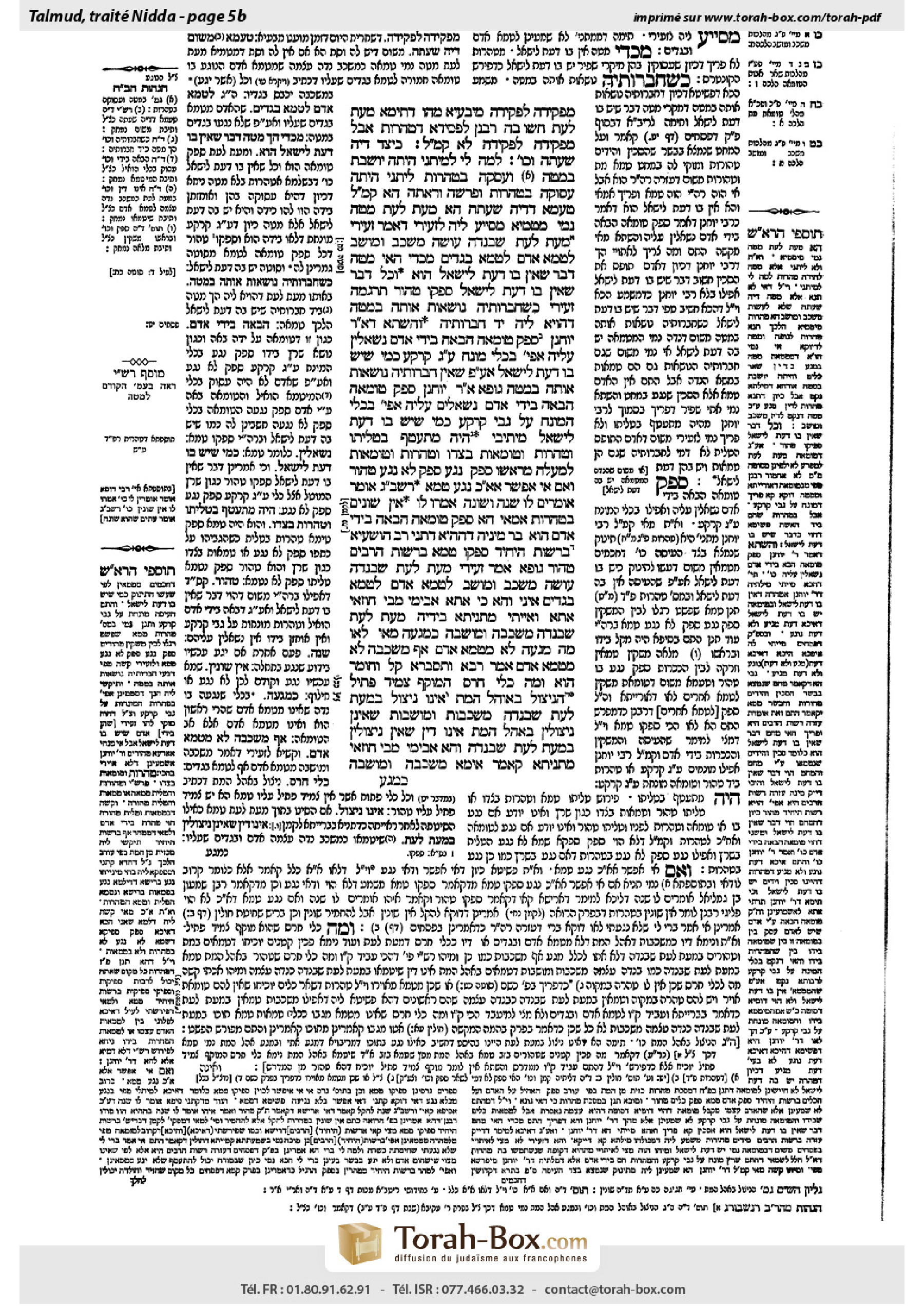
Niddah 5b: Talmud study for Daf Yomi
Daf Yomi is the daily study of one Talmud folio. Explore 37 tractates with scans, Hebrew text, Sefaria English and AI-generated French translations where annotated.
Passage selection and English or AI-generated French translation are available where the scan has annotations. Daf Study is independent of Torah-Box and Sefaria.
Browse Niddah · נידה · All tractatesNiddah 5b text and translations
This page of Niddah includes the Aramaic text, an English translation and an AI-generated French translation, alongside the scan above.
נידה ה׳ ב · Aramaic and Hebrew text
מִפְּקִידָה לִפְקִידָה מִיבַּעְיָא?!
מַהוּ דְּתֵימָא: מֵעֵת לְעֵת — חַשּׁוּ בַּהּ רַבָּנַן לִפְסֵידָא דִטְהָרוֹת, אֲבָל מִפְּקִידָה לִפְקִידָה — לָא, קָא מַשְׁמַע לַן.
כֵּיצַד דַּיָּה שְׁעָתָהּ וְכוּ׳. לְמָה לִי לְמִיתְנֵי: ״הָיְתָה יוֹשֶׁבֶת בַּמִּטָּה וַעֲסֻקָה בִּטְהָרוֹת״? לִיתְנֵי: ״הָיְתָה עֲסוּקָה בִּטְהָרוֹת וּפָרְשָׁה וְרָאֲתָה״!
הָא קָא מַשְׁמַע לַן: טַעְמָא דְּדַיָּהּ שְׁעָתָהּ, הָא מֵעֵת לְעֵת — מִטָּה נָמֵי מְטַמְּיָא. מְסַיַּיע לֵיהּ לִזְעֵירִי, דְּאָמַר זְעֵירִי: מֵעֵת לְעֵת שֶׁבְּנִדָּה עוֹשָׂה מִשְׁכָּב וּמוֹשָׁב, לְטַמֵּא אָדָם לְטַמֵּא בְּגָדִים.
מִכְּדִי הַאי מִטָּה דָּבָר שֶׁאֵין בּוֹ דַּעַת לִישָּׁאֵל הוּא, וְכׇל דָּבָר שֶׁאֵין בּוֹ דַּעַת לִישָּׁאֵל — סְפֵקוֹ טָהוֹר! תַּרְגְּמַהּ זְעֵירִי כְּשֶׁחַבְרוֹתֶיהָ נוֹשְׂאוֹת אוֹתָהּ בַּמִּטָּה, דְּהָוְיָא לַיהּ יַד חַבְרוֹתֶיהָ.
וְהַשְׁתָּא דְּאָמַר רַבִּי יוֹחָנָן: סְפֵק טוּמְאָה הַבָּאָה בִּידֵי אָדָם — נִשְׁאָלִין עָלֶיהָ, אֲפִילּוּ בִּכְלִי מוּנָּח עַל גַּבֵּי קַרְקַע כְּמִי שֶׁיֵּשׁ בּוֹ דַּעַת לִישָּׁאֵל, אַף עַל פִּי שֶׁאֵין חַבְרוֹתֶיהָ נוֹשְׂאוֹת אוֹתָהּ בַּמִּטָּה.
גּוּפָא, אָמַר רַבִּי יוֹחָנָן: סְפֵק טוּמְאָה הַבָּאָה בִּידֵי אָדָם — נִשְׁאָלִים עָלֶיהָ, אֲפִילּוּ בִּכְלִי הַמּוּנָּח עַל גַּבֵּי קַרְקַע כְּמִי שֶׁיֵּשׁ בּוֹ דַּעַת לִישָּׁאֵל.
מֵיתִיבִי: הָיָה מִתְעַטֵּף בְּטַלִּיתוֹ, וּטְהָרוֹת וְטוּמְאוֹת בְּצִדּוֹ, וּטְהָרוֹת וְטוּמְאוֹת לְמַעְלָה מֵרֹאשׁוֹ, סָפֵק נָגַע סָפֵק לֹא נָגַע — טָהוֹר, וְאִם אִי אֶפְשָׁר אֶלָּא אִם כֵּן נָגַע — טָמֵא.
רַבָּן שִׁמְעוֹן בֶּן גַּמְלִיאֵל אוֹמֵר: אוֹמְרִים לוֹ: ״שְׁנֵה״, וְשׁוֹנֶה. אָמְרוּ לוֹ: אֵין שׁוֹנִים בִּטְהָרוֹת.
אַמַּאי? הָא סְפֵק טוּמְאָה הַבָּאָה בִּידֵי אָדָם הוּא!
בַּר מִינֵּיהּ דְּהַהִיא, דְּתָנֵי רַב הוֹשַׁעְיָא: בִּרְשׁוּת הַיָּחִיד — סְפֵקוֹ טָמֵא, בִּרְשׁוּת הָרַבִּים — טָהוֹר.
גּוּפָא: אָמַר זְעֵירִי: מֵעֵת לְעֵת שֶׁבְּנִדָּה עוֹשֶׂה מִשְׁכָּב וּמוֹשָׁב, לְטַמֵּא אָדָם לְטַמֵּא בְּגָדִים.
אִינִי? וְהָא כִּי אֲתָא אֲבִימִי מִבֵּי חוֹזָאֵי, אֲתָא וְאַיְיתִי מַתְנִיתָא בִּידֵיהּ: מֵעֵת לְעֵת שֶׁבְּנִדָּה — מִשְׁכָּבָהּ וּמוֹשָׁבָהּ כְּמַגָּעָהּ. מַאי לָאו, מָה מַגָּעָהּ לֹא מְטַמֵּא אָדָם, אַף מִשְׁכָּבָהּ לֹא מְטַמֵּא אָדָם!
אָמַר רָבָא: וְתִסְבְּרָא? קַל וָחוֹמֶר הוּא: וּמָה כְּלִי חֶרֶס הַמּוּקָּף צָמִיד פָּתִיל, הַנִּיצּוֹל בְּאוֹהֶל הַמֵּת, אֵינוֹ נִיצּוֹל בְּמֵעֵת לְעֵת שֶׁבְּנִדָּה — מִשְׁכָּבוֹת וּמוֹשָׁבוֹת, שֶׁאֵינָן נִיצּוֹלִין בְּאֹהֶל הַמֵּת, אֵינוֹ דִּין שֶׁאֵין נִיצּוֹלִין בְּמֵעֵת לְעֵת שֶׁבְּנִדָּה?
וְהָא אֲבִימִי מִבֵּי חוֹזָאֵי מַתְנִיתָא קָאָמַר! אֵימָא: מִשְׁכָּבָהּ וּמוֹשָׁבָהּ
Niddah 5b · English translation
is it necessary to teach that an examination reduces the time from examination to examination, which is less than twenty-four hours?
The Gemara answers: This ruling is necessary, lest you say that with regard to the significant passage of a twenty-four-hour period the Sages are concerned for the possible loss of ritually pure items, but with regard to the smaller period from examination to examination, the Sages are not concerned for the loss of pure items, and therefore the use of an examination cloth should not reduce the time of possible impurity between that and her next examination. Therefore, the mishna teaches us that it does reduce this time.
§ The mishna teaches with regard to a woman who has a fixed menstrual cycle: Her time is sufficient, how so? If the woman was sitting in a bed and engaged in handling ritually pure items, and she left the bed and saw blood, she is impure and those items are pure. The Gemara asks: Why do I need the mishna to teach: If the woman was sitting in a bed and engaged in handling pure items? Let the mishna teach the same ruling without mentioning the bed: If she was engaged in handling pure items and she left and saw blood. The detail that she was sitting in a bed is apparently superfluous.
The Gemara answers: This detail teaches us that the reason why the bed is not rendered impure is that her time is sufficient and there is no retroactive impurity. It can be inferred that in a case where she is impure retroactively for a twenty-four-hour period, her bed is also rendered impure. This supports the opinion of Ze’eiri, as Ze’eiri said: The level of impurity of the retroactive twenty-four-hour period of a menstruating woman renders impure a bed upon which she lies and a chair upon which she sits, to the extent that they transmit impurity to a person who comes in contact with them, to the extent that he transmits impurity to the garments he is wearing.
This Gemara raises a difficulty: Now, this bed upon which she sat is an entity that lacks consciousness in order for it to be asked, and the principle with regard to any entity that lacks consciousness in order for it to be asked is that the item with uncertain status is deemed pure. The Gemara explains: Ze’eiri interpreted his ruling as applying specifically to a case where her friends are carrying her in the bed, where the bed is considered as the extended hand of her friends. In other words, it is part of an entity that has consciousness in order for it to be asked, and therefore the item with uncertain status is deemed impure.
The Gemara provides another answer: And now that Rabbi Yoḥanan said: In a case of uncertain ritual impurity that comes about by the hand of a person, i.e., through his involvement, the owner of the vessel must consult a Sage about it, i.e., it is considered an entity that has consciousness in order for it to be asked, as in such a case even with regard to a vessel that is placed upon the ground, which is certainly incapable of providing an answer if asked, its halakhic status is like that of an item that has consciousness in order for it to be asked. With this statement in mind, one can explain that according to Ze’eiri a menstruating woman transmits impurity to a bed even though her friends are not carrying her in the bed. Rather, as the bed’s ritual impurity was caused by the hand of a person, it has the halakhic status of an item that has consciousness in order for it to be asked.
§ The Gemara discusses the matter of Rabbi Yoḥanan’s statement itself. Rabbi Yoḥanan says: In a case of uncertain ritual impurity that comes about by the hand of man, its owner must consult a Sage about it, i.e., it is ritually impure, as in such a case even with regard to a vessel that is placed upon the ground, its halakhic status is like that of an item that has consciousness in order for it to be asked.
The Gemara raises an objection from a baraita (Tosefta, Teharot 4:1): If a man who contracted ritual impurity was wrapping himself in his cloak and there were pure items beside him; or if he was pure and there were impure items beside him as he was wrapping his cloak; or if there were pure items and impure items above his head at the time and there is uncertainty whether he touched the impure items with his cloak and then touched the pure items with his cloak, and uncertainty whether it did not touch them, the halakha is that the pure items remain pure. But if it is impossible for him to have wrapped himself unless his cloak had touched the impure items in the process, then those previously pure items become impure.
The baraita continues: Rabban Shimon ben Gamliel says that we say to him: Repeat your action. And he repeats the action of wrapping himself with his cloak, and it can then be determined whether or not the cloak and the other items came in contact with each other. The Rabbis said to him: We do not rely on repeated actions with regard to the determination of ritually pure items. Since the second action may not exactly mimic the first, it cannot be relied upon to determine ritual purity status.
The Gemara explains the objection: But according to the Rabbis, why is the halakha that the items in question remain pure? Isn’t this a case of uncertain ritual impurity that comes about by the hand of man, which, according to Rabbi Yoḥanan, is considered as having consciousness in order for it to be asked? If so, these items should be ritually impure.
The Gemara answers: Except for that one, i.e., do not raise a difficulty from that baraita, since it is referring to a specific case. As Rav Hoshaya teaches with regard to an item whose purity status is uncertain: When it is in the private domain, the item with uncertain status is deemed impure; when it is in the public domain, it is deemed pure. The baraita is referring to an item located in the public domain. Consequently, even if it is considered as having consciousness in order to be asked, nevertheless it is pure, as its uncertainty occurred in the public domain.
§ The Gemara analyzes the matter of Ze’eiri’s ruling itself. Ze’eiri says: The level of impurity assumed during the retroactive twenty-four-hour period of a menstruating woman renders a bed upon which she lies and a chair upon which she sits impure to the extent that they transmit impurity to a person who comes in contact with them to the extent that he transmits impurity to the garments he is wearing.
The Gemara asks: Is that so? But when Avimi came from Bei Ḥozai, he came and brought the following baraita with him: The level of impurity during the retroactive twenty-four-hour period of a menstruating woman renders her bed upon which she lies and her chair upon which she sits impure like the impurity level caused by her touch. The Gemara explains the difficulty: What, is it not correct to say that this means that just as an item rendered impure by her touch does not render another person impure, so too, her bed does not render another person impure?
Rava says: And how can you understand it in that manner? There is an a fortiori inference here: And if an earthenware vessel sealed with a tightly bound cover, which is spared from impurity when it is in a tent that has a corpse in it, is nevertheless not spared from impurity if the woman moved it during the twenty-four-hour period of retroactive impurity of a menstruating woman and is impure as though she moved it after she experienced bleeding; so too, with regard to beds and chairs, which are not spared from impurity in a tent that has a corpse in it, is it not logical that they are also not spared from impurity when used during the twenty-four-hour period of retroactive impurity of a menstruating woman and are impure as though she used them after she experienced bleeding?
The Gemara asks: But Avimi from Bei Ḥozai cited a baraita that apparently does not accept Rava’s a fortiori inference. The Gemara answers: One can say that the baraita does not mean that her bed and chair are rendered impure with the light level of impurity caused by her touch, but rather: Her bed upon which she lies and her chair upon which she sits
Niddah 5b · Traduction française (IA)
Faut-il enseigner qu’un examen réduit l’intervalle entre deux examens, qui est inférieur à vingt-quatre heures ?
La Guemara répond : Cette règle est nécessaire, de peur que tu ne dises que les Sages se soucient de la perte éventuelle d’objets rituellement purs lorsqu’il s’agit d’un intervalle important de vingt-quatre heures, mais qu’ils ne s’en soucient pas pour l’intervalle plus court entre deux examens. Par conséquent, l’utilisation d’un linge d’examen ne devrait pas réduire la période d’impureté possible entre cet examen et le suivant. La Michna nous enseigne donc que cette période est effectivement réduite.
§ La Michna enseigne au sujet d’une femme dont le cycle menstruel est régulier : « Son temps suffit. » Comment cela ? Si la femme était assise sur un lit et s’occupait d’objets rituellement purs, puis se levait du lit et voyait du sang, elle est impure et ces objets restent purs. La Guemara demande : Pourquoi la Michna doit-elle préciser qu’elle était assise sur un lit et s’occupait d’objets purs ? Qu’elle enseigne la même règle sans mentionner le lit : si elle s’occupait d’objets purs, puis se levait et voyait du sang. La précision selon laquelle elle était assise sur un lit semble superflue.
La Guemara répond : Cette précision nous enseigne que le lit ne devient pas impur parce que son temps suffit et qu’il n’y a pas d’impureté rétroactive. On peut en déduire que, dans un cas où elle est impure rétroactivement pendant vingt-quatre heures, son lit devient lui aussi impur. Cela confirme l’opinion de Ze’eiri, car Ze’eiri a dit : Le degré d’impureté de la période rétroactive de vingt-quatre heures d’une femme menstruée rend impurs le lit sur lequel elle est couchée et le siège sur lequel elle est assise, au point qu’ils transmettent l’impureté à la personne qui les touche, laquelle transmet à son tour l’impureté aux vêtements qu’elle porte.
La Guemara soulève une difficulté : Or, ce lit sur lequel elle était assise est une entité dépourvue de conscience, à laquelle on ne peut demander de témoigner ; et le principe concernant toute entité dépourvue de conscience à laquelle on ne peut demander de témoigner est que l’objet au statut incertain est considéré comme pur. La Guemara explique : Ze’eiri a interprété sa règle comme s’appliquant précisément au cas où ses amies la transportent sur le lit, de sorte que le lit est considéré comme le prolongement de la main de ses amies. Autrement dit, il fait partie d’une entité dotée de conscience à laquelle on peut demander de témoigner ; l’objet au statut incertain est donc considéré comme impur.
La Guemara donne une autre réponse : Et maintenant que Rabbi Yoḥanan a dit que, dans le cas d’une impureté rituelle incertaine causée par l’intervention d’une personne, le propriétaire du récipient doit consulter un Sage à son sujet — autrement dit, qu’il est considéré comme une entité dotée de conscience à laquelle on peut demander de témoigner —, on comprend que, dans un tel cas, même un récipient posé à terre, qui est évidemment incapable de répondre si on l’interroge, a le même statut halakhique qu’un objet doté de conscience auquel on peut demander de témoigner. À la lumière de cette déclaration, on peut expliquer que, selon Ze’eiri, une femme menstruée transmet l’impureté à un lit même si ses amies ne la transportent pas dessus. En effet, puisque l’impureté rituelle du lit a été causée par l’intervention d’une personne, il a le statut halakhique d’un objet doté de conscience auquel on peut demander de témoigner.
§ La Guemara examine la déclaration de Rabbi Yoḥanan elle-même. Rabbi Yoḥanan dit : Dans le cas d’une impureté rituelle incertaine causée par l’intervention d’une personne, le propriétaire doit consulter un Sage à son sujet, c’est-à-dire que l’objet est rituellement impur, car, dans un tel cas, même un récipient posé à terre a le statut halakhique d’un objet doté de conscience auquel on peut demander de témoigner.
La Guemara soulève une objection à partir d’une baraïta (Tosefta, Teharot 4:1) : Si un homme devenu rituellement impur s’enveloppait dans son manteau et qu’il y avait des objets purs près de lui ; ou s’il était pur et qu’il y avait des objets impurs près de lui tandis qu’il s’enveloppait dans son manteau ; ou s’il y avait des objets purs et des objets impurs au-dessus de sa tête à ce moment-là, et qu’il y avait un doute quant au fait qu’il ait touché les objets impurs avec son manteau, puis les objets purs avec celui-ci, ou qu’il ne les ait pas touchés, la halakha est que les objets purs restent purs. Mais s’il lui était impossible de s’envelopper sans que son manteau ait touché les objets impurs au cours du mouvement, alors les objets auparavant purs deviennent impurs.
La baraïta poursuit : Rabban Shimon ben Gamliel dit qu’on lui demande de répéter son geste. Il répète alors le geste de s’envelopper dans son manteau, et l’on peut déterminer si le manteau et les autres objets sont entrés en contact. Les Sages lui répondent : Nous ne nous fions pas à la répétition des gestes pour déterminer le statut d’objets rituellement purs. Comme le second geste peut ne pas reproduire exactement le premier, on ne peut s’y fier pour déterminer le statut de pureté rituelle.
La Guemara explicite l’objection : Mais, selon les Sages, pourquoi les objets en question restent-ils purs selon la halakha ? Ne s’agit-il pas d’un cas d’impureté rituelle incertaine causée par l’intervention d’une personne, lequel, selon Rabbi Yoḥanan, est considéré comme doté de conscience à laquelle on peut demander de témoigner ? Si tel est le cas, ces objets devraient être rituellement impurs.
La Guemara répond : Sauf dans ce cas, c’est-à-dire qu’il ne faut pas soulever de difficulté à partir de cette baraïta, car elle traite d’un cas particulier. Rav Hoshaya enseigne en effet, au sujet d’un objet dont le statut de pureté est incertain : lorsqu’il se trouve dans le domaine privé, l’objet au statut incertain est considéré comme impur ; lorsqu’il se trouve dans le domaine public, il est considéré comme pur. La baraïta traite d’un objet situé dans le domaine public. Par conséquent, même si on le considère comme doté de conscience à laquelle on peut demander de témoigner, il reste néanmoins pur, puisque l’incertitude est survenue dans le domaine public.
§ La Guemara examine la règle de Ze’eiri elle-même. Ze’eiri dit : Le degré d’impureté présumé pendant la période rétroactive de vingt-quatre heures d’une femme menstruée rend impurs le lit sur lequel elle est couchée et le siège sur lequel elle est assise, au point qu’ils transmettent l’impureté à la personne qui les touche, laquelle transmet à son tour l’impureté aux vêtements qu’elle porte.
La Guemara demande : Est-ce vraiment ainsi ? Or, lorsqu’Avimi revint de Bei Ḥozai, il rapporta avec lui la baraïta suivante : Le degré d’impureté de la période rétroactive de vingt-quatre heures d’une femme menstruée rend impurs son lit, sur lequel elle est couchée, et son siège, sur lequel elle est assise, au même degré d’impureté que celui causé par son contact. La Guemara précise la difficulté : N’est-il pas juste de comprendre que, de même qu’un objet rendu impur par son contact ne rend pas une autre personne impure, de même son lit ne rend pas une autre personne impure ?
Rava dit : Comment peux-tu le comprendre ainsi ? Il y a ici un raisonnement a fortiori : si même un récipient en terre cuite hermétiquement fermé par un couvercle bien attaché, qui échappe à l’impureté lorsqu’il se trouve sous une tente où il y a un cadavre, n’échappe pourtant pas à l’impureté si la femme l’a déplacé durant la période rétroactive d’impureté de vingt-quatre heures d’une femme menstruée, et devient impur comme si elle l’avait déplacé après avoir constaté un saignement, à plus forte raison les lits et les sièges, qui n’échappent pas à l’impureté sous une tente où se trouve un cadavre, n’échappent-ils pas non plus à l’impureté lorsqu’ils ont été utilisés durant la période rétroactive d’impureté de vingt-quatre heures d’une femme menstruée et ne deviennent-ils pas impurs comme si elle les avait utilisés après avoir constaté un saignement ?
La Guemara demande : Mais Avimi de Bei Ḥozai a cité une baraïta qui semble rejeter le raisonnement a fortiori de Rava. La Guemara répond : On peut dire que la baraïta ne veut pas dire que son lit et son siège sont rendus impurs au degré léger d’impureté causé par son contact, mais plutôt : son lit, sur lequel elle est couchée, et son siège, sur lequel elle est assise
Traduction française générée par IA à partir de l’édition anglaise de Sefaria. Vérifie toujours un passage avec le texte source.
Text from Sefaria: William Davidson Edition - Vocalized Aramaic (CC BY NC); William Davidson Edition - English (CC BY NC).