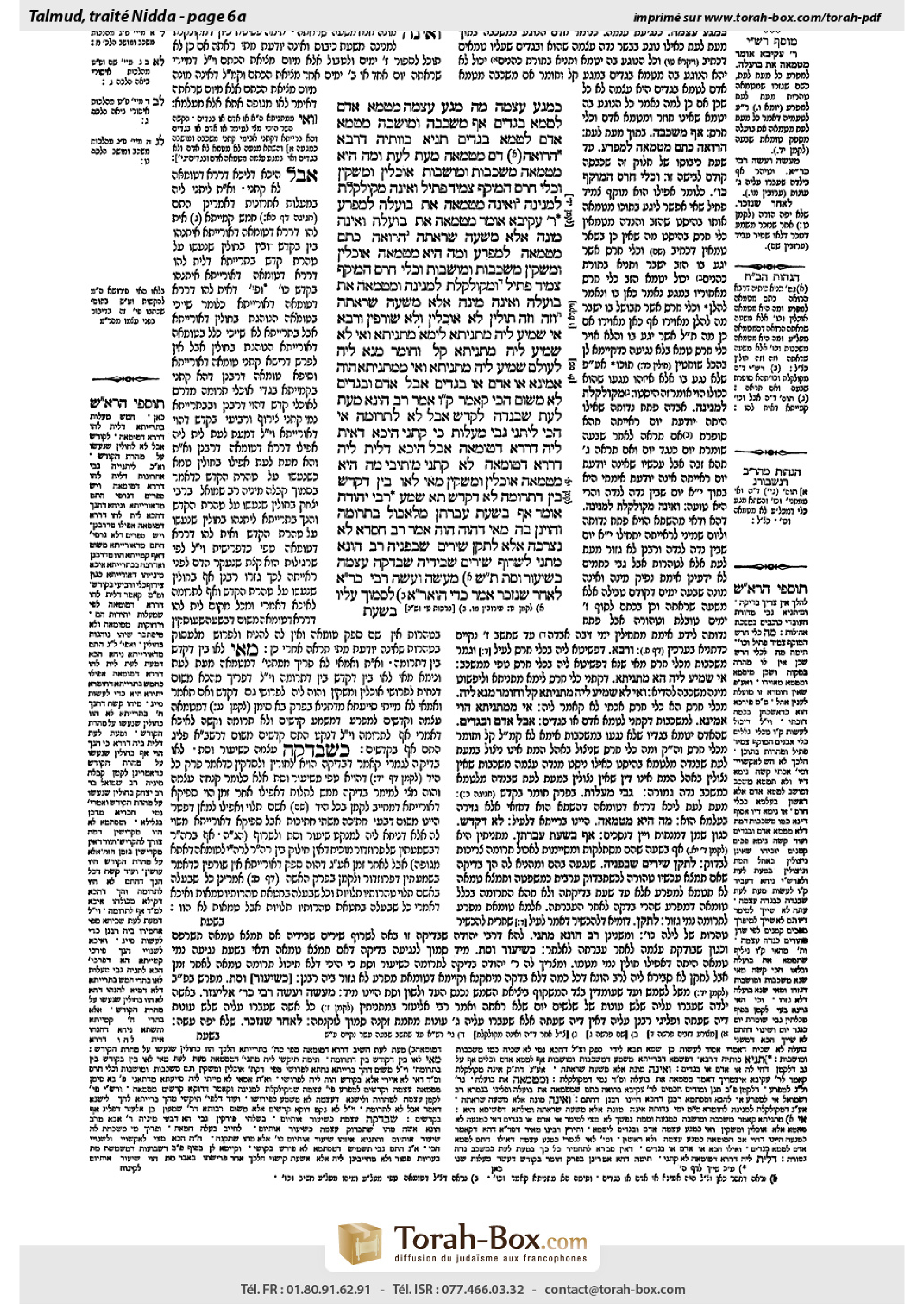
Niddah 6a: Talmud study for Daf Yomi
Daf Yomi is the daily study of one Talmud folio. Explore 37 tractates with scans, Hebrew text, Sefaria English and AI-generated French translations where annotated.
Passage selection and English or AI-generated French translation are available where the scan has annotations. Daf Study is independent of Torah-Box and Sefaria.
Browse Niddah · נידה · All tractatesNiddah 6a text and translations
This page of Niddah includes the Aramaic text, an English translation and an AI-generated French translation, alongside the scan above.
נידה ו׳ א · Aramaic and Hebrew text
כְּמַגַּע עַצְמָהּ, מָה מַגַּע עַצְמָהּ מְטַמֵּא אָדָם לְטַמֵּא בְּגָדִים, אַף מִשְׁכָּבָהּ וּמוֹשָׁבָהּ מְטַמֵּא אָדָם לְטַמֵּא בְּגָדִים.
תַּנְיָא כְּוָותֵיהּ דְּרָבָא: הָרוֹאָה דָּם — מְטַמְּאָה מֵעֵת לְעֵת, וּמָה הִיא מְטַמְּאָה? מִשְׁכָּבוֹת וּמוֹשָׁבוֹת, אֳוכָלִין וּמַשְׁקִין, וּכְלִי חֶרֶס הַמּוּקָּף צָמִיד פָּתִיל, וְאֵינָהּ מְקוּלְקֶלֶת לְמִנְיָנָהּ, וְאֵינָהּ מְטַמְּאָה אֶת בּוֹעֲלָהּ לְמַפְרֵעַ. רַבִּי עֲקִיבָא אוֹמֵר: מְטַמֵּא אֶת בּוֹעֲלָהּ, וְאֵינָהּ מוֹנָה אֶלָּא מִשָּׁעָה שֶׁרָאֲתָה.
הָרוֹאָה כֶּתֶם, מְטַמְּאָה לְמַפְרֵעַ, וּמָה הִיא מְטַמְּאָה? אֳוכָלִין וּמַשְׁקִין, מִשְׁכָּבוֹת וּמוֹשָׁבוֹת, וּכְלִי חֶרֶס הַמּוּקָּף צָמִיד פָּתִיל, וּמְקוּלְקֶלֶת לְמִנְיָנָהּ, וּמְטַמְּאָה אֶת בּוֹעֲלָהּ, וְאֵינָהּ מוֹנָה אֶלָּא מִשָּׁעָה שֶׁרָאֲתָה.
וְזֶה וָזֶה תּוֹלִין, לֹא אוֹכְלִין וְלֹא שׂוֹרְפִין.
וְרָבָא, אִי שְׁמִיעַ לֵיהּ מַתְנִיתָא — לֵימָא מַתְנִיתָא, וְאִי לָא שְׁמִיעַ לֵיהּ מַתְנִיתָא — קַל וָחוֹמֶר מְנָא לֵיהּ?
לְעוֹלָם שְׁמִיעַ לֵיהּ מַתְנִיתָא, וְאִי מִמַּתְנִיתָא הֲוָה אָמֵינָא: אוֹ אָדָם אוֹ בְּגָדִים, אֲבָל אָדָם וּבְגָדִים — לָא, מִשּׁוּם הָכִי קָאָמַר קַל וָחוֹמֶר.
אָמַר רַב הוּנָא: מֵעֵת לְעֵת שֶׁבְּנִדָּה לַקֹּדֶשׁ, אֲבָל לֹא לַתְּרוּמָה. אִי הָכִי, לִיתְנֵי גַּבֵּי מַעֲלוֹת! כִּי קָתָנֵי הֵיכָא דְּאִית לֵיהּ דְּרָרָא דְּטוּמְאָה, אֲבָל הֵיכָא דְּלֵית לֵיהּ דְּרָרָא דְּטוּמְאָה — לָא קָתָנֵי.
מֵיתִיבִי: מָה הִיא מְטַמְּאָה? אֳוכָלִין וּמַשְׁקִין. מַאי לָאו, בֵּין דְּקֹדֶשׁ בֵּין דִּתְרוּמָה? לָא, דְּקֹדֶשׁ.
תָּא שְׁמַע: רַבִּי יְהוּדָה אוֹמֵר, אַף בִּשְׁעַת עֲבָרָתָן מִלֶּאֱכוֹל בִּתְרוּמָה. וְהָוֵינַן בַּהּ: מַאי דַהֲוָה הֲוָה!
אָמַר רַב חִסְדָּא: לֹא נִצְרְכָה אֶלָּא לְתַקֵּן שִׁירַיִם שֶׁבְּפָנֶיהָ.
רַב הוּנָא מַתְנֵי לִישְׂרוֹף שִׁירַיִם שֶׁבְּיָדֶיהָ, שֶׁבָּדְקָה עַצְמָהּ כְּשִׁיעוּר וֶסֶת.
תָּא שְׁמַע: מַעֲשֶׂה, וְעָשָׂה רַבִּי כְּרַבִּי אֱלִיעֶזֶר.
לְאַחַר שֶׁנִּזְכַּר, אָמַר: כְּדַי הוּא רַבִּי אֱלִיעֶזֶר לִסְמוֹךְ עָלָיו
Niddah 6a · English translation
are like her touch itself. Just as her touch transmits impurity to a person who comes in contact with them to the extent that he transmits impurity to the garments he is wearing, so too her bed and her chair transmit impurity to a person who comes in contact with them to the extent that he transmits impurity to the garments he is wearing.
§ It is taught in a baraita in accordance with the opinion of Rava: If a woman sees menstrual blood, it renders her impure retroactively for a twenty-four-hour period. And what does she render impure during that period? Beds and chairs, food and drink, and an earthenware vessel sealed with a tightly bound cover [tzamid patil], if she moves it. But she does not disrupt her count of the periods of menstruation and ziva, i.e., she starts her cycle only from that day when she saw the blood, and she does not render impure retroactively a man who engaged in intercourse with her. Rabbi Akiva says: She does render impure a man who engaged in intercourse with her. And she counts her seven days of impurity only from the time that she saw her menstrual blood, not retroactively.
The baraita continues: With regard to a woman who sees a blood stain, it renders her impure retroactive to when the garment was last checked. And what does she render impure during that period? Food and drink, beds and chairs, and an earthenware vessel sealed with a tightly bound cover, if she moves it. And it also disrupts her count of eleven days during which emission of blood renders the woman a zava, as the time of the stain is unknown, and she renders ritually impure a man who engaged in intercourse with her. And she counts her seven days of impurity only from the time that she saw her menstrual blood, not retroactively.
The baraita further teaches: With regard to both this, one who sees menstrual blood, and that, one who sees a blood stain, if they had touched teruma, its status is suspended. It is not eaten, as impure teruma is prohibited in consumption, but it is not burned either, since it is prohibited to burn pure teruma.
The Gemara raises a difficulty: And as for Rava, why is the halakha of an earthenware vessel more obvious to him than the halakha of a bed and a chair? If he had heard this baraita, which states the halakha of an earthenware vessel, then let him say that the baraita itself is proof for his opinion with regard to a bed and a chair as well, as the baraita states both halakhot. And if he had not heard this baraita, from where did he learn his a fortiori inference, which is based on the halakha that an earthenware vessel sealed with a tightly bound cover is not spared from impurity if a menstruating woman moved it during her twenty-four-hour period of retroactive impurity?
The Gemara answers: Actually, he did hear the baraita. But if his proof had been merely from the baraita, I would say that a different halakha applies to a bed and chair than to the earthenware vessels, as the baraita means that the bed and chair render impure a person or garments that they touch, but they do not render a person impure to the extent that he then transmits impurity to his garments. It is due to that reason that Rava says the a fortiori inference.
§ Rav Huna says: The twenty-four-hour period of retroactive impurity of a menstruating woman applies only to sacrificial food but not to teruma. The Gemara asks: If so, let the mishna in Ḥagiga 20b teach this among the other higher levels of purity that apply to sacrificial foods but not to teruma. That mishna lists stringencies of ritual purity that are in effect with regard to sacrificial foods and not teruma. The Gemara answers: When that mishna teaches those higher levels of purity, it is referring only to types of impurity that have a connection [derara] to impurity as defined by Torah law. But it does not teach a case where there is no connection to impurity as defined by Torah law, and the retroactive impurity of a menstruating woman is by rabbinic law.
The Gemara raises an objection from the aforementioned baraita that deals with the retroactive impurity of a menstruating woman: What does she render impure during that period? Food and drink. The Gemara asks: What, is it not correct to say that this is referring both to sacrificial food and to teruma? The Gemara answers: No, it is referring only to sacrificial food, not to teruma.
The Gemara suggests: Come and hear a proof from a mishna (11a): With regard to women of priestly families who must examine themselves before partaking of teruma, Rabbi Yehuda says: Even when they conclude partaking of teruma, they still need to examine themselves. And we discussed this statement of Rabbi Yehuda and asked: Why do they need to examine themselves after they finish eating teruma? What was, was; i.e., if a woman was impure when she ate the teruma, what is achieved by an examination now?
And Rav Ḥisda says in explanation: It was necessary only in order to amend the situation of the remaining teruma that is left before her, i.e., to prevent it from being rendered ritually impure. In other words, if she later experiences a flow of menstrual blood, her retroactive impurity status will not render the remaining teruma impure. This ruling apparently contradicts the opinion of Rav Huna, who said that the retroactive impurity of a menstruating woman affects only sacrificial foods, not teruma.
The Gemara answers: According to Rav Huna, Rabbi Yehuda teaches that since impure teruma must be burned, she must examine herself in order to determine whether it is correct to burn the remaining teruma that was in her hands. If she examined herself immediately after eating the teruma, in the period of time needed for the onset of menstruation (see 14b), and she found that she was impure, it is assumed as a certainty that she was impure when she ate the teruma. Consequently, the remaining teruma must be burned, in accordance with the halakha of teruma that was definitely rendered impure. But in fact, Rav Huna maintains that she does not render that remaining teruma impure retroactively, in a case where she did not examine herself.
The Gemara further suggests: Come and hear another difficulty with regard to the opinion of Rav Huna from a baraita: There was an incident in which Rabbi Yehuda HaNasi performed an action by ruling that the halakha is in accordance with the opinion of Rabbi Eliezer. Rabbi Eliezer maintains that a woman who passed three expected menstrual cycles without experiencing bleeding is presumed not to be menstruating any longer, and therefore any menstrual blood that she emits later renders her ritually impure only from then onward, but not retroactively. By contrast, the Rabbis contend that this halakha applies only to an older woman, for whom it is natural to stop menstruating, but not to a young woman, even if three typical periods have passed without bleeding.
The baraita continues: After Rabbi Yehuda HaNasi remembered that Rabbi Eliezer’s colleagues disagree with Rabbi Eliezer on this matter and that he had apparently ruled incorrectly, he nevertheless said: Rabbi Eliezer is worthy [kedai] to rely upon
Niddah 6a · Traduction française (IA)
sont comme son contact lui-même. De même que son contact transmet l’impureté à la personne qui les touche, au point que celle-ci transmet à son tour l’impureté aux vêtements qu’elle porte, de même son lit et sa chaise transmettent l’impureté à la personne qui les touche, au point que celle-ci transmet à son tour l’impureté aux vêtements qu’elle porte.
§ Une baraïta est enseignée conformément à l’opinion de Rava : si une femme voit du sang menstruel, elle est impure rétroactivement pendant une période de vingt-quatre heures. Et que rend-elle impur durant cette période ? Des lits et des chaises, de la nourriture et des boissons, ainsi qu’un récipient en terre cuite fermé hermétiquement par un couvercle solidement fixé [tzamid patil], si elle le déplace. Mais cela ne modifie pas le décompte de ses périodes de menstruation et de ziva, c’est-à-dire qu’elle ne commence à compter son cycle qu’à partir du jour où elle a vu le sang, et elle ne rend pas impur rétroactivement un homme qui a eu des relations sexuelles avec elle. Rabbi Akiva dit : elle rend impur rétroactivement un homme qui a eu des relations sexuelles avec elle. Et elle ne compte ses sept jours d’impureté qu’à partir du moment où elle a vu son sang menstruel, et non rétroactivement.
La baraïta poursuit : dans le cas d’une femme qui découvre une tache de sang, elle est impure rétroactivement à partir du dernier examen du vêtement. Et que rend-elle impur durant cette période ? De la nourriture et des boissons, des lits et des chaises, ainsi qu’un récipient en terre cuite fermé hermétiquement par un couvercle solidement fixé, si elle le déplace. Cela modifie également le décompte des onze jours pendant lesquels un écoulement de sang rend la femme zava, puisque le moment où la tache est apparue est inconnu, et elle rend rituellement impur un homme qui a eu des relations sexuelles avec elle. Et elle ne compte ses sept jours d’impureté qu’à partir du moment où elle a vu son sang menstruel, et non rétroactivement.
La baraïta enseigne encore : que ce soit dans le premier cas, celui d’une femme qui voit du sang menstruel, ou dans le second, celui d’une femme qui découvre une tache de sang, si elles ont touché de la terouma, le statut de celle-ci est suspendu. On ne la consomme pas, car la terouma impure est interdite à la consommation, mais on ne la brûle pas non plus, puisqu’il est interdit de brûler de la terouma pure.
La Guemara soulève une difficulté : pour Rava, pourquoi la halakha relative à un récipient en terre cuite lui paraît-elle plus évidente que celle relative à un lit et à une chaise ? S’il avait entendu cette baraïta, qui énonce la halakha relative à un récipient en terre cuite, qu’il dise donc que la baraïta elle-même prouve aussi son opinion au sujet d’un lit et d’une chaise, puisqu’elle énonce les deux halakhot. Et s’il n’avait pas entendu cette baraïta, d’où tirait-il son raisonnement a fortiori, fondé sur la halakha selon laquelle un récipient en terre cuite fermé hermétiquement par un couvercle solidement fixé n’est pas préservé de l’impureté si une femme menstruée l’a déplacé durant sa période de vingt-quatre heures d’impureté rétroactive ?
La Guemara répond : en réalité, il avait entendu la baraïta. Mais si sa preuve se fondait uniquement sur la baraïta, j’aurais dit qu’une halakha différente s’applique au lit et à la chaise par rapport aux récipients en terre cuite : la baraïta signifie que le lit et la chaise rendent impur une personne ou des vêtements qu’ils touchent, mais qu’ils ne rendent pas une personne impure au point que celle-ci transmette ensuite l’impureté à ses vêtements. C’est pour cette raison que Rava formule son raisonnement a fortiori.
§ Rav Houna dit : la période de vingt-quatre heures d’impureté rétroactive d’une femme menstruée s’applique uniquement aux aliments destinés aux sacrifices, et non à la terouma. La Guemara demande : dans ce cas, que la Michna de ‘Haguiga 20b enseigne cette règle parmi les autres niveaux de pureté plus stricts qui s’appliquent aux aliments destinés aux sacrifices, mais non à la terouma. Cette Michna énumère les exigences de pureté rituelle qui s’appliquent aux aliments destinés aux sacrifices, mais non à la terouma. La Guemara répond : lorsque cette Michna enseigne ces niveaux de pureté plus stricts, elle ne se réfère qu’à des types d’impureté ayant un lien [derara] avec l’impureté telle que la définit la Torah. Mais elle n’enseigne pas un cas sans lien avec l’impureté définie par la Torah, et l’impureté rétroactive d’une femme menstruée relève de la loi rabbinique.
La Guemara soulève une objection à partir de la baraïta susmentionnée sur l’impureté rétroactive d’une femme menstruée : que rend-elle impur durant cette période ? De la nourriture et des boissons. La Guemara demande : n’est-il pas juste de dire que cela désigne à la fois les aliments destinés aux sacrifices et la terouma ? La Guemara répond : non, cela désigne uniquement les aliments destinés aux sacrifices, et non la terouma.
La Guemara propose : viens et entends une preuve tirée d’une Michna (11a) : au sujet des femmes de familles sacerdotales qui doivent s’examiner avant de consommer de la terouma, Rabbi Yehouda dit : même lorsqu’elles cessent d’en consommer, elles doivent encore s’examiner. Nous avons discuté cette déclaration de Rabbi Yehouda et demandé : pourquoi doivent-elles s’examiner après avoir fini de manger de la terouma ? Ce qui est fait est fait ; autrement dit, si une femme était impure lorsqu’elle a mangé la terouma, à quoi sert un examen à présent ?
Et Rav Hisda explique : cela n’était nécessaire que pour régler le statut de la terouma restante qui se trouve devant elle, c’est-à-dire pour éviter qu’elle ne soit rendue rituellement impure. Autrement dit, si elle a ensuite un écoulement de sang menstruel, son statut d’impureté rétroactive ne rendra pas impure la terouma restante. Cette décision semble contredire l’opinion de Rav Houna, selon laquelle l’impureté rétroactive d’une femme menstruée ne concerne que les aliments destinés aux sacrifices, et non la terouma.
La Guemara répond : selon Rav Houna, Rabbi Yehouda enseigne que, puisque la terouma impure doit être brûlée, elle doit s’examiner afin de déterminer s’il convient de brûler la terouma restante qu’elle avait entre les mains. Si elle s’est examinée immédiatement après avoir mangé la terouma, dans le délai nécessaire à l’apparition des règles (voir 14b), et qu’elle a constaté qu’elle était impure, on considère avec certitude qu’elle était impure lorsqu’elle a mangé la terouma. Par conséquent, la terouma restante doit être brûlée, conformément à la halakha relative à la terouma dont l’impureté est certaine. En réalité, toutefois, Rav Houna maintient qu’elle ne rend pas rétroactivement impure cette terouma restante si elle ne s’est pas examinée.
La Guemara propose encore : viens et entends une autre difficulté concernant l’opinion de Rav Houna, tirée d’une baraïta : il arriva que Rabbi Yehouda HaNassi rende une décision conforme à l’opinion de Rabbi Eliezer. Rabbi Eliezer soutient qu’une femme qui a passé trois cycles menstruels attendus sans saigner est présumée ne plus être menstruée ; par conséquent, tout sang menstruel qu’elle émet par la suite ne la rend rituellement impure qu’à partir de ce moment, et non rétroactivement. Les Sages, en revanche, soutiennent que cette halakha ne s’applique qu’à une femme âgée, pour qui il est naturel de cesser d’être menstruée, mais pas à une jeune femme, même si trois périodes habituelles se sont écoulées sans saignement.
La baraïta poursuit : après que Rabbi Yehouda HaNassi se fut rappelé que les collègues de Rabbi Eliezer étaient en désaccord avec lui sur cette question et qu’il avait apparemment statué à tort, il dit néanmoins : Rabbi Eliezer est digne [kedai] que l’on s’appuie sur lui.
Traduction française générée par IA à partir de l’édition anglaise de Sefaria. Vérifie toujours un passage avec le texte source.
Text from Sefaria: William Davidson Edition - Vocalized Aramaic (CC BY NC); William Davidson Edition - English (CC BY NC).