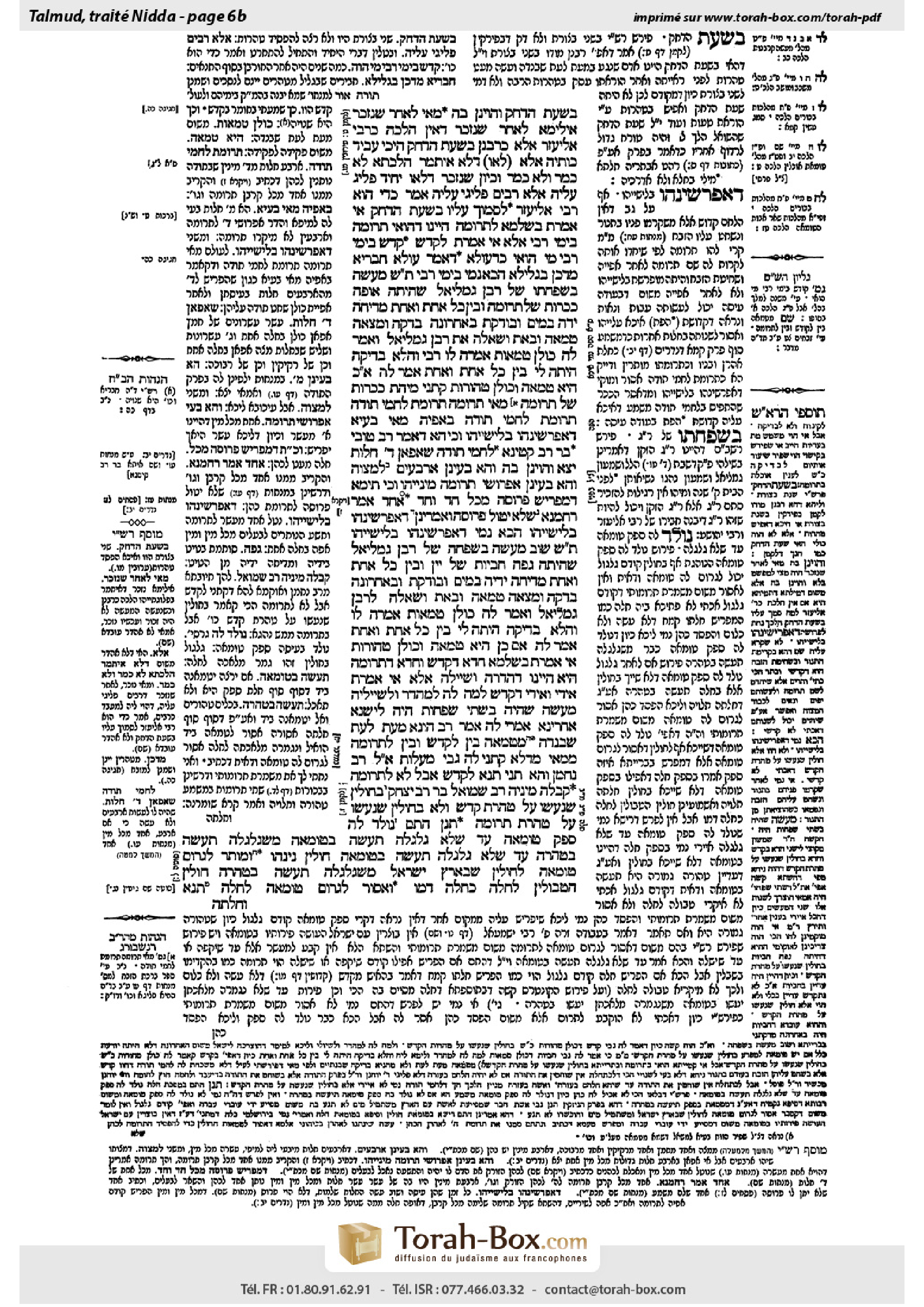
Niddah 6b: Talmud study for Daf Yomi
Daf Yomi is the daily study of one Talmud folio. Explore 37 tractates with scans, Hebrew text, Sefaria English and AI-generated French translations where annotated.
Passage selection and English or AI-generated French translation are available where the scan has annotations. Daf Study is independent of Torah-Box and Sefaria.
Browse Niddah · נידה · All tractatesNiddah 6b text and translations
This page of Niddah includes the Aramaic text, an English translation and an AI-generated French translation, alongside the scan above.
נידה ו׳ ב · Aramaic and Hebrew text
בִּשְׁעַת הַדְּחָק. וְהָוֵינַן בַּהּ: מַאי ״לְאַחַר שֶׁנִּזְכַּר״? אִילֵּימָא לְאַחַר שֶׁנִּזְכַּר דְּאֵין הֲלָכָה כְּרַבִּי אֱלִיעֶזֶר אֶלָּא כְּרַבָּנַן, בִּשְׁעַת הַדְּחָק הֵיכִי עָבֵיד כְּוָתֵיהּ?
אֶלָּא (לָאו) דְּלָא אִיתְּמַר הִלְכְתָא, לָא כְּמָר וְלָא כְּמָר, וְכֵיוָן שֶׁנִּזְכַּר דְּלָאו יָחִיד פְּלִיג עֲלֵיהּ, אֶלָּא רַבִּים פְּלִיגִי עֲלֵיהּ, אָמַר: ״כְּדַי הוּא רַבִּי אֱלִיעֶזֶר לִסְמוֹךְ עָלָיו בִּשְׁעַת הַדְּחָק״.
אִי אָמְרַתְּ בִּשְׁלָמָא לִתְרוּמָה, הַיְינוּ דַּהֲוַאי תְּרוּמָה בִּימֵי רַבִּי, אֶלָּא אִי אָמְרַתְּ לְקֹדֶשׁ — קֹדֶשׁ בִּימֵי רַבִּי מִי הֲוַאי?
כִּדְעוּלָּא, דְּאָמַר עוּלָּא: חַבְרַיָּא מְדַכַּן בְּגָלִילָא. הָכָא נָמֵי בִּימֵי רַבִּי.
תָּא שְׁמַע: מַעֲשֶׂה בְּשִׁפְחָתוֹ שֶׁל רַבָּן גַּמְלִיאֵל שֶׁהָיְתָה אוֹפָה כִּכָּרוֹת שֶׁל תְּרוּמָה, וּבֵין כׇּל אַחַת וְאַחַת מְדִיחָה יָדָהּ בְּמַיִם וּבוֹדֶקֶת, בָּאַחֲרוֹנָה בָּדְקָה וּמָצְאָה טְמֵאָה, וּבָאת וְשָׁאֲלָה אֶת רַבָּן גַּמְלִיאֵל, וְאָמַר לָהּ: כּוּלָּן טְמֵאוֹת. אָמְרָה לוֹ: רַבִּי, וַהֲלֹא בְּדִיקָה הָיְתָה לִי בֵּין כׇּל אַחַת וְאַחַת! אָמַר לָהּ: אִם כֵּן, הִיא טְמֵאָה וְכוּלָּן טְהוֹרוֹת.
קָתָנֵי מִיהַת: כִּכָּרוֹת שֶׁל תְּרוּמָה. מַאי תְּרוּמָה? תְּרוּמַת לַחְמֵי תוֹדָה. תְּרוּמַת לַחְמֵי תוֹדָה בַּאֲפִיָּה מַאי בָּעֲיָא?
דְּאַפְרְשִׁינְהוּ בְּלֵישַׁיְיהוּ, וְכִי הָא דְּאָמַר רַב טוֹבִי בַּר רַב קַטִּינָא: לַחְמֵי תוֹדָה שֶׁאֲפָאָן אַרְבַּע חַלּוֹת — יָצָא, וְהָוֵינַן בַּהּ: וְהָא בָּעֵינַן אַרְבָּעִים! לְמִצְוָה.
וְהָא בָּעֵינַן אַפְרוֹשֵׁי תְּרוּמָה מִינַּיְיהוּ! וְכִי תֵּימָא דְּמַפְרֵישׁ פְּרוּסָה מִכׇּל חַד וְחַד, ״אֶחָד״ אֲמַר רַחֲמָנָא, שֶׁלֹּא יִטּוֹל פְּרוּסָה, וְאָמְרִינַן דְּאַפְרְשִׁינְהוּ בְּלֵישַׁיְיהוּ, הָכָא נָמֵי דְּאַפְרְשִׁינְהוּ בְּלֵישַׁיְיהוּ.
תָּא שְׁמַע: שׁוּב מַעֲשֶׂה בְּשִׁפְחָה שֶׁל רַבָּן גַּמְלִיאֵל, שֶׁהָיְתָה גָּפָה חָבִיּוֹת שֶׁל יַיִן, וּבֵין כׇּל אַחַת וְאַחַת מְדִיחָה יָדֶיהָ בְּמַיִם וּבוֹדֶקֶת, וּבָאַחֲרוֹנָה בָּדְקָה וּמָצְאָה טְמֵאָה, וּבָאת וְשָׁאֲלָה לְרַבָּן גַּמְלִיאֵל, וְאָמַר לָהּ: כּוּלָּן טְמֵאוֹת. אָמְרָה לוֹ: וַהֲלֹא בְּדִיקָה הָיְתָה לִי בֵּין כׇּל אַחַת וְאַחַת! אֲמַר לַהּ: אִם כֵּן, הִיא טְמֵאָה וְכוּלָּן טְהוֹרוֹת.
אִי אָמְרַתְּ בִּשְׁלָמָא חֲדָא דְּקֹדֶשׁ, וַחֲדָא דִּתְרוּמָה הִיא, הַיְינוּ דְּהָדְרָה וְשָׁיְילָה. אֶלָּא אִי אָמְרַתְּ אִידֵּי וְאִידֵּי דְּקֹדֶשׁ, לְמָה לַהּ לְמֶהְדַּר וּלְשַׁיּוֹלֵיהּ? מַעֲשֶׂה שֶׁהָיָה — בִּשְׁתֵּי שְׁפָחוֹת הָיָה.
לִישָּׁנָא אַחֲרִינָא אָמְרִי לַהּ, אָמַר רַב הוּנָא: מֵעֵת לְעֵת שֶׁבְּנִדָּה מְטַמְּאָה בֵּין לַקֹּדֶשׁ וּבֵין לַתְּרוּמָה. מִמַּאי? מִדְּלָא קָתָנֵי לַהּ גַּבֵּי מַעֲלוֹת. אֲמַר לֵיהּ רַב נַחְמָן: וְהָא תָּנֵי תַּנָּא לַקֹּדֶשׁ אֲבָל לֹא לַתְּרוּמָה!
קַבְּלַהּ מִינֵּיהּ רַב שְׁמוּאֵל בַּר רַב יִצְחָק: בְּחוּלִּין שֶׁנַּעֲשׂוּ עַל טׇהֳרַת קֹדֶשׁ, וְלֹא בְּחוּלִּין שֶׁנַּעֲשׂוּ עַל טׇהֳרַת תְּרוּמָה.
תְּנַן הָתָם: נוֹלַד לָהּ סְפֵק טוּמְאָה, עַד שֶׁלֹּא גִּלְגְּלָה — תֵּעָשֶׂה בְּטוּמְאָה, מִשֶּׁגִּלְגְּלָה — תֵּעָשֶׂה בְּטׇהֳרָה.
עַד שֶׁלֹּא גִּלְגְּלָהּ — תֵּעָשֶׂה בְּטוּמְאָה, חוּלִּין נִינְהוּ, וּמוּתָּר לִגְרוֹם טוּמְאָה לְחוּלִּין שֶׁבְּאֶרֶץ יִשְׂרָאֵל; מִשֶּׁגִּלְגְּלָה — תֵּעָשֶׂה בְּטׇהֳרָה, חוּלִּין הַטְּבוּלִין לְחַלָּה כְּחָלָה דָּמוּ, וְאָסוּר לִגְרוֹם טוּמְאָה לְחַלָּה.
תָּנָא:
Niddah 6b · English translation
in exigent circumstances [bishe’at hadeḥak]. And we discussed it and asked: What is the meaning of: After he remembered? If we say that this means after he remembered that the halakha is not in accordance with the opinion of Rabbi Eliezer but in accordance with the opinion of the Rabbis, if so, how could Rabbi Yehuda HaNasi act in accordance with Rabbi Eliezer even in exigent circumstances, since the halakha has been decided against him?
Rather, is it not correct that the halakha had not been stated on this matter, neither in accordance with the opinion of this Sage, Rabbi Eliezer, nor in accordance with the opinion of that Sage, i.e., the Rabbis. And once Rabbi Yehuda HaNasi remembered that it was not a single authority who disagrees with Rabbi Eliezer, but it was several Sages who disagreed with him, and there is a principle that the halakha follows the opinion of the many over that of an individual, he nevertheless said: Rabbi Eliezer is worthy to rely upon in exigent circumstances.
The Gemara explains the proof from the baraita: Granted, if you say that it was a case of a menstruating woman who had touched teruma during the previous twenty-four hours, this is fine, as teruma still existed in the days of Rabbi Yehuda HaNasi. But if you say that it was a case of a woman who touched sacrificial food, was there still sacrificial food in days of Rabbi Yehuda HaNasi, after the destruction of the Temple? Clearly, the case involved teruma, and according to the Rabbis, whose opinion is accepted as halakha, this woman who had skipped three menstrual cycles nevertheless renders teruma impure retroactively. This ruling apparently contradicts the opinion of Rav Huna.
The Gemara answers: This can be answered in accordance with the testimony of Ulla, as Ulla said: Ḥaverim purify their wine and oil in the Galilee, i.e., they produce their wine and oil by the standards of purity used for sacrificial food, in the hope that the Temple will be rebuilt in their lifetime. Here, too, in the days of Rabbi Yehuda HaNasi there were those who kept the standards of purity observed for sacrificial food.
The Gemara suggests: Come and hear a baraita: There was an incident involving the maidservant of Rabban Gamliel, who was baking loaves of teruma bread. And in between each and every one she would wash her hand in water and examine herself. After the last one she examined herself and found that she was impure due to menstrual blood, and she came and asked Rabban Gamliel about the status of the loaves. And he said to her: They are all impure, due to her retroactive impurity for the previous twenty-four hours. She said to him: My teacher, didn’t I perform an examination in between each and every one? Rabban Gamliel said to her: If so, then this last one is impure and the rest are all pure, as your retroactive impurity is reduced until the time of the most recent examination.
The Gemara explains the difficulty: In any event, the baraita teaches that the case involved loaves of teruma bread. This apparently contradicts the opinion of Rav Huna, as Rabban Gamliel applied retroactive impurity in a case of teruma. The Gemara answers: What is meant by: Teruma? It means teruma of the loaves of the thanks offering, i.e., the four loaves of the thanks offering that were separated from the total of forty and eaten by the priests. These are sacrificial foods, not teruma. The Gemara raises a difficulty with regard to this interpretation: What was she doing baking the teruma of the loaves of the thanks offering alone? All forty loaves of the thanks offering are baked together, and only afterward are four set aside as teruma to be eaten by priests.
The Gemara answers: This is referring to a case where dough for the teruma loaves was separated and designated for the priests during its kneading. And this halakha is in accordance with that which Rav Tovi bar Rav Ketina said: If one baked the loaves of the thanks offering as four loaves, rather than the requisite forty loaves, he has fulfilled his obligation. And we discussed it and asked: Isn’t one required to bring forty loaves with the thanks offering, ten loaves of each of the four different types? The Gemara answers: One must bake forty loaves in order to fulfill the mitzva in the optimal fashion, but he has nevertheless fulfilled his obligation with four loaves, one of each type.
The Gemara continues its answer by further elucidating the statement of Rav Tovi bar Rav Ketina. And we asked with regard to this opinion: But he is required to separate teruma from it, i.e., to designate one loaf from each type that is given to the priests. And if you would say that he separates a slice from each one of the four loaves and gives them to the priest, this cannot be the case, as the Merciful One states in the Torah: “And of it he shall present one out of each offering for a gift to the Lord; it shall be the priest’s” (Leviticus 7:14). The word “one” indicates that he may not take a slice, but rather he takes a complete loaf. The Gemara answers: Rather, we must say that he separated dough for the teruma loaves during its kneading. Here too, in the incident involving Rabban Gamliel’s maidservant, she separated the dough during its kneading.
The Gemara suggests: Come and hear a proof from a baraita: There was another incident involving the maidservant of Rabban Gamliel who was sealing barrels of wine. And in between each and every one she would wash her hands in water and examine herself. And after the last one she examined herself and found that she was ritually impure, and she came and asked Rabban Gamliel about the wine. And he said to her: They are all impure. She said to him: My teacher, didn’t I perform an examination in between each and every one? Rabban Gamliel said to her: If so, this last one is impure and the rest are all pure.
The Gemara clarifies the difficulty with regard to Rav Huna’s opinion: Granted, if you say that one incident involved a case of sacrificial food and one incident involved a case of teruma, this is the reason that she returned and again asked Rabban Gamliel what to do. But if you say that both this incident and that incident involved sacrificial food, why did she need to return and ask him the same question a second time? The Gemara answers: Each incident that occurred was with sacrificial food and they happened with two different maidservants.
Some say another version of Rav Huna’s statement. Rav Huna says: During the twenty-four-hour period of retroactive impurity of a menstruating woman, she renders impure both sacrificial food and teruma. The Gemara asks: From where is this derived? The Gemara answers: It can be inferred from the fact that the mishna in Ḥagiga (20b) does not teach this matter among the other matters where higher levels of purity are required only for sacrificial foods but not for teruma. Rav Naḥman said to Rav Huna: But doesn’t the tanna explicitly teach in a baraita: The retroactive impurity of a menstruating woman applies only with regard to sacrificial food but not with regard to teruma?
The Gemara answers: Rav Shmuel bar Rav Yitzḥak received the following explanation from Rav Naḥman: The baraita means that this retroactive impurity applies to non-sacred food that was prepared according to the standards of purity of sacrificial food, but not to non-sacred food that was prepared according to the standards of purity of teruma. It does apply to teruma itself.
§ With regard to a non-sacred food prepared according to the standards of purity of teruma, we learned in a mishna elsewhere (Ḥalla 3:2): In a case of dough where uncertainty developed as to whether it was ritually impure, if the uncertainty developed before it was kneaded, it may be prepared even in definite impurity, i.e., with impure vessels. If it developed after it was kneaded, it must be prepared in purity.
The baraita elaborates: Before it was kneaded it may be prepared even in definite impurity because it is non-sacred food, and the halakha is that it is permitted to cause impurity to non-sacred food in Eretz Yisrael. After it was kneaded it must be prepared in purity, since non-sacred food that is untithed with regard to the obligation to separate ḥalla, i.e., its ḥalla has not yet been separated, is considered like ḥalla, and it is prohibited to cause impurity to ḥalla.
It is taught in a baraita:
Niddah 6b · Traduction française (IA)
En cas de nécessité impérieuse [bishe’at hadeḥak]. Nous avons examiné cette question et demandé : Que signifie « après qu’il s’en fut souvenu » ? Si l’on dit que cela signifie après qu’il se fut souvenu que la halakha ne suit pas l’avis de Rabbi Eliezer, mais celui des Rabbins, comment Rabbi Yehuda HaNasi aurait-il alors pu agir selon l’avis de Rabbi Eliezer, même en cas de nécessité impérieuse, puisque la halakha avait été tranchée contre lui ?
Ne faut-il pas plutôt dire que la halakha n’avait pas été énoncée sur cette question, ni selon l’avis de ce sage, Rabbi Eliezer, ni selon celui de ces sages, c’est-à-dire les Rabbins ? Lorsque Rabbi Yehuda HaNasi se souvint que Rabbi Eliezer n’était pas en désaccord avec un seul sage, mais avec plusieurs, et qu’un principe veut que la halakha suive l’avis de la majorité plutôt que celui d’un individu, il dit néanmoins : Rabbi Eliezer est digne que l’on s’appuie sur son avis en cas de nécessité impérieuse.
La Guemara explique la preuve tirée de la baraïta : Admettons qu’il s’agisse d’une femme menstruée qui avait touché de la terouma au cours des vingt-quatre heures précédentes ; cela convient, puisque la terouma existait encore à l’époque de Rabbi Yehuda HaNasi. Mais si l’on dit qu’il s’agissait d’une femme qui avait touché des aliments consacrés, y avait-il encore des aliments consacrés à l’époque de Rabbi Yehuda HaNasi, après la destruction du Temple ? Il est donc clair que le cas concernait de la terouma et, selon les Rabbins, dont l’avis est retenu comme halakha, cette femme qui avait sauté trois cycles menstruels rend néanmoins la terouma impure rétroactivement. Cette décision semble contredire l’avis de Rav Huna.
La Guemara répond : On peut résoudre cette question conformément au témoignage d’Ulla, car Ulla a dit : Les ḥaverim purifient leur vin et leur huile en Galilée, c’est-à-dire qu’ils produisent leur vin et leur huile selon les normes de pureté appliquées aux aliments consacrés, dans l’espoir que le Temple sera reconstruit de leur vivant. De même, à l’époque de Rabbi Yehuda HaNasi, certains observaient les normes de pureté appliquées aux aliments consacrés.
La Guemara propose : Viens et entends une baraïta : Un incident eut lieu avec la servante de Rabban Gamliel, qui faisait cuire des pains de terouma. Entre chaque pain, elle se lavait la main à l’eau et s’examinait. Après le dernier, elle s’examina et constata qu’elle était impure à cause du sang menstruel ; elle vint alors demander à Rabban Gamliel quel était le statut des pains. Il lui dit : Ils sont tous impurs, en raison de son impureté rétroactive durant les vingt-quatre heures précédentes. Elle lui dit : Mon maître, ne me suis-je pas examinée entre chaque pain ? Rabban Gamliel lui dit : Dans ce cas, le dernier est impur et tous les autres sont purs, car la période de ton impureté rétroactive est réduite jusqu’au moment de l’examen le plus récent.
La Guemara explique la difficulté : Quoi qu’il en soit, la baraïta enseigne que le cas concernait des pains de terouma. Cela semble contredire l’avis de Rav Huna, puisque Rabban Gamliel a appliqué l’impureté rétroactive à un cas de terouma. La Guemara répond : Que signifie ici « terouma » ? Il s’agit de la terouma des pains de l’offrande de remerciement, c’est-à-dire des quatre pains de cette offrande, prélevés sur le total de quarante et mangés par les prêtres. Ce sont des aliments consacrés, et non de la terouma. La Guemara soulève une difficulté à propos de cette interprétation : Pourquoi faisait-elle cuire uniquement la terouma des pains de l’offrande de remerciement ? Les quarante pains de cette offrande sont cuits ensemble, et ce n’est qu’ensuite que quatre sont mis de côté comme terouma, pour être mangés par les prêtres.
La Guemara répond : Il s’agit d’un cas où la pâte destinée aux pains de terouma a été séparée et réservée aux prêtres pendant le pétrissage. Cette halakha est conforme à ce que Rav Tovi bar Rav Ketina a dit : Si quelqu’un a cuit les pains de l’offrande de remerciement sous la forme de quatre pains, au lieu des quarante requis, il s’est acquitté de son obligation. Nous avons examiné cette question et demandé : Ne faut-il pas apporter quarante pains avec l’offrande de remerciement, dix pains de chacun des quatre types ? La Guemara répond : Il faut cuire quarante pains pour accomplir la mitsva de la manière optimale, mais on s’est néanmoins acquitté de son obligation avec quatre pains, un de chaque type.
La Guemara poursuit sa réponse en précisant davantage la déclaration de Rav Tovi bar Rav Ketina. Nous avons soulevé une objection à propos de cet avis : Mais il doit en prélever la terouma, c’est-à-dire désigner un pain de chaque type qui sera donné aux prêtres. Et si l’on dit qu’il découpe une tranche de chacun des quatre pains et la donne au prêtre, cela ne peut être le cas, car le Miséricordieux dit dans la Torah : « Il en présentera un de chaque offrande comme prélèvement pour l’Éternel ; il appartiendra au prêtre » (Lévitique 7:14). Le mot « un » indique qu’il ne peut pas prendre une tranche, mais qu’il doit prendre un pain entier. La Guemara répond : Il faut donc dire qu’il a séparé la pâte destinée aux pains de terouma pendant le pétrissage. De même ici, dans l’incident concernant la servante de Rabban Gamliel, elle a séparé la pâte pendant le pétrissage.
La Guemara propose : Viens et entends une preuve tirée d’une baraïta : Un autre incident eut lieu avec la servante de Rabban Gamliel, qui scellait des tonneaux de vin. Entre chaque tonneau, elle se lavait les mains à l’eau et s’examinait. Après le dernier, elle s’examina et constata qu’elle était rituellement impure ; elle vint alors demander à Rabban Gamliel quel était le statut du vin. Il lui dit : Ils sont tous impurs. Elle lui dit : Mon maître, ne me suis-je pas examinée entre chaque tonneau ? Rabban Gamliel lui dit : Dans ce cas, le dernier est impur et tous les autres sont purs.
La Guemara précise la difficulté que pose l’avis de Rav Huna : Admettons qu’un incident concernait des aliments consacrés et l’autre de la terouma ; c’est pour cette raison qu’elle revint demander à Rabban Gamliel ce qu’elle devait faire. Mais si l’on dit que cet incident et l’autre concernaient tous deux des aliments consacrés, pourquoi a-t-elle dû revenir lui poser une seconde fois la même question ? La Guemara répond : Les deux incidents concernaient des aliments consacrés, mais impliquaient deux servantes différentes.
Certains rapportent une autre version de la déclaration de Rav Huna. Rav Huna dit : Pendant la période de vingt-quatre heures d’impureté rétroactive d’une femme menstruée, elle rend impurs aussi bien les aliments consacrés que la terouma. La Guemara demande : D’où cela découle-t-il ? La Guemara répond : On peut l’inférer du fait que la Michna de Ḥaguiga (20b) ne mentionne pas cette règle parmi les autres cas où un degré supérieur de pureté est exigé uniquement pour les aliments consacrés, mais pas pour la terouma. Rav Naḥman dit à Rav Huna : Mais le tanna n’enseigne-t-il pas explicitement dans une baraïta que l’impureté rétroactive d’une femme menstruée s’applique uniquement aux aliments consacrés, et non à la terouma ?
La Guemara répond : Rav Shmuel bar Rav Yitzḥak reçut de Rav Naḥman l’explication suivante : La baraïta signifie que cette impureté rétroactive s’applique aux aliments profanes préparés selon les normes de pureté des aliments consacrés, mais pas aux aliments profanes préparés selon les normes de pureté de la terouma. Elle s’applique bien à la terouma elle-même.
§ À propos d’un aliment profane préparé selon les normes de pureté de la terouma, nous avons appris dans une Michna ailleurs (Ḥalla 3:2) : Dans le cas d’une pâte au sujet de laquelle un doute apparaît quant à son impureté rituelle, si ce doute apparaît avant qu’elle soit pétrie, elle peut être préparée même dans un état d’impureté avérée, c’est-à-dire avec des ustensiles impurs. S’il apparaît après qu’elle a été pétrie, elle doit être préparée en état de pureté.
La baraïta précise : Avant qu’elle soit pétrie, elle peut être préparée même dans un état d’impureté avérée, car il s’agit d’un aliment profane, et la halakha permet de rendre impurs les aliments profanes en Eretz Israël. Après qu’elle a été pétrie, elle doit être préparée en état de pureté, car un aliment profane dont l’obligation de prélever la ḥalla n’a pas encore été acquittée, c’est-à-dire dont la ḥalla n’a pas encore été prélevée, est considéré comme de la ḥalla, et il est interdit de rendre la ḥalla impure.
Il est enseigné dans une baraïta :
Traduction française générée par IA à partir de l’édition anglaise de Sefaria. Vérifie toujours un passage avec le texte source.
Text from Sefaria: William Davidson Edition - Vocalized Aramaic (CC BY NC); William Davidson Edition - English (CC BY NC).