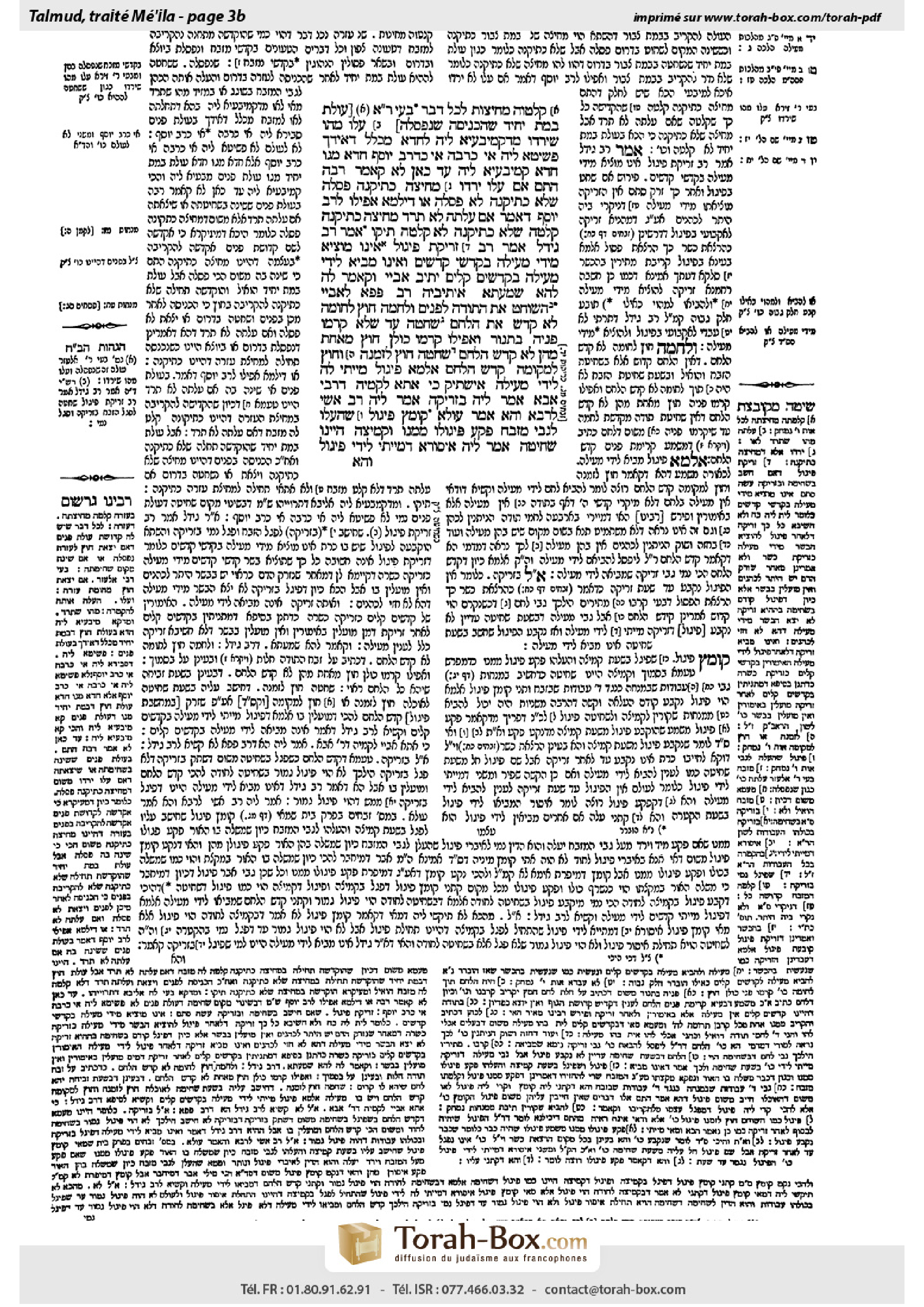
Meilah 3b: Talmud study for Daf Yomi
Daf Yomi is the daily study of one Talmud folio. Explore 37 tractates with scans, Hebrew text, Sefaria English and AI-generated French translations where annotated.
Passage selection and English or AI-generated French translation are available where the scan has annotations. Daf Study is independent of Torah-Box and Sefaria.
Browse Meilah · מעילה · All tractatesMeilah 3b text and translations
This page of Meilah includes the Aramaic text, an English translation and an AI-generated French translation, alongside the scan above.
מעילה ג׳ ב · Aramaic and Hebrew text
קְלָטוּהָ מְחִיצוֹת לְכׇל דָּבָר.
בָּעֵי רַבִּי אֶלְעָזָר: [עוֹלַת בָּמַת יָחִיד שֶׁהִכְנִיסָהּ, שֶׁנִּפְסְלָה] – עָלוּ, מַהוּ שֶׁיֵּרְדוּ?
מִדְּקָמִיבַּעְיָא לֵיהּ לַחֲדָא, מִכְּלַל דְּאִידַּךְ פְּשִׁיטָא לֵיהּ, אִי כְּרַבָּה אִי כִּדְרַב יוֹסֵף.
חֲדָא מִגּוֹ חֲדָא קָמִיבַּעְיָא לֵיהּ:
עַד כָּאן לָא קָאָמַר רַבָּה הָתָם אִם עָלוּ – יֵרְדוּ, מְחִיצָה כְּתִיקְנָהּ –
פָּסְלָה, שֶׁלֹּא כְּתִיקְנָהּ – לֹא פָּסְלָה,
אוֹ דִילְמָא: אֲפִילּוּ לְרַב יוֹסֵף דְּאָמַר אִם עָלְתָה – לֹא תֵּרֵד, מְחִיצָה כְּתִיקְנָהּ – קָלְטָה, שֶׁלֹּא כְּתִיקְנָהּ – לָא קָלְטָה. תֵּיקוּ.
אָמַר רַב גִּידֵּל אָמַר רַב: זְרִיקַת פִּיגּוּל אֵינוֹ מוֹצִיא מִידֵי מְעִילָה בְּקׇדְשֵׁי קָדָשִׁים, וְאֵינוֹ מֵבִיא לִידֵי מְעִילָה בְּקָדָשִׁים קַלִּים.
יְתֵיב אַבָּיֵי וְקָאָמַר לַהּ לְהָא שְׁמַעְתָּא, אֵיתִיבֵיהּ רַב פָּפָּא לְאַבָּיֵי: הַשּׁוֹחֵט אֶת הַתּוֹדָה לִפְנִים, וְלַחְמָהּ חוּץ לַחוֹמָה – לֹא קִדֵּשׁ אֶת הַלֶּחֶם.
שְׁחָטָהּ עַד שֶׁלֹּא קָרְמוּ פָּנֶיהָ בַּתַּנּוּר, וַאֲפִילּוּ קָרְמוּ כּוּלָּן חוּץ מֵאַחַת מֵהֶן – לֹא קָדַשׁ הַלֶּחֶם. שְׁחָטָהּ חוּץ לִזְמַנָּהּ וְחוּץ לִמְקוֹמָהּ – קָדַשׁ הַלֶּחֶם.
אַלְמָא פִּיגּוּל מַיְיתֵי לַהּ לִידֵי מְעִילָה! אִישְׁתִּיק.
כִּי אֲתָא לְקַמֵּיהּ דְּרַבִּי אַבָּא, אֲמַר לֵיהּ: בִּזְרִיקָה.
אֲמַר לֵיהּ רַב אָשֵׁי לְרָבָא: וְהָא אָמַר עוּלָּא: קוֹמֶץ פִּיגּוּל שֶׁהֶעֱלוֹ לְגַבֵּי מִזְבֵּחַ – פָּקַע פִּיגּוּלוֹ מִמֶּנּוּ,
וּקְמִיצָה הַיְינוּ שְׁחִיטָה!
אֲמַר לֵיהּ: אִיסּוּרָא דְּמַיְיתֵי לִידֵי פִיגּוּל.
Meilah 3b · English translation
it is admitted by the partitions of the courtyard for all matters; and from that point onward it has the status of a burnt offering sacrificed in the Temple with regard to all halakhot.
The Gemara continues: In this regard, Rabbi Elazar asks: In the case of a burnt offering consecrated to be sacrificed on a personal altar that one brought into the Temple courtyard and it was rendered unfit for sacrifice, e.g., it was slaughtered in the south rather than its proper place in the north, if its limbs ascended the altar to be sacrificed, what is the halakha as to whether they should descend? Although the animal was disqualified due to the change in location, had it been slaughtered in the south on a personal altar it would not have been disqualified.
The Gemara concludes: From the fact that Rabbi Elazar asked this question only with regard to this one case, one can conclude that in the other case, where the burnt offering was consecrated for sacrifice in the Temple, the halakha of the limbs that ascended the altar is obvious to him. He either holds that the halakha is that they are not sacrificed, in accordance with the opinion of Rabba, or he maintains that they are sacrificed, in accordance with the opinion of Rav Yosef.
The Gemara rejects this inference, as it is possible that Rabbi Elazar was actually uncertain with regard to that case as well; but he raises one dilemma as a result of the other. In other words, Rabbi Elazar was asking two questions, one predicated on the other, and the second question is valid regardless of whether he holds in accordance with the opinion of Rabba or Rav Yosef.
The Gemara elaborates: Even if Rabbi Elazar holds in accordance with the opinion of Rabba, that in a regular case the limbs are removed from the altar, one can claim that Rabba says that if the limbs ascend the altar they shall descend only there, i.e., if the burnt offering was consecrated for sacrifice in the Temple. In that case, the owner consecrated the offering with the intention of sacrificing it within the partition of the courtyard, where slaughtering is performed properly, in the north.
Consequently, if it was slaughtered in the south, that renders the offering entirely disqualified, and therefore even if it ascended the altar it must descend. But in a case where he consecrated the offering in order to sacrifice it improperly on a personal altar, slaughtering it in the south does not render the offering entirely disqualified, and therefore if it ascends the altar it does not descend.
Or perhaps, the opposite is the case: Even according to the opinion of Rav Yosef, who said that if it ascends the altar it shall not descend, that halakha applies only in a case where the owner consecrated the offering in order to sacrifice it within the partition of the courtyard, in which case it was consecrated properly. In such an instance, the offering is admitted by the partitions of the courtyard, and therefore even in a case where it was disqualified, if it ascended the altar it does not descend. By contrast, in a case where he consecrated it in order to sacrifice it improperly on a personal altar, the offering is not admitted at all by the partitions of the courtyard, which means that even if it ascends the altar it must descend. The Gemara concludes that the dilemma shall stand unresolved [teiku].
§ With regard to the misuse of offerings that were rendered unfit, Rav Giddel says that Rav said: Sprinkling the blood of an offering with the intent to consume it after its appointed time [piggul], in a case where there was piggul intent during the slaughter as well, does not remove the meat of the offering from the status of being subject to the halakhot of misuse, in the case of offerings of the most sacred order. The reason is that its meat is still classified as “the sacred items of the Lord” (Leviticus 5:15), since there was no proper sprinkling that permitted the priests to partake of the offering, as it is piggul. Similarly, this sprinkling does not bring the sacrificial portions of offerings of lesser sanctity into the status of being subject to the halakhot of misuse, as only a valid sprinkling confers that status.
The Gemara relates that Abaye sat and related this halakha, which Rav Giddel said that Rav said. Rav Pappa raised an objection to Abaye from a mishna (Menaḥot 78b): With regard to one who slaughters the thanks offering in its proper place inside the Temple courtyard, and at that time, its forty accompanying loaves were outside the wall, where it is prohibited to partake of the loaves, the loaves are not sanctified by this slaughtering.
Likewise, if he slaughtered the thanks offering before the surface of the loaves formed a crust in the oven, and this is the halakha even if the surface of all the loaves formed a crust except for one of them, the loaves are not sanctified, even those that had already formed a crust. If the priest slaughtered the thanks offering with the intent to partake of it or to burn the portions consumed on the altar beyond its designated time and it was thereby rendered piggul, or outside its designated area and was disqualified, the loaves are sanctified and are subject to the halakhot of misuse. This is presumably the case even if he also sprinkled the blood with piggul intent, as the mishna does not differentiate in this regard.
The Gemara explains the objection: Evidently, sprinkling the blood of offerings of lesser sanctity with the intent of piggul subjects offerings of lesser sanctity to the halakhot of misuse. This apparently contradicts the opinion that Abaye stated that Rav Giddel said that Rav said. Abaye was silent, and was unable to resolve the difficulty against Rav’s statement.
When Abaye came before Rabbi Abba and reported Rav Pappa’s comments, Rabbi Abba said to Abaye: That is not a difficulty, as Rav Giddel said that the intent of piggul during sprinkling does not subject offerings of lesser sanctity to the halakhot of misuse. Since the offering is rendered full-fledged piggul and is disqualified, it cannot become subject to the halakhot of misuse. By contrast, the mishna in Menaḥot is referring specifically to the intent of piggul during slaughtering, whereas there was no such intent during sprinkling. In such a case, the sprinkling was performed with proper intent, and therefore it subjects the offering to the halakhot of misuse.
Rav Ashi said to Rava, with regard to this explanation of Rav Giddel’s statement: But doesn’t Ulla say: In the case of a handful that is piggul, which is unfit for sacrifice, that was brought up onto the altar to be sacrificed and was burned by the fire of the altar, its piggul status lapsed from it, and it is fit for sacrifice?
And since the removal of the handful in the case of the meal offering is the same as slaughtering animal offerings, i.e., it is the equivalent rite, and in this case the improper intent during the removal of the handful rendered the meal offering piggul, the same should apply to slaughtering in the case of an animal offering: The sacrificial portions of the offerings of lesser sanctity should be rendered full-fledged piggul by slaughtering alone with the intent of piggul, regardless of the intent during sprinkling. If so, Rabbi Abba’s answer above is incorrect.
Rava said to Rav Ashi: This is not a difficulty, as Ulla did not mean that the intent during the removal of the handful alone rendered the meal offering full-fledged piggul. Rather, he meant that a prohibited act was performed upon it which brings it to a status of piggul, but the full status of piggul is attained only if there is also improper intent at the time of the sacrificing of the handful, which is equivalent to sprinkling in the case of an animal.
Meilah 3b · Traduction française (IA)
elle est admise par les cloisons de la cour à tous égards ; à partir de là, elle a, pour toutes les halakhot, le statut d’un holocauste offert dans le Temple.
La Guemara poursuit : À ce sujet, Rabbi Elazar pose la question suivante : dans le cas d’un holocauste consacré pour être offert sur un autel privé, qu’on a introduit dans la cour du Temple et qui est devenu impropre au sacrifice — par exemple, parce qu’il a été égorgé au sud au lieu de l’être à l’endroit qui lui convient, au nord —, si ses membres ont été placés sur l’autel en vue d’y être offerts, quelle est la halakha : doit-on les en retirer ? Bien que l’animal ait été disqualifié en raison du changement d’emplacement, s’il avait été égorgé au sud sur un autel privé, il n’aurait pas été disqualifié.
La Guemara conclut : Puisque Rabbi Elazar n’a posé cette question qu’à propos de ce cas précis, on peut en déduire que, dans l’autre cas, où l’holocauste avait été consacré pour être offert dans le Temple, la halakha concernant les membres placés sur l’autel lui paraît évidente. Il estime soit qu’ils ne doivent pas être offerts, conformément à l’avis de Rabba, soit qu’ils doivent l’être, conformément à l’avis de Rav Yosef.
La Guemara rejette cette déduction : il est possible que Rabbi Elazar ait également été incertain dans ce cas, mais qu’il ait soulevé une question à partir de l’autre. Autrement dit, Rabbi Elazar posait deux questions, l’une découlant de l’autre, et la seconde se pose qu’il suive l’avis de Rabba ou celui de Rav Yosef.
La Guemara développe : même si Rabbi Elazar suit l’avis de Rabba, selon lequel, dans un cas ordinaire, les membres doivent être retirés de l’autel, on peut soutenir que, selon Rabba, ils ne doivent en être retirés que dans le cas où l’holocauste avait été consacré pour être offert dans le Temple. Dans ce cas, le propriétaire a consacré l’offrande avec l’intention qu’elle soit offerte à l’intérieur des cloisons de la cour, où l’égorgement s’effectue correctement, au nord.
Par conséquent, s’il a été égorgé au sud, cela rend l’offrande entièrement impropre, et même s’il a été placé sur l’autel, il faut l’en retirer. Mais si le propriétaire a consacré l’offrande afin qu’elle soit offerte de manière inappropriée sur un autel privé, l’égorgement au sud ne la rend pas entièrement impropre ; par conséquent, s’il est placé sur l’autel, on ne l’en retire pas.
Ou peut-être est-ce le contraire : même selon l’avis de Rav Yosef, qui dit que si l’offrande est placée sur l’autel, on ne l’en retire pas, cette halakha ne s’applique que lorsque le propriétaire l’a consacrée afin qu’elle soit offerte à l’intérieur des cloisons de la cour, auquel cas elle a été consacrée comme il convient. Dans une telle situation, l’offrande est admise par les cloisons de la cour ; par conséquent, même si elle a été disqualifiée, on ne la retire pas de l’autel si elle y a été placée. En revanche, si le propriétaire l’a consacrée afin qu’elle soit offerte de manière inappropriée sur un autel privé, les cloisons de la cour ne l’admettent pas du tout ; même si elle est placée sur l’autel, il faut donc l’en retirer. La Guemara conclut que la question reste sans réponse [teiku].
§ Au sujet du détournement d’offrandes devenues impropres, Rav Giddel dit au nom de Rav : l’aspersion du sang d’une offrande avec l’intention de la consommer après le délai prescrit [piggul], lorsqu’une intention de piggul était également présente lors de l’égorgement, ne fait pas sortir la viande de l’offrande du statut auquel s’appliquent les halakhot du détournement, dans le cas des offrandes de sainteté suprême. En effet, sa viande reste classée parmi « les choses saintes du Seigneur » (Lévitique 5:15), puisque l’aspersion n’a pas été valide et n’a donc pas permis aux prêtres de consommer l’offrande, car celle-ci est piggul. De même, cette aspersion ne fait pas entrer les parties des offrandes de moindre sainteté destinées à l’autel dans le statut auquel s’appliquent les halakhot du détournement, car seule une aspersion valide confère ce statut.
La Guemara rapporte qu’Abayé était assis et enseignait cette halakha, que Rav Giddel avait énoncée au nom de Rav. Rav Pappa souleva contre Abayé une objection tirée d’une Michna (Menaḥot 78b) : celui qui égorge l’offrande de remerciement à l’endroit qui lui convient, dans la cour du Temple, alors que ses quarante pains d’accompagnement se trouvent à l’extérieur du mur, où il est interdit de les consommer, ne sanctifie pas les pains par cet égorgement.
De même, s’il a égorgé l’offrande de remerciement avant que la surface des pains ne se soit couverte d’une croûte dans le four — et telle est la halakha même si tous les pains, sauf un, ont déjà formé une croûte —, les pains ne sont pas sanctifiés, y compris ceux qui avaient déjà formé une croûte. Si le prêtre a égorgé l’offrande de remerciement avec l’intention de la consommer ou de brûler sur l’autel les portions destinées à y être consumées après le délai prescrit, la rendant ainsi piggul, ou hors de la zone prévue, la disqualifiant, les pains sont sanctifiés et soumis aux halakhot du détournement. Cela vaut vraisemblablement même s’il a également aspergé le sang avec une intention de piggul, puisque la Michna n’établit aucune distinction à cet égard.
La Guemara explique l’objection : il ressort de là que l’aspersion du sang d’offrandes de moindre sainteté avec une intention de piggul soumet ces offrandes aux halakhot du détournement. Cela semble contredire l’avis qu’Abayé avait énoncé au nom de Rav Giddel, lequel le tenait de Rav. Abayé garda le silence, incapable de résoudre la difficulté soulevée contre la déclaration de Rav.
Quand Abayé se présenta devant Rabbi Abba et lui rapporta les remarques de Rav Pappa, Rabbi Abba lui dit : ce n’est pas une difficulté, car Rav Giddel a dit qu’une intention de piggul lors de l’aspersion ne soumet pas les offrandes de moindre sainteté aux halakhot du détournement. Puisque l’offrande devient pleinement piggul et est disqualifiée, elle ne peut être soumise aux halakhot du détournement. En revanche, la Michna de Menaḥot parle précisément d’une intention de piggul lors de l’égorgement, alors qu’il n’y avait pas d’intention de ce genre au moment de l’aspersion. Dans ce cas, l’aspersion a été effectuée avec l’intention requise ; elle soumet donc l’offrande aux halakhot du détournement.
Rav Ashi dit à Rava, au sujet de cette explication de la déclaration de Rav Giddel : Mais Ulla ne dit-il pas que, dans le cas d’une poignée qui est piggul et donc impropre au sacrifice, si elle a été placée sur l’autel en vue d’y être offerte et consumée par le feu de l’autel, son statut de piggul est annulé et elle devient apte au sacrifice ?
Et puisque le prélèvement de la poignée, dans le cas de l’offrande végétale, équivaut à l’égorgement des offrandes animales, c’est-à-dire qu’il s’agit du rite correspondant, et que, dans ce cas, l’intention irrégulière lors du prélèvement de la poignée a rendu l’offrande végétale piggul, il devrait en aller de même pour l’égorgement d’une offrande animale : les parties des offrandes de moindre sainteté destinées à l’autel devraient devenir pleinement piggul par le seul égorgement effectué avec une intention de piggul, quelle que soit l’intention lors de l’aspersion. Si tel est le cas, la réponse donnée plus haut par Rabbi Abba est erronée.
Rava dit à Rav Ashi : ce n’est pas une difficulté, car Ulla ne voulait pas dire que l’intention lors du seul prélèvement de la poignée avait rendu l’offrande végétale pleinement piggul. Il voulait plutôt dire qu’un acte interdit avait été accompli à son égard, ce qui la fait accéder au statut de piggul ; mais elle n’atteint pleinement ce statut que s’il y a également une intention irrégulière au moment de l’offrande de la poignée, ce qui équivaut à l’aspersion dans le cas d’une offrande animale.
Traduction française générée par IA à partir de l’édition anglaise de Sefaria. Vérifie toujours un passage avec le texte source.
Text from Sefaria: William Davidson Edition - Vocalized Aramaic (CC BY NC); William Davidson Edition - English (CC BY NC).