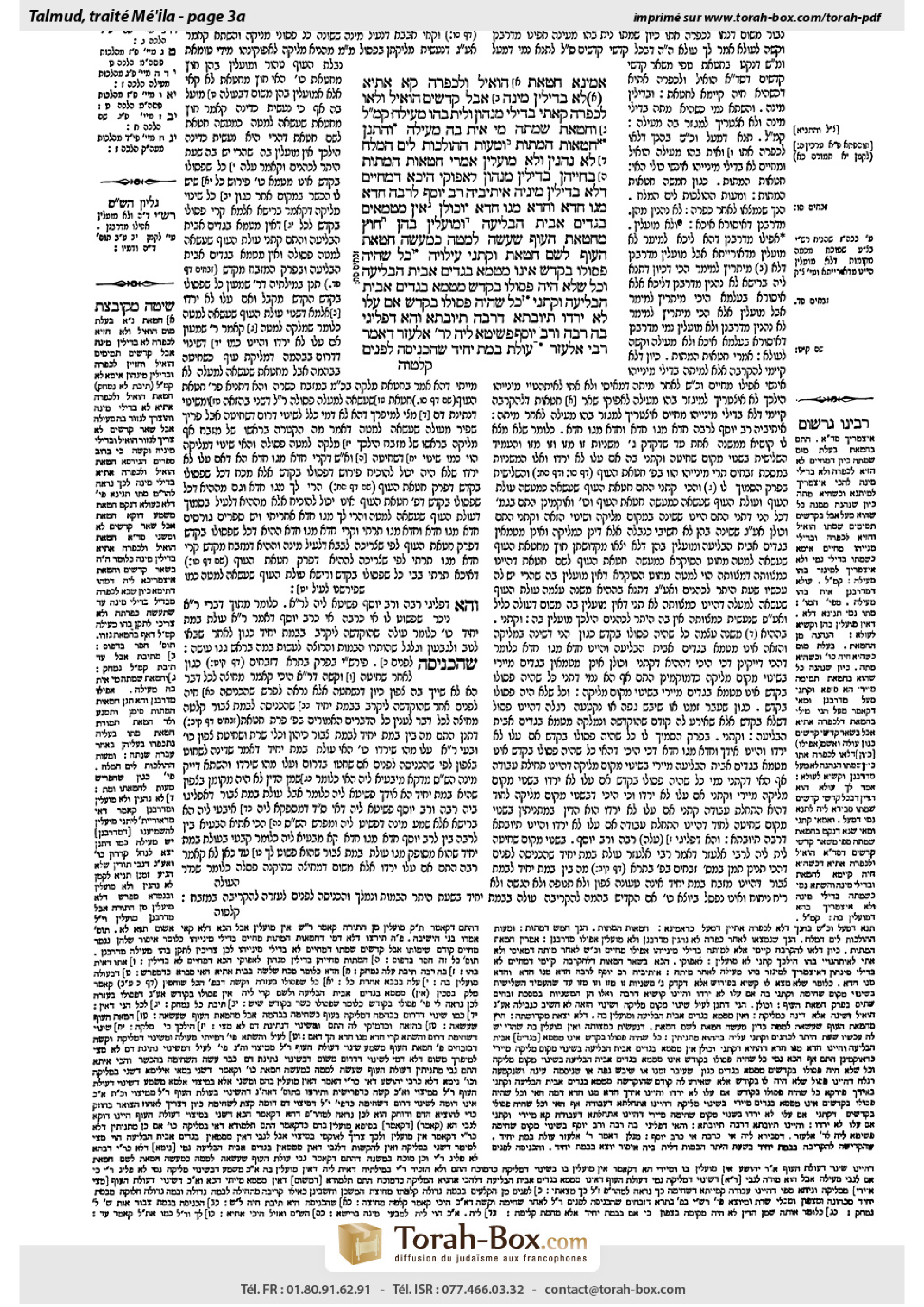
Meilah 3a: Talmud study for Daf Yomi
Daf Yomi is the daily study of one Talmud folio. Explore 37 tractates with scans, Hebrew text, Sefaria English and AI-generated French translations where annotated.
Passage selection and English or AI-generated French translation are available where the scan has annotations. Daf Study is independent of Torah-Box and Sefaria.
Browse Meilah · מעילה · All tractatesMeilah 3a text and translations
This page of Meilah includes the Aramaic text, an English translation and an AI-generated French translation, alongside the scan above.
מעילה ג׳ א · Aramaic and Hebrew text
אָמֵינָא: חַטָּאת, הוֹאִיל וּלְכַפָּרָה קָא אָתְיָא – לָא בְּדִילִין מִינַּהּ, אֲבָל קָדָשִׁים, הוֹאִיל וְלָאו לְכַפָּרָה קָאָתֵי – בְּדִילִי מִנְּהוֹן, וְלֵית בְּהוּ מְעִילָה, קָא מַשְׁמַע לַן.
וְחַטָּאת שֶׁמֵּתָה מִי אִית בַּהּ מְעִילָה? וְהָתְנַן: חַטָּאוֹת הַמֵּתוֹת וּמָעוֹת הַהוֹלְכוֹת לְיָם הַמֶּלַח – לֹא נֶהֱנִין וְלֹא מוֹעֲלִין!
אָמְרִי: חַטָּאוֹת הַמֵּתוֹת – בְּחַיֵּיהֶן בְּדִילִין מִנְּהוֹן, לְאַפּוֹקֵי הֵיכָא דְּמֵחַיִּים – דְּלָא בְּדִילִין מִינֵּיהּ.
אֵיתִיבֵיהּ רַב יוֹסֵף לְרַבָּה חֲדָא מִגּוֹ חֲדָא, וַחֲדָא מִגּוֹ חֲדָא:
וְכוּלָּן, אֵין מְטַמְּאִים בְּגָדִים אַבֵּית הַבְּלִיעָה וּמוֹעֲלִין בָּהֶן,
חוּץ מֵחַטַּאת הָעוֹף שֶׁעָשָׂה לְמַטָּה, כְּמַעֲשֵׂה חַטַּאת הָעוֹף לְשֵׁם חַטָּאת.
וְקָתָנֵי עִילָּוֵיהּ: כׇּל שֶׁהָיָה פְּסוּלוֹ בַּקֹּדֶשׁ – אֵינוֹ מְטַמֵּא בְּגָדִים אַבֵּית הַבְּלִיעָה, וְכׇל שֶׁלֹּא הָיָה פְּסוּלוֹ בַּקֹּדֶשׁ – מְטַמֵּא בְּגָדִים אַבֵּית הַבְּלִיעָה.
וְקָתָנֵי: כׇּל שֶׁהָיָה פְּסוּלוֹ בַּקֹּדֶשׁ – אִם עָלוּ, לֹא יֵרְדוּ. תְּיוּבְתָּא דְּרַבָּה! תְּיוּבְתָּא.
וְהָא דִּפְלִיגִי בַּהּ רַבָּה וְרַב יוֹסֵף פְּשִׁיטָא לֵיהּ לְרַבִּי אֶלְעָזָר, דְּאָמַר רַבִּי אֶלְעָזָר: עוֹלַת בָּמַת יָחִיד, שֶׁהִכְנִיסָהּ לִפְנִים –
Meilah 3a · English translation
to say: Since a sin offering is brought for atonement, people do not distance themselves from it after it dies, as they realize that it is no longer fit to atone. Therefore, in order to ensure that people do not show disrespect, the Sages decreed that one is liable for its misuse. But with regard to other sacrificial animals of the most sacred order, since they are not brought for atonement, people still distance themselves from them after the animals die, and therefore one might think that there is no need to decree that they are subject to the halakhot of misuse. Consequently, Ulla teaches us that even other sacrificial animals that die are subject to misuse by rabbinic decree.
The Gemara asks: And is a sin offering that died subject to the halakhot of misuse? But didn’t we learn in a baraita: With regard to sin offerings that are left to die because they are no longer fit for the altar, from which one is prohibited to derive benefit, and likewise money from which one is prohibited to derive benefit, which goes to the Dead Sea to be destroyed, one may not derive benefit from them ab initio, but if one derived benefit from them, he is not liable for their misuse?
They say in response to this question: With regard to sin offerings that are left to die, since even during their lifetimes people distance themselves from them, as they are no longer fit for sacrifice, there was no need for the Sages to institute a prohibition of misuse. This is to the exclusion of a sin offering that was fit during its lifetime, as people do not distance themselves from it, and therefore the Sages saw fit to institute a prohibition of misuse after it dies.
§ The Gemara returns to the dispute with regard to offerings that were slaughtered in the wrong place and then were brought up to the altar. Rabba maintains that such offerings are removed from the altar while Rav Yosef rules that once they ascended the altar they do not descend from it and are burned. Rav Yosef raised an objection to Rabba, one source from another one, and that one from another one, i.e., his objection is based upon the combination of several sources.
The Gemara elaborates: The mishna on Zevaḥim 66b, which deals with bird offerings that were disqualified for having either the napes of their necks pinched or their blood sprinkled in the wrong place, teaches: And all of the offerings mentioned in that mishna do not render one who swallows their meat ritually impure to the extent that his garments are rendered impure when it is in the throat. Although the offering is disqualified, since the nape of its neck was pinched as part of the rite one is not rendered impure by swallowing an olive-bulk of its meat, as is the halakha with regard to a carcass of a kosher bird. And one who derives benefit from these offerings is liable for misusing them.
This is the halakha concerning all bird offerings, except for the bird sin offering that one performed below the red line, according to the procedure of a bird sin offering, and for the sake of a sin offering. Since it was sacrificed correctly, its meat is permitted to the priests and is no longer subject to the halakhot of misuse.
And it is taught in another mishna (Zevaḥim 68b) with regard to the same disqualified bird offerings: For any one of them whose disqualification occurred in the sacred area, i.e., the Temple courtyard, e.g., if the nape of its neck was pinched at night, it does not render the garments of one who swallows it impure when the meat is in the throat. And for any one of them whose disqualification did not take place in the sacred area, it does render the garments of one who swallows it impure when the meat is in the throat.
And it is taught in yet another mishna (Zevaḥim 84a): With regard to any offering whose disqualification took place in the sacred area, the sacred area renders the offering acceptable, and if such offerings ascended onto the altar they shall not descend. The first mishna establishes that birds disqualified because their rites were performed in the wrong place are subject to the halakhot of misuse. The second mishna teaches that these same birds are considered items whose disqualification occurred in the sacred area. The last mishna establishes that if items whose disqualification occurred in the sacred area ascend the altar, they do not descend. By citing all these mishnayot, Rav Yosef demonstrates that an offering that is slaughtered in the wrong place is not removed from the altar, contrary to Rabba’s opinion. The Gemara concludes: The refutation of the opinion of Rabba is indeed a conclusive refutation.
§ The Gemara notes: And that matter with regard to which Rabba and Rav Yosef disagree is obvious to Rabbi Elazar, as Rabbi Elazar says: In the case of a burnt offering consecrated to be sacrificed on a personal altar, during the period when it is permitted to do so, that one brought inside the Temple courtyard,
Meilah 3a · Traduction française (IA)
à dire : Puisqu’un sacrifice expiatoire est offert pour obtenir le pardon, les gens ne s’en détournent pas après sa mort, car ils comprennent qu’il n’est désormais plus apte à expier. Par conséquent, afin que les gens ne lui manquent pas de respect, les Sages ont décrété que celui qui en fait un usage illicite en est passible. Mais, s’agissant des autres sacrifices de très haute sainteté, puisqu’ils ne sont pas offerts pour obtenir le pardon, les gens continuent de s’en détourner après la mort des animaux ; on pourrait donc penser qu’il n’est pas nécessaire de décréter qu’ils sont soumis aux règles de l’usage illicite. Ulla nous enseigne donc que même les autres sacrifices morts sont soumis aux règles de l’usage illicite par décret rabbinique.
La Guemara demande : Un sacrifice expiatoire mort est-il soumis aux règles de l’usage illicite ? N’avons-nous pas appris dans une baraïta : Concernant les sacrifices expiatoires qu’on laisse mourir parce qu’ils ne sont plus aptes à être offerts sur l’autel, dont il est interdit de tirer profit, et de même, concernant l’argent dont il est interdit de tirer profit et qui est jeté dans la mer Morte pour être détruit, il est interdit d’en tirer profit a priori ; mais si quelqu’un en a tiré profit, il n’est pas passible pour usage illicite ?
On répond à cette question : s’agissant des sacrifices expiatoires qu’on laisse mourir, puisque les gens s’en détournent même de leur vivant, car ils ne sont plus aptes à être offerts, les Sages n’avaient pas besoin d’instituer une interdiction d’usage illicite. Cela ne concerne pas le sacrifice expiatoire qui était apte de son vivant : les gens ne s’en détournent pas, et les Sages ont donc jugé bon d’instituer une interdiction d’usage illicite après sa mort.
§ La Guemara revient au débat concernant les sacrifices qui ont été égorgés au mauvais endroit, puis placés sur l’autel. Rabba soutient que ces sacrifices doivent être retirés de l’autel, tandis que Rav Yosef estime qu’une fois montés sur l’autel, ils n’en redescendent pas et sont brûlés. Rav Yosef soulève contre Rabba une objection fondée sur une source, puis sur une autre, c’est-à-dire que son objection s’appuie sur la combinaison de plusieurs sources.
La Guemara développe : la Michna de Zevaḥim 66b, qui traite des offrandes d’oiseaux invalidées parce que leur nuque a été pincée ou que leur sang a été aspergé au mauvais endroit, enseigne : aucune des offrandes mentionnées dans cette Michna ne rend impur celui qui en avale la chair, au point que ses vêtements deviennent impurs lorsque la chair se trouve dans sa gorge. Bien que l’offrande soit invalidée, puisque la nuque de l’oiseau a été pincée dans le cadre du rite, on ne devient pas impur en avalant un volume d’olive de sa chair, contrairement à la halakha concernant la carcasse d’un oiseau cachère. Et celui qui tire profit de ces offrandes est passible pour usage illicite.
Telle est la halakha concernant toutes les offrandes d’oiseaux, à l’exception du sacrifice expiatoire d’oiseau que l’on a accompli sous la ligne rouge, selon le rite d’un sacrifice expiatoire d’oiseau et dans l’intention d’offrir un sacrifice expiatoire. Puisqu’il a été sacrifié correctement, sa chair est permise aux prêtres et n’est plus soumise aux règles de l’usage illicite.
Et une autre Michna (Zevaḥim 68b) enseigne au sujet des mêmes offrandes d’oiseaux invalidées : pour chacune d’elles dont l’invalidation a eu lieu dans l’enceinte sacrée, c’est-à-dire dans la cour du Temple — par exemple, si sa nuque a été pincée de nuit —, elle ne rend pas impurs les vêtements de celui qui l’avale lorsque la chair se trouve dans sa gorge. Et pour chacune d’elles dont l’invalidation n’a pas eu lieu dans l’enceinte sacrée, elle rend impurs les vêtements de celui qui l’avale lorsque la chair se trouve dans sa gorge.
Et une autre Michna encore (Zevaḥim 84a) enseigne : pour tout sacrifice dont l’invalidation a eu lieu dans l’enceinte sacrée, l’enceinte sacrée rend le sacrifice acceptable ; et si de tels sacrifices sont montés sur l’autel, ils n’en redescendent pas. La première Michna établit que les oiseaux invalidés parce que leurs rites ont été accomplis au mauvais endroit sont soumis aux règles de l’usage illicite. La deuxième Michna enseigne que ces mêmes oiseaux sont considérés comme des objets dont l’invalidation a eu lieu dans l’enceinte sacrée. La dernière Michna établit que si des objets dont l’invalidation a eu lieu dans l’enceinte sacrée montent sur l’autel, ils n’en redescendent pas. En citant toutes ces Michnayot, Rav Yosef démontre qu’un sacrifice égorgé au mauvais endroit n’est pas retiré de l’autel, contrairement à l’opinion de Rabba. La Guemara conclut : la réfutation de l’opinion de Rabba est effectivement concluante.
§ La Guemara fait remarquer : la question sur laquelle Rabba et Rav Yosef sont en désaccord est évidente pour Rabbi Elazar, car Rabbi Elazar dit : dans le cas d’un holocauste consacré pour être offert sur un autel privé, durant la période où cela est permis, que l’on a apporté dans la cour du Temple,
Traduction française générée par IA à partir de l’édition anglaise de Sefaria. Vérifie toujours un passage avec le texte source.
Text from Sefaria: William Davidson Edition - Vocalized Aramaic (CC BY NC); William Davidson Edition - English (CC BY NC).