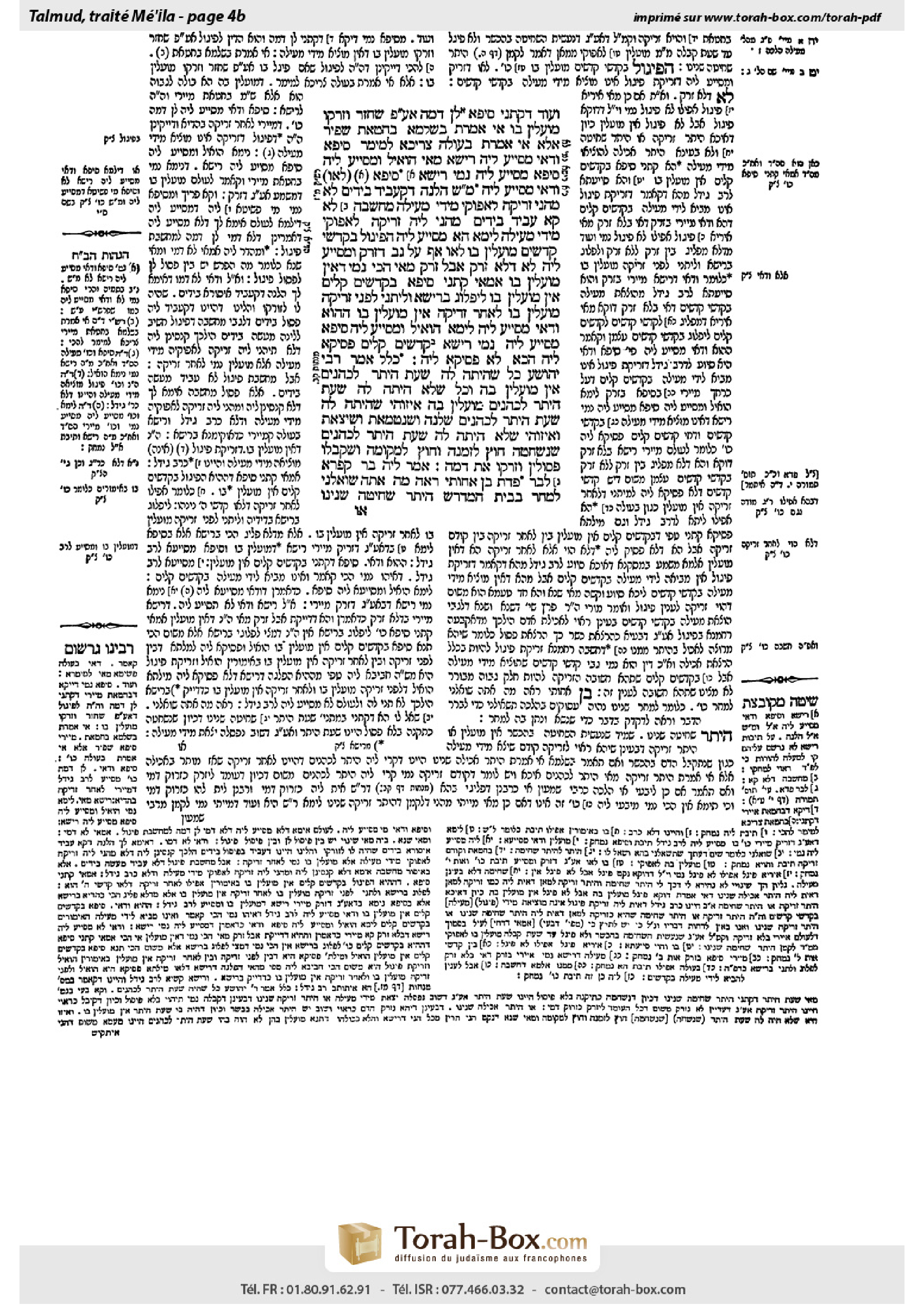
Meilah 4b: Talmud study for Daf Yomi
Daf Yomi is the daily study of one Talmud folio. Explore 37 tractates with scans, Hebrew text, Sefaria English and AI-generated French translations where annotated.
Passage selection and English or AI-generated French translation are available where the scan has annotations. Daf Study is independent of Torah-Box and Sefaria.
Browse Meilah · מעילה · All tractatesMeilah 4b text and translations
This page of Meilah includes the Aramaic text, an English translation and an AI-generated French translation, alongside the scan above.
מעילה ד׳ ב · Aramaic and Hebrew text
וְעוֹד, דְּקָתָנֵי סֵיפָא: לָן דָּמָהּ, אַף עַל פִּי שֶׁחָזַר וּזְרָקוֹ – מוֹעֲלִין בּוֹ.
אִי אָמְרַתְּ בִּשְׁלָמָא בְּחַטָּאת – שַׁפִּיר.
אֶלָּא אִי אָמְרַתְּ בְּעוֹלָה – צְרִיכָא לְמֵימַר?
סֵיפָא וַדַּאי מְסַיַּיע לֵיהּ. רֵישָׁא, מַאי? הוֹאִיל וּמְסַיַּיע לֵיהּ סֵיפָא, מְסַיַּיע לֵיהּ נָמֵי רֵישָׁא?
סֵיפָא לָאו וַדַּאי מְסַיַּיע לֵיהּ: מַאי שְׁנָא הֲלָנָה – דְּקָעָבֵיד בְּיָדַיִם, לָא מַהְנֵי זְרִיקָה לְאַפּוֹקֵי מִידֵי מְעִילָה.
מַחְשָׁבָה – לָא קָא עָבֵיד בְּיָדַיִם, מַהְנֵי לֵיהּ זְרִיקָה לְאַפּוֹקֵי מִידֵי מְעִילָה.
לֵימָא הָא מְסַיַּיע לֵיהּ: הַפִּיגּוּל בְּקׇדְשֵׁי קָדָשִׁים – מוֹעֲלִין בּוֹ. לָאו אַף עַל גַּב דְּזָרַק וּמְסַיַּיע לֵיהּ! לָא, דְּלֹא זָרַק.
אֲבָל זָרַק, מַאי? הָכִי נָמֵי דְּאֵין מוֹעֲלִין בּוֹ? אַמַּאי קָתָנֵי סֵיפָא: בְּקָדָשִׁים קַלִּים – אֵין מוֹעֲלִין בּוֹ?
לִיפְלוֹג בְּרֵישָׁא, וְלִיתְנֵי: לִפְנֵי זְרִיקָה – מוֹעֲלִין בּוֹ, לְאַחַר זְרִיקָה – אֵין מוֹעֲלִין בּוֹ! הָהוּא וַדַּאי מְסַיַּיע לֵיהּ.
לֵימָא הוֹאִיל וּמְסַיַּיע לֵיהּ סֵיפָא מְסַיַּיע לֵיהּ נָמֵי רֵישָׁא? קָדָשִׁים קַלִּים – פְּסִיקָא לֵיהּ, הָכָא – לָא פְּסִיקָא לֵיהּ.
כְּלָל אָמַר רַבִּי יְהוֹשֻׁעַ: כֹּל שֶׁהָיְתָה לָהּ שְׁעַת הֶיתֵּר לַכֹּהֲנִים – אֵין מוֹעֲלִין בָּהּ, וְכֹל שֶׁלֹּא הָיְתָה לָהּ שְׁעַת הֶיתֵּר לַכֹּהֲנִים – מוֹעֲלִין בָּהּ.
אֵיזוֹהִי שֶׁהָיְתָה לָהּ שְׁעַת הֶיתֵּר לַכֹּהֲנִים? שֶׁלָּנָה, וְשֶׁנִּטְמֵאת, וְשֶׁיָּצָאת.
וְאֵיזוֹהִי שֶׁלֹּא הָיְתָה לָהּ שְׁעַת הֶיתֵּר לַכֹּהֲנִים? שֶׁנִּשְׁחֲטָה חוּץ לִזְמַנָּהּ, וְחוּץ לִמְקוֹמָהּ, וְשֶׁקִּבְּלוּ פְּסוּלִין וְזָרְקוּ אֶת דָּמָהּ.
אֲמַר לֵיהּ בַּר קַפָּרָא לְבַר פְּדָת: בֶּן אֲחוֹתִי, רְאֵה מָה אַתָּה שׁוֹאֲלֵנִי לְמָחָר בְּבֵית הַמִּדְרָשׁ: הֶיתֵּר שְׁחִיטָה שָׁנִינוּ,
Meilah 4b · English translation
And furthermore, one may cite proof for the opinion of Rav Giddel from that baraita, as the latter clause of the baraita teaches: If its blood was left overnight instead of being sprinkled on the altar on the day it was slaughtered, even though the priest later sprinkled it on the following day, nevertheless, one who derives benefit from it is liable for misuse of consecrated property.
The Gemara analyzes this statement of the baraita: Granted, if you say that the baraita is referring to a sin offering, then it is well. Since the blood was disqualified for sprinkling by being left overnight, it does not become permitted to the priests even after the blood is sprinkled, and is therefore subject to the halakhot of misuse. But if the blood had not been left overnight, the offering would not be subject to the halakhot of misuse, as the sprinkling would have removed the sin offering from that category due to the fact that it became permitted for the priests.
But if you say that the baraita is referring to a burnt offering, does it need to be said that it is still subject to the halakhot of misuse? A burnt offering remains subject to the halakhot of misuse even if the blood had not been left overnight and the sprinkling was performed properly, as it never becomes permitted to the priests.
The Gemara comments: The latter clause of the baraita certainly supports the opinion of Rav Giddel, as it clearly shows that an unfit sprinkling does not remove an offering from being subject to the halakhot of misuse. But with regard to the first clause of the baraita, what does it teach concerning the opinion of Rav Giddel? Is it reasonable to say that since the latter clause of the baraita supports the opinion of Rav Giddel, the earlier clause, which states that piggul is always subject to the halakhot of misuse, also supports his opinion?
The Gemara rejects this suggestion: It is not even certain that the latter clause supports Rav Giddel, as it is possible that although the sprinkling of blood that was left overnight does not remove an offering from being subject to the halakhot of misuse, nevertheless, sprinkling after piggul does achieve this. The Gemara clarifies: What is the difference between the two cases? The difference is with regard to leaving the blood overnight, where it is performed in relation to an action, i.e., the priest failed to act in the proper manner, sprinkling the blood is not effective to remove the offering from the status of being subject to the halakhot of misuse.
By contrast, in the case of sprinkling after piggul, where the disqualification is merely a function of intent, which is not performed in relation to an action, perhaps sprinkling the blood is effective to remove the offering from the status of being subject to the halakhot of misuse.
The Gemara suggests: Let us say that this baraita supports the opinion of Rav Giddel: With regard to an offering of the most sacred order that is piggul, one who derives benefit from it is liable for misuse of consecrated property.Does this not mean that it is subject to the halakhot of misuse even though the priest sprinkled its blood, and if so this baraita supports Rav Giddel’s opinion? The Gemara rejects this suggestion: No, one cannot cite a proof from this baraita, as it is possible that it is referring to a case where the priest did not yet sprinkle the blood.
The Gemara asks: But if that is so, what, then, is the halakha if the priest did sprinkle the blood? Is the halakha indeed that one is not liable for misusing it? If so, why is it taught in the latter clause of the baraita: Unlike an offering of the most sacred order, in the case of an offering of lesser sanctity, one who derives benefit from it is not liable for misuse of consecrated property?
The Gemara explains the difficulty: If there is a difference between whether or not the priest sprinkled the blood, let the baraita distinguish and teach the distinction in the first clause, with regard to the case of offerings of the most sacred order itself, as follows: Before the sprinkling of the blood one is liable for misusing the offering, but after the sprinkling of the blood one is not liable for misusing it. It is not necessary to mention offerings of lesser sanctity at all. The Gemara concludes: That statement in the latter clause of the baraita certainly supports Rav Giddel’s opinion.
The Gemara suggests: Shall we say that since the latter clause supports the opinion of Rav Giddel, the first clause also supports his opinion? The Gemara again answers that even the latter clause does not necessarily support the opinion of Rav Giddel, as one can explain that the reason the baraita distinguishes between offerings of the most sacred order and offerings of lesser sanctity, rather than providing a distinction within the category of offerings of the most sacred order itself, is that the case of offerings of lesser sanctity is clear-cut, i.e., all cases of offerings of lesser sanctity that are piggul are not subject to the halakhot of misuse. By contrast, here in the case of offerings of the most sacred order, it is not clear-cut, as there is a difference depending on the sprinkling of the blood.
§ The mishna teaches that Rabbi Yehoshua said a principle with regard to misuse of disqualified sacrificial animals: With regard to any sacrificial animal that had a period of fitness to the priests before it was disqualified, one is not liable for misusing it. Misuse fundamentally applies to items consecrated to God, which are not permitted for human consumption at all. Once the offering was permitted for consumption by the priests, it is no longer in that category. And with regard to any sacrificial animal that did not have a period of fitness for the priests before it was disqualified, one is liable for misusing it, as it remained consecrated to God throughout.
The mishna clarifies: Which is the sacrificial animal that had a period of fitness for the priests? This category includes a sacrificial animal whose meat remained overnight after it was properly sacrificed, and was therefore disqualified as notar, and one that was disqualified when it became ritually impure after it was properly sacrificed, and one that left the Temple courtyard after it was properly sacrificed and was thereby disqualified. All of these disqualifications transpired after consumption of the sacrificial meat was permitted, and therefore one who derives benefit from these offerings is not liable for misuse.
And which is the sacrificial animal that did not have a period of fitness for the priests? It is a sacrificial animal that was slaughtered with the intent to partake of it or sprinkle its blood or sacrifice its sacrificial portions beyond its designated time, or outside its designated area, or one that those unfit for Temple service collected and sprinkled its blood. All of these disqualifications occurred before consumption of the sacrificial meat was permitted by means of the sprinkling of the blood. Therefore, these offerings remain consecrated to God and one is liable for misuse if one derives benefit from them.
With regard to this matter, the Gemara relates that bar Kappara said to bar Pedat: My sister’s son, look into the topic of the question that you will ask me tomorrow in the study hall. The question involved the interpretation of Rabbi Yehoshua’s statement: Any sacrificial animal that had a period of fitness to the priests. Was it fitness of slaughtering that we learned, i.e., provided that it was slaughtered properly, even if the offering was later disqualified, it is no longer subject to the halakhot of misuse.
Meilah 4b · Traduction française (IA)
Et de plus, on peut apporter une preuve à l’appui de l’opinion de Rav Giddel à partir de cette baraïta, car sa dernière partie enseigne : si le sang de l’offrande est resté toute la nuit au lieu d’être aspergé sur l’autel le jour où l’animal a été égorgé, même si le prêtre l’a aspergé le lendemain, celui qui en tire profit est néanmoins passible pour usage illicite de biens consacrés.
La Guemara analyse cette déclaration de la baraïta : certes, si l’on dit que la baraïta parle d’un sacrifice expiatoire, cela se comprend. Puisque le sang a été rendu impropre à l’aspersion parce qu’il est resté toute la nuit, l’offrande ne devient pas permise aux prêtres, même après l’aspersion du sang ; elle reste donc soumise aux halakhot de l’usage illicite. En revanche, si le sang n’était pas resté toute la nuit, l’offrande ne serait pas soumise aux halakhot de l’usage illicite, puisque l’aspersion aurait fait sortir le sacrifice expiatoire de cette catégorie, dès lors qu’il serait devenu permis aux prêtres.
Mais si l’on dit que la baraïta parle d’un holocauste, faut-il même préciser qu’il reste soumis aux halakhot de l’usage illicite ? Un holocauste reste soumis à ces halakhot même si le sang n’est pas resté toute la nuit et que l’aspersion a été effectuée correctement, puisqu’il ne devient jamais permis aux prêtres.
La Guemara fait remarquer : la dernière partie de la baraïta appuie certainement l’opinion de Rav Giddel, car elle montre clairement qu’une aspersion impropre ne fait pas sortir une offrande de la catégorie des biens soumis aux halakhot de l’usage illicite. Mais que nous enseigne la première partie de la baraïta au sujet de l’opinion de Rav Giddel ? Est-il raisonnable de dire que, puisque la dernière partie de la baraïta appuie l’opinion de Rav Giddel, la première partie, qui affirme que le piggul est toujours soumis aux halakhot de l’usage illicite, appuie elle aussi son opinion ?
La Guemara rejette cette suggestion : il n’est même pas certain que la dernière partie appuie l’opinion de Rav Giddel, car il est possible que, bien que l’aspersion du sang resté toute la nuit ne fasse pas sortir une offrande de la catégorie des biens soumis aux halakhot de l’usage illicite, l’aspersion après un piggul y parvienne. La Guemara précise : quelle est la différence entre les deux cas ? Elle concerne le sang resté toute la nuit : puisque cela résulte d’une action, à savoir que le prêtre n’a pas agi comme il convenait, l’aspersion du sang ne fait pas sortir l’offrande du statut de bien soumis aux halakhot de l’usage illicite.
En revanche, dans le cas d’une aspersion après un piggul, où l’invalidation découle simplement d’une intention, laquelle ne se traduit pas par une action, il se peut que l’aspersion du sang fasse sortir l’offrande du statut de bien soumis aux halakhot de l’usage illicite.
La Guemara suggère : disons que cette baraïta appuie l’opinion de Rav Giddel : pour une offrande de sainteté suprême qui est piggul, celui qui en tire profit est passible pour usage illicite de biens consacrés. Cela ne signifie-t-il pas qu’elle reste soumise aux halakhot de l’usage illicite même si le prêtre a aspergé son sang, auquel cas cette baraïta appuie l’opinion de Rav Giddel ? La Guemara rejette cette suggestion : non, on ne peut pas apporter de preuve à partir de cette baraïta, car il est possible qu’elle parle d’un cas où le prêtre n’a pas encore aspergé le sang.
La Guemara demande : mais si tel est le cas, quelle est alors la halakha si le prêtre a aspergé le sang ? La halakha est-elle vraiment qu’on n’est pas passible pour en avoir fait un usage illicite ? Si tel est le cas, pourquoi la dernière partie de la baraïta enseigne-t-elle : contrairement à une offrande de sainteté suprême, dans le cas d’une offrande de moindre sainteté, celui qui en tire profit n’est pas passible pour usage illicite de biens consacrés ?
La Guemara expose la difficulté : s’il existe une différence selon que le prêtre a aspergé le sang ou non, que la baraïta établisse cette distinction dans sa première partie, à propos des offrandes de sainteté suprême elles-mêmes, de la manière suivante : avant l’aspersion du sang, on est passible pour usage illicite de l’offrande ; après l’aspersion du sang, on ne l’est pas. Il n’est pas nécessaire de mentionner les offrandes de moindre sainteté. La Guemara conclut : cette déclaration de la dernière partie de la baraïta appuie certainement l’opinion de Rav Giddel.
La Guemara suggère : faut-il dire que, puisque la dernière partie appuie l’opinion de Rav Giddel, la première partie appuie elle aussi son opinion ? La Guemara répond de nouveau que même la dernière partie n’appuie pas nécessairement l’opinion de Rav Giddel : on peut expliquer que si la baraïta distingue les offrandes de sainteté suprême des offrandes de moindre sainteté, au lieu d’établir une distinction au sein même de la catégorie des offrandes de sainteté suprême, c’est parce que le cas des offrandes de moindre sainteté est clair : toutes les offrandes de moindre sainteté qui sont piggul ne sont pas soumises aux halakhot de l’usage illicite. En revanche, dans le cas des offrandes de sainteté suprême, la situation n’est pas aussi claire, car elle varie selon que le sang a été aspergé ou non.
§ La Michna enseigne que Rabbi Yehoshua a formulé un principe concernant l’usage illicite d’animaux sacrificiels invalidés : pour tout animal sacrificiel qui a été apte à la consommation des prêtres pendant un certain temps avant d’être invalidé, on n’est pas passible pour en faire un usage illicite. En principe, l’usage illicite s’applique aux biens consacrés à Dieu, qui ne sont absolument pas permis à la consommation humaine. Dès lors que l’offrande a été permise à la consommation des prêtres, elle ne relève plus de cette catégorie. Et pour tout animal sacrificiel qui n’a pas été apte à la consommation des prêtres avant d’être invalidé, on est passible pour en faire un usage illicite, car il est resté consacré à Dieu sans interruption.
La Michna précise : quel est l’animal sacrificiel qui a été apte à la consommation des prêtres pendant un certain temps ? Cette catégorie comprend un animal sacrificiel dont la viande est restée toute la nuit après que le sacrifice a été accompli correctement et qui a donc été invalidé comme notar ; un animal qui a été invalidé parce qu’il est devenu rituellement impur après que le sacrifice a été accompli correctement ; et un animal qui, après que le sacrifice a été accompli correctement, est sorti de la cour du Temple et a ainsi été invalidé. Toutes ces invalidations sont survenues après que la consommation de la viande sacrificielle a été permise ; par conséquent, celui qui tire profit de ces offrandes n’est pas passible pour usage illicite.
Et quel est l’animal sacrificiel qui n’a pas été apte à la consommation des prêtres pendant un certain temps ? C’est un animal sacrificiel qui a été égorgé avec l’intention d’en consommer la viande, d’en asperger le sang ou d’offrir ses portions sacrificielles après le temps fixé ou hors de l’aire désignée ; ou un animal dont le sang a été recueilli et aspergé par des personnes inaptes au service du Temple. Toutes ces invalidations sont survenues avant que l’aspersion du sang ne permette la consommation de la viande sacrificielle. Ces offrandes restent donc consacrées à Dieu, et celui qui en tire profit est passible pour usage illicite.
À ce sujet, la Guemara rapporte que bar Kappara dit à bar Pedat : « Mon neveu, examine la question que tu me poseras demain dans la maison d’étude. » La question portait sur l’interprétation de la déclaration de Rabbi Yehoshua : « Tout animal sacrificiel qui a été apte à la consommation des prêtres pendant un certain temps. » S’agissait-il de l’aptitude à être égorgé dont nous avons parlé, c’est-à-dire que, pourvu que l’animal ait été égorgé correctement, même si l’offrande a ensuite été invalidée, elle n’est plus soumise aux halakhot de l’usage illicite ?
Traduction française générée par IA à partir de l’édition anglaise de Sefaria. Vérifie toujours un passage avec le texte source.
Text from Sefaria: William Davidson Edition - Vocalized Aramaic (CC BY NC); William Davidson Edition - English (CC BY NC).