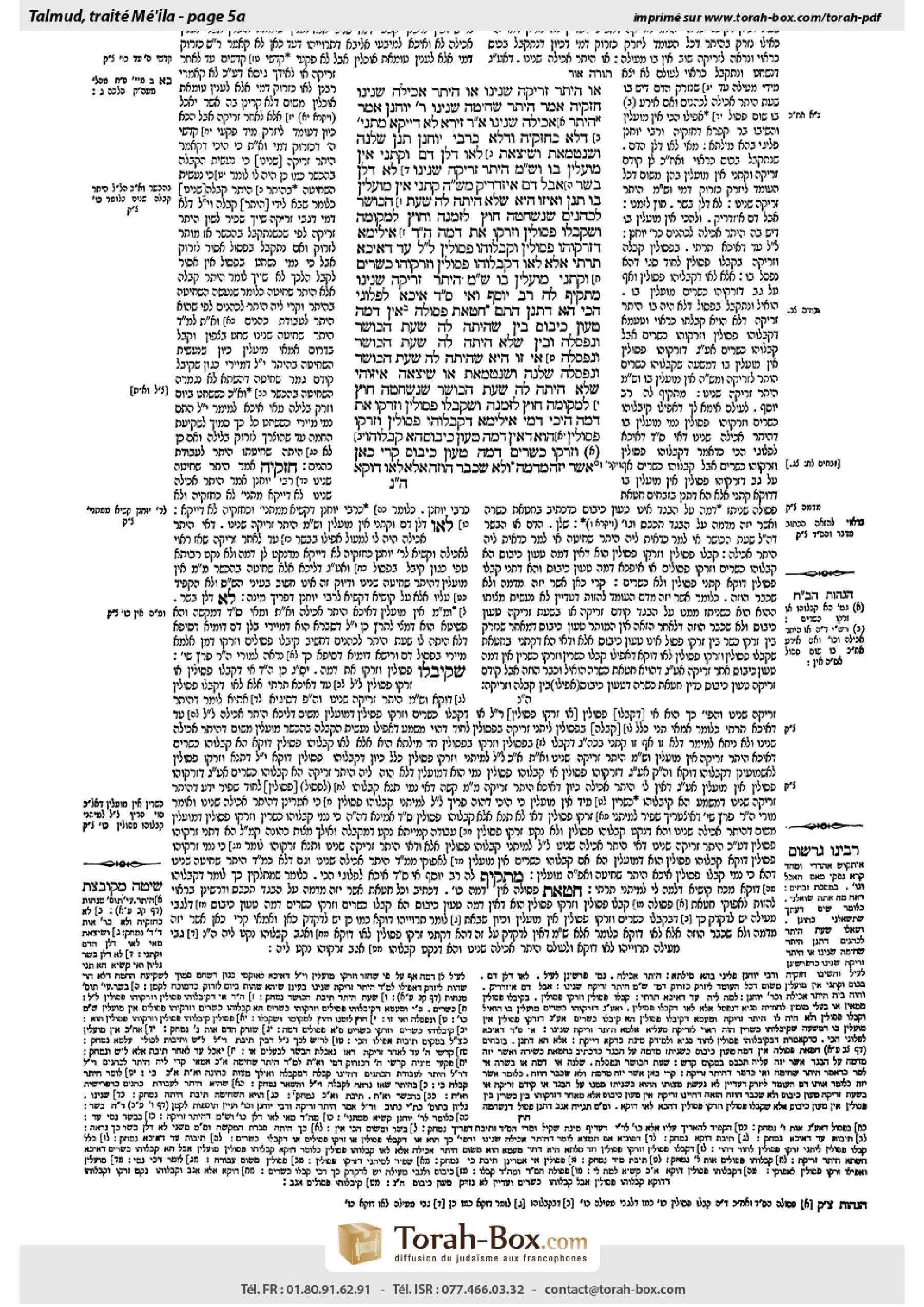
Meilah 5a: Talmud study for Daf Yomi
Daf Yomi is the daily study of one Talmud folio. Explore 37 tractates with scans, Hebrew text, Sefaria English and AI-generated French translations where annotated.
Passage selection and English or AI-generated French translation are available where the scan has annotations. Daf Study is independent of Torah-Box and Sefaria.
Browse Meilah · מעילה · All tractatesMeilah 5a text and translations
This page of Meilah includes the Aramaic text, an English translation and an AI-generated French translation, alongside the scan above.
מעילה ה׳ א · Aramaic and Hebrew text
אוֹ הֶיתֵּר זְרִיקָה שָׁנִינוּ, אוֹ הֶיתֵּר אֲכִילָה שָׁנִינוּ? חִזְקִיָּה אָמַר: הֶיתֵּר שְׁחִיטָה שָׁנִינוּ, רַבִּי יוֹחָנָן אָמַר: הֶיתֵּר אֲכִילָה שָׁנִינוּ.
אָמַר רַבִּי זֵירָא: לָא דַּיְיקָא מַתְנִיתִין דְּלָא כְּחִזְקִיָּה וּדְלָא כְּרַבִּי יוֹחָנָן.
תְּנַן: שֶׁלָּנָה, וְשֶׁנִּטְמֵאת, וְשֶׁיָּצָאת. לָאו דְּלָן דָּם, וְקָתָנֵי: אֵין מוֹעֲלִין בּוֹ,
וּשְׁמַע מִינַּהּ: הֶיתֵּר זְרִיקָה שָׁנִינוּ!
לָא, דְּלָן בָּשָׂר, אֲבָל דָּם אִיזְדְּרִיק, מִשּׁוּם הָכִי קָתָנֵי: אֵין מוֹעֲלִין בּוֹ.
תְּנַן: וְאֵיזוֹ הִיא שֶׁלֹּא הָיְתָה לָהּ שְׁעַת הַכּוֹשֶׁר לַכֹּהֲנִים? שֶׁנִּשְׁחֲטָה חוּץ לִזְמַנָּהּ, וְחוּץ לִמְקוֹמָהּ, וְשֶׁקִּבְּלוּ פְּסוּלִין וְזָרְקוּ אֶת דָּמָהּ.
הֵיכִי דָּמֵי, אִילֵּימָא דִּזְרָקוּהוּ פְּסוּלִין וְקִבְּלוּהוּ פְּסוּלִין – לְמָה לִי עַד דְּאִיכָּא תַּרְתֵּי?
אֶלָּא לָאו דְּקִבְּלוּהוּ פְּסוּלִין וּזְרָקוּהוּ כְּשֵׁרִים, וְקָתָנֵי מוֹעֲלִין בּוֹ,
שְׁמַע מִינַּהּ: הֶיתֵּר זְרִיקָה שָׁנִינוּ.
מַתְקֵיף לַהּ רַב יוֹסֵף: וְאִי סָלְקָא דַּעְתָּךְ אִיכָּא לְפַלּוֹגֵי הָכִי, הָא דִּתְנַן הָתָם:
חַטָּאת פְּסוּלָה – אֵין דָּמָהּ טָעוּן כִּיבּוּס, בֵּין שֶׁהָיְתָה לָהּ שְׁעַת הַכּוֹשֶׁר וְנִפְסְלָה, וּבֵין שֶׁלֹּא הָיְתָה לָהּ שְׁעַת הַכּוֹשֶׁר וְנִפְסְלָה.
אִי זוֹ הִיא שֶׁהָיְתָה לָהּ שְׁעַת הַכּוֹשֶׁר וְנִפְסְלָה? שֶׁלָּנָה, וְשֶׁנִּטְמֵאת, אוֹ שֶׁיָּצְאָה.
אֵיזוֹהִי שֶׁלֹּא הָיְתָה לָהּ שְׁעַת הַכּוֹשֶׁר? שֶׁנִּשְׁחֲטָה חוּץ לִמְקוֹמָהּ, חוּץ לִזְמַנָּהּ, וְשֶׁקִּבְּלוּ פְּסוּלִין וְזָרְקוּ אֶת דָּמָהּ.
הֵיכִי דָמֵי? אִילֵּימָא דְּקִבְּלוּהוּ פְּסוּלִין וְזָרְקוּ פְּסוּלִין – הוּא דְּאֵין דָּמָהּ טָעוּן כִּיבּוּס, הָא קִבְּלוּהוּ וְזָרְקוּ כְּשֵׁרִים – דָּמָהּ טָעוּן כִּיבּוּס.
קְרִי כָּאן: ״אֲשֶׁר יִזֶּה מִדָּמָהּ״ – וְלֹא שֶׁכְּבָר הוּזָּה? אֶלָּא: לָאו דַּוְקָא,
Meilah 5a · English translation
Or was it fitness of sprinkling of the blood that we learned, i.e., once the blood is ready to be sprinkled, even if it was not sprinkled yet, the offering is no longer subject to the halakhot of misuse? Or was it fitness of consuming the meat of the offering that we learned? In other words, is it only after the blood was actually sprinkled properly, and the meat of the offering is permitted to be consumed by the priests, that the offering is no longer subject to the halakhot of misuse? The Gemara cites the different opinions with regard to this matter: Ḥizkiyya says: It was fitness of slaughtering that we learned, whereas Rabbi Yoḥanan says: It was fitness of consuming the meat of the offering that we learned.
The Gemara further discusses this matter. Rabbi Zeira says: The mishna is not precisely in accordance with the opinion of Ḥizkiyya nor precisely in accordance with the opinion of Rabbi Yoḥanan, i.e., a close reading of the mishna does not conform to either of their interpretations of the phrase: A period of fitness.
Rabbi Zeira elaborates: We learned in the mishna, in its list of examples of offerings that were disqualified after a period of fitness: A sacrificial animal that remained overnight after its blood was sacrificed on the altar and was therefore disqualified as notar, and one that was disqualified when it became ritually impure, and one that left the Temple courtyard and was thereby disqualified. Isn’t the case of remaining overnight referring to a situation where the blood remained overnight and was not sprinkled after it was collected in a cup? And yet the mishna teaches: One is not liable for misusing it, as there was a period of fitness.
And therefore, one can learn from the mishna that it was fitness of sprinkling of the blood that we learned. Since the slaughtering and collecting of the blood was performed properly, the offering is no longer subject to the halakhot of misuse, despite the fact that the blood was not actually sprinkled. This is not in accordance with the opinion of Ḥizkiyya or with the opinion of Rabbi Yoḥanan.
The Gemara rejects this conclusion: No, the mishna is not referring to a case where the blood had not been sprinkled. Rather, it is dealing with a case where the meat was left overnight, but the blood had already been sprinkled properly. It is due to this that the mishna teaches: One is not liable for misusing it, as there was a period of fitness of consuming the meat, as stated by Rabbi Yoḥanan.
The Gemara further analyzes Rabbi Yehoshua’s statement. We learned in the mishna: And which is the sacrificial animal that did not have a period of fitness for the priests? It is a sacrificial animal that was slaughtered with the intent to partake of it or sprinkle its blood beyond its designated time, or outside its designated area, or one that those who are unfit for Temple service collected its blood for use in the sacrificial rite and sprinkled its blood.
What are the circumstances referred to in the mishna, with regard to people who are unfit for collecting and sprinkling the blood? If we say that the mishna is dealing with a case where the blood was both sprinkled by those who are unfit for Temple service and the blood was also collected by those who are unfit for Temple service, this is difficult: Why do I need to say that it is not disqualified until there are two actions, collecting and sprinkling, which were performed improperly? After all, the offering is disqualified as soon as those who are unfit for Temple service collect the blood.
Rather, is it not referring to a case where the blood was collected by those who are unfit for Temple service but sprinkled by those who are fit? And the mishna thereby teaches us that it is only in this case that one is liable for misusing it. This is due to the fact that there was no period of fitness for sprinkling the blood. By contrast, had the blood been collected by those who are fit for Temple service, where the blood is fit for sprinkling, the offering would no longer be subject to the halakhot of misuse, even if it was sprinkled by those who are unfit for Temple service.
If so, one can learn from the mishna that it is fitness of sprinkling of the blood that we learned. In other words, already at this stage the offering is no longer subject to the halakhot of misuse, despite the fact that the blood was not actually sprinkled. This is not in accordance with the opinion of Ḥizkiyya or the opinion of Rabbi Yoḥanan.
Rav Yosef objects to this interpretation of the mishna: But if it enters your mind that there is a way to make this distinction in the mishna, between a case where the blood was collected by those who are unfit for Temple service and sprinkled by those who are fit and a situation where it was collected by those who are fit for Temple service and sprinkled by those who are unfit, then this would present a difficulty with regard to that which we learned in a mishna there (Zevaḥim 92a).
The Gemara cites the relevant mishna: With regard to a disqualified sin offering, its blood does not cause a garment to require laundering whether the offering had a period of fitness when its blood was fit for presentation or whether it did not have a period of fitness. In either case, as the offering is currently unfit, its blood does not require laundering.
The mishna proceeds to explain: Which offering is the disqualified sin offering that had a period of fitness and was then disqualified? It is one that was left overnight and then became disqualified as notar; or it is one that became ritually impure; or it is one that left the Temple courtyard.
Which offering is the disqualified sin offering that did not have a period of fitness? It is one that was slaughtered with the intent to eat it or present its blood beyond its designated time or outside its designated area; or it is one whose blood was collected by people disqualified for Temple service and they sprinkled its blood.
Rav Yosef analyzes this mishna: What are the circumstances of the mishna’s case? If we say that the mishna is referring specifically to a situation where the blood was both collected by those who are unfit for Temple service and also sprinkled by those who are unfit for Temple service, and it is only in such a case that its blood does not cause a garment to require laundering, it may be inferred that if the blood was collected by those who are fit for Temple service and sprinkled by those who are unfit, or collected by those who are unfit and sprinkled by those who are fit, then its blood does cause a garment to require laundering. But this inference is difficult: It is not possible to interpret the mishna in such a manner, as that conclusion is incorrect.
The Gemara explains why the above conclusion is untenable: Read here the verse that states, with regard to laundering a garment on which the blood of a sin offering was sprayed: “And if any of its blood is sprinkled on a garment, you shall wash that upon which it was sprinkled in a holy place” (Leviticus 6:20). The Sages infer from the verse that this halakha applies only to the blood of a sin offering that has not yet been sprinkled, and not to blood of a sin offering whose blood had already been sprinkled. Rather, one can conclude that the language of the mishna with regard to the topic of the blood of a sin offering is not exact, as the same halakha applies even if the blood was collected and sprinkled by those who are fit.
Meilah 5a · Traduction française (IA)
Ou bien avons-nous appris que l’offrande cesse d’être soumise aux halakhot du détournement dès que le sang est apte à être aspergé, même s’il ne l’a pas encore été ? Ou bien avons-nous appris qu’elle cesse de l’être seulement lorsque la viande de l’offrande est apte à être consommée ? Autrement dit, est-ce seulement après que le sang a été aspergé comme il convient et que la viande de l’offrande est permise à la consommation des prêtres que l’offrande cesse d’être soumise aux halakhot du détournement ? La Guemara rapporte les différents avis sur cette question : Ḥizkiyya dit : Nous avons appris qu’il s’agit de l’aptitude à l’abattage, tandis que Rabbi Yoḥanan dit : Nous avons appris qu’il s’agit de l’aptitude à la consommation de la viande de l’offrande.
La Guemara poursuit l’examen de cette question. Rabbi Zeira dit : La Michna ne correspond précisément ni à l’avis de Ḥizkiyya ni à celui de Rabbi Yoḥanan ; autrement dit, une lecture attentive de la Michna ne concorde avec aucune de leurs interprétations de l’expression « période d’aptitude ».
Rabbi Zeira précise : Nous avons appris dans la Michna, dans sa liste d’exemples d’offrandes disqualifiées après une période d’aptitude : un animal sacrificiel dont le sang a été sacrifié sur l’autel et dont la viande est ensuite restée toute la nuit, de sorte qu’elle a été disqualifiée comme notar ; un animal devenu rituellement impur ; et un animal qui a quitté le parvis du Temple et a ainsi été disqualifié. Le cas où la viande est restée toute la nuit ne désigne-t-il pas une situation où le sang est resté toute la nuit, sans être aspergé après avoir été recueilli dans un récipient ? Pourtant, la Michna enseigne qu’on n’est pas passible pour son détournement, puisqu’il y a eu une période d’aptitude.
On peut donc déduire de la Michna que nous avons appris qu’il s’agit de l’aptitude à l’aspersion du sang. Puisque l’abattage et le recueil du sang ont été accomplis comme il convient, l’offrande cesse d’être soumise aux halakhot du détournement, bien que le sang n’ait pas été effectivement aspergé. Cela ne correspond ni à l’avis de Ḥizkiyya ni à celui de Rabbi Yoḥanan.
La Guemara rejette cette conclusion : Non, la Michna ne parle pas d’un cas où le sang n’a pas été aspergé. Elle traite plutôt d’un cas où la viande est restée toute la nuit, alors que le sang avait déjà été aspergé comme il convient. C’est pourquoi la Michna enseigne qu’on n’est pas passible pour son détournement, puisqu’il y a eu une période d’aptitude à la consommation de la viande, comme l’a dit Rabbi Yoḥanan.
La Guemara examine plus avant la déclaration de Rabbi Yehoshua. Nous avons appris dans la Michna : « Et quel est l’animal sacrificiel qui n’a pas connu de période d’aptitude pour les prêtres ? C’est un animal sacrificiel abattu avec l’intention d’en consommer la viande ou d’en asperger le sang au-delà du délai prévu, ou hors de l’endroit prévu, ou dont le sang a été recueilli pour le rite sacrificiel et aspergé par des personnes inaptes au service du Temple. »
À quelles circonstances la Michna fait-elle référence au sujet des personnes inaptes à recueillir et à asperger le sang ? Si l’on dit qu’elle traite d’un cas où le sang a été à la fois aspergé et recueilli par des personnes inaptes au service du Temple, cela pose une difficulté : pourquoi faut-il préciser que l’offrande n’est disqualifiée qu’après deux actes accomplis de manière irrégulière, le recueil et l’aspersion ? Après tout, l’offrande est disqualifiée dès que des personnes inaptes au service du Temple recueillent le sang.
Ne faut-il pas plutôt comprendre qu’il s’agit d’un cas où le sang a été recueilli par des personnes inaptes au service du Temple, mais aspergé par des personnes aptes ? La Michna nous enseigne ainsi que c’est seulement dans ce cas qu’on est passible pour le détournement de l’offrande. En effet, il n’y a pas eu de période d’aptitude à l’aspersion du sang. En revanche, si le sang avait été recueilli par des personnes aptes au service du Temple, de sorte qu’il était apte à être aspergé, l’offrande aurait cessé d’être soumise aux halakhot du détournement, même si elle avait été aspergée par des personnes inaptes au service du Temple.
Si tel est le cas, on peut déduire de la Michna que nous avons appris qu’il s’agit de l’aptitude à l’aspersion du sang. Autrement dit, dès ce stade, l’offrande cesse d’être soumise aux halakhot du détournement, bien que le sang n’ait pas été effectivement aspergé. Cela ne correspond ni à l’avis de Ḥizkiyya ni à celui de Rabbi Yoḥanan.
Rav Yosef objecte à cette interprétation de la Michna : Mais si l’on peut effectivement faire dans la Michna cette distinction entre un cas où le sang a été recueilli par des personnes inaptes au service du Temple et aspergé par des personnes aptes, et un cas où il a été recueilli par des personnes aptes au service du Temple et aspergé par des personnes inaptes, cela poserait une difficulté au sujet de ce que nous avons appris dans une Michna, là-bas (Zevaḥim 92a).
La Guemara cite la Michna pertinente : Dans le cas d’un sacrifice expiatoire disqualifié, son sang n’impose pas de laver un vêtement, que l’offrande ait connu une période d’aptitude, où son sang était apte à être présenté, ou qu’elle n’en ait pas connu. Dans les deux cas, puisque l’offrande est actuellement inapte, son sang n’impose pas de lavage.
La Michna poursuit son explication : Quel est le sacrifice expiatoire disqualifié qui a connu une période d’aptitude, puis a été disqualifié ? C’est celui dont la viande est restée toute la nuit et qui a alors été disqualifié comme notar ; ou celui qui est devenu rituellement impur ; ou celui qui a quitté le parvis du Temple.
Quel est le sacrifice expiatoire disqualifié qui n’a pas connu de période d’aptitude ? C’est celui qui a été abattu avec l’intention d’en consommer la viande ou de présenter son sang au-delà du délai prévu ou hors de l’endroit prévu ; ou celui dont le sang a été recueilli par des personnes inaptes au service du Temple et aspergé par elles.
Rav Yosef analyse cette Michna : Quelles sont les circonstances du cas dont parle la Michna ? Si l’on dit qu’elle fait spécifiquement référence à une situation où le sang a été à la fois recueilli et aspergé par des personnes inaptes au service du Temple, et que c’est seulement dans un tel cas que le sang n’impose pas de laver un vêtement, on pourrait en déduire que si le sang a été recueilli par des personnes aptes au service du Temple et aspergé par des personnes inaptes, ou recueilli par des personnes inaptes et aspergé par des personnes aptes, alors son sang impose de laver un vêtement. Mais cette déduction pose une difficulté : il est impossible d’interpréter la Michna de cette manière, car cette conclusion est erronée.
La Guemara explique pourquoi cette conclusion ne tient pas : Lis ici le verset qui prescrit le lavage d’un vêtement sur lequel a été aspergé le sang d’un sacrifice expiatoire : « Si une partie de son sang est aspergée sur un vêtement, tu laveras dans un lieu saint ce sur quoi il a été aspergé » (Lévitique 6:20). Les Sages déduisent de ce verset que cette halakha s’applique uniquement au sang d’un sacrifice expiatoire qui n’a pas encore été aspergé, et non au sang d’un sacrifice expiatoire qui a déjà été aspergé. Il faut donc conclure que la formulation de la Michna au sujet du sang d’un sacrifice expiatoire n’est pas précise, car la même halakha s’applique même si le sang a été recueilli et aspergé par des personnes aptes.
Traduction française générée par IA à partir de l’édition anglaise de Sefaria. Vérifie toujours un passage avec le texte source.
Text from Sefaria: William Davidson Edition - Vocalized Aramaic (CC BY NC); William Davidson Edition - English (CC BY NC).