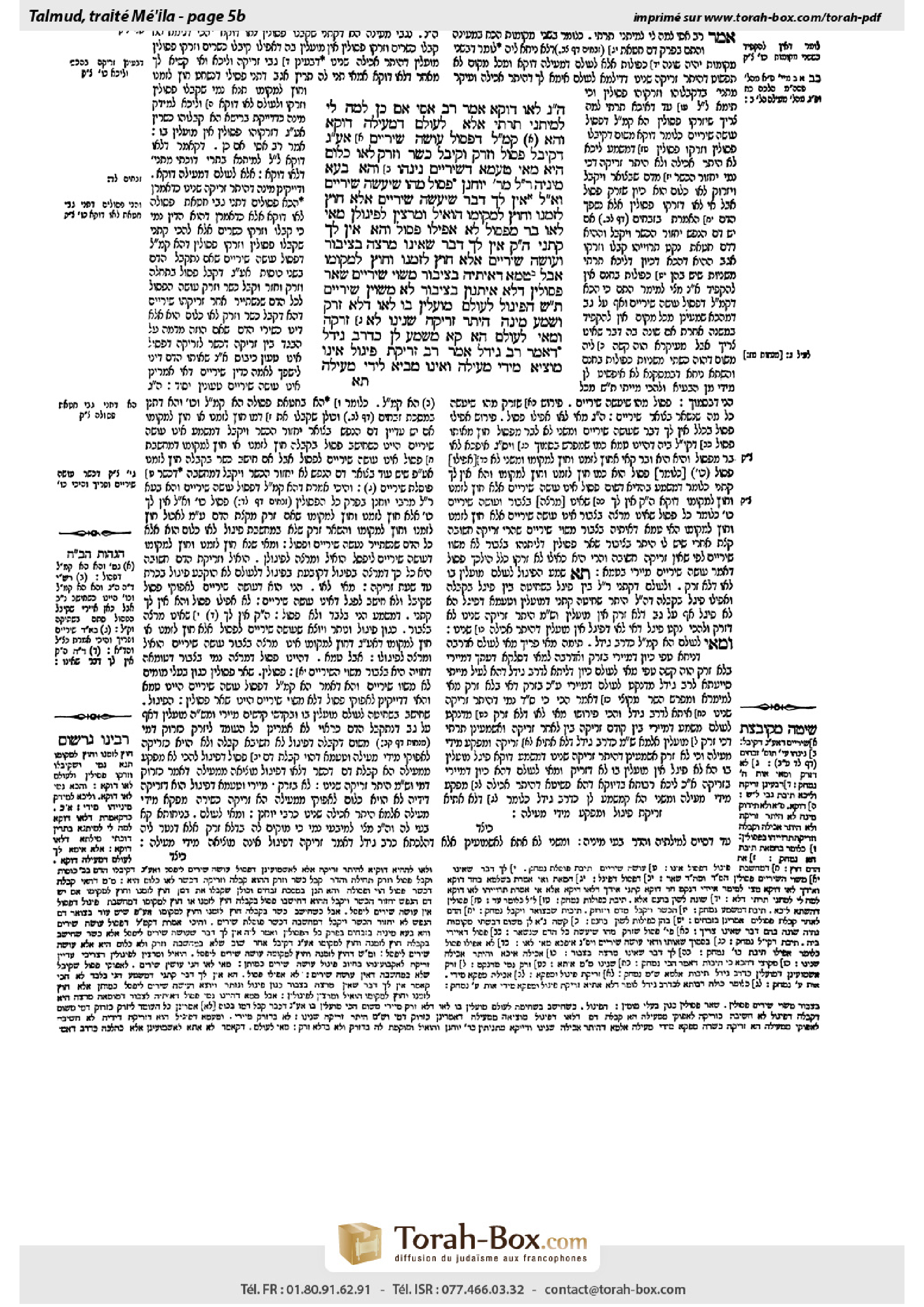
Meilah 5b: Talmud study for Daf Yomi
Daf Yomi is the daily study of one Talmud folio. Explore 37 tractates with scans, Hebrew text, Sefaria English and AI-generated French translations where annotated.
Passage selection and English or AI-generated French translation are available where the scan has annotations. Daf Study is independent of Torah-Box and Sefaria.
Browse Meilah · מעילה · All tractatesMeilah 5b text and translations
This page of Meilah includes the Aramaic text, an English translation and an AI-generated French translation, alongside the scan above.
מעילה ה׳ ב · Aramaic and Hebrew text
הָכִי נָמֵי, לָאו דַּוְקָא. אָמַר רַב אַסִּי: אִם כֵּן, לְמָה לִי לְמִיתְנֵי תַּרְתֵּי?
אֶלָּא לְעוֹלָם דִּמְעִילָה דַּוְקָא,
וְהָא קָא מַשְׁמַע לַן: דְּפָסוּל עוֹשֶׂה שִׁירַיִים,
אַף עַל גַּב דְּקִיבֵּל פָּסוּל וְזָרַק, וְקִיבֵּל כָּשֵׁר וְזָרַק – לָאו כְּלוּם הִיא. מַאי טַעְמָא? דְּשִׁירַיִים נִינְהוּ.
וְהָא בְּעָא מִינֵּיהּ רֵישׁ לָקִישׁ מֵרַבִּי יוֹחָנָן: פָּסוּל, מַהוּ שֶׁיַּעֲשֶׂה שִׁירַיִים?
וַאֲמַר לֵיהּ: אֵין לְךָ דָּבָר שֶׁיַּעֲשֶׂה שִׁירַיִים אֶלָּא חוּץ לִזְמַנּוֹ וְחוּץ לִמְקוֹמוֹ, הוֹאִיל וּמְרַצִּין לְפִיגּוּלָן.
מַאי לָאו, בַּר מִפָּסוּל? לָא, אֲפִילּוּ פָּסוּל.
וְהָא ״אֵין לְךָ״ קָתָנֵי!
הָכִי קָתָנֵי: אֵין לְךָ דָּבָר שֶׁאֵינוֹ מְרַצֶּה בְּצִיבּוּר וְעוֹשֶׂה שִׁירַיִים אֶלָּא חוּץ לִזְמַנּוֹ וְחוּץ לִמְקוֹמוֹ, אֲבָל טָמֵא, דְּאִיתֵיהּ בְּצִיבּוּר – מְשַׁוֵּי שִׁירַיִים,
שְׁאָר פְּסוּלִין דְּלָא אִיתַנּוּן בְּצִיבּוּר – לָא מְשַׁוִּין שִׁירַיִים.
תָּא שְׁמַע: הַפִּיגּוּל – לְעוֹלָם מוֹעֲלִין בּוֹ.
לָאו דְּלֹא זָרַק, וּשְׁמַע מִינַּהּ: הֶיתֵּר זְרִיקָה שָׁנִינוּ!
לָא, זַרְקֵהּ.
וּמַאי ״לְעוֹלָם״? הָא קָא מַשְׁמַע לַן כִּדְרַב גִּידֵּל, דְּאָמַר רַב גִּידֵּל אָמַר רַב: זְרִיקַת פִּיגּוּל – אֵינוֹ מוֹצִיא מִידֵי מְעִילָה, וְאֵינוֹ מֵבִיא לִידֵי מְעִילָה.
Meilah 5b · English translation
If so, one can say that so too the mishna here is not exact, and therefore one cannot infer from it that the halakhot of misuse apply only when those who were unfit for Temple service collected the blood. Rather, the halakhot of misuse are in effect even if those who collected the blood were fit and those who sprinkled it were unfit, which means that the phrase: A period of fitness, can be referring to fitness of consuming the meat of the offering. Rav Asi said: If so, that the mishna is not exact, why do I need the tanna to teach two mishnayot in an inexact manner? It must be that at least one of them is taught in a precise fashion, and for that reason the same style was preserved in the other mishna.
Rather, one must say that only one mishna is imprecise, i.e., the one in Zevaḥim with regard to the blood of a sin offering, and actually the mishna here with regard to misuse of consecrated property is precise, and therefore one can infer that the meaning of the phrase: A period of fitness, is fitness to sprinkle the blood.
And as for the mishna in Zevaḥim, which speaks of those who are unfit for collecting the blood despite the fact that the same halakha applies if those who are fit collected it, this is what it teaches us: That if those who are unfit for Temple service collected some of the blood, it renders the blood, including that which he did not collect, as leftovers. The blood has the same status as the remainder of the blood of a fit offering after some of its blood was sprinkled on the altar.
And consequently, it teaches with regard to a case where the blood was collected in two vessels, that even though the priest who was unfit collected the blood and sprinkled it, and a priest who was fit subsequently collected the blood and sprinkled it, the sprinkling of the fit priest is considered as though he did not do anything. What is the reason for this? The reason is that the blood is considered leftovers.
The Gemara objects: But didn’t Reish Lakish ask Rabbi Yoḥanan: In the case of an individual unfit for Temple service who sprinkled the blood, what is the halakha with regard to the remaining blood? Does the fact that he sprinkled some of the blood render the remaining blood leftovers?
And Rabbi Yoḥanan said to him in response: You do not have a matter of an invalid sprinkling that renders the remaining blood leftovers except for a case where he sprinkled the blood with the intent to consume the offering beyond its designated time or outside its designated area. In these instances it is considered a significant sprinkling, since this sprinkling with improper intent effects acceptance, i.e., it is considered a valid sprinkling with regard to rendering the meat of the offering piggul.
The Gemara analyzes Rabbi Yoḥanan’s statement: What, is it not the case that when he said that only piggul intent renders the blood leftovers, this is to the exclusion of a sprinkling performed by an unfit priest? If so, this would mean that an unfit priest does not render the remainder of the blood leftovers, which contradicts the opinion of Rav Asi. The Gemara rejects this inference: No, even an unfit priest renders the blood leftovers.
The Gemara objects: But Rabbi Yoḥanan taught in a broad manner: You do not have a matter of an invalid sprinkling that renders the remaining blood leftovers except for a case where he sprinkled the blood with the intent to consume the offering beyond its designated time or outside its designated area. Evidently, Rabbi Yoḥanan maintains that the blood is rendered leftovers only in those cases.
The Gemara explains that this is what Rabbi Yoḥanan is teaching: You do not have a matter of an invalid sprinkling that does not effect acceptance in the case of offerings of the community, and yet which renders the remaining blood leftovers, except for a case where he sprinkled the blood with the intent to consume the offering beyond its designated time or outside its designated area. Although these offerings are not sacrificed, nevertheless the sprinklings render the blood leftovers. But Rabbi Yoḥanan was not referring to a ritually impure priest, who is fit to effect acceptance for offerings of the community in a case where the majority of the community is impure, as he does render the remainder of the blood leftovers.
By contrast, with regard to all other invalid sprinklings, which are not fit to effect acceptance in the case of offerings of the community, e.g., a blemished priest, they do not render the blood leftovers. Accordingly, Rav Asi’s comment, that the mishna in Zevaḥim teaches that if those who are unfit for Temple service collect some of the blood they thereby render the blood leftovers, is referring only to an impure priest.
The Gemara further analyzes Rabbi Yehoshua’s phrase: That had a period of fitness to the priests. Come and hear a baraita: With regard to an offering of the most sacred order that is piggul, one who derives benefit from it is always liable for misuse of consecrated property.
The Gemara analyzes this statement: Is this not referring to a case where the priest collected the blood but did not yet sprinkle it? If so, this would mean that it is specifically the collection of the blood after the intent of piggul that does not remove the offering from the halakhot of misuse. One can infer from here that if the blood was collected with the proper intent, i.e., when the offering is not piggul, and is ready to be sprinkled, it does remove the offering from the halakhot of misuse. Accordingly, conclude from the baraita that it is fitness of sprinkling of the blood that we learned in the mishna.
The Gemara rejects this inference: No, one cannot cite a proof from here, as it is possible that the baraita is referring to a case where the priest already sprinkled the blood. If so, the reason that one is liable for misuse is because the sprinkling of piggul does not remove it from the halakhot of misuse. It can therefore be inferred from the baraita that if the offering was not piggul, then the sprinkling would remove it from misuse. This interpretation is in accordance with the opinion that when Rabbi Yehoshua referred to a period of fitness, he meant fitness of consuming the meat of the offering, i.e., only when the blood was sprinkled properly.
And if so, what does the baraita mean when it states that one who derives benefit from an offering that is piggul always remains subject to the halakhot of misuse? This is what the baraita teaches us by this phrase, that the halakha is in accordance with the opinion of Rav Giddel, as Rav Giddel said that Rav said: Sprinkling the blood of an offering with piggul intent does not remove the offering from the status of being subject to the halakhot of misuse, in the case of offerings of the most sacred order. And similarly, such a sprinkling does not bring the sacrificial portions of offerings of lesser sanctity into the status of being subject to the halakhot of misuse.
Meilah 5b · Traduction française (IA)
Si tel est le cas, on peut dire que la Michna ici aussi n’est pas précise, et l’on ne peut donc pas en déduire que les halakhot de l’usage illicite ne s’appliquent que lorsque ceux qui étaient inaptes au service du Temple ont recueilli le sang. Les halakhot de l’usage illicite sont plutôt en vigueur même si ceux qui ont recueilli le sang étaient aptes et ceux qui l’ont aspergé étaient inaptes. Cela signifie que l’expression « une période d’aptitude » peut désigner l’aptitude à consommer la viande de l’offrande. Rav Asi dit : Si tel est le cas, si la Michna n’est pas précise, pourquoi le tanna aurait-il besoin d’enseigner deux Michnayot de manière imprécise ? Il faut qu’au moins l’une d’elles soit enseignée avec précision, et c’est pourquoi la même formulation a été conservée dans l’autre Michna.
Il faut plutôt dire qu’une seule Michna est imprécise, à savoir celle de Zevaḥim concernant le sang d’un sacrifice expiatoire. En réalité, la Michna ici, concernant l’usage illicite des biens consacrés, est précise, et l’on peut donc en déduire que l’expression « une période d’aptitude » désigne l’aptitude à asperger le sang.
Quant à la Michna de Zevaḥim, qui parle de personnes inaptes au service du Temple pour le recueil du sang, alors que la même halakha s’applique si ce sont des personnes aptes qui l’ont recueilli, voici ce qu’elle nous enseigne : si des personnes inaptes au service du Temple ont recueilli une partie du sang, cela rend le sang entier, y compris la partie qu’elles n’ont pas recueillie, assimilable à un reste. Le sang a le même statut que le sang restant d’une offrande apte après qu’une partie de son sang a été aspergée sur l’autel.
Par conséquent, elle enseigne, dans le cas où le sang a été recueilli dans deux récipients, que même si le prêtre inapte a recueilli et aspergé le sang, puis qu’un prêtre apte a ensuite recueilli et aspergé le sang, l’aspersion du prêtre apte est considérée comme n’ayant rien accompli. Pourquoi ? Parce que le sang est considéré comme un reste.
La Guemara objecte : Mais Reish Lakish n’a-t-il pas demandé à Rabbi Yoḥanan : dans le cas d’un individu inapte au service du Temple qui a aspergé le sang, quelle est la halakha concernant le sang restant ? Le fait qu’il ait aspergé une partie du sang rend-il le sang restant assimilable à un reste ?
Rabbi Yoḥanan lui répondit : Il n’existe pas de cas où une aspersion invalide rend le sang restant assimilable à un reste, sauf lorsque le sang a été aspergé avec l’intention de consommer l’offrande après le délai prescrit ou en dehors de l’endroit prescrit. Dans ces cas, l’aspersion est considérée comme significative, car cette aspersion accompagnée d’une intention incorrecte entraîne l’acceptation, c’est-à-dire qu’elle est considérée comme une aspersion valide pour rendre la viande de l’offrande piggul.
La Guemara analyse les propos de Rabbi Yoḥanan : n’est-ce pas que, lorsqu’il a dit que seule une intention de piggul rend le sang assimilable à un reste, il excluait une aspersion effectuée par un prêtre inapte ? Si tel est le cas, cela signifierait qu’un prêtre inapte ne rend pas le reste du sang assimilable à un reste, ce qui contredit l’avis de Rav Asi. La Guemara rejette cette déduction : non, même un prêtre inapte rend le sang assimilable à un reste.
La Guemara objecte : Mais Rabbi Yoḥanan a formulé sa réponse de manière générale : « Il n’existe pas de cas où une aspersion invalide rend le sang restant assimilable à un reste, sauf lorsque le sang a été aspergé avec l’intention de consommer l’offrande après le délai prescrit ou en dehors de l’endroit prescrit. » Il apparaît donc que, selon Rabbi Yoḥanan, le sang ne devient assimilable à un reste que dans ces cas.
La Guemara explique que voici ce qu’enseigne Rabbi Yoḥanan : dans le cas des offrandes de la communauté, il n’existe pas d’aspersion invalide qui n’entraîne pas l’acceptation et qui rende pourtant le sang restant assimilable à un reste, sauf lorsque le sang a été aspergé avec l’intention de consommer l’offrande après le délai prescrit ou en dehors de l’endroit prescrit. Bien que ces offrandes ne soient pas sacrifiées, les aspersions rendent néanmoins le sang assimilable à un reste. Mais Rabbi Yoḥanan ne parlait pas d’un prêtre rituellement impur, qui est apte à entraîner l’acceptation pour les offrandes de la communauté lorsque la majorité de celle-ci est impure ; celui-ci rend bien le reste du sang assimilable à un reste.
En revanche, toutes les autres aspersions invalides, qui ne sont pas aptes à entraîner l’acceptation dans le cas des offrandes de la communauté, par exemple celles effectuées par un prêtre atteint d’un défaut physique, ne rendent pas le sang assimilable à un reste. Ainsi, la remarque de Rav Asi, selon laquelle la Michna de Zevaḥim enseigne que ceux qui sont inaptes au service du Temple rendent le sang assimilable à un reste s’ils en recueillent une partie, ne concerne qu’un prêtre rituellement impur.
La Guemara examine en outre l’expression de Rabbi Yehoshua : « qu’il y eut une période d’aptitude pour les prêtres ». Viens et entends une baraïta : concernant une offrande de très haute sainteté qui est piggul, celui qui en tire profit est toujours passible de l’usage illicite de biens consacrés.
La Guemara analyse cette déclaration : ne s’agit-il pas d’un cas où le prêtre a recueilli le sang, mais ne l’a pas encore aspergé ? Si tel est le cas, cela signifierait que c’est précisément le recueil du sang après une intention de piggul qui ne soustrait pas l’offrande aux halakhot de l’usage illicite. On peut en déduire que, si le sang a été recueilli avec l’intention appropriée, c’est-à-dire lorsque l’offrande n’est pas piggul, et qu’il est prêt à être aspergé, cela soustrait l’offrande aux halakhot de l’usage illicite. Il faut donc conclure de la baraïta que, dans la Michna, nous avons appris qu’il s’agit de l’aptitude à asperger le sang.
La Guemara rejette cette déduction : non, on ne peut pas en apporter la preuve, car il est possible que la baraïta parle d’un cas où le prêtre a déjà aspergé le sang. Si tel est le cas, la raison pour laquelle on est passible de l’usage illicite est que l’aspersion de piggul ne soustrait pas l’offrande aux halakhot de l’usage illicite. On peut donc déduire de la baraïta que, si l’offrande n’était pas piggul, l’aspersion la soustrairait à l’usage illicite. Cette interprétation est conforme à l’avis selon lequel, lorsque Rabbi Yehoshua a parlé d’une période d’aptitude, il entendait l’aptitude à consommer la viande de l’offrande, c’est-à-dire seulement lorsque le sang a été aspergé correctement.
Et si tel est le cas, que signifie la baraïta lorsqu’elle dit que celui qui tire profit d’une offrande qui est piggul reste toujours soumis aux halakhot de l’usage illicite ? Par cette formulation, la baraïta nous enseigne que la halakha suit l’avis de Rav Giddel. En effet, Rav Giddel a dit au nom de Rav : l’aspersion du sang d’une offrande avec une intention de piggul ne soustrait pas l’offrande au statut de bien soumis aux halakhot de l’usage illicite, dans le cas des offrandes de très haute sainteté. De même, une telle aspersion ne fait pas entrer les parties sacrificielles des offrandes de moindre sainteté dans le statut de biens soumis aux halakhot de l’usage illicite.
Traduction française générée par IA à partir de l’édition anglaise de Sefaria. Vérifie toujours un passage avec le texte source.
Text from Sefaria: William Davidson Edition - Vocalized Aramaic (CC BY NC); William Davidson Edition - English (CC BY NC).