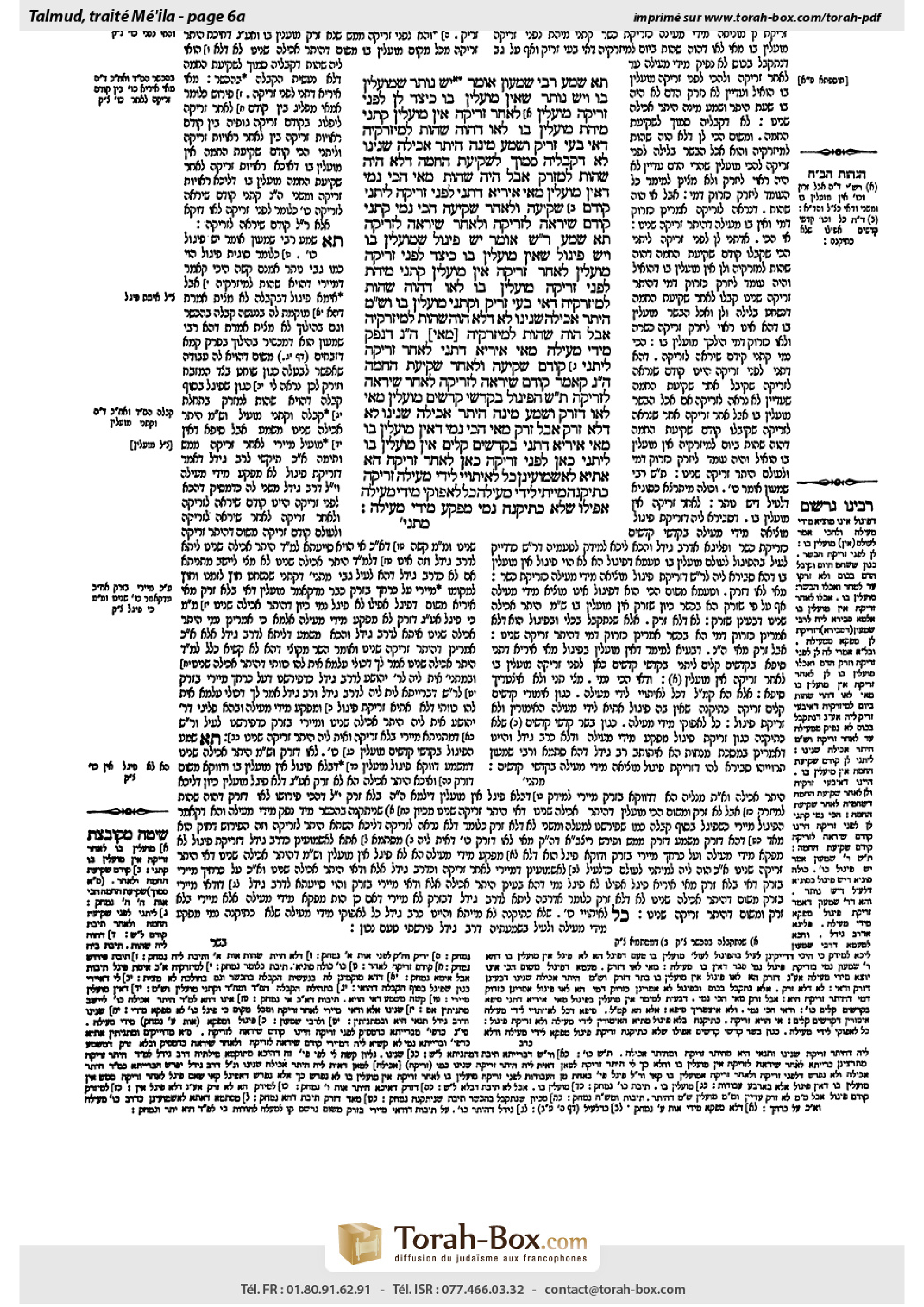
Meilah 6a: Talmud study for Daf Yomi
Daf Yomi is the daily study of one Talmud folio. Explore 37 tractates with scans, Hebrew text, Sefaria English and AI-generated French translations where annotated.
Passage selection and English or AI-generated French translation are available where the scan has annotations. Daf Study is independent of Torah-Box and Sefaria.
Browse Meilah · מעילה · All tractatesMeilah 6a text and translations
This page of Meilah includes the Aramaic text, an English translation and an AI-generated French translation, alongside the scan above.
מעילה ו׳ א · Aramaic and Hebrew text
תָּא שְׁמַע, רַבִּי שִׁמְעוֹן אוֹמֵר: יֵשׁ נוֹתָר שֶׁמּוֹעֲלִין בּוֹ, וְיֵשׁ נוֹתָר שֶׁאֵין מוֹעֲלִין בּוֹ.
כֵּיצַד? לָן לִפְנֵי זְרִיקָה – מוֹעֲלִין, לְאַחַר זְרִיקָה – אֵין מוֹעֲלִין.
קָתָנֵי מִיהַת: מוֹעֲלִין בּוֹ, לָאו דַּהֲוָה שְׁהוּת לְמִיזְרְקֵיהּ, דְּאִי בָּעֵי – זָרֵיק,
וּשְׁמַע מִינַּהּ: הֶיתֵּר אֲכִילָה שָׁנִינוּ!
לָא, דְּקַבְּלֵיהּ סָמוּךְ לִשְׁקִיעַת הַחַמָּה, דְּלֹא הָיָה שְׁהוּת לְמִזְרַק.
אֲבָל הָיָה שְׁהוּת, מַאי? הָכִי נָמֵי דְּאֵין מוֹעֲלִין?
מַאי אִירְיָא דְּתָנֵי ״לִפְנֵי זְרִיקָה״, לִיתְנֵי ״קוֹדֶם שְׁקִיעָה״ וּ״לְאַחַר שְׁקִיעָה״!
הָכִי נָמֵי קָתָנֵי: קוֹדֶם שֶׁיֵּרָאֶה לִזְרִיקָה, וּלְאַחַר שֶׁיֵּרָאֶה לִזְרִיקָה.
תָּא שְׁמַע, רַבִּי שִׁמְעוֹן אוֹמֵר: יֵשׁ פִּיגּוּל שֶׁמּוֹעֲלִין בּוֹ, וְיֵשׁ פִּיגּוּל שֶׁאֵין מוֹעֲלִין בּוֹ.
כֵּיצַד? לִפְנֵי זְרִיקָה – מוֹעֲלִין, לְאַחַר זְרִיקָה – אֵין מוֹעֲלִין.
קָתָנֵי מִיהַת: לִפְנֵי זְרִיקָה – מוֹעֲלִין בּוֹ, לָאו דַּהֲוָה שְׁהוּת לְמִיזְרְקֵיהּ, דְּאִי בָּעֵי – זָרֵיק, וְקָתָנֵי ״מוֹעֲלִין בּוֹ״, וּשְׁמַע מִינַּהּ: הֶיתֵּר אֲכִילָה שָׁנִינוּ!
לָא, דְּלָא הֲוָה שְׁהוּת לְמִיזְרְקֵיהּ. אֲבָל הֲוָה שְׁהוּת לְמִיזְרְקֵיהּ, מַאי? הָכִי נָמֵי דִּנְפַק מִידֵי מְעִילָה?
מַאי אִירְיָא דְּתָנֵי ״לְאַחַר זְרִיקָה״, לִיתְנֵי ״קוֹדֶם שְׁקִיעָה״ וּ״לְאַחַר שְׁקִיעַת הַחַמָּה״!
הָכִי נָמֵי קָאָמַר: קוֹדֶם שֶׁיֵּרָאֶה לִזְרִיקָה, לְאַחַר שֶׁיֵּרָאֶה לִזְרִיקָה.
תָּא שְׁמַע: הַפִּיגּוּל בְּקׇדְשֵׁי קָדָשִׁים – מוֹעֲלִין. מַאי לָאו דְּזָרַק, וּשְׁמַע מִינַּהּ: הֶיתֵּר אֲכִילָה שָׁנִינוּ! לָא, דְּלֹא זָרַק.
אֲבָל זָרַק מַאי? הָכִי נָמֵי דְּאֵין מוֹעֲלִין בּוֹ? מַאי אִירְיָא דְּתָנֵי בְּקָדָשִׁים קַלִּים אֵין מוֹעֲלִין בּוֹ,
לִיתְנֵי: כָּאן – לִפְנֵי זְרִיקָה, כָּאן – לְאַחַר זְרִיקָה!
הָא אָתְיָא לְאַשְׁמוֹעִינַן: כֹּל לְאֵיתוֹיֵי לִידֵי מְעִילָה, זְרִיקָה כְּתִיקְנָהּ מַיְיתֵי לִידֵי מְעִילָה.
כֹּל לְאַפּוֹקֵי מִידֵי מְעִילָה, אֲפִילּוּ שֶׁלֹּא כְּתִיקְנָהּ נָמֵי מַפְקַע מִידֵי מְעִילָה.
Meilah 6a · English translation
The Gemara cites another source that might resolve the issue: Come and hear a baraita that can provide a proof with regard to the meaning of Rabbi Yehoshua’s statement about a period of fitness to the priests: Rabbi Shimon says that there is a case of notar, when the blood was left overnight and was rendered unfit, where one is liable for misusing the meat of the offering, and there is also a case of notar where one is not liable for misusing it.
The baraita elaborates: How so? If the blood was left over and someone consumed the meat before the sprinkling of the blood, he is liable for misusing consecrated property. But if it was consumed after the sprinkling of the blood, he is not liable for misusing consecrated property, as the sprinkling removes the meat from being subject to the halakhot of misuse.
The Gemara notes: In any event, Rabbi Shimon teaches that if one consumes the meat before the leftover blood was sprinkled, he is liable for misusing it. Is this not referring to a case where there was time left in the day to sprinkle the blood that had already been collected in the service vessel, and therefore, if he had desired, he could have sprinkled the blood? Nevertheless, the offering is subject to the halakhot of misuse. This indicates that merely collecting the blood in the service vessel alone, without actually sprinkling it, does not remove the offering from being subject to the halakhot of misuse.
And accordingly, one may conclude from the baraita that it is fitness of consuming the meat of the offering that we learned in Rabbi Yehoshua’s statement in the mishna. It is the fitness of consuming the meat of the offering that removes the possibility of being liable for the prohibition of misuse, not the fitness of sprinkling.
The Gemara refutes this conclusion: No, the baraita is not referring to a case where there was time left in the day to sprinkle the blood that had already been collected. Rather, it is referring to a situation where the priest collected the blood shortly before sunset, where there was no time left in the day to sprinkle the blood while it was still daytime. Since the blood could not have been sprinkled, the offering is still subject to the prohibition of misuse. But if there had been time to sprinkle the blood, then that blood would be considered ready to be sprinkled, and the offering would no longer be subject to the prohibition of misuse, in accordance with the opinion that the criteria is the fitness of sprinkling of the blood.
The Gemara raises a difficulty: But in that case, what is the halakha in a situation where there was time in the day to sprinkle the blood? According to the above claim, so too the halakha is that he is not liable for misusing the offering.
If so, why does Rabbi Shimon specifically teach this distinction between a case before sprinkling, when the offering is still subject to the halakhot of misuse, and after sprinkling, when the offering is no longer subject to misuse? Let Rabbi Shimon instead teach a more precise distinction, between a situation where the blood was collected before sunset and there was time to sprinkle it but it was left overnight, in which case the offering is not subject to the prohibition of misuse, and a situation where the blood was collected after sunset, in which case it is still subject to the prohibition of misuse.
The Gemara answers that this is indeed what Rabbi Shimon meant, as he actually taught: Before it was fit for sprinkling, the offering is still subject to the prohibition of misuse, but after it was fit for sprinkling, it is no longer subject to the prohibition of misuse.
The Gemara suggests another proof from a similar baraita. Come and hear: Rabbi Shimon says that there is a case of an offering of the most sacred order that was sacrificed with piggul intent where one is liable for misusing it, and there is also a case of piggul intent where one is not liable for misusing it.
The baraita elaborates: How so? If someone consumed the meat before the sprinkling of the blood, he is liable for misusing consecrated property. If he consumed it after the sprinkling of the blood, he is not liable for misusing consecrated property, as the sprinkling removed the prohibition of misuse.
In any event, Rabbi Shimon teaches that if one consumes the meat of an offering that was rendered piggul before the blood was sprinkled, he is liable for misusing it. Is this not referring to a case where there was time left in the day to sprinkle the blood that had already been collected in the service vessel, and therefore, if he had desired, he could have sprinkled the blood? And yet Rabbi Shimon teaches that one is liable for misusing it. Once again, this would indicate that merely collecting the blood in the service vessel alone, without sprinkling, does not remove the possibility of the prohibition of misuse. And accordingly, one may conclude from the baraita that it is fitness of consuming the meat of the offering that we learned in Rabbi Yehoshua’s statement in the mishna.
The Gemara refutes this conclusion: No, the baraita is referring to a situation where the priest collected the blood shortly before sunset, where there was no time to sprinkle the blood while it was still daytime. Since the blood could not have been sprinkled, the offering is still subject to the prohibition of misuse. The Gemara raises a difficulty: But if so, what is the halakha in a case where there was time in the day to sprinkle the blood? According to the above claim, the offering is indeed removed from being subject to the halakhot of misuse.
If so, why does Rabbi Shimon specifically teach this distinction between after sprinkling, when the offering is no longer subject to the halakhot of misuse, and before sprinkling, when the offering is still subject to misuse? Let Rabbi Shimon instead teach a more precise distinction, between a situation where the blood was collected before sunset and there was time to sprinkle it but it was left overnight, in which case the offering is not subject to the prohibition of misuse, and a situation where the blood was collected after sunset, in which case it is still subject to the prohibition of misuse.
The Gemara answers that that is indeed what Rabbi Shimon is saying: Before it was fit for sprinkling, the offering is still subject to the prohibition of misuse, but after it was fit for sprinkling, it is no longer subject to the prohibition of misuse.
§ The Gemara suggests another proof. Come and hear: An offering of the most sacred order which is piggul is subject to the halakhot of misuse. The Gemara analyzes this statement: What, is this baraita not referring to a case where the priest already sprinkled its blood? This would indicate that a fit offering, unlike a piggul offering, is no longer subject to the prohibition of misuse only once the blood is sprinkled. And if so, one may conclude from the baraita that it is fitness of consuming the meat of the offering that we learned in Rabbi Yehoshua’s statement in the mishna, i.e., this fitness of consuming the meat of the offering removes the prohibition of misuse. The Gemara rejects this suggestion: No, one cannot cite a proof from this baraita, as it is possible that the baraita is referring to a case where the priest did not yet sprinkle the blood.
The Gemara asks: But if so, what, then, is the halakha in a case where the priest did sprinkle the blood? Is the halakha indeed that one is no longer liable for misusing it? If so, why does the latter clause of the baraita specifically teach: Unlike an offering of the most sacred order, in the case of the sacrificial portions of an offering of lesser sanctity one is not liable for misusing it?
Let the baraita instead teach a distinction within the category of offerings of the most sacred order themselves: Here, the offering is subject to the prohibition of misuse because it is before the sprinkling of the blood, and there, the offering is not subject to the prohibition of misuse because it is after the sprinkling of the blood.
The Gemara answers: The baraita could have taught that distinction, but it chose to state a distinction between offerings of the most sacred order and offerings of lesser sanctity because it comes to teach us this following principle: In any case where the result of sprinkling brings the offering into the category of the halakhot of misuse, e.g., the sacrificial portions of offerings of lesser sanctity, to which the halakhot of misuse apply only after the blood had been sprinkled, only sprinkling the blood properly brings the offering into the halakhot of misuse.
By contrast, in any situation where the result of sprinkling is removing the offering from the halakhot of misuse, e.g., the meat of an offering of the most sacred order, which was subject to the halakhot of misuse even before the blood was sprinkled, even sprinkling the blood improperly removes the offering from the halakhot of misuse. This ruling is not in accordance with the opinion of Rav Giddel.
Meilah 6a · Traduction française (IA)
La Guemara cite une autre source susceptible de résoudre la question : Viens et entends une baraïta qui peut apporter une preuve quant au sens de la déclaration de Rabbi Yehoshua au sujet de la période où la viande est permise aux prêtres : Rabbi Shimon dit qu’il existe un cas de notar où le sang a été laissé toute la nuit et est devenu impropre, dans lequel on est passible pour avoir fait un usage illicite de la viande du sacrifice, ainsi qu’un autre cas de notar dans lequel on n’est pas passible pour en avoir fait un usage illicite.
La baraïta précise : Comment cela ? Si le sang a été laissé et que quelqu’un a consommé la viande avant l’aspersion du sang, il est passible pour avoir fait un usage illicite d’un bien consacré. Mais si la viande a été consommée après l’aspersion du sang, il n’est pas passible pour avoir fait un usage illicite d’un bien consacré, car l’aspersion soustrait la viande aux lois du détournement de biens consacrés.
La Guemara relève : Quoi qu’il en soit, Rabbi Shimon enseigne que si quelqu’un consomme la viande avant que le sang resté soit aspergé, il est passible pour en avoir fait un usage illicite. Cela ne désigne-t-il pas un cas où il restait assez de temps dans la journée pour asperger le sang déjà recueilli dans le récipient de service et où, par conséquent, s’il l’avait voulu, il aurait pu l’asperger ? Pourtant, le sacrifice reste soumis aux lois du détournement de biens consacrés. Cela indique que le simple fait de recueillir le sang dans le récipient de service, sans procéder effectivement à l’aspersion, ne soustrait pas le sacrifice aux lois du détournement de biens consacrés.
On peut donc conclure de la baraïta que, dans la déclaration de Rabbi Yehoshua de la Michna, ce qui rend le sacrifice apte, c’est la consommation de sa viande. C’est l’aptitude de la viande du sacrifice à être consommée qui écarte la possibilité d’être passible pour l’interdit de détournement de biens consacrés, et non l’aptitude à asperger le sang.
La Guemara réfute cette conclusion : Non, la baraïta ne parle pas d’un cas où il restait assez de temps dans la journée pour asperger le sang déjà recueilli. Elle parle plutôt d’une situation où le prêtre a recueilli le sang peu avant le coucher du soleil, alors qu’il ne restait pas assez de temps pour l’asperger avant la fin de la journée. Puisque le sang ne pouvait pas être aspergé, le sacrifice reste soumis à l’interdit de détournement de biens consacrés. En revanche, s’il y avait eu assez de temps pour l’asperger, le sang aurait été considéré comme prêt à être aspergé et le sacrifice n’aurait plus été soumis à cet interdit, conformément à l’opinion selon laquelle le critère est l’aptitude du sang à être aspergé.
La Guemara soulève une difficulté : Mais dans ce cas, quelle est la halakha lorsqu’il restait assez de temps dans la journée pour asperger le sang ? Selon l’argument qui précède, la halakha serait également qu’il n’est pas passible pour avoir fait un usage illicite du sacrifice.
Si tel est le cas, pourquoi Rabbi Shimon enseigne-t-il précisément cette distinction entre le cas antérieur à l’aspersion, où le sacrifice reste soumis aux lois du détournement de biens consacrés, et le cas postérieur à l’aspersion, où il ne l’est plus ? Que Rabbi Shimon enseigne plutôt une distinction plus précise : d’une part, le cas où le sang a été recueilli avant le coucher du soleil, où il y avait assez de temps pour l’asperger, mais où il a été laissé toute la nuit, auquel cas le sacrifice n’est pas soumis à l’interdit de détournement de biens consacrés ; d’autre part, le cas où le sang a été recueilli après le coucher du soleil, auquel cas il reste soumis à cet interdit.
La Guemara répond que c’est bien ce que Rabbi Shimon voulait dire, car il a en réalité enseigné : Avant que le sang ne soit apte à être aspergé, le sacrifice reste soumis à l’interdit de détournement de biens consacrés ; mais, dès que le sang a été apte à être aspergé, il n’y est plus soumis.
La Guemara propose une autre preuve tirée d’une baraïta semblable. Viens et entends : Rabbi Shimon dit qu’il existe un cas de sacrifice de sainteté supérieure accompli avec une intention de piggul où l’on est passible pour en avoir fait un usage illicite, ainsi qu’un autre cas d’intention de piggul où l’on n’est pas passible pour en avoir fait un usage illicite.
La baraïta précise : Comment cela ? Si quelqu’un a consommé la viande avant l’aspersion du sang, il est passible pour avoir fait un usage illicite d’un bien consacré. S’il l’a consommée après l’aspersion du sang, il n’est pas passible pour avoir fait un usage illicite d’un bien consacré, car l’aspersion a levé l’interdit de détournement de biens consacrés.
Quoi qu’il en soit, Rabbi Shimon enseigne que si quelqu’un consomme la viande d’un sacrifice devenu piggul avant que le sang soit aspergé, il est passible pour en avoir fait un usage illicite. Cela ne désigne-t-il pas un cas où il restait assez de temps dans la journée pour asperger le sang déjà recueilli dans le récipient de service et où, par conséquent, s’il l’avait voulu, il aurait pu l’asperger ? Pourtant, Rabbi Shimon enseigne que l’on est passible pour en avoir fait un usage illicite. Cela indiquerait une nouvelle fois que le simple fait de recueillir le sang dans le récipient de service, sans procéder à l’aspersion, n’écarte pas la possibilité de l’interdit de détournement de biens consacrés. On peut donc conclure de la baraïta que, dans la déclaration de Rabbi Yehoshua de la Michna, ce qui rend le sacrifice apte, c’est la consommation de sa viande.
La Guemara réfute cette conclusion : Non, la baraïta parle d’une situation où le prêtre a recueilli le sang peu avant le coucher du soleil, alors qu’il ne restait pas assez de temps pour l’asperger avant la fin de la journée. Puisque le sang ne pouvait pas être aspergé, le sacrifice reste soumis à l’interdit de détournement de biens consacrés. La Guemara soulève une difficulté : Mais dans ce cas, quelle est la halakha lorsqu’il restait assez de temps dans la journée pour asperger le sang ? Selon l’argument qui précède, le sacrifice serait effectivement soustrait aux lois du détournement de biens consacrés.
Si tel est le cas, pourquoi Rabbi Shimon enseigne-t-il précisément cette distinction entre le cas postérieur à l’aspersion, où le sacrifice n’est plus soumis aux lois du détournement de biens consacrés, et le cas antérieur à l’aspersion, où il y reste soumis ? Que Rabbi Shimon enseigne plutôt une distinction plus précise : d’une part, le cas où le sang a été recueilli avant le coucher du soleil, où il y avait assez de temps pour l’asperger, mais où il a été laissé toute la nuit, auquel cas le sacrifice n’est pas soumis à l’interdit de détournement de biens consacrés ; d’autre part, le cas où le sang a été recueilli après le coucher du soleil, auquel cas il reste soumis à cet interdit.
La Guemara répond que c’est bien ce que dit Rabbi Shimon : Avant que le sang ne soit apte à être aspergé, le sacrifice reste soumis à l’interdit de détournement de biens consacrés ; mais, dès que le sang a été apte à être aspergé, il n’y est plus soumis.
§ La Guemara propose une autre preuve. Viens et entends : Un sacrifice de sainteté supérieure qui est piggul est soumis aux lois du détournement de biens consacrés. La Guemara analyse cette déclaration : Cette baraïta ne parle-t-elle pas d’un cas où le prêtre a déjà aspergé son sang ? Cela indiquerait qu’un sacrifice apte, contrairement à un sacrifice piggul, n’est soustrait à l’interdit de détournement de biens consacrés qu’une fois le sang aspergé. On pourrait alors conclure de la baraïta que, dans la déclaration de Rabbi Yehoshua de la Michna, ce qui rend le sacrifice apte, c’est la consommation de sa viande, c’est-à-dire que l’aptitude de la viande du sacrifice à être consommée lève l’interdit de détournement de biens consacrés. La Guemara rejette cette proposition : Non, on ne peut pas tirer de preuve de cette baraïta, car il est possible qu’elle parle d’un cas où le prêtre n’a pas encore aspergé le sang.
La Guemara demande : Mais dans ce cas, quelle est alors la halakha si le prêtre a aspergé le sang ? La halakha serait-elle bien qu’on n’est plus passible pour avoir fait un usage illicite du sacrifice ? Si tel est le cas, pourquoi la dernière partie de la baraïta enseigne-t-elle précisément : contrairement à un sacrifice de sainteté supérieure, pour les parties sacrificielles d’un sacrifice de moindre sainteté, on n’est pas passible pour en avoir fait un usage illicite ?
Que la baraïta enseigne plutôt une distinction au sein même de la catégorie des sacrifices de sainteté supérieure : ici, le sacrifice est soumis à l’interdit de détournement de biens consacrés parce qu’il s’agit du cas antérieur à l’aspersion du sang ; là, il n’y est pas soumis parce qu’il s’agit du cas postérieur à l’aspersion du sang.
La Guemara répond : La baraïta aurait pu enseigner cette distinction, mais elle a choisi d’établir une distinction entre les sacrifices de sainteté supérieure et ceux de moindre sainteté afin de nous enseigner le principe suivant : dans tout cas où l’aspersion fait entrer le sacrifice dans le champ d’application des lois du détournement de biens consacrés, par exemple les parties sacrificielles des sacrifices de moindre sainteté, auxquelles ces lois ne s’appliquent qu’après l’aspersion du sang, seule une aspersion correcte fait entrer le sacrifice dans le champ d’application de ces lois.
À l’inverse, dans toute situation où l’aspersion fait sortir le sacrifice du champ d’application des lois du détournement de biens consacrés, par exemple la viande d’un sacrifice de sainteté supérieure, qui était soumise à ces lois même avant l’aspersion du sang, même une aspersion incorrecte soustrait le sacrifice à ces lois. Cette décision n’est pas conforme à l’opinion de Rav Giddel.
Traduction française générée par IA à partir de l’édition anglaise de Sefaria. Vérifie toujours un passage avec le texte source.
Text from Sefaria: William Davidson Edition - Vocalized Aramaic (CC BY NC); William Davidson Edition - English (CC BY NC).