Meilah 6b: Talmud study for Daf Yomi
Daf Yomi is the daily study of one Talmud folio. Explore 37 tractates with scans, Hebrew text, Sefaria English and AI-generated French translations where annotated.
Passage selection and English or AI-generated French translation are available where the scan has annotations. Daf Study is independent of Torah-Box and Sefaria.
Browse Meilah · מעילה · All tractatesMeilah 6b text and translations
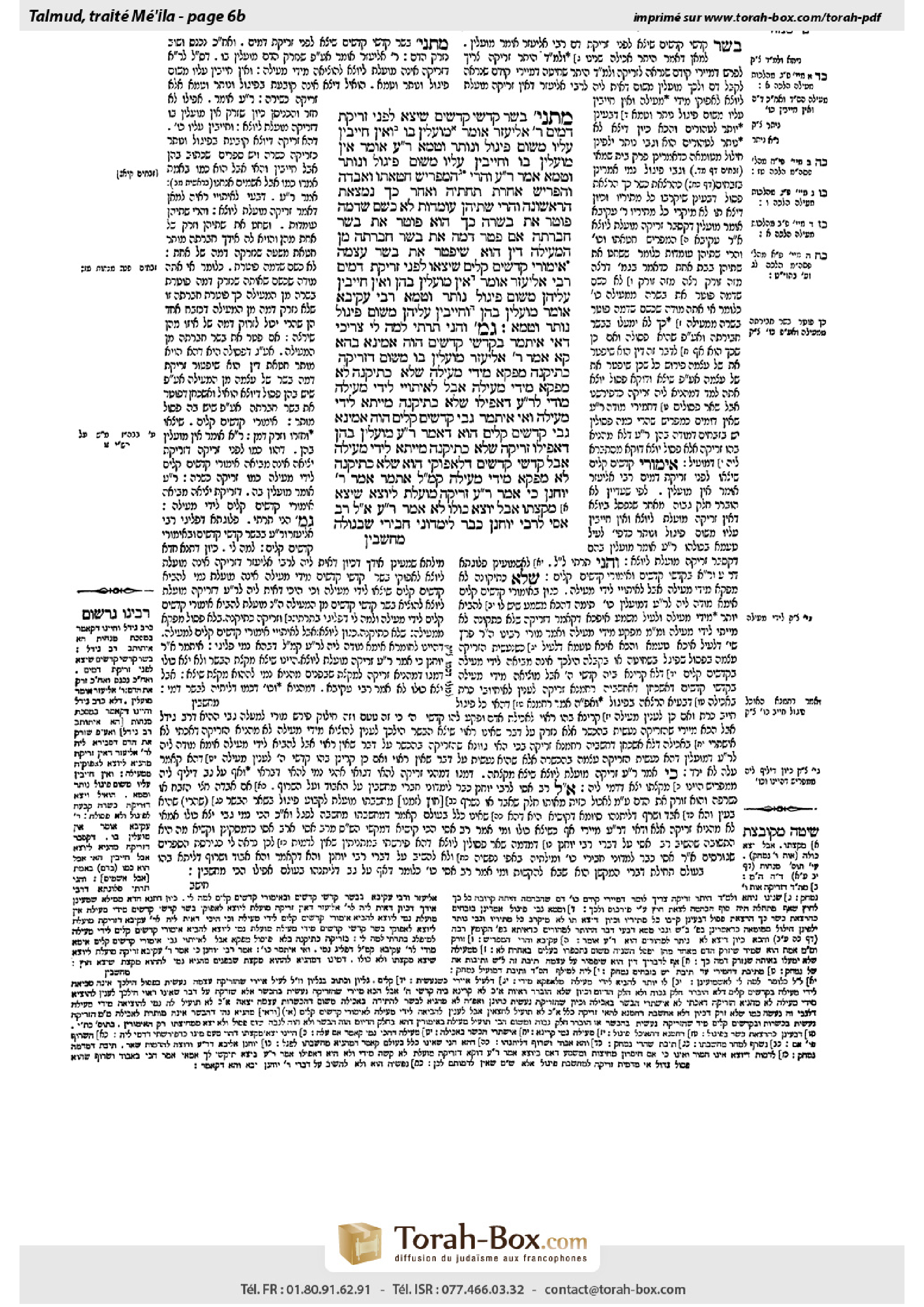
This page of Meilah includes the Aramaic text, an English translation and an AI-generated French translation, alongside the scan above.
מעילה ו׳ ב · Aramaic and Hebrew text
מַתְנִי׳ בְּשַׂר קׇדְשֵׁי קָדָשִׁים שֶׁיָּצָא לִפְנֵי זְרִיקַת דָּמִים,
רַבִּי אֱלִיעֶזֶר אוֹמֵר: מוֹעֲלִין בּוֹ, וְאֵין חַיָּיבִין עָלָיו מִשּׁוּם פִּיגּוּל וְנוֹתָר וְטָמֵא.
רַבִּי עֲקִיבָא אוֹמֵר: אֵין מוֹעֲלִין בּוֹ, וְחַיָּיבִין עָלָיו מִשּׁוּם פִּיגּוּל וְנוֹתָר וְטָמֵא.
אָמַר רַבִּי עֲקִיבָא: וַהֲרֵי הַמַּפְרִישׁ חַטָּאתוֹ וְאָבְדָה, וְהִפְרִישׁ אַחֶרֶת תַּחְתֶּיהָ, וְאַחַר כָּךְ נִמְצֵאת הָרִאשׁוֹנָה, וַהֲרֵי שְׁתֵּיהֶן עוֹמְדוֹת.
לֹא כְּשֵׁם שֶׁדָּמָהּ פּוֹטֵר אֶת בְּשָׂרָהּ, כָּךְ הוּא פּוֹטֵר אֶת בְּשַׂר חֲבֶרְתָּהּ?
אִם פָּטַר דָּמָהּ אֶת בְּשַׂר חֲבֶרְתָּהּ מִן הַמְּעִילָה, דִּין הוּא שֶׁיִּפְטֹר אֶת בְּשַׂר עַצְמָהּ!
אֵימוּרַי קָדָשִׁים קַלִּים שֶׁיָּצְאוּ לִפְנֵי זְרִיקַת דָּמִים,
רַבִּי אֱלִיעֶזֶר אוֹמֵר: אֵין מוֹעֲלִין בָּהֶן, וְאֵין חַיָּיבִין עֲלֵיהֶן מִשּׁוּם פִּיגּוּל נוֹתָר וְטָמֵא. רַבִּי עֲקִיבָא אוֹמֵר: מוֹעֲלִין בָּהֶן, וְחַיָּיבִין עֲלֵיהֶן מִשּׁוּם פִּיגּוּל נוֹתָר וְטָמֵא.
גְּמָ׳ וְהָנֵי תַּרְתֵּי לְמָה לִי?
צְרִיכִי, דְּאִי אִיתְּמַר בְּקׇדְשֵׁי קָדָשִׁים, הֲוָה אָמֵינָא: בְּהָא קָא אָמַר רַבִּי אֱלִיעֶזֶר מוֹעֲלִין בּוֹ, מִשּׁוּם דִּזְרִיקָה כְּתִיקְנָהּ מַפְּקָא מִידֵי מְעִילָה, שֶׁלֹּא כְּתִיקְנָהּ – לָא מַפְּקָא מִידֵי מְעִילָה.
אֲבָל לְאֵיתוֹיֵי לִידֵי מְעִילָה – מוֹדֵי לְרַבִּי עֲקִיבָא דַּאֲפִילּוּ שֶׁלֹּא כְּתִיקְנָהּ מַיְיתָא לִידֵי מְעִילָה,
וְאִי אִיתְּמַר גַּבֵּי קָדָשִׁים קַלִּים, הֲוָה אָמֵינָא: גַּבֵּי קָדָשִׁים קַלִּים הוּא דְּאָמַר רַבִּי עֲקִיבָא מוֹעֲלִין בָּהֶן, דַּאֲפִילּוּ זְרִיקָה שֶׁלֹּא כְּתִיקְנָהּ מַיְיתָא לִידֵי מְעִילָה,
אֲבָל קׇדְשֵׁי קָדָשִׁים, דִּלְאַפּוֹקֵי הוּא, שֶׁלֹּא כְּתִיקְנָהּ – לָא מַפְּקָא מִידֵי מְעִילָה, קָא מַשְׁמַע לַן.
אִתְּמַר, אָמַר רַבִּי יוֹחָנָן: כִּי אָמַר רַבִּי עֲקִיבָא זְרִיקָה מוֹעֶלֶת לַיּוֹצֵא – שֶׁיָּצָא מִקְצָתוֹ, אֲבָל יוֹצֵא כּוּלּוֹ – לֹא אָמַר רַבִּי עֲקִיבָא.
אֲמַר לֵיהּ רַב אַסִּי לְרַבִּי יוֹחָנָן: כְּבָר לִימְּדוּנִי חֲבֵירַי שֶׁבַּגּוֹלָה
Meilah 6b · English translation
MISHNA: The mishna presents a dispute with regard to the status of offerings of the most sacred order, which normally are not subject to the halakhot of misuse once their blood has been sprinkled and they have been permitted to the priests. The case of the mishna is the meat of offerings of the most sacred order, whose consumption is permitted from the moment their blood was sprinkled, that left the Temple courtyard before the sprinkling of the blood, and then reentered the courtyard.
Rabbi Eliezer says: The sprinkling of this blood does not permit its consumption by the priests. Consequently, one is liable for misusing it. And he is not liable for eating it due to violation of the prohibitions of piggul, if he partook of it after it was slaughtered with the intent to partake of it or sprinkle its blood beyond its designated time, or of notar, if he partook of the meat after it remained overnight, or of partaking of the meat while ritually impure.
Rabbi Akiva says: The sprinkling is effective despite the fact that the meat left the Temple courtyard and was disqualified, and therefore one is not liable for misusing it. Likewise, other halakhot that apply to offerings whose blood was sprinkled apply to it, and consequently one is liable for eating it due to violation of the prohibitions of partaking of meat that is piggul, or notar, or remained overnight, or of partaking of the meat while ritually impure.
Rabbi Akiva said, in support of his opinion: But there is the case of one who designated an animal as his sin offering and it was lost, and he designated another animal in its stead, and thereafter the first sin offering was found and both of them are standing fit for sacrifice. If he slaughtered both animals at the same time and sprinkled the blood of one of them, which means that the second was disqualified as a leftover sin offering, the question arises as to the status of the meat of the second animal with regard to the halakhot of misuse.
Is it not the case that just as the blood of the animal whose blood was sprinkled exempts its meat from liability for its misuse, so too it exempts the meat of the other animal? Since he could have chosen to sprinkle the blood of either animal, they are considered as though they were one offering.
If so, one may learn from there by an a fortiori inference with regard to the case of sprinkling the blood of meat that left the courtyard and returned: If the sprinkling of its blood exempted the meat of the other animal from the halakhot of misuse, it is only right that it should exempt its own meat that left the courtyard.
The mishna adds that just as Rabbi Eliezer and Rabbi Akiva disagree as to whether the sprinkling of blood exempts meat that left the courtyard from liability for its misuse, so too, they disagree with regard to the sacrificial portions of offerings of lesser sanctity consumed on the altar that left the Temple courtyard before the sprinkling of the blood. The dispute is whether the subsequent sprinkling of the blood generates liability for misuse of those portions.
Rabbi Eliezer says: The sprinkling of the blood is completely ineffective in rendering those portions consecrated to the Lord. Consequently, one is not liable for misusing them. And similarly, one is not liable for their consumption due to violation of the prohibitions of piggul, notar, or of partaking of meat while ritually impure. Rabbi Akiva says: The sprinkling is effective, and therefore one is liable for misusing them. And likewise, one is liable for its consumption due to violation of the prohibitions of piggul, notar, or of partaking of the meat while ritually impure.
GEMARA: The Gemara asks: Why do I need the mishna to cite these two disagreements, i.e., both the case of offerings of the most sacred order and offerings of lesser sanctity? After all, both disagreements are based on the same principle.
The Gemara answers: Both cases are necessary, as, if the disagreement was stated only with regard to offerings of the most sacred order, I would say that it is specifically in that case that Rabbi Eliezer says that one is liable for misusing the meat of the offering, due to the fact that only sprinkling the blood properly removes the offering from being subject to the halakhot of misuse. By contrast, sprinkling the blood improperly, including for meat that left the courtyard, does not remove the offering from the halakhot of misuse.
But with regard to the issue of when the rite of sprinkling brings the offering into being subject to the halakhot of misuse, i.e., in the case of sacrificial portions of offerings of lesser sanctity, Rabbi Eliezer concedes to Rabbi Akiva that even sprinkling the blood improperly, as in this case, brings the offering into being subject to the halakhot of misuse.
And by contrast, if their disagreement was stated only with regard to offerings of lesser sanctity, I would say that it is specifically in the case of offerings of lesser sanctity that Rabbi Akiva said one is liable for misusing them. This is due to the fact that here the act of sprinkling serves to include them in the category of misuse, and therefore even sprinkling the blood improperly, as in this case, brings the offering into being subject to the halakhot of misuse.
But with regard to offerings of the most sacred order, where the sprinkling of the blood serves to remove the offering from being subject to the halakhot of misuse, one might say that Rabbi Akiva agrees that sprinkling the blood improperly does not remove the offering from being subject to the halakhot of misuse. Therefore, the mishna teaches us that the tanna’im disagree in both cases.
§ It was stated that amora’im disagree with regard to the opinion of Rabbi Akiva in the mishna. Rabbi Yoḥanan says: When Rabbi Akiva says that sprinkling is effective to remove the meat of offerings of the most sacred order that left the courtyard from the halakhot of misuse, that applies specifically in a case where only part of it left the courtyard and part remained inside. In such a situation, as the sprinkling is effective for the portion that remained inside the courtyard, it also is effective for the portion that left the courtyard. But if all of it left the courtyard, Rabbi Akiva did not say that the sprinkling is effective to remove the meat from the halakhot of misuse.
Rav Asi said to Rabbi Yoḥanan: My colleagues in the exile, i.e., the Sages of Babylonia, already taught me that
Meilah 6b · Traduction française (IA)
MICHNA : La Michna présente une controverse sur le statut des offrandes de sainteté suprême, qui ne sont normalement plus soumises aux lois du détournement des biens consacrés une fois que leur sang a été aspergé et que leur consommation a été permise aux prêtres. Le cas de la Michna concerne la viande d’offrandes de sainteté suprême, dont la consommation est permise dès que leur sang a été aspergé, mais qui est sortie de la cour du Temple avant l’aspersion du sang, puis y est rentrée.
Rabbi Eliezer dit : L’aspersion de ce sang ne rend pas la consommation de cette viande permise aux prêtres. Par conséquent, celui qui en fait un usage profane est passible. En revanche, il n’est pas passible pour l’avoir mangée en transgressant les interdits de piggul — s’il en a mangé après que l’animal a été abattu avec l’intention d’en manger ou d’en asperger le sang après le délai prescrit —, de notar, s’il a mangé la viande après qu’elle a passé la nuit, ni pour en avoir mangé alors qu’il était en état d’impureté rituelle.
Rabbi Akiva dit : L’aspersion est efficace, bien que la viande soit sortie de la cour du Temple et ait été disqualifiée ; par conséquent, celui qui en fait un usage profane n’est pas passible. De même, les autres halakhot applicables aux offrandes dont le sang a été aspergé s’appliquent à cette viande ; par conséquent, celui qui la mange est passible pour avoir transgressé les interdits de consommer de la viande qui est piggul, qui est notar ou qui a passé la nuit, ainsi que l’interdit d’en manger en état d’impureté rituelle.
Rabbi Akiva dit, à l’appui de son opinion : Considérons le cas d’un homme qui a désigné un animal comme sacrifice expiatoire, puis l’a perdu et en a désigné un autre à sa place. Par la suite, le premier sacrifice expiatoire a été retrouvé, et les deux animaux se trouvent alors aptes au sacrifice. S’il les a abattus tous deux en même temps et a aspergé le sang de l’un d’eux — ce qui signifie que le second a été disqualifié en tant que sacrifice expiatoire surnuméraire —, la question se pose quant au statut de la viande du second animal au regard des lois du détournement des biens consacrés.
N’est-il pas vrai que, de même que le sang de l’animal dont le sang a été aspergé exonère sa viande de toute responsabilité pour détournement de biens consacrés, il exonère aussi la viande de l’autre animal ? Puisqu’il aurait pu choisir d’asperger le sang de l’un ou l’autre animal, ils sont considérés comme une seule offrande.
Si tel est le cas, on peut en déduire, par raisonnement a fortiori, ce qu’il en est lorsque le sang est aspergé alors que la viande est sortie de la cour puis y est rentrée : si l’aspersion de son sang exonère la viande de l’autre animal des lois du détournement des biens consacrés, à plus forte raison doit-elle exonérer sa propre viande, qui est sortie de la cour.
La Michna ajoute que, de même que Rabbi Eliezer et Rabbi Akiva divergent sur la question de savoir si l’aspersion du sang exonère de toute responsabilité pour détournement de biens consacrés la viande qui est sortie de la cour, ils divergent également au sujet des portions sacrificielles d’offrandes de moindre sainteté destinées à être consumées sur l’autel, qui sont sorties de la cour du Temple avant l’aspersion du sang. La controverse porte sur la question de savoir si l’aspersion ultérieure du sang entraîne une responsabilité pour détournement de ces portions.
Rabbi Eliezer dit : L’aspersion du sang est totalement sans effet pour consacrer ces portions à l’Éternel. Par conséquent, celui qui en fait un usage profane n’est pas passible. De même, il n’est pas passible pour en avoir mangé en transgressant les interdits de piggul, de notar ou l’interdit de consommer de la viande en état d’impureté rituelle. Rabbi Akiva dit : L’aspersion est efficace, et celui qui en fait un usage profane est donc passible. De même, celui qui en mange est passible pour avoir transgressé les interdits de piggul, de notar ou l’interdit de consommer cette viande en état d’impureté rituelle.
GUEMARA : La Guemara demande : Pourquoi la Michna doit-elle citer ces deux controverses, c’est-à-dire à la fois le cas des offrandes de sainteté suprême et celui des offrandes de moindre sainteté ? Après tout, les deux controverses reposent sur le même principe.
La Guemara répond : Les deux cas sont nécessaires. En effet, si la controverse n’avait été énoncée qu’au sujet des offrandes de sainteté suprême, j’aurais dit que Rabbi Eliezer enseigne qu’on est passible pour détournement de la viande de l’offrande uniquement dans ce cas, car seule l’aspersion correcte du sang soustrait l’offrande aux lois du détournement des biens consacrés. En revanche, une aspersion incorrecte du sang, notamment lorsque la viande est sortie de la cour, ne soustrait pas l’offrande à ces lois.
Mais quant à la question de savoir à quel moment le rite de l’aspersion assujettit l’offrande aux lois du détournement des biens consacrés, c’est-à-dire dans le cas des portions sacrificielles d’offrandes de moindre sainteté, Rabbi Eliezer concède à Rabbi Akiva que même une aspersion incorrecte du sang, comme dans le cas présent, assujettit l’offrande à ces lois.
À l’inverse, si leur controverse n’avait été énoncée qu’au sujet des offrandes de moindre sainteté, j’aurais dit que Rabbi Akiva enseigne qu’on est passible pour en avoir fait un usage profane uniquement dans le cas des offrandes de moindre sainteté. En effet, ici, l’acte d’aspersion les fait entrer dans la catégorie des biens soumis aux lois du détournement ; par conséquent, même une aspersion incorrecte du sang, comme dans le cas présent, assujettit l’offrande à ces lois.
Mais concernant les offrandes de sainteté suprême, pour lesquelles l’aspersion du sang soustrait l’offrande aux lois du détournement des biens consacrés, on aurait pu dire que Rabbi Akiva convient qu’une aspersion incorrecte du sang ne soustrait pas l’offrande à ces lois. La Michna nous enseigne donc que les tannaïm divergent dans les deux cas.
§ Il a été rapporté que des amoraïm divergent au sujet de l’opinion de Rabbi Akiva dans la Michna. Rabbi Yoḥanan dit : Lorsque Rabbi Akiva enseigne que l’aspersion soustrait aux lois du détournement des biens consacrés la viande d’offrandes de sainteté suprême qui est sortie de la cour, cela s’applique précisément lorsqu’une partie seulement de la viande est sortie de la cour et qu’une autre partie est restée à l’intérieur. Dans une telle situation, puisque l’aspersion est efficace pour la portion restée dans la cour, elle l’est aussi pour celle qui en est sortie. Mais si toute la viande est sortie de la cour, Rabbi Akiva n’a pas enseigné que l’aspersion la soustrait aux lois du détournement des biens consacrés.
Rav Asi dit à Rabbi Yoḥanan : Mes collègues de l’exil, c’est-à-dire les Sages de Babylonie, m’ont déjà enseigné que
Traduction française générée par IA à partir de l’édition anglaise de Sefaria. Vérifie toujours un passage avec le texte source.
Text from Sefaria: William Davidson Edition - Vocalized Aramaic (CC BY NC); William Davidson Edition - English (CC BY NC).