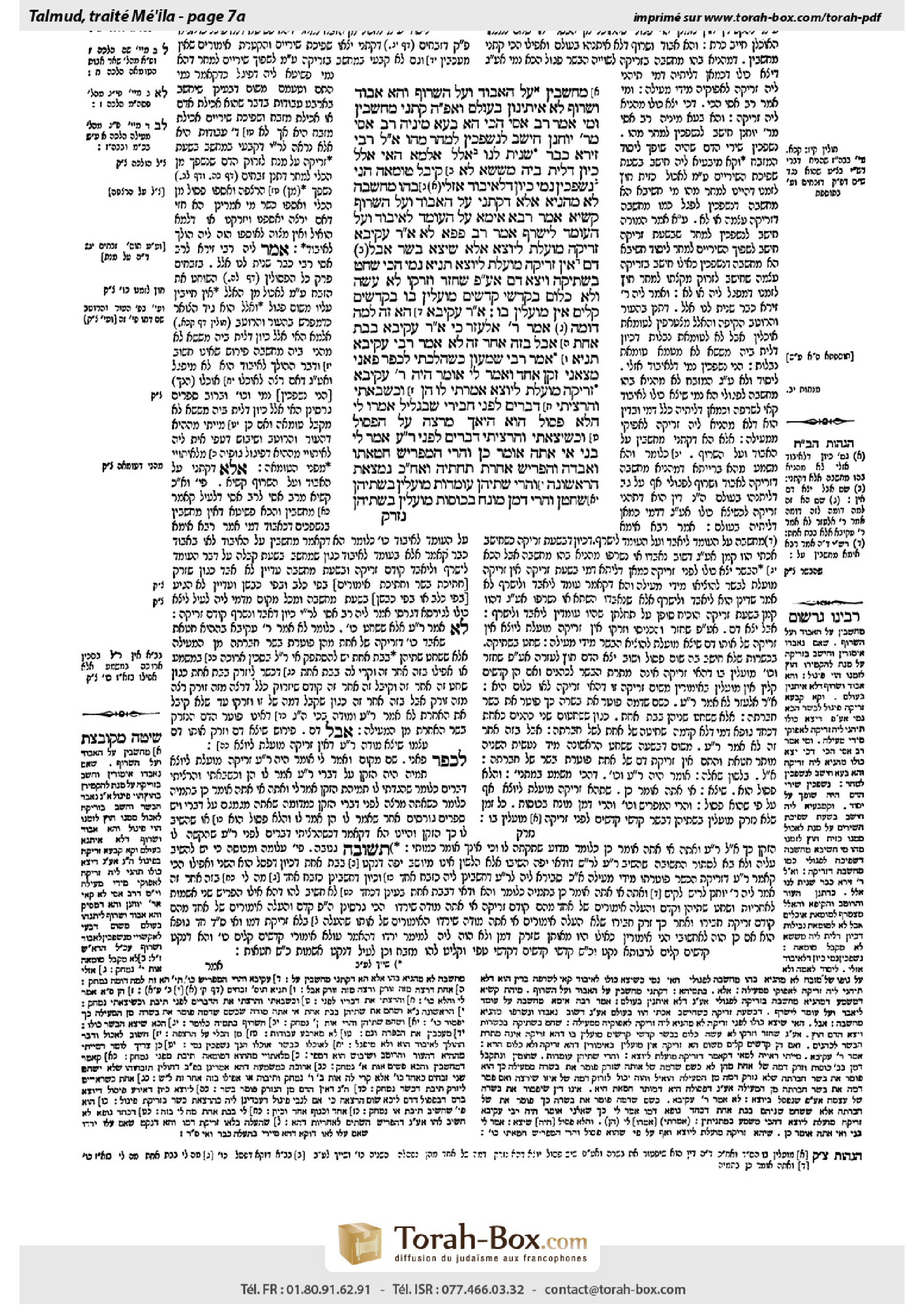
Meilah 7a: Talmud study for Daf Yomi
Daf Yomi is the daily study of one Talmud folio. Explore 37 tractates with scans, Hebrew text, Sefaria English and AI-generated French translations where annotated.
Passage selection and English or AI-generated French translation are available where the scan has annotations. Daf Study is independent of Torah-Box and Sefaria.
Browse Meilah · מעילה · All tractatesMeilah 7a text and translations
This page of Meilah includes the Aramaic text, an English translation and an AI-generated French translation, alongside the scan above.
מעילה ז׳ א · Aramaic and Hebrew text
מְחַשְּׁבִין עַל הָאָבוּד וְעַל הַשָּׂרוּף.
וְהָא אָבוּד וְשָׂרוּף לָא אִיתִינּוּן בָּעוֹלָם, וַאֲפִילּוּ הָכִי קָתָנֵי מְחַשְּׁבִין!
וּמִי אָמַר רַב אַסִּי הָכִי? הָא בְּעָא מִינֵּיהּ רַב אַסִּי מֵרַבִּי יוֹחָנָן: חִישֵּׁב לַנִּשְׁפָּכִין, לְמָחָר, מַהוּ?
אֲמַר לֵיהּ רַבִּי זֵירָא: כְּבָר שָׁנִיתָ לָנוּ אָלָל! אַלְמָא הַאי אָלָל, כֵּיוָן דְּלֵית בֵּיהּ מְשָׁשָׁא – לֹא קִיבֵּל טוּמְאָה,
הָנֵי נִשְׁפָּכִין נָמֵי, כֵּיוָן דִּלְאִיבּוּד אָזְלִי – בְּהוּ מַחְשָׁבָה לָא מַהְנְיָא!
אֶלָּא דְּקָתָנֵי עַל הָאָבוּד וְעַל הַשָּׂרוּף – קַשְׁיָא! אָמַר רָבָא: אֵימָא: עַל הָעוֹמֵד לְאִיבּוּד וְעַל הָעוֹמֵד לִישָּׂרֵף.
אָמַר רַב פָּפָּא: לָא אָמַר רַבִּי עֲקִיבָא זְרִיקָה מוֹעֶלֶת לַיּוֹצֵא אֶלָּא שֶׁיָּצָא בָּשָׂר, אֲבָל דָּם – אֵין זְרִיקָה מוֹעֶלֶת לַיּוֹצֵא.
תַּנְיָא נָמֵי הָכִי: שָׁחַט בִּשְׁתִיקָה וְיָצָא דָּם, אַף עַל פִּי שֶׁחָזַר וּזְרָקוֹ – לֹא עָשָׂה וְלֹא כְלוּם. בְּקׇדְשֵׁי קָדָשִׁים – מוֹעֲלִין בּוֹ, בְּקָדָשִׁים קַלִּים – אֵין מוֹעֲלִין בּוֹ.
אָמַר רַבִּי עֲקִיבָא: הָא זֶה, לְמָה דּוֹמֶה?
אָמַר רַבִּי אֶלְעָזָר: כִּי אָמַר רַבִּי עֲקִיבָא, בְּבַת אַחַת, אֲבָל בְּזֶה אַחַר זֶה – לֹא אָמַר רַבִּי עֲקִיבָא.
תַּנְיָא, אָמַר רַבִּי שִׁמְעוֹן: כְּשֶׁהָלַכְתִּי לִכְפַר פָּאנִי, מְצָאַנִי זָקֵן אֶחָד וְאָמַר לִי: אוֹמֵר הָיָה רַבִּי עֲקִיבָא זְרִיקָה מוֹעֶלֶת לַיּוֹצֵא? אָמַרְתִּי לוֹ: הֵן. וּכְשֶׁבָּאתִי וְהִרְצֵיתִי דְּבָרִים לִפְנֵי חֲבֵירַי שֶׁבַּגָּלִיל, אָמְרוּ לִי: הֲלֹא פָּסוּל הוּא, הֵיאַךְ מְרַצֶּה עַל הַפָּסוּל?
וּכְשֶׁיָּצָאתִי וְהִרְצֵיתִי דְּבָרִים לִפְנֵי רַבִּי עֲקִיבָא, אָמַר לִי: בְּנִי, אִי אַתָּה אוֹמֵר כֵּן? וַהֲרֵי הַמַּפְרִישׁ חַטָּאתוֹ וְאָבְדָה, וְהִפְרִישׁ אַחֶרֶת תַּחְתֶּיהָ, וְאַחַר כָּךְ נִמְצֵאת הָרִאשׁוֹנָה, וַהֲרֵי שְׁתֵּיהֶן עוֹמְדוֹת – מוֹעֲלִין בִּשְׁתֵּיהֶן. שְׁחָטָן, וַהֲרֵי דָּמָן מוּנָּח בְּכוֹסוֹת – מוֹעֲלִין בִּשְׁתֵּיהֶן.
Meilah 7a · English translation
one renders an offering piggul by having an intention at the time of sprinkling to later sacrifice its sacrificial portions after the proper time, even with regard to sacrificial portions that were already lost and with regard to sacrificial portions that were already burned.
The Gemara analyzes this statement: But sacrificial portions that are lost or burned are not present in the world, i.e., they are not available, and even so it is taught that one renders an offering piggul by an intention to consume it after its appointed time. It can be derived from here that if the entire offering left the courtyard, which is comparable to a case where it was lost, the sprinkling is effective with regard to the halakhot of misuse according to Rabbi Akiva. This apparently contradicts the opinion of Rabbi Yoḥanan.
The Gemara asks: But did Rav Asi actually say this? Does he maintain that even if all of the meat and the sacrificial portions left the courtyard, the sprinkling is effective according to Rabbi Akiva? Didn’t Rav Asi raise the following dilemma before Rabbi Yoḥanan: What is the halakha in a case where the priest intended during the sacrificial rites that the remnant of the blood, which is meant to be poured on the base of the altar immediately after the sprinkling, will be poured improperly tomorrow? Does the offering thereby become piggul, as this is similar to intending to sprinkle the blood after the proper time; or does such intent apply only to the blood that is actually sprinkled on the altar?
And Rabbi Zeira said to Rav Asi in response to this dilemma: You already taught us in tractate Ḥullin, with regard to the ritual impurity of food and animal carcasses, that items that are not themselves edible but are attached to meat combine with the meat to constitute the requisite measure of an egg-bulk to transmit the impurity of foods. One instance of this principle is the meat residue attached to the hide after flaying, which combines with the meat to transmit the impurity of foods, despite the fact that it is not considered food and does not transmit impurity of foods on its own. Evidently this meat residue, since it has no substance and significance in and of itself, it is not susceptible to impurity.
The Gemara explains the contradiction: It follows that according to Rav Asi, in the case of this blood, which is meant to be poured on the base of the altar, since it is going to be lost and therefore is also insignificant, intent with regard to it is not effective to render the offering piggul. The blood that is to be poured on the base of the altar is similar to an offering that left the courtyard in its entirety, as they are both considered as though they are not present. Consequently, according to Rav Asi, in a case where the entire offering left the courtyard and is meant to be burned and thereby destroyed, it cannot be rendered piggul by means of intent during the sprinkling. This follows Rabbi Yoḥanan’s interpretation of the opinion of Rabbi Akiva, that he is referring only to a case where the offering left partially, not where the entire offering left.
The Gemara objects: But Rav Asi cited that which the baraita teaches: One can render an offering piggul by means of one’s intent, even with regard to sacrificial portions that were already lost and with regard to sacrificial portions that were already burned. This baraita itself poses a difficulty, as it indicates that intent is effective even for that which has been destroyed. Rava said in response: Emend the wording of the baraita and say instead: One can render an offering piggul by means of one’s intent, even with regard to sacrificial portions that stand to be lost or with regard to sacrificial portions that stand to be burned, but were not yet destroyed. Since they are currently present, such intent is effective to render the offering piggul. But in a case where the offering left the courtyard, as it is not present, intent is ineffective with regard to it.
§ With regard to Rabbi Akiva’s opinion in the mishna, Rav Pappa says that Rabbi Akiva says his ruling, that sprinkling is effective for the meat of offerings that left the courtyard before sprinkling, with regard to piggul and the halakhot of misuse, only in a case where the meat left while the blood remained inside and was sprinkled. But if the blood itself left, then even if it was returned to the courtyard and was sprinkled, in such a case the sprinkling of blood that left the courtyard is not effective to remove the meat from the halakhot of misuse.
The Gemara notes that this opinion of Rav Pappa is also taught in a baraita: If one slaughtered the animal in silence, i.e., with no improper intent, and the blood subsequently left the courtyard, even though it was returned to the courtyard and the priest later sprinkled it, he has done nothing, i.e., it is ineffective. Therefore, in the case of offerings of the most sacred order, one who derives benefit from it is still liable for misuse of consecrated property, as the sprinkling did not render the meat permitted. Likewise, in the case of offerings of lesser sanctity, the sprinkling does not render the sacrificial portions subject to the halakhot of misuse, and therefore one who derives benefit from it is not liable for misuse, as is the case before the sprinkling.
The Gemara continues to analyze the opinion of Rabbi Akiva. Rabbi Akiva said, in support of his opinion: To what is this case, where the meat left before the blood was sprinkled, comparable? To the case of one who designated an animal as his sin offering and it was lost, and he designated another animal in its stead, and thereafter the first sin offering was found and both of them stand fit for sacrifice. From the fact that the second, unfit offering is exempted by means of the sprinkling of the blood of the first, fit offering, it may be inferred that the meat of an offering is exempted from the halakhot of misuse by the sprinkling of its own blood, despite the fact that the meat left the courtyard.
Rabbi Elazar says: When Rabbi Akiva says his opinion, that the sprinkling of the blood of one of the offerings exempts the other from the halakhot of misuse, that applies specifically in a situation where the two offerings were slaughtered at the same time, i.e., by two priests simultaneously, as in such a case they are considered like a single body. But in a case where the two offerings were slaughtered one after the other, Rabbi Akiva did not say that the sprinkling of one exempts the other from the halakhot of misuse. This is because when the first offering was slaughtered, the other became unfit as a leftover sin offering. Since there was no point at which its meat was permitted to be consumed by the priests, it was not exempted from the halakhot of misuse.
The Gemara cites a relevant baraita: It is taught in a baraita that Rabbi Shimon said: When I went to the village of Pani, a certain old man found me and said to me: Is it so that Rabbi Akiva would say that sprinkling is effective for the meat of offerings that left the courtyard and were thereby rendered unfit, with regard to the halakhot of misuse? I said to him: Yes. And when I came and presented this matter that the old man said before my colleagues in Galilee, they said, agreeing with his skepticism: How could Rabbi Akiva have said that? Since the meat that left the courtyard is unfit, how can the sprinkling effect acceptance for that which is unfit?
But when I left their presence and presented this matter before Rabbi Akiva, he said: And you, my son, do you not say so, that sprinkling is effective even with regard to that which is unfit? But in the case of one who designated an animal as his sin offering and it was lost and he designated another animal in its stead, and thereafter the first sin offering was found and both of them stand fit for sacrifice, he may sacrifice either animal, thereby rendering the other unfit, and yet both are subject to the halakhot of misuse. This is due to the fact that these offerings remain consecrated to God, and therefore one who derives benefit from them is liable for misuse. Likewise, if one slaughtered them both, and their blood is placed in cups and the blood of one of them will be sprinkled on the altar, both of them are subject to the halakhot of misuse.
Meilah 7a · Traduction française (IA)
On rend une offrande piggul en ayant, au moment de l’aspersion, l’intention de sacrifier ultérieurement ses parties sacrificielles après le délai prescrit, même s’il s’agit de parties sacrificielles déjà perdues ou déjà brûlées.
La Guemara analyse cette déclaration : mais les parties sacrificielles perdues ou brûlées ne sont plus présentes dans le monde, c’est-à-dire qu’elles ne sont pas disponibles ; pourtant, il est enseigné que l’on rend une offrande piggul en ayant l’intention de la consommer après le délai qui lui est imparti. On peut en déduire que, si l’offrande entière a quitté la cour, ce qui est comparable à un cas où elle a été perdue, l’aspersion est efficace au regard des halakhot de l’usage illicite, selon Rabbi Akiva. Cela semble contredire l’opinion de Rabbi Yoḥanan.
La Guemara demande : mais Rav Asi a-t-il réellement dit cela ? Soutient-il que, même si toute la viande et les parties sacrificielles ont quitté la cour, l’aspersion est efficace selon Rabbi Akiva ? Rav Asi n’a-t-il pas soumis à Rabbi Yoḥanan le dilemme suivant : quelle est la halakha dans le cas où le prêtre a eu, durant les rites sacrificiels, l’intention que le reste du sang, destiné à être versé sur le soubassement de l’autel immédiatement après l’aspersion, soit versé de manière incorrecte le lendemain ? L’offrande devient-elle ainsi piggul, puisque cette intention est comparable à celle de faire l’aspersion du sang après le délai prescrit, ou une telle intention ne s’applique-t-elle qu’au sang effectivement aspergé sur l’autel ?
Et Rabbi Zeira répondit à Rav Asi à propos de ce dilemme : tu nous as déjà enseigné, dans le traité Ḥullin, au sujet de l’impureté rituelle des aliments et des carcasses animales, que des éléments qui ne sont pas eux-mêmes comestibles, mais qui adhèrent à la viande, s’associent à celle-ci pour constituer le volume requis d’un œuf et transmettre l’impureté des aliments. Un exemple de ce principe est le résidu de viande qui adhère à la peau après le dépeçage : il s’associe à la viande pour transmettre l’impureté des aliments, bien qu’il ne soit pas considéré comme un aliment et ne transmette pas à lui seul l’impureté des aliments. Il apparaît donc que ce résidu de viande, puisqu’il n’a en lui-même ni substance ni importance, n’est pas susceptible de contracter l’impureté.
La Guemara explique la contradiction : il s’ensuit que, selon Rav Asi, dans le cas de ce sang destiné à être versé sur le soubassement de l’autel, puisque celui-ci va être perdu et est donc également dépourvu d’importance, l’intention qui le concerne n’est pas efficace pour rendre l’offrande piggul. Le sang destiné à être versé sur le soubassement de l’autel est comparable à une offrande qui aurait quitté la cour dans sa totalité, car, dans les deux cas, on les considère comme absents. Par conséquent, selon Rav Asi, lorsqu’une offrande entière a quitté la cour et qu’elle est destinée à être brûlée et ainsi détruite, l’intention formulée au moment de l’aspersion ne peut pas la rendre piggul. Cela correspond à l’interprétation que Rabbi Yoḥanan donne de l’opinion de Rabbi Akiva : il ne parle que d’un cas où l’offrande a quitté la cour en partie, et non d’un cas où elle l’a quittée dans sa totalité.
La Guemara objecte : mais Rav Asi a cité ce qu’enseigne la baraïta : on peut rendre une offrande piggul par son intention, même lorsque celle-ci concerne des parties sacrificielles déjà perdues ou déjà brûlées. Cette baraïta elle-même pose problème, puisqu’elle indique que l’intention est efficace même à l’égard de ce qui a été détruit. Rava répondit : corrige le texte de la baraïta et lis plutôt : on peut rendre une offrande piggul par son intention, même lorsque celle-ci concerne des parties sacrificielles qui sont destinées à être perdues ou brûlées, mais qui n’ont pas encore été détruites. Puisqu’elles sont encore présentes, une telle intention est efficace pour rendre l’offrande piggul. En revanche, si l’offrande a quitté la cour, puisqu’elle n’est pas présente, l’intention qui la concerne est inefficace.
§ À propos de l’opinion de Rabbi Akiva dans la Michna, Rav Pappa dit que Rabbi Akiva énonce sa règle — selon laquelle l’aspersion est efficace pour la viande des offrandes qui a quitté la cour avant l’aspersion — uniquement en ce qui concerne le piggul et les halakhot de l’usage illicite lorsque la viande a quitté la cour tandis que le sang est resté à l’intérieur et a été aspergé. Mais si le sang lui-même a quitté la cour, alors, même s’il y a été rapporté et aspergé, l’aspersion de ce sang qui avait quitté la cour n’est pas efficace pour soustraire la viande aux halakhot de l’usage illicite.
La Guemara relève que cette opinion de Rav Pappa est également enseignée dans une baraïta : si quelqu’un a égorgé l’animal sans intention incorrecte, puis que le sang a quitté la cour, même s’il y a été rapporté et que le prêtre l’a ensuite aspergé, il n’a rien fait, c’est-à-dire que cela est sans effet. Par conséquent, dans le cas des offrandes de très haute sainteté, celui qui en tire profit reste passible pour usage illicite de biens consacrés, car l’aspersion n’a pas rendu la viande permise. De même, dans le cas des offrandes de moindre sainteté, l’aspersion ne soustrait pas les parties sacrificielles aux halakhot de l’usage illicite ; par conséquent, celui qui en tire profit n’est pas passible pour usage illicite, comme avant l’aspersion.
La Guemara poursuit l’analyse de l’opinion de Rabbi Akiva. Rabbi Akiva dit, à l’appui de son opinion : à quel cas celui-ci, où la viande a quitté la cour avant l’aspersion du sang, est-il comparable ? Au cas où quelqu’un a consacré un animal comme sacrifice expiatoire, puis l’a perdu, en a consacré un autre à sa place, et où le premier sacrifice expiatoire a ensuite été retrouvé, les deux étant aptes au sacrifice. Du fait que le second sacrifice, devenu impropre, est soustrait aux halakhot de l’usage illicite par l’aspersion du sang du premier, qui est apte, on peut déduire que la viande d’une offrande est soustraite aux halakhot de l’usage illicite par l’aspersion de son propre sang, bien que la viande ait quitté la cour.
Rabbi Elazar dit : lorsque Rabbi Akiva énonce son opinion — selon laquelle l’aspersion du sang de l’une des offrandes soustrait l’autre aux halakhot de l’usage illicite — cela ne s’applique que dans une situation où les deux offrandes ont été égorgées au même moment, c’est-à-dire simultanément par deux prêtres, car elles sont alors considérées comme un seul corps. Mais si les deux offrandes ont été égorgées l’une après l’autre, Rabbi Akiva n’a pas dit que l’aspersion de l’une soustrait l’autre aux halakhot de l’usage illicite. En effet, dès que la première offrande a été égorgée, l’autre est devenue impropre, étant un sacrifice expiatoire de remplacement devenu superflu. Puisqu’il n’y a eu aucun moment où sa viande pouvait être consommée par les prêtres, elle n’a pas été soustraite aux halakhot de l’usage illicite.
La Guemara cite une baraïta pertinente : une baraïta enseigne que Rabbi Shimon a dit : lorsque je me rendis au village de Pani, un certain vieillard me rencontra et me dit : « Est-il vrai que Rabbi Akiva aurait dit que l’aspersion est efficace pour la viande d’offrandes qui a quitté la cour et est ainsi devenue impropre, au regard des halakhot de l’usage illicite ? » Je lui répondis : « Oui. » Et lorsque je vins rapporter à mes collègues de Galilée ce que le vieillard avait dit, ils exprimèrent leur scepticisme et dirent : « Comment Rabbi Akiva aurait-il pu dire cela ? Puisque la viande qui a quitté la cour est impropre, comment l’aspersion pourrait-elle valider ce qui est impropre ? »
Mais lorsque je les quittai et présentai cette question à Rabbi Akiva, il dit : « Et toi, mon fils, ne dis-tu pas toi aussi que l’aspersion est efficace même à l’égard de ce qui est impropre ? Dans le cas de quelqu’un qui a consacré un animal comme sacrifice expiatoire, l’a perdu, en a consacré un autre à sa place, et où le premier sacrifice expiatoire a ensuite été retrouvé, les deux étant aptes au sacrifice, il peut sacrifier l’un ou l’autre, rendant ainsi l’autre impropre ; pourtant, tous deux sont soumis aux halakhot de l’usage illicite. C’est parce que ces offrandes restent consacrées à Dieu et que, par conséquent, celui qui en tire profit est passible pour usage illicite. De même, s’il les a égorgées toutes les deux, que leur sang a été recueilli dans des coupes et que le sang de l’une d’elles doit être aspergé sur l’autel, toutes deux sont soumises aux halakhot de l’usage illicite. »
Traduction française générée par IA à partir de l’édition anglaise de Sefaria. Vérifie toujours un passage avec le texte source.
Text from Sefaria: William Davidson Edition - Vocalized Aramaic (CC BY NC); William Davidson Edition - English (CC BY NC).