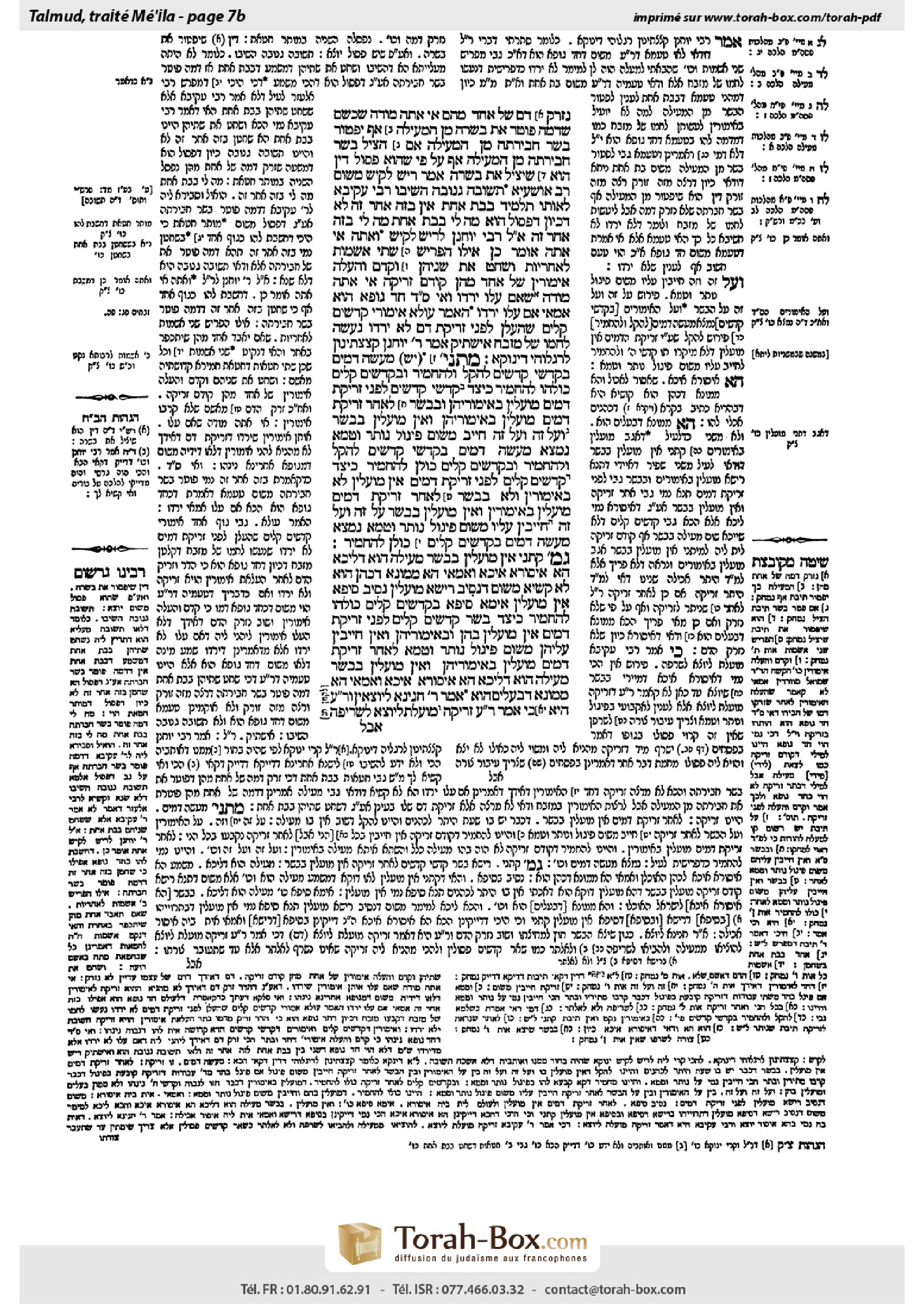
Meilah 7b: Talmud study for Daf Yomi
Daf Yomi is the daily study of one Talmud folio. Explore 37 tractates with scans, Hebrew text, Sefaria English and AI-generated French translations where annotated.
Passage selection and English or AI-generated French translation are available where the scan has annotations. Daf Study is independent of Torah-Box and Sefaria.
Browse Meilah · מעילה · All tractatesMeilah 7b text and translations
This page of Meilah includes the Aramaic text, an English translation and an AI-generated French translation, alongside the scan above.
מעילה ז׳ ב · Aramaic and Hebrew text
נִזְרַק דָּם שֶׁל אֶחָד מֵהֶם, אִי אַתָּה מוֹדֶה שֶׁכְּשֵׁם שֶׁדָּמָהּ פּוֹטֵר אֶת בְּשָׂרָהּ מִן הַמְּעִילָה, אַף יִפְטוֹר בְּשַׂר חֲבֶירְתָּהּ מִן הַמְּעִילָה?
אִם הִצִּיל בְּשַׂר חֲבֶירְתָּהּ מִן הַמְּעִילָה, אַף עַל פִּי שֶׁהוּא פָּסוּל, דִּין הוּא שֶׁיַּצִּיל אֶת בְּשָׂרָהּ!
אָמַר רֵישׁ לָקִישׁ מִשּׁוּם רַב אוֹשַׁעְיָא: תְּשׁוּבָה גְּנוּבָה הֱשִׁיבוֹ רַבִּי עֲקִיבָא לְאוֹתוֹ תַּלְמִיד, בְּבַת אַחַת – אִין, בְּזֶה אַחַר זֶה – לָא,
דְּכֵיוָן דְּפָסוּל הוּא, מָה לִי בְּבַת אַחַת, מָה לִי בְּזֶה אַחַר זֶה?!
אֲמַר לֵיהּ רַבִּי יוֹחָנָן לְרֵישׁ לָקִישׁ: וְאַתָּה, אִי אַתָּה אוֹמֵר כֵּן?
אִילּוּ הִפְרִישׁ שְׁתֵּי אֲשָׁמוֹת לְאַחְרָיוּת, וְשָׁחַט אֶת שְׁנֵיהֶן, וְקָדַם וְהֶעֱלָה אֵימוּרִין שֶׁל אֶחָד מֵהֶן קוֹדֶם זְרִיקָה, אִי אַתָּה מוֹדֶה שֶׁאִם עָלוּ – יֵרְדוּ?
וְאִי סָלְקָא דַעְתָּךְ חַד גּוּפָא הוּא, אַמַּאי אִם עָלוּ – יֵרְדוּ? הָאָמַר עוּלָּא: אֵימוּרֵי קָדָשִׁים קַלִּים שֶׁהֶעֱלָן לִפְנֵי זְרִיקַת דָּם – לֹא יֵרְדוּ, נַעֲשָׂה לַחְמוֹ שֶׁל מִזְבֵּחַ!
אִישְׁתִּיק. אָמַר רַבִּי יוֹחָנָן: קַצֵּצְתִּינּוּן לְרַגְלוֹהִי דְיָנוֹקָא.
מַתְנִי׳ יֵשׁ מַעֲשֵׂה דָמִים בְּקׇדְשֵׁי קָדָשִׁים לְהָקֵל וּלְהַחֲמִיר, וּבְקָדָשִׁים קַלִּים כּוּלְּהוּ לְהַחֲמִיר.
כֵּיצַד? קׇדְשֵׁי קָדָשִׁים לִפְנֵי זְרִיקַת דָּמִים – מוֹעֲלִין בְּאֵימוּרֵיהֶן וּבַבָּשָׂר. לְאַחַר זְרִיקַת דָּמִים – מוֹעֲלִין בְּאֵימוּרֵיהֶן, וְאֵין מוֹעֲלִין בַּבָּשָׂר.
וְעַל זֶה וְעַל זֶה – חַיָּיב מִשּׁוּם פִּיגּוּל, נוֹתָר, וְטָמֵא. נִמְצָא, מַעֲשֵׂה דָמִים בְּקׇדְשֵׁי קָדָשִׁים לְהָקֵל וּלְהַחֲמִיר,
וּבְקָדָשִׁים קַלִּים כּוּלָּן לְהַחֲמִיר. כֵּיצַד? קָדָשִׁים קַלִּים לִפְנֵי זְרִיקַת דָמִים – אֵין מוֹעֲלִין לֹא בָּאֵימוּרִין וְלֹא בַּבָּשָׂר, לְאַחַר זְרִיקַת דָמִים – מוֹעֲלִין בָּאֵימוּרִין וְאֵין מוֹעֲלִין בַּבָּשָׂר.
עַל זֶה וְעַל זֶה חַיָּיבִין עָלָיו מִשּׁוּם פִּיגּוּל, נוֹתָר, וְטָמֵא. נִמְצָא מַעֲשֵׂה דָמִים בְּקָדָשִׁים קַלִּים כּוּלָּן לְהַחֲמִיר.
גְּמָ׳ קָתָנֵי ״אֵין מוֹעֲלִין בַּבָּשָׂר״ – מְעִילָה הוּא דְּלֵיכָּא, הָא אִיסּוּרָא אִיכָּא, וְאַמַּאי? הָא מָמוֹנָא דְכֹהֵן הוּא!
לָא קַשְׁיָא, מִשּׁוּם דְּנָסֵיב רֵישָׁא ״מוֹעֲלִין״, נָסֵיב סֵיפָא ״אֵין מוֹעֲלִין״.
אֵימָא סֵיפָא: ״בְּקָדָשִׁים קַלִּים כּוּלְּהוּ לְהַחֲמִיר. כֵּיצַד? בְּשַׂר קָדָשִׁים קַלִּים לִפְנֵי זְרִיקַת דָּמִים – אֵין מוֹעֲלִין בָּהֶן וּבְאֵימוּרֵיהֶן, וְאֵין חַיָּיבִין עֲלֵיהֶן מִשּׁוּם פִּיגּוּל, נוֹתָר, וְטָמֵא. לְאַחַר זְרִיקַת דָּמִים – מוֹעֲלִין בְּאֵימוּרֵיהֶן וְאֵין מוֹעֲלִין בַּבָּשָׂר״.
מְעִילָה הוּא דְּלֵיכָּא, הָא אִיסּוּרָא אִיכָּא, וְאַמַּאי? הָא מָמוֹנָא דִבְעָלִים הוּא!
אָמַר רַבִּי חֲנִינָא: לַיּוֹצְאִין, וְרַבִּי עֲקִיבָא הִיא.
כִּי אָמַר רַבִּי עֲקִיבָא זְרִיקָה מוֹעֶלֶת, לַיּוֹצֵא לִשְׂרֵיפָה,
Meilah 7b · English translation
And in a case where the blood of one of the sin offerings was sprinkled, do you not concede that just as the sprinkling of its blood exempts its meat from the halakhot of misuse, so too, it exempts the meat of the other animal from the halakhot of misuse?
If so, one may infer from here by an a fortiori inference with regard to the case of sprinkling the blood of meat that left the courtyard: If the sprinkling of its blood spared the meat of the other animal from the halakhot of misuse, even though that animal is unfit, as it is a leftover sin offering, it is only right that the blood that was sprinkled should exempt its own meat, despite the fact that it left the courtyard.
With regard to this reply by Rabbi Akiva, Reish Lakish says in the name of Rav Oshaya: Rabbi Akiva gave a deceptive response to that student of his, Rabbi Shimon. Reish Lakish elaborates: Based on Rabbi Akiva’s reply, one would think that if the two sin offerings were slaughtered at the same time, then yes, the blood of one sin offering exempts the meat of the other from the halakhot of misuse. But if they were slaughtered one after the other, it does not exempt the meat of the other offering.
But since in either case the other offering, whose blood was not sprinkled, is unfit, as it is a leftover sin offering, what difference does it make to me whether they were slaughtered at the same time or whether they were slaughtered one after the other? In either case, according to Rabbi Akiva, the sprinkling of one should exempt the meat of the other from the halakhot of misuse.
Rabbi Yoḥanan said to Reish Lakish in response: And you, who raise this difficulty, do you not also say the same, that there is a difference between a case where they were slaughtered at the same time, and are therefore considered one entity, when the sprinkling of the blood of one offering exempts the meat of the other, and a case where they were slaughtered one after the other, and are therefore considered two separate entities, which means that the blood of one offering does not exempt the meat of the other?
But in a case where one separated two guilt offerings as a guarantee for his obligation of a single guilt offering, i.e., that if one were lost he could achieve atonement by means of the second, and one slaughtered both of them, and the priest first brought up the sacrificial portions of one of them onto the altar before sprinkling any blood, and then sprinkled the blood of the other offering, would you not concede that even if the sacrificial portions of this offering whose blood was not sprinkled ascended the altar, that they shall descend without being sacrificed? The proper procedure is that first the blood is sprinkled and only then are the sacrificial portions brought up onto the altar to be sacrificed.
Rabbi Yoḥanan analyzes this case: And if it enters your mind to say that even when the two offerings were slaughtered one after the other they are still considered as one entity, why is it the halakha that if the sacrificial portions ascended the altar, they shall descend? Doesn’t Ulla say that sacrificial portions of offerings of lesser sanctity which one brought up to the altar before the sprinkling of the offering’s blood, and are therefore not yet fit for the altar, shall not descend, but are sacrificed, as the sacrificial portions have become the food of the altar, by virtue of their placement upon it?
Reish Lakish was silent, as he had no answer to Rabbi Yoḥanan’s difficulty. Rabbi Yoḥanan said in this regard: We have cut off the legs of the child, i.e., I have refuted Reish Lakish’s opinion by raising a difficulty that eliminates the basis for his opinion.
MISHNA: With regard to establishing liability for misuse of consecrated items, there is an aspect of leniency and an aspect of stringency in the act of sprinkling the blood of offerings of the most sacred order. But with regard to the sprinkling of the blood in the case of offerings of lesser sanctity, it contains in its entirety aspects of stringency, i.e., there are only aspects of stringency.
How so? The status of offerings of the most sacred order is that before the sprinkling of blood, one is liable for misusing their sacrificial portions that are to be burned on the altar, and for misusing the meat that is to be eaten by the priests. Since the meat is prohibited prior to sprinkling the blood, it is in the category of items consecrated to God, which are subject to the halakhot of misuse. After the sprinkling of the blood of offerings of the most sacred order, one is still liable for misuse of their sacrificial portions, as they remain prohibited to be eaten and are in the category of items consecrated to God, but one is not liable for misuse of the meat, as it is now permitted for consumption by the priests. This explains how there is an aspect of leniency in the sprinkling of the blood of offerings of the most sacred order.
By contrast, for consumption of both this, the sacrificial portions, and that, the meat, after the sprinkling of the blood, one is liable to receive karet due to violation of the prohibition against consumption of piggul, and the prohibition against consumption of notar, and the prohibition against consumption of sacrificial meat while ritually impure. Consequently, the act of sprinkling blood of offerings of the most sacred order is found to contain an aspect of leniency and an aspect of stringency.
But with regard to the sprinkling of the blood of offerings of lesser sanctity, all of their aspects are of stringency. How so? The status of offerings of lesser sanctity is that before the sprinkling of the blood, one is not liable for misuse, not for their sacrificial portions nor for the meat. After the sprinkling of the blood, one is liable for misuse of their sacrificial portions, but one is not liable for misuse of the meat. This explains how the sprinkling of the blood in the case of offerings of lesser sanctity causes a stringency in terms of the halakhot of misuse.
And for consumption of both this, the sacrificial portions, and that, the meat, after the sprinkling of the blood, one is liable to receive karet due to violation of the prohibition against consumption of piggul, and of the prohibition against consumption of notar, and of the prohibition against consumption of sacrificial meat while ritually impure. Consequently, in the act of sprinkling the blood of offerings of lesser sanctity, it is found that all of their aspects are of stringency.
GEMARA: The mishna teaches: After the sprinkling of the blood of offerings of the most sacred order, one is not liable for misusing the meat. The Gemara infers from this that there is no liability for misuse of consecrated property, but there is a prohibition for the priest to eat from it even after the blood has been sprinkled. The Gemara therefore asks: But why is there such a prohibition? Isn’t the meat the property of the priests after the blood has been sprinkled, and therefore it is permitted for them in consumption?
The Gemara answers: This is not difficult, as the above inference is invalid. The reason that the mishna taught that one is not liable, rather than saying that the meat is permitted, is as follows: Since the first clause mentions the phrase: One is liable for misusing, the latter clause also mentions the parallel phrase: One is not liable for misusing. Therefore, the above inference is incorrect, as there is in fact no prohibition for the priests to eat the meat.
The Gemara continues to analyze the mishna. Say the latter clause: But with regard to the sprinkling of the blood of offerings of lesser sanctity, all of their aspects are of stringency. How so? The status of the meat of offerings of lesser sanctity is that before the sprinkling of the blood, one is not liable for misuse, not for their meat nor for their sacrificial portions. And one is not liable due to violation of the prohibition against piggul, notar, or the consumption of sacrificial meat while ritually impure. After the sprinkling of the blood, one is liable for misuse of their sacrificial portions, and one is not liable for misuse of the meat.
The Gemara infers as above: There is no liability for misuse of the meat of offerings of lesser sanctity, but there is a prohibition for the owners to consume it, even after the blood has been sprinkled. But why is there such a prohibition? Isn’t this meat the property of the owners after the blood has been sprinkled, and it is permitted for them in consumption?
Rabbi Ḥanina says in explanation: This is referring to meat that was taken out from the place where it is permitted to be eaten before the sprinkling of the blood, and the blood was later sprinkled. In such a case, the meat is prohibited. And this ruling is in accordance with the opinion of Rabbi Akiva in the mishna on 6b, who rules that sprinkling is effective in that it exempts the meat of the offerings of the most sacred order from the halakhot of misuse, and renders the meat of offerings of lesser sanctity subject to misuse, even if the meat left the courtyard.
Rabbi Ḥanina continues: The tanna here is teaching that when Rabbi Akiva says that sprinkling is effective with regard to the meat of offerings of the most sacred order or the sacrificial portions of offerings of lesser sanctity that left the courtyard, with regard to the halakhot of misuse, piggul, notar, and the prohibition against consumption of sacrificial meat while ritually impure, that applies specifically with regard to the halakhot of its burning, that it is not burned right away, but that one must wait until the following morning to burn it.
Meilah 7b · Traduction française (IA)
Et dans le cas où le sang de l’un des sacrifices expiatoires a été aspergé, ne reconnais-tu pas que, de même que l’aspersion de son sang soustrait sa viande aux règles du détournement d’objets consacrés, elle soustrait également la viande de l’autre animal à ces règles ?
Si tel est le cas, on peut en déduire ici, par raisonnement a fortiori, ce qu’il en est de l’aspersion du sang d’une viande qui a quitté la cour : si l’aspersion de son sang a soustrait la viande de l’autre animal aux règles du détournement d’objets consacrés, alors que cet animal est impropre, puisqu’il s’agit d’un sacrifice expiatoire laissé en surplus, à plus forte raison le sang aspergé doit-il soustraire sa propre viande à ces règles, bien qu’elle ait quitté la cour.
Au sujet de cette réponse de Rabbi Akiva, Reish Lakish dit au nom de Rav Oshaya : Rabbi Akiva a répondu de manière trompeuse à son élève, Rabbi Shimon. Reish Lakish précise : d’après la réponse de Rabbi Akiva, on pourrait penser que, si les deux sacrifices expiatoires ont été abattus en même temps, le sang de l’un soustrait la viande de l’autre aux règles du détournement d’objets consacrés. Mais s’ils ont été abattus l’un après l’autre, il ne soustrait pas la viande de l’autre sacrifice à ces règles.
Mais puisque, dans les deux cas, l’autre sacrifice, dont le sang n’a pas été aspergé, est impropre, puisqu’il s’agit d’un sacrifice expiatoire laissé en surplus, quelle différence cela fait-il qu’ils aient été abattus en même temps ou l’un après l’autre ? Dans les deux cas, selon Rabbi Akiva, l’aspersion du sang de l’un devrait soustraire la viande de l’autre aux règles du détournement d’objets consacrés.
En réponse, Rabbi Yoḥanan dit à Reish Lakish : et toi, qui soulèves cette difficulté, ne dis-tu pas toi aussi qu’il y a une différence entre le cas où ils ont été abattus en même temps, et sont donc considérés comme une seule entité, de sorte que l’aspersion du sang d’un sacrifice soustrait la viande de l’autre aux règles du détournement d’objets consacrés, et le cas où ils ont été abattus l’un après l’autre, et sont donc considérés comme deux entités distinctes, de sorte que le sang de l’un ne soustrait pas la viande de l’autre à ces règles ?
Mais dans le cas où quelqu’un a mis à part deux sacrifices de culpabilité pour garantir l’acquittement de son obligation d’offrir un seul sacrifice de culpabilité, c’est-à-dire que, si l’un venait à être perdu, il pourrait obtenir l’expiation grâce au second, et où il les a tous deux abattus, puis où le prêtre a d’abord fait monter sur l’autel les parties sacrificielles de l’un, avant d’asperger le sang de l’un ou l’autre, puis a aspergé le sang de l’autre sacrifice, ne reconnais-tu pas que, même si les parties sacrificielles de ce sacrifice dont le sang n’a pas été aspergé sont montées sur l’autel, elles doivent en redescendre sans être offertes ? La procédure correcte consiste à asperger d’abord le sang, puis à faire monter les parties sacrificielles sur l’autel pour les offrir.
Rabbi Yoḥanan analyse ce cas : si tu penses que, même lorsque les deux sacrifices ont été abattus l’un après l’autre, ils sont encore considérés comme une seule entité, pourquoi la halakha veut-elle que, si les parties sacrificielles sont montées sur l’autel, elles en redescendent ? Oulla ne dit-il pas que les parties sacrificielles des offrandes de moindre sainteté qu’on a fait monter sur l’autel avant l’aspersion du sang de l’offrande, et qui ne sont donc pas encore aptes à être offertes sur l’autel, n’en redescendent pas, mais sont offertes, car elles sont devenues la nourriture de l’autel du fait qu’elles y ont été placées ?
Reish Lakish garda le silence, car il n’avait pas de réponse à la difficulté de Rabbi Yoḥanan. Rabbi Yoḥanan dit à ce propos : « Nous avons coupé les jambes de l’enfant », c’est-à-dire que j’ai réfuté l’opinion de Reish Lakish en soulevant une difficulté qui en supprime le fondement.
MICHNA : En ce qui concerne l’établissement de la responsabilité pour détournement d’objets consacrés, l’aspersion du sang des offrandes de sainteté suprême comporte un aspect de clémence et un aspect de rigueur. En revanche, l’aspersion du sang des offrandes de moindre sainteté ne comporte que des aspects de rigueur.
Comment cela ? Pour les offrandes de sainteté suprême, avant l’aspersion du sang, on est passible pour le détournement de leurs parties sacrificielles destinées à être brûlées sur l’autel et de la viande destinée à être mangée par les prêtres. Comme la viande est interdite avant l’aspersion du sang, elle relève de la catégorie des biens consacrés à Dieu, soumis aux règles du détournement d’objets consacrés. Après l’aspersion du sang des offrandes de sainteté suprême, on reste passible pour le détournement de leurs parties sacrificielles, car elles demeurent interdites à la consommation et relèvent de la catégorie des biens consacrés à Dieu ; mais on n’est pas passible pour le détournement de la viande, puisqu’elle est désormais autorisée à la consommation des prêtres. Voilà en quoi l’aspersion du sang des offrandes de sainteté suprême comporte un aspect de clémence.
En revanche, pour la consommation de ces unes, les parties sacrificielles, et de ces autres, la viande, après l’aspersion du sang, on est passible du retranchement pour avoir enfreint l’interdiction de consommer du piggoul, l’interdiction de consommer du notar et l’interdiction de consommer de la viande sacrificielle en état d’impureté rituelle. Par conséquent, l’aspersion du sang des offrandes de sainteté suprême comporte à la fois un aspect de clémence et un aspect de rigueur.
Mais, pour l’aspersion du sang des offrandes de moindre sainteté, tous les aspects relèvent de la rigueur. Comment cela ? Pour les offrandes de moindre sainteté, avant l’aspersion du sang, on n’est passible de détournement ni pour leurs parties sacrificielles ni pour leur viande. Après l’aspersion du sang, on est passible pour le détournement de leurs parties sacrificielles, mais pas pour celui de la viande. Voilà en quoi l’aspersion du sang des offrandes de moindre sainteté entraîne une rigueur au regard des règles du détournement d’objets consacrés.
Et pour la consommation de ces unes, les parties sacrificielles, et de ces autres, la viande, après l’aspersion du sang, on est passible du retranchement pour avoir enfreint l’interdiction de consommer du piggoul, l’interdiction de consommer du notar et l’interdiction de consommer de la viande sacrificielle en état d’impureté rituelle. Par conséquent, l’aspersion du sang des offrandes de moindre sainteté ne comporte, sous tous ses aspects, que de la rigueur.
GUEMARA : La Michna enseigne qu’après l’aspersion du sang des offrandes de sainteté suprême, on n’est pas passible pour le détournement de la viande. La Guemara en déduit qu’il n’y a pas de responsabilité pour le détournement d’un bien consacré, mais qu’il est interdit au prêtre d’en manger, même après l’aspersion du sang. La Guemara demande donc : mais pourquoi une telle interdiction ? Après l’aspersion du sang, la viande n’appartient-elle pas aux prêtres, et n’est-elle donc pas autorisée à la consommation ?
La Guemara répond : il n’y a pas de difficulté, car la déduction ci-dessus est invalide. Si la Michna dit qu’on n’est pas passible, plutôt que de dire que la viande est autorisée, c’est pour la raison suivante : puisque la première partie mentionne l’expression « on est passible pour le détournement », la dernière partie emploie aussi l’expression correspondante : « on n’est pas passible pour le détournement ». La déduction ci-dessus est donc incorrecte, car il n’est en réalité pas interdit aux prêtres de manger la viande.
La Guemara poursuit l’analyse de la Michna. Reprenons la dernière partie : « Mais, pour l’aspersion du sang des offrandes de moindre sainteté, tous les aspects relèvent de la rigueur. Comment cela ? » Pour la viande des offrandes de moindre sainteté, avant l’aspersion du sang, on n’est passible de détournement ni pour leur viande ni pour leurs parties sacrificielles. Et on n’est pas passible pour avoir enfreint l’interdiction de consommer du piggoul, du notar ou de la viande sacrificielle en état d’impureté rituelle. Après l’aspersion du sang, on est passible pour le détournement de leurs parties sacrificielles, mais pas pour celui de la viande.
La Guemara en déduit comme précédemment : il n’y a pas de responsabilité pour le détournement de la viande des offrandes de moindre sainteté, mais il est interdit à leurs propriétaires de la consommer, même après l’aspersion du sang. Mais pourquoi une telle interdiction ? Après l’aspersion du sang, cette viande n’appartient-elle pas aux propriétaires, et n’est-elle pas autorisée à la consommation ?
Rabbi Ḥanina explique : il s’agit d’une viande qui a été emportée hors de l’endroit où elle peut être mangée avant l’aspersion du sang, puis dont le sang a été aspergé par la suite. Dans un tel cas, la viande est interdite. Cette décision suit l’opinion de Rabbi Akiva dans la Michna en 6b, selon laquelle l’aspersion produit son effet : elle soustrait la viande des offrandes de sainteté suprême aux règles du détournement d’objets consacrés et rend la viande des offrandes de moindre sainteté sujette à ces règles, même si la viande a quitté la cour.
Rabbi Ḥanina poursuit : le tanna enseigne ici que, lorsque Rabbi Akiva dit que l’aspersion produit son effet sur la viande des offrandes de sainteté suprême ou sur les parties sacrificielles des offrandes de moindre sainteté qui ont quitté la cour, en ce qui concerne les règles du détournement d’objets consacrés, du piggoul, du notar et de l’interdiction de consommer de la viande sacrificielle en état d’impureté rituelle, cela s’applique précisément aux règles de leur combustion : elles ne sont pas brûlées immédiatement, mais il faut attendre le lendemain matin pour les brûler.
Traduction française générée par IA à partir de l’édition anglaise de Sefaria. Vérifie toujours un passage avec le texte source.
Text from Sefaria: William Davidson Edition - Vocalized Aramaic (CC BY NC); William Davidson Edition - English (CC BY NC).