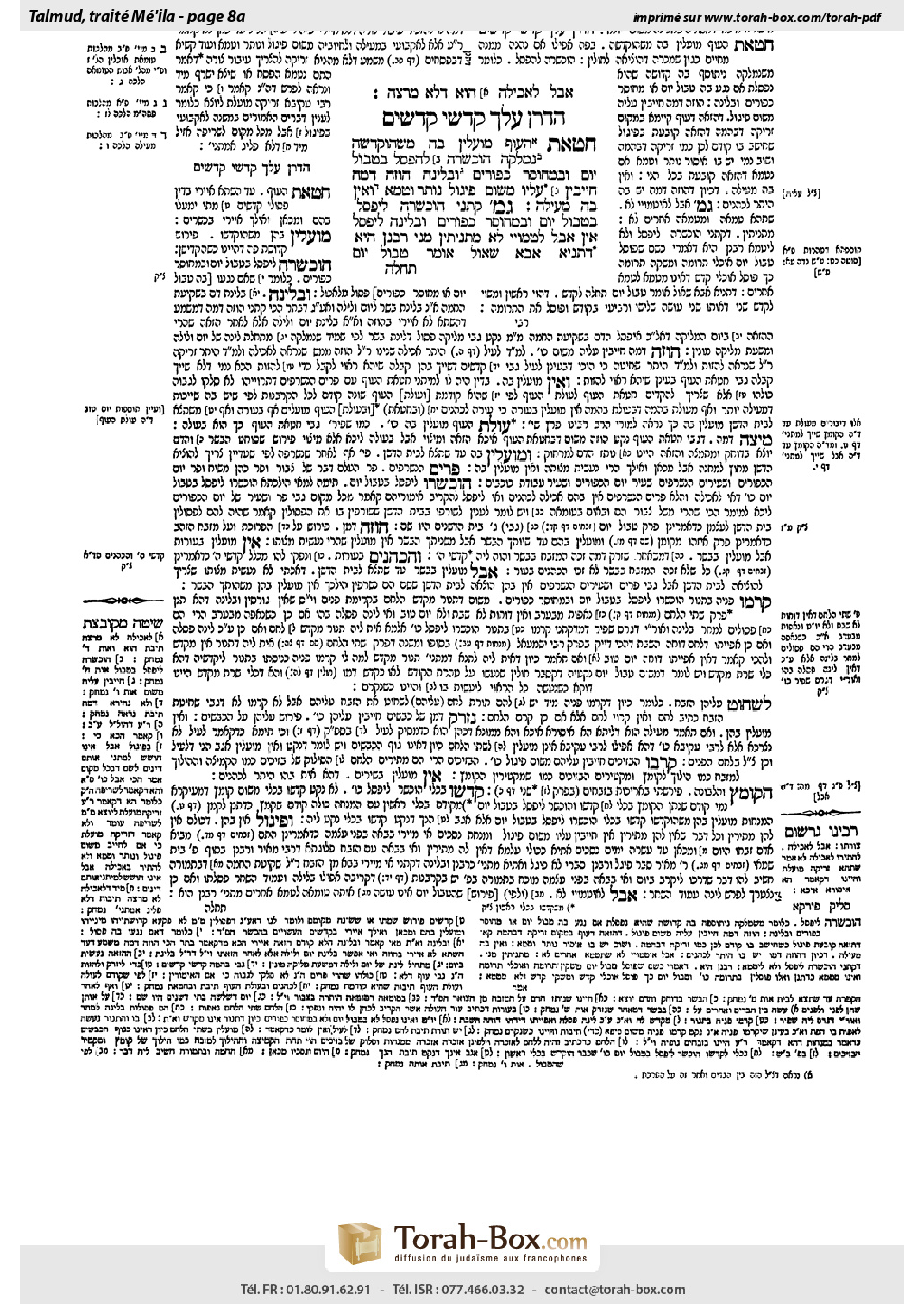
Meilah 8a: Talmud study for Daf Yomi
Daf Yomi is the daily study of one Talmud folio. Explore 37 tractates with scans, Hebrew text, Sefaria English and AI-generated French translations where annotated.
Passage selection and English or AI-generated French translation are available where the scan has annotations. Daf Study is independent of Torah-Box and Sefaria.
Browse Meilah · מעילה · All tractatesMeilah 8a text and translations
This page of Meilah includes the Aramaic text, an English translation and an AI-generated French translation, alongside the scan above.
מעילה ח׳ א · Aramaic and Hebrew text
אֲבָל לַאֲכִילָה הוּא דְּלֹא מְרַצָּה.
הַדְרָן עֲלָךְ קׇדְשֵׁי קָדָשִׁים
חַטַּאת הָעוֹף מוֹעֲלִין בָּהּ מִשֶּׁהוּקְדְּשָׁה, נִמְלְקָה – הוּכְשְׁרָה לְהִפָּסֵל בִּטְבוּל יוֹם וּבִמְחוּסַּר כִּפּוּרִים וּבְלִינָה.
הוּזָּה דָּמָהּ – חַיָּיבִין עָלָיו מִשּׁוּם פִּיגּוּל, נוֹתָר, וְטָמֵא, וְאֵין בָּהּ מְעִילָה.
גְּמָ׳ קָתָנֵי הוּכְשְׁרָה לִיפָּסֵל בִּטְבוּל יוֹם, וּבִמְחוּסַּר כִּפּוּרִים, וּבְלִינָה. לִיפָּסֵל – אִין, אֲבָל לְטַמּוֹיֵי – לָא.
מַתְנִיתִין מַנִּי? רַבָּנַן הִיא, דְּתַנְיָא: אַבָּא שָׁאוּל אוֹמֵר: טְבוּל יוֹם
Meilah 8a · English translation
But as for permitting it for eating, in this regard even Rabbi Akiva concedes that the sprinkling of the blood does not effect acceptance.
MISHNA: One who derives benefit from a bird sin offering is liable for misuse of consecrated property from the moment that it was consecrated. Once the nape of its neck was pinched, it was rendered susceptible to disqualification for sacrifice through contact with one who was ritually impure who immersed in a ritual bath that day and is waiting for nightfall for the purification process to be completed, and through contact with one who has not yet brought an atonement offering to complete his purification process, e.g., a zav and a leper, who are not yet permitted to partake of sacrificial meat; and through its blood being left overnight, i.e., if its blood was not sprinkled before sunset.
Once its blood was sprinkled, one is liable to receive karet for eating it due to violation of the prohibition of piggul, and the prohibition of notar, and the prohibition of partaking of sacrificial meat while ritually impure. But there is no liability for misuse of consecrated property, because after the blood is sprinkled it is permitted for priests to partake of its meat and it is no longer consecrated exclusively to God.
GEMARA: The mishna teaches: From the time the nape of its neck was pinched, the bird sin offering was rendered susceptible to disqualification for sacrifice through contact with one who immersed that day, and through contact with one who has not yet brought an atonement offering, and through its blood being left overnight. It can be inferred from here that yes, it is susceptible to disqualification, but it is not fit to render other items ritually impure.
In light of the above inference, the Gemara asks: Whose opinion is expressed in the mishna? The Gemara answers: It is the opinion of the Rabbis, as it is taught in a baraita (Tosefta, Teharot 1:4) that Abba Shaul says: With regard to one who immersed that day,
Meilah 8a · Traduction française (IA)
Mais quant à autoriser sa consommation, Rabbi Akiva lui-même reconnaît que, sur ce point, l’aspersion du sang ne vaut pas acceptation.
MICHNA : Celui qui tire profit d’un sacrifice expiatoire d’oiseau est passible de détournement d’un bien consacré dès le moment où celui-ci a été consacré. Une fois sa nuque pincée, l’oiseau devient susceptible d’être disqualifié comme sacrifice en cas de contact avec une personne rituellement impure qui s’est immergée dans un bain rituel ce jour-là et attend la tombée de la nuit pour achever sa purification, en cas de contact avec une personne qui n’a pas encore apporté de sacrifice expiatoire pour achever sa purification, par exemple un zav ou un lépreux, qui ne sont pas encore autorisés à consommer de la viande sacrificielle, ainsi que si son sang est laissé toute la nuit, c’est-à-dire si son sang n’a pas été aspergé avant le coucher du soleil.
Une fois son sang aspergé, celui qui en mange est passible de karet pour avoir enfreint l’interdiction de piggoul, l’interdiction de notar et l’interdiction de consommer de la viande sacrificielle en état d’impureté rituelle. Mais il n’est pas passible de détournement d’un bien consacré, car, après l’aspersion du sang, les prêtres sont autorisés à consommer sa viande et celle-ci n’est plus consacrée exclusivement à Dieu.
GUEMARA : La Michna enseigne : À partir du moment où la nuque de l’oiseau est pincée, le sacrifice expiatoire d’oiseau devient susceptible d’être disqualifié comme sacrifice en cas de contact avec une personne qui s’est immergée ce jour-là, en cas de contact avec une personne qui n’a pas encore apporté de sacrifice expiatoire, et si son sang est laissé toute la nuit. On peut en déduire qu’il est bien susceptible d’être disqualifié, mais qu’il n’est pas apte à rendre d’autres objets rituellement impurs.
À la lumière de cette déduction, la Guemara demande : De qui la Michna exprime-t-elle l’opinion ? La Guemara répond : C’est l’opinion des Rabbins, comme il est enseigné dans une baraïta (Tosefta, Teharot 1:4) qu’Abba Shaul dit : En ce qui concerne une personne qui s’est immergée ce jour-là,
Traduction française générée par IA à partir de l’édition anglaise de Sefaria. Vérifie toujours un passage avec le texte source.
Text from Sefaria: William Davidson Edition - Vocalized Aramaic (CC BY NC); William Davidson Edition - English (CC BY NC).