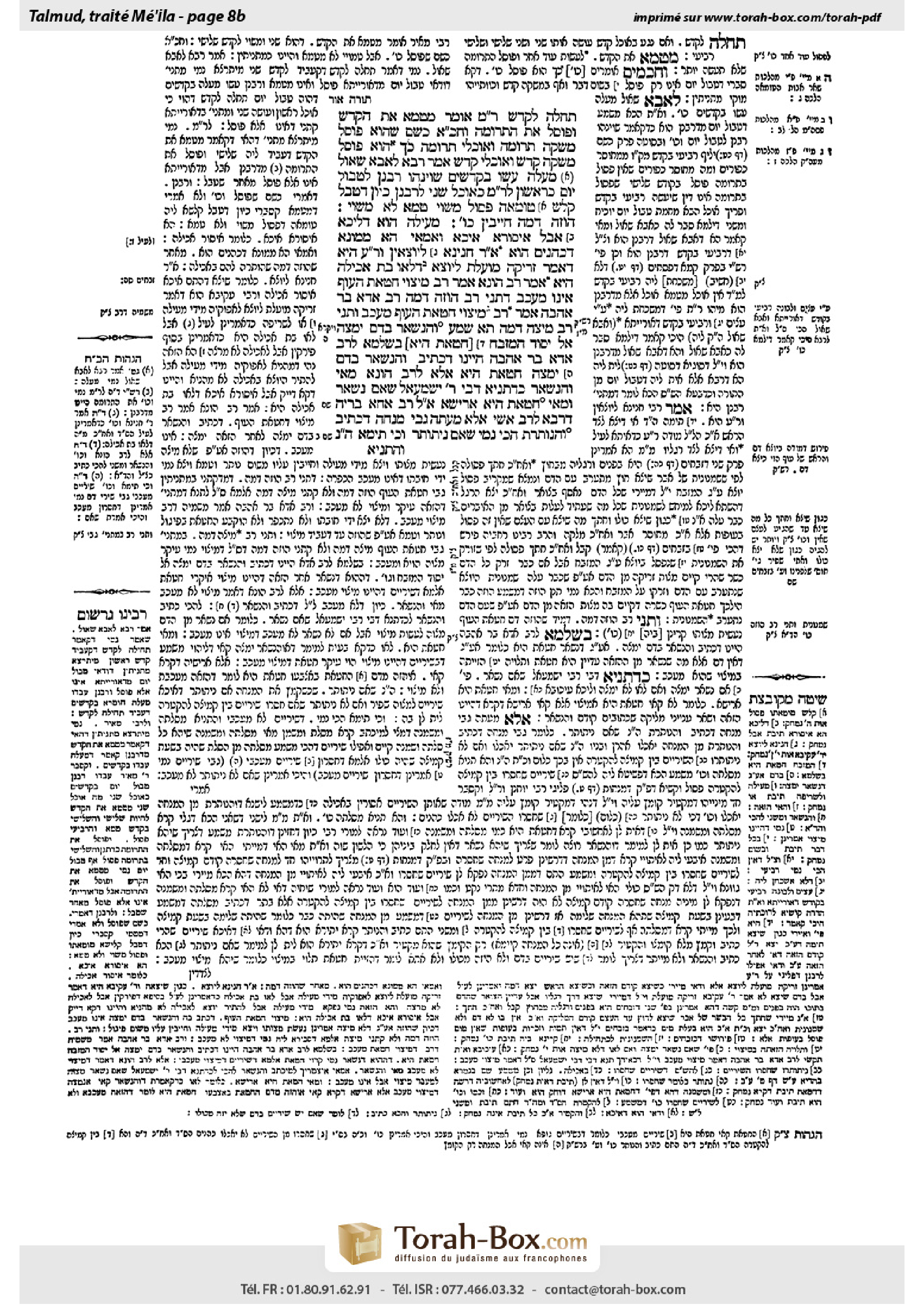
Meilah 8b: Talmud study for Daf Yomi
Daf Yomi is the daily study of one Talmud folio. Explore 37 tractates with scans, Hebrew text, Sefaria English and AI-generated French translations where annotated.
Passage selection and English or AI-generated French translation are available where the scan has annotations. Daf Study is independent of Torah-Box and Sefaria.
Browse Meilah · מעילה · All tractatesMeilah 8b text and translations
This page of Meilah includes the Aramaic text, an English translation and an AI-generated French translation, alongside the scan above.
מעילה ח׳ ב · Aramaic and Hebrew text
תְּחִלָּה לַקֹּדֶשׁ.
רַבִּי מֵאִיר אוֹמֵר: מְטַמֵּא אֶת הַקֹּדֶשׁ, וּפוֹסֵל אֶת הַתְּרוּמָה. וַחֲכָמִים אוֹמְרִים: כְּשֵׁם שֶׁהוּא פּוֹסֵל מַשְׁקֵה תְרוּמָה וְאוֹכְלֵי תְרוּמָה, כָּךְ הוּא פּוֹסֵל מַשְׁקֵה קֹדֶשׁ וְאוֹכְלֵי קֹדֶשׁ.
אָמַר רָבָא: לְאַבָּא שָׁאוּל מַעֲלָה עָשׂוּ בַּקֳּדָשִׁים, שַׁוִּינְהוּ רַבָּנַן לִטְבוּל יוֹם כָּרִאשׁוֹן,
לְרַבִּי מֵאִיר כְּאוֹכֶל שֵׁנִי. לְרַבָּנַן, כֵּיוָן דִּטְבַל – קְלַשׁ טוּמְאָה, פָּסוּל – מְשַׁוֵּי, טָמֵא – לָא מְשַׁוֵּי.
הוּזָּה דָּמָהּ – חַיָּיבִין כּוּ׳. מְעִילָה הוּא דְּלֵיכָּא, אֲבָל אִיסּוּרָא – אִיכָּא. וְאַמַּאי? הָא מָמוֹנָא דְכֹהֲנִים הוּא!
אָמַר רַבִּי חֲנִינָא: לַיּוֹצְאִין, וְרַבִּי עֲקִיבָא הִיא, דְּאָמַר זְרִיקָה מוֹעֶלֶת לַיּוֹצֵא, דְּלָאו בַּת אֲכִילָה הִיא.
אָמַר רַב הוּנָא אָמַר רַב: מִיצּוּי חַטַּאת הָעוֹף – אֵינוֹ מְעַכֵּב. דְּתָנֵי רַב: ״הוּזָּה דָּמָהּ״.
רַב אַדָּא בַּר אַהֲבָה אָמַר רַב: מִיצּוּי חַטַּאת הָעוֹף מְעַכֵּב. וְתָנֵי רַב: ״מִיצָּה דָּמָהּ״.
תָּא שְׁמַע: ״וְהַנִּשְׁאָר בַּדָּם יִמָּצֵה אֶל יְסוֹד הַמִּזְבֵּחַ חַטָּאת הִיא״. בִּשְׁלָמָא לְרַב אַדָּא בַּר אַהֲבָה, הַיְינוּ דִּכְתִיב: ״וְהַנִּשְׁאָר בַּדָּם יִמָּצֵה... חַטָּאת הִיא״, אֶלָּא לְרַב הוּנָא, מַאי ״וְהַנִּשְׁאָר״?
כִּדְתַנְיָא דְּבֵי רַבִּי יִשְׁמָעֵאל: שֶׁאִם נִשְׁאַר. וּמַאי ״חַטָּאת הִיא״? אַרֵישָׁא.
אֲמַר לֵיהּ רַב אַחָא בְּרֵיהּ דְּרָבָא לְרַב אָשֵׁי: אֶלָּא מֵעַתָּה, גַּבֵּי מִנְחָה דִּכְתִיב: ״וְהַנּוֹתֶרֶת״. הָכִי נָמֵי שֶׁאִם נִיתּוֹתַר? וְכִי תֵּימָא: הָכִי נָמֵי,
Meilah 8b · English translation
until sunset he is treated as one who is impure with first-degree impurity with regard to sacrificial food. In other words, an item of sacrificial food that he touches assumes the status of second-degree impurity. A second item that comes into contact with the first item of food assumes third-degree impurity. If a third item comes into contact with the second item, it assumes fourth-degree impurity, i.e., it may not be eaten but does not impart impurity to other items.
Rabbi Meir says: One who immersed that day is considered impure with second-degree impurity, even with regard to sacrificial food, and therefore he renders sacrificial food impure and disqualifies teruma. And the Rabbis say: Just as he merely disqualifies teruma liquids and teruma foods, without them becoming impure to a degree that their impurity is transferred to another item, so too, he only disqualifies sacrificial liquids and sacrificial foods. Apparently, the mishna here is in accordance with the opinion of the Rabbis, not the opinions of Abba Shaul and Rabbi Meir.
Rava rejects this analysis and says: The mishna can be explained even in accordance with the opinions of Abba Shaul and Rabbi Meir, as they might agree that by Torah law one who immersed that day only disqualifies the food and does not render it impure. But according to Abba Shaul, the Sages established a higher standard with regard to consecrated items, and therefore the Sages equated one who immersed that day to one who is impure with first-degree ritual impurity.
Rava continues: According to Rabbi Meir, the Sages equated the impurity of one who immersed that day to food of second-degree ritual impurity, but according to the opinion of the Rabbis there is no additional impurity by rabbinic law. Their reasoning is that since he has immersed, although he is not completely pure, his level of ritual impurity is relatively weak. Therefore, he renders a sin offering disqualified, but he does not render it ritually impure.
§ The mishna teaches with regard to a sin offering: Once its blood was sprinkled, one is liable to receive karet for its consumption due to violation of the prohibition of piggul, and the prohibition of notar, and the prohibition of partaking of sacrificial meat while ritually impure, but there is no liability for misuse of consecrated property. The Gemara infers: There is no liability for misuse of consecrated property, but there is a prohibition against deriving benefit from it even after the blood has been sprinkled. But why is there such a prohibition? Isn’t the meat of the sin offering the property of the priests after the blood has been sprinkled? Accordingly, they would therefore be permitted to consume this meat.
Rabbi Ḥanina says in explanation: The mishna is referring to meat that has been taken out from the place where it is permitted to be eaten. And this ruling is in accordance with the opinion of Rabbi Akiva, who said: Sprinkling of the blood renders fit those portions that were taken out of the place where they may be eaten, i.e., the prohibition of misuse no longer applies to them, but they are not fit for consumption.
The Gemara continues to discuss the halakha of a bird sin offering. After the nape of its neck has been pinched and the blood sprinkled, the neck of the bird is pressed onto the side of the altar so that the blood is squeezed out and trickles down to the base of the altar. Rav Huna says that Rav says: Failure to squeeze out the blood from a bird sin offering after sprinkling the blood does not invalidate the offering or prevent atonement, as Rav teaches in his version of the mishna: Once its blood was sprinkled.
By contrast, Rav Adda bar Ahava says that Rav says: Failure to squeeze out the blood from a bird sin offering after sprinkling the blood does invalidate the offering and prevents atonement. And Rav teaches in his version of the mishna: Once its blood was squeezed out. Only after the blood has been squeezed out is the atonement complete and the bird may be eaten.
The Gemara raises a difficulty with regard to the statement of Rav Huna. Come and hear a verse in the Torah: “And he shall sprinkle of the blood of the sin offering upon the side of the altar; and the remainder of the blood shall be squeezed out at the base of the altar, it is a sin offering” (Leviticus 5:9). Granted, according to the opinion of Rav Adda bar Ahava, who holds that the squeezing out of the blood is essential, this is as it is written: “And the remainder of the blood shall be squeezed out at the base of the altar, it is a sin offering.” This clause indicates that only after the blood has been squeezed out is it considered a valid sin offering. But according to the opinion of Rav Huna, what does the verse mean when it states: “The remainder of the blood shall be squeezed out at the base of the altar, it is a sin offering”?
The Gemara answers that Rav Huna explains this verse as it is taught in a baraita of the school of Rabbi Yishmael: The verse teaches that if any of the blood remains inside the bird it must be squeezed out, but there is no requirement to ensure that blood must remain so that it can be squeezed out. Consequently, even if one does not squeeze out any blood on the side of the altar, the offering is valid. And what is the meaning of the phrase: “It is a sin offering”? This is referring to the first clause of the verse, i.e., it is a valid sin offering only if the blood is sprinkled on the side of the altar.
Rav Aḥa, son of Rava, said to Rav Ashi: If that is so, consider the fact that it is written with regard to a meal offering: “But that which is left of the meal offering shall be Aaron’s and his sons’; it is a thing most holy of the offerings of the Lord made by fire” (Leviticus 2:3). Does this also mean that if some of the meal offering remains then it is given to the priests, but there is no need to ensure that some of it remains ab initio? And if you would say this is indeed the case,
Meilah 8b · Traduction française (IA)
Jusqu’au coucher du soleil, il est considéré comme impur au premier degré en ce qui concerne les aliments consacrés. Autrement dit, tout aliment consacré qu’il touche acquiert le statut d’impureté de deuxième degré. Un deuxième aliment qui entre en contact avec le premier acquiert le statut d’impureté de troisième degré. Si un troisième aliment entre en contact avec le deuxième, il acquiert le statut d’impureté de quatrième degré, c’est-à-dire qu’il ne peut pas être consommé, mais ne transmet pas l’impureté à d’autres aliments.
Rabbi Meïr dit : Celui qui s’est immergé ce jour-là est considéré comme impur au deuxième degré, même en ce qui concerne les aliments consacrés ; il rend donc les aliments consacrés impurs et disqualifie la terouma. Les Sages disent : De même qu’il ne fait que disqualifier les liquides et les aliments de terouma, sans qu’ils deviennent impurs au point de transmettre leur impureté à un autre élément, de même, il ne fait que disqualifier les liquides et les aliments consacrés. Apparemment, la Michna ici suit l’opinion des Sages, et non celles d’Abba Shaoul et de Rabbi Meïr.
Rava rejette cette analyse et dit : La Michna peut aussi s’expliquer conformément aux opinions d’Abba Shaoul et de Rabbi Meïr, car ils pourraient admettre que, selon la Torah, celui qui s’est immergé ce jour-là ne fait que disqualifier l’aliment et ne le rend pas impur. Mais, selon Abba Shaoul, les Sages ont établi une norme plus stricte pour les objets consacrés et ont donc assimilé celui qui s’est immergé ce jour-là à une personne impure au premier degré d’impureté rituelle.
Rava poursuit : Selon Rabbi Meïr, les Sages ont assimilé l’impureté de celui qui s’est immergé ce jour-là à celle d’un aliment atteint d’une impureté rituelle de deuxième degré ; mais, selon l’opinion des Sages, il n’y a pas d’impureté supplémentaire d’origine rabbinique. Ils estiment que, puisqu’il s’est immergé, son degré d’impureté rituelle est relativement faible, bien qu’il ne soit pas complètement pur. Il disqualifie donc un sacrifice expiatoire, mais ne le rend pas rituellement impur.
§ La Michna enseigne au sujet d’un sacrifice expiatoire : Une fois que son sang a été aspergé, on encourt le karet en le consommant, pour avoir transgressé l’interdiction du piggoul, celle du notar et celle de consommer de la viande consacrée en état d’impureté rituelle ; mais on n’encourt pas de responsabilité pour détournement d’un bien consacré. La Guemara en déduit qu’il n’y a pas de responsabilité pour détournement d’un bien consacré, mais qu’il est interdit d’en tirer profit même après l’aspersion du sang. Mais pourquoi une telle interdiction ? La viande du sacrifice expiatoire n’appartient-elle pas aux prêtres après l’aspersion du sang ? Ceux-ci seraient donc autorisés à la consommer.
Rabbi Ḥanina explique : La Michna parle de viande qui a été emportée hors de l’endroit où sa consommation est autorisée. Cette décision est conforme à l’opinion de Rabbi Akiva, qui a dit : L’aspersion du sang rend aptes les portions emportées hors de l’endroit où elles peuvent être consommées, c’est-à-dire que l’interdiction de détournement ne s’applique plus à elles, mais qu’elles ne sont pas pour autant aptes à la consommation.
La Guemara poursuit son examen de la halakha concernant un sacrifice expiatoire d’oiseau. Après que sa nuque a été tranchée et que le sang a été aspergé, on presse le cou de l’oiseau contre le côté de l’autel, afin d’en faire sortir le sang, qui s’écoule jusqu’à la base de l’autel. Rav Houna dit au nom de Rav : Ne pas faire sortir le sang d’un sacrifice expiatoire d’oiseau après l’aspersion du sang n’invalide pas le sacrifice et n’empêche pas l’expiation, comme l’enseigne Rav dans sa version de la Michna : « Une fois que son sang a été aspergé. »
En revanche, Rav Adda bar Ahava dit au nom de Rav : Ne pas faire sortir le sang d’un sacrifice expiatoire d’oiseau après l’aspersion du sang invalide le sacrifice et empêche l’expiation. Dans sa version de la Michna, Rav enseigne : « Une fois que son sang a été extrait par pression. » L’expiation n’est complète et l’oiseau ne peut être consommé qu’après que le sang a été extrait par pression.
La Guemara soulève une difficulté concernant la déclaration de Rav Houna. Écoutons ce verset de la Torah : « Il aspergera du sang du sacrifice expiatoire sur le côté de l’autel ; et le reste du sang sera pressé à la base de l’autel : c’est un sacrifice expiatoire » (Lévitique 5, 9). Selon l’opinion de Rav Adda bar Ahava, qui soutient que l’extraction du sang par pression est indispensable, on comprend la formulation : « Et le reste du sang sera pressé à la base de l’autel : c’est un sacrifice expiatoire. » Cette clause indique que le sacrifice n’est considéré comme un sacrifice expiatoire valide qu’une fois le sang extrait par pression. Mais, selon l’opinion de Rav Houna, que signifie le verset lorsqu’il dit : « Le reste du sang sera pressé à la base de l’autel : c’est un sacrifice expiatoire » ?
La Guemara répond que Rav Houna explique ce verset conformément à l’enseignement d’une baraïta de l’école de Rabbi Yishmaël : le verset enseigne que, si du sang reste à l’intérieur de l’oiseau, il faut le faire sortir par pression ; mais il n’est pas nécessaire de veiller à ce qu’il en reste afin de pouvoir l’extraire par pression. Par conséquent, même si l’on ne fait sortir aucun sang en pressant l’oiseau contre le côté de l’autel, le sacrifice est valide. Que signifie l’expression « C’est un sacrifice expiatoire » ? Elle renvoie à la première clause du verset, c’est-à-dire que le sacrifice expiatoire n’est valide que si le sang est aspergé sur le côté de l’autel.
Rav Aḥa, fils de Rava, dit à Rav Ashi : S’il en est ainsi, considère ce qui est écrit au sujet d’une offrande de farine : « Mais ce qui restera de l’offrande de farine sera pour Aaron et ses fils ; c’est une chose très sainte parmi les offrandes du Seigneur faites par le feu » (Lévitique 2, 3). Cela signifie-t-il également que, si une partie de l’offrande de farine reste, elle est donnée aux prêtres, mais qu’il n’est pas nécessaire de veiller à ce qu’il en reste dès le départ ? Et si tu dis que c’est effectivement le cas,
Traduction française générée par IA à partir de l’édition anglaise de Sefaria. Vérifie toujours un passage avec le texte source.
Text from Sefaria: William Davidson Edition - Vocalized Aramaic (CC BY NC); William Davidson Edition - English (CC BY NC).