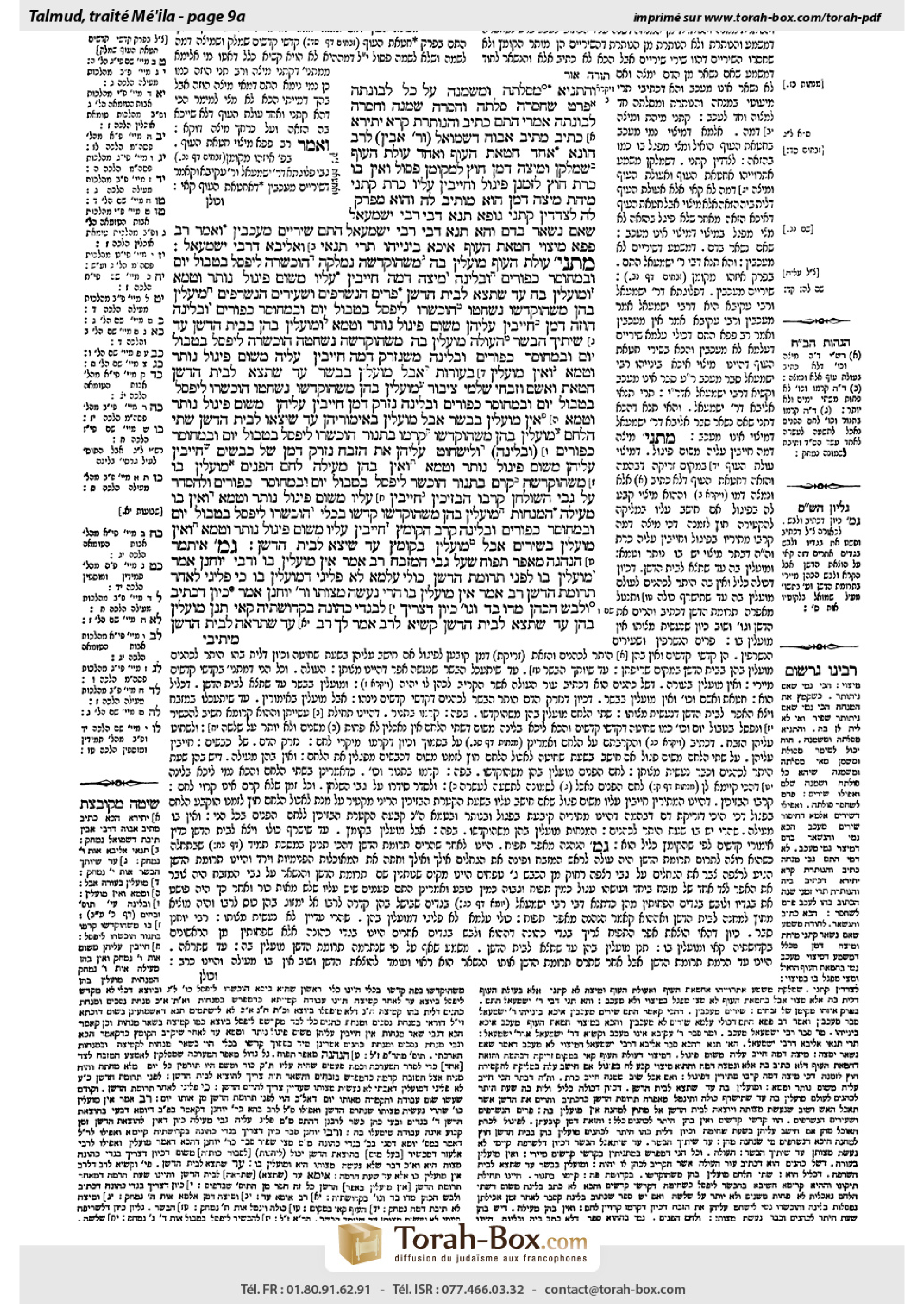
Meilah 9a: Talmud study for Daf Yomi
Daf Yomi is the daily study of one Talmud folio. Explore 37 tractates with scans, Hebrew text, Sefaria English and AI-generated French translations where annotated.
Passage selection and English or AI-generated French translation are available where the scan has annotations. Daf Study is independent of Torah-Box and Sefaria.
Browse Meilah · מעילה · All tractatesMeilah 9a text and translations
This page of Meilah includes the Aramaic text, an English translation and an AI-generated French translation, alongside the scan above.
מעילה ט׳ א · Aramaic and Hebrew text
וְהָתַנְיָא: ״מִסׇּלְתָּהּ וּמִשַּׁמְנָהּ עַל כׇּל לְבֹנָתָהּ״ – פְּרָט שֶׁחָסְרָה סׇלְתָּהּ וְחָסְרָה שַׁמְנָהּ וְחָסְרָה לְבוֹנָתָהּ!
אָמְרִי: הָתָם כְּתִיב ״וְהַנּוֹתֶרֶת״, קְרָא יַתִּירָא כְּתִיב.
מֵתִיב אֲבוּהּ דִּשְׁמוּאֵל לְרַב הוּנָא: אֶחָד חַטַּאת הָעוֹף וְאֶחָד עוֹלַת הָעוֹף שֶׁמְּלָקָן וּמִיצָּה דָּמָן חוּץ לִמְקוֹמָן – פָּסוּל וְאֵין בּוֹ כָּרֵת. חוּץ לִזְמַנָּן – פִּיגּוּל וְחַיָּיבִין עָלָיו כָּרֵת. קָתָנֵי מִיהַת מִיצָּה דָּמָן!
הוּא מוֹתֵיב לַהּ וְהוּא מְפָרֵק לַהּ: לִצְדָדִין קָתָנֵי.
גּוּפָא, תָּנָא דְּבֵי רַבִּי יִשְׁמָעֵאל: שֶׁאִם נִשְׁאַר בַּדָּם.
וְהָא תָּנָא דְּבֵי רַבִּי יִשְׁמָעֵאל הָתָם: שִׁירַיִים מְעַכְּבִין, וְאָמַר רַב פָּפָּא: מִיצּוּי חַטַּאת הָעוֹף אִיכָּא בֵּינַיְיהוּ! תְּרֵי תַנָּאֵי, וְאַלִּיבָּא דְּרַבִּי יִשְׁמָעֵאל.
מַתְנִי׳ עוֹלַת הָעוֹף – מוֹעֲלִין בָּהּ מִשֶּׁהוּקְדְּשָׁה. נִמְלְקָה – הוּכְשְׁרָה לִיפָּסֵל בִּטְבוּל יוֹם, וּבִמְחוּסַּר כִּפּוּרִים, וּבְלִינָה. מִיצָה דָּמָהּ – חַיָּיבִין עָלָיו מִשּׁוּם פִּיגּוּל, נוֹתָר, וְטָמֵא. וּמוֹעֲלִין בָּהּ עַד שֶׁתֵּצֵא לְבֵית הַדֶּשֶׁן.
פָּרִים הַנִּשְׂרָפִים, וּשְׂעִירִים הַנִּשְׂרָפִים – מוֹעֲלִין בָּהֶן מִשֶּׁהוּקְדְּשׁוּ. נִשְׁחֲטוּ – הוּכְשְׁרוּ לִיפָּסֵל בִּטְבוּל יוֹם, וּבִמְחוּסַּר כִּפּוּרִים, וּבְלִינָה. הוּזָּה דָּמָן – חַיָּיבִין עֲלֵיהֶן מִשּׁוּם פִּיגּוּל, נוֹתָר, וְטָמֵא, וּמוֹעֲלִין בָּהֶן בְּבֵית הַדֶּשֶׁן עַד שֶׁיַּתִּיךְ הַבָּשָׂר.
הָעוֹלָה – מוֹעֲלִין בָּהּ מִשֶּׁהוּקְדְּשָׁה. נִשְׁחֲטָה – הוּכְשְׁרָה לִיפָּסֵל בִּטְבוּל יוֹם, וּבִמְחוּסַּר כִּפּוּרִים, וּבְלִינָה. מִשֶּׁנִּזְרַק דָּמָהּ – חַיָּיבִין עָלֶיהָ מִשּׁוּם פִּיגּוּל, נוֹתָר, וְטָמֵא. וְאֵין מוֹעֲלִין בָּעוֹרוֹת, אֲבָל מוֹעֲלִין בַּבָּשָׂר עַד שֶׁתֵּצֵא לְבֵית הַדֶּשֶׁן.
חַטָּאת, וְאָשָׁם, וְזִבְחֵי שַׁלְמֵי צִיבּוּר – מוֹעֲלִין בָּהֶן מִשֶּׁהוּקְדְּשׁוּ. נִשְׁחֲטוּ – הוּכְשְׁרוּ לִיפָּסֵל בִּטְבוּל יוֹם, וּבִמְחוּסַּר כִּפּוּרִים, וּבְלִינָה. נִזְרַק דָּמָן – חַיָּיבִין עֲלֵיהֶן מִשּׁוּם פִּיגּוּל, נוֹתָר, וְטָמֵא. אֵין מוֹעֲלִין בַּבָּשָׂר, אֲבָל מוֹעֲלִין בְּאֵימוּרֵיהֶן עַד שֶׁיֵּצְאוּ לְבֵית הַדֶּשֶׁן.
שְׁתֵּי הַלֶּחֶם – מוֹעֲלִין בָּהֶן מִשֶּׁהוּקְדְּשׁוּ. קָרְמוּ בַּתַּנּוּר – הוּכְשְׁרוּ לִיפָּסֵל בִּטְבוּל יוֹם, וּבִמְחוּסַּר כִּפּוּרִים, וּבְלִינָה, וְלִישְׁחוֹט עֲלֵיהֶן אֶת הַזֶּבַח. נִזְרַק דָּמָן שֶׁל כְּבָשִׂים – חַיָּיבִין עֲלֵיהֶן מִשּׁוּם פִּיגּוּל, נוֹתָר, וְטָמֵא, וְאֵין בָּהֶן מְעִילָה.
לֶחֶם הַפָּנִים – מוֹעֲלִין בּוֹ מִשֶּׁהוּקְדְּשָׁה. קָרַם בַּתַּנּוּר – הוּכְשַׁר לִיפָּסֵל בִּטְבוּל יוֹם וּבִמְחוּסַּר כִּפּוּרִים, וּלְהִסָּדֵר עַל גַּבֵּי הַשּׁוּלְחָן.
קָרְבוּ הַבָּזִיכִּין – חַיָּיבִין עָלָיו מִשּׁוּם פִּיגּוּל, נוֹתָר, וְטָמֵא, וְאֵין בּוֹ מְעִילָה.
הַמְּנָחוֹת – מוֹעֲלִין בָּהֶן מִשֶּׁהוּקְדְּשׁוּ. קָדְשׁוּ בִּכְלִי – הוּכְשְׁרוּ לִיפָּסֵל בִּטְבוּל יוֹם, וּבִמְחוּסַּר כִּפּוּרִים, וּבְלִינָה.
קָרַב הַקּוֹמֶץ – חַיָּיבִין עָלָיו מִשּׁוּם פִּיגּוּל, נוֹתָר, וְטָמֵא. וְאֵין מוֹעֲלִין בַּשִּׁירַיִם, אֲבָל מוֹעֲלִין בַּקּוֹמֶץ עַד שֶׁיֵּצֵא לְבֵית הַדֶּשֶׁן.
גְּמָ׳ אִיתְּמַר, הַנֶּהֱנֶה מֵאֵפֶר תַּפּוּחַ שֶׁעַל גַּבֵּי הַמִּזְבֵּחַ, רַב אָמַר: אֵין מוֹעֲלִין בּוֹ, וְרַבִּי יוֹחָנָן אָמַר: מוֹעֲלִין בּוֹ.
לִפְנֵי תְּרוּמַת הַדֶּשֶׁן כּוּלֵּי עָלְמָא לָא פְּלִיגִי דְּמוֹעֲלִין בּוֹ. כִּי פְּלִיגִי – לְאַחַר תְּרוּמַת הַדֶּשֶׁן.
רַב אָמַר: אֵין מוֹעֲלִין בּוֹ – הֲרֵי נַעֲשָׂה מִצְוָתוֹ. וְרַבִּי יוֹחָנָן אָמַר: כֵּיוָן דִּכְתִיב: ״וְלָבַשׁ הַכֹּהֵן מִדּוֹ בַד וְגוֹ׳״ – כֵּיוָן דִּצְרִיךְ לְבִגְדֵי כְהוּנָּה, בִּקְדוּשְּׁתֵיהּ קָאֵי.
תְּנַן: מוֹעֲלִין בָּהֶן עַד שֶׁתֵּצֵא לְבֵית הַדֶּשֶׁן, קַשְׁיָא לְרַב! אָמַר לְךָ רַב: עַד שֶׁתֵּרָאֶה לְבֵית הַדֶּשֶׁן.
Meilah 9a · English translation
but isn’t it taught in a baraita: The verse states: “And he shall bring it to Aaron’s sons the priests; and he shall remove his handful of its fine flour, and of its oil, together with all its frankincense; and the priest shall make its memorial part smoke upon the altar, an offering made by fire, of a pleasing aroma to the Lord” (Leviticus 2:2)? This verse excludes those situations where some of its flour was missing, or some of its oil was missing, or some of its frankincense was missing, in which case the priest may not place the meal offering on the fire. This indicates that one must ensure that some of the flour, oil, and frankincense remain.
The Sages said in response to the difficulty of Rav Aḥa, son of Rava: In general, the terms “remainder” or “leftover” refer to a situation where there happened to be some of the item remaining. Yet, the case of the meal offering is unique, as there it is written: “But that which is left of the meal offering shall be Aaron’s and his sons’; it is a thing most holy of the offerings of the Lord made by fire” (Leviticus 2:3). This part of the verse is superfluous, as it appears in Leviticus 2:10 as well. It is therefore derived from the repetition of this phrase that in the specific case of a meal offering one must ensure that some of the items remain. This requirement does not apply to a bird sin offering.
Shmuel’s father raises an objection to Rav Huna from a mishna (Zevaḥim 64b): With regard to both a bird sin offering and a bird burnt offering, where the priest pinched their nape or squeezed out their blood with the intent to partake of an item whose typical manner is to partake of it, or to burn an item whose typical manner is to burn it on the altar, outside its designated area, the offering is not valid, but there is no liability for karet for one who partakes of the offering. If his intent was to eat it or burn it beyond its designated time, the offering is piggul and one is liable to receive karet for partaking of the offering, provided that the permitting factor, the blood, was sacrificed in accordance with its mitzva. In any event, this mishna teaches: Squeezed out their blood, indicating that failure to squeeze out the blood disqualifies the offering.
Shmuel’s father raises the objection and he resolves it himself. The tanna of that mishna teaches it disjunctively. In other words, the two clauses of the mishna are referring to two different cases. The halakha of pinching the nape of the neck applies to both the bird sin offering and the bird burnt offering. By contrast, the squeezing out of the blood applies only to a bird burnt offering, whose blood is not sprinkled on the altar. For this reason, the priest’s intent at the time of squeezing out the blood is significant. In the case of a bird sin offering, it is only an intent at the time of sprinkling that invalidates the offering.
The Gemara returns to the matter itself, i.e., the baraita cited above: The tanna of the school of Rabbi Yishmael taught that if any of the blood remains inside the bird it must be squeezed out, but there is no requirement to ensure that blood remains for this purpose. Consequently, even if one does not squeeze out the blood on the side of the altar, the offering is valid.
The Gemara asks: But the school of Rabbi Yishmael taught there, on Zevaḥim 52a, that failure with regard to the remainder of the blood invalidates the offering, and Rav Pappa said: Both Rabbi Yishmael and Rabbi Akiva agree that failure to pour the remainder of the blood on the base does not invalidate the offering. The practical difference between them is whether or not failure to squeeze out the blood from a bird sin offering after sprinkling the blood invalidates the offering. The school of Rabbi Yishmael rules that it does invalidate the offering, and Rabbi Akiva maintains that it does not invalidate the offering. The Gemara answers: There are two tanna’im and they disagree with regard to the opinion of Rabbi Yishmael.
MISHNA: One is liable for misusing a bird burnt offering from the moment that it was consecrated. When the nape of its neck was pinched, it was rendered susceptible to disqualification for sacrifice through contact with one who immersed in a ritual bath that day, and through contact with one who has not yet brought an atonement offering, and through its blood being left overnight. Once its blood was squeezed out, one is liable to receive karet for eating it, due to violation of the prohibition of piggul, and the prohibition of notar, and the prohibition of partaking of sacrificial meat while ritually impure. And as it may not be eaten, one is liable for its misuse until it leaves to the place of the ashes, where it is burned.
One is liable for misuse of bulls that are burned and goats that are burned from the moment that they were consecrated. Once they were slaughtered, they were rendered susceptible to disqualification for sacrifice through contact with one who immersed that day, and through contact with one who has not yet brought an atonement offering, and through its blood being left overnight. Once its blood was sprinkled, one is liable to receive karet for eating it, due to violation of the prohibition of piggul, and the prohibition of notar, and the prohibition of partaking of sacrificial meat while ritually impure. And one is liable for its misuse even when it is in the place of the ashes, until the flesh has been completely scorched.
One is liable for misuse of the burnt offering from the moment that it was consecrated. Once it was slaughtered it was rendered susceptible to disqualification for sacrifice through contact with one who immersed that day, and through contact with one who has not yet brought an atonement offering, and through its blood being left overnight. Once its blood was sprinkled, one is liable to receive karet for eating it, due to violation of the prohibition of piggul, and the prohibition of notar, and the prohibition of partaking of sacrificial meat while ritually impure. And one is not liable for misuse of the hides, but one is liable for misuse of the flesh until it leaves to the place of the ashes.
One is liable for misuse of a sin offering, and a guilt offering, and communal peace offerings from the moment that they were consecrated. Once they were slaughtered they were rendered susceptible to disqualification for sacrifice through contact with one who immersed that day, and through contact with one who has not yet brought an atonement offering, and through its blood being left overnight. Once their blood was sprinkled, one is liable to receive karet for eating them, due to violation of the prohibition of piggul, and the prohibition of notar, and the prohibition of partaking of sacrificial meat while ritually impure. One is not liable for misuse of the flesh, but one is liable for misuse of their sacrificial portions, i.e., the portions that are to be consumed on the altar, until they leave to the place of the ashes.
One is liable for misuse of the two loaves brought on the festival of Shavuot from the moment that they were consecrated. Once they formed a crust, they were rendered susceptible to disqualification for sacrifice through contact with one who immersed that day, and through contact with one who has not yet brought an atonement offering, and through it being left overnight, and they are rendered eligible to slaughter with them the accompanying offering of the two lambs. Once the blood of the lambs is sprinkled, one is liable to receive karet for eating the loaves, due to violation of the prohibition of piggul, and the prohibition of notar, and the prohibition of partaking of consecrated food while ritually impure. And they are not subject to the halakhot of misuse, as at that point their consumption is permitted.
One is liable for misuse of the shewbread, which is arranged on the Golden Table in the Sanctuary each Shabbat, from the moment that it was consecrated. Once it formed a crust in the oven it assumes the status of bread and its halakhic status is like that of offerings of the most sacred order after the animal was slaughtered, in that it was rendered susceptible to disqualification through contact with one who immersed that day, and through contact with one who has not yet brought an atonement offering, and it is rendered eligible for arrangement upon the Table in the Sanctuary.
Once the bowls of frankincense brought with the shewbread of the previous week were sacrificed, one is liable to receive karet for eating the loaves due to violation of the prohibition of piggul, and the prohibition of notar, and the prohibition of partaking of consecrated food while ritually impure. But it is not subject to the halakhot of misuse, as at that point its consumption is permitted.
One is liable for misuse of the meal offerings from the moment that they were consecrated. Once they were consecrated through placement of the flour in a service vessel, they were rendered susceptible to disqualification for sacrifice through contact with one who immersed that day, and through contact with one who has not yet brought an atonement offering, and through its blood being left overnight.
Once the handful taken from the meal offering was sacrificed, one is liable to receive karet for eating the meal offering due to violation of the prohibition of piggul, and the prohibition of notar, and the prohibition of partaking of consecrated food while ritually impure. And one is not liable for misuse of the remainder of the meal offering, which is eaten by the priests, but one is liable for misuse of the handful that is sacrificed, until it leaves to the place of the ashes.
GEMARA: It was stated that there is a dispute between amora’im with regard to one who derives benefit from the ash of the round heap that is on top of the altar. Rav says: One who derives benefit from it is not liable for misuse of consecrated property, and Rabbi Yoḥanan says: One who derives benefit from it is liable for misuse of consecrated property.
The Gemara clarifies this dispute: Before the removal of the ashes, everyone agrees that one who derives benefit from it is liable for misuse of consecrated property. The reason is that the mitzva of the removal of the ashes has not yet been completed. When they disagree it is with regard to the halakha after the removal of the ashes, at which point the mitzva has been completed.
Rav says that one who derives benefit from it is not liable for misuse of consecrated property, as its mitzva has been performed and completed. And Rabbi Yoḥanan says that one is liable for misuse, since it is written: “And the priest shall put on his linen garment, and his linen breeches shall he put upon his flesh; and he shall take up the ashes to where the fire has consumed the burnt offering on the altar, and he shall put them beside the altar. And he shall remove his garments, and don other garments, and carry forth the ashes outside the camp” (Leviticus 6:3–4). Rabbi Yoḥanan explains: Since taking the ashes outside the Temple also requires the priestly vestments, albeit garments of lesser quality than those used to remove the ashes from the altar, evidently the ash remains in its consecrated state.
The Gemara raises a difficulty against the opinion of Rav. We learned in the mishna, with regard to the bird burnt offering: One is liable for its misuse until it leaves to the place of the ashes, where it is burned. This indicates that the halakhot of misuse apply while the ashes remain on the altar, even after the removal of ashes, which is difficult for the opinion of Rav. The Gemara answers that Rav could have said to you: The mishna means that one is liable until the ash is fit to be taken out to the place of ashes, i.e., once it is burned on the altar and has had a shovel of ashes removed from it.
Meilah 9a · Traduction française (IA)
Mais n’est-il pas enseigné dans une baraïta : « Il l’apportera aux fils d’Aaron, les prêtres ; il en prélèvera une pleine poignée de sa fleur de farine et de son huile, ainsi que tout son encens ; et le prêtre fera fumer sur l’autel sa part de souvenir, offrande consumée par le feu, d’une odeur agréable pour le Seigneur » (Lévitique 2:2) ? Ce verset exclut les cas où il manque une partie de la farine, de l’huile ou de l’encens : dans ce cas, le prêtre ne peut pas faire brûler l’offrande de farine. Cela indique qu’il faut veiller à ce qu’il reste une partie de la farine, de l’huile et de l’encens.
Les Sages répondirent à la difficulté soulevée par Rav Aḥa, fils de Rava : En général, les termes « reste » ou « reliquat » désignent une situation où il se trouve que quelque chose est resté. Toutefois, le cas de l’offrande de farine est particulier, car il est écrit à son sujet : « Mais ce qui restera de l’offrande de farine sera pour Aaron et ses fils ; c’est une chose très sainte parmi les offrandes du Seigneur consumées par le feu » (Lévitique 2:3). Cette partie du verset est superflue, puisqu’elle figure également en Lévitique 2:10. On déduit donc de la répétition de cette expression que, dans le cas particulier d’une offrande de farine, il faut veiller à ce qu’il reste une partie des éléments. Cette exigence ne s’applique pas au sacrifice expiatoire d’oiseau.
Le père de Shmuel soulève une objection contre Rav Huna à partir d’une Michna (Zevaḥim 64b) : Pour le sacrifice expiatoire d’oiseau comme pour l’holocauste d’oiseau, si le prêtre leur a pincé la nuque ou en a exprimé le sang avec l’intention de consommer un élément qui est habituellement consommé, ou de brûler un élément qui est habituellement brûlé sur l’autel, hors de son lieu prévu, le sacrifice n’est pas valide, mais celui qui en consomme n’encourt pas la peine de retranchement. Si son intention était de le consommer ou de le brûler après le délai prescrit, le sacrifice est piggoul et celui qui en consomme encourt la peine de retranchement, à condition que l’acte qui rend le sacrifice permis — le service du sang — ait été accompli conformément à sa mitsva. Quoi qu’il en soit, cette Michna enseigne : « en a exprimé le sang », ce qui indique que ne pas exprimer le sang invalide le sacrifice.
Le père de Shmuel soulève l’objection et la résout lui-même. Le tanna de cette Michna enseigne les cas séparément. Autrement dit, les deux clauses de la Michna portent sur deux cas différents. La règle concernant le pincement de la nuque s’applique aussi bien au sacrifice expiatoire d’oiseau qu’à l’holocauste d’oiseau. En revanche, l’expression du sang ne s’applique qu’à l’holocauste d’oiseau, dont le sang n’est pas aspergé sur l’autel. C’est pourquoi l’intention du prêtre au moment où il exprime le sang est déterminante. Dans le cas du sacrifice expiatoire d’oiseau, seule une intention au moment de l’aspersion invalide le sacrifice.
La Guemara revient au sujet lui-même, c’est-à-dire à la baraïta citée plus haut : Le tanna de l’école de Rabbi Yishmael enseigna que si une partie du sang reste à l’intérieur de l’oiseau, il faut l’exprimer, mais qu’il n’est pas nécessaire de veiller à ce qu’il reste du sang à cette fin. Par conséquent, même si l’on n’exprime pas le sang du côté de l’autel, le sacrifice est valide.
La Guemara demande : Mais l’école de Rabbi Yishmael a enseigné là-bas, en Zevaḥim 52a, que ne pas accomplir ce qui concerne le reste du sang invalide le sacrifice ; et Rav Pappa a dit : Rabbi Yishmael et Rabbi Akiva sont tous deux d’accord que ne pas verser le reste du sang à la base de l’autel n’invalide pas le sacrifice. La différence pratique entre eux concerne la question de savoir si ne pas exprimer le sang d’un sacrifice expiatoire d’oiseau après l’aspersion du sang invalide le sacrifice. L’école de Rabbi Yishmael statue que cela l’invalide, tandis que Rabbi Akiva estime que cela ne l’invalide pas. La Guemara répond : Il y a deux tannaïm qui sont en désaccord sur l’opinion de Rabbi Yishmael.
MICHNA : On est passible pour l’usage profane d’un holocauste d’oiseau dès le moment où il a été consacré. Lorsque sa nuque a été pincée, il est devenu susceptible d’être disqualifié comme sacrifice par le contact avec une personne qui s’est immergée dans un mikvé ce jour-là, par le contact avec une personne qui n’a pas encore apporté son sacrifice expiatoire, ou si son sang est resté toute la nuit. Une fois son sang exprimé, celui qui en mange encourt la peine de retranchement en raison de la transgression des interdictions du piggoul, du notar et de la consommation de viande sacrificielle en état d’impureté rituelle. Et puisqu’il ne peut pas être consommé, on est passible pour son usage profane jusqu’à ce qu’il soit emporté au lieu des cendres, où il est brûlé.
On est passible pour l’usage profane des taureaux et des boucs destinés à être brûlés dès le moment où ils ont été consacrés. Une fois abattus, ils sont devenus susceptibles d’être disqualifiés comme sacrifices par le contact avec une personne qui s’est immergée ce jour-là, par le contact avec une personne qui n’a pas encore apporté son sacrifice expiatoire, ou si leur sang est resté toute la nuit. Une fois leur sang aspergé, celui qui en mange encourt la peine de retranchement en raison de la transgression des interdictions du piggoul, du notar et de la consommation de viande sacrificielle en état d’impureté rituelle. Et on est passible pour leur usage profane même lorsqu’ils se trouvent au lieu des cendres, jusqu’à ce que la chair soit entièrement consumée.
On est passible pour l’usage profane de l’holocauste dès le moment où il a été consacré. Une fois abattu, il est devenu susceptible d’être disqualifié comme sacrifice par le contact avec une personne qui s’est immergée ce jour-là, par le contact avec une personne qui n’a pas encore apporté son sacrifice expiatoire, ou si son sang est resté toute la nuit. Une fois son sang aspergé, celui qui en mange encourt la peine de retranchement en raison de la transgression des interdictions du piggoul, du notar et de la consommation de viande sacrificielle en état d’impureté rituelle. On n’est pas passible pour l’usage profane de la peau, mais on l’est pour la chair jusqu’à ce qu’elle soit emportée au lieu des cendres.
On est passible pour l’usage profane d’un sacrifice expiatoire, d’un sacrifice de culpabilité et des offrandes de paix communautaires dès le moment où ils ont été consacrés. Une fois abattus, ils sont devenus susceptibles d’être disqualifiés comme sacrifices par le contact avec une personne qui s’est immergée ce jour-là, par le contact avec une personne qui n’a pas encore apporté son sacrifice expiatoire, ou si leur sang est resté toute la nuit. Une fois leur sang aspergé, celui qui en mange encourt la peine de retranchement en raison de la transgression des interdictions du piggoul, du notar et de la consommation de viande sacrificielle en état d’impureté rituelle. On n’est pas passible pour l’usage profane de la chair, mais on l’est pour leurs portions sacrificielles, c’est-à-dire les portions destinées à être brûlées sur l’autel, jusqu’à ce qu’elles soient emportées au lieu des cendres.
On est passible pour l’usage profane des deux pains apportés lors de la fête de Chavouot dès le moment où ils ont été consacrés. Une fois qu’ils ont formé une croûte, ils sont devenus susceptibles d’être disqualifiés comme sacrifices par le contact avec une personne qui s’est immergée ce jour-là, par le contact avec une personne qui n’a pas encore apporté son sacrifice expiatoire, ou s’ils sont restés toute la nuit ; ils deviennent alors aptes à ce que l’offrande accompagnant les deux agneaux soit abattue avec eux. Une fois le sang des agneaux aspergé, celui qui mange les pains encourt la peine de retranchement en raison de la transgression des interdictions du piggoul, du notar et de la consommation d’aliments consacrés en état d’impureté rituelle. Ils ne sont pas soumis aux règles de l’usage profane, car leur consommation est alors permise.
On est passible pour l’usage profane des pains de proposition, disposés chaque Chabbat sur la Table d’or dans le Sanctuaire, dès le moment où ils ont été consacrés. Une fois qu’ils ont formé une croûte dans le four, ils acquièrent le statut de pain et leur statut halakhique est celui des offrandes du plus haut degré de sainteté après l’abattage de l’animal : ils sont devenus susceptibles d’être disqualifiés par le contact avec une personne qui s’est immergée ce jour-là, ou par le contact avec une personne qui n’a pas encore apporté son sacrifice expiatoire, et ils deviennent aptes à être disposés sur la Table dans le Sanctuaire.
Une fois que les bols d’encens apportés avec les pains de proposition de la semaine précédente ont été offerts, celui qui mange les pains encourt la peine de retranchement en raison de la transgression des interdictions du piggoul, du notar et de la consommation d’aliments consacrés en état d’impureté rituelle. Toutefois, ils ne sont pas soumis aux règles de l’usage profane, car leur consommation est alors permise.
On est passible pour l’usage profane des offrandes de farine dès le moment où elles ont été consacrées. Une fois consacrées par le placement de la farine dans un récipient de service, elles sont devenues susceptibles d’être disqualifiées comme sacrifices par le contact avec une personne qui s’est immergée ce jour-là, par le contact avec une personne qui n’a pas encore apporté son sacrifice expiatoire, ou si leur sang est resté toute la nuit.
Une fois que la pleine poignée prélevée de l’offrande de farine a été offerte, celui qui mange l’offrande encourt la peine de retranchement en raison de la transgression des interdictions du piggoul, du notar et de la consommation d’aliments consacrés en état d’impureté rituelle. On n’est pas passible pour l’usage profane du reste de l’offrande de farine, que les prêtres mangent, mais on l’est pour la pleine poignée offerte, jusqu’à ce qu’elle soit emportée au lieu des cendres.
GUEMARA : Il a été rapporté qu’il existe un désaccord entre des amoraïm concernant celui qui tire profit de la cendre du tas rond qui se trouve au sommet de l’autel. Rav dit : Celui qui en tire profit n’est pas passible pour l’usage profane d’un bien consacré ; Rabbi Yoḥanan dit : Celui qui en tire profit est passible pour l’usage profane d’un bien consacré.
La Guemara précise les termes de ce désaccord : avant l’enlèvement des cendres, tous conviennent que celui qui en tire profit est passible pour l’usage profane d’un bien consacré. La raison en est que la mitsva de l’enlèvement des cendres n’est pas encore achevée. Leur désaccord porte sur la halakha après l’enlèvement des cendres, moment où la mitsva a été accomplie.
Rav dit que celui qui en tire profit n’est pas passible pour l’usage profane d’un bien consacré, car la mitsva a été accomplie et menée à son terme. Rabbi Yoḥanan dit qu’on est passible pour l’usage profane, puisqu’il est écrit : « Le prêtre revêtira son vêtement de lin et mettra sur sa chair son caleçon de lin ; il ramassera les cendres de l’endroit où le feu a consumé l’holocauste sur l’autel et les déposera à côté de l’autel. Il ôtera ensuite ses vêtements, en revêtira d’autres et transportera les cendres hors du camp » (Lévitique 6:3–4). Rabbi Yoḥanan explique : Puisque le transport des cendres hors du Temple exige lui aussi des vêtements sacerdotaux, quoique de moindre qualité que ceux utilisés pour enlever les cendres de l’autel, il est manifeste que la cendre conserve son statut consacré.
La Guemara soulève une difficulté contre l’opinion de Rav. Nous avons appris dans la Michna, à propos de l’holocauste d’oiseau : On est passible pour son usage profane jusqu’à ce qu’il soit emporté au lieu des cendres, où il est brûlé. Cela indique que les règles de l’usage profane s’appliquent tant que les cendres restent sur l’autel, même après leur enlèvement, ce qui pose une difficulté à l’opinion de Rav. La Guemara répond que Rav aurait pu te dire : La Michna signifie qu’on est passible jusqu’à ce que la cendre soit prête à être emportée au lieu des cendres, c’est-à-dire une fois qu’elle a brûlé sur l’autel et qu’on en a retiré une pelletée.
Traduction française générée par IA à partir de l’édition anglaise de Sefaria. Vérifie toujours un passage avec le texte source.
Text from Sefaria: William Davidson Edition - Vocalized Aramaic (CC BY NC); William Davidson Edition - English (CC BY NC).