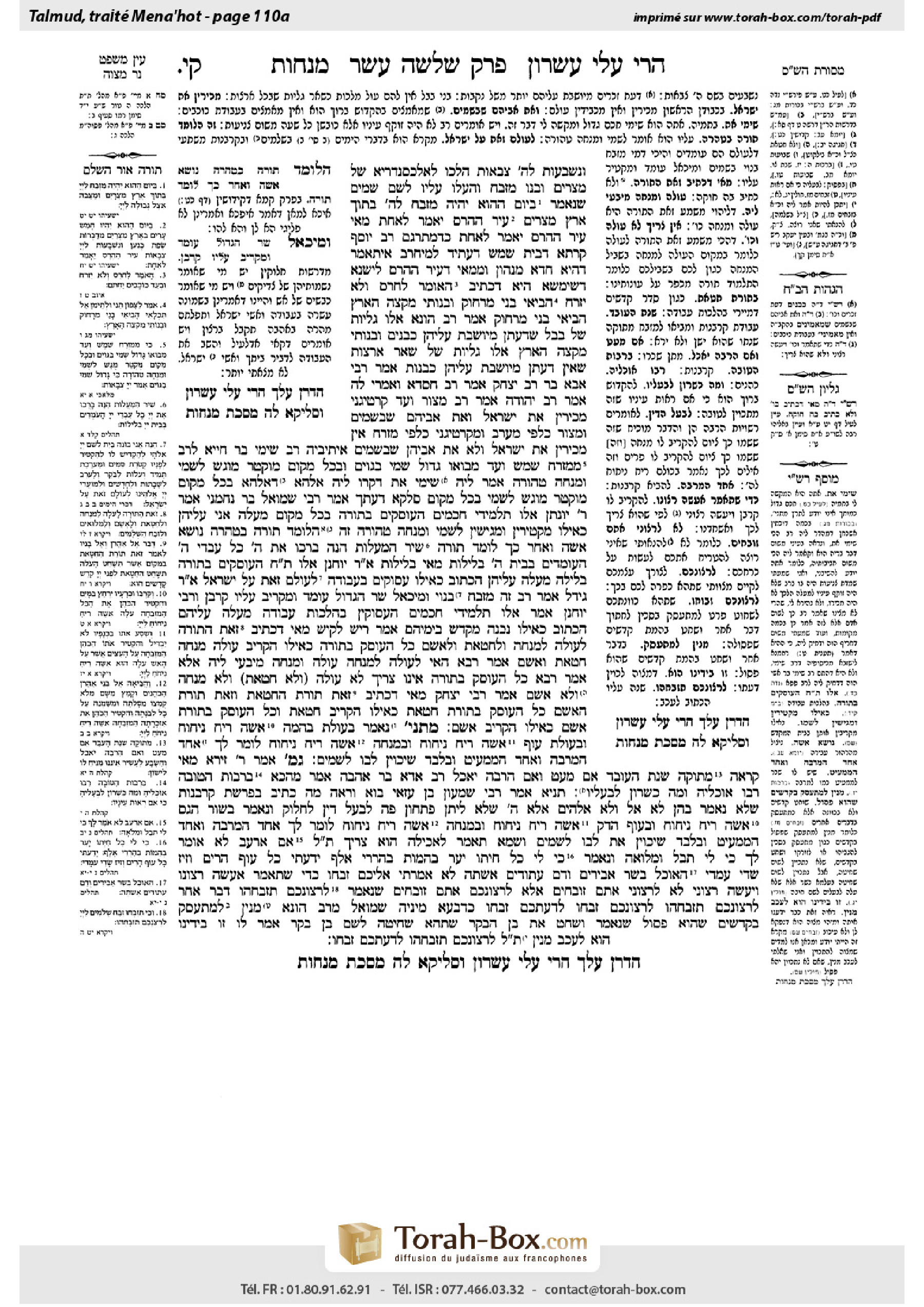
Menachot 110a: Talmud study for Daf Yomi
Daf Yomi is the daily study of one Talmud folio. Explore 37 tractates with scans, Hebrew text, Sefaria English and AI-generated French translations where annotated.
Passage selection and English or AI-generated French translation are available where the scan has annotations. Daf Study is independent of Torah-Box and Sefaria.
Browse Menachot · מנחות · All tractatesMenachot 110a text and translations
This page of Menachot includes the Aramaic text, an English translation and an AI-generated French translation, alongside the scan above.
מנחות ק״י א · Aramaic and Hebrew text
וְנִשְׁבָּעוֹת לַה׳ צְבָאוֹת״. הָלְכוּ לַאֲלֶכְּסַנְדְּרִיָּא שֶׁל מִצְרַיִם וּבָנוּ מִזְבֵּחַ וְהֶעֱלוּ עָלָיו לְשֵׁם שָׁמַיִם, שֶׁנֶּאֱמַר: ״בַּיּוֹם הַהוּא יִהְיֶה מִזְבֵּחַ לַה׳ בְּתוֹךְ אֶרֶץ מִצְרָיִם״.
״עִיר הַהֶרֶס יֵאָמֵר לְאַחַת״, מַאי ״עִיר הַהֶרֶס יֵאָמֵר לְאֶחָת״? כְּדִמְתַרְגֵּם רַב יוֹסֵף: ״קַרְתָּא דְּבֵית שֶׁמֶשׁ דַּעֲתִיד לְמִיחֲרַב״, אִיתְאֲמַר דְּהִיא חֲדָא מִנְּהוֹן. וּמִמַּאי דְּ״עִיר הַהֶרֶס״ לִישָּׁנָא דְּשִׁימְשָׁא הִיא? דִּכְתִיב: ״הָאוֹמֵר לַחֶרֶס וְלֹא יִזְרָח״.
״הָבִיאִי בָנַי מֵרָחוֹק וּבְנוֹתַי מִקְצֵה הָאָרֶץ״ – ״הָבִיאִי בָנַי מֵרָחוֹק״, אָמַר רַב הוּנָא: אֵלּוּ גָּלִיּוֹת שֶׁל בָּבֶל, שֶׁדַּעְתָּן מְיוּשֶּׁבֶת עֲלֵיהֶן כְּבָנִים. ״וּבְנוֹתַי מִקְצֵה הָאָרֶץ״ – אֵלּוּ גָּלִיּוֹת שֶׁל שְׁאָר אֲרָצוֹת, שֶׁאֵין דַּעְתָּן מְיוּשֶּׁבֶת עֲלֵיהֶן כְּבָנוֹת.
אָמַר רַבִּי אַבָּא בַּר רַב יִצְחָק, אָמַר רַב חִסְדָּא, וְאָמְרִי לַהּ אָמַר רַב יְהוּדָה, אָמַר רַב: מִצּוֹר וְעַד קַרְטִיגְנֵי מַכִּירִין אֶת יִשְׂרָאֵל וְאֶת אֲבִיהֶם שֶׁבַּשָּׁמַיִם, וּמִצּוֹר כְּלַפֵּי מַעֲרָב וּמִקַּרְטִיגְנֵי כְּלַפֵּי מִזְרָח אֵין מַכִּירִין אֶת יִשְׂרָאֵל וְלֹא אֶת אֲבִיהֶן שֶׁבַּשָּׁמַיִם.
אֵיתִיבֵיהּ רַב שִׁימִי בַּר חִיָּיא לְרַב: ״מִמִּזְרַח שֶׁמֶשׁ וְעַד מְבוֹאוֹ גָּדוֹל שְׁמִי בַּגּוֹיִם וּבְכׇל מָקוֹם מֻקְטָר מֻגָּשׁ לִשְׁמִי וּמִנְחָה טְהוֹרָה״. אֲמַר לֵיהּ: שִׁימִי אַתְּ?! דְּקָרוּ לֵיהּ אֱלָהָא דֵּאלָהָא.
״בְּכׇל מָקוֹם מֻקְטָר מֻגָּשׁ לִשְׁמִי״ – בְּכׇל מָקוֹם סָלְקָא דַּעְתָּךְ? אָמַר רַבִּי שְׁמוּאֵל בַּר נַחְמָנִי אָמַר רַבִּי יוֹנָתָן: אֵלּוּ תַּלְמִידֵי חֲכָמִים הָעוֹסְקִים בַּתּוֹרָה בְּכׇל מָקוֹם, מַעֲלֶה אֲנִי עֲלֵיהֶן כְּאִילּוּ מַקְטִירִין וּמַגִּישִׁין לִשְׁמִי.
״וּמִנְחָה טְהוֹרָה״ – זֶה הַלּוֹמֵד תּוֹרָה בְּטָהֳרָה, נוֹשֵׂא אִשָּׁה וְאַחַר כָּךְ לוֹמֵד תּוֹרָה.
״שִׁיר הַמַּעֲלוֹת הִנֵּה בָּרְכוּ אֶת ה׳ כׇּל עַבְדֵי ה׳ הָעֹמְדִים בְּבֵית ה׳ בַּלֵּילוֹת״, מַאי ״בַּלֵּילוֹת״? אָמַר רַבִּי יוֹחָנָן: אֵלּוּ תַּלְמִידֵי חֲכָמִים הָעוֹסְקִים בְּתוֹרָה בַּלַּיְלָה, מַעֲלֶה עֲלֵיהֶן הַכָּתוּב כְּאִילּוּ עֲסוּקִים בַּעֲבוֹדָה.
״לְעוֹלָם זֹאת עַל יִשְׂרָאֵל״, אָמַר רַב גִּידֵּל אָמַר רַב: זֶה מִזְבֵּחַ בָּנוּי, וּמִיכָאֵל שַׂר הַגָּדוֹל עוֹמֵד וּמַקְרִיב עָלָיו קׇרְבָּן.
וְרַבִּי יוֹחָנָן אָמַר: אֵלּוּ תַּלְמִידֵי חֲכָמִים הָעֲסוּקִין בְּהִלְכוֹת עֲבוֹדָה, מַעֲלֶה עֲלֵיהֶם הַכָּתוּב כְּאִילּוּ נִבְנָה מִקְדָּשׁ בִּימֵיהֶם.
אָמַר רֵישׁ לָקִישׁ: מַאי דִּכְתִיב ״זֹאת הַתּוֹרָה לָעֹלָה לַמִּנְחָה וְלַחַטָּאת וְלָאָשָׁם״ – כׇּל הָעוֹסֵק בַּתּוֹרָה כְּאִילּוּ הִקְרִיב עוֹלָה, מִנְחָה, חַטָּאת, וְאָשָׁם.
אָמַר רָבָא: הַאי ״לָעֹלָה לַמִּנְחָה״ – ״עֹלָה וּמִנְחָה״ מִיבְּעֵי לֵיהּ! אֶלָּא אָמַר רָבָא: כׇּל הָעוֹסֵק בַּתּוֹרָה אֵינוֹ צָרִיךְ לֹא עוֹלָה (וְלֹא חַטָּאת) וְלֹא מִנְחָה וְלֹא אָשָׁם.
אָמַר רַבִּי יִצְחָק: מַאי דִּכְתִיב ״זֹאת תּוֹרַת הַחַטָּאת״ וְ״זֹאת תּוֹרַת הָאָשָׁם״? כׇּל הָעוֹסֵק בְּתוֹרַת חַטָּאת – כְּאִילּוּ הִקְרִיב חַטָּאת, וְכׇל הָעוֹסֵק בְּתוֹרַת אָשָׁם – כְּאִילּוּ הִקְרִיב אָשָׁם.
מַתְנִי׳ נֶאֱמַר בְּעוֹלַת בְּהֵמָה ״אִשֶּׁה רֵיחַ נִיחוֹחַ״, וּבְעוֹלַת עוֹף ״אִשֶּׁה רֵיחַ נִיחוֹחַ״, וּבְמִנְחָה ״אִשֶּׁה רֵיחַ נִיחוֹחַ״, לוֹמַר לְךָ: אֶחָד הַמַּרְבֶּה וְאֶחָד הַמַּמְעִיט, וּבִלְבַד שֶׁיְּכַוֵּין לִבּוֹ לַשָּׁמַיִם.
גְּמָ׳ אָמַר רַבִּי זֵירָא: מַאי קְרָאָה? ״מְתוּקָה שְׁנַת הָעֹבֵד אִם מְעַט וְאִם הַרְבֵּה יֹאכֵל״.
רַב אַדָּא בַּר אַהֲבָה אָמַר, מֵהָכָא: ״בִּרְבוֹת הַטּוֹבָה רַבּוּ אוֹכְלֶיהָ וּמַה כִּשְׁרוֹן לִבְעָלָיו״.
תַּנְיָא, אָמַר רַבִּי שִׁמְעוֹן בֶּן עַזַּאי: בּוֹא וּרְאֵה מָה כְּתִיב בְּפָרָשַׁת קׇרְבָּנוֹת, שֶׁלֹּא נֶאֱמַר בָּהֶן לֹא ״אֵל״ וְלֹא ״אֱלֹהִים״, אֶלָּא ״ה׳״, שֶׁלֹּא לִיתֵּן פִּתְחוֹן פֶּה לְבַעַל דִּין לַחְלוֹק.
וְנֶאֱמַר בְּשׁוֹר הַגַּס ״אִשֶּׁה רֵיחַ נִיחוֹחַ״, וּבְעוֹף הַדַּק ״אִשֶּׁה רֵיחַ נִיחוֹחַ״, וּבְמִנְחָה ״אִשֶּׁה רֵיחַ נִיחוֹחַ״, לוֹמַר לְךָ: אֶחָד הַמַּרְבֶּה וְאֶחָד הַמַּמְעִיט, וּבִלְבַד שֶׁיְּכַוֵּין אֶת לִבּוֹ לַשָּׁמַיִם.
וְשֶׁמָּא תֹּאמַר: לַאֲכִילָה הוּא צָרִיךְ, תַּלְמוּד לוֹמַר: ״אִם אֶרְעַב לֹא אֹמַר לָךְ כִּי לִי תֵבֵל וּמְלֹאָהּ״, וְנֶאֱמַר: ״כִּי לִי כׇל חַיְתוֹ יָעַר בְּהֵמוֹת בְּהַרְרֵי אָלֶף, יָדַעְתִּי כׇּל עוֹף הָרִים וְזִיז שָׂדַי עִמָּדִי״, ״הַאוֹכַל בְּשַׂר אַבִּירִים וְדַם עַתּוּדִים אֶשְׁתֶּה״.
לֹא אָמַרְתִּי אֲלֵיכֶם זִבְחוּ, כְּדֵי שֶׁתֹּאמַר ״אֶעֱשֶׂה רְצוֹנוֹ וְיַעֲשֶׂה רְצוֹנִי״. לֹא לִרְצוֹנִי אַתֶּם זוֹבְחִים, אֶלָּא לִרְצוֹנְכֶם אַתֶּם זוֹבְחִים, שֶׁנֶּאֱמַר: ״לִרְצֹנְכֶם תִּזְבָּחֻהוּ״.
דָּבָר אַחֵר: ״לִרְצֹנְכֶם תִּזְבָּחֻהוּ״ – לִרְצוֹנְכֶם זִבְחוּ, לְדַעְתְּכֶם זִבְחוּ.
כְּדִבְעָא מִינֵּיהּ שְׁמוּאֵל מֵרַב הוּנָא: מִנַּיִן לַמִּתְעַסֵּק בַּקֳּדָשִׁים שֶׁהוּא פָּסוּל? שֶׁנֶּאֱמַר: ״וְשָׁחַט אֶת בֶּן הַבָּקָר״, שֶׁתְּהֵא שְׁחִיטָה לְשֵׁם בֶּן בָּקָר.
אָמַר לוֹ: זוֹ בְּיָדֵינוּ הוּא, לְעַכֵּב מִנַּיִן? תַּלְמוּד לוֹמַר: ״לִרְצֹנְכֶם תִּזְבָּחֻהוּ״ – לְדַעְתְּכֶם זִבְחוּ.
הֲדַרַן עֲלָךְ הֲרֵי עָלַי עִשָּׂרוֹן, וּסְלִיקָא לַהּ מַסֶּכֶת מְנָחוֹת.
Menachot 110a · English translation
and swear to the Lord of hosts; one shall be called the city of destruction” (Isaiah 19:18). They went to Alexandria in Egypt and built an altar and sacrificed offerings upon it for the sake of Heaven, as it is stated in the following verse: “In that day shall there be an altar to the Lord in the midst of the land of Egypt, and a pillar at its border, to the Lord” (Isaiah 19:19).
The verse states: “One shall be called the city of destruction” (Isaiah 19:18). The Gemara asks: What is the meaning of the verse: “One shall be called the city of destruction”? The Gemara answers: As Rav Yosef translates into Aramaic: Concerning the City of the Sun, which will be destroyed in the future, it will be said that it is one of them. And from where is it derived that in the phrase: “The city of destruction [heres],” the term heres is referring to the sun? As it is written: “Who commands the sun [ḥeres], and it does not rise; and seals up the stars” (Job 9:7).
§ After mentioning the Jewish community in Egypt, the Gemara discusses Jewish communities in other locations. The verse states: “Fear not, for I am with you; I will bring your seed from the east and gather you from the west; I will say to the north: Give up, and to the south: Keep not back, bring My sons from far, and My daughters from the end of the earth” (Isaiah 43:5–6). What is the meaning of “bring My sons from far”? Rav Huna says: These are the exiles of Babylonia, whose minds are calm, like sons, and who can therefore focus properly on Torah study and mitzvot. What is the meaning of “and My daughters from the end of the earth”? These are the exiles of other countries, whose minds are unsettled, like daughters.
§ Rabbi Abba bar Rav Yitzḥak says that Rav Ḥisda says, and some say that Rav Yehuda says that Rav says: The gentiles living from Tyre to Carthage recognize the Jewish people, their religion, and their Father in Heaven. But those living to the west of Tyre and to the east of Carthage recognize neither the Jewish people nor their Father in Heaven.
Rav Shimi bar Ḥiyya raised an objection to the statement of Rav from the verse: “From the rising of the sun until it sets, My name is great among the nations; and in every place offerings are presented to My name, and a pure meal offering; for My name is great among the nations, says the Lord of hosts” (Malachi 1:11). This indicates that God’s name is known across the entire world, even to the west of Tyre and the east of Carthage. Rav said to him: Shimi, is it you who is raising such an objection? The verse does not mean that they recognize God and worship him. Rather, it means that although they worship idols, they call Him the God of gods.
§ The verse states: “And in every place offerings are presented to My name, and a pure meal offering; for My name is great among the nations, says the Lord of hosts.” Does it enter your mind to say that it is permitted to sacrifice offerings in every place? Rather, Rabbi Shmuel bar Naḥmani says that Rabbi Yonatan says: These are Torah scholars, who engage in Torah study in every place. God says: I ascribe them credit as though they burn and present offerings to My name.
Furthermore, when the verse states: “And a pure meal offering,” this is referring to one who studies Torah in purity, i.e., one who first marries a woman and afterward studies Torah. Since he is married, he is not disturbed by sinful thoughts.
The Gemara cites another verse that praises Torah scholars. “A Song of Ascents, Behold, bless the Lord, all you servants of the Lord, who stand in the House of the Lord at night” (Psalms 134:1). What is the meaning of “at night,” given that the Temple service is not performed at night and all the offerings must be sacrificed during the daytime? Rabbi Yoḥanan says: These are Torah scholars, who engage in Torah study at night. The verse ascribes them credit as though they engage in the Temple service.
§ The Gemara cites another verse that is interpreted in a similar vein. King Solomon said to Hiram of Tyre: “Behold, I am about to build a house for the name of the Lord my God, to dedicate it to Him, and to burn before Him incense of sweet spices, and for the continual shewbread, and for the burnt offerings morning and evening, on the Shabbatot, and on the New Moons, and on the Festivals of the Lord our God. This is an ordinance forever for Israel” (II Chronicles 2:3). Since the Temple was eventually destroyed, what did Solomon mean when he said that it is “an ordinance forever”? Rav Giddel says that Rav says: This is referring to the altar that remains built in Heaven even after the earthly Temple was destroyed, and the angel Michael, the great minister, stands and sacrifices an offering upon it.
And Rabbi Yoḥanan says that there is an alternative explanation of the verse: These are Torah scholars, who engage in studying the halakhot of the Temple service. The verse ascribes them credit as though the Temple was built in their days and they are serving in it.
§ The Gemara cites similar interpretations of verses: Reish Lakish said: What is the meaning of that which is written: “This is the law [torah] of the burnt offering, of the meal offering, and of the sin offering, and of the guilt offering, and of the consecration offering, and of the sacrifice of peace offerings” (Leviticus 7:37)? This teaches that anyone who engages in Torah study is considered as though he sacrificed a burnt offering, a meal offering, a sin offering, and a guilt offering.
Rava said an objection to this interpretation: This verse states: “Of the burnt offering, of the meal offering.” If the interpretation of Reish Lakish is correct, the verse should have written: “Burnt offering and meal offering.” Rather, Rava says that the correct interpretation of this verse is: Anyone who engages in Torah study need not bring a burnt offering, nor a sin offering, nor a meal offering, nor a guilt offering.
Rabbi Yitzḥak said: What is the meaning of that which is written: “This is the law of the sin offering” (Leviticus 6:18), and: “This is the law of the guilt offering” (Leviticus 7:1)? These verses teach that anyone who engages in studying the law of the sin offering is ascribed credit as though he sacrificed a sin offering, and anyone who engages in studying the law of a guilt offering is ascribed credit as though he sacrificed a guilt offering.
MISHNA: It is stated with regard to an animal burnt offering: “A fire offering, an aroma pleasing to the Lord” (Leviticus 1:9), and with regard to a bird burnt offering: “A fire offering, an aroma pleasing to the Lord” (Leviticus 1:17), and with regard to a meal offering: “A fire offering, an aroma pleasing to the Lord” (Leviticus 2:2). The repetitive language employed concerning all of these different offerings is to say to you that one who brings a substantial offering and one who brings a meager offering have equal merit, provided that he directs his heart toward Heaven.
GEMARA: Rabbi Zeira said: What is the verse from which this principle is derived? “Sweet is the sleep of a laboring man, whether he consumes little or much”(Ecclesiastes 5:11). The verse is interpreted as referring to one who brings an offering, and teaches that one who brings a substantial offering and one who brings a meager offering can be equally assured that their offering will be accepted.
Rav Adda bar Ahava said that the source is from here: “When goods increase, those who consume them increase; and what advantage is there to the owner, except seeing them with his eyes?” (Ecclesiastes 5:10). One who brings a substantial offering, who thereby increases the number of priests who partake of it, does not have more merit than one who brings a meager offering. Rather, the offering that God desires is one where He recognizes, i.e., “seeing them with His eyes,” that its owner has the proper intent.
The Gemara addresses the expression “an aroma pleasing to the Lord” stated in the verses mentioned in the mishna. It is taught in a baraita that Rabbi Shimon ben Azzai says: Come and see what is written in the portion of offerings: As in these verses, the divine names El and Elohim are not stated, but only “the Lord.” This is so as not to give a claim to a litigant to argue. Only one name of God is used in conjunction with all the various offerings, to prevent heretics from claiming that different offerings are brought to different gods.
And it is stated with regard to a large bull offering: “A fire offering, an aroma pleasing to the Lord” (Leviticus 1:9), and with regard to a small bird offering: “A fire offering, an aroma pleasing to the Lord” (Leviticus 1:17), and with regard to a meal offering: “A fire offering, an aroma pleasing to the Lord” (Leviticus 1:9). The repetitive language employed concerning all of these different offerings is to say to you that one who brings a substantial offering and one who brings a meager offering have equal merit, provided that he directs his heart toward Heaven.
And lest you say that God needs these offerings for consumption, in which case a larger offering would be preferable to a smaller one, the verse states: “If I were hungry, I would not tell you; for the world is Mine, and everything within it” (Psalms 50:12). And it is stated: “For every beast of the forest is Mine, and the cattle upon a thousand hills. I know all the fowls of the mountains; and the wild beasts of the field are Mine” (Psalms 50:10–11). Similarly, it is stated in the following verse: “Do I eat the flesh of bulls, or drink the blood of goats?” (Psalms 50:13).
I did not say to you: Sacrifice offerings to me, so that you will say: I will do His will, i.e., fulfill His needs, and He will do my will. You are not sacrificing to fulfill My will, i.e., My needs, but you are sacrificing to fulfill your will, i.e., your needs, in order to achieve atonement for your sins by observing My mitzvot, as it is stated: “And when you sacrifice an offering of peace offerings to the Lord, you shall sacrifice it so that you may be accepted” (Leviticus 19:5).
Alternatively, the verse: “And when you sacrifice an offering of peace offerings to the Lord, you shall sacrifice it so that you may be accepted [lirtzonkhem]” (Leviticus 19:5), can be interpreted differently: Sacrifice willingly [lirtzonkhem]; sacrifice intentionally.
This is as Shmuel asked Rav Huna: From where is it derived with regard to one who acts unawares in the case of consecrated items, i.e., if one slaughtered an offering without intending to perform the act of slaughter at all, but rather appeared like one occupied with other matters, that the offering is disqualified? Rav Huna said to Shmuel: It is derived from a verse, as it is stated: “And he shall slaughter the young bull before the Lord” (Leviticus 1:5), teaching that the mitzva is not performed properly unless the slaughter is for the sake of a young bull, i.e., with the knowledge that he is performing an act of slaughter.
Shmuel said to Rav Huna: We have this as an established halakha already, that it is a mitzva to slaughter the offering for the sake of a bull, but from where is it derived that this requirement is indispensable? Rav Huna said to him that the verse states: “With your will you shall slaughter it” (Leviticus 19:5), i.e., sacrifice intentionally, in the form of a purposeful action.
Menachot 110a · Traduction française (IA)
et prêter serment au Seigneur des armées ; on l’appellera la ville de la destruction » (Isaïe 19:18). Ils se rendirent à Alexandrie, en Égypte, et y bâtirent un autel sur lequel ils offrirent des sacrifices pour le Ciel, comme il est dit dans le verset suivant : « En ce jour-là, il y aura un autel au Seigneur au milieu du pays d’Égypte, et une stèle à sa frontière, pour le Seigneur » (Isaïe 19:19).
Le verset dit : « On l’appellera la ville de la destruction » (Isaïe 19:18). La Guemara demande : Que signifie le verset « On l’appellera la ville de la destruction » ? La Guemara répond : Rav Yosef le traduit en araméen ainsi : « À propos de la Ville du Soleil, qui sera détruite à l’avenir, on dira qu’elle est l’une d’entre elles. » D’où déduit-on que, dans l’expression « la ville de la destruction [heres] », le terme heres désigne le soleil ? Comme il est écrit : « Il commande au soleil [ḥeres], et celui-ci ne se lève pas ; il scelle les étoiles » (Job 9:7).
§ Après avoir évoqué la communauté juive d’Égypte, la Guemara parle de communautés juives d’autres régions. Le verset dit : « Ne crains pas, car Je suis avec toi ; Je ramènerai ta descendance de l’Orient et te rassemblerai de l’Occident ; Je dirai au Nord : “Rends-les !”, et au Sud : “Ne les retiens pas !” Ramène Mes fils de loin et Mes filles des confins de la terre » (Isaïe 43:5–6). Que signifie « Ramène Mes fils de loin » ? Rav Huna dit : Il s’agit des exilés de Babylonie, dont l’esprit est apaisé comme celui des fils, ce qui leur permet de se concentrer convenablement sur l’étude de la Torah et les mitsvot. Que signifie « et Mes filles des confins de la terre » ? Il s’agit des exilés des autres pays, dont l’esprit est agité comme celui des filles.
§ Rabbi Abba bar Rav Yitzḥak dit au nom de Rav Ḥisda, et certains disent que Rav Yehuda dit au nom de Rav : Les non-Juifs qui vivent entre Tyr et Carthage reconnaissent le peuple juif, sa religion et son Père céleste. Mais ceux qui vivent à l’ouest de Tyr et à l’est de Carthage ne reconnaissent ni le peuple juif ni son Père céleste.
Rav Shimi bar Ḥiyya objecta à l’affirmation de Rav en citant le verset : « Du lever du soleil à son coucher, Mon nom est grand parmi les nations ; en tout lieu, on présente des offrandes à Mon nom ainsi qu’une oblation pure ; car Mon nom est grand parmi les nations, dit le Seigneur des armées » (Malachie 1:11). Cela indique que le nom de Dieu est connu dans le monde entier, même à l’ouest de Tyr et à l’est de Carthage. Rav lui dit : « Shimi, est-ce toi qui soulèves une telle objection ? » Le verset ne signifie pas qu’ils reconnaissent Dieu et L’adorent. Il signifie plutôt que, même s’ils adorent des idoles, ils L’appellent le Dieu des dieux.
§ Le verset dit : « En tout lieu, on présente des offrandes à Mon nom ainsi qu’une oblation pure ; car Mon nom est grand parmi les nations, dit le Seigneur des armées. » Peut-on imaginer qu’il soit permis d’offrir des sacrifices en tout lieu ? Rabbi Shmuel bar Naḥmani dit plutôt au nom de Rabbi Yonatan : Il s’agit des sages de la Torah, qui étudient la Torah en tout lieu. Dieu leur en tient compte comme s’ils brûlaient des offrandes et les présentaient à Son nom.
En outre, lorsque le verset dit : « Et une oblation pure », il s’agit de celui qui étudie la Torah dans la pureté, c’est-à-dire celui qui épouse d’abord une femme, puis étudie la Torah. Étant marié, il n’est pas troublé par des pensées pécheresses.
La Guemara cite un autre verset qui fait l’éloge des sages de la Torah : « Cantique des montées. Voici, bénissez le Seigneur, vous tous, serviteurs du Seigneur, qui vous tenez dans la Maison du Seigneur pendant la nuit » (Psaumes 134:1). Que signifie « pendant la nuit », étant donné que le service du Temple n’a pas lieu la nuit et que tous les sacrifices doivent être offerts pendant la journée ? Rabbi Yoḥanan dit : Il s’agit des sages de la Torah, qui étudient la Torah la nuit. Le verset leur en tient compte comme s’ils accomplissaient le service du Temple.
§ La Guemara cite un autre verset interprété de manière semblable. Le roi Salomon dit à Hiram de Tyr : « Voici, je m’apprête à bâtir une maison pour le nom du Seigneur mon Dieu, afin de la Lui consacrer, d’y brûler devant Lui de l’encens parfumé, d’y présenter les pains de proposition en permanence, et d’offrir les holocaustes matin et soir, les Chabbatot, les nouvelles lunes et les fêtes du Seigneur notre Dieu. C’est une ordonnance perpétuelle pour Israël » (II Chroniques 2:3). Puisque le Temple a finalement été détruit, que voulait dire Salomon lorsqu’il affirmait qu’il s’agissait d’une « ordonnance perpétuelle » ? Rav Giddel dit au nom de Rav : Cela désigne l’autel qui demeure bâti dans le Ciel même après la destruction du Temple terrestre ; l’ange Michael, le grand ministre, se tient là et y offre un sacrifice.
Et Rabbi Yoḥanan donne une autre explication du verset : Il s’agit des sages de la Torah, qui étudient les halakhot du service du Temple. Le verset leur en tient compte comme si le Temple avait été bâti de leur vivant et qu’ils y accomplissaient le service.
§ La Guemara cite des interprétations semblables de versets. Reish Lakish dit : Que signifie ce qui est écrit : « Telle est la loi [torah] de l’holocauste, de l’oblation, du sacrifice expiatoire, du sacrifice de culpabilité, du sacrifice d’investiture et du sacrifice de paix » (Lévitique 7:37) ? Cela enseigne que quiconque étudie la Torah est considéré comme s’il avait offert un holocauste, une oblation, un sacrifice expiatoire et un sacrifice de culpabilité.
Rava objecte à cette interprétation : Le verset dit « de l’holocauste, de l’oblation ». Si l’interprétation de Reish Lakish était juste, le verset aurait dû dire : « Holocauste et oblation ». Rava donne plutôt l’interprétation correcte de ce verset : quiconque étudie la Torah n’a pas besoin d’apporter un holocauste, un sacrifice expiatoire, une oblation ni un sacrifice de culpabilité.
Rabbi Yitzḥak dit : Que signifie ce qui est écrit : « Telle est la loi du sacrifice expiatoire » (Lévitique 6:18), et : « Telle est la loi du sacrifice de culpabilité » (Lévitique 7:1) ? Ces versets enseignent que quiconque étudie la loi du sacrifice expiatoire est considéré comme s’il avait offert un sacrifice expiatoire, et que quiconque étudie la loi du sacrifice de culpabilité est considéré comme s’il avait offert un sacrifice de culpabilité.
MICHNA : À propos de l’holocauste d’un animal, il est dit : « Un sacrifice consumé par le feu, d’odeur agréable au Seigneur » (Lévitique 1:9) ; à propos de l’holocauste d’un oiseau, il est dit : « Un sacrifice consumé par le feu, d’odeur agréable au Seigneur » (Lévitique 1:17) ; et à propos d’une oblation, il est dit : « Un sacrifice consumé par le feu, d’odeur agréable au Seigneur » (Lévitique 2:2). La répétition de cette formule pour toutes ces différentes offrandes vise à t’enseigner que celui qui apporte une offrande importante et celui qui en apporte une modeste ont un mérite égal, à condition d’orienter leur cœur vers le Ciel.
GUEMARA : Rabbi Zeira dit : De quel verset déduit-on ce principe ? « Le sommeil du travailleur est doux, qu’il mange peu ou beaucoup » (Ecclésiaste 5:11). Le verset est interprété comme se rapportant à celui qui apporte une offrande, et enseigne que celui qui apporte une offrande importante et celui qui en apporte une modeste peuvent être tout aussi assurés que leur offrande sera agréée.
Rav Adda bar Ahava dit que la source se trouve ici : « Quand les biens augmentent, ceux qui les consomment augmentent ; et quel avantage en a le propriétaire, sinon de les voir de ses yeux ? » (Ecclésiaste 5:10). Celui qui apporte une offrande importante, augmentant ainsi le nombre de prêtres qui en prennent leur part, n’a pas plus de mérite que celui qui apporte une offrande modeste. L’offrande que Dieu désire est plutôt celle pour laquelle Il reconnaît — c’est-à-dire « voit de Ses yeux » — que son propriétaire a l’intention qui convient.
La Guemara examine l’expression « d’odeur agréable au Seigneur » qui figure dans les versets mentionnés dans la Michna. Une baraïta enseigne que Rabbi Shimon ben Azzai dit : « Viens voir ce qui est écrit dans la section des offrandes : dans ces versets, les noms divins El et Elohim ne sont pas mentionnés ; seul apparaît “le Seigneur”. » C’est afin de ne pas donner à un plaideur matière à formuler une objection. Un seul nom de Dieu est employé pour toutes les différentes offrandes, afin d’empêcher les hérétiques de prétendre que différentes offrandes sont apportées à différents dieux.
À propos d’un grand sacrifice de taureau, il est dit : « Un sacrifice consumé par le feu, d’odeur agréable au Seigneur » (Lévitique 1:9) ; à propos d’un petit sacrifice d’oiseau, il est dit : « Un sacrifice consumé par le feu, d’odeur agréable au Seigneur » (Lévitique 1:17) ; et à propos d’une oblation, il est dit : « Un sacrifice consumé par le feu, d’odeur agréable au Seigneur » (Lévitique 1:9). La répétition de cette formule pour toutes ces différentes offrandes vise à t’enseigner que celui qui apporte une offrande importante et celui qui en apporte une modeste ont un mérite égal, à condition d’orienter leur cœur vers le Ciel.
Et de peur que tu ne dises que Dieu a besoin de ces offrandes pour s’en nourrir, auquel cas une offrande plus importante serait préférable à une plus petite, le verset dit : « Si j’avais faim, je ne te le dirais pas ; car le monde m’appartient, et tout ce qu’il contient » (Psaumes 50:12). Il est également dit : « Car toutes les bêtes de la forêt sont à moi, ainsi que le bétail sur mille montagnes. Je connais tous les oiseaux des montagnes, et les animaux sauvages des champs sont à moi » (Psaumes 50:10–11). De même, le verset suivant dit : « Est-ce que je mange la chair des taureaux, ou bois le sang des boucs ? » (Psaumes 50:13).
Je ne vous ai pas dit : « Offrez-moi des sacrifices », afin que vous disiez : « Je ferai Sa volonté », c’est-à-dire que je satisferai Ses besoins, et qu’Il fera ma volonté. Vous n’offrez pas de sacrifices pour satisfaire Ma volonté, c’est-à-dire Mes besoins ; vous le faites pour satisfaire votre volonté, c’est-à-dire vos besoins, afin d’obtenir l’expiation de vos péchés en observant Mes mitsvot, comme il est dit : « Lorsque vous offrirez au Seigneur un sacrifice de paix, vous l’offrirez de manière à être agréés » (Lévitique 19:5).
Autre interprétation : le verset « Lorsque vous offrirez au Seigneur un sacrifice de paix, vous l’offrirez de manière à être agréés [lirtzonkhem] » (Lévitique 19:5) peut recevoir une autre explication : « Offrez volontairement [lirtzonkhem] ; offrez avec intention. »
Cela correspond à la question que Shmuel posa à Rav Huna : D’où déduit-on que, dans le cas d’objets consacrés, celui qui agit sans en avoir conscience — c’est-à-dire celui qui égorge une offrande sans avoir du tout l’intention d’accomplir l’acte d’égorgement, mais semble plutôt occupé à autre chose — rend l’offrande invalide ? Rav Huna répondit à Shmuel : Cela se déduit d’un verset, comme il est dit : « Il égorgera le jeune taureau devant le Seigneur » (Lévitique 1:5). Cela enseigne que la mitsva n’est pas accomplie correctement si l’égorgement n’est pas fait en vue d’un jeune taureau, c’est-à-dire en sachant qu’il accomplit un acte d’égorgement.
Shmuel dit à Rav Huna : Nous savons déjà, comme halakha établie, qu’il faut égorger l’offrande en vue d’un taureau ; mais d’où déduit-on que cette exigence est indispensable ? Rav Huna lui répondit que le verset dit : « Vous l’égorgerez selon votre volonté » (Lévitique 19:5), c’est-à-dire qu’il faut égorger avec intention, en accomplissant un acte délibéré.
Traduction française générée par IA à partir de l’édition anglaise de Sefaria. Vérifie toujours un passage avec le texte source.
Text from Sefaria: William Davidson Edition - Vocalized Aramaic (unknown); William Davidson Edition - English (CC BY NC).