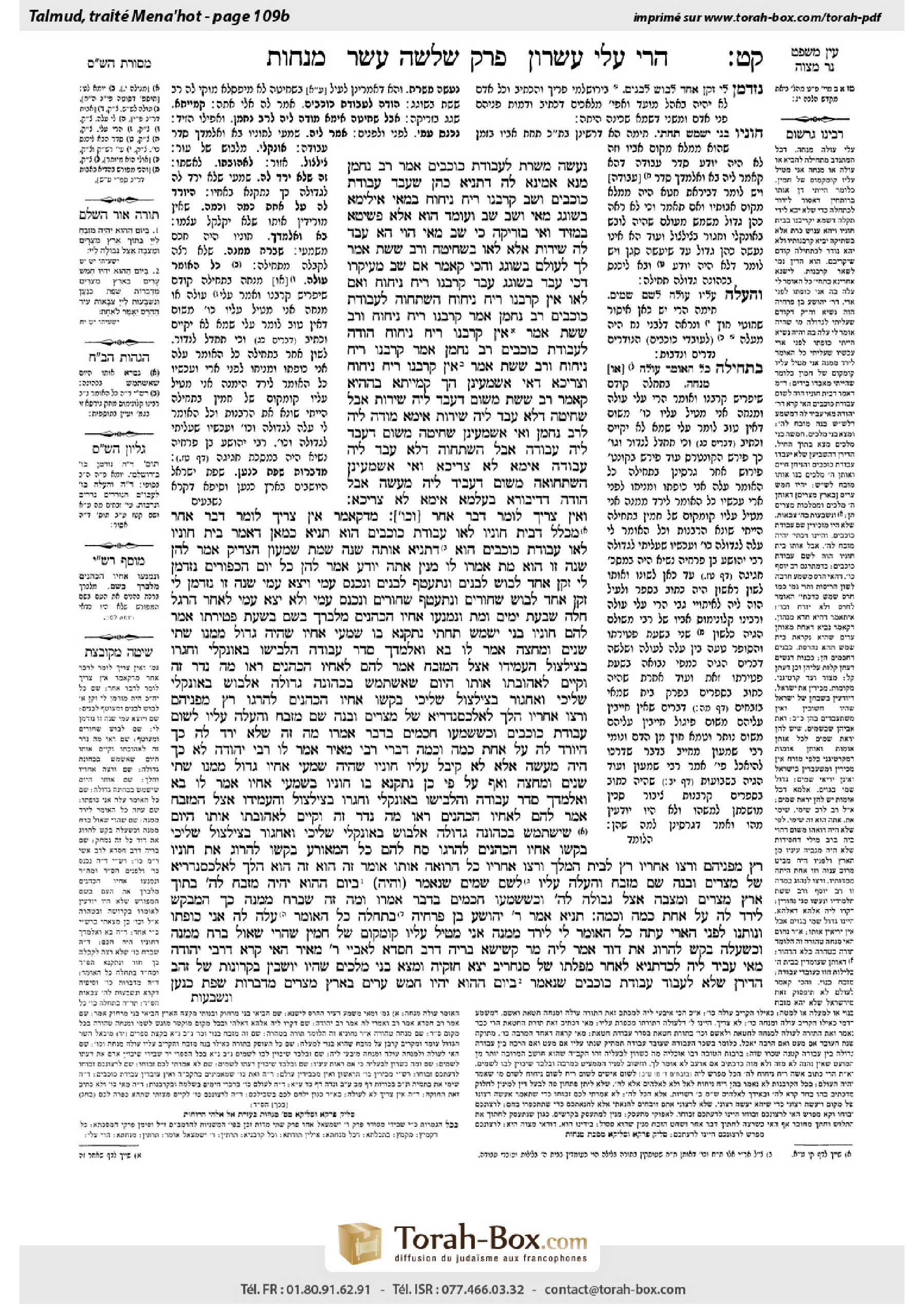
Menachot 109b: Talmud study for Daf Yomi
Daf Yomi is the daily study of one Talmud folio. Explore 37 tractates with scans, Hebrew text, Sefaria English and AI-generated French translations where annotated.
Passage selection and English or AI-generated French translation are available where the scan has annotations. Daf Study is independent of Torah-Box and Sefaria.
Browse Menachot · מנחות · All tractatesMenachot 109b text and translations
This page of Menachot includes the Aramaic text, an English translation and an AI-generated French translation, alongside the scan above.
מנחות ק״ט ב · Aramaic and Hebrew text
נַעֲשָׂה כּוֹמֶר לַעֲבוֹדָה זָרָה.
אָמַר רַב נַחְמָן: מְנָא אָמֵינָא לַהּ? דְּתַנְיָא: כֹּהֵן שֶׁעָבַד עֲבוֹדָה זָרָה, וְשָׁב, קׇרְבָּנוֹ רֵיחַ נִיחוֹחַ.
בְּמַאי? אִילֵּימָא בְּשׁוֹגֵג – מַאי ״וְשָׁב״? שָׁב וְעוֹמֵד הוּא! אֶלָּא פְּשִׁיטָא בְּמֵזִיד, וְאִי בִּזְרִיקָה – כִּי שָׁב מַאי הָוֵי? הָא עֲבַד לֵהּ שֵׁירוּת! אֶלָּא לָאו בִּשְׁחִיטָה.
וְרַב שֵׁשֶׁת אָמַר לָךְ, לְעוֹלָם בְּשׁוֹגֵג, וְהָכִי קָאָמַר: אִם שָׁב מֵעִיקָּרוֹ, דְּכִי עֲבַד בְּשׁוֹגֵג עֲבַד – קׇרְבָּנוֹ רֵיחַ נִיחוֹחַ, וְאִם לָאו – אֵין קׇרְבָּנוֹ רֵיחַ נִיחוֹחַ.
הִשְׁתַּחֲוָה לַעֲבוֹדָה זָרָה – רַב נַחְמָן אָמַר: קׇרְבָּנוֹ רֵיחַ נִיחוֹחַ, וְרַב שֵׁשֶׁת אָמַר: אֵין קׇרְבָּנוֹ רֵיחַ נִיחוֹחַ. הוֹדָה לַעֲבוֹדָה זָרָה – רַב נַחְמָן אָמַר: קׇרְבָּנוֹ רֵיחַ נִיחוֹחַ, וְרַב שֵׁשֶׁת אָמַר: אֵין קׇרְבָּנוֹ רֵיחַ נִיחוֹחַ.
וּצְרִיכָא, דְּאִי אַשְׁמְעִינַן הָךְ קַמַּיְיתָא – בְּהַהִיא קָאָמַר רַב שֵׁשֶׁת מִשּׁוּם דַּעֲבַד לֵיהּ שֵׁירוּת, אֲבָל שְׁחִיטָה דְּלָא עֲבַד לֵיהּ שֵׁירוּת – אֵימָא מוֹדֶה לֵיהּ לְרַב נַחְמָן.
וְאִי אַשְׁמְעִינַן שְׁחִיטָה, מִשּׁוּם דְּעָבֵד לֵיהּ עֲבוֹדָה, אֲבָל הִשְׁתַּחֲוָה דְּלָא עֲבַד לֵיהּ עֲבוֹדָה – אֵימָא לָא. צְרִיכָא.
וְאִי אַשְׁמְעִינַן הִשְׁתַּחֲוָאָה, מִשּׁוּם דְּעָבֵיד לֵיהּ מַעֲשֶׂה, אֲבָל הוֹדָה דְּדִיבּוּרָא בְּעָלְמָא – אֵימָא לָא. צְרִיכָא.
וְאֵין צָרִיךְ לוֹמַר דָּבָר אַחֵר [וְכוּ׳]. מִדְּקָאָמַר: אֵין צָרִיךְ לוֹמַר דָּבָר אַחֵר, מִכְּלָל דְּבֵית חוֹנְיוֹ לָאו עֲבוֹדָה זָרָה הוּא.
תַּנְיָא כְּמַאן דְּאָמַר בֵּית חוֹנְיוֹ לָאו עֲבוֹדָה זָרָה הוּא, דְּתַנְיָא: אוֹתָהּ שָׁנָה שֶׁמֵּת שִׁמְעוֹן הַצַּדִּיק, אָמַר לָהֶן: שָׁנָה זוֹ הוּא מֵת, אָמְרוּ לוֹ: מִנַּיִן אַתָּה יוֹדֵעַ?
אָמַר לָהֶן: כׇּל יוֹם הַכִּפּוּרִים נִזְדַּמֵּן לִי זָקֵן אֶחָד לָבוּשׁ לְבָנִים, וְנִתְעַטֵּף לְבָנִים, וְנִכְנַס עִמִּי וְיָצָא עִמִּי. שָׁנָה זוֹ נִזְדַּמֵּן לִי זָקֵן אֶחָד לָבוּשׁ שְׁחוֹרִים, וְנִתְעַטֵּף שְׁחוֹרִים, וְנִכְנַס עִמִּי וְלֹא יָצָא עִמִּי.
לְאַחַר הָרֶגֶל, חָלָה שִׁבְעַת יָמִים וָמֵת, וְנִמְנְעוּ אֶחָיו הַכֹּהֲנִים מִלְּבָרֵךְ בַּשֵּׁם.
בִּשְׁעַת פְּטִירָתוֹ, אָמַר לָהֶם: חוֹנְיוֹ בְּנִי יְשַׁמֵּשׁ תַּחְתַּי. נִתְקַנֵּא בּוֹ שִׁמְעִי אָחִיו, שֶׁהָיָה גָּדוֹל מִמֶּנּוּ שְׁתֵּי שָׁנִים וּמֶחֱצָה. אָמַר לוֹ: בֹּא וַאֲלַמֶּדְךָ סֵדֶר עֲבוֹדָה. הִלְבִּישׁוֹ בְּאוּנְקְלִי, וַחֲגָרוֹ בְּצִילְצוֹל, (העמידו) [וְהֶעֱמִידוֹ] אֵצֶל הַמִּזְבֵּחַ. אָמַר לָהֶם לְאֶחָיו הַכֹּהֲנִים: רְאוּ מָה נָדַר זֶה וְקִיֵּים לַאֲהוּבָתוֹ: ״אוֹתוֹ הַיּוֹם שֶׁאֶשְׁתַּמֵּשׁ בִּכְהוּנָּה גְּדוֹלָה אֶלְבּוֹשׁ בְּאוּנְקְלִי שֶׁלִּיכִי וְאֶחְגּוֹר בְּצִילְצוֹל שֶׁלִּיכִי״.
בִּקְּשׁוּ אֶחָיו הַכֹּהֲנִים לְהׇרְגוֹ, רָץ מִפְּנֵיהֶם, וְרָצוּ אַחֲרָיו. הָלַךְ לַאֲלֶכְּסַנְדְּרִיָּא שֶׁל מִצְרַיִם, וּבָנָה שָׁם מִזְבֵּחַ, וְהֶעֱלָה עָלָיו לְשׁוּם עֲבוֹדָה זָרָה. וּכְשֶׁשָּׁמְעוּ חֲכָמִים בַּדָּבָר, אָמְרוּ: מָה זֶה שֶׁלֹּא יָרַד לָהּ – כָּךְ, הַיּוֹרֵד לָהּ – עַל אַחַת כַּמָּה וְכַמָּה. דִּבְרֵי רַבִּי מֵאִיר.
אָמַר לוֹ רַבִּי יְהוּדָה: לֹא כָּךְ הָיָה מַעֲשֶׂה, אֶלָּא לֹא קִיבֵּל עָלָיו חוֹנְיוֹ, שֶׁהָיָה שִׁמְעִי אָחִיו גָּדוֹל מִמֶּנּוּ שְׁתֵּי שָׁנִים וּמֶחֱצָה, וְאַף עַל פִּי כֵן נִתְקַנֵּא בּוֹ חוֹנְיוֹ בְּשִׁמְעִי אָחִיו. אָמַר לוֹ: בֹּא וַאֲלַמֶּדְךָ סֵדֶר עֲבוֹדָה, וְהִלְבִּישׁוֹ בְּאוּנְקְלִי, וַחֲגָרוֹ בְּצִילְצוֹל, וְהֶעֱמִידוֹ אֵצֶל הַמִּזְבֵּחַ. אָמַר לָהֶם לְאֶחָיו הַכֹּהֲנִים: רְאוּ מָה נָדַר זֶה וְקִיֵּים לַאֲהוּבָתוֹ ״אוֹתוֹ הַיּוֹם שֶׁיִּשְׁתַּמֵּשׁ בִּכְהוּנָּה גְּדוֹלָה אֶלְבּוֹשׁ בְּאוּנְקְלִי שֶׁלִּיכִי וְאֶחְגּוֹר בְּצִילְצוֹל שֶׁלִּיכִי״.
בִּקְּשׁוּ אֶחָיו הַכֹּהֲנִים לְהׇרְגוֹ, סָח לָהֶם כׇּל הַמְאוֹרָע, בִּקְּשׁוּ לַהֲרוֹג אֶת חוֹנְיוֹ, רָץ מִפְּנֵיהֶם, וְרָצוּ אַחֲרָיו, רָץ לְבֵית הַמֶּלֶךְ, וְרָצוּ אַחֲרָיו, כׇּל הָרוֹאֶה אוֹתוֹ אוֹמֵר: זֶה הוּא, זֶה הוּא, הָלַךְ לַאֲלֶכְּסַנְדְּרִיָּא שֶׁל מִצְרַיִם, וּבָנָה שָׁם מִזְבֵּחַ, וְהֶעֱלָה עָלָיו לְשֵׁם שָׁמַיִם, שֶׁנֶּאֱמַר: ״(וְהָיָה) בַּיּוֹם הַהוּא יִהְיֶה מִזְבֵּחַ לַה׳ בְּתוֹךְ אֶרֶץ מִצְרָיִם וּמַצֵּבָה אֵצֶל גְּבוּלָהּ לַה׳״.
וּכְשֶׁשָּׁמְעוּ חֲכָמִים בַּדָּבָר, אָמְרוּ: וּמָה זֶה שֶׁבָּרַח מִמֶּנָּה כָּךְ, הַמְבַקֵּשׁ לֵירֵד לָהּ – עַל אַחַת כַּמָּה וְכַמָּה.
תַּנְיָא, אָמַר רַבִּי יְהוֹשֻׁעַ בֶּן פְּרַחְיָה: בַּתְּחִלָּה, כׇּל הָאוֹמֵר ״עֲלֵה לָהּ״ – אֲנִי כּוֹפְתוֹ וְנוֹתְנוֹ לִפְנֵי הָאֲרִי; עַתָּה, כׇּל הָאוֹמֵר לִי לֵירֵד מִמֶּנָּה – אֲנִי מֵטִיל עָלָיו קוּמְקוּם שֶׁל חַמִּין.
שֶׁהֲרֵי שָׁאוּל בָּרַח מִמֶּנָּה, וּכְשֶׁעָלָה בִּקֵּשׁ לַהֲרוֹג אֶת דָּוִד.
אֲמַר לֵיהּ מָר קַשִּׁישָׁא בְּרֵיהּ דְּרַב חִסְדָּא לְאַבָּיֵי: רַבִּי מֵאִיר, הַאי קְרָא דְּרַבִּי יְהוּדָה מַאי עָבֵיד לֵיהּ?
לְכִדְתַנְיָא: לְאַחַר מַפַּלְתּוֹ שֶׁל סַנְחֵרִיב, יָצָא חִזְקִיָּה וּמָצָא בְּנֵי מְלָכִים שֶׁהָיוּ יוֹשְׁבִין בִּקְרוֹנוֹת שֶׁל זָהָב, הִדִּירָן שֶׁלֹּא לַעֲבוֹד עֲבוֹדָה זָרָה, שֶׁנֶּאֱמַר: ״בַּיּוֹם הַהוּא יִהְיוּ חָמֵשׁ עָרִים בְּאֶרֶץ מִצְרַיִם מְדַבְּרוֹת שְׂפַת כְּנַעַן
Menachot 109b · English translation
as by slaughtering the idolatrous offering intentionally he became a servant of idol worship.
Rav Naḥman said: From where do I say that even a priest who intentionally slaughters an idolatrous offering is nevertheless fit to serve in the Temple if he repents? As it is taught in a baraita: With regard to a priest who served in idol worship and repented, his offering in the Temple is an aroma pleasing to the Lord and is acceptable.
Rav Naḥman clarifies: In what manner did he serve in idol worship? If we say that he served in idol worship unwittingly, what does the baraita mean when it says: And repented? He is already repentant, as he never intended to sin in the first place. Rather, it is obvious that the baraita is referring to a case of intentional idol worship. And if the baraita is referring to sprinkling the blood of an idolatrous offering, when he repents, what of it? Hasn’t he performed idolatrous service, thereby disqualifying himself from serving in the Temple in any event? Rather, is it not referring to the slaughter of an idolatrous offering? Evidently, even if the priest slaughtered it intentionally, once he repents he is fit to serve in the Temple.
And as for Rav Sheshet, he could have said to you that actually the baraita is referring to unwitting slaughter. And this is what the baraita is saying: If the priest is repentant from the outset, as when he served in idol worship he served unwittingly, then his offering is an aroma pleasing to the Lord and is acceptable. But if not, i.e., he slaughtered an idolatrous offering intentionally, his subsequent offering in the Temple is not an aroma pleasing to the Lord.
§ The Gemara lists other similar disagreements between Rav Naḥman and Rav Sheshet. In a case where a priest bowed to an object of idol worship, Rav Naḥman says: If he subsequently repents and serves in the Temple, his offering is an aroma pleasing to the Lord. And Rav Sheshet says: His offering is not an aroma pleasing to the Lord. In a case where a priest acknowledges an object of idol worship as a divinity, Rav Naḥman says: If he subsequently repents and serves in the Temple, his offering is an aroma pleasing to the Lord. And Rav Sheshet says: His offering is not an aroma pleasing to the Lord.
Having listed four similar disputes between Rav Naḥman and Rav Sheshet, namely, with regard to a priest who unwittingly sprinkled the blood of an idolatrous offering, a priest who intentionally slaughtered an idolatrous offering, a priest who bowed to an idol, and a priest who acknowledged an idol as a divinity, the Gemara explains: And it was necessary to teach the dispute with regard to all four cases. As, had the Sages taught us only this first case, where a priest sprinkles the blood of an idolatrous offering unwittingly, one might have thought that only in that case Rav Sheshet says that the priest’s subsequent service in the Temple is disqualified, because he performed a service for idolatry that is considered a sacrificial rite in the Temple. But in a case where the priest merely performed slaughter, since he did not perform a service for idolatry that is a sacrificial rite in the Temple, there is room to say that Rav Sheshet concedes to the opinion of Rav Naḥman.
And had the Sages taught us only the dispute with regard to a priest intentionally performing slaughter for an idolatrous offering, one might have thought that Rav Sheshet says that the priest’s subsequent service in the Temple is disqualified because he performed a sacrificial rite for idolatry. But if he merely bowed to the idol, since he did not perform a sacrificial rite for idolatry, there is room to say that Rav Sheshet does not disqualify the priest’s subsequent service in the Temple. Therefore, it was necessary to teach this case as well.
And had the Sages taught us only the case of a priest bowing to an idol, one might have thought that in this case Rav Sheshet says that the priest’s subsequent service in the Temple is disqualified because he performed an action for idolatry. But if he only acknowledged the idol as a divinity, which is mere speech, there is room to say that Rav Sheshet does not disqualify the priest’s subsequent service in the Temple. The Gemara concludes: Therefore, it was necessary to teach this case as well.
§ The mishna teaches: And needless to say, if priests served for something else, a euphemism for idolatry, they are disqualified from service in the Temple. The Gemara comments: From the fact that it says: Needless to say, if they served for something else, by inference, the temple of Onias is not a temple of idol worship, but rather a temple devoted to the worship of God.
It is taught in a baraita like the one who says that the temple of Onias is not a temple of idol worship. As it is taught: During the year in which Shimon HaTzaddik died, he said to his associates: This year, he will die, euphemistically referring to himself. They said to him: From where do you know?
Shimon HaTzaddik said to them: In previous years, every Yom Kippur, upon entering the Holy of Holies, I had a prophetic vision in which I would be met by an old man who was dressed in white, and his head was wrapped in white, and he would enter the Holy of Holies with me, and he would leave with me. But this year, I was met by an old man who was dressed in black, and his head was wrapped in black, and he entered the Holy of Holies with me, but he did not leave with me. Shimon HaTzaddik understood this to be a sign that his death was impending.
Indeed, after the pilgrimage festival of Sukkot, he was ill for seven days and died. And his fellow priests refrained from reciting the Priestly Benediction with the ineffable name of God.
At the time of his death, he said to the Sages: Onias, my son, will serve as High Priest in my stead. Shimi, Onias’ brother, became jealous of him, as Shimi was two and a half years older than Onias. Shimi said to Onias treacherously: Come and I will teach you the order of the service of the High Priest. Shimi dressed Onias in a tunic [be’unkeli] and girded him with a ribbon [betziltzul] as a belt, i.e., not in the vestments of the High Priest, and stood him next to the altar. Shimi said to his fellow priests: Look what this man vowed and fulfilled for his beloved, that he had said to her: On the day that I serve in the High Priesthood I will wear your tunic and gird your ribbon.
The fellow priests of Onias wanted to kill him because he had disgraced the Temple service with his garments. Onias ran away from them and they ran after him. He went to Alexandria in Egypt and built an altar there, and sacrificed offerings upon it for the sake of idol worship. When the Sages heard of the matter they said: If this person, Shimi, who did not enter the position of High Priest, acted with such jealousy, all the more so will one who enters a prestigious position rebel if that position is taken away from him. This is the statement of Rabbi Meir. According to Rabbi Meir, the temple of Onias was built for idol worship.
Rabbi Yehuda said to him: The incident was not like this. Rather, Onias did not accept the position of High Priest because his brother Shimi was two and a half years older than him, so Shimi was appointed as High Priest. And even so, even though Onias himself offered the position to Shimi, Onias was jealous of his brother Shimi. Onias said to Shimi: Come and I will teach you the order of the service of the High Priest. And Onias dressed Shimi in a tunic and girded him in a ribbon and stood him next to the altar. Onias said to his fellow priests: Look what this man, Shimi, vowed and fulfilled for his beloved, that he had said to her: On the day that I serve in the High Priesthood I will wear your tunic and gird your ribbon.
His fellow priests wanted to kill Shimi. Shimi then told them the entire incident, that he had been tricked by his brother Onias, so the priests wanted to kill Onias. Onias ran away from them, and they ran after him. Onias ran to the palace of the king, and they ran after him. Anyone who saw him would say: This is him, this is him, and he was not able to escape unnoticed. Onias went to Alexandria in Egypt and built an altar there, and sacrificed offerings upon it for the sake of Heaven. As it is stated: “In that day shall there be an altar to the Lord in the midst of the land of Egypt, and a pillar at its border, to the Lord” (Isaiah 19:19). According to Rabbi Yehuda, the temple of Onias was dedicated to the worship of God.
And when the Sages heard of the matter they said: If this one, Onias, who fled from the position of High Priest and offered it to his brother, still was overcome with such jealousy to the point where he tried to have Shimi killed, all the more so will one who wants to enter a prestigious position be jealous of the one who already has that position.
§ As a corollary to the statement of the Sages with regard to one who is jealous and wants the position of another, it is taught in a baraita that Rabbi Yehoshua ben Peraḥya said: Initially, in response to anyone who would say to me: Ascend to the position of Nasi, I would tie him up and place him in front of a lion out of anger for his suggestion. Now that I have become the Nasi, in response to anyone who tells me to leave the position, I would throw a kettle [kumkum] of boiling water at him out of anger at his suggestion.
It is human nature that after one ascends to a prestigious position he does not wish to lose it. As evidence of this principle, Saul initially fled from the kingship, as he did not wish to be king, as stated in the verse: “When they sought him he could not be found…Behold he has hidden himself among the baggage” (I Samuel 10:21–22). But when he ascended to the kingship he tried to kill David, who he thought was trying to usurp his authority (see I Samuel, chapters 18–27).
§ Mar Kashisha, son of Rav Ḥisda, said to Abaye: What does Rabbi Meir do with this verse of Rabbi Yehuda? Since Rabbi Meir holds that the temple of Onias was dedicated to idol worship, how does he explain the verse in Isaiah?
Abaye answered Mar Kashisha and said that Rabbi Meir uses this verse for that which is taught in a baraita: After the downfall of Sennacherib, the king of Assyria who besieged Jerusalem (see II Kings, chapters 18–19), King Hezekiah emerged from Jerusalem and found the gentile princes Sennacherib had brought with him from his other conquests, sitting in carriages [bikronot] of gold. He made them vow that they would not worship idols, and they fulfilled their vow, as it is stated in Isaiah’s prophecy about Egypt: “In that day there shall be five cities in the land of Egypt that speak the language of Canaan
Menachot 109b · Traduction française (IA)
car, en égorgeant intentionnellement l’offrande idolâtre, il était devenu un serviteur de l’idolâtrie.
Rav Naḥman dit : D’où sais-je que même un prêtre qui égorge intentionnellement une offrande idolâtre reste apte à officier dans le Temple s’il se repent ? Comme l’enseigne une baraïta : « Un prêtre qui a servi l’idolâtrie puis s’est repenti peut offrir dans le Temple une offrande qui est un parfum agréable au Seigneur et qui est agréée. »
Rav Naḥman précise : De quelle manière a-t-il servi l’idolâtrie ? Si l’on dit qu’il l’a servie par inadvertance, que signifie la formule de la baraïta : « puis s’est repenti » ? Il est déjà repentant, puisqu’il n’avait jamais eu l’intention de pécher. Il est donc évident que la baraïta parle d’un service idolâtre accompli intentionnellement. Et si elle parle de l’aspersion du sang d’une offrande idolâtre, que change alors son repentir ? N’a-t-il pas accompli un service idolâtre et ne s’est-il donc pas disqualifié, de toute façon, pour officier dans le Temple ? Ne faut-il pas plutôt dire qu’elle parle de l’égorgement d’une offrande idolâtre ? Il en ressort que même si le prêtre l’a égorgée intentionnellement, dès lors qu’il se repent, il est apte à officier dans le Temple.
Quant à Rav Sheshet, il aurait pu te répondre qu’en réalité, la baraïta parle d’un égorgement accompli par inadvertance. Voici ce que dit la baraïta : si le prêtre est repentant depuis le départ, c’est-à-dire que lorsqu’il a servi l’idolâtrie, il l’a fait par inadvertance, alors son offrande est un parfum agréable au Seigneur et elle est agréée. Mais sinon, c’est-à-dire s’il a égorgé intentionnellement une offrande idolâtre, l’offrande qu’il apporte ensuite dans le Temple n’est pas un parfum agréable au Seigneur.
§ La Guemara rapporte d’autres désaccords similaires entre Rav Naḥman et Rav Sheshet. Dans le cas d’un prêtre qui s’est prosterné devant un objet d’idolâtrie, Rav Naḥman dit que s’il se repent ensuite et officie dans le Temple, son offrande est un parfum agréable au Seigneur. Rav Sheshet dit que son offrande n’est pas un parfum agréable au Seigneur. Dans le cas d’un prêtre qui reconnaît un objet d’idolâtrie comme une divinité, Rav Naḥman dit que s’il se repent ensuite et officie dans le Temple, son offrande est un parfum agréable au Seigneur. Rav Sheshet dit que son offrande n’est pas un parfum agréable au Seigneur.
Après avoir rapporté quatre désaccords similaires entre Rav Naḥman et Rav Sheshet — au sujet d’un prêtre qui a aspergé par inadvertance le sang d’une offrande idolâtre, d’un prêtre qui a égorgé intentionnellement une offrande idolâtre, d’un prêtre qui s’est prosterné devant une idole et d’un prêtre qui a reconnu une idole comme une divinité —, la Guemara explique qu’il était nécessaire d’enseigner le désaccord dans les quatre cas. En effet, si les Sages nous avaient enseigné uniquement le premier cas, celui d’un prêtre qui asperge par inadvertance le sang d’une offrande idolâtre, on aurait pu penser que Rav Sheshet affirme que le service ultérieur du prêtre dans le Temple est disqualifié uniquement dans ce cas, parce qu’il a accompli pour l’idolâtrie un service qui est considéré comme un rite sacrificiel dans le Temple. Mais si le prêtre s’est contenté d’égorger, puisqu’il n’a pas accompli pour l’idolâtrie un service qui constitue un rite sacrificiel dans le Temple, on pourrait penser que Rav Sheshet concède l’opinion de Rav Naḥman.
Et si les Sages nous avaient enseigné uniquement le désaccord au sujet d’un prêtre qui égorge intentionnellement une offrande idolâtre, on aurait pu penser que Rav Sheshet affirme que le service ultérieur du prêtre dans le Temple est disqualifié parce qu’il a accompli un rite sacrificiel pour l’idolâtrie. Mais s’il s’est contenté de se prosterner devant l’idole, puisqu’il n’a pas accompli de rite sacrificiel pour l’idolâtrie, on pourrait penser que Rav Sheshet ne disqualifie pas son service ultérieur dans le Temple. Il était donc nécessaire d’enseigner également ce cas.
Et si les Sages nous avaient enseigné uniquement le cas d’un prêtre qui se prosterne devant une idole, on aurait pu penser que Rav Sheshet affirme que le service ultérieur du prêtre dans le Temple est disqualifié dans ce cas parce qu’il a accompli un acte pour l’idolâtrie. Mais s’il s’est contenté de reconnaître l’idole comme une divinité, ce qui relève de la seule parole, on pourrait penser que Rav Sheshet ne disqualifie pas son service ultérieur dans le Temple. La Guemara conclut qu’il était donc nécessaire d’enseigner également ce cas.
§ La Michna enseigne : « Et cela va sans dire si les prêtres ont officié pour autre chose », euphémisme désignant l’idolâtrie : ils sont disqualifiés pour officier dans le Temple. La Guemara fait remarquer : du fait qu’il est dit « cela va sans dire s’ils ont officié pour autre chose », il s’ensuit que le temple d’Onias n’est pas un temple consacré au culte des idoles, mais plutôt un temple consacré au culte de Dieu.
Une baraïta enseigne conformément à l’opinion selon laquelle le temple d’Onias n’est pas consacré au culte des idoles. En effet, il est enseigné : l’année où Shimon HaTzaddik mourut, il dit à ses compagnons : « Cette année, il mourra », se désignant ainsi par euphémisme. Ils lui demandèrent : « D’où le sais-tu ? »
Shimon HaTzaddik leur dit : « Les années précédentes, chaque Yom Kippour, lorsque j’entrais dans le Saint des Saints, j’avais une vision prophétique : un vieil homme vêtu de blanc, la tête enveloppée de blanc, venait à ma rencontre. Il entrait avec moi dans le Saint des Saints et en ressortait avec moi. Mais cette année, un vieil homme vêtu de noir, la tête enveloppée de noir, est venu à ma rencontre. Il est entré avec moi dans le Saint des Saints, mais il n’en est pas ressorti avec moi. » Shimon HaTzaddik comprit que c’était le signe de sa mort imminente.
En effet, après la fête de pèlerinage de Soukkot, il fut malade pendant sept jours, puis mourut. Ses collègues prêtres s’abstinrent alors de réciter la bénédiction sacerdotale en prononçant le nom ineffable de Dieu.
Au moment de sa mort, il dit aux Sages : « Onias, mon fils, me succédera comme grand prêtre. » Shimi, le frère d’Onias, fut jaloux de lui, car Shimi avait deux ans et demi de plus qu’Onias. Shimi dit perfidement à Onias : « Viens, je vais t’enseigner l’ordre du service du grand prêtre. » Shimi revêtit Onias d’une tunique [be’unkeli] et le ceignit d’un ruban [betziltzul] en guise de ceinture, c’est-à-dire qu’il ne lui mit pas les vêtements du grand prêtre, puis le plaça près de l’autel. Shimi dit à ses collègues prêtres : « Regardez ce que cet homme a promis à sa bien-aimée et accompli pour elle : il lui avait dit : “Le jour où j’exercerai la grande prêtrise, je porterai ta tunique et me ceindrai de ton ruban.” »
Les collègues prêtres d’Onias voulurent le tuer, car il avait déshonoré le service du Temple par ses vêtements. Onias s’enfuit devant eux, et ils le poursuivirent. Il se rendit à Alexandrie, en Égypte, y construisit un autel et y offrit des sacrifices pour l’idolâtrie. Lorsque les Sages apprirent la chose, ils dirent : « Si cet homme, Shimi, qui n’est pas devenu grand prêtre, a manifesté une telle jalousie, à plus forte raison celui qui accède à une fonction prestigieuse se révoltera-t-il si on la lui retire. » Telle est l’opinion de Rabbi Meïr. Selon Rabbi Meïr, le temple d’Onias fut construit pour le culte des idoles.
Rabbi Yehouda lui dit : « L’incident ne s’est pas déroulé ainsi. Onias refusa la fonction de grand prêtre parce que son frère Shimi avait deux ans et demi de plus que lui ; Shimi fut donc nommé grand prêtre. Malgré cela, bien qu’Onias lui-même ait proposé la fonction à Shimi, Onias fut jaloux de son frère Shimi. Onias dit à Shimi : “Viens, je vais t’enseigner l’ordre du service du grand prêtre.” Onias revêtit Shimi d’une tunique, le ceignit d’un ruban et le plaça près de l’autel. Onias dit à ses collègues prêtres : “Regardez ce que cet homme, Shimi, a promis à sa bien-aimée et accompli pour elle : il lui avait dit : ‘Le jour où j’exercerai la grande prêtrise, je porterai ta tunique et me ceindrai de ton ruban.’” »
Les collègues prêtres voulurent tuer Shimi. Celui-ci leur raconta alors toute l’affaire : son frère Onias l’avait trompé. Les prêtres voulurent donc tuer Onias. Onias s’enfuit devant eux, et ils le poursuivirent. Onias courut vers le palais du roi, et ils le poursuivirent. Quiconque le voyait disait : « C’est lui, c’est lui ! », si bien qu’il ne pouvait s’échapper sans être remarqué. Onias se rendit à Alexandrie, en Égypte, y construisit un autel et y offrit des sacrifices pour le Ciel. Comme il est dit : « En ce jour-là, il y aura un autel pour le Seigneur au milieu du pays d’Égypte, et une stèle à sa frontière, pour le Seigneur » (Isaïe 19,19). Selon Rabbi Yehouda, le temple d’Onias était consacré au culte de Dieu.
Lorsque les Sages apprirent la chose, ils dirent : « Si cet homme, Onias, qui a fui la fonction de grand prêtre et l’a proposée à son frère, a néanmoins été saisi d’une telle jalousie qu’il a tenté de faire tuer Shimi, à plus forte raison celui qui veut accéder à une fonction prestigieuse sera-t-il jaloux de celui qui l’occupe déjà. »
§ Dans le prolongement de la déclaration des Sages au sujet de celui qui est jaloux et convoite la fonction d’un autre, une baraïta enseigne que Rabbi Yehoshua ben Peraḥya disait : « Au début, quand quelqu’un me disait : “Accède à la fonction de nasi”, je l’attachais et le plaçais devant un lion, tant sa suggestion me mettait en colère. Maintenant que je suis devenu nasi, si quelqu’un me dit de quitter cette fonction, je lui jetterais une marmite [kumkum] d’eau bouillante, tant sa suggestion me mettrait en colère. »
Il est dans la nature humaine que, lorsqu’on accède à une fonction prestigieuse, on ne souhaite pas la perdre. Saül illustre ce principe : au début, il fuyait la royauté, car il ne voulait pas être roi, comme le dit le verset : « Lorsqu’on le chercha, on ne le trouva pas… Voici, il s’est caché parmi les bagages » (I Samuel 10,21-22). Mais une fois devenu roi, il tenta de tuer David, qu’il croyait vouloir usurper son autorité (voir I Samuel, chapitres 18 à 27).
§ Mar Kashisha, fils de Rav Ḥisda, dit à Abaye : « Que fait Rabbi Meïr de ce verset cité par Rabbi Yehouda ? Puisque Rabbi Meïr soutient que le temple d’Onias était consacré au culte des idoles, comment explique-t-il le verset d’Isaïe ? »
Abaye répondit à Mar Kashisha que Rabbi Meïr utilise ce verset à l’appui de ce qui est enseigné dans une baraïta : après la défaite de Sennachérib, le roi d’Assyrie qui avait assiégé Jérusalem (voir II Rois, chapitres 18-19), le roi Ézéchias sortit de Jérusalem et trouva les princes étrangers que Sennachérib avait emmenés avec lui lors de ses autres conquêtes, assis dans des carrosses [bikronot] d’or. Il leur fit jurer qu’ils ne pratiqueraient pas l’idolâtrie, et ils tinrent leur serment, comme le dit la prophétie d’Isaïe au sujet de l’Égypte : « En ce jour-là, il y aura cinq villes dans le pays d’Égypte qui parleront la langue de Canaan
Traduction française générée par IA à partir de l’édition anglaise de Sefaria. Vérifie toujours un passage avec le texte source.
Text from Sefaria: William Davidson Edition - Vocalized Aramaic (unknown); William Davidson Edition - English (CC BY NC).