Menachot 109a: Talmud study for Daf Yomi
Daf Yomi is the daily study of one Talmud folio. Explore 37 tractates with scans, Hebrew text, Sefaria English and AI-generated French translations where annotated.
Passage selection and English or AI-generated French translation are available where the scan has annotations. Daf Study is independent of Torah-Box and Sefaria.
Browse Menachot · מנחות · All tractatesMenachot 109a text and translations
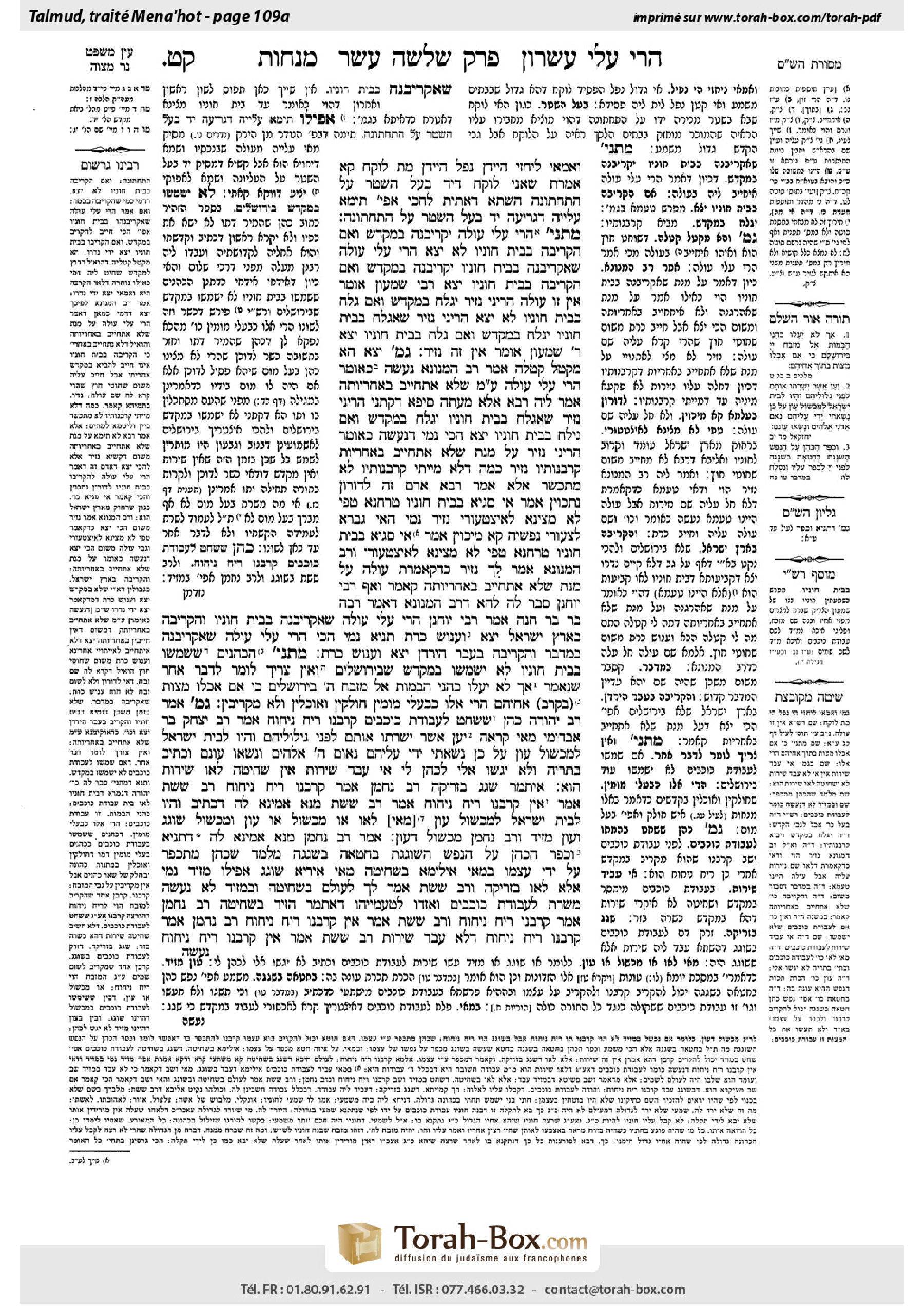
This page of Menachot includes the Aramaic text, an English translation and an AI-generated French translation, alongside the scan above.
מנחות ק״ט א · Aramaic and Hebrew text
וְאַמַּאי? לִיחְזֵי הֵיידֵן נְפַל, הֵיידֵן מֵת!
לוֹקֵחַ קָא אָמְרַתְּ? שָׁאנֵי לוֹקֵחַ, דְּיַד בַּעַל הַשְּׁטָר עַל הַתַּחְתּוֹנָה.
הַשְׁתָּא דְּאָתֵית לְהָכִי, אֲפִילּוּ תֵּימָא עֲלִיָּיה דִּגְרִיעָה – יַד בַּעַל הַשְּׁטָר עַל הַתַּחְתּוֹנָה.
מַתְנִי׳ ״הֲרֵי עָלַי עוֹלָה״ – יַקְרִיבֶנָּה בַּמִּקְדָּשׁ, וְאִם הִקְרִיבָהּ בְּבֵית חוֹנְיוֹ – לֹא יָצָא. ״הֲרֵי עָלַי עוֹלָה שֶׁאַקְרִיבֶנָּה בְּבֵית חוֹנְיוֹ״ – יַקְרִיבֶנָּה בַּמִּקְדָּשׁ, וְאִם הִקְרִיבָהּ בְּבֵית חוֹנְיוֹ – יָצָא. רַבִּי שִׁמְעוֹן אוֹמֵר: אֵין זוֹ עוֹלָה.
״הֲרֵינִי נָזִיר״ – יְגַלַּח בַּמִּקְדָּשׁ, וְאִם גִּלַּח בְּבֵית חוֹנְיוֹ – לֹא יָצָא. ״הֲרֵינִי נָזִיר שֶׁאֲגַלֵּחַ בְּבֵית חוֹנְיוֹ״ – יְגַלֵּחַ בַּמִּקְדָּשׁ, וְאִם גִּלַּח בְּבֵית חוֹנְיוֹ – יָצָא. רַבִּי שִׁמְעוֹן אוֹמֵר: אֵין זֶה נָזִיר.
גְּמָ׳ יָצָא? הָא מִקְטָל קַטְלַהּ!
אָמַר רַב הַמְנוּנָא: נַעֲשָׂה כְּאוֹמֵר ״הֲרֵי עָלַי עוֹלָה, עַל מְנָת שֶׁלֹּא אֶתְחַיֵּיב בְּאַחְרָיוּתָהּ״.
אֲמַר לֵיהּ רָבָא: אֶלָּא מֵעַתָּה, סֵיפָא דְּקָתָנֵי הֲרֵינִי נָזִיר שֶׁאֲגַלֵּחַ בְּבֵית חוֹנְיוֹ – יְגַלַּח בַּמִּקְדָּשׁ, וְאִם גִּילַּח בְּבֵית חוֹנְיוֹ – יָצָא, הָכִי נָמֵי דְּנַעֲשָׂה כְּאוֹמֵר ״הֲרֵינִי נָזִיר עַל מְנָת שֶׁלֹּא אֶתְחַיֵּיב בְּאַחְרָיוּת קׇרְבְּנוֹתָיו״? נָזִיר כַּמָּה דְּלָא מַיְיתֵי קׇרְבְּנוֹתָיו – לָא מִתַּכְשַׁר!
אֶלָּא אָמַר רָבָא: אָדָם זֶה לְדוֹרוֹן נִתְכַּוֵּין, אָמַר: אִי סַגִּיא בְּבֵית חוֹנְיוֹ – טָרַחְנָא, טְפֵי – לָא מָצֵינָא לְאִיצְטַעוֹרֵי.
נָזִיר נָמֵי, הַאי גַּבְרָא לְצַעוֹרֵי נַפְשֵׁיהּ קָא מִיכַּוֵּין, אָמַר: אִי סַגִּיא בְּבֵית חוֹנְיוֹ – טָרַחְנָא, טְפֵי לָא מָצֵינָא לְאִיצְטַעוֹרֵי.
וְרַב הַמְנוּנָא אָמַר לָךְ: נָזִיר – כִּדְקָאָמְרַתְּ, עוֹלָה – עַל מְנָת שֶׁלֹּא אֶתְחַיֵּיב בְּאַחְרָיוּתָהּ קָאָמַר.
וְאַף רַבִּי יוֹחָנָן סָבַר לַהּ לְהָא דְּרַב הַמְנוּנָא, דְּאָמַר רַבָּה בַּר בַּר חָנָה אָמַר רַבִּי יוֹחָנָן: ״הֲרֵי עָלַי עוֹלָה שֶׁאַקְרִיבֶנָּה בְּבֵית חוֹנְיוֹ״, וְהִקְרִיבָהּ בְּאֶרֶץ יִשְׂרָאֵל – יָצָא, וְעָנוּשׁ כָּרֵת.
תַּנְיָא נָמֵי הָכִי: הֲרֵי עָלַי עוֹלָה שֶׁאַקְרִיבֶנָּה בַּמִּדְבָּר, וְהִקְרִיבָהּ בְּעֵבֶר הַיַּרְדֵּן – יָצָא, וְעָנוּשׁ כָּרֵת.
מַתְנִי׳ הַכֹּהֲנִים שֶׁשִּׁמְּשׁוּ בְּבֵית חוֹנְיוֹ – לֹא יְשַׁמְּשׁוּ בַּמִּקְדָּשׁ שֶׁבִּירוּשָׁלַיִם, וְאֵין צָרִיךְ לוֹמַר לְדָבָר אַחֵר, שֶׁנֶּאֱמַר: ״אַךְ לֹא יַעֲלוּ כֹּהֲנֵי הַבָּמוֹת אֶל מִזְבַּח ה׳ בִּירוּשָׁלִָם כִּי אִם אָכְלוּ מַצּוֹת בְּקֶרֶב אֲחֵיהֶם״. הֲרֵי אֵלּוּ כְּבַעֲלֵי מוּמִין – חוֹלְקִין וְאוֹכְלִין וְלֹא מַקְרִיבִין.
גְּמָ׳ אָמַר רַב יְהוּדָה: כֹּהֵן שֶׁשָּׁחַט לַעֲבוֹדָה זָרָה, קׇרְבָּנוֹ רֵיחַ נִיחוֹחַ.
אָמַר רַב יִצְחָק בַּר אַבְדִּימִי: מַאי קְרָאָה? ״יַעַן אֲשֶׁר יְשָׁרְתוּ אוֹתָם לִפְנֵי גִלּוּלֵיהֶם וְהָיוּ לְבֵית יִשְׂרָאֵל לְמִכְשׁוֹל עָוֹן עַל כֵּן נָשָׂאתִי יָדִי עֲלֵיהֶם נְאֻם ה׳ אֱלֹהִים וְנָשְׂאוּ עֲוֹנָם״, וּכְתִיב בָּתְרֵיהּ: ״וְלֹא יִגְּשׁוּ אֵלַי לְכַהֵן לִי״. אִי עֲבַד שֵׁירוּת – אִין, שְׁחִיטָה לָאו שֵׁירוּת הוּא.
אִיתְּמַר: שָׁגַג בִּזְרִיקָה, רַב נַחְמָן אָמַר: קׇרְבָּנוֹ רֵיחַ נִיחוֹחַ, רַב שֵׁשֶׁת אָמַר: אֵין קׇרְבָּנוֹ רֵיחַ נִיחוֹחַ.
אָמַר רַב שֵׁשֶׁת: מְנָא אָמֵינָא לַהּ, דִּכְתִיב: ״וְהָיוּ לְבֵית יִשְׂרָאֵל לְמִכְשׁוֹל עָוֹן״, מַאי לָאו – אוֹ מִכְשׁוֹל אוֹ עָוֹן, וּ״מִכְשׁוֹל״ – שׁוֹגֵג, וְ״עָוֹן״ – מֵזִיד.
וְרַב נַחְמָן – ״מִכְשׁוֹל״ דְּ״עָוֹן״.
אָמַר רַב נַחְמָן: מְנָא אָמֵינָא לַהּ, דְּתַנְיָא: ״וְכִפֶּר הַכֹּהֵן עַל הַנֶּפֶשׁ הַשֹּׁגֶגֶת בְּחֶטְאָה בִשְׁגָגָה״, מְלַמֵּד שֶׁכֹּהֵן מִתְכַּפֵּר עַל יְדֵי עַצְמוֹ.
בְּמַאי? אִילֵימָא בִּשְׁחִיטָה – מַאי אִירְיָא שׁוֹגֵג? אֲפִילּוּ מֵזִיד נָמֵי! אֶלָּא לָאו בִּזְרִיקָה.
וְרַב שֵׁשֶׁת אָמַר לָךְ: לְעוֹלָם בִּשְׁחִיטָה, וּבְמֵזִיד – לֹא נַעֲשָׂה כּוֹמֶר לַעֲבוֹדָה זָרָה?!
וְאָזְדוּ לְטַעְמַיְיהוּ, דְּאִתְּמַר: הֵזִיד בִּשְׁחִיטָה – רַב נַחְמָן אָמַר: קׇרְבָּנוֹ רֵיחַ נִיחוֹחַ, וְרַב שֵׁשֶׁת אָמַר: אֵין קׇרְבָּנוֹ רֵיחַ נִיחוֹחַ.
רַב נַחְמָן אָמַר: קׇרְבָּנוֹ רֵיחַ נִיחוֹחַ, דְּלָא עֲבַד שֵׁירוּת. רַב שֵׁשֶׁת אָמַר: אֵין קׇרְבָּנוֹ רֵיחַ נִיחוֹחַ,
Menachot 109a · English translation
But according to the opinion of Rabba bar Avuh, why can the seller automatically give the purchaser the fallen house or the dead slave? Let him see which house fell, or which slave died, as according to Rabba bar Avuh, the sale should apply to the house or slave that was the most valuable at the time of the sale.
The Gemara answers: Are you saying that the statement of Rabba bar Avuh applies in the case of a purchaser? A purchaser is different, as there is a principle in the halakhot of commerce that in a case involving a dispute between the seller and the purchaser, the owner of the document of sale, i.e., the purchaser, is at a disadvantage, as a document is always interpreted as narrowly as possible. Therefore, the seller can claim that he has sold the buyer the fallen house or the dead slave.
The Gemara adds: Now that you have arrived at this explanation, the objection posed earlier to the statement of Rabba bar Avuh from the statement of Ulla can be rejected easily. Ulla said that if one says to another: I am selling you a house from among my houses, since he did not specify which house he is selling, he can show him an attic [aliyya]. Although this was explained above as referring not to a loft but to the best [me’ula] of his houses, now you may even say that it is referring to a loft, which is the worst of his houses, due to the principle that the owner of the document is at a disadvantage.
MISHNA: One who says: It is incumbent upon me to bring a burnt offering, must sacrifice it in the Temple in Jerusalem. And if he sacrificed it in the temple of Onias in Egypt, he has not fulfilled his obligation. One who says: It is incumbent upon me to bring a burnt offering that I will sacrifice in the temple of Onias, must sacrifice it in the Temple in Jerusalem, but if he sacrificed it in the temple of Onias, he has fulfilled his obligation. Rabbi Shimon says that if one says: It is incumbent upon me to bring a burnt offering that I will sacrifice in the temple of Onias, it is not consecrated as a burnt offering; such a statement does not consecrate the animal at all.
If one says: I am hereby a nazirite, then when his term of naziriteship is completed he must shave the hair of his head and bring the requisite offerings in the Temple in Jerusalem; and if he shaved in the temple of Onias, he has not fulfilled his obligation. If one says: I am hereby a nazirite provided that I will shave in the temple of Onias, he must shave in the Temple in Jerusalem; but if he shaved in the temple of Onias, he has fulfilled his obligation. Rabbi Shimon says that one who says: I am hereby a nazirite provided that I will shave in the temple of Onias, is not a nazirite at all, as his vow does not take effect.
GEMARA: The mishna teaches that one who says: It is incumbent upon me to bring a burnt offering that I will sacrifice in the temple of Onias, and sacrifices it in the temple of Onias, has fulfilled his obligation. The Gemara asks: How has he fulfilled his obligation? By sacrificing it in the temple of Onias, hasn’t he merely killed it without sacrificing it properly?
Rav Hamnuna says: The mishna does not mean that he has fulfilled his vow to bring an offering. Rather, he is rendered like one who says: It is incumbent upon me to bring a burnt offering on the condition that I will not be responsible for it if I kill it beforehand. When the mishna says that he has fulfilled his obligation it simply means that if the animal he consecrated is no longer alive, he does not have to bring another animal in its place.
Rava said to Rav Hamnuna: If that is so, what about the latter clause of the mishna, which teaches that if one says: I am hereby a nazirite provided that I will shave in the temple of Onias, he must shave in the Temple in Jerusalem, but if he shaved in the temple of Onias, he has fulfilled his obligation? In this case do you also maintain that he is rendered like one who says: I am hereby a nazirite on the condition that I will not be responsible for bringing its offerings if I kill them beforehand? Such a condition cannot exempt a nazirite from bringing his offerings, because as long as he does not bring his offerings, he is not fit to conclude his term of naziriteship and is still bound by all of the restrictions of a nazirite.
Rather, Rava said there is a different explanation: The animal was never consecrated at all, as this person intended merely to bring the animal as a gift [doron], but not to consecrate it as an offering. He presumably lives closer to the temple of Onias than to the Temple in Jerusalem, and must have said to himself: If it is sufficient to sacrifice this animal in the temple of Onias, I am prepared to exert myself and bring it. But if it is necessary to do more than that, i.e., to bring it to Jerusalem, I am not able to afflict myself. The mishna teaches that although the person never intended to bring the offering to Jerusalem, ideally, he should sacrifice the animal properly, in the Temple in Jerusalem. If he did not bring it there, but sacrificed it in the temple of Onias, he has fulfilled his obligation, and is not required to bring any other offering in its place.
This is the explanation of the latter clause of the mishna as well: If one said that he would be a nazirite provided that he will shave in the temple of Onias, this man did not intend to accept upon himself the halakhic status of naziriteship. Rather, he merely intends to practice abstinence by not drinking wine, along with observing the other restrictions of a nazirite. Therefore, he said to himself: If it is sufficient to shave in the temple of Onias, I am prepared to exert myself and do so. But if it is necessary to do more than that, i.e., to go to Jerusalem to shave and bring the required offerings, I am not able to afflict myself. The mishna teaches that ideally, he should go to the Temple in Jerusalem to shave and bring all his offerings. If he shaved and brought his offerings in the temple of Onias, he has fulfilled his vow and has no further obligation.
And Rav Hamnuna could have said to you in response to Rava’s challenge: With regard to the case of one who vowed to become a nazirite on the condition that he would shave and bring his offerings in the temple of Onias, the interpretation of the mishna is as you said. But with regard to one who vows to bring a burnt offering in the temple of Onias, his intent is as I explained, and it is as if he says: It is incumbent upon me to bring a burnt offering on the condition that I will not be responsible for it if I kill it beforehand.
And Rabbi Yoḥanan also holds in accordance with that which Rav Hamnuna said, as Rabba bar bar Ḥana said that Rabbi Yoḥanan said that if one says: It is incumbent upon me to bring a burnt offering on the condition that I will sacrifice it in the temple of Onias, and he sacrificed it in Eretz Yisrael but not in the Temple, he has fulfilled his obligation, but his actions are also punishable by excision from the World-to-Come [karet] because he sacrificed an offering outside of the Temple. This is in accordance with the opinion of Rav Hamnuna that the animal is consecrated.
This explanation of Rav Hamnuna and Rabbi Yoḥanan is also taught in a baraita: If one says: It is incumbent upon me to bring a burnt offering on the condition that I will sacrifice it in the wilderness of Sinai, thinking that the wilderness of Sinai still has sanctity since the Tabernacle had been located there, and he sacrificed it on the east bank of the Jordan, he has fulfilled his obligation, but his actions are also punishable by karet because he sacrificed an offering outside of the Temple.
MISHNA: The priests who served in the temple of Onias may not serve in the Temple in Jerusalem; and needless to say, if they served for something else, a euphemism for idolatry, they are disqualified from service in the Temple. As it is stated: “Nevertheless the priests of the private altars did not come up to the altar of the Lord in Jerusalem, but they did eat matza among their brethren” (II Kings 23:9). The halakhic status of these priests is like that of blemished priests in that they receive a share in the distribution of the meat of the offerings and partake of that meat, but they do not sacrifice offerings or perform any of the sacrificial rites.
GEMARA: Rav Yehuda says: With regard to a priest who slaughtered an offering for idol worship and who subsequently repented and came to the Temple in Jerusalem to serve, his offering is acceptable and considered to be an aroma pleasing to the Lord.
Rav Yitzḥak bar Avdimi says: What is the verse from which it is derived? The verse states: “Because they served them before their idols and became a stumbling block of iniquity unto the house of Israel, therefore I have lifted up My hand against them, says the Lord God, and they shall bear their iniquity” (Ezekiel 44:12). And it is written afterward: “And they shall not come near to Me, to serve Me in the priestly role” (Ezekiel 44:13). This indicates that if a priest performed a service for an idol that is considered a sacrificial rite in the Temple, he is disqualified from serving in the Temple, but the slaughter of an offering is not considered service, as it is not considered a sacrificial rite in the Temple and can be performed in the Temple even by a non-priest.
It was stated: If a priest unwittingly performed the sprinkling of the blood of an idolatrous offering and then repented and came to serve in the Temple, Rav Naḥman says that his offering is accepted and is an aroma pleasing to the Lord. Rav Sheshet says: His offering is not a pleasing aroma to the Lord, as he is not fit to serve in the Temple.
Rav Sheshet said: From where do I say that if a priest sprinkled blood unwittingly for idol worship he cannot serve in the Temple? As it is written: “And they became a stumbling block of iniquity unto the house of Israel.” What, is it not referring to one who served in idol worship either as a stumbling block or as an iniquity? Accordingly, neither may perform the service in the Temple. And the term “stumbling block” is a reference to one who sins unwittingly, and the term “iniquity” is a reference to an intentional sinner. Therefore, even one who unwittingly served in idol worship may not subsequently serve in the Temple.
And Rav Naḥman interprets the verse to mean a stumbling block of iniquity, i.e., only one who serves in idol worship intentionally is disqualified from serving in the Temple, but not one who serves in idol worship unwittingly.
Rav Naḥman said: From where do I say that if a priest sprinkled the blood of an idolatrous offering unwittingly his subsequent offering in the Temple is accepted? As it is taught in a baraita: The verse states with regard to one who unwittingly committed idolatry: “And if one person sin through error, then he shall offer a she-goat in its first year for a sin offering. And the priest shall effect atonement for the soul that errs unwittingly, when he sins unwittingly, before the Lord, to effect atonement for him; and he shall be forgiven” (Numbers 15:27–28). The phrase: “For the soul that errs unwittingly” teaches that a priest who sins unwittingly may receive atonement by sacrificing his sin offering on his own.
Rav Naḥman clarifies: In what manner did this priest commit idolatry? If we say he sinned through slaughtering an idolatrous offering, why does the verse indicate specifically that a priest who slaughtered an idolatrous offering unwittingly can bring his own sin offering? This is obvious, as even one who did so intentionally may serve in the Temple after repentance. Rather, is it not referring to a priest who committed idolatry by sprinkling the blood of an idolatrous offering? Accordingly, if he did so unwittingly his subsequent service in the Temple is valid, but if he did so intentionally, he is disqualified from serving in the Temple.
And how does Rav Sheshet interpret that baraita? He could have said to you: Actually, the verse is referring to a case where the priest sinned through slaughtering an idolatrous offering. And although Rav Yehuda said that a priest who slaughtered an idolatrous offering may serve in the Temple after repentance, that statement applies only to one who slaughtered an idolatrous offering unwittingly. But if he did so intentionally, the priest is disqualified from serving in the Temple. Rav Yehuda’s reasoning is that slaughter is not a sacrificial rite in the Temple; but does one who slaughters an idolatrous offering intentionally not become a servant of idol worship?
And Rav Naḥman and Rav Sheshet follow their respective lines of reasoning, as it was stated that if a priest acted intentionally in the slaughter of an idolatrous offering and subsequently repented, Rav Naḥman says that his offering in the Temple is an aroma pleasing to the Lord, i.e., it is not disqualified, and Rav Sheshet says that his offering in the Temple is not an aroma pleasing to the Lord, i.e., it is disqualified.
Rav Naḥman says that his offering is an aroma pleasing to the Lord, because he did not perform service for an idol that is considered a sacrificial rite in the Temple. And Rav Sheshet says that his offering is not an aroma pleasing to the Lord,
Menachot 109a · Traduction française (IA)
Mais, selon l’avis de Rabba bar Avuh, pourquoi le vendeur peut-il automatiquement donner à l’acheteur la maison qui s’est écroulée ou l’esclave qui est mort ? Qu’il voie quelle maison s’est écroulée ou quel esclave est mort, car, selon Rabba bar Avuh, la vente devrait porter sur la maison ou l’esclave qui avait le plus de valeur au moment de la vente.
La Guemara répond : Parlez-vous de l’application de la déclaration de Rabba bar Avuh au cas d’un acheteur ? Le cas de l’acheteur est différent, car, selon les règles du commerce, lorsqu’un litige oppose le vendeur et l’acheteur, le détenteur de l’acte de vente, c’est-à-dire l’acheteur, est désavantagé, puisque l’acte est toujours interprété de la manière la plus restrictive possible. Le vendeur peut donc prétendre avoir vendu à l’acheteur la maison qui s’est écroulée ou l’esclave qui est mort.
La Guemara ajoute : À présent que vous êtes parvenus à cette explication, on peut facilement écarter l’objection formulée plus tôt contre la déclaration de Rabba bar Avuh à partir de celle d’Oulla. Oulla a dit que si quelqu’un dit à un autre : « Je te vends une maison parmi mes maisons », puisqu’il n’a pas précisé laquelle il vend, il peut lui montrer un grenier [aliyya]. Bien qu’on ait expliqué plus haut que cela ne désigne pas un grenier, mais la meilleure [me’ula] de ses maisons, on peut maintenant même dire qu’il s’agit d’un grenier, le moins bon de ses biens, en vertu du principe selon lequel le détenteur de l’acte est désavantagé.
Michna : Celui qui dit : « Je suis tenu d’apporter un holocauste » doit l’offrir dans le Temple de Jérusalem. S’il l’offre dans le temple d’Onias, en Égypte, il ne s’est pas acquitté de son obligation. Celui qui dit : « Je suis tenu d’apporter un holocauste que j’offrirai dans le temple d’Onias » doit l’offrir dans le Temple de Jérusalem ; mais s’il l’offre dans le temple d’Onias, il s’est acquitté de son obligation. Rabbi Chimon dit que si quelqu’un dit : « Je suis tenu d’apporter un holocauste que j’offrirai dans le temple d’Onias », l’animal n’est pas consacré comme holocauste ; une telle déclaration ne le consacre pas du tout.
Si quelqu’un dit : « Me voici nazir », à la fin de sa période de naziréat, il doit se raser la tête et apporter les sacrifices requis au Temple de Jérusalem ; s’il se rase dans le temple d’Onias, il ne s’est pas acquitté de son obligation. Si quelqu’un dit : « Me voici nazir, à condition de me raser dans le temple d’Onias », il doit se raser au Temple de Jérusalem ; mais s’il se rase dans le temple d’Onias, il s’est acquitté de son obligation. Rabbi Chimon dit que celui qui dit : « Me voici nazir, à condition de me raser dans le temple d’Onias », n’est pas nazir du tout, car son vœu ne prend pas effet.
Guemara : La Michna enseigne que celui qui dit : « Je suis tenu d’apporter un holocauste que j’offrirai dans le temple d’Onias », et qui l’offre dans le temple d’Onias, s’est acquitté de son obligation. La Guemara demande : Comment s’en est-il acquitté ? En l’offrant dans le temple d’Onias, ne l’a-t-il pas simplement tué sans l’offrir selon les règles ?
Rav Hamnouna dit : La Michna ne veut pas dire qu’il s’est acquitté de son vœu d’apporter un sacrifice. Il est plutôt considéré comme quelqu’un qui dit : « Je suis tenu d’apporter un holocauste, à condition de ne pas en être tenu responsable si je le tue auparavant. » Lorsque la Michna dit qu’il s’est acquitté de son obligation, cela signifie simplement que si l’animal qu’il avait consacré n’est plus en vie, il n’a pas à en apporter un autre à sa place.
Rava dit à Rav Hamnouna : Si c’est ainsi, qu’en est-il de la dernière partie de la Michna, qui enseigne que si quelqu’un dit : « Me voici nazir, à condition de me raser dans le temple d’Onias », il doit se raser au Temple de Jérusalem, mais que s’il se rase dans le temple d’Onias, il s’est acquitté de son obligation ? Dans ce cas, soutenez-vous également qu’il est considéré comme quelqu’un qui dit : « Me voici nazir, à condition de ne pas être tenu responsable d’apporter ses sacrifices si je les tue auparavant » ? Une telle condition ne peut dispenser un nazir d’apporter ses sacrifices, car tant qu’il ne les a pas apportés, il ne peut pas achever sa période de naziréat et reste soumis à toutes les restrictions du nazir.
Rava dit plutôt qu’il faut donner une autre explication : l’animal n’a jamais été consacré, car cet homme avait seulement l’intention de l’apporter comme cadeau [doron], et non de le consacrer comme sacrifice. Il habite vraisemblablement plus près du temple d’Onias que du Temple de Jérusalem et a dû se dire : « S’il suffit d’offrir cet animal dans le temple d’Onias, je suis prêt à faire l’effort de l’y apporter. Mais s’il faut faire davantage, c’est-à-dire l’apporter à Jérusalem, je ne peux pas m’imposer cette peine. » La Michna enseigne que, même si cet homme n’a jamais eu l’intention d’apporter le sacrifice à Jérusalem, idéalement, il devrait offrir l’animal comme il convient, au Temple de Jérusalem. S’il ne l’y a pas apporté, mais l’a offert dans le temple d’Onias, il s’est acquitté de son obligation et n’a pas à apporter un autre sacrifice à sa place.
C’est également ainsi qu’il faut comprendre la dernière partie de la Michna : si quelqu’un dit qu’il sera nazir à condition de se raser dans le temple d’Onias, cet homme n’avait pas l’intention d’assumer le statut halakhique de nazir. Il entendait seulement pratiquer l’abstinence en ne buvant pas de vin et en observant les autres restrictions du nazir. Il s’est donc dit : « S’il suffit de me raser dans le temple d’Onias, je suis prêt à faire l’effort de le faire. Mais s’il faut faire davantage, c’est-à-dire aller à Jérusalem pour me raser et apporter les sacrifices requis, je ne peux pas m’imposer cette peine. » La Michna enseigne qu’idéalement, il devrait se rendre au Temple de Jérusalem pour se raser et apporter tous ses sacrifices. S’il s’est rasé et a apporté ses sacrifices dans le temple d’Onias, il a accompli son vœu et n’a plus aucune obligation.
Rav Hamnouna aurait pu répondre à l’objection de Rava : dans le cas de celui qui a fait vœu de devenir nazir à condition de se raser et d’apporter ses sacrifices dans le temple d’Onias, l’interprétation de la Michna est celle que tu as proposée. Mais, pour celui qui fait vœu d’apporter un holocauste dans le temple d’Onias, son intention est celle que j’ai expliquée : c’est comme s’il disait : « Je suis tenu d’apporter un holocauste, à condition de ne pas en être tenu responsable si je le tue auparavant. »
Rabbi Yoḥanan est également d’accord avec ce qu’a dit Rav Hamnouna, car Rabba bar bar Ḥana a rapporté que Rabbi Yoḥanan a dit que si quelqu’un déclare : « Je suis tenu d’apporter un holocauste, à condition de l’offrir dans le temple d’Onias », et qu’il l’offre en terre d’Israël, mais pas au Temple, il s’est acquitté de son obligation ; toutefois, ses actes le rendent également passible de retranchement du monde à venir [karet], car il a offert un sacrifice hors du Temple. Cela concorde avec l’avis de Rav Hamnouna, selon lequel l’animal est consacré.
Cette explication de Rav Hamnouna et de Rabbi Yoḥanan est également enseignée dans une baraïta : si quelqu’un dit : « Je suis tenu d’apporter un holocauste, à condition de l’offrir dans le désert du Sinaï », pensant que le désert du Sinaï conserve son caractère sacré puisque le Tabernacle s’y trouvait, et qu’il l’offre sur la rive orientale du Jourdain, il s’est acquitté de son obligation ; toutefois, ses actes le rendent également passible de retranchement du monde à venir [karet], car il a offert un sacrifice hors du Temple.
Michna : Les prêtres qui ont officié dans le temple d’Onias ne peuvent pas officier au Temple de Jérusalem ; et, à plus forte raison, s’ils ont officié pour autre chose — euphémisme désignant l’idolâtrie —, ils sont inaptes au service au Temple. Comme il est dit : « Néanmoins, les prêtres des hauts lieux ne montaient pas à l’autel de l’Éternel à Jérusalem, mais ils mangeaient des pains sans levain au milieu de leurs frères » (II Rois 23:9). Le statut halakhique de ces prêtres est semblable à celui des prêtres ayant un défaut physique : ils reçoivent une part de la distribution de la viande des sacrifices et en mangent, mais ils n’offrent pas de sacrifices et n’accomplissent aucun des rites sacrificiels.
Guemara : Rav Yehouda dit : le sacrifice d’un prêtre qui a égorgé un sacrifice pour l’idolâtrie, puis s’est repenti et est venu officier au Temple de Jérusalem, est agréé et considéré comme une odeur agréable à l’Éternel.
Rav Yitzḥak bar Avdimi dit : Quel verset permet de le déduire ? Le verset dit : « Parce qu’ils les ont servis devant leurs idoles et qu’ils sont devenus un sujet de chute et d’iniquité pour la maison d’Israël, c’est pourquoi j’ai levé ma main contre eux, dit le Seigneur Dieu, et ils porteront leur iniquité » (Ézéchiel 44:12). Et il est écrit ensuite : « Ils ne s’approcheront pas de moi pour me servir dans leur fonction de prêtres » (Ézéchiel 44:13). Cela indique que si un prêtre a accompli pour une idole un service qui est considéré comme un rite sacrificiel au Temple, il est disqualifié pour y officier ; mais l’égorgement d’un sacrifice n’est pas considéré comme un service, puisqu’il ne constitue pas un rite sacrificiel au Temple et qu’il peut y être effectué même par un non-prêtre.
Il a été dit : si un prêtre a aspergé par inadvertance le sang d’un sacrifice idolâtre, puis s’est repenti et est venu officier au Temple, Rav Naḥman dit que son sacrifice est agréé et constitue une odeur agréable à l’Éternel. Rav Sheshet dit : son sacrifice n’est pas une odeur agréable à l’Éternel, car il n’est pas apte à officier au Temple.
Rav Sheshet dit : D’où déduis-je qu’un prêtre qui a aspergé par inadvertance du sang pour l’idolâtrie ne peut pas officier au Temple ? Il est écrit : « Et ils sont devenus un sujet de chute et d’iniquité pour la maison d’Israël. » N’est-ce pas une référence à celui qui a servi l’idolâtrie, soit comme sujet de chute, soit dans l’iniquité ? Par conséquent, ni l’un ni l’autre ne peut accomplir le service au Temple. Le terme « sujet de chute » désigne celui qui a péché par inadvertance, et le terme « iniquité » désigne celui qui a péché intentionnellement. Ainsi, même celui qui a servi l’idolâtrie par inadvertance ne peut ensuite officier au Temple.
Rav Naḥman interprète le verset comme signifiant « un sujet de chute d’iniquité », c’est-à-dire que seul celui qui sert l’idolâtrie intentionnellement est disqualifié pour officier au Temple, et non celui qui la sert par inadvertance.
Rav Naḥman dit : D’où déduis-je que si un prêtre a aspergé par inadvertance le sang d’un sacrifice idolâtre, son sacrifice ultérieur au Temple est agréé ? Comme il est enseigné dans une baraïta : le verset dit, au sujet de celui qui a commis l’idolâtrie par inadvertance : « Si une personne pèche par erreur, elle offrira une chèvre âgée d’un an en sacrifice expiatoire. Le prêtre fera expiation pour la personne qui a erré par inadvertance, lorsqu’elle a péché par inadvertance devant l’Éternel, afin de faire expiation pour elle ; et elle sera pardonnée » (Nombres 15:27–28). L’expression « pour la personne qui a erré par inadvertance » enseigne qu’un prêtre qui pèche par inadvertance peut obtenir l’expiation en offrant lui-même son sacrifice expiatoire.
Rav Naḥman précise : de quelle manière ce prêtre a-t-il commis l’idolâtrie ? Si l’on dit qu’il a péché en égorgeant un sacrifice idolâtre, pourquoi le verset indique-t-il spécifiquement qu’un prêtre ayant égorgé par inadvertance un sacrifice idolâtre peut apporter son propre sacrifice expiatoire ? Cela va de soi, puisque même celui qui l’a fait intentionnellement peut officier au Temple après s’être repenti. Ne s’agit-il pas plutôt d’un prêtre qui a commis l’idolâtrie en aspergeant le sang d’un sacrifice idolâtre ? Ainsi, s’il l’a fait par inadvertance, son service ultérieur au Temple est valide ; mais s’il l’a fait intentionnellement, il est disqualifié pour y officier.
Et comment Rav Sheshet interprète-t-il cette baraïta ? Il aurait pu te répondre : en réalité, le verset parle d’un cas où le prêtre a péché en égorgeant un sacrifice idolâtre. Bien que Rav Yehouda ait dit qu’un prêtre ayant égorgé un sacrifice idolâtre peut officier au Temple après s’être repenti, cela ne s’applique qu’à celui qui a égorgé un sacrifice idolâtre par inadvertance. Mais s’il l’a fait intentionnellement, le prêtre est disqualifié pour officier au Temple. Le raisonnement de Rav Yehouda est que l’égorgement n’est pas un rite sacrificiel au Temple ; mais celui qui égorge intentionnellement un sacrifice idolâtre ne devient-il pas un serviteur de l’idolâtrie ?
Rav Naḥman et Rav Sheshet suivent chacun leur propre raisonnement, car il a été dit que si un prêtre a égorgé intentionnellement un sacrifice idolâtre, puis s’est repenti, Rav Naḥman dit que son sacrifice au Temple est une odeur agréable à l’Éternel, c’est-à-dire qu’il n’est pas disqualifié ; Rav Sheshet dit que son sacrifice au Temple n’est pas une odeur agréable à l’Éternel, c’est-à-dire qu’il est disqualifié.
Rav Naḥman dit que son sacrifice est une odeur agréable à l’Éternel, car il n’a pas accompli pour une idole un service considéré comme un rite sacrificiel au Temple. Rav Sheshet dit que son sacrifice n’est pas une odeur agréable à l’Éternel,
Traduction française générée par IA à partir de l’édition anglaise de Sefaria. Vérifie toujours un passage avec le texte source.
Text from Sefaria: William Davidson Edition - Vocalized Aramaic (unknown); William Davidson Edition - English (CC BY NC).