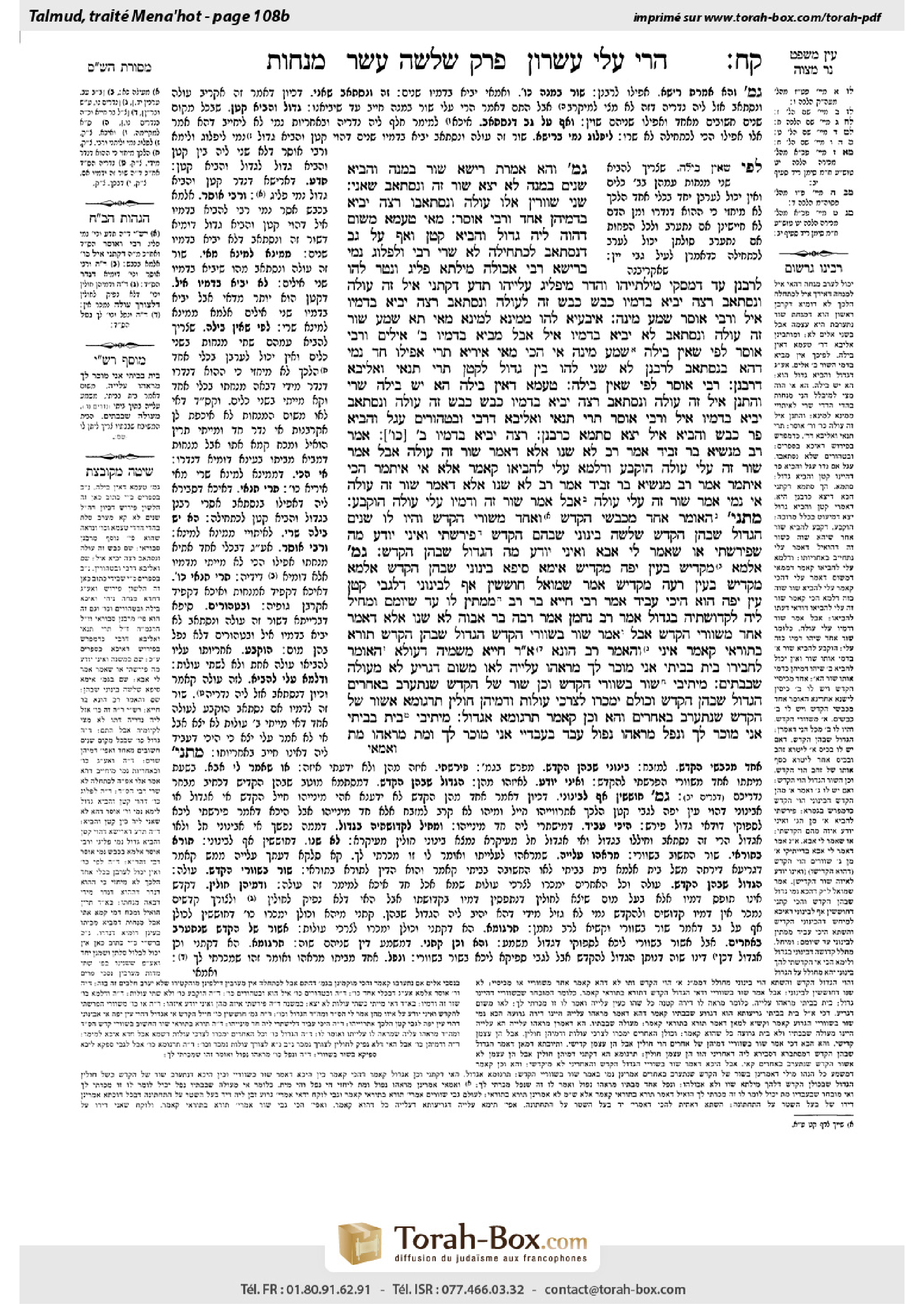
Menachot 108b: Talmud study for Daf Yomi
Daf Yomi is the daily study of one Talmud folio. Explore 37 tractates with scans, Hebrew text, Sefaria English and AI-generated French translations where annotated.
Passage selection and English or AI-generated French translation are available where the scan has annotations. Daf Study is independent of Torah-Box and Sefaria.
Browse Menachot · מנחות · All tractatesMenachot 108b text and translations
This page of Menachot includes the Aramaic text, an English translation and an AI-generated French translation, alongside the scan above.
מנחות ק״ח ב · Aramaic and Hebrew text
גְּמָ׳ וְהָא אָמְרַתְּ רֵישָׁא: ״שׁוֹר בְּמָנֶה״ וְהֵבִיא שְׁנַיִם בְּמָנֶה – לֹא יָצָא.
״שׁוֹר זֶה״ וְנִסְתָּאֵב שָׁאנֵי.
״שְׁנֵי שְׁוָורִין אֵלּוּ עוֹלָה״ וְנִסְתָּאֲבוּ, רָצָה יָבִיא בִּדְמֵיהֶן אֶחָד, וְרַבִּי אוֹסֵר. מַאי טַעְמָא?
מִשּׁוּם דְּהָוֵה לֵיהּ גָּדוֹל וְהֵבִיא קָטָן, וְאַף עַל גַּב דְּנִסְתָּאֵב, לְכִתְחִילָּה לָא שָׁרֵי רַבִּי.
וְלִפְלוֹג נָמֵי בְּרֵישָׁא?
רַבִּי אַכּוּלַּהּ מִילְּתָא פְּלִיג, וְנָטַר לְהוּ לְרַבָּנַן עַד דְּמַסְּקִי מִילְּתַיְיהוּ, וַהֲדַר מִיפְּלִיג עֲלַיְיהוּ.
תֵּדַע, דְּקָתָנֵי: ״אַיִל זֶה עוֹלָה״ וְנִסְתָּאֵב – רָצָה יָבִיא בְּדָמָיו כֶּבֶשׂ; ״כֶּבֶשׂ זֶה לְעוֹלָה״ וְנִסְתָּאֵב – רָצָה יָבִיא בְּדָמָיו אַיִל, וְרַבִּי אוֹסֵר. שְׁמַע מִינַּהּ.
אִיבַּעְיָא לְהוּ: מִמִּינָא לְמִינָא מַאי?
תָּא שְׁמַע: שׁוֹר זֶה עוֹלָה, וְנִסְתָּאֵב – לֹא יָבִיא בְּדָמָיו אַיִל, אֲבָל מֵבִיא בְּדָמָיו שְׁנֵי אֵילִים, וְרַבִּי אוֹסֵר, לְפִי שֶׁאֵין בִּילָּה. שְׁמַע מִינַּהּ.
אִי הָכִי, מַאי אִירְיָא תְּרֵי? אֲפִילּוּ חַד נָמֵי! דְּהָא בְּנִסְתָּאֵב, לְרַבָּנַן לָא שָׁנֵי לְהוּ בֵּין גָּדוֹל לְקָטָן!
תְּרֵי תַּנָּאֵי, וְאַלִּיבָּא דְּרַבָּנַן.
רַבִּי אוֹסֵר, לְפִי שֶׁאֵין בִּילָּה; טַעְמָא דְּאֵין בִּילָּה, הָא יֵשׁ בִּילָּה – שְׁרֵי.
וְהָתְנַן: ״אַיִל זֶה עוֹלָה״ וְנִסְתָּאֵב, רָצָה יָבִיא בְּדָמָיו כֶּבֶשׂ. ״כֶּבֶשׂ זֶה עוֹלָה״ וְנִסְתָּאֵב, יָבִיא בְּדָמָיו אַיִל, וְרַבִּי אוֹסֵר.
תְּרֵי תַנָּאֵי, וְאַלִּיבָּא דְּרַבִּי.
וּבִטְהוֹרִים, ״עֵגֶל״ וְהֵבִיא פַּר, ״כֶּבֶשׂ״ וְהֵבִיא אַיִל – יָצָא. סְתָמָא – כְּרַבָּנַן.
רָצָה יָבִיא בְּדָמָיו שְׁנַיִם [כּוּ׳]. אָמַר רַב מְנַשְּׁיָא בַּר זְבִיד אָמַר רַב: לֹא שָׁנוּ אֶלָּא דְּאָמַר ״שׁוֹר זֶה עוֹלָה״, אֲבָל אָמַר ״שׁוֹר זֶה עָלַי עוֹלָה״ – הוּקְבַּע.
וְדִלְמָא ״עָלַי לַהֲבִיאוֹ״ קָאָמַר?
אֶלָּא אִי אִיתְּמַר הָכִי אִיתְּמַר, אָמַר רַב מְנַשְּׁיָא בַּר זְבִיד אָמַר רַב: לֹא שָׁנוּ אֶלָּא דְּאָמַר ״שׁוֹר זֶה עוֹלָה״, אִי נָמֵי אָמַר ״שׁוֹר זֶה עָלַי עוֹלָה״, אֲבָל אָמַר ״שׁוֹר זֶה וְדָמָיו עָלַי עוֹלָה״ – הוּקְבַּע.
מַתְנִי׳ הָאוֹמֵר ״אֶחָד מִכְּבָשַׂי הֶקְדֵּשׁ״ וְ״אֶחָד מִשְּׁוָרַי הֶקְדֵּשׁ״, וְהָיוּ לוֹ שְׁנַיִם – הַגָּדוֹל שֶׁבָּהֶן הֶקְדֵּשׁ. שְׁלֹשָׁה – בֵּינוֹנִי שֶׁבָּהֶם הֶקְדֵּשׁ. ״פֵּירַשְׁתִּי, וְאֵינִי יוֹדֵעַ מַה שֶּׁפֵּירַשְׁתִּי״, אוֹ שֶׁ״אָמַר לִי אַבָּא, וְאֵינִי יוֹדֵעַ מַה״ – הַגָּדוֹל שֶׁבָּהֶן הֶקְדֵּשׁ.
גְּמָ׳ אַלְמָא מַקְדִּישׁ – בְּעַיִן יָפָה מַקְדִּישׁ, אֵימָא סֵיפָא: בֵּינוֹנִי שֶׁבָּהֶן הֶקְדֵּשׁ, אַלְמָא מַקְדִּישׁ – בְּעַיִן רָעָה מַקְדִּישׁ!
אָמַר שְׁמוּאֵל: חוֹשְׁשִׁין אַף לְבֵינוֹנִי, דִּלְגַבֵּי קָטָן – עַיִן יָפָה הוּא.
הֵיכִי עָבֵיד? אָמַר רַבִּי חִיָּיא בַּר רַב: מַמְתִּין לוֹ עַד שֶׁיּוּמַם, וּמַחֵיל לֵיהּ לִקְדוּשְּׁתֵיהּ בַּגָּדוֹל.
אָמַר רַב נַחְמָן, אָמַר רַבָּה בַּר אֲבוּהּ: לֹא שָׁנוּ אֶלָּא דְּאָמַר ״אֶחָד מִשְּׁוָורַי הֶקְדֵּשׁ״, אֲבָל אָמַר ״שׁוֹר בִּשְׁוָורַי הֶקְדֵּשׁ״ – הַגָּדוֹל שֶׁבָּהֶן הֶקְדֵּשׁ, ״תּוֹרָא בְּתוֹרַאי״ קָאָמַר.
אִינִי? וְהָאָמַר רַב הוּנָא, אָמַר רַבִּי חִיָּיא מִשְּׁמֵיהּ דְּעוּלָּא: הָאוֹמֵר לַחֲבֵירוֹ ״בַּיִת בְּבָתַּי אֲנִי מוֹכֵר לָךְ״ – מַרְאֵהוּ עֲלִיָּיה, לָאו מִשּׁוּם דִּגְרִיעַ? לָא, מְעוּלֶּה שֶׁבַּבָּתִּים.
מֵיתִיבִי: ״שׁוֹר בִּשְׁוָורַי הֶקְדֵּשׁ״, וְכֵן שׁוֹר שֶׁל הֶקְדֵּשׁ שֶׁנִּתְעָרֵב בַּאֲחֵרִים – הַגָּדוֹל שֶׁבָּהֶן הֶקְדֵּשׁ, וְכוּלָּם יִמָּכְרוּ לְצׇרְכֵי עוֹלוֹת, וּדְמֵיהֶן חוּלִּין.
תַּרְגּוּמָא: אַשּׁוֹר שֶׁל הֶקְדֵּשׁ שֶׁנִּתְעָרֵב בַּאֲחֵרִים. וְהָא ״וְכֵן״ קָאָמַר? תַּרְגְּומַאּ: אַגָּדוֹל.
מֵיתִיבִי: ״בַּיִת בְּבָיתַּי אֲנִי מוֹכֵר לָךְ״, וְנָפַל – מַרְאֵהוּ נָפוּל, ״עֶבֶד בַּעֲבָדַיי אֲנִי מוֹכֵר לָךְ״, וָמֵת – מַרְאֵהוּ מֵת.
Menachot 108b · English translation
GEMARA: The mishna teaches that if one vows to bring a certain bull as a burnt offering and it became blemished, he may bring two bulls with its redemption money. The Gemara asks: But didn’t you say in the first clause, i.e., in the previous mishna (107b), that if one said: It is incumbent upon me to bring a bull with the value of one hundred dinars as a burnt offering or peace offering, and he brought two bulls with a combined value of one hundred dinars, he has not fulfilled his obligation? If so, why does the mishna here teach that one may bring two bulls with the redemption money of one bull?
The Gemara answers that these two cases are not comparable. The previous mishna was referring to a case where one vowed to bring a bull worth one hundred dinars, without referring to a specific bull. Therefore, he is obligated to fulfill the specific conditions of his vow. By contrast, this mishna is referring to a case where one said: This bull is hereby a burnt offering, and therefore, if the bull becomes blemished and disqualified as an offering the halakha is different. Since he was only ever obligated to sacrifice this bull, and is no longer able to sacrifice it, he is no longer obligated by his vow, and may bring any number of offerings with its value.
The mishna teaches that if one says: These two bulls are hereby a burnt offering, and they became blemished, if he wishes he may bring with the money of their redemption one bull. And Rabbi Yehuda HaNasi deems this prohibited, and holds that he must bring two bulls. The Gemara asks: What is the reason that Rabbi Yehuda HaNasi deems it prohibited to bring only one bull?
The Gemara answers: Because it is similar to a case where one vowed to bring a large bull and he brought a small bull, in which case he has not fulfilled his vow. Similarly, in this case, he vowed to bring two bulls and brought only one. And although he is not actually obligated to bring two bulls, as the bulls that he consecrated became blemished and he needs only to bring an offering with their redemption money, nevertheless Rabbi Yehuda HaNasi does not permit bringing two bulls instead of one ab initio.
The Gemara asks: But if so, let Rabbi Yehuda HaNasi disagree in the first clause of the mishna as well, which states that if one consecrated a specific bull as a burnt offering and it subsequently became blemished, he may purchase two bulls with its redemption money. There, too, Rabbi Yehuda HaNasi should prohibit bringing two bulls ab initio, as it is similar to a case where one vowed to bring a small bull and brought a large one, in which case Rabbi Yehuda HaNasi also holds that he has not fulfilled his obligation.
The Gemara answers: Rabbi Yehuda HaNasi disagrees with this entire matter, both in the first and latter clauses of the mishna; but he waited until the Rabbis had completed their statement, and then disagreed with them with regard to both cases.
Know that Rabbi Yehuda HaNasi disagrees with the statement of the Rabbis in the first clause of the mishna as well, as the mishna teaches that if one said: This ram is hereby a burnt offering, and it became blemished, if he wishes he may bring a lamb with its redemption money. In a case where one said: This lamb is hereby a burnt offering, and it became blemished, if he wishes he may bring a ram with its redemption money. And Rabbi Yehuda HaNasi deems it prohibited for one to bring one type of animal with the redemption money of another type of animal, even if he wishes to bring a ram with the redemption money of a lamb. Evidently, Rabbi Yehuda HaNasi disagrees with the Rabbis even in a case where one consecrated a small animal and wishes to bring a large animal with its redemption money. Conclude from it that he also disagrees in a case where one vowed to bring a certain animal which subsequently became blemished; the person may not bring two animals with the redemption money.
§ A dilemma was raised before the Sages: According to the Rabbis, what is the halakha with regard to one who wishes to use the redemption money from an animal of one species which became blemished to purchase a different species of animal? For example, if one vowed to bring a bull which subsequently became blemished, may he bring rams with its value instead?
The Gemara suggests: Come and hear a resolution from that which is taught in a baraita: If one said: This bull is hereby a burnt offering, and it became blemished, he may not bring a ram with its redemption money, as a ram is not worth as much as a bull. But he may bring two rams with its redemption money, if together they are equal in value to the bull. And Rabbi Yehuda HaNasi deems this prohibited, the reason being that one must bring two meal offerings to accompany his two rams. These meal offerings must be brought in two vessels, because there is no mixing permitted. Accordingly, bringing two offerings runs counter to the person’s vow, which involved bringing only one meal offering. Conclude from this baraita that according to the Rabbis it is permitted to use the redemption money from one species of animal to purchase a different species.
The Gemara asks: If so, if the Rabbis deem it permitted to bring a different species of animal, why does the baraita specifically state that one may bring two rams in place of a bull? The same halakha would apply even for one ram, as although one ram is smaller than one bull, in a case where the animal became blemished, according to the Rabbis, there is no difference whether one brings a large animal or a small animal. If one vowed to bring a ram he may bring a lamb instead, so why not a ram in place of a bull?
The Gemara answers: There are two tanna’im, and they disagree with regard to the opinion of the Rabbis. The tanna of the mishna holds that the Rabbis deem it permitted to bring a small animal in place of a large animal that became blemished. The tanna of the baraita holds that the Rabbis do not deem it permitted to bring a small animal in place of a large animal.
The baraita states: Rabbi Yehuda HaNasi deems it prohibited to bring two rams with the redemption money of a bull, because there is no mixing. The Gemara infers: The reason that he deems it prohibited is because there is no mixing. But had there been mixing, then according to Rabbi Yehuda HaNasi it would be permitted.
The Gemara asks: But didn’t we learn in the mishna that if one said: This ram is hereby a burnt offering, and it became blemished, if he wishes he may bring a lamb with its redemption money. If one said: This lamb is hereby a burnt offering, and it became blemished, he may bring a ram with its redemption money. And Rabbi Yehuda HaNasi deems it prohibited for one to bring one type of animal with the redemption money of another type of animal. Evidently, Rabbi Yehuda HaNasi prohibits any kind of divergence from the animal that was consecrated, regardless of whether mixing is permitted.
The Gemara answers: There are two tanna’im, and they disagree with regard to the opinion of Rabbi Yehuda HaNasi. The tanna of the baraita holds that Rabbi Yehuda deems it prohibited to switch to a different type of animal only if it affects the accompanying meal offering, whereas the tanna of the mishna holds that Rabbi Yehuda HaNasi deems any kind of change prohibited.
The Gemara cites the latter clause of the baraita: All of the cases in the mishna and baraita are referring to a case where the animal became blemished; and with regard to pure animals, i.e., those that are not blemished, if one vowed to bring a calf and brought a bull instead, or he vowed to bring a lamb and brought a ram instead, he has fulfilled his obligation. The Gemara explains that the unattributed last clause of the baraita is in accordance with the opinion of the Rabbis. Rabbi Yehuda HaNasi would disagree in this case as well.
§ The mishna teaches that if one vows to bring a certain bull as a burnt offering, and it became blemished, if he wishes, he may bring two bulls with its redemption money. Rabbi Menashya bar Zevid says that Rav says: The Sages taught this halakha only in a case where one said: This bull is hereby a burnt offering. But if he said: This bull is incumbent upon me to bring as a burnt offering, his responsibility for it in a case where it became blemished is fixed, and he must bring one bull with its redemption money, not two.
The Gemara challenges Rav’s opinion: But perhaps when he said: This bull is incumbent upon me, he meant: It is incumbent upon me to bring it as an offering, but he did not intend to accept responsibility in case it becomes blemished.
Rather, if it was stated that there is a case where one is responsible if the animal becomes blemished, it was stated as follows: Rabbi Menashya bar Zevid says that Rav says: The Sages taught this halakha only in a case where one said: This bull is hereby a burnt offering, or he said: This bull is incumbent upon me to bring as a burnt offering. But if he said: This bull and its value are incumbent upon me to bring as a burnt offering, his responsibility for it in a case where it becomes blemished is fixed, and he must bring one bull with its redemption money, and not two.
MISHNA: With regard to one who says: One of my lambs is consecrated, or: One of my bulls is consecrated, and he has two lambs or bulls, the larger of them is consecrated. If he has three lambs or bulls, the middle-sized animal among them is consecrated. If one says: I specified the lamb or bull that is to be consecrated but I do not know what animal I specified in my vow, or he says that: My father said to me before his death that he consecrated one of the lambs or the bulls, but I do not know what animal he consecrated, the largest of them is consecrated.
GEMARA: The first clause of the mishna teaches that if one says: One of my lambs is consecrated, and he has two lambs, the larger one is consecrated. The Gemara infers: Apparently, one who consecrates, consecrates generously. But say the latter clause of the mishna: If he has three lambs, the middle-sized animal among them is consecrated. Apparently, one who consecrates, consecrates sparingly. How can this contradiction be resolved?
Shmuel said: The presumption is that one who consecrates, consecrates generously. When the latter clause of the mishna states that the middle-sized animal is consecrated, it does not mean that only the middle-sized animal is consecrated. Rather, the larger animal is consecrated, and additionally we are concerned, i.e., we must take in consideration the possibility, that the middle-sized animal is consecrated, as compared to consecrating the small animal, consecrating the middle-sized animal is generous. Therefore, the vow could have been referring to either the large animal or the middle-sized animal.
The Gemara asks: How should he act? He consecrated only one of them, and it is uncertain which animal should be sacrificed. Rabbi Ḥiyya bar Rav said: He should wait until the middle-sized animal becomes blemished and then desacralize it by transferring its sanctity onto the large animal, which is then sacrificed on the altar.
§ The mishna teaches that if one had three lambs or bulls, the middle-sized animal is consecrated. Rav Naḥman said that Rabba bar Avuh said: The Sages taught that the middle-sized animal is consecrated only when he said: One of my bulls is hereby consecrated. But if he said: A bull from among my bulls is hereby consecrated, only the largest of them is consecrated. It is as if he said: The most valuable bull from among my bulls [tora betorai] is consecrated.
The Gemara asks: Is that so? But didn’t Rav Huna say that Rabbi Ḥiyya said in the name of Ulla: One who says to another: I am selling you a house from among my houses, can show him a loft [aliyya], since he did not specify which house he is selling? Is this not because the loft is the worst of his houses? If so, when one says: A bull from among my bulls is hereby consecrated, he is presumably referring to the least valuable of his bulls. The Gemara answers: No, Ulla did not say that the seller gives the purchaser a loft, but rather the best [me’ula] of his houses.
The Gemara raises an objection to the statement of Rabba bar Avuh from a baraita: If one said: A bull from among my bulls is consecrated, or similarly if a consecrated bull became mixed with other non-consecrated bulls, the largest of them is consecrated, and all of the other bulls must be sold to people who vowed to bring burnt offerings, for the purpose of bringing them as burnt offerings, since it is uncertain which one of them was consecrated, and the payment for them is non-sacred. Evidently, if one says: I hereby consecrate a bull from among my bulls, all of his bulls have uncertain consecrated status.
The Gemara answers: Interpret this as referring only to a consecrated bull that became mixed with others. The Gemara challenges: But doesn’t the baraita say: And similarly, indicating that this halakha applies to both cases? The Gemara answers: Interpret it as referring to the halakha that the largest of the bulls is consecrated. That halakha does apply to both cases, but the halakha that the rest of the bulls have uncertain consecrated status applies only to the latter case.
The Gemara raises an objection to the statement of Rabba bar Avuh from a baraita: If one says to another: I am selling you a house from among my houses, and one of the houses subsequently fell, he can show him the fallen house, and say to him: This is the one I sold you. Similarly, if one says to another: I sell you a slave from among my slaves, and one of the slaves dies, he can show him the dead slave and say: This is the slave I sold you.
Menachot 108b · Traduction française (IA)
GUEMARA : La Michna enseigne que si quelqu’un s’engage à apporter un taureau déterminé en holocauste et que celui-ci est atteint d’un défaut, il peut apporter deux taureaux avec l’argent de son rachat. La Guemara demande : Mais n’as-tu pas dit dans la première partie, c’est-à-dire dans la Michna précédente (107b), que si quelqu’un dit : « Je suis tenu d’apporter un taureau d’une valeur de cent dinars en holocauste ou en sacrifice de paix », et qu’il apporte deux taureaux dont la valeur totale est de cent dinars, il ne s’est pas acquitté de son obligation ? Si tel est le cas, pourquoi la Michna enseigne-t-elle ici qu’on peut apporter deux taureaux avec l’argent du rachat d’un seul taureau ?
La Guemara répond que ces deux cas ne sont pas comparables. La Michna précédente traite d’un cas où quelqu’un s’est engagé à apporter un taureau d’une valeur de cent dinars, sans désigner de taureau précis. Il est donc tenu de respecter les conditions précises de son vœu. En revanche, la présente Michna traite d’un cas où quelqu’un a dit : « Ce taureau est désormais un holocauste. » Par conséquent, si le taureau est atteint d’un défaut et disqualifié comme sacrifice, la halakha est différente. Puisqu’il n’a jamais été tenu que d’offrir ce taureau, et qu’il ne peut désormais plus l’offrir, il n’est plus lié par son vœu et peut apporter autant de sacrifices qu’il le souhaite avec sa valeur.
La Michna enseigne que si quelqu’un dit : « Ces deux taureaux sont désormais des holocaustes », et qu’ils sont atteints d’un défaut, il peut, s’il le souhaite, apporter un taureau avec l’argent de leur rachat. Rabbi Yehouda HaNassi juge cela interdit et estime qu’il doit apporter deux taureaux. La Guemara demande : Pourquoi Rabbi Yehouda HaNassi juge-t-il interdit de n’apporter qu’un seul taureau ?
La Guemara répond : Parce que cela ressemble au cas où quelqu’un s’est engagé à apporter un grand taureau et en apporte un petit, auquel cas il ne s’est pas acquitté de son vœu. De même ici, il s’est engagé à apporter deux taureaux et n’en apporte qu’un seul. Bien qu’il ne soit pas réellement tenu d’apporter deux taureaux, puisque ceux qu’il avait consacrés sont atteints d’un défaut et qu’il ne doit apporter qu’un sacrifice avec l’argent de leur rachat, Rabbi Yehouda HaNassi n’autorise néanmoins pas à apporter deux taureaux au lieu d’un, a priori.
La Guemara demande : Mais alors, que Rabbi Yehouda HaNassi s’oppose aussi à la première partie de la Michna, qui affirme que si quelqu’un a consacré un taureau précis en holocauste et que celui-ci est ensuite atteint d’un défaut, il peut acheter deux taureaux avec l’argent de son rachat. Là aussi, Rabbi Yehouda HaNassi devrait interdire d’apporter deux taureaux, a priori, puisque cela ressemble au cas où quelqu’un s’est engagé à apporter un petit taureau et en apporte un grand, auquel cas Rabbi Yehouda HaNassi estime également qu’il ne s’est pas acquitté de son obligation.
La Guemara répond : Rabbi Yehouda HaNassi s’oppose à toute cette règle, aussi bien dans la première que dans la dernière partie de la Michna ; mais il a attendu que les Rabbins aient terminé leur déclaration, puis s’est opposé à eux dans les deux cas.
Sache que Rabbi Yehouda HaNassi s’oppose également à la déclaration des Rabbins dans la première partie de la Michna, car celle-ci enseigne que si quelqu’un dit : « Ce bélier est désormais un holocauste », et qu’il est atteint d’un défaut, il peut, s’il le souhaite, apporter un agneau avec l’argent de son rachat. Si quelqu’un dit : « Cet agneau est désormais un holocauste », et qu’il est atteint d’un défaut, il peut, s’il le souhaite, apporter un bélier avec l’argent de son rachat. Or Rabbi Yehouda HaNassi juge interdit d’apporter un animal d’une espèce avec l’argent du rachat d’un animal d’une autre espèce, même s’il s’agit d’apporter un bélier avec l’argent du rachat d’un agneau. Il est donc manifeste que Rabbi Yehouda HaNassi s’oppose aux Rabbins même dans le cas où quelqu’un a consacré un petit animal et souhaite apporter un grand animal avec l’argent de son rachat. Conclus-en qu’il s’oppose également au cas où quelqu’un s’est engagé à apporter un animal déterminé, qui est ensuite atteint d’un défaut : la personne ne peut pas apporter deux animaux avec l’argent de son rachat.
§ Les Sages ont soulevé un dilemme : Selon les Rabbins, quelle est la halakha concernant quelqu’un qui souhaite utiliser l’argent du rachat d’un animal d’une espèce donnée, atteint d’un défaut, pour acheter un animal d’une autre espèce ? Par exemple, si quelqu’un s’est engagé à apporter un taureau qui est ensuite atteint d’un défaut, peut-il apporter des béliers à la place, avec sa valeur ?
La Guemara propose : Viens et écoute une réponse tirée de ce qui est enseigné dans une baraïta : Si quelqu’un dit : « Ce taureau est désormais un holocauste », et qu’il est atteint d’un défaut, il ne peut pas apporter un bélier avec l’argent de son rachat, car un bélier ne vaut pas autant qu’un taureau. Mais il peut apporter deux béliers avec l’argent de son rachat, si leur valeur totale équivaut à celle du taureau. Rabbi Yehouda HaNassi juge cela interdit, au motif qu’il faut apporter deux offrandes de farine pour accompagner ses deux béliers. Ces offrandes de farine doivent être présentées dans deux récipients, car aucun mélange n’est permis. Ainsi, apporter deux sacrifices va à l’encontre du vœu de la personne, qui consistait à n’apporter qu’une seule offrande de farine. Conclus de cette baraïta que, selon les Rabbins, il est permis d’utiliser l’argent du rachat d’un animal d’une espèce pour acheter un animal d’une autre espèce.
La Guemara demande : Si tel est le cas, et que les Rabbins estiment qu’il est permis d’apporter un animal d’une autre espèce, pourquoi la baraïta précise-t-elle qu’on peut apporter deux béliers à la place d’un taureau ? La même halakha devrait s’appliquer même à un seul bélier : bien qu’un bélier soit plus petit qu’un taureau, lorsque l’animal est atteint d’un défaut, selon les Rabbins, il n’y a pas de différence entre apporter un grand animal ou un petit animal. Si quelqu’un s’est engagé à apporter un bélier, il peut apporter un agneau à la place ; pourquoi ne pourrait-il donc pas apporter un bélier à la place d’un taureau ?
La Guemara répond : Il y a deux tannaïm, qui sont en désaccord sur l’opinion des Rabbins. Le tanna de la Michna estime que les Rabbins autorisent à apporter un petit animal à la place d’un grand animal atteint d’un défaut. Le tanna de la baraïta estime que les Rabbins n’autorisent pas à apporter un petit animal à la place d’un grand animal.
La baraïta affirme que Rabbi Yehouda HaNassi juge interdit d’apporter deux béliers avec l’argent du rachat d’un taureau, car aucun mélange n’est permis. La Guemara en déduit que la raison pour laquelle il juge cela interdit est l’absence de mélange. Mais s’il y avait eu mélange, cela aurait donc été permis selon Rabbi Yehouda HaNassi.
La Guemara demande : Mais n’avons-nous pas appris dans la Michna que si quelqu’un dit : « Ce bélier est désormais un holocauste », et qu’il est atteint d’un défaut, il peut, s’il le souhaite, apporter un agneau avec l’argent de son rachat ; et que si quelqu’un dit : « Cet agneau est désormais un holocauste », et qu’il est atteint d’un défaut, il peut apporter un bélier avec l’argent de son rachat ? Or Rabbi Yehouda HaNassi juge interdit d’apporter un animal d’une espèce avec l’argent du rachat d’un animal d’une autre espèce. Il est donc manifeste que Rabbi Yehouda HaNassi interdit tout écart par rapport à l’animal consacré, que le mélange soit permis ou non.
La Guemara répond : Il y a deux tannaïm, qui sont en désaccord sur l’opinion de Rabbi Yehouda HaNassi. Le tanna de la baraïta estime que Rabbi Yehouda interdit de passer à une autre espèce d’animal uniquement si cela modifie l’offrande de farine qui l’accompagne, tandis que le tanna de la Michna estime que Rabbi Yehouda HaNassi interdit tout changement.
La Guemara cite la dernière partie de la baraïta : Tous les cas de la Michna et de la baraïta concernent un animal atteint d’un défaut ; mais, s’agissant d’animaux sans défaut, si quelqu’un s’est engagé à apporter un veau et apporte un taureau à la place, ou s’il s’est engagé à apporter un agneau et apporte un bélier à la place, il s’est acquitté de son obligation. La Guemara explique que la dernière partie anonyme de la baraïta est conforme à l’opinion des Rabbins. Rabbi Yehouda HaNassi serait également en désaccord dans ce cas.
§ La Michna enseigne que si quelqu’un s’engage à apporter un taureau déterminé en holocauste et que celui-ci est atteint d’un défaut, il peut, s’il le souhaite, apporter deux taureaux avec l’argent de son rachat. Rabbi Menachya bar Zevid dit au nom de Rav : Les Sages n’ont enseigné cette halakha que dans le cas où quelqu’un a dit : « Ce taureau est désormais un holocauste. » Mais s’il a dit : « Je suis tenu d’apporter ce taureau en holocauste », sa responsabilité à son égard, s’il est atteint d’un défaut, est fixée : il doit apporter un taureau avec l’argent de son rachat, et non deux.
La Guemara conteste l’opinion de Rav : Mais peut-être voulait-il dire, en disant : « Je suis tenu pour ce taureau » : « Je suis tenu de l’apporter comme sacrifice », sans pour autant avoir l’intention d’assumer la responsabilité s’il est atteint d’un défaut.
En revanche, si l’on a enseigné qu’il existe un cas où l’on est responsable si l’animal est atteint d’un défaut, l’enseignement était le suivant : Rabbi Menachya bar Zevid dit au nom de Rav : Les Sages n’ont enseigné cette halakha que dans le cas où quelqu’un a dit : « Ce taureau est désormais un holocauste », ou : « Je suis tenu d’apporter ce taureau en holocauste. » Mais s’il a dit : « Je suis tenu d’apporter ce taureau et sa valeur en holocauste », sa responsabilité à son égard, s’il est atteint d’un défaut, est fixée : il doit apporter un taureau avec l’argent de son rachat, et non deux.
MICHNA : Concernant quelqu’un qui dit : « L’un de mes agneaux est consacré », ou : « L’un de mes taureaux est consacré », et qui possède deux agneaux ou deux taureaux, le plus grand des deux est consacré. S’il en possède trois, c’est l’animal de taille moyenne qui est consacré. Si quelqu’un dit : « J’ai désigné l’agneau ou le taureau à consacrer, mais je ne sais pas quel animal j’ai désigné dans mon vœu », ou : « Mon père m’a dit avant sa mort qu’il avait consacré l’un des agneaux ou des taureaux, mais je ne sais pas quel animal il a consacré », c’est le plus grand d’entre eux qui est consacré.
GUEMARA : La première partie de la Michna enseigne que si quelqu’un dit : « L’un de mes agneaux est consacré », et qu’il possède deux agneaux, le plus grand est consacré. La Guemara en déduit qu’apparemment, celui qui consacre le fait généreusement. Mais considère la dernière partie de la Michna : s’il possède trois agneaux, c’est l’animal de taille moyenne qui est consacré. Apparemment, celui qui consacre le fait avec parcimonie. Comment résoudre cette contradiction ?
Chmouel a dit : On présume que celui qui consacre le fait généreusement. Lorsque la dernière partie de la Michna déclare que l’animal de taille moyenne est consacré, cela ne signifie pas que seul l’animal de taille moyenne est consacré. C’est plutôt le plus grand animal qui est consacré, et, en outre, il faut tenir compte de la possibilité que ce soit l’animal de taille moyenne qui soit consacré : comparé à la consécration du petit animal, consacrer l’animal de taille moyenne est généreux. Le vœu pourrait donc avoir désigné aussi bien le grand animal que celui de taille moyenne.
La Guemara demande : Que doit-il faire ? Il n’en a consacré qu’un seul, et l’on ne sait pas quel animal doit être sacrifié. Rabbi Ḥiyya bar Rav a dit : Il doit attendre que l’animal de taille moyenne soit atteint d’un défaut, puis le désacraliser en transférant sa sainteté au grand animal, qui sera alors sacrifié sur l’autel.
§ La Michna enseigne que si quelqu’un possède trois agneaux ou trois taureaux, c’est l’animal de taille moyenne qui est consacré. Rav Naḥman a dit au nom de Rabba bar Avuh : Les Sages n’ont enseigné que l’animal de taille moyenne est consacré que dans le cas où quelqu’un a dit : « L’un de mes taureaux est désormais consacré. » Mais s’il a dit : « Un taureau parmi mes taureaux est désormais consacré », seul le plus grand est consacré. C’est comme s’il avait dit : « Le taureau le plus précieux parmi mes taureaux [tora betorai] est consacré. »
La Guemara demande : Est-ce vraiment le cas ? Rav Houna n’a-t-il pas dit que Rabbi Ḥiyya a dit au nom d’Oulla : Celui qui dit à un autre : « Je te vends une maison parmi mes maisons », peut lui désigner un grenier [aliyya], puisqu’il n’a pas précisé quelle maison il vend ? N’est-ce pas parce que le grenier est la moins bonne de ses maisons ? Si tel est le cas, lorsque quelqu’un dit : « Un taureau parmi mes taureaux est désormais consacré », il se réfère vraisemblablement au moins précieux de ses taureaux. La Guemara répond : Non, Oulla n’a pas dit que le vendeur donne à l’acheteur un grenier, mais plutôt la meilleure [me’ula] de ses maisons.
La Guemara soulève une objection à l’enseignement de Rabba bar Avuh à partir d’une baraïta : Si quelqu’un dit : « Un taureau parmi mes taureaux est consacré », ou, de même, si un taureau consacré se mêle à d’autres taureaux non consacrés, le plus grand d’entre eux est consacré, et tous les autres taureaux doivent être vendus à des personnes qui se sont engagées à apporter des holocaustes, afin qu’elles les offrent en holocaustes, puisqu’on ne sait pas lequel d’entre eux a été consacré et que leur paiement est profane. Il est donc manifeste que si quelqu’un dit : « Je consacre un taureau parmi mes taureaux », tous ses taureaux ont un statut incertain de consécration.
La Guemara répond : Interprète cela comme se rapportant uniquement au cas d’un taureau consacré qui s’est mêlé à d’autres. La Guemara objecte : Mais la baraïta ne dit-elle pas : « et de même », indiquant que cette halakha s’applique aux deux cas ? La Guemara répond : Interprète ces mots comme se rapportant à la halakha selon laquelle le plus grand des taureaux est consacré. Cette halakha s’applique effectivement aux deux cas, mais celle selon laquelle les autres taureaux ont un statut incertain de consécration ne s’applique qu’au dernier cas.
La Guemara soulève une objection à l’enseignement de Rabba bar Avuh à partir d’une baraïta : Si quelqu’un dit à un autre : « Je te vends une maison parmi mes maisons », et que l’une des maisons s’effondre ensuite, il peut lui désigner la maison effondrée et lui dire : « C’est celle que je t’ai vendue. » De même, si quelqu’un dit à un autre : « Je te vends un esclave parmi mes esclaves », et que l’un des esclaves meurt, il peut lui désigner l’esclave mort et lui dire : « C’est cet esclave que je t’ai vendu. »
Traduction française générée par IA à partir de l’édition anglaise de Sefaria. Vérifie toujours un passage avec le texte source.
Text from Sefaria: William Davidson Edition - Vocalized Aramaic (unknown); William Davidson Edition - English (CC BY NC).