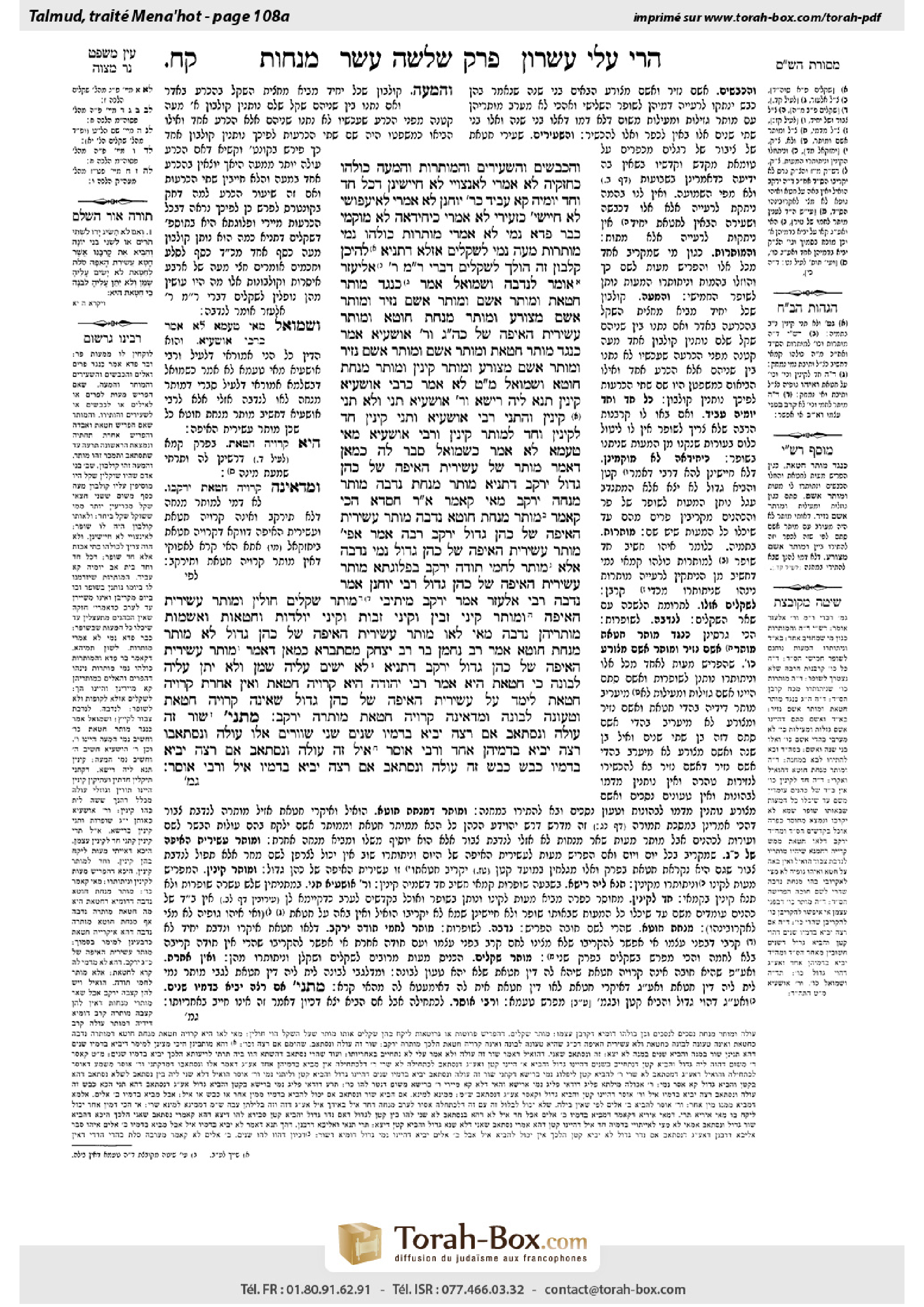
Menachot 108a: Talmud study for Daf Yomi
Daf Yomi is the daily study of one Talmud folio. Explore 37 tractates with scans, Hebrew text, Sefaria English and AI-generated French translations where annotated.
Passage selection and English or AI-generated French translation are available where the scan has annotations. Daf Study is independent of Torah-Box and Sefaria.
Browse Menachot · מנחות · All tractatesMenachot 108a text and translations
This page of Menachot includes the Aramaic text, an English translation and an AI-generated French translation, alongside the scan above.
מנחות ק״ח א · Aramaic and Hebrew text
וְהַכְּבָשִׂים, וְהַשְּׂעִירִים, וְהַמּוֹתָרוֹת, וְהַמָּעָה.
כּוּלְּהוּ כְּחִזְקִיָּה לָא אָמְרִי, לְאִנְּצוֹיֵי לָא חָיְישִׁינַן, דְּכֹל חַד וְחַד יוֹמֵיהּ קָא עָבֵיד.
כְּרַבִּי יוֹחָנָן לָא אָמְרִי, לְאִיעַפּוֹשֵׁי לָא חָיְישִׁינַן.
כִּזְעֵירִי לָא אָמְרִי, כִּיחִידָאָה לָא מוֹקְמִי.
כְּבָר פְּדָא נָמֵי לָא אָמְרִי. מוֹתָרוֹת – כּוּלְּהוּ נָמֵי מוֹתָרוֹת.
מָעָה נָמֵי לִשְׁקָלִים אָזְלָא, דְּתַנְיָא: לְהֵיכָן קָלְבּוֹן זֶה הוֹלֵךְ? לִשְׁקָלִים, דִּבְרֵי רַבִּי מֵאִיר. רַבִּי אֱלִיעֶזֶר אוֹמֵר: לִנְדָבָה.
וּשְׁמוּאֵל אָמַר: כְּנֶגֶד מוֹתַר חַטָּאת, וּמוֹתַר אָשָׁם, וּמוֹתַר אֲשַׁם נָזִיר, וּמוֹתַר אֲשַׁם מְצוֹרָע, וּמוֹתַר מִנְחַת חוֹטֵא, וּמוֹתַר עֲשִׂירִית הָאֵיפָה שֶׁל כֹּהֵן גָּדוֹל.
וְרַבִּי אוֹשַׁעְיָא אָמַר: כְּנֶגֶד מוֹתַר חַטָּאת, וּמוֹתַר אָשָׁם, וּמוֹתַר אֲשַׁם נָזִיר, וּמוֹתַר אֲשַׁם מְצוֹרָע, וּמוֹתַר קִינִּין, וּמוֹתַר מִנְחַת חוֹטֵא.
וּשְׁמוּאֵל מַאי טַעְמָא לָא אָמַר כְּרַבִּי אוֹשַׁעְיָא? קִינִּין תְּנָא לֵיהּ רֵישָׁא.
וְרַבִּי אוֹשַׁעְיָא תָּנֵי, וְלָא תָּנֵי קִינִּין? וְהָתָנֵי רַבִּי אוֹשַׁעְיָא וְתָנֵי קִינִּין! חַד לְקִינִּין, וְחַד לְמוֹתַר קִינִּין.
וְרַבִּי אוֹשַׁעְיָא מַאי טַעְמָא לָא אָמַר כִּשְׁמוּאֵל? סָבַר לַהּ כְּמַאן דְּאָמַר: מוֹתָר שֶׁל עֲשִׂירִית הָאֵיפָה שֶׁל כֹּהֵן גָּדוֹל יִרְקַב, דְּתַנְיָא: מוֹתַר מִנְחַת – נְדָבָה, מוֹתַר מִנְחָה – יִרְקַב.
מַאי קָאָמַר? אָמַר רַב חִסְדָּא: הָכִי קָאָמַר – מוֹתַר מִנְחַת חוֹטֵא נְדָבָה, מוֹתַר עֲשִׂירִית הָאֵיפָה שֶׁל כֹּהֵן גָּדוֹל – יִרְקַב.
רַבָּה אָמַר: אֲפִילּוּ מוֹתַר עֲשִׂירִית הָאֵיפָה שֶׁל כֹּהֵן גָּדוֹל – נָמֵי נְדָבָה, אֶלָּא מוֹתַר לַחְמֵי תוֹדָה – יִרְקַב.
בִּפְלוּגְתָּא: מוֹתַר עֲשִׂירִית הָאֵיפָה שֶׁל כֹּהֵן גָּדוֹל, רַבִּי יוֹחָנָן אָמַר: נְדָבָה, רַבִּי אֶלְעָזָר אָמַר: יִרְקַב.
מֵיתִיבִי: מוֹתַר שְׁקָלִים – חוּלִּין, וּמוֹתַר עֲשִׂירִית הָאֵיפָה, וּמוֹתַר קִינֵּי זָבִין וְקִינֵּי זָבוֹת וְקִינֵּי יוֹלְדוֹת וְחַטָּאוֹת וַאֲשָׁמוֹת – מוֹתְרֵיהֶן נְדָבָה.
מַאי לָאו: מוֹתַר עֲשִׂירִית הָאֵיפָה – שֶׁל כֹּהֵן גָּדוֹל?
לֹא, מוֹתַר מִנְחַת חוֹטֵא.
אָמַר רַב נַחְמָן בַּר רַב יִצְחָק: מִסְתַּבְּרָא כְּמַאן דְּאָמַר מוֹתַר עֲשִׂירִית הָאֵיפָה שֶׁל כֹּהֵן גָּדוֹל יִרְקַב.
דְּתַנְיָא: ״לֹא יָשִׂים עָלֶיהָ שֶׁמֶן וְלֹא יִתֵּן עָלֶיהָ לְבֹנָה כִּי חַטָּאת הִיא״, אָמַר רַבִּי יְהוּדָה: הִיא קְרוּיָה ״חַטָּאת״, וְאֵין אַחֶרֶת קְרוּיָה ״חַטָּאת״. לִימֵּד עַל עֲשִׂירִית הָאֵיפָה שֶׁל כֹּהֵן גָּדוֹל שֶׁאֵינָהּ קְרוּיָה ״חַטָּאת״, וּטְעוּנָה לְבוֹנָה.
וּמִדְּאֵינָהּ קְרוּיָה ״חַטָּאת״, מוֹתָרָהּ יִרְקַב.
מַתְנִי׳ ״שׁוֹר זֶה עוֹלָה״, וְנִסְתָּאֵב – אִם רָצָה יָבִיא בְּדָמָיו שְׁנַיִם. ״שְׁנֵי שְׁוָורִים אֵלּוּ עוֹלָה״, וְנִסְתָּאֲבוּ – רָצָה יָבִיא בִּדְמֵיהֶן אֶחָד, וְרַבִּי אוֹסֵר.
״אַיִל זֶה עוֹלָה״, וְנִסְתָּאֵב – אִם רָצָה יָבִיא בְּדָמָיו כֶּבֶשׂ. ״כֶּבֶשׂ זֶה עוֹלָה״, וְנִסְתָּאֵב – אִם רָצָה יָבִיא בְּדָמָיו אַיִל, וְרַבִּי אוֹסֵר.
Menachot 108a · English translation
And one was for the value of the lambs brought as a nazirite’s or a leper’s guilt offering. And one was for the value of the goats brought as communal sin offerings on Festivals. And one was for the surplus coins of one who designated money to purchase one of those offerings and had money left over after purchasing the animal. And one was for the additional silver ma’a paid as a premium in a case when two people brought their half-shekel jointly as one shekel.
After citing these four opinions, the Gemara explains: All of the other Sages do not say in accordance with the explanation of Ḥizkiyya that the six collection horns are to prevent quarrels between the families of priests, as they hold that we are not concerned about quarreling between the priests. There is no reason for them to fight, as each and every family serves on its own day and receives the hides of the animals sacrificed on that day.
The other Sages do not say in accordance with the explanation of Rabbi Yoḥanan that the six horns are to prevent the coins from decaying, as we are not concerned that the coins will decay.
The other Sages do not say in accordance with the explanation of Ze’eiri that the mishna is in accordance with the opinion of Rabbi Yehuda HaNasi, because we do not interpret a mishna in accordance with an individual opinion against the majority opinion.
The other Sages also do not say in accordance with the explanation of bar Padda that the six collection horns were for the value of bulls, rams, lambs, and goats that had been lost, for the surplus coins left over after purchasing an offering, and for the ma’a paid as a premium in addition to the half-shekel of two people. This is because they hold that there is no reason to differentiate between the surplus and the value of specific animals, as all of the animals that were lost and another offered in their place are also surplus, and their value is surplus after the replacement offering was purchased.
The other Sages also do not agree with bar Padda’s explanation that the sixth collection horn was for the ma’a, because they hold that the ma’a goes toward the same purpose as the regular shekels, as it is taught in a baraita with regard to the ma’a: Where would this premium [kalbon] go, i.e., what was done with it? It would be added to the shekels themselves, which would be used to buy the daily and additional offerings; this is the statement of Rabbi Meir. Rabbi Eliezer says: It would be used for communal gift offerings.
The Gemara cites two additional explanations for the purpose of the six collection horns. And Shmuel says: These six horns correspond to the surplus coins left over after purchasing six offerings, namely: The surplus coins left over after purchasing a sin offering; and the surplus coins left over after purchasing a guilt offering; and the surplus coins left over after purchasing a nazirite’s guilt offering, brought if he comes into contact with a corpse during his term of naziriteship; and the surplus coins left over after purchasing a leper’s guilt offering, brought as part of his purification process; and the surplus coins left over after purchasing a meal offering of a sinner; and the surplus coins left over after purchasing the tenth of an ephah griddle-cake meal offering sacrificed by the High Priest each day, half in the morning and half in the evening.
And Rabbi Oshaya says that there is a different explanation for the six collection horns: They correspond to the surplus coins left over after purchasing a sin offering; and the surplus coins left over after purchasing a guilt offering; and the surplus coins left over after purchasing a nazirite’s guilt offering; and the surplus coins left over after purchasing a leper’s guilt offering; and the surplus coins left over after the purchase of pairs of doves or pigeons by women after childbirth, by zavim as part of their purification process, and others; and the surplus coins left over after purchasing a meal offering of a sinner.
The Gemara asks: And what is the reason that Shmuel does not say in accordance with the explanation of Rabbi Oshaya that one of the collection horns was for the surplus coins left over after purchasing pairs of birds? The Gemara answers: A collection horn for coins for pairs of birds is already taught in the first clause of the mishna in tractate Shekalim (18a), among the list of seven collection horns that served purposes other than the communal gift offerings.
The Gemara asks: And does Rabbi Oshaya teach the mishna without teaching that one of the collection horns was for pairs of birds? Does he have a different version of the mishna? But doesn’t Rabbi Oshaya teach the mishna explicitly, teaching in his version of the mishna that there was a collection horn for pairs of birds? The Gemara answers that one of the collection horns was for coins designated for purchasing pairs of birds, and one collection horn was for the surplus coins remaining after purchasing pairs of birds.
The Gemara asks: And what is the reason that Rabbi Oshaya does not say in accordance with the opinion of Shmuel? The Gemara answers that he holds like the one who says that the surplus coins left over after purchasing the tenth of an ephah griddle-cake meal offering of the High Priest are not used to purchase other offerings but are left to rot; as it is taught in a baraita: The surplus coins left over after purchasing the meal offering of are used for the purchase of a communal gift offering. The surplus coins left over after purchasing a meal offering are left to rot.
The Gemara clarifies the opaque wording: What is the baraita saying? Rav Ḥisda said that this is what the baraita is saying: The surplus coins left over from the purchase of a meal offering of a sinner are used for the purchase of a communal gift offering. The surplus coins left over from purchasing the tenth of an ephah griddle-cake meal offering of the High Priest are left to rot.
Rabba offered an alternative interpretation of the baraita and said: Even the surplus coins left over from purchasing the tenth of an ephah griddle-cake meal offering of the High Priest are also used for the purchase of a communal gift offering. Rather, the surplus coins left over from purchasing the loaves accompanying a thanks offering are left to rot.
The Gemara points out that the opinions of Rav Ḥisda and Rabba correspond to opinions raised in the dispute among earlier amora’im, as with regard to the surplus coins left over from purchasing the tenth of an ephah griddle-cake meal offering of the High Priest, Rabbi Yoḥanan says that they are used to buy a communal gift offering, while Rabbi Elazar says that they must be left to rot.
The Gemara raises an objection to the opinion of Rabbi Elazar from a mishna (Shekalim 6b): The surplus coins that had been designated for shekels are non-sacred property; but with regard to the surplus coins left over after purchasing the tenth of an ephah meal offering, and the surplus money that had been designated to purchase offerings that are brought due to ritual impurity or a sin, such as the pairs of birds of zavim, the pairs of birds of zavot, the pairs of birds of women after childbirth, and sin offerings, and guilt offerings, in these cases, the surplus coins must be used for a communal gift offering.
The Gemara explains the objection: What is the meaning of the phrase: The tenth of an ephah meal offering? Is it not referring to the surplus coins left over after purchasing the High Priest’s tenth of an ephah griddle-cake meal offering?
The Gemara answers: No, it is referring to the surplus coins left over after purchasing the meal offering of a sinner, which is also brought from a tenth of an ephah of fine flour (Leviticus 5:11).
Rav Naḥman bar Rav Yitzḥak said: It is reasonable to accept the opinion of the one who said: The surplus coins left over from purchasing the tenth of an ephah griddle-cake meal offering of the High Priest are left to rot.
As it is taught in a baraita with regard to a sinner’s meal offering: The verse states: “But if his means are not sufficient for two doves or two pigeons, then he shall bring his offering for that which he has sinned, the tenth part of an ephah of fine flour for a sin offering; he shall put no oil upon it, nor shall he put any frankincense upon it, for it is a sin offering” (Leviticus 5:11). Rabbi Yehuda said that the phrase “it is a sin offering” is interpreted as a restriction: It is called a sin offering, and no other meal offering is called a sin offering. This taught that with regard to the tenth of an ephah griddle-cake meal offering of the High Priest, it is not called a sin offering, and consequently it requires frankincense.
Rav Naḥman inferred: And since it is not called a sin offering, its surplus coins should not be used to buy communal gift offerings like the surplus coins of sin offerings; rather, they should be left to rot.
MISHNA: With regard to one who said: This bull is hereby a burnt offering, and subsequently it became blemished [venista’ev] and was disqualified from sacrifice, he should redeem the bull and with that money purchase another bull as an offering in its stead. If he wishes, he may bring two bulls with its redemption money instead of one. If one says: These two bulls are hereby a burnt offering, and subsequently they became blemished, if he wishes he may bring one bull with their redemption money. And Rabbi Yehuda HaNasi deems this prohibited, and holds that he must bring two bulls.
In a case where one said: This ram is hereby a burnt offering, and it became blemished, if he wishes he may bring a lamb with its redemption money. In a case where one said: This lamb is hereby a burnt offering, and it became blemished, if he wishes he may bring a ram with its redemption money. And Rabbi Yehuda HaNasi deems it prohibited for one to bring one type of animal with redemption money from another type of animal.
Menachot 108a · Traduction française (IA)
L’un était destiné à la valeur des agneaux apportés comme sacrifices de culpabilité par un nazir ou un lépreux. L’un était destiné à la valeur des boucs apportés comme sacrifices expiatoires communautaires lors des fêtes. L’un était destiné aux pièces excédentaires de celui qui avait réservé de l’argent pour acheter l’un de ces sacrifices et à qui il restait de l’argent après l’achat de l’animal. L’un était destiné à la ma’a supplémentaire versée comme prime lorsque deux personnes réunissaient leurs demi-sicles pour former un sicle.
Après avoir cité ces quatre opinions, la Guemara explique : les autres Sages ne retiennent pas l’explication de Ḥizkiyya, selon laquelle les six troncs de collecte servaient à éviter les querelles entre les familles de prêtres, car ils ne craignent pas que les prêtres se querellent. Il n’y a aucune raison pour eux de se disputer, puisque chaque famille officie à son tour et reçoit les peaux des animaux sacrifiés ce jour-là.
Les autres Sages ne retiennent pas l’explication de Rabbi Yoḥanan, selon laquelle les six troncs servaient à empêcher les pièces de se détériorer, car ils ne craignent pas que les pièces se détériorent.
Les autres Sages ne retiennent pas l’explication de Ze’eiri, selon laquelle la Michna suit l’opinion de Rabbi Yehuda HaNasi, car on n’interprète pas une Michna conformément à l’opinion d’un individu contre celle de la majorité.
Les autres Sages ne retiennent pas non plus l’explication de bar Padda, selon laquelle les six troncs de collecte étaient destinés à la valeur des taureaux, des béliers, des agneaux et des boucs qui avaient été perdus, aux pièces excédentaires après l’achat d’un sacrifice, ainsi qu’à la ma’a versée comme prime en plus des demi-sicles de deux personnes. En effet, ils considèrent qu’il n’y a pas lieu de distinguer le surplus de la valeur d’animaux précis, puisque les animaux perdus et remplacés par un autre animal offert à leur place constituent eux aussi un surplus, et que leur valeur est excédentaire après l’achat du sacrifice de remplacement.
Les autres Sages ne retiennent pas non plus l’explication de bar Padda selon laquelle le sixième tronc de collecte était destiné à la ma’a, car ils considèrent que la ma’a est affectée au même usage que les sicles ordinaires, comme l’enseigne une baraïta au sujet de la ma’a : À quoi servait cette prime [kalbon], c’est-à-dire qu’en faisait-on ? Elle était ajoutée aux sicles eux-mêmes, qui servaient à acheter les sacrifices quotidiens et supplémentaires. Telle est l’opinion de Rabbi Meïr. Rabbi Eliezer dit : elle servait à acheter des offrandes volontaires communautaires.
La Guemara cite deux autres explications de la fonction des six troncs de collecte. Shmuel dit : ces six troncs correspondent aux pièces excédentaires après l’achat de six sacrifices, à savoir : les pièces excédentaires après l’achat d’un sacrifice expiatoire ; celles après l’achat d’un sacrifice de culpabilité ; celles après l’achat du sacrifice de culpabilité d’un nazir, apporté s’il entre en contact avec un cadavre pendant sa période de naziréat ; celles après l’achat du sacrifice de culpabilité d’un lépreux, apporté dans le cadre de son processus de purification ; celles après l’achat de l’offrande de farine d’un pécheur ; et celles après l’achat de l’offrande de farine cuite sur la plaque, d’un dixième d’épha, que le Grand Prêtre offre chaque jour, une moitié le matin et l’autre le soir.
Rabbi Oshaya donne une autre explication des six troncs de collecte : ils correspondent aux pièces excédentaires après l’achat d’un sacrifice expiatoire ; aux pièces excédentaires après l’achat d’un sacrifice de culpabilité ; aux pièces excédentaires après l’achat du sacrifice de culpabilité d’un nazir ; aux pièces excédentaires après l’achat du sacrifice de culpabilité d’un lépreux ; aux pièces excédentaires après l’achat de paires de tourterelles ou de pigeons par les femmes après l’accouchement, par les zavim dans le cadre de leur purification et par d’autres personnes ; et aux pièces excédentaires après l’achat de l’offrande de farine d’un pécheur.
La Guemara demande : Pourquoi Shmuel ne retient-il pas l’explication de Rabbi Oshaya, selon laquelle l’un des troncs de collecte était destiné aux pièces excédentaires après l’achat de paires d’oiseaux ? La Guemara répond : un tronc destiné aux pièces pour l’achat de paires d’oiseaux est déjà mentionné dans la première partie de la Michna du traité Chekalim (18a), parmi la liste des sept troncs de collecte qui servaient à des fins autres que les offrandes volontaires communautaires.
La Guemara demande : Rabbi Oshaya enseigne-t-il la Michna sans mentionner qu’un des troncs de collecte était destiné aux paires d’oiseaux ? A-t-il une autre version de la Michna ? Pourtant, Rabbi Oshaya enseigne explicitement la Michna et précise dans sa version qu’il y avait un tronc destiné aux paires d’oiseaux. La Guemara répond qu’un des troncs était destiné aux pièces affectées à l’achat de paires d’oiseaux, tandis qu’un autre était destiné aux pièces excédentaires après leur achat.
La Guemara demande : Pourquoi Rabbi Oshaya ne retient-il pas l’opinion de Shmuel ? La Guemara répond qu’il suit l’opinion selon laquelle les pièces excédentaires après l’achat de l’offrande de farine cuite sur la plaque, d’un dixième d’épha, du Grand Prêtre ne servent pas à acheter d’autres sacrifices, mais sont laissées à se détériorer. En effet, une baraïta enseigne : Les pièces excédentaires après l’achat de l’offrande de farine de [texte manquant] servent à acheter une offrande volontaire communautaire. Les pièces excédentaires après l’achat d’une offrande de farine sont laissées à se détériorer.
La Guemara clarifie cette formulation obscure : que dit la baraïta ? Rav Ḥisda dit que voici ce qu’elle enseigne : les pièces excédentaires après l’achat de l’offrande de farine d’un pécheur servent à acheter une offrande volontaire communautaire. Les pièces excédentaires après l’achat de l’offrande de farine cuite sur la plaque, d’un dixième d’épha, du Grand Prêtre, sont laissées à se détériorer.
Rabba proposa une autre interprétation de la baraïta et dit : même les pièces excédentaires après l’achat de l’offrande de farine cuite sur la plaque, d’un dixième d’épha, du Grand Prêtre, servent elles aussi à acheter une offrande volontaire communautaire. En revanche, les pièces excédentaires après l’achat des pains accompagnant un sacrifice de remerciement sont laissées à se détériorer.
La Guemara souligne que les opinions de Rav Ḥisda et de Rabba correspondent à celles exprimées dans un désaccord entre des amoraïm antérieurs : au sujet des pièces excédentaires après l’achat de l’offrande de farine cuite sur la plaque, d’un dixième d’épha, du Grand Prêtre, Rabbi Yoḥanan dit qu’elles servent à acheter une offrande volontaire communautaire, tandis que Rabbi Elazar dit qu’elles doivent être laissées à se détériorer.
La Guemara objecte à l’opinion de Rabbi Elazar en citant une Michna (Chekalim 6b) : les pièces excédentaires affectées aux sicles sont des biens profanes. En revanche, les pièces excédentaires après l’achat de l’offrande de farine d’un dixième d’épha, ainsi que l’argent excédentaire affecté à l’achat de sacrifices apportés en raison d’une impureté rituelle ou d’un péché — tels que les paires d’oiseaux des zavim, celles des zavot, celles des femmes après l’accouchement, les sacrifices expiatoires et les sacrifices de culpabilité — doivent servir à acheter une offrande volontaire communautaire.
La Guemara explique l’objection : que signifie l’expression « l’offrande de farine d’un dixième d’épha » ? Ne désigne-t-elle pas les pièces excédentaires après l’achat de l’offrande de farine cuite sur la plaque, d’un dixième d’épha, du Grand Prêtre ?
La Guemara répond : non, il s’agit des pièces excédentaires après l’achat de l’offrande de farine d’un pécheur, qui est elle aussi composée d’un dixième d’épha de farine fine (Lévitique 5:11).
Rav Naḥman bar Rav Yitzḥak dit : il est raisonnable d’accepter l’opinion selon laquelle les pièces excédentaires après l’achat de l’offrande de farine cuite sur la plaque, d’un dixième d’épha, du Grand Prêtre, sont laissées à se détériorer.
En effet, une baraïta enseigne au sujet de l’offrande de farine d’un pécheur : le verset dit : « Mais s’il n’a pas les moyens de se procurer deux tourterelles ou deux pigeons, il apportera, pour le péché qu’il a commis, un dixième d’épha de farine fine comme sacrifice expiatoire ; il n’y mettra pas d’huile et n’y mettra pas d’encens, car c’est un sacrifice expiatoire » (Lévitique 5:11). Rabbi Yehuda dit que l’expression « c’est un sacrifice expiatoire » est interprétée comme une restriction : elle est appelée sacrifice expiatoire, et aucune autre offrande de farine n’est appelée sacrifice expiatoire. Cela enseigne que l’offrande de farine cuite sur la plaque, d’un dixième d’épha, du Grand Prêtre, n’est pas appelée sacrifice expiatoire et que, par conséquent, elle requiert de l’encens.
Rav Naḥman en déduit : puisqu’elle n’est pas appelée sacrifice expiatoire, ses pièces excédentaires ne doivent pas servir à acheter des offrandes volontaires communautaires comme le font les pièces excédentaires des sacrifices expiatoires ; elles doivent plutôt être laissées à se détériorer.
MICHNA : Si quelqu’un a dit : « Ce taureau est désormais un holocauste », puis que celui-ci a été atteint d’un défaut [venista’ev] et disqualifié pour le sacrifice, il doit le racheter et acheter avec l’argent obtenu un autre taureau pour l’offrir à sa place. S’il le souhaite, il peut en apporter deux avec cet argent au lieu d’un seul. Si quelqu’un a dit : « Ces deux taureaux sont désormais des holocaustes », puis qu’ils ont été atteints d’un défaut, il peut, s’il le souhaite, en apporter un avec l’argent obtenu par leur rachat. Rabbi Yehuda HaNasi interdit cette possibilité et considère qu’il doit en apporter deux.
Si quelqu’un a dit : « Ce bélier est désormais un holocauste », puis qu’il a été atteint d’un défaut, il peut, s’il le souhaite, apporter un agneau avec l’argent obtenu par son rachat. Si quelqu’un a dit : « Cet agneau est désormais un holocauste », puis qu’il a été atteint d’un défaut, il peut, s’il le souhaite, apporter un bélier avec l’argent obtenu par son rachat. Rabbi Yehuda HaNasi interdit d’apporter un animal d’une espèce avec l’argent obtenu par le rachat d’un animal d’une autre espèce.
Traduction française générée par IA à partir de l’édition anglaise de Sefaria. Vérifie toujours un passage avec le texte source.
Text from Sefaria: William Davidson Edition - Vocalized Aramaic (unknown); William Davidson Edition - English (CC BY NC).