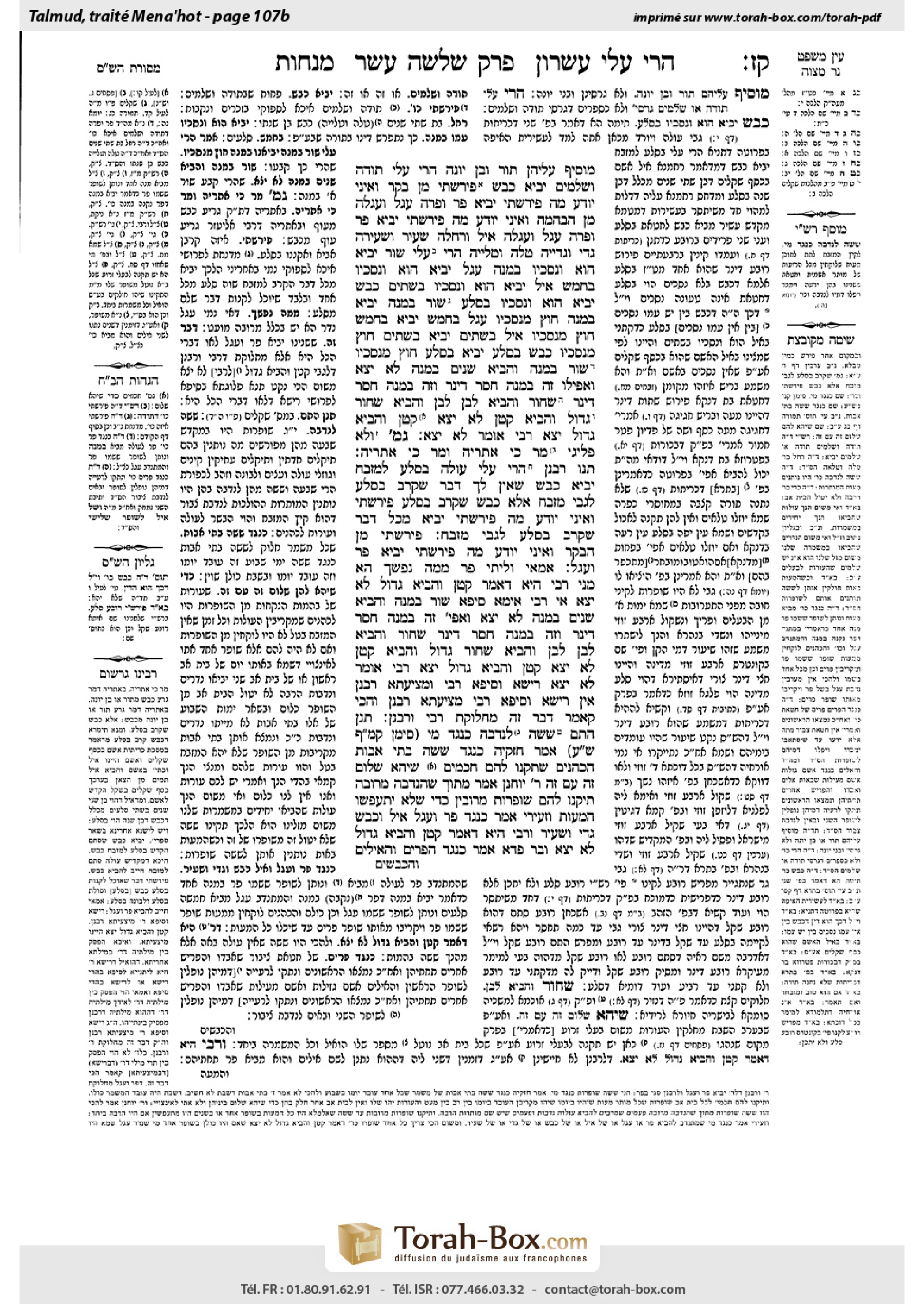
Menachot 107b: Talmud study for Daf Yomi
Daf Yomi is the daily study of one Talmud folio. Explore 37 tractates with scans, Hebrew text, Sefaria English and AI-generated French translations where annotated.
Passage selection and English or AI-generated French translation are available where the scan has annotations. Daf Study is independent of Torah-Box and Sefaria.
Browse Menachot · מנחות · All tractatesMenachot 107b text and translations
This page of Menachot includes the Aramaic text, an English translation and an AI-generated French translation, alongside the scan above.
מנחות ק״ז ב · Aramaic and Hebrew text
מוֹסִיף עֲלֵיהֶן תּוֹר וּבֶן יוֹנָה.
״הֲרֵי עָלַי תּוֹדָה וּשְׁלָמִים״ – יָבִיא כֶּבֶשׂ. ״פֵּירַשְׁתִּי מִן בָּקָר, וְאֵינִי יוֹדֵעַ מָה פֵּירַשְׁתִּי״ – יָבִיא פַּר וּפָרָה, עֵגֶל וְעֶגְלָה. ״מִן הַבְּהֵמָה, וְאֵינִי יוֹדֵעַ מָה פֵּירַשְׁתִּי״ – יָבִיא פַּר וּפָרָה, עֵגֶל וְעֶגְלָה, אַיִל וּרְחֵלָה, שָׂעִיר וּשְׂעִירָה, גְּדִי וּגְדִיָּיה, טָלֶה וְטַלְיָיה.
״הֲרֵי עָלַי שׁוֹר״ – יָבִיא הוּא וּנְסָכָיו בְּמָנֶה, ״עֵגֶל״ – יָבִיא הוּא וּנְסָכָיו בְּחָמֵשׁ, ״אַיִל״ – יָבִיא הוּא וּנְסָכָיו בִּשְׁתַּיִם, ״כֶּבֶשׂ״ – יָבִיא הוּא וּנְסָכָיו בְּסֶלַע.
״שׁוֹר בְּמָנֶה״ – יָבִיא בְּמָנֶה, חוּץ מִנְּסָכָיו. ״עֵגֶל בְּחָמֵשׁ״ – יָבִיא בְּחָמֵשׁ, חוּץ מִנְּסָכָיו. ״אַיִל בִּשְׁתַּיִם״ – יָבִיא בִּשְׁתַּיִם, חוּץ מִנְּסָכָיו. ״כֶּבֶשׂ בְּסֶלַע״ – יָבִיא בַּסֶּלַע, חוּץ מִנְּסָכָיו.
״שׁוֹר בְּמָנֶה״, וְהֵבִיא שְׁנַיִם בְּמָנֶה – לֹא יָצָא, וַאֲפִילּוּ זֶה בְּמָנֶה חָסֵר דִּינָר וְזֶה בְּמָנֶה חָסֵר דִּינָר.
״שָׁחוֹר״ וְהֵבִיא לָבָן, ״לָבָן״ וְהֵבִיא שָׁחוֹר, ״גָּדוֹל״ וְהֵבִיא קָטָן – לֹא יָצָא. ״קָטָן״ וְהֵבִיא גָּדוֹל – יָצָא. רַבִּי אוֹמֵר: לֹא יָצָא.
גְּמָ׳ וְלָא פְּלִיגִי, מָר כִּי אַתְרֵיהּ וּמָר כִּי אַתְרֵיהּ.
תָּנוּ רַבָּנַן: ״הֲרֵי עָלַי עוֹלָה בְּסֶלַע לַמִּזְבֵּחַ״ – יָבִיא כֶּבֶשׂ, שֶׁאֵין לְךָ דָּבָר שֶׁקָּרֵב בְּסֶלַע לְגַבֵּי מִזְבֵּחַ אֶלָּא כֶּבֶשׂ. ״שֶׁקָּרֵב בְּסֶלַע פֵּירַשְׁתִּי, וְאֵינִי יוֹדֵעַ מָה פֵּירַשְׁתִּי״ – יָבִיא מִכׇּל דָּבָר שֶׁקָּרֵב בְּסֶלַע לְגַבֵּי מִזְבֵּחַ.
״פֵּירַשְׁתִּי מִן הַבָּקָר, וְאֵינִי יוֹדֵעַ מָה פֵּירַשְׁתִּי״ – יָבִיא פָּר וְעֵגֶל. אַמַּאי? וְלַיְתֵי פַּר, מִמָּה נַפְשָׁךְ!
הָא מַנִּי? רַבִּי הִיא, דְּאָמַר: קָטָן וְהֵבִיא גָּדוֹל – לֹא יָצָא.
אִי רַבִּי, אֵימָא סֵיפָא: ״שׁוֹר בְּמָנֶה״ וְהֵבִיא שְׁנַיִם בְּמָנֶה – לֹא יָצָא, וַאֲפִילּוּ זֶה בְּמָנֶה חָסֵר דִּינָר וְזֶה בְּמָנֶה חָסֵר דִּינָר.
״שָׁחוֹר״ וְהֵבִיא לָבָן, ״לָבָן״ וְהֵבִיא שָׁחוֹר, ״גָּדוֹל״ וְהֵבִיא קָטָן – לֹא יָצָא, ״קָטָן״ וְהֵבִיא גָּדוֹל – יָצָא, רַבִּי אוֹמֵר: לֹא יָצָא.
רֵישָׁא וְסֵיפָא – רַבִּי, וּמְצִיעֲתָא – רַבָּנַן.
אִין, רֵישָׁא וְסֵיפָא רַבִּי, מְצִיעֲתָא רַבָּנַן, וְהָכִי קָאָמַר: דָּבָר זֶה מַחְלוֹקֶת רַבִּי וְרַבָּנַן.
תְּנַן הָתָם: שִׁשָּׁה לִנְדָבָה, כְּנֶגֶד מִי? (סִימָן (קמ״ף) [קנ״ז] ש״ע.)
אָמַר חִזְקִיָּה: כְּנֶגֶד שִׁשָּׁה בָּתֵּי אָבוֹת הַכֹּהֲנִים, שֶׁתִּקְּנוּ לָהֶם חֲכָמִים שֶׁיְּהֵא שָׁלוֹם זֶה עִם זֶה.
רַבִּי יוֹחָנָן אָמַר: מִתּוֹךְ שֶׁהַנְּדָבָה מְרוּבָּה, תִּיקְּנוּ לָהֶם שׁוֹפָרוֹת מְרוּבִּין, כְּדֵי שֶׁלֹּא יִתְעַפְּשׁוּ הַמָּעוֹת.
וּזְעֵירִי אָמַר: כְּנֶגֶד פַּר וָעֵגֶל, אַיִל וָכֶבֶשׂ, גְּדִי וְשָׂעִיר, וְרַבִּי הִיא, דְּאָמַר: קָטָן וְהֵבִיא גָּדוֹל – לֹא יָצָא.
וּבַר פְּדָא אָמַר: כְּנֶגֶד הַפָּרִים, וְהָאֵילִים,
Menachot 107b · English translation
adds a dove and a pigeon to the previous list.
One who says: It is incumbent upon me to bring a thanks offering and a peace offering, must bring a lamb, which is the least expensive land animal sacrificed as an offering. One who says: I vowed to bring a peace offering and I specified that it would be from the herd but I do not know what animal I specified, must bring a bull and a cow, and a male calf and a female calf. One who says: I vowed to bring a burnt offering and specified that it would be from the animals, but I do not know what animal I specified, must bring a bull and a cow, a male calf and a female calf, a ram and a ewe, a large, i.e., adult, male goat and a large female goat, a small, i.e., young, male goat and a small female goat, and a male lamb and a female lamb.
One who says: It is incumbent upon me to bring a bull as a burnt offering or peace offering, must bring the bull, its accompanying meal offering, and its libations, with the total value of one hundred dinars. One who says: It is incumbent upon me to bring a calf, must bring the calf, its accompanying meal offering, and its libations, with the total value of five sela, which equal twenty dinars. One who says: It is incumbent upon me to bring a ram, must bring the ram, its accompanying meal offering, and its libations, with the value of two sela, which equal eight dinars. One who says: It is incumbent upon me to bring a lamb, must bring the lamb, its accompanying meal offering, and its libations, with the value of one sela, which equals four dinars.
One who says: It is incumbent upon me to bring a bull with the value of one hundred dinars as a burnt offering or peace offering, must bring the bull with the value of one hundred dinars excluding its accompanying meal offering and libations. One who says: It is incumbent upon me to bring a calf with the value of five sela as a burnt offering or peace offering, must bring the calf with the value of five sela excluding its accompanying meal offering and libations. One who says: It is incumbent upon me to bring a ram with the value of two sela as a burnt offering or peace offering, must bring the ram with the value of two sela excluding its accompanying meal offering and libations. One who says: It is incumbent upon me to bring a lamb with the value of one sela as a burnt offering or peace offering, must bring the lamb with the value of one sela excluding its accompanying meal offering and libations.
If one said: It is incumbent upon me to bring a bull with the value of one hundred dinars as a burnt offering or peace offering, and he brought two bulls with a combined value of one hundred dinars, he has not fulfilled his obligation. And that is the halakha even if this bull has the value of one hundred dinars less one dinar and that bull has the value of one hundred dinars less one dinar.
If one said: It is incumbent upon me to bring a black bull, and he brought a white bull; or said: It is incumbent upon me to bring a white bull, and he brought a black bull; or said: It is incumbent upon me to bring a large bull, and he brought a small bull, in all these cases he has not fulfilled his obligation. But if he said: It is incumbent upon me to bring a small bull, and he brought a large bull, he has fulfilled his obligation, as the value of a small bull is included in the value of a large bull. Rabbi Yehuda HaNasi says: He has not fulfilled his obligation, as the offering that he brought did not correspond to his vow.
GEMARA: The mishna teaches that if one vows to bring a burnt offering and does not specify which animal he will bring, according to the first tanna he must bring a lamb, and according to Rabbi Elazar ben Azarya he may bring a dove or a pigeon. The Gemara explains: And they do not disagree in principle. This Sage rules in accordance with the custom of his locale, and that Sage rules in accordance with the custom of his locale. In the locale of the first tanna, when people would say: Burnt offering, they would be referring to a land animal, whereas in the locale of Rabbi Elazar ben Azarya, when people would say: Burnt offering, they would also be referring to a bird.
The Sages taught in a baraita: One who says: It is incumbent upon me to bring a burnt offering with the value of one sela for the altar, must bring a lamb; as you have no animal that is sacrificed on the altar and has the value of one sela but a lamb. One who says: When I made my vow I specified that I will bring an item that is sacrificed on the altar and has the value of one sela, but I do not know what I specified, must bring one of every animal that is sacrificed on the altar and has the value of one sela. Although this condition generally indicates a lamb, since the person specified a particular animal but does not remember which, one cannot be certain that he specified a lamb.
§ The mishna teaches that if one says: I vowed to bring a peace offering, and I specified that it would be from the herd, but I do not know what animal I specified, he must bring a bull and a calf. The Gemara asks: Why? Let him bring a bull, as whichever way you look at it he has fulfilled his vow. If he vowed to bring a bull, he has done so. If he vowed to bring a calf, he has fulfilled his vow, because the value of a calf is included in the value of a bull.
The Gemara answers: In accordance with whose opinion is this? It is in accordance with the opinion of Rabbi Yehuda HaNasi, who said that if one said: It is incumbent upon me to bring a small bull, and he brought a large bull, he has not fulfilled his obligation.
The Gemara asks: If the mishna is in accordance with the opinion of Rabbi Yehuda HaNasi, say the latter clause of the mishna: If one said: It is incumbent upon me to bring a bull with the value of one hundred dinars, and he brought two bulls with the combined value of one hundred dinars, he has not fulfilled his obligation, and that is the halakha even if this bull has the value of one hundred dinars less one dinar and that bull has the value of one hundred dinars less one dinar.
If one said: It is incumbent upon me to bring a black bull, and he brought a white bull; or said: It is incumbent upon me to bring a white bull, and he brought a black bull; or said: It is incumbent upon me to bring a large bull, and he brought a small bull, in all these cases he has not fulfilled his obligation. But if he said: It is incumbent upon me to bring a small bull, and he brought a large bull, he has fulfilled his obligation, as the value of a small bull is included in the value of a large bull. Rabbi Yehuda HaNasi says: He has not fulfilled his obligation, as the offering that he brought did not correspond to his vow.
If the first clause, which teaches that one who vowed to bring an offering from the herd must bring both a bull and a calf, is in accordance with the opinion of Rabbi Yehuda HaNasi, then it turns out that the first clause and the last clause are in accordance with the opinion of Rabbi Yehuda HaNasi, and the middle clause is in accordance with the opinion of the Rabbis. Can that be so?
The Gemara answers: Yes, the first clause and the last clause are in accordance with the opinion of Rabbi Yehuda HaNasi, and the middle clause is in accordance with the opinion of the Rabbis. And this is what the mishna is saying: This matter, i.e., the ruling that one who vows to bring an offering from the herd must bring a bull and a calf, is not universally accepted. Rather, it is subject to a dispute between Rabbi Yehuda HaNasi and the Rabbis.
§ We learned in a mishna there (Shekalim 18b): There were six collection horns in the Temple for the collection of donations for communal gift offerings, i.e., burnt offerings that were sacrificed when the altar was idle. The Gemara asks: To what did these six horns correspond? The Gemara gives a mnemonic for the names of the five Sages who give answers to this question: Kuf, mem, peh, shin, ayin.
Ḥizkiyya says: These six collection horns corresponded to the six extended patrilineal families of priests who served each week in the Temple. There was one collection horn for each family, which the Sages installed for them so that there would be peace between one another and they would not quarrel. The hides of the burnt offerings are given to the priests, and by keeping the money for the offerings sacrificed by each family separate, they would not come to quarrel over those hides.
Rabbi Yoḥanan says: Since the money for the communal gift offerings was plentiful, as much money was donated for this purpose, there was a concern that if too many coins were placed in one collection horn, only the uppermost coins would be taken and the bottom ones would deteriorate. Therefore, the Sages installed many collection horns for them, so that each horn would contain fewer coins and the coins would not decay.
And Ze’eiri says: The six collection horns correspond to the six types of animals from which burnt offerings can be brought: A bull, a calf, a ram, a lamb, a small goat, and a large goat. And each type of animal required its own collection horn, because the mishna is in accordance with the opinion of Rabbi Yehuda HaNasi, who says that if one said: It is incumbent upon me to bring a small bull and he brought a large bull, he has not fulfilled his obligation, as the offering that he brought did not correspond to his vow.
And bar Padda says: The six collection horns correspond to the six types of animals from which sin offerings and guilt offerings can be brought. If an animal designated for a guilt offering or a communal sin offering was lost, another animal was consecrated in its stead, and then the first animal was found, the value of that animal is placed into one of these collection horns, and a communal gift offering is brought with it. One was for the value of the bulls brought as communal sin offerings. And one was for the value of the rams brought as guilt offerings for robbery or for misuse of consecrated property.
Menachot 107b · Traduction française (IA)
ajoute une tourterelle et un pigeon à la liste précédente.
Celui qui dit : « Je suis tenu d’apporter un sacrifice de reconnaissance et un sacrifice de paix » doit apporter un agneau, qui est l’animal terrestre sacrifié le moins coûteux. Celui qui dit : « J’ai fait le vœu d’apporter un sacrifice de paix et j’ai précisé qu’il proviendrait du gros bétail, mais je ne sais plus quel animal j’avais précisé » doit apporter un taureau et une vache, un veau mâle et un veau femelle. Celui qui dit : « J’ai fait le vœu d’apporter un holocauste et j’ai précisé qu’il proviendrait des animaux, mais je ne sais plus quel animal j’avais précisé » doit apporter un taureau et une vache, un veau mâle et un veau femelle, un bélier et une brebis, un grand bouc mâle, c’est-à-dire adulte, et une grande chèvre, un petit bouc mâle, c’est-à-dire jeune, et une petite chèvre, ainsi qu’un agneau mâle et une agnelle.
Celui qui dit : « Je suis tenu d’apporter un taureau comme holocauste ou comme sacrifice de paix » doit apporter le taureau, son offrande de farine et ses libations, pour une valeur totale de cent dinars. Celui qui dit : « Je suis tenu d’apporter un veau » doit apporter le veau, son offrande de farine et ses libations, pour une valeur totale de cinq séla, soit vingt dinars. Celui qui dit : « Je suis tenu d’apporter un bélier » doit apporter le bélier, son offrande de farine et ses libations, pour une valeur de deux séla, soit huit dinars. Celui qui dit : « Je suis tenu d’apporter un agneau » doit apporter l’agneau, son offrande de farine et ses libations, pour une valeur d’un séla, soit quatre dinars.
Celui qui dit : « Je suis tenu d’apporter un taureau d’une valeur de cent dinars comme holocauste ou comme sacrifice de paix » doit apporter un taureau d’une valeur de cent dinars, sans compter son offrande de farine ni ses libations. Celui qui dit : « Je suis tenu d’apporter un veau d’une valeur de cinq séla comme holocauste ou comme sacrifice de paix » doit apporter un veau d’une valeur de cinq séla, sans compter son offrande de farine ni ses libations. Celui qui dit : « Je suis tenu d’apporter un bélier d’une valeur de deux séla comme holocauste ou comme sacrifice de paix » doit apporter un bélier d’une valeur de deux séla, sans compter son offrande de farine ni ses libations. Celui qui dit : « Je suis tenu d’apporter un agneau d’une valeur d’un séla comme holocauste ou comme sacrifice de paix » doit apporter un agneau d’une valeur d’un séla, sans compter son offrande de farine ni ses libations.
Si quelqu’un a dit : « Je suis tenu d’apporter un taureau d’une valeur de cent dinars comme holocauste ou comme sacrifice de paix », et qu’il a apporté deux taureaux dont la valeur totale est de cent dinars, il ne s’est pas acquitté de son obligation. Il en est ainsi même si chacun de ces taureaux vaut cent dinars moins un dinar.
Si quelqu’un a dit : « Je suis tenu d’apporter un taureau noir » et qu’il a apporté un taureau blanc, ou s’il a dit : « Je suis tenu d’apporter un taureau blanc » et qu’il a apporté un taureau noir, ou s’il a dit : « Je suis tenu d’apporter un grand taureau » et qu’il a apporté un petit taureau, dans tous ces cas, il ne s’est pas acquitté de son obligation. Mais s’il a dit : « Je suis tenu d’apporter un petit taureau » et qu’il a apporté un grand taureau, il s’est acquitté de son obligation, car la valeur d’un petit taureau est comprise dans celle d’un grand taureau. Rabbi Yehouda HaNassi dit : « Il ne s’est pas acquitté de son obligation », car le sacrifice qu’il a apporté ne correspondait pas à son vœu.
GUEMARA : La Michna enseigne que si quelqu’un fait le vœu d’apporter un holocauste sans préciser quel animal il apportera, selon le premier tanna, il doit apporter un agneau, tandis que, selon Rabbi Elazar ben Azarya, il peut apporter une tourterelle ou un pigeon. La Guemara explique : Ils ne sont pas en désaccord sur le principe. Chaque Sage statue conformément à l’usage de sa région. Dans la région du premier tanna, quand les gens disaient « holocauste », ils faisaient référence à un animal terrestre, tandis que dans la région de Rabbi Elazar ben Azarya, quand ils disaient « holocauste », ils faisaient également référence à un oiseau.
Les Sages ont enseigné dans une baraïta : Celui qui dit : « Je suis tenu d’apporter un holocauste d’une valeur d’un séla pour l’autel » doit apporter un agneau, car aucun animal sacrifié sur l’autel ne vaut un séla, à l’exception de l’agneau. Celui qui dit : « Lorsque j’ai fait mon vœu, j’ai précisé que j’apporterais un animal sacrifié sur l’autel d’une valeur d’un séla, mais je ne sais plus ce que j’avais précisé » doit apporter un exemplaire de chaque animal sacrifié sur l’autel et valant un séla. Bien que cette condition désigne généralement un agneau, puisque cette personne avait précisé un animal particulier mais ne se souvient plus lequel, on ne peut pas être certain qu’elle avait précisé un agneau.
§ La Michna enseigne que si quelqu’un dit : « J’ai fait le vœu d’apporter un sacrifice de paix et j’ai précisé qu’il proviendrait du gros bétail, mais je ne sais plus quel animal j’avais précisé », il doit apporter un taureau et un veau. La Guemara demande : Pourquoi ? Qu’il apporte un taureau, car, dans tous les cas, il aura accompli son vœu. S’il avait fait le vœu d’apporter un taureau, il l’aura fait. S’il avait fait le vœu d’apporter un veau, il aura accompli son vœu, puisque la valeur d’un veau est comprise dans celle d’un taureau.
La Guemara répond : De l’avis de qui est-ce ? De celui de Rabbi Yehouda HaNassi, qui a dit que si quelqu’un dit : « Je suis tenu d’apporter un petit taureau » et qu’il apporte un grand taureau, il ne s’est pas acquitté de son obligation.
La Guemara demande : Si la Michna est conforme à l’avis de Rabbi Yehouda HaNassi, citons la clause suivante de la Michna : Si quelqu’un dit : « Je suis tenu d’apporter un taureau d’une valeur de cent dinars » et qu’il apporte deux taureaux dont la valeur totale est de cent dinars, il ne s’est pas acquitté de son obligation ; il en est ainsi même si chacun de ces taureaux vaut cent dinars moins un dinar.
Si quelqu’un a dit : « Je suis tenu d’apporter un taureau noir » et qu’il a apporté un taureau blanc, ou s’il a dit : « Je suis tenu d’apporter un taureau blanc » et qu’il a apporté un taureau noir, ou s’il a dit : « Je suis tenu d’apporter un grand taureau » et qu’il a apporté un petit taureau, dans tous ces cas, il ne s’est pas acquitté de son obligation. Mais s’il a dit : « Je suis tenu d’apporter un petit taureau » et qu’il a apporté un grand taureau, il s’est acquitté de son obligation, car la valeur d’un petit taureau est comprise dans celle d’un grand taureau. Rabbi Yehouda HaNassi dit : « Il ne s’est pas acquitté de son obligation », car le sacrifice qu’il a apporté ne correspondait pas à son vœu.
Si la première clause, qui enseigne que celui qui a fait le vœu d’apporter un sacrifice provenant du gros bétail doit apporter à la fois un taureau et un veau, est conforme à l’avis de Rabbi Yehouda HaNassi, il s’ensuit que la première et la dernière clause sont conformes à l’avis de Rabbi Yehouda HaNassi, tandis que la clause médiane est conforme à l’avis des Rabbins. Est-ce possible ?
La Guemara répond : Oui, la première et la dernière clause sont conformes à l’avis de Rabbi Yehouda HaNassi, et la clause médiane est conforme à l’avis des Rabbins. Voici ce que dit la Michna : cette question, à savoir la règle selon laquelle celui qui fait le vœu d’apporter un sacrifice provenant du gros bétail doit apporter un taureau et un veau, ne fait pas l’unanimité. Elle fait plutôt l’objet d’un désaccord entre Rabbi Yehouda HaNassi et les Rabbins.
§ Nous avons appris dans une Michna, là-bas (Shekalim 18b) : Il y avait dans le Temple six troncs de collecte destinés à recueillir les dons pour les holocaustes offerts au nom de la communauté, c’est-à-dire les holocaustes sacrifiés lorsque l’autel était inactif. La Guemara demande : À quoi correspondaient ces six troncs ? La Guemara donne un moyen mnémotechnique pour retenir les noms des cinq Sages qui répondent à cette question : qof, mem, peh, shin, ayin.
Ḥizkiyya dit : Ces six troncs de collecte correspondaient aux six grandes familles patrilinéaires de prêtres qui assuraient leur service chaque semaine dans le Temple. Les Sages avaient installé un tronc de collecte pour chaque famille afin qu’il y ait la paix entre elles et qu’elles ne se querellent pas. Les peaux des holocaustes sont remises aux prêtres ; en séparant l’argent destiné aux sacrifices offerts par chaque famille, ils évitaient de se quereller au sujet de ces peaux.
Rabbi Yoḥanan dit : Puisque l’argent destiné aux holocaustes offerts au nom de la communauté était abondant, car de nombreux dons étaient faits à cette fin, on craignait que, si trop de pièces étaient déposées dans un seul tronc de collecte, seules les pièces du dessus seraient prises et celles du fond se détérioreraient. Les Sages installèrent donc plusieurs troncs de collecte afin que chacun contienne moins de pièces et que celles-ci ne se détériorent pas.
Et Ze’eiri dit : Les six troncs de collecte correspondaient aux six types d’animaux dont on peut apporter des holocaustes : un taureau, un veau, un bélier, un agneau, un petit bouc et un grand bouc. Chaque type d’animal nécessitait son propre tronc de collecte, car la Michna est conforme à l’avis de Rabbi Yehouda HaNassi, qui dit que si quelqu’un affirme : « Je suis tenu d’apporter un petit taureau » et qu’il apporte un grand taureau, il ne s’est pas acquitté de son obligation, car le sacrifice qu’il a apporté ne correspondait pas à son vœu.
Et bar Padda dit : Les six troncs de collecte correspondaient aux six types d’animaux pouvant être apportés comme sacrifices expiatoires et sacrifices de culpabilité. Si un animal destiné à un sacrifice de culpabilité ou à un sacrifice expiatoire communautaire était perdu, qu’un autre animal était consacré à sa place, puis que le premier était retrouvé, sa valeur était déposée dans l’un de ces troncs de collecte, et un holocauste offert au nom de la communauté était apporté avec cette somme. Un tronc était destiné à la valeur des taureaux apportés comme sacrifices expiatoires communautaires. Un autre était destiné à la valeur des béliers apportés comme sacrifices de culpabilité pour vol ou pour usage indu de biens consacrés.
Traduction française générée par IA à partir de l’édition anglaise de Sefaria. Vérifie toujours un passage avec le texte source.
Text from Sefaria: William Davidson Edition - Vocalized Aramaic (unknown); William Davidson Edition - English (CC BY NC).