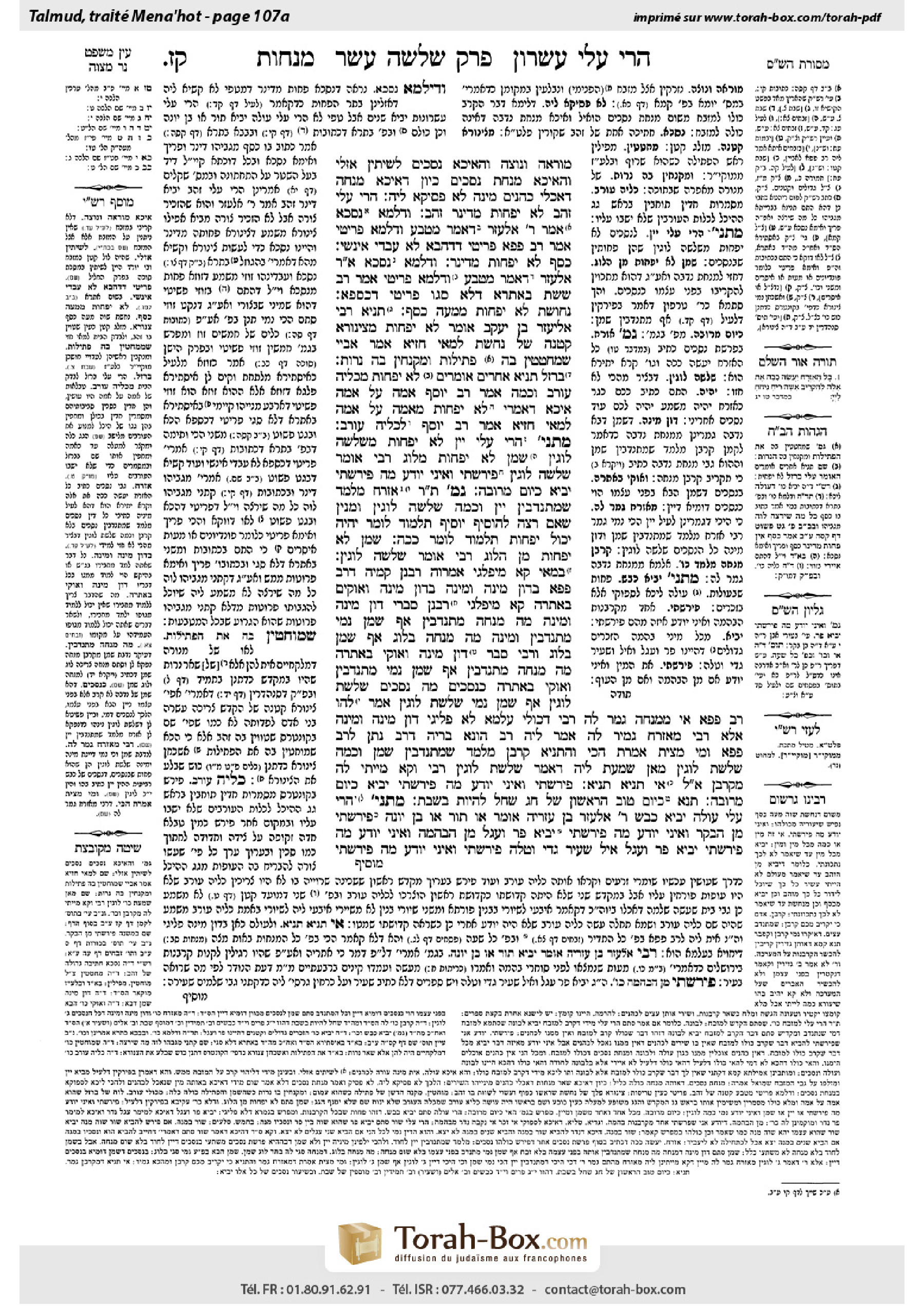
Menachot 107a: Talmud study for Daf Yomi
Daf Yomi is the daily study of one Talmud folio. Explore 37 tractates with scans, Hebrew text, Sefaria English and AI-generated French translations where annotated.
Passage selection and English or AI-generated French translation are available where the scan has annotations. Daf Study is independent of Torah-Box and Sefaria.
Browse Menachot · מנחות · All tractatesMenachot 107a text and translations
This page of Menachot includes the Aramaic text, an English translation and an AI-generated French translation, alongside the scan above.
מנחות ק״ז א · Aramaic and Hebrew text
מוּרְאָה וְנוֹצָה.
וְהָאִיכָּא נְסָכִים, לַשִּׁיתִין אָזְלִי.
וְהָאִיכָּא מִנְחַת נְסָכִים? כֵּיוָן דְּאִיכָּא מִנְחָה דְּאָכְלִי כֹּהֲנִים מִינַּהּ, לָא פְּסִיקָא לֵיהּ.
״הֲרֵי עָלַי זָהָב״ – לֹא יִפְחוֹת מִדִּינַר זָהָב. וְדִלְמָא נְסָכָא? אָמַר רַבִּי אֶלְעָזָר: דְּאָמַר ״מַטְבֵּעַ״. וְדִלְמָא פְּרִיטֵי? אָמַר רַב פָּפָּא: פְּרִיטֵי דְּדַהֲבָא לָא עָבְדִי אִינָשֵׁי.
״כֶּסֶף״ – לֹא יִפְחוֹת מִדִּינָר. וְדִלְמָא נְסָכָא? אָמַר רַבִּי אֶלְעָזָר: דְּאָמַר ״מַטְבֵּעַ״, וְדִלְמָא פְּרִיטֵי? אָמַר רַב שֵׁשֶׁת: בְּאַתְרָא דְּלָא סָגוּ פְּרִיטֵי דְכַסְפָּא.
״נְחוֹשֶׁת״ – לֹא יִפְחוֹת מִמָּעָה כֶּסֶף. תַּנְיָא: רַבִּי אֱלִיעֶזֶר בֶּן יַעֲקֹב אוֹמֵר – לֹא יִפְחוֹת מִצִּינּוֹרָא קְטַנָּה שֶׁל נְחֹשֶׁת. לְמַאי חַזְיָא? אָמַר אַבָּיֵי: שֶׁמְּחַטְּטִין בָּהּ פְּתִילוֹת, וּמְקַנְּחִין בָּהּ נֵרוֹת.
בַּרְזֶל, תַּנְיָא, אֲחֵרִים אוֹמְרִים: לֹא יִפְחוֹת מִכָּלְיָה עוֹרֵב, וְכַמָּה? אָמַר רַב יוֹסֵף: אַמָּה עַל אַמָּה.
אִיכָּא דְאָמְרִי: לֹא יִפְחוֹת מֵאַמָּה עַל אַמָּה. לְמַאי חַזְיָא? אָמַר רַב יוֹסֵף: לְכָלְיָה עוֹרֵב.
מַתְנִי׳ ״הֲרֵי עָלַי יַיִן״ – לֹא יִפְחוֹת מִשְּׁלֹשָׁה לוּגִּין, ״שֶׁמֶן״ – לֹא יִפְחוֹת מִלּוֹג, רַבִּי אוֹמֵר: שְׁלֹשָׁה לוּגִּין.
״פֵּירַשְׁתִּי, וְאֵינִי יוֹדֵעַ מָה פֵּירַשְׁתִּי״ – יָבִיא כְּיוֹם מְרוּבֶּה.
גְּמָ׳ תָּנוּ רַבָּנַן: ״אֶזְרָח״ – מְלַמֵּד שֶׁמִּתְנַדְּבִין יַיִן, וְכַמָּה? שְׁלֹשָׁה לוּגִּין.
וּמִנַּיִן שֶׁאִם רָצָה לְהוֹסִיף יוֹסִיף? תַּלְמוּד לוֹמַר ״יִהְיֶה״. יָכוֹל יִפְחוֹת? תַּלְמוּד לוֹמַר ״כָּכָה״.
שֶׁמֶן – לֹא יִפְחוֹת מִן הַלּוֹג, רַבִּי אוֹמֵר: שְׁלֹשָׁה לוּגִּין. בְּמַאי קָא מִיפַּלְגִי?
אַמְרוּהָ רַבָּנַן קַמֵּיהּ דְּרַב פָּפָּא: בְּדוּן מִינַּהּ וּמִינַּהּ, בְּדוּן מִינַּהּ וְאוֹקֵים בְּאַתְרַהּ – קָא מִיפַּלְגִי.
רַבָּנַן סָבְרִי: דּוּן מִינַּהּ וּמִינַּהּ, מָה מִנְחָה מִתְנַדְּבִין – אַף שֶׁמֶן נָמֵי מִתְנַדְּבִין, וּמִינַּהּ: מָה מִנְחָה בְּלוֹג – אַף שֶׁמֶן בְּלוֹג.
וְרַבִּי סָבַר: דּוּן מִינַּהּ וְאוֹקֵי בְּאַתְרַהּ, מָה מִנְחָה מִתְנַדְּבִין, אַף שֶׁמֶן נָמֵי מִתְנַדְּבִין, וְאוֹקֵי בְּאַתְרַהּ כִּנְסָכִים, מָה נְסָכִים שְׁלֹשֶׁת לוּגִּין, אַף שֶׁמֶן נָמֵי שְׁלֹשֶׁת לוּגִּין.
אֲמַר לְהוּ רַב פָּפָּא: אִי מִמִּנְחָה גָּמַר לַהּ רַבִּי, דְּכוּלֵּי עָלְמָא לָא פְּלִיגִי דּוּן מִינַּהּ וּמִינַּהּ, אֶלָּא רַבִּי מֵ״אֶזְרָח״ גְּמִיר לַהּ.
אֲמַר לֵיהּ רַב הוּנָא בְּרֵיהּ דְּרַב נָתָן לְרַב פָּפָּא: וּמִי מָצֵית אָמְרַתְּ הָכִי? וְהָתַנְיָא: ״קׇרְבָּן״ – מְלַמֵּד שֶׁמִּתְנַדְּבִין שֶׁמֶן, וְכַמָּה? שְׁלֹשֶׁת לוּגִּין. מַאן שָׁמְעַתְּ לֵיהּ דְּאָמַר שְׁלֹשֶׁת לוּגִּין? רַבִּי, וְקָא מַיְיתֵי לַהּ מִ״קׇּרְבָּן״. אֲמַר לֵיהּ: אִי תַּנְיָא תַּנְיָא.
״פֵּירַשְׁתִּי, וְאֵינִי יוֹדֵעַ מָה פֵּירַשְׁתִּי״ – יָבִיא כְּיוֹם מְרוּבֶּה. תְּנָא: כְּיוֹם טוֹב הָרִאשׁוֹן שֶׁל חַג שֶׁחָל לִהְיוֹת בַּשַּׁבָּת.
מַתְנִי׳ ״הֲרֵי עָלַי עוֹלָה״ – יָבִיא כֶּבֶשׂ. רַבִּי אֶלְעָזָר בֶּן עֲזַרְיָה אוֹמֵר: אוֹ תּוֹר אוֹ בֶּן יוֹנָה.
״פֵּירַשְׁתִּי מִן הַבָּקָר, וְאֵינִי יוֹדֵעַ מָה פֵּירַשְׁתִּי״ – יָבִיא פַּר וְעֵגֶל. ״מִן הַבְּהֵמָה, וְאֵינִי יוֹדֵעַ מָה פֵּירַשְׁתִּי״ – יָבִיא פַּר וְעֵגֶל, אַיִל, שָׂעִיר, גְּדִי וְטָלֶה. ״פֵּירַשְׁתִּי, וְאֵינִי יוֹדֵעַ מָה פֵּירַשְׁתִּי״ –
Menachot 107a · English translation
the crop and feathers, which are thrown on the ground next to the altar and are not burned.
The Gemara asks: But aren’t there wine libations, which are poured entirely onto the altar? The Gemara answers that the wine is not actually poured onto the altar; it is poured into ducts on the side of the altar and goes down to the drainpipes.
The Gemara asks: But isn’t there a meal offering brought with libations, which is entirely burned on the altar? The Gemara answers that when one says: It is incumbent upon me to bring to the altar, his intent is clearly to bring a type of offering that is only sacrificed on the altar. A meal offering brought with libations is a type of meal offering. Therefore, since there are other types of a meal offering from which the priests eat, after a handful has been removed from it and burned, a meal offering brought with libations is not a clear example of an offering that is sacrificed on the altar in its entirety, and certainly was not his intent. Therefore, his intent must have been to bring frankincense.
§ The mishna teaches that one who says: It is incumbent upon me to donate gold to the Temple treasury, must donate no less than a gold dinar. The Gemara challenges: But perhaps his intention in using the word gold is not to a coin at all, but to a small piece [naskha] of gold. Rabbi Elazar said: The case of the baraita is where he said the word coin. The Gemara challenges further: But perhaps his intention is not to a dinar, but to smaller coins, such as perutot. Rav Pappa said: People do not make perutot of gold. Therefore, it is unlikely that this was his intent.
§ The mishna teaches that one who says: It is incumbent upon me to donate silver to the Temple maintenance, must donate no less than the value of a silver dinar. The Gemara challenges: But perhaps his intention in using the word silver is not to a coin at all, but to a small piece of silver. Rabbi Elazar said: The case of the baraita is where he said the word coin. The Gemara challenges further: But perhaps his intention is not to a dinar, but to smaller coins, such as perutot. Rav Pappa said: The halakha of the baraita is stated with regard to a place where silver perutot do not circulate.
§ The mishna teaches that one who says: It is incumbent upon me to donate copper to the Temple maintenance, must donate no less than the value of a silver ma’a. It is taught in a baraita that Rabbi Eliezer ben Ya’akov says: He must donate no less than the amount needed to forge a small copper hook. The Gemara asks: For what use is that suitable in the Temple? Abaye said: They scrape the wicks from the Candelabrum with it and clean the lamps of the Candelabrum with it.
The mishna discusses pledges of gold, silver, and copper. What is the halakha if one says: It is incumbent upon me to donate iron? It is taught in a baraita that others say: He must donate no less than the amount that can be made into a base and spike designed to eliminate the ravens [mikkalya orev]. The Gemara asks: And how much is that? Rav Yosef said: One cubit in width by one cubit in length.
There are those who say another version of this baraita and the subsequent explanation: One who pledges to donate iron must donate no less than one cubit in width by one cubit in length. The Gemara asks: For what is this amount of iron suitable? Rav Yosef said: It is suitable for a base and spike designed to eliminate the ravens.
MISHNA: One who says: It is incumbent upon me to bring a libation of wine, must bring no less than three log, as that is the minimum amount of wine brought as a libation accompanying an animal offering. One who says: It is incumbent upon me to bring oil, must bring no less than a log, as the smallest meal offering includes one log of oil. Rabbi Yehuda HaNasi says: He must bring no less than three log, as that is the amount of oil in the meal offering that accompanies the sacrifice of a lamb, which is the smallest amount in any of the meal offerings that accompany the sacrifice of an animal.
One who says: I specified how many log I vowed to bring but I do not know what amount I specified, must bring an amount of oil equivalent to the amount brought on the day that the largest amount of oil is sacrificed in the Temple.
GEMARA: The Torah states with regard to libations: “All that are native born shall do these things in this manner, in presenting an offering made by fire, of a pleasing aroma to the Lord” (Numbers 15:13). As this verse is superfluous, the various terms in it are used to derive halakhot. The term “native born” teaches that one may pledge libations independently, even when they are not sacrificed together with an offering. And how much is the minimum size that is offered? Three log, which is the smallest measurement of a libation in the Torah and is offered with a lamb.
And from where is it derived that if one desires to add to this amount, he may add to it? The verse states with regard to libations associated with the additional offerings for the New Moon: “And their libations: Half a hin of wine shall be for the bull, and the third part of a hin for the ram, and the fourth part of a hin for the lamb (Numbers 28:14). From the superfluous “shall be” one may understand that there are other amounts of wine that may be brought as independent libations. One might have thought that he can decrease the amount of wine in a libation to less than three log. Therefore, the verse states: “All that are native born shall do these things, in this manner” (Numbers 15:13), i.e., one may not bring less than three log of wine.
The mishna teaches that if one said: It is incumbent upon me to bring oil, he must bring no less than a log, as the smallest meal offering includes a log of oil. Rabbi Yehuda HaNasi says: He must bring no less than three log. The Gemara asks: With regard to what principle do they disagree?
The Sages said before Rav Pappa: The Rabbis and Rabbi Yehuda HaNasi disagree with regard to the proper method of logical derivation when deriving the halakha with regard to one matter from the halakha with regard to another matter. One opinion holds that the proper method is to infer from it, and again from it, i.e., equate the two cases in all aspects, while the other holds that the comparison extends only to one specific issue derived from the primary case, in accordance with the principle: Infer from it but interpret the halakha according to its own place, i.e., in all other aspects the cases are not equated.
The Sages explained: The Rabbis hold by the principle: Infer from it, and again from it. The Gemara explains the application of this principle: Just as a meal offering is contributed, so too oil is contributed, as inferred from the verse addressing the meal offering. And again one infers from this source: Just as a meal offering requires a log of oil, so too here, an offering of oil alone must be a log of oil.
And Rabbi Yehuda HaNasi holds that the proper method is to infer from it but interpret the halakha according to its own place: Just as a meal offering is contributed, so too oil is contributed. But with regard to all other aspects of this halakha, interpret the halakha according to its own place, and its status is like that of libations, which are similar to oil in that they are also poured onto the altar: Just as one contributes libations of three log, so too when one contributes oil, one contributes three log.
Rav Pappa said to the Sages who suggested this interpretation: If Rabbi Yehuda HaNasi derived the source of the gift offering of oil from the verse addressing the meal offering, he would not disagree with the Rabbis, as everyone employs the principle of: Infer from it, and again from it. Rather, Rabbi Yehuda HaNasi derives the gift offering of oil from a verse concerning libations: “All that are native born shall do these things in this manner, in presenting an offering made by fire” (Numbers 15:13). Rabbi Yehuda HaNasi derives from here that just as one may contribute wine libations, so too one may contribute oil. Therefore, Rabbi Yehuda HaNasi compares oil to wine libations: Just as one contributes libations of three log, so too one contributes three log of oil.
Rav Huna, son of Rav Natan, said to Rav Pappa: And how can you say that according to Rabbi Yehuda HaNasi the source of the gift offering of oil is not from the meal offering? But isn’t it taught in a baraita with regard to the verse: “And when one brings a meal offering [korban minḥa]” (Leviticus 2:1), that the superfluous word korban teaches that one may contribute oil. And how much must one contribute? Three log. The Gemara explains the question: Who did you hear that says the gift offering of oil is three log? This is the opinion of Rabbi Yehuda HaNasi, and yet he cites the source of the gift offering of oil from the word korban, which is referring to a meal offering. Rav Pappa said to him: If this baraita is taught, it is taught, and I cannot take issue with it.
The mishna teaches that one who says: I specified how many log I vowed to bring but I do not know what number I specified, must bring an amount of oil equivalent to the amount brought on the day that the largest amount of oil is sacrificed in the Temple. The Sages taught: He must bring an amount of oil equivalent to the amount that is brought on the first day of the Festival, i.e., Sukkot, when it occurs on Shabbat. The offerings brought on that day include the additional offerings for Sukkot and also the additional offerings for Shabbat, and the total amount of oil brought on that day is 140 log.
MISHNA: One who says: It is incumbent upon me to bring a burnt offering, must bring a lamb, which is the least expensive land animal sacrificed as an offering. Rabbi Elazar ben Azarya says: He may bring either a dove or a pigeon, as a bird burnt offering.
One who says: I vowed to bring a burnt offering, and I specified that it would be from the herd, but I do not know what animal I specified, must bring a bull and a male calf, as a burnt offering is brought only from male animals. One who says: I vowed to bring a burnt offering and I specified that it would be from the animals but I do not know what animal I specified, must bring a bull and a male calf, a ram, a large male goat, a small male goat, and a male lamb. One who says: I vowed to bring a burnt offering, and I specified what type of burnt offering it would be, but I do not know what I specified,
Menachot 107a · Traduction française (IA)
le jabot et les plumes, qui sont jetés à terre près de l’autel et ne sont pas brûlés.
La Guemara demande : Mais n’y a-t-il pas les libations de vin, qui sont entièrement versées sur l’autel ? La Guemara répond que le vin n’est pas réellement versé sur l’autel : il est versé dans des conduits situés sur le côté de l’autel, puis s’écoule dans les canalisations.
La Guemara demande : Mais n’y a-t-il pas une offrande de farine accompagnée de libations, qui est entièrement brûlée sur l’autel ? La Guemara répond que, lorsqu’on dit : « Je suis tenu d’apporter à l’autel », son intention est clairement d’apporter un type d’offrande qui n’est sacrifié que sur l’autel. Une offrande de farine accompagnée de libations est un type d’offrande de farine. Par conséquent, puisqu’il existe d’autres types d’offrandes de farine dont les prêtres mangent après qu’une poignée en a été prélevée et brûlée, une offrande de farine accompagnée de libations n’est pas un exemple évident d’offrande entièrement sacrifiée sur l’autel, et ce n’était certainement pas son intention. Son intention devait donc être d’apporter de l’encens.
§ La Michna enseigne que celui qui dit : « Je suis tenu de faire don d’or au trésor du Temple » doit donner au moins un dinar d’or. La Guemara objecte : Mais peut-être son intention, en employant le mot « or », n’est-elle pas de désigner une pièce de monnaie, mais un petit morceau [naskha] d’or. Rabbi Elazar a dit : Le cas de la baraïta est celui où il a prononcé le mot « pièce ». La Guemara objecte encore : Mais peut-être son intention n’est-elle pas de donner un dinar, mais des pièces plus petites, comme des peroutot. Rav Pappa a dit : Les gens ne fabriquent pas de peroutot en or. Il est donc peu probable que telle ait été son intention.
§ La Michna enseigne que celui qui dit : « Je suis tenu de faire don d’argent pour l’entretien du Temple » doit donner au moins l’équivalent d’un dinar d’argent. La Guemara objecte : Mais peut-être son intention, en employant le mot « argent », n’est-elle pas de désigner une pièce de monnaie, mais un petit morceau d’argent. Rabbi Elazar a dit : Le cas de la baraïta est celui où il a prononcé le mot « pièce ». La Guemara objecte encore : Mais peut-être son intention n’est-elle pas de donner un dinar, mais des pièces plus petites, comme des peroutot. Rav Pappa a dit : La halakha de la baraïta concerne un endroit où les peroutot d’argent ne sont pas en circulation.
§ La Michna enseigne que celui qui dit : « Je suis tenu de faire don de cuivre pour l’entretien du Temple » doit donner au moins l’équivalent d’un ma’a d’argent. Il est enseigné dans une baraïta que Rabbi Eliezer ben Ya’akov dit : Il doit donner au moins la quantité nécessaire pour forger un petit crochet de cuivre. La Guemara demande : À quel usage cela pourrait-il servir dans le Temple ? Abaye a dit : On s’en sert pour gratter les mèches du candélabre et en nettoyer les lampes.
La Michna traite des vœux portant sur l’or, l’argent et le cuivre. Quelle est la halakha si quelqu’un dit : « Je suis tenu de faire don de fer » ? Il est enseigné dans une baraïta que d’autres disent : Il doit donner au moins la quantité de fer nécessaire pour fabriquer un socle et une pointe destinés à chasser les corbeaux [mikkalya orev]. La Guemara demande : Et quelle quantité cela représente-t-il ? Rav Yosef a dit : une coudée de largeur sur une coudée de longueur.
Certains transmettent une autre version de cette baraïta et de l’explication qui suit : Celui qui fait vœu de donner du fer doit donner au moins une coudée de largeur sur une coudée de longueur. La Guemara demande : À quoi cette quantité de fer peut-elle servir ? Rav Yosef a dit : Elle convient pour fabriquer un socle et une pointe destinés à chasser les corbeaux.
MICHNA : Celui qui dit : « Je suis tenu d’apporter une libation de vin » doit en apporter au moins trois log, car c’est la quantité minimale de vin apportée en libation avec une offrande animale. Celui qui dit : « Je suis tenu d’apporter de l’huile » doit en apporter au moins un log, car la plus petite offrande de farine comprend un log d’huile. Rabbi Yehouda HaNassi dit : Il doit en apporter au moins trois log, car c’est la quantité d’huile de l’offrande de farine qui accompagne le sacrifice d’un agneau, soit la plus petite quantité parmi toutes les offrandes de farine accompagnant le sacrifice d’un animal.
Celui qui dit : « J’ai précisé combien de log je m’étais engagé à apporter, mais je ne sais plus quelle quantité j’ai précisée » doit apporter une quantité d’huile équivalente à celle apportée le jour où l’on offre la plus grande quantité d’huile au Temple.
GUEMARA : La Torah dit au sujet des libations : « Tous ceux qui sont nés dans le pays feront ainsi ces choses, en présentant une offrande consumée par le feu, d’une odeur agréable pour le Seigneur » (Nombres 15:13). Comme ce verset est redondant, ses différents termes servent à déduire des halakhot. Le terme « nés dans le pays » enseigne qu’on peut faire vœu d’apporter des libations de manière indépendante, même lorsqu’elles ne sont pas offertes avec un sacrifice. Et quelle est la quantité minimale à offrir ? Trois log, mesure minimale d’une libation dans la Torah, apportée avec un agneau.
Et d’où déduit-on que celui qui le souhaite peut augmenter cette quantité ? Le verset dit, au sujet des libations associées aux sacrifices supplémentaires de la nouvelle lune : « Et leurs libations : une demi-hîn de vin pour le taureau, un tiers de hîn pour le bélier et un quart de hîn pour l’agneau » (Nombres 28:14). Le terme redondant « sera » permet de comprendre qu’il existe d’autres quantités de vin que l’on peut apporter comme libations indépendantes. On aurait pu penser qu’on peut réduire la quantité de vin d’une libation à moins de trois log. Le verset dit donc : « Tous ceux qui sont nés dans le pays feront ainsi ces choses » (Nombres 15:13), c’est-à-dire qu’on ne peut pas apporter moins de trois log de vin.
La Michna enseigne que si quelqu’un dit : « Je suis tenu d’apporter de l’huile », il doit en apporter au moins un log, car la plus petite offrande de farine comprend un log d’huile. Rabbi Yehouda HaNassi dit : Il doit en apporter au moins trois log. La Guemara demande : Sur quel principe sont-ils en désaccord ?
Les Sages dirent à Rav Pappa : Les Rabbins et Rabbi Yehouda HaNassi sont en désaccord sur la méthode d’inférence logique à appliquer pour déduire la halakha relative à un sujet à partir de celle qui concerne un autre sujet. Selon une opinion, la méthode appropriée consiste à l’inférer de ce cas, puis à inférer de nouveau à partir de celui-ci, c’est-à-dire à assimiler les deux cas sous tous leurs aspects ; selon l’autre, la comparaison ne s’étend qu’à un seul point précis déduit du cas de référence, conformément au principe : « Infère de ce cas, mais interprète la halakha selon son propre contexte », c’est-à-dire que, sous tous les autres aspects, les cas ne sont pas assimilés.
Les Sages expliquèrent : Les Rabbins suivent le principe : « Infère de ce cas, puis infère de nouveau à partir de celui-ci. » La Guemara en explique l’application : De même qu’on fait don d’une offrande de farine, on fait aussi don d’huile, ainsi qu’on le déduit du verset relatif à l’offrande de farine. Et l’on déduit encore de cette source : De même qu’une offrande de farine requiert un log d’huile, de même, ici, une offrande d’huile seule doit comporter un log d’huile.
Et Rabbi Yehouda HaNassi estime que la méthode appropriée consiste à inférer de ce cas, mais à interpréter la halakha selon son propre contexte : de même qu’on fait don d’une offrande de farine, on fait aussi don d’huile. Mais, pour tous les autres aspects de cette halakha, il faut l’interpréter selon son propre contexte ; son statut est alors celui des libations, qui ressemblent à l’huile en ce qu’elles aussi sont versées sur l’autel. De même qu’on fait don de libations à hauteur de trois log, de même, lorsqu’on fait don d’huile, on en donne trois log.
Rav Pappa dit aux Sages qui proposaient cette interprétation : Si Rabbi Yehouda HaNassi déduisait la source du don d’huile du verset relatif à l’offrande de farine, il ne serait pas en désaccord avec les Rabbins, car tous appliquent le principe : « Infère de ce cas, puis infère de nouveau à partir de celui-ci. » Rabbi Yehouda HaNassi déduit plutôt le don d’huile d’un verset concernant les libations : « Tous ceux qui sont nés dans le pays feront ainsi ces choses, en présentant une offrande consumée par le feu » (Nombres 15:13). Rabbi Yehouda HaNassi en déduit que, de même qu’on peut faire don de libations de vin, on peut aussi faire don d’huile. Il compare donc l’huile aux libations de vin : de même qu’on fait don de libations à hauteur de trois log, on fait aussi don de trois log d’huile.
Rav Houna, fils de Rav Natan, dit à Rav Pappa : Comment peux-tu dire que, selon Rabbi Yehouda HaNassi, la source du don d’huile ne provient pas de l’offrande de farine ? N’est-il pas enseigné dans une baraïta, au sujet du verset « Lorsqu’une personne apporte une offrande de farine [korban minḥa] » (Lévitique 2:1), que le mot redondant « offrande » enseigne qu’on peut faire don d’huile ? Et quelle quantité faut-il donner ? Trois log. La Guemara explicite la question : Qui as-tu entendu dire que le don d’huile doit être de trois log ? C’est l’opinion de Rabbi Yehouda HaNassi ; pourtant, il cite comme source du don d’huile le mot « offrande », qui se rapporte à une offrande de farine. Rav Pappa lui dit : Si cette baraïta est enseignée, elle est enseignée, et je ne peux pas la contester.
La Michna enseigne que celui qui dit : « J’ai précisé combien de log je m’étais engagé à apporter, mais je ne sais plus quel nombre j’ai précisé » doit apporter une quantité d’huile équivalente à celle apportée le jour où l’on offre la plus grande quantité d’huile au Temple. Les Sages enseignèrent : Il doit apporter une quantité d’huile équivalente à celle apportée le premier jour de la fête, c’est-à-dire Soukkot, lorsqu’il tombe un Chabbat. Les sacrifices apportés ce jour-là comprennent les sacrifices supplémentaires de Soukkot ainsi que ceux du Chabbat, et la quantité totale d’huile apportée ce jour-là est de 140 log.
MICHNA : Celui qui dit : « Je suis tenu d’apporter un holocauste » doit apporter un agneau, qui est l’animal terrestre le moins coûteux offert en sacrifice. Rabbi Elazar ben Azarya dit : Il peut apporter une tourterelle ou un pigeon, comme holocauste d’oiseau.
Celui qui dit : « J’ai fait vœu d’apporter un holocauste et j’ai précisé qu’il proviendrait du gros bétail, mais je ne sais plus quel animal j’ai précisé » doit apporter un taureau et un jeune bovin mâle, car un holocauste n’est offert qu’avec des animaux mâles. Celui qui dit : « J’ai fait vœu d’apporter un holocauste et j’ai précisé qu’il proviendrait du bétail, mais je ne sais plus quel animal j’ai précisé » doit apporter un taureau et un jeune bovin mâle, un bélier, un grand bouc, un petit bouc et un agneau mâle. Celui qui dit : « J’ai fait vœu d’apporter un holocauste et j’ai précisé quel type d’holocauste ce serait, mais je ne sais plus ce que j’ai précisé… »
Traduction française générée par IA à partir de l’édition anglaise de Sefaria. Vérifie toujours un passage avec le texte source.
Text from Sefaria: William Davidson Edition - Vocalized Aramaic (unknown); William Davidson Edition - English (CC BY NC).