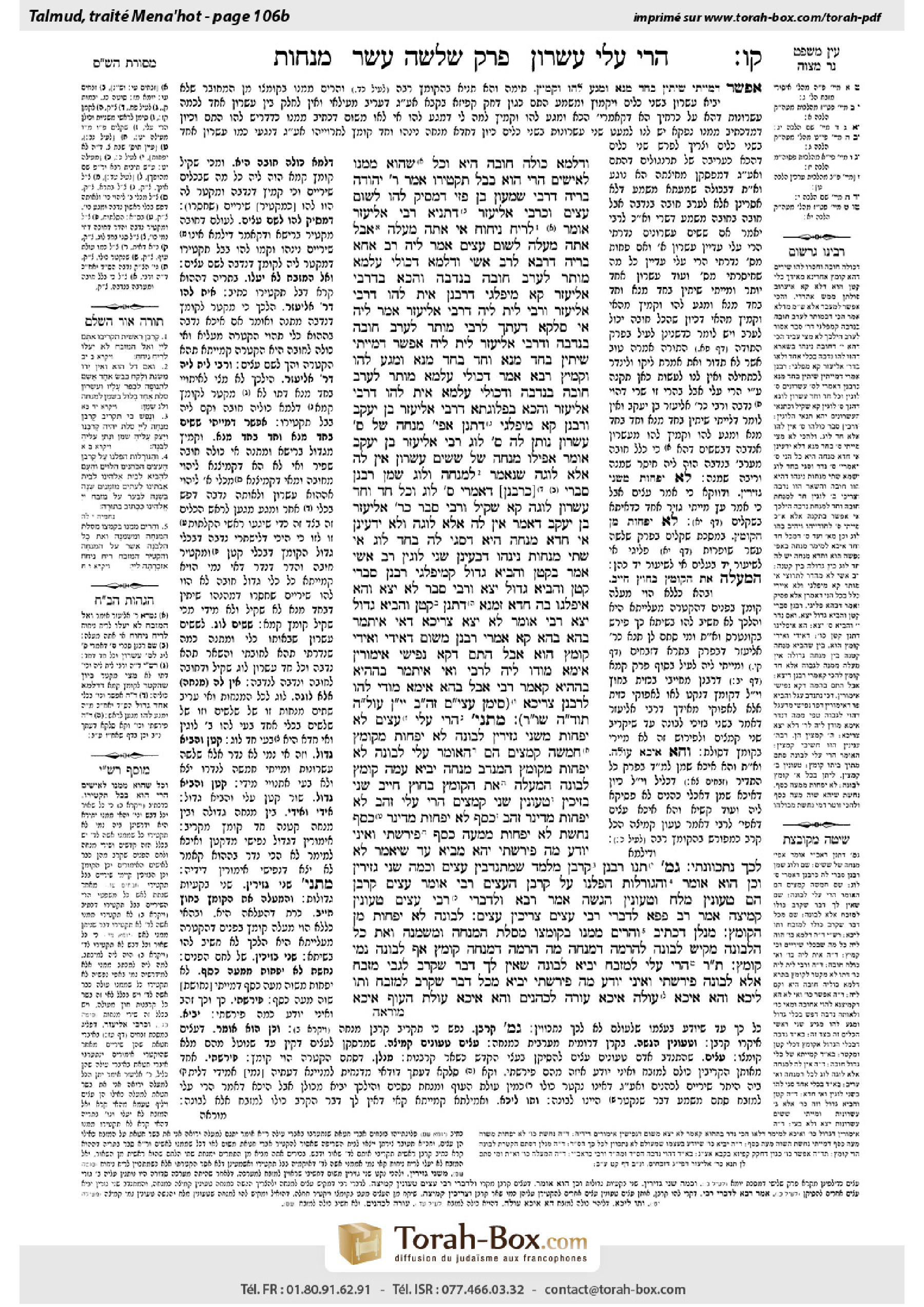
Menachot 106b: Talmud study for Daf Yomi
Daf Yomi is the daily study of one Talmud folio. Explore 37 tractates with scans, Hebrew text, Sefaria English and AI-generated French translations where annotated.
Passage selection and English or AI-generated French translation are available where the scan has annotations. Daf Study is independent of Torah-Box and Sefaria.
Browse Menachot · מנחות · All tractatesMenachot 106b text and translations
This page of Menachot includes the Aramaic text, an English translation and an AI-generated French translation, alongside the scan above.
מנחות ק״ו ב · Aramaic and Hebrew text
וְדִלְמָא כּוּלַּהּ חוֹבָה הִיא, וְכֹל שֶׁהוּא מִמֶּנּוּ לָאִישִּׁים הֲרֵי הוּא בְּ״בַל תַּקְטִירוּ״.
אָמַר רַבִּי יְהוּדָה בְּרֵיהּ דְּרַבִּי שִׁמְעוֹן בֶּן פַּזִּי: דְּמַסֵּיק לְהוּ לְשׁוּם עֵצִים, וּכְרַבִּי אֱלִיעֶזֶר. דְּתַנְיָא, רַבִּי אֱלִיעֶזֶר אוֹמֵר: לְרֵיחַ נִיחוֹחַ אִי אַתָּה מַעֲלֶה, אֲבָל אַתָּה מַעֲלֶה לְשׁוּם עֵצִים.
אֲמַר לֵיהּ רַב אַחָא בְּרֵיהּ דְּרָבָא לְרַב אָשֵׁי: וְדִלְמָא דְּכוּלֵּי עָלְמָא מוּתָּר לְעָרֵב חוֹבָה בִּנְדָבָה, וְהָכָא בִּדְרַבִּי אֱלִיעֶזֶר קָא מִיפַּלְגִי – דְּרַבָּנַן אִית לְהוּ דְּרַבִּי אֱלִיעֶזֶר, וְרַבִּי לֵית לֵיהּ דְּרַבִּי אֱלִיעֶזֶר?
אֲמַר לֵיהּ: אִי סָלְקָא דַעְתָּךְ לְרַבִּי מוּתָּר לְעָרֵב חוֹבָה בִּנְדָבָה, וּדְרַבִּי אֱלִיעֶזֶר לֵית לֵיהּ, אֶפְשָׁר דְּמַיְיתֵי שִׁיתִּין בְּחַד מָנָא, וְחַד בְּחַד מָנָא, וּמַגַּע לְהוּ, וְקָמֵיץ.
רָבָא אָמַר: דְּכוּלֵּי עָלְמָא מוּתָּר לְעָרֵב חוֹבָה בִּנְדָבָה, וּדְכוּלֵּי עָלְמָא אִית לְהוּ דְּרַבִּי אֱלִיעֶזֶר, וְהָכָא בִּפְלוּגְתָּא דְּרַבִּי אֱלִיעֶזֶר בֶּן יַעֲקֹב וְרַבָּנַן קָא מִיפַּלְגִי.
דִּתְנַן: אֲפִילּוּ מִנְחָה שֶׁל שִׁשִּׁים עִשָּׂרוֹן נוֹתֵן לָהּ שִׁשִּׁים לוֹג. רַבִּי אֱלִיעֶזֶר בֶּן יַעֲקֹב אוֹמֵר: אֲפִילּוּ מִנְחָה שֶׁל שִׁשִּׁים עִשָּׂרוֹן אֵין לָהּ אֶלָּא לוּגָּהּ, שֶׁנֶּאֱמַר: ״לְמִנְחָה וְלֹג שָׁמֶן״.
רַבָּנַן סָבְרִי [כְּרַבָּנַן], דְּאָמְרִי: שִׁשִּׁים לוֹג, וְכֹל חַד וְחַד עִשָּׂרוֹן – לוּגָּה קָא שָׁקֵיל.
וְרַבִּי סָבַר כְּרַבִּי אֱלִיעֶזֶר בֶּן יַעֲקֹב, דְּאָמַר אֵין לָהּ אֶלָּא לוּגָּהּ, וְלָא יָדְעִינַן אִי חֲדָא מִנְחָה הִיא – דְּסַגִּי לַהּ בְּחַד לוֹג, אִי שְׁתֵּי מְנָחוֹת נִינְהוּ – דְּבָעֵינַן שְׁנֵי לוּגִּין.
רַב אָשֵׁי אָמַר: בְּקָטָן וְהֵבִיא גָּדוֹל קָמִיפַּלְגִי. רַבָּנַן סָבְרִי: קָטָן וְהֵבִיא גָּדוֹל – יָצָא, וְרַבִּי סָבַר: לֹא יָצָא.
וְהָא אִיפְּלִגוּ בַּהּ חֲדָא זִמְנָא, דִּתְנַן: קָטָן וְהֵבִיא גָּדוֹל – יָצָא, רַבִּי אוֹמֵר: לֹא יָצָא.
צְרִיכָא, דְּאִי אִיתְּמַר בְּהָא – בְּהָא קָא אָמְרִי רַבָּנַן, מִשּׁוּם דְּאִידֵּי וְאִידֵּי קוֹמֶץ הוּא; אֲבָל הָתָם, דְּקָא נְפִישִׁי אֵימוּרִין – אֵימָא מוֹדוּ לֵיהּ לְרַבִּי.
וְאִי אִיתְּמַר בְּהָהִיא – בְּהַהִיא קָאָמַר רַבִּי, אֲבָל בְּהָא אֵימָא מוֹדֵי לְהוּ לְרַבָּנַן; צְרִיכָא.
סִימָן: עֵצִים, זָהָב, יַיִן, עוֹלָה, תּוֹדָה, שׁוֹר.
מַתְנִי׳ הֲרֵי עָלַי עֵצִים – לֹא יִפְחוֹת מִשְּׁנֵי גְזִירִין, לְבוֹנָה – לֹא יִפְחוֹת מִקּוֹמֶץ.
חֲמִשָּׁה קְמָצִים הֵם: הָאוֹמֵר ״עָלַי לְבוֹנָה״ – לֹא יִפְחוֹת מִקּוֹמֶץ, הַמְנַדֵּב מִנְחָה – יָבִיא עִמָּהּ קוֹמֶץ לְבוֹנָה, הַמַּעֲלֶה אֶת הַקּוֹמֶץ בַּחוּץ – חַיָּיב, שְׁנֵי בָּזִיכִין טְעוּנִין שְׁנֵי קְמָצִים.
״הֲרֵי עָלַי זָהָב״ – לֹא יִפְחוֹת מִדִּינַר זָהָב, ״כֶּסֶף״ – לֹא יִפְחוֹת מִדִּינַר כֶּסֶף, ״נְחֹשֶׁת״ – לֹא יִפְחוֹת מִמָּעָה כֶּסֶף. ״פֵּירַשְׁתִּי וְאֵינִי יוֹדֵעַ מָה פֵּירַשְׁתִּי״ – יְהֵא מֵבִיא עַד שֶׁיֹּאמַר ״לֹא לְכָךְ נִתְכַּוַּונְתִּי״.
גְּמָ׳ תָּנוּ רַבָּנַן: ״קׇרְבָּן״ – מְלַמֵּד שֶׁמִּתְנַדְּבִין עֵצִים, וְכַמָּה? שְׁנֵי גְּזִירִין. וְכֵן הוּא אוֹמֵר: ״וְהַגּוֹרָלוֹת הִפַּלְנוּ עַל קֻרְבַּן הָעֵצִים״. רַבִּי אוֹמֵר: עֵצִים קׇרְבָּן הֵם, טְעוּנִין מֶלַח וּטְעוּנִין הַגָּשָׁה.
אָמַר רָבָא: וּלְדִבְרֵי רַבִּי, עֵצִים טְעוּנִין קְמִיצָה. אָמַר רַב פָּפָּא: לְדִבְרֵי רַבִּי, עֵצִים צְרִיכִין עֵצִים.
לְבוֹנָה – לֹא יִפְחוֹת מִן הַקּוֹמֶץ. מְנָלַן? דִּכְתִיב: ״וְהֵרִים מִמֶּנּוּ בְּקֻמְצוֹ מִסֹּלֶת הַמִּנְחָה וּמִשַּׁמְנָהּ וְאֵת כׇּל הַלְּבֹנָה״. מַקִּישׁ לְבוֹנָה לַהֲרָמָה דְּמִנְחָה – מָה הֲרָמָה דְּמִנְחָה קוֹמֶץ, אַף לְבוֹנָה נָמֵי קוֹמֶץ.
תָּנוּ רַבָּנַן: ״הֲרֵי עָלַי לַמִּזְבֵּחַ״ – יָבִיא לְבוֹנָה, שֶׁאֵין לְךָ דָּבָר שֶׁקָּרֵב לְגַבֵּי מִזְבֵּחַ אֶלָּא לְבוֹנָה. ״פֵּירַשְׁתִּי וְאֵינִי יוֹדֵעַ מָה פֵּירַשְׁתִּי״ – יָבִיא מִכׇּל דָּבָר שֶׁקָּרֵב לַמִּזְבֵּחַ.
וְתוּ לֵיכָּא? וְהָא אִיכָּא עוֹלָה! אִיכָּא עוֹרָהּ לְכֹהֲנִים.
וְהָא אִיכָּא עוֹלַת הָעוֹף, אִיכָּא
Menachot 106b · English translation
But perhaps the vow was to bring sixty-tenths of an ephah, in which case the entire meal offering is necessary to fulfill the obligation. Consequently, only one handful may be removed, and all the rest is considered the remainder. And there is a principle: Whatever is partly burned in the fire on the altar is subject to the prohibition of: You may not make as an offering (see Leviticus 2:11). This principle states that if part of an item, such as the blood of an animal offering or the handful of a meal offering, has been sacrificed, one who sacrifices any other part of it that is not designated for sacrifice has violated a prohibition. In this case, the second handful is considered part of the remainder of the meal offering, and burning it is prohibited.
Rabbi Yehuda, son of Rabbi Shimon ben Pazi, said: The priest does not burn the oil as an offering but burns it for the sake of wood, i.e., not as a sacrificial rite, in accordance with the opinion of Rabbi Eliezer. As it is taught in a baraita that Rabbi Eliezer says: The verse states: “No meal offering that you shall bring unto the Lord shall be made with leaven; for you shall make no leaven, nor any honey, smoke from it as an offering made by fire unto the Lord. As an offering of first fruits you may bring them unto the Lord; but they shall not come up for a pleasing aroma on the altar” (Leviticus 2:11–12). This verse indicates that you may not offer up leaven and honey as a pleasing aroma, i.e., as an offering. But you may offer up leaven and honey and other substances for the sake of wood, not as an offering.
Rav Aḥa, son of Rava, said to Rav Ashi: But perhaps everyone agrees that it is permitted to mix an offering that fulfills an obligation together with a gift offering, and here Rabbi Yehuda HaNasi and the Rabbis disagree with regard to the statement of Rabbi Eliezer that it is permitted to burn on the altar as fuel even items that are prohibited from being burned as offerings. As the Rabbis accept the opinion of Rabbi Eliezer, and therefore they allow one to bring one meal offering of sixty-tenths of an ephah, since the handful removed from it may be burned, and Rabbi Yehuda HaNasi does not accept the opinion of Rabbi Eliezer.
Rav Ashi said to him: This cannot be the dispute, as if it enters your mind that according to Rabbi Yehuda HaNasi it is permitted to mix an offering brought as an obligation together with a gift offering, and he does not accept the opinion of Rabbi Eliezer, Rabbi Yehuda HaNasi would not require sixty separate vessels. Instead, one could bring sixty-tenths of an ephah in one vessel, and one additional tenth in one other vessel, from which the handful of the gift offering would be removed. And he could touch them, i.e., place them so they touch each other, so that they are considered as one, and the priest could then remove a handful from that tenth for the gift, and remove another handful from the vessel with sixty-tenths to fulfill the obligation.
Rava said that there is an alternative explanation of the dispute between the Rabbis and Rabbi Yehuda HaNasi: Everyone agrees that it is permitted to mix an offering brought as an obligation together with a gift offering, and everyone accepts the opinion of Rabbi Eliezer. And here they disagree with regard to the issue that is the subject of the dispute between Rabbi Eliezer ben Ya’akov and the Rabbis.
As we learned in a mishna (88a): Each tenth of an ephah of flour requires one log of oil. Accordingly, even if one brings a meal offering of sixty-tenths of an ephah of flour, one adds to it sixty log of oil. Rabbi Eliezer ben Ya’akov says: Each meal offering, irrespective of its volume, even a meal offering of sixty-tenths of an ephah of flour, requires only its single log of oil, as it is stated with regard to the offering brought by a poor leper on the day of his purification: “And a tenth of an ephah of fine flour mixed with oil for a meal offering, and a log of oil” (Leviticus 14:21). The juxtaposition of “a meal offering” with “a log of oil” teaches a principle that pertains to all meal offerings, that each offering requires only one log of oil.
Rava explains: The Rabbis in the mishna hold in accordance with the opinion of the Rabbis, who disagree with Rabbi Eliezer ben Ya’akov and who said: A meal offering of sixty-tenths of an ephah requires sixty log of oil. Therefore, in a case of uncertainty, it is possible to bring sixty-tenths of an ephah, and each and every measurement of one-tenth takes one log.
And Rabbi Yehuda HaNasi holds in accordance with the opinion of Rabbi Eliezer ben Ya’akov, who said that a meal offering of sixty-tenths of an ephah has only its one log of oil. And therefore, when one is uncertain about his vow and brings sixty-tenths, he cannot bring them with one log of oil, as we do not know whether the entire sixty-tenths is one meal offering, so that one log suffices for it, or whether they are two meal offerings, one that is obligatory and one that is a gift, which require two log of oil. For this reason, there is no way of resolving the uncertainty except by bringing sixty separate meal offerings, with one log of oil for each.
Rav Ashi said that there is alternative explanation of the disagreement between the Rabbis and Rabbi Yehuda HaNasi: They disagree with regard to the halakha of one who is obligated to bring a small offering and instead brings a large offering. The Rabbis hold that if one is obligated to bring a small offering and brings a large one instead he has fulfilled his obligation, and Rabbi Yehuda HaNasi holds that in such a case he has not fulfilled his obligation. Therefore, in the case of the uncertainty in the mishna, Rabbi Yehuda HaNasi holds that by bringing one meal offering of sixty-tenths of an ephah one does not fulfill his obligation if he vowed to bring a smaller offering.
The Gemara asks: But didn’t they already disagree about this topic once? As we learned in a mishna (107b) that if one said: It is incumbent upon me to bring a small bull, and he brought a large bull instead, he has fulfilled his obligation, as the value of a small bull is included in the value of a large bull. Rabbi Yehuda HaNasi says: He has not fulfilled his obligation, as the offering that he brought did not correspond to his vow.
The Gemara answers: It is necessary for the dispute to be mentioned with regard to both cases, as had their dispute been stated only with regard to this case of one who vows to bring a small meal offering and brings a large one instead, there would be room to reason that it is only in this case that the Rabbis say that he has fulfilled his obligation, because both this small meal offering and that large meal offering are identical with regard to the portion of the offering that is sacrificed on the altar; in both cases it is a handful. But there, in the case of one who vows to bring a small bull but brings a large one, since the sacrificial portions are greater, i.e., larger, there is room to say that the Rabbis concede to Rabbi Yehuda HaNasi that he has not fulfilled his obligation.
And had their dispute been stated only in that case of one who vows to bring a small bull and brings a big one, there would be room to reason that only in that case Rabbi Yehuda HaNasi says that the person has not fulfilled his obligation, because the sacrificial portions are larger. But in this case of bringing a large meal offering instead of a small one, there is room to say that Rabbi Yehuda HaNasi concedes to the opinion of the Rabbis. Therefore, it is necessary for the mishna to teach both cases.
§ The Gemara gives a mnemonic for the halakhot discussed in the upcoming mishnayot: Wood, gold, wine, burnt offering, thanks offering, bull.
MISHNA: One who says: It is incumbent upon me to donate pieces of wood as fuel for the altar, must donate no fewer than two logs. One who says: It is incumbent upon me to bring frankincense, must bring no less than a handful.
The mishna states tangentially: There are five halakhot pertaining to handfuls. One who says: It is incumbent upon me to bring an offering of frankincense, may not bring less than a handful. One who pledges to bring a meal offering must bring with it a handful of frankincense. One who intentionally offers up a handful of a meal offering outside the Temple courtyard is liable to receive excision from the World-to-Come [karet]. The two bowls of frankincense that accompany the shewbread are required to have two handfuls of frankincense.
One who says: It is incumbent upon me to donate gold to the Temple treasury, must give no less than a gold dinar. One who says: It is incumbent upon me to donate silver to the Temple treasury, must give no less than the value of a silver dinar. One who says: It is incumbent upon me to donate copper to the Temple maintenance, must give no less than the value of a silver ma’a. One who says: I specified the amount of gold, silver, or copper, but I do not know what I specified, must bring the maximum amount of gold, silver, or copper, until it reaches an amount where he says: I am certain that I did not intend to donate that much.
GEMARA: With regard to one who pledges to donate wood, the Sages taught in a baraita: The verse states: “And when one brings a meal offering [korban minḥa]” (Leviticus 2:1). The superfluous word “korban” teaches that one can voluntarily give wood as an offering for the altar. And how much wood must one bring if he does not specify an amount? Two logs. And the support for the fact that wood can be brought as a voluntary offering is as the verse states: “And we cast lots for the wood offering” (Nehemiah 10:35). Rabbi Yehuda HaNasi says: This voluntary donation of wood is an offering like a meal offering, and therefore it requires salt and requires bringing to the corner of the altar, like a meal offering.
Rava says: According to the statement of Rabbi Yehuda HaNasi, wood donated in this manner requires the removal of a handful; just as in the case of a meal offering, a portion of the wood must be removed and sacrificed separately. And Rav Pappa says that according to the statement of Rabbi Yehuda HaNasi, since it is an offering for the altar, the wood that is brought as an offering needs to be placed on other wood to burn, like any other offering that is burned on wood on the altar.
The mishna teaches: One who says: It is incumbent upon me to bring frankincense, may not bring less than a handful. The Gemara asks: From where do we derive this halakha? The Gemara answers: It is derived from a verse, as it is written: “And he shall take up from it his handful, of the fine flour of the meal offering, and of its oil, and all the frankincense which is upon the meal offering, and shall make the memorial part of it smoke upon the altar for an aroma pleasing to the Lord” (Leviticus 6:8). The Torah juxtaposes the frankincense with the taking up of a handful of the meal offering. This indicates that just as the taking up from a meal offering is referring to a handful, so too, the minimum size of a frankincense offering is also a handful.
§ The Sages taught in a baraita which discusses vows to bring frankincense that one who says: It is incumbent upon me to bring to the altar, and does not specify what he will bring, must bring frankincense, as you have nothing that is entirely sacrificed on the altar other than frankincense. One who says: I specified what I intended to bring to the altar, but I do not know what I specified, must bring one of everything that is sacrificed on the altar.
The Gemara asks: And is there nothing else that is entirely sacrificed on the altar other than frankincense? But isn’t there a burnt offering, which is entirely burned on the altar? The Gemara answers that there is its hide, which is given to the priests and not burned on the altar.
The Gemara asks: But isn’t there a bird burnt offering, which is entirely burned on the altar, including its skin? The Gemara answers: There are
Menachot 106b · Traduction française (IA)
Mais peut-être avait-il fait vœu d’apporter soixante dixièmes d’épha, auquel cas toute l’offrande végétale est nécessaire pour s’acquitter de son obligation. On ne peut donc en prélever qu’une seule poignée, et tout le reste est considéré comme le reste. Or, il existe un principe : tout élément dont une partie est brûlée sur le feu de l’autel est soumis à l’interdit énoncé ainsi : « Tu n’en feras pas une offrande » (voir Lévitique 2,11). Ce principe signifie que si une partie d’un élément, comme le sang d’une offrande animale ou la poignée d’une offrande végétale, a été sacrifiée, celui qui en sacrifie une autre partie qui n’est pas destinée au sacrifice transgresse un interdit. En l’occurrence, la deuxième poignée est considérée comme faisant partie du reste de l’offrande végétale, et il est interdit de la brûler.
Rabbi Yehouda, fils de Rabbi Shimon ben Pazi, dit : Le prêtre ne brûle pas l’huile comme une offrande, mais la brûle comme combustible, c’est-à-dire sans accomplir de rite sacrificiel, conformément à l’opinion de Rabbi Eliezer. En effet, il est enseigné dans une baraïta que Rabbi Eliezer dit : Le verset énonce : « Aucune offrande végétale que vous apporterez à l’Éternel ne sera faite avec du levain ; car vous ne ferez fumer ni levain ni miel comme offrande consumée par le feu pour l’Éternel. Vous pourrez les apporter à l’Éternel comme offrande des prémices ; mais ils ne monteront pas sur l’autel comme une odeur agréable » (Lévitique 2,11-12). Ce verset indique qu’on ne peut pas offrir du levain et du miel comme une odeur agréable, c’est-à-dire comme une offrande. Mais on peut faire brûler du levain, du miel et d’autres substances comme combustible, et non comme offrande.
Rav Aḥa, fils de Rava, dit à Rav Ashi : Mais peut-être tous sont-ils d’accord qu’il est permis de mélanger une offrande obligatoire et une offrande volontaire, et que Rabbi Yehouda HaNassi et les Rabbins divergent ici au sujet de l’affirmation de Rabbi Eliezer selon laquelle il est permis de brûler sur l’autel comme combustible même des éléments qu’il est interdit d’y brûler comme offrandes. Les Rabbins acceptent l’opinion de Rabbi Eliezer et permettent donc d’apporter une seule offrande végétale de soixante dixièmes d’épha, puisque la poignée prélevée peut être brûlée ; Rabbi Yehouda HaNassi, lui, n’accepte pas l’opinion de Rabbi Eliezer.
Rav Ashi lui dit : Ce ne peut pas être là le motif de leur désaccord. Car si l’on pouvait envisager que, selon Rabbi Yehouda HaNassi, il soit permis de mélanger une offrande obligatoire et une offrande volontaire, mais qu’il n’accepte pas l’opinion de Rabbi Eliezer, Rabbi Yehouda HaNassi n’exigerait pas soixante récipients distincts. On pourrait plutôt apporter soixante dixièmes d’épha dans un récipient et un dixième supplémentaire dans un autre récipient, dont on prélèverait la poignée de l’offrande volontaire. On pourrait les mettre en contact, c’est-à-dire les placer de manière qu’ils se touchent, afin qu’ils soient considérés comme un seul ensemble ; le prêtre pourrait alors prélever une poignée de ce dixième pour l’offrande volontaire, puis une autre poignée du récipient contenant les soixante dixièmes pour s’acquitter de l’obligation.
Rava propose une autre explication du désaccord entre les Rabbins et Rabbi Yehouda HaNassi : tous sont d’accord qu’il est permis de mélanger une offrande obligatoire et une offrande volontaire, et tous acceptent l’opinion de Rabbi Eliezer. Leur désaccord porte ici sur la question qui fait l’objet du différend entre Rabbi Eliezer ben Ya’akov et les Rabbins.
En effet, nous avons appris dans une Michna (88a) : chaque dixième d’épha de farine requiert un log d’huile. Ainsi, même si l’on apporte une offrande végétale de soixante dixièmes d’épha de farine, on y ajoute soixante log d’huile. Rabbi Eliezer ben Ya’akov dit : chaque offrande végétale, quel que soit son volume, même une offrande végétale de soixante dixièmes d’épha de farine, ne requiert qu’un seul log d’huile, comme il est dit au sujet de l’offrande apportée par un lépreux pauvre le jour de sa purification : « Un dixième d’épha de fleur de farine mêlée d’huile, comme offrande végétale, et un log d’huile » (Lévitique 14,21). La juxtaposition de « offrande végétale » et de « un log d’huile » enseigne un principe applicable à toutes les offrandes végétales : chacune ne requiert qu’un seul log d’huile.
Rava explique : les Rabbins de la Michna suivent l’opinion des Rabbins qui sont en désaccord avec Rabbi Eliezer ben Ya’akov et qui disent qu’une offrande végétale de soixante dixièmes d’épha requiert soixante log d’huile. Par conséquent, en cas de doute, il est possible d’apporter soixante dixièmes d’épha, chacun des dixièmes nécessitant un log.
Rabbi Yehouda HaNassi suit l’opinion de Rabbi Eliezer ben Ya’akov, qui dit qu’une offrande végétale de soixante dixièmes d’épha ne requiert qu’un seul log d’huile. Par conséquent, lorsqu’on doute de la nature de son vœu et qu’on apporte soixante dixièmes, on ne peut les apporter avec un seul log d’huile, car on ne sait pas si les soixante dixièmes constituent une seule offrande végétale, auquel cas un log suffit, ou s’il s’agit de deux offrandes végétales, l’une obligatoire et l’autre volontaire, qui requièrent deux log d’huile. Pour cette raison, il n’y a aucun moyen de résoudre le doute si ce n’est d’apporter soixante offrandes végétales distinctes, chacune avec un log d’huile.
Rav Ashi propose une autre explication du désaccord entre les Rabbins et Rabbi Yehouda HaNassi : ils divergent sur la halakha concernant celui qui est tenu d’apporter une petite offrande, mais en apporte une grande. Les Rabbins estiment que s’il est tenu d’apporter une petite offrande et en apporte une grande à la place, il s’est acquitté de son obligation ; Rabbi Yehouda HaNassi estime qu’en pareil cas, il ne s’en est pas acquitté. Par conséquent, dans le cas du doute présenté dans la Michna, Rabbi Yehouda HaNassi estime qu’en apportant une seule offrande végétale de soixante dixièmes d’épha, on ne s’acquitte pas de son obligation si l’on avait fait vœu d’apporter une offrande plus petite.
La Guemara demande : Mais n’ont-ils pas déjà divergé une fois sur ce sujet ? Nous avons appris dans une Michna (107b) que si quelqu’un dit : « Je m’engage à apporter un petit taureau », puis apporte un grand taureau à la place, il s’est acquitté de son obligation, puisque la valeur d’un petit taureau est comprise dans celle d’un grand taureau. Rabbi Yehouda HaNassi dit : Il ne s’en est pas acquitté, car l’offrande qu’il a apportée ne correspondait pas à son vœu.
La Guemara répond : Il est nécessaire de rapporter leur désaccord dans les deux cas. En effet, si leur désaccord n’était énoncé que dans le cas de celui qui fait vœu d’apporter une petite offrande végétale et en apporte une grande à la place, on pourrait penser que les Rabbins disent qu’il s’est acquitté de son obligation uniquement dans ce cas, parce que la partie de la petite offrande végétale et celle de la grande qui est sacrifiée sur l’autel sont identiques : dans les deux cas, il s’agit d’une poignée. Mais dans le cas de celui qui fait vœu d’apporter un petit taureau et en apporte un grand, puisque les parties sacrificielles sont plus importantes, c’est-à-dire plus grandes, on pourrait penser que les Rabbins reconnaissent l’opinion de Rabbi Yehouda HaNassi et estiment qu’il ne s’est pas acquitté de son obligation.
Et si leur désaccord n’était énoncé que dans le cas de celui qui fait vœu d’apporter un petit taureau et en apporte un grand, on pourrait penser que Rabbi Yehouda HaNassi dit que la personne ne s’est pas acquittée de son obligation uniquement dans ce cas, parce que les parties sacrificielles sont plus grandes. Mais dans le cas où l’on apporte une grande offrande végétale à la place d’une petite, on pourrait penser que Rabbi Yehouda HaNassi reconnaît l’opinion des Rabbins. Il est donc nécessaire que la Michna enseigne les deux cas.
§ La Guemara donne un moyen mnémotechnique pour les halakhot examinées dans les Michnayot à venir : bois, or, vin, holocauste, sacrifice de reconnaissance, taureau.
MICHNA : Celui qui dit : « Je m’engage à donner des morceaux de bois comme combustible pour l’autel » doit en donner au moins deux bûches. Celui qui dit : « Je m’engage à apporter de l’encens » doit en apporter au moins une poignée.
La Michna mentionne incidemment cinq halakhot concernant les poignées. Celui qui dit : « Je m’engage à apporter une offrande d’encens » ne peut en apporter moins d’une poignée. Celui qui fait vœu d’apporter une offrande végétale doit y joindre une poignée d’encens. Celui qui offre intentionnellement une poignée d’une offrande végétale en dehors de la cour du Temple est passible du retranchement du Monde à venir [karet]. Les deux coupes d’encens qui accompagnent les pains de proposition doivent contenir deux poignées d’encens.
Celui qui dit : « Je m’engage à donner de l’or au trésor du Temple » doit donner au moins un dinar d’or. Celui qui dit : « Je m’engage à donner de l’argent au trésor du Temple » doit donner au moins l’équivalent d’un dinar d’argent. Celui qui dit : « Je m’engage à donner du cuivre pour l’entretien du Temple » doit donner au moins l’équivalent d’une ma’a d’argent. Celui qui dit : « J’avais précisé la quantité d’or, d’argent ou de cuivre, mais je ne me souviens pas de ce que j’avais précisé » doit apporter la quantité maximale d’or, d’argent ou de cuivre, jusqu’à ce qu’il atteigne une quantité dont il dit : « Je suis certain que je n’avais pas l’intention d’en donner autant. »
Guemara : Au sujet de celui qui fait vœu de donner du bois, les Sages enseignent dans une baraïta : Le verset énonce : « Lorsqu’un homme apporte une offrande [korban minḥa] » (Lévitique 2,1). Le mot superflu « korban » enseigne qu’on peut donner volontairement du bois comme offrande pour l’autel. Quelle quantité de bois doit-on apporter si l’on n’en a pas précisé la quantité ? Deux bûches. La preuve que le bois peut être apporté comme offrande volontaire se trouve dans le verset : « Nous avons tiré au sort au sujet de l’offrande de bois » (Néhémie 10,35). Rabbi Yehouda HaNassi dit : Ce don volontaire de bois est une offrande semblable à une offrande végétale ; il requiert donc du sel et doit être apporté à l’angle de l’autel, comme une offrande végétale.
Rava dit : Selon Rabbi Yehouda HaNassi, le bois donné de cette manière requiert le prélèvement d’une poignée ; comme dans le cas d’une offrande végétale, une partie du bois doit être prélevée et sacrifiée séparément. Rav Pappa dit que, selon Rabbi Yehouda HaNassi, puisque le bois est une offrande destinée à l’autel, le bois apporté comme offrande doit être placé sur d’autres bûches pour brûler, comme toute autre offrande brûlée sur du bois, sur l’autel.
La Michna enseigne : Celui qui dit : « Je m’engage à apporter de l’encens » ne peut en apporter moins d’une poignée. La Guemara demande : D’où déduisons-nous cette halakha ? La Guemara répond : Elle est déduite d’un verset, comme il est écrit : « Il en prélèvera une poignée, de la fleur de farine de l’offrande végétale, de son huile, ainsi que tout l’encens qui se trouve sur l’offrande végétale, et il fera fumer sur l’autel sa part de souvenir, en odeur agréable pour l’Éternel » (Lévitique 6,8). La Torah met l’encens en rapport avec le prélèvement d’une poignée de l’offrande végétale. Cela indique que, de même que le prélèvement sur une offrande végétale désigne une poignée, de même la quantité minimale d’une offrande d’encens est une poignée.
§ Les Sages enseignent dans une baraïta traitant des vœux d’apporter de l’encens que celui qui dit : « Je m’engage à apporter à l’autel », sans préciser ce qu’il apportera, doit apporter de l’encens, car il n’y a rien d’autre qui soit entièrement sacrifié sur l’autel. Celui qui dit : « J’avais précisé ce que j’avais l’intention d’apporter à l’autel, mais je ne me souviens pas de ce que j’avais précisé » doit apporter un exemplaire de chaque élément sacrifié sur l’autel.
La Guemara demande : N’y a-t-il rien d’autre que l’encens qui soit entièrement sacrifié sur l’autel ? Mais il y a l’holocauste, qui est entièrement brûlé sur l’autel. La Guemara répond qu’il en reste la peau, qui est donnée aux prêtres et n’est pas brûlée sur l’autel.
La Guemara demande : Mais n’y a-t-il pas l’holocauste d’un oiseau, qui est entièrement brûlé sur l’autel, peau comprise ? La Guemara répond : Il y a
Traduction française générée par IA à partir de l’édition anglaise de Sefaria. Vérifie toujours un passage avec le texte source.
Text from Sefaria: William Davidson Edition - Vocalized Aramaic (unknown); William Davidson Edition - English (CC BY NC).