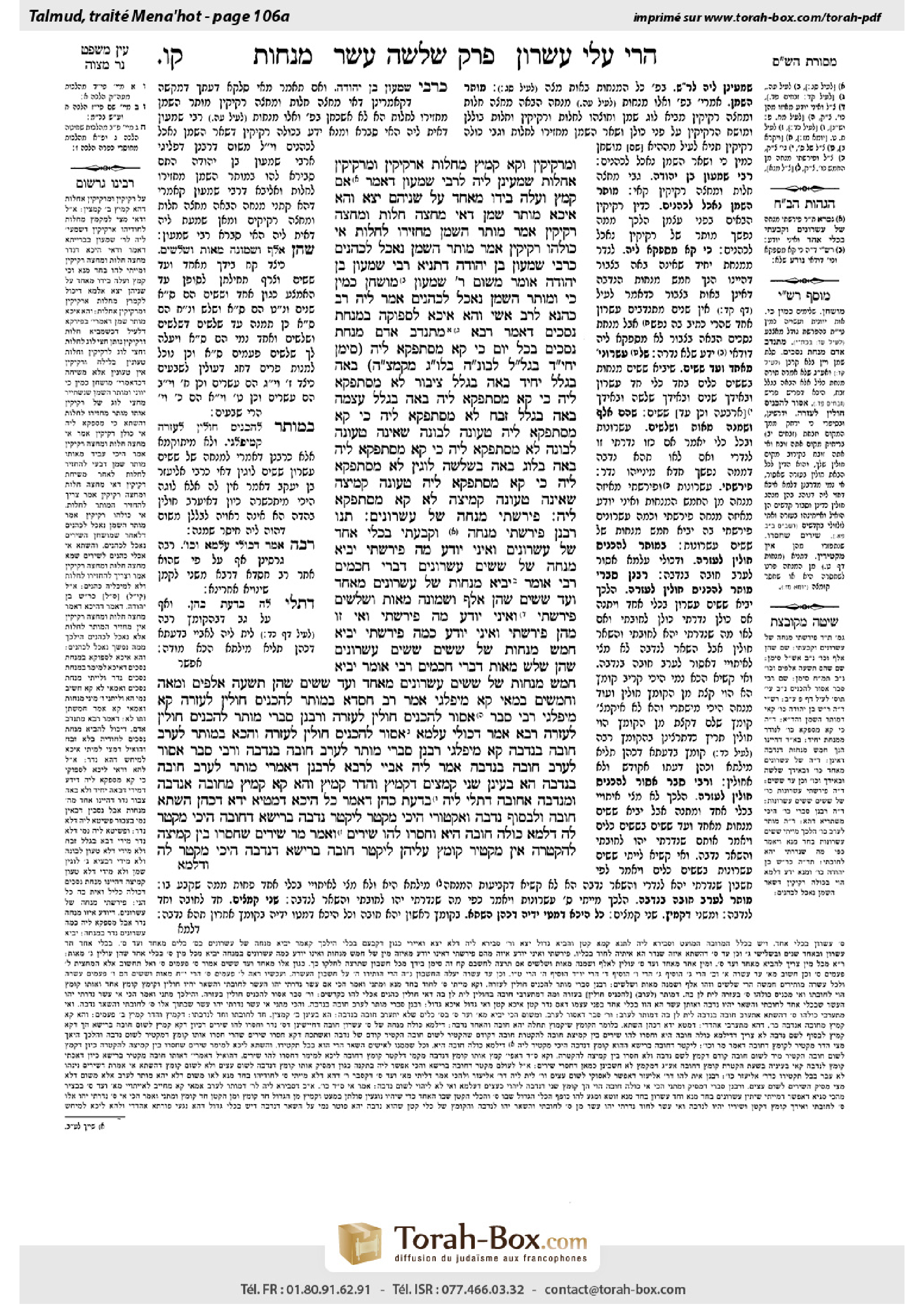
Menachot 106a: Talmud study for Daf Yomi
Daf Yomi is the daily study of one Talmud folio. Explore 37 tractates with scans, Hebrew text, Sefaria English and AI-generated French translations where annotated.
Passage selection and English or AI-generated French translation are available where the scan has annotations. Daf Study is independent of Torah-Box and Sefaria.
Browse Menachot · מנחות · All tractatesMenachot 106a text and translations
This page of Menachot includes the Aramaic text, an English translation and an AI-generated French translation, alongside the scan above.
מנחות ק״ו א · Aramaic and Hebrew text
וּמֵרְקִיקִין, וְקָא קָמֵיץ מֵחַלּוֹת אַרְקִיקִין וּמֵרְקִיקִין אַחַלּוֹת.
שָׁמְעִינַן לֵיהּ לְרַבִּי שִׁמְעוֹן, דְּאָמַר: אִם קָמַץ וְעָלָה בְּיָדוֹ מֵאֶחָד עַל שְׁנֵיהֶם – יָצָא.
וְהָא אִיכָּא מוֹתַר שֶׁמֶן, דְּאִי מֶחֱצָה חַלּוֹת וּמֶחֱצָה רְקִיקִין אָמַר – מוֹתַר הַשֶּׁמֶן מַחְזִירוֹ לַחַלּוֹת, אִי כּוּלְּהוּ רְקִיקִין אָמַר – מוֹתַר הַשֶּׁמֶן נֶאֱכָל לַכֹּהֲנִים.
כְּרַבִּי שִׁמְעוֹן בֶּן יְהוּדָה, דְּתַנְיָא: רַבִּי שִׁמְעוֹן בֶּן יְהוּדָה אוֹמֵר מִשּׁוּם רַבִּי שִׁמְעוֹן: מוֹשְׁחָן כְּמִין כִּי, וּמוֹתַר הַשֶּׁמֶן נֶאֱכָל לַכֹּהֲנִים.
אֲמַר לֵיהּ רַב כָּהֲנָא לְרַב אָשֵׁי: וְהָא אִיכָּא לְסַפּוֹקַהּ בְּמִנְחַת נְסָכִים, דְּאָמַר רָבָא: מִתְנַדֵּב אָדָם מִנְחַת נְסָכִים בְּכׇל יוֹם.
כִּי קָא מִסְתַּפְּקָא לֵיהּ (סִימָן: ״יָחִיד״, ״בִּגְלַל״, ״לְבוֹנָה״, ״בְּלוֹג״, ״מְקַמְּצָה״) –
בָּאָה בִּגְלַל יָחִיד, בָּאָה בִּגְלַל צִיבּוּר – לָא מִסְתַּפְּקָא לֵיהּ.
כִּי קָא מִסְתַּפְּקָא לֵיהּ – בָּאָה בִּגְלַל עַצְמָהּ, בָּאָה בִּגְלַל זֶבַח – לָא מִסְתַּפְּקָא לֵיהּ.
כִּי קָא מִסְתַּפְּקָא לֵיהּ – טְעוּנָה לְבוֹנָה, שֶׁאֵינָהּ טְעוּנָה לְבוֹנָה – לָא מִסְתַּפְּקָא לֵיהּ.
כִּי קָא מִסְתַּפְּקָא לֵיהּ – בָּאָה בְּלוֹג, בָּאָה בִּשְׁלֹשָׁה לוּגִּין – לָא מִסְתַּפְּקָא לֵיהּ.
כִּי קָא מִסְתַּפְּקָא לֵיהּ – טְעוּנָה קְמִיצָה, שֶׁאֵינָהּ טְעוּנָה קְמִיצָה – לָא קָא מִסְתַּפְּקָא לֵיהּ.
״פֵּירַשְׁתִּי מִנְחָה שֶׁל עֶשְׂרוֹנִים״.
תָּנוּ רַבָּנַן: ״פֵּירַשְׁתִּי מִנְחָה, וְקָבַעְתִּי בִּכְלִי אֶחָד שֶׁל עֶשְׂרוֹנִים, וְאֵינִי יוֹדֵעַ מָה פֵּירַשְׁתִּי״ – יָבִיא מִנְחָה שֶׁל שִׁשִּׁים עֶשְׂרוֹנִים, דִּבְרֵי חֲכָמִים. רַבִּי אוֹמֵר: יָבִיא מְנָחוֹת שֶׁל עֶשְׂרוֹנִים מֵאֶחָד וְעַד שִׁשִּׁים, שֶׁהֵן אֶלֶף וּשְׁמוֹנֶה מֵאוֹת וּשְׁלֹשִׁים.
״פֵּירַשְׁתִּי וְאֵינִי יוֹדֵעַ מָה פֵּירַשְׁתִּי, וְאִי זוֹ מֵהֶן פֵּירַשְׁתִּי, וְאֵינִי יוֹדֵעַ כַּמָּה פֵּירַשְׁתִּי״ – יָבִיא חָמֵשׁ מְנָחוֹת שֶׁל שִׁשִּׁים שִׁשִּׁים עֶשְׂרוֹנִים, שֶׁהֵן שְׁלֹשׁ מֵאוֹת, דִּבְרֵי חֲכָמִים. רַבִּי אוֹמֵר: יָבִיא חָמֵשׁ מְנָחוֹת שֶׁל שִׁשִּׁים עֶשְׂרוֹנִים מֵאֶחָד וְעַד שִׁשִּׁים, שֶׁהֵן תִּשְׁעָה אֲלָפִים וּמֵאָה וַחֲמִשִּׁים.
בְּמַאי קָא מִיפַּלְגִי? אָמַר רַב חִסְדָּא: בְּמוּתָּר לְהַכְנִיס חוּלִּין לָעֲזָרָה קָא מִיפַּלְגִי, רַבִּי סָבַר: אָסוּר לְהַכְנִיס חוּלִּין לָעֲזָרָה, וְרַבָּנַן סָבְרִי: מוּתָּר לְהַכְנִיס חוּלִּין לָעֲזָרָה.
רָבָא אָמַר: דְּכוּלֵּי עָלְמָא אָסוּר לְהַכְנִיס חוּלִּין לָעֲזָרָה, וְהָכָא בְּמוּתָּר לְעָרֵב חוֹבָה בִּנְדָבָה קָא מִיפַּלְגִי.
רַבָּנַן סָבְרִי: מוּתָּר לְעָרֵב חוֹבָה בִּנְדָבָה, וְרַבִּי סָבַר: אָסוּר לְעָרֵב חוֹבָה בִּנְדָבָה.
אֲמַר לֵיהּ אַבָּיֵי לְרָבָא: לְרַבָּנַן דְּאָמְרִי מוּתָּר לְעָרֵב חוֹבָה בִּנְדָבָה, הָא בָּעֵינַן שְׁנֵי קְמָצִים? דְּקָמֵיץ וַהֲדַר קָמֵיץ.
וְהָא קָא קָמֵיץ מֵחוֹבָה אַנְּדָבָה וּמִנְּדָבָה אַחוֹבָה!
דְּתָלֵי לֵיהּ בְּדַעַת כֹּהֵן, דְּאָמַר: כֹּל הֵיכָא דְּמָטְיָא יְדָא דְּכֹהֵן הַשְׁתָּא – חוֹבָה, וּלְבַסּוֹף – נְדָבָה.
וְאַקְטוֹרֵי הֵיכִי מַקְטַר? לַיקְטַר נְדָבָה בְּרֵישָׁא – דְּחוֹבָה הֵיכִי מַקְטַר לַהּ? דִּלְמָא כּוּלַּהּ חוֹבָה הִיא, וְחָסְרוּ לְהוּ שִׁירַיִם.
וְאָמַר מָר: שִׁירַיִם שֶׁחָסְרוּ בֵּין קְמִיצָה לְהַקְטָרָה – אֵין מַקְטִיר קוֹמֶץ עֲלֵיהֶן!
לַיקְטַר חוֹבָה בְּרֵישָׁא – דִּנְדָבָה הֵיכִי מַקְטַר לַהּ?
Menachot 106a · English translation
and wafers together; and according to this suggestion, he removes a handful from the loaves for the wafers and a handful from the wafers for the loaves.
The Gemara answers: We have heard that Rabbi Shimon said: If one brought a meal offering that is part loaves and part wafers, and the priest removed a handful, and that which came up in his hand was only from one of the two types, either only loaves or only wafers, he has fulfilled his obligation of removing a handful.
The Gemara asks: But isn’t there a problem with the surplus oil? The Gemara (75a) states that if a meal offering is brought half as loaves and half as wafers, the oil is divided equally between them; half is mixed with the loaves and half is applied to the wafers. The surplus oil from the wafers may also be mixed in with the loaves. But if the meal offering is baked entirely as wafers, the oil that remains is given to the priests. Therefore, Abaye’s explanation of the mishna is problematic, because if the person said in his vow that he would bring half loaves and half wafers, one brings back the surplus oil and mixes it in with the loaves. But if he said that the entire offering shall be wafers, the surplus oil should be eaten by the priests.
The Gemara resolves this problem in accordance with the statement of Rabbi Shimon ben Yehuda. As it is taught in a baraita that Rabbi Shimon ben Yehuda says in the name of Rabbi Shimon that the oil of a meal offering baked half as loaves and half as wafers is applied as follows: One anoints the wafers in the shape of the Greek letter chi, Χ, and the surplus oil is eaten by the priests. Consequently, the surplus oil of a meal offering baked half as loaves and half as wafers is used the same way as that of a meal offering baked entirely as wafers.
§ Rav Kahana said to Rav Ashi: If one specifies in his vow which meal offering he will bring, and subsequently forgets, why does he bring only five types of meal offerings? Isn’t there room to be uncertain with regard to another type of meal offering, namely, the meal offering brought with the libations that accompany various burnt offerings? This meal offering can also be brought independently as a gift, as Rava said: A person may volunteer a meal offering brought with the libations every day, if he so wishes.
The Gemara answers that there is no uncertainty with regard to the possibility that he said that he would bring a meal offering brought with the libations, because it is completely different than the other types of meal offerings. When one is uncertain as to which meal offering he vowed to bring, the uncertainty is only with regard to certain meal offerings. The Gemara presents a mnemonic for these differences: Individual, due to, frankincense, with a log, removes a handful of it.
The Gemara elaborates: The uncertainty with regard to which meal offering one vowed to bring is with regard to a meal offering that is brought exclusively due to the obligation of an individual. But one is not uncertain with regard to a meal offering that is brought due to the obligation of the public, e.g., a meal offering brought with libations, which accompany communal offerings as well as individual ones; he certainly did not vow to bring this type of meal offering.
Furthermore, when one is uncertain it is with regard to a meal offering that is brought due to its own obligation. But one is not uncertain with regard to a meal offering brought with libations due to the requirements of an offering.
When one is uncertain it is with regard to a meal offering that requires that frankincense be brought with it. But one is not uncertain with regard to a meal offering brought with libations, which does not require frankincense.
When one is uncertain, it is with regard to a type of meal offering that is brought with one log of oil. But one is not uncertain if it is brought with three log of oil or more, which is the halakha with regard to meal offerings brought with libations (see Numbers 15:5–6, 9).
When one is uncertain it is only with regard to a meal offering that requires removal of a handful. But one is not uncertain with regard to a meal offering that does not require removal of a handful, which is the halakha with regard to a meal offering brought with libations.
§ The mishna teaches: If one says: I specified a meal offering of tenths of an ephah but I do not remember how many I specified, according to the Rabbis he must bring a meal offering of sixty-tenths of an ephah. According to Rabbi Yehuda HaNasi he must bring sixty meal offerings, each with a different number of tenths, from one to sixty.
The Sages taught in a baraita: If one says: I specified that I would bring a meal offering, and I established that they must be brought in one vessel of tenths of an ephah, but I do not know what number of tenths I specified, he must bring one meal offering of sixty-tenths of an ephah. This is the statement of the Rabbis. Rabbi Yehuda HaNasi says: He must bring sixty meal offerings of tenths in sixty vessels, each containing an amount from one-tenth until sixty-tenths, which are in total 1,830 tenths of an ephah.
The baraita continues: If one said: I specified a certain type of meal offering with a certain number of tenths of an ephah to be brought in one vessel, but I do not know what I specified, or which type of meal offering I specified, and I do not know how many tenths of an ephah I specified, he must bring the five different types of meal offerings, and each one must contain sixty-tenths of an ephah, which are in total three-hundred-tenths of an ephah. This is the statement of the Rabbis. Rabbi Yehuda HaNasi says: He must bring five different types of meal offerings, and for each type he must bring sixty meal offerings, each with a different number of tenths, from one until sixty, which are in total 9,150 tenths of an ephah.
The Gemara asks: With regard to what principle do the Rabbis and Rabbi Yehuda HaNasi disagree? Rav Ḥisda said: They disagree with regard to whether it is permitted to bring non-sacred items into the Temple courtyard. Rabbi Yehuda HaNasi holds that it is prohibited to bring non-sacred items into the Temple courtyard. Therefore, it is necessary to bring sixty meal offerings of each type, as if one merely brings one meal offering of sixty-tenths of an ephah in a single vessel, he may be in violation of this prohibition, as it is possible that he vowed to bring less than that amount, and the surplus amount is non-sacred. And the Rabbis hold that it is permitted to bring non-sacred items into the Temple courtyard. Therefore, even if the meal offering is of a greater volume than necessary, it is inconsequential.
Rava said that the dispute between the Rabbis and Rabbi Yehuda HaNasi is with regard to a different issue: Everyone agrees that it is prohibited to bring non-sacred items into the Temple courtyard, and here they disagree with regard to whether it is permitted to mix an offering that fulfills an obligation together with a gift offering.
The Rabbis hold that it is permitted to mix an offering that fulfills an obligation together with a gift offering, and therefore one may bring sixty-tenths in one vessel and stipulate that the amount beyond his obligation will be a gift offering. And Rabbi Yehuda HaNasi holds that it is prohibited to mix an offering that fulfills an obligation together with a gift offering, and therefore one cannot make such a stipulation; every possible meal offering requires its own vessel. Concerning each vessel, he stipulates that if this one can fulfill his vow, it should count as fulfillment of his vow, and otherwise it should serve as a gift offering.
Abaye said to Rava: According to the Rabbis, who say that it is permitted to mix an offering that fulfills an obligation together with a gift offering, and one vessel with sixty-tenths of an ephah can serve in part to fulfill the obligation and in part as a gift offering, there is a difficulty: Don’t we require the removal of two handfuls, one for the obligatory meal offering and one for the gift offering? Rava answered: According to the Rabbis, it is required that the priest removes a handful and again removes a handful.
Abaye said to Rava: But if so, since the tenths that fulfill an obligation and the tenths that are a gift are mixed together in a single vessel, when the priest removes a handful, isn’t he removing a handful from tenths that fulfill an obligation to account for tenths that are a gift offering, and removing a handful from tenths that are a gift offering to account for tenths that fulfill an obligation?
Rava answered Abaye: This is not difficult, as the one who brings the meal offering renders it dependent on the intent of the priest, as he says: Wherever the priest’s hand reaches now, when he removes the first handful, shall be the location of the tenths that fulfill my obligation, and wherever his hand reaches at the end, when removing the second handful, shall be a gift offering.
Abaye asked Rava: But how does the priest burn the handful upon the altar? If the priest will burn the handful from the gift offering first, how can he then burn the handful of the tenths that fulfill the obligation? Perhaps the entire meal offering is for the obligation, as the vow was to bring sixty-tenths of an ephah, and everything apart from the first handful, including the second handful, is the remainder, and by burning part of it the priest causes the remainder to be lacking.
And the Master said: With regard to the remainder of a meal offering that became lacking between the removal of the handful and the burning of the handful upon the altar, the halakha is that one does not burn the handful on its account, as it is not considered a valid meal offering.
Alternatively, if the priest will burn the handful that fulfills the obligation first, how can he burn the handful of the gift offering?
Menachot 106a · Traduction française (IA)
et des galettes ensemble ; selon cette hypothèse, il prélève une poignée sur les pains pour les galettes, et une poignée sur les galettes pour les pains.
La Guemara répond : Nous avons appris que Rabbi Chimon a dit : Si quelqu’un apporte une offrande de farine composée pour moitié de pains et pour moitié de galettes, et que le prêtre en prélève une poignée, mais que celle-ci ne contient que l’un des deux types, soit uniquement des pains, soit uniquement des galettes, il s’est acquitté de son obligation de prélever une poignée.
La Guemara demande : Mais le surplus d’huile ne pose-t-il pas problème ? La Guemara (75a) enseigne que si une offrande de farine est apportée pour moitié sous forme de pains et pour moitié sous forme de galettes, l’huile est répartie également entre les deux : la moitié est mêlée aux pains et l’autre moitié est appliquée sur les galettes. Le surplus d’huile des galettes peut également être mêlé aux pains. Mais si l’offrande de farine est entièrement préparée sous forme de galettes, l’huile restante est donnée aux prêtres. L’explication d’Abayé sur la Michna pose donc problème : si la personne a dit dans son vœu qu’elle apporterait pour moitié des pains et pour moitié des galettes, on rapporte le surplus d’huile et on le mêle aux pains. Mais si elle a dit que l’offrande entière serait composée de galettes, le surplus d’huile devrait être mangé par les prêtres.
La Guemara résout ce problème conformément à l’enseignement de Rabbi Chimon ben Yehouda. En effet, une baraïta enseigne que Rabbi Chimon ben Yehouda dit au nom de Rabbi Chimon que l’huile d’une offrande de farine préparée pour moitié sous forme de pains et pour moitié sous forme de galettes est appliquée de la manière suivante : on oint les galettes en dessinant la lettre grecque chi, Χ, et le surplus d’huile est mangé par les prêtres. Par conséquent, le surplus d’huile d’une offrande de farine préparée pour moitié sous forme de pains et pour moitié sous forme de galettes est utilisé de la même manière que celui d’une offrande de farine préparée entièrement sous forme de galettes.
§ Rav Kahana dit à Rav Achi : Si quelqu’un précise dans son vœu quelle offrande de farine il apportera, puis l’oublie, pourquoi n’apporte-t-il que cinq types d’offrandes de farine ? N’y a-t-il pas lieu de douter qu’il ait voulu apporter un autre type d’offrande de farine, à savoir celle qui accompagne les libations associées à diverses offrandes holocaustes ? Cette offrande de farine peut également être apportée indépendamment à titre de don, comme l’a dit Rava : Une personne peut, si elle le souhaite, s’engager à apporter chaque jour une offrande de farine accompagnant les libations.
La Guemara répond qu’il n’y a pas lieu de douter qu’il ait dit qu’il apporterait une offrande de farine accompagnant les libations, car celle-ci diffère entièrement des autres types d’offrandes de farine. Lorsqu’on ignore quelle offrande de farine une personne a voué d’apporter, le doute ne porte que sur certaines offrandes de farine. La Guemara présente un moyen mnémotechnique pour rappeler ces différences : particulier, en raison de, encens, avec un log, prélève une poignée.
La Guemara précise : Le doute sur l’offrande de farine qu’une personne a voué d’apporter porte sur une offrande due exclusivement à l’obligation d’un particulier. En revanche, on ne doute pas qu’il s’agisse d’une offrande due à l’obligation du public, par exemple une offrande de farine accompagnant des libations, qui accompagnent aussi bien les offrandes communautaires que celles des particuliers ; il est certain qu’elle n’a pas voué d’apporter ce type d’offrande de farine.
En outre, le doute porte sur une offrande de farine due à une obligation qui lui est propre. En revanche, on ne doute pas qu’il s’agisse d’une offrande de farine accompagnant des libations, qui est due aux exigences d’une autre offrande.
Le doute porte sur une offrande de farine qui exige qu’on apporte de l’encens avec elle. En revanche, on ne doute pas qu’il s’agisse d’une offrande de farine accompagnant des libations, qui n’exige pas d’encens.
Le doute porte sur un type d’offrande de farine accompagné d’un log d’huile. En revanche, on ne doute pas qu’il s’agisse d’une offrande accompagnée de trois logs d’huile ou davantage, comme le prévoit la halakha pour les offrandes de farine accompagnant des libations (voir Nombres 15, 5-6 et 9).
Le doute porte uniquement sur une offrande de farine qui exige le prélèvement d’une poignée. En revanche, on ne doute pas qu’il s’agisse d’une offrande de farine qui n’exige pas le prélèvement d’une poignée, comme c’est le cas pour une offrande de farine accompagnant des libations.
§ La Michna enseigne : Si quelqu’un dit : « J’ai précisé que j’apporterais une offrande de farine composée de dixièmes d’épha, mais je ne me souviens pas du nombre que j’ai précisé », selon les Rabbins, il doit apporter une offrande de farine de soixante dixièmes d’épha. Selon Rabbi Yehouda HaNassi, il doit apporter soixante offrandes de farine, chacune composée d’un nombre différent de dixièmes, de un à soixante.
Les Sages ont enseigné dans une baraïta : Si quelqu’un dit : « J’ai précisé que j’apporterais une offrande de farine et établi qu’elle devait être apportée dans un seul récipient, en dixièmes d’épha, mais je ne sais pas combien de dixièmes j’ai précisé », il doit apporter une seule offrande de farine de soixante dixièmes d’épha. Telle est la déclaration des Rabbins. Rabbi Yehouda HaNassi dit : Il doit apporter soixante offrandes de farine dans soixante récipients, contenant respectivement d’un à soixante dixièmes, soit au total 1 830 dixièmes d’épha.
La baraïta poursuit : Si quelqu’un dit : « J’ai précisé un certain type d’offrande de farine, composé d’un certain nombre de dixièmes d’épha et à apporter dans un seul récipient, mais je ne me souviens pas de ce que j’ai précisé ; ou bien j’ai précisé un certain type d’offrande de farine, mais je ne me souviens pas combien de dixièmes d’épha j’ai précisé », il doit apporter les cinq types différents d’offrandes de farine, chacune composée de soixante dixièmes d’épha, soit au total trois cents dixièmes d’épha. Telle est la déclaration des Rabbins. Rabbi Yehouda HaNassi dit : Il doit apporter les cinq types différents d’offrandes de farine et, pour chaque type, soixante offrandes de farine, chacune composée d’un nombre différent de dixièmes, de un à soixante, soit au total 9 150 dixièmes d’épha.
La Guemara demande : Sur quel principe les Rabbins et Rabbi Yehouda HaNassi sont-ils en désaccord ? Rav Ḥisda dit : Ils sont en désaccord sur la question de savoir s’il est permis d’introduire des objets profanes dans la cour du Temple. Rabbi Yehouda HaNassi estime qu’il est interdit d’y introduire des objets profanes. Il faut donc apporter soixante offrandes de farine de chaque type : si l’on apporte simplement une offrande de farine de soixante dixièmes d’épha dans un seul récipient, on risque d’enfreindre cette interdiction, car il est possible que la personne ait voué d’en apporter une quantité moindre et que le surplus soit profane. Les Rabbins, eux, estiment qu’il est permis d’introduire des objets profanes dans la cour du Temple. Par conséquent, il importe peu que le volume de l’offrande de farine dépasse la quantité requise.
Rava dit que le désaccord entre les Rabbins et Rabbi Yehouda HaNassi porte sur une autre question : tous conviennent qu’il est interdit d’introduire des objets profanes dans la cour du Temple, et leur désaccord porte ici sur la question de savoir s’il est permis de mêler une offrande qui acquitte une obligation à une offrande apportée à titre de don.
Les Rabbins estiment qu’il est permis de mêler une offrande qui acquitte une obligation à une offrande apportée à titre de don ; on peut donc apporter soixante dixièmes dans un seul récipient et stipuler que la quantité dépassant ce qui est dû constituera un don. Rabbi Yehouda HaNassi estime qu’il est interdit de mêler une offrande qui acquitte une obligation à une offrande apportée à titre de don ; il est donc impossible de faire une telle stipulation et chaque offrande de farine possible doit être apportée dans son propre récipient. Pour chaque récipient, il stipule que, si le contenu peut acquitter son vœu, il sera considéré comme l’accomplissement de celui-ci ; sinon, il constituera un don.
Abayé dit à Rava : Selon les Rabbins, qui disent qu’il est permis de mêler une offrande qui acquitte une obligation à une offrande apportée à titre de don, un seul récipient contenant soixante dixièmes d’épha pouvant servir en partie à acquitter l’obligation et en partie de don, une difficulté se pose : ne faut-il pas prélever deux poignées, l’une pour l’offrande de farine obligatoire et l’autre pour le don ? Rava répondit : Selon les Rabbins, le prêtre doit prélever une poignée, puis en prélever une autre.
Abayé dit à Rava : Mais dans ce cas, puisque les dixièmes qui acquittent une obligation et ceux qui constituent un don sont mêlés dans un seul récipient, lorsque le prêtre prélève une poignée, ne prélève-t-il pas une poignée de dixièmes qui acquittent une obligation pour la mettre au compte des dixièmes constituant un don, et une poignée de dixièmes constituant un don pour la mettre au compte des dixièmes qui acquittent une obligation ?
Rava répondit à Abayé : Cela ne pose pas de difficulté, car celui qui apporte l’offrande de farine la soumet à l’intention du prêtre, en disant : « Là où la main du prêtre atteint maintenant, lorsqu’il prélève la première poignée, se trouveront les dixièmes qui acquittent mon obligation ; et là où sa main atteint à la fin, lorsqu’il prélève la deuxième poignée, se trouvera le don. »
Abayé demanda à Rava : Mais comment le prêtre brûle-t-il la poignée sur l’autel ? S’il brûle d’abord la poignée provenant du don, comment peut-il ensuite brûler celle prélevée sur les dixièmes qui acquittent l’obligation ? Peut-être l’offrande de farine entière est-elle destinée à acquitter l’obligation, puisque le vœu était d’apporter soixante dixièmes d’épha, et que tout ce qui reste après le prélèvement de la première poignée, y compris la deuxième poignée, constitue le reste ; en brûlant une partie de celui-ci, le prêtre le rend incomplet.
Et le Maître a dit : Si le reste d’une offrande de farine devient incomplet entre le prélèvement de la poignée et sa combustion sur l’autel, la halakha est qu’on ne brûle pas la poignée à cause de ce reste, car l’offrande de farine n’est pas considérée comme valide.
Ou bien, si le prêtre brûle d’abord la poignée qui acquitte l’obligation, comment peut-il brûler la poignée du don ?
Traduction française générée par IA à partir de l’édition anglaise de Sefaria. Vérifie toujours un passage avec le texte source.
Text from Sefaria: William Davidson Edition - Vocalized Aramaic (unknown); William Davidson Edition - English (CC BY NC).