Menachot 105b: Talmud study for Daf Yomi
Daf Yomi is the daily study of one Talmud folio. Explore 37 tractates with scans, Hebrew text, Sefaria English and AI-generated French translations where annotated.
Passage selection and English or AI-generated French translation are available where the scan has annotations. Daf Study is independent of Torah-Box and Sefaria.
Browse Menachot · מנחות · All tractatesMenachot 105b text and translations
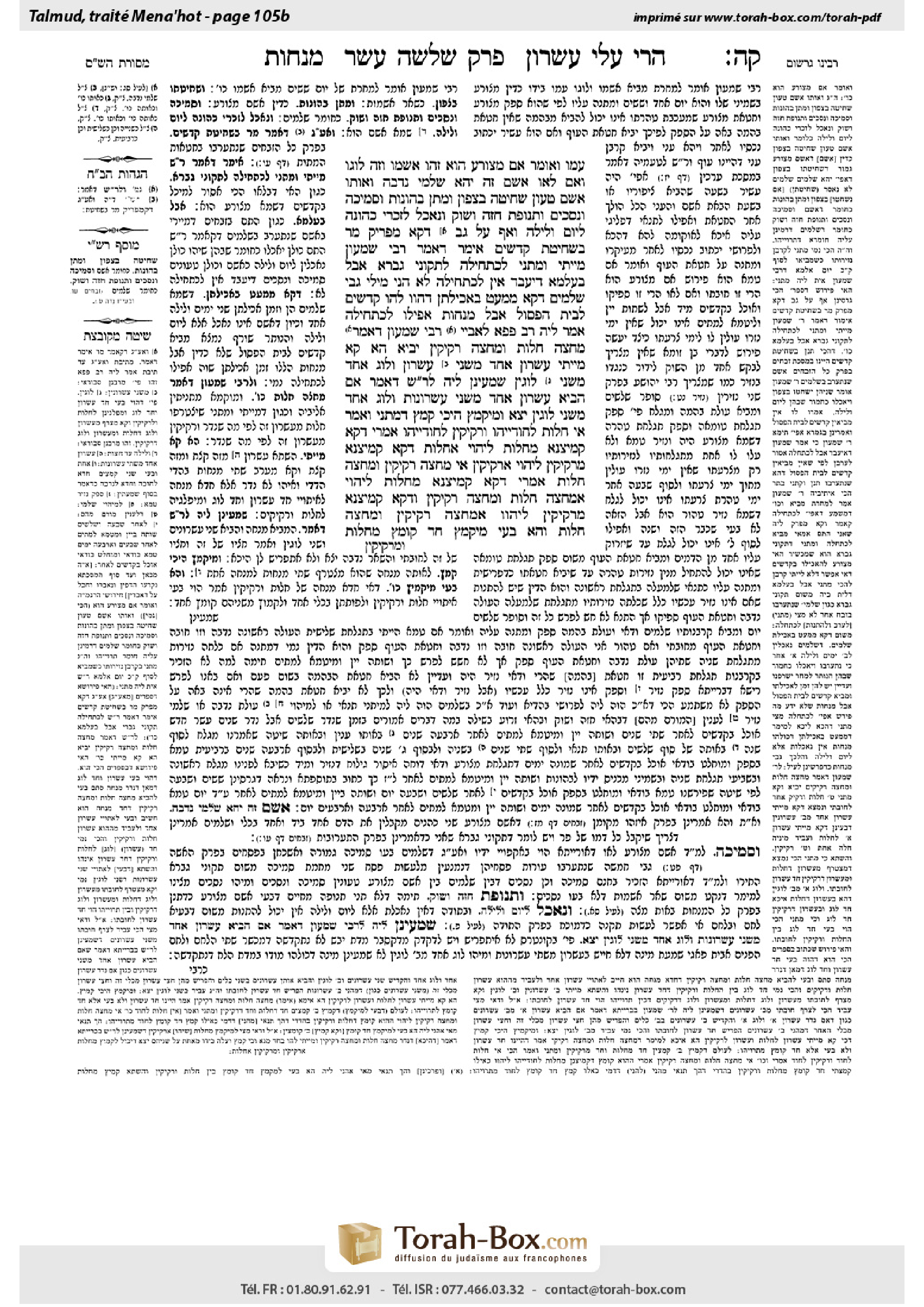
This page of Menachot includes the Aramaic text, an English translation and an AI-generated French translation, alongside the scan above.
מנחות ק״ה ב · Aramaic and Hebrew text
עִמּוֹ, וְאוֹמֵר: אִם מְצוֹרָע הוּא – זֶהוּ אֲשָׁמוֹ וְזֶה לוּגּוֹ, וְאִם לָאו – אָשָׁם זֶה יְהֵא שַׁלְמֵי נְדָבָה.
וְאוֹתוֹ אָשָׁם טָעוּן שְׁחִיטָה בַּצָּפוֹן, וּמַתַּן בְּהוֹנוֹת, וּסְמִיכָה, וּנְסָכִים, וּתְנוּפַת חָזֶה וָשׁוֹק, וְנֶאֱכָל לְזִכְרֵי כְהוּנָּה לְיוֹם וָלַיְלָה.
וְאַף עַל גַּב דְּקָא מְפָרֵיק מָר בִּשְׁחִיטַת קָדָשִׁים.
אֵימַר דְּאָמַר רַבִּי שִׁמְעוֹן: מַיְיתֵי וּמַתְנֵי לְכַתְּחִילָּה – לְתַקּוֹנֵי גַּבְרָא, אֲבָל בְּעָלְמָא – דִּיעֲבַד אִין, לְכַתְּחִילָּה לָא.
הָנֵי מִילֵּי גַּבֵּי שְׁלָמִים, דְּקָא מְמַעֵט בַּאֲכִילָתָן, דְּהָווּ לְהוּ קָדָשִׁים לְבֵית הַפְּסוּל, אֲבָל מְנָחוֹת – אֲפִילּוּ לְכַתְּחִילָּה.
אֲמַר לֵיהּ רַב פָּפָּא לְאַבָּיֵי: רַבִּי שִׁמְעוֹן דְּאָמַר מֶחֱצָה חַלּוֹת וּמֶחֱצָה רְקִיקִין יָבִיא, הָא קָא מַיְיתֵי עִשָּׂרוֹן אֶחָד מִשְּׁנֵי עִשָּׂרוֹן, וְלוֹג אֶחָד מִשְּׁנֵי לוּגִּין!
שָׁמְעִינַן לֵיהּ לְרַבִּי שִׁמְעוֹן, דְּאָמַר: אִם הֵבִיא עִשָּׂרוֹן אֶחָד מִשְּׁנֵי עֶשְׂרוֹנוֹת, וְלוֹג אֶחָד מִשְּׁנֵי לוּגִּין – יָצָא.
וּמִיקְמָץ הֵיכִי קָמַץ? דְּמַתְנֵי וְאָמַר: אִי חַלּוֹת לְחוֹדַיְיהוּ, וּרְקִיקִין לְחוֹדַיְיהוּ אֲמַרִי – דְּקָא קָמֵיצְנָא מֵחַלּוֹת לֶיהֱוֵי אַחַלּוֹת, דְּקָא קָמֵיצְנָא מֵרְקִיקִין לֶיהֱוֵי אַרְקִיקִין. אִי מֶחֱצָה רְקִיקִין וּמֶחֱצָה חַלּוֹת אֲמַרִי – דְּקָא קָמֵיצְנָא מֵחַלּוֹת לֶיהֱוֵי אַמֶּחֱצָה חַלּוֹת וּמֶחֱצָה רְקִיקִין, וּדְקָא קָמֵיצְנָא מֵרְקִיקִין לִיהְווֹ אַמֶּחֱצָה רְקִיקִין וּמֶחֱצָה חַלּוֹת.
וְהָא בָּעֵי מִיקְמָץ חַד קוֹמֶץ מֵחַלּוֹת
Menachot 105b · English translation
with it and says the following stipulation: If this offering is one of a leper, i.e., if I am a leper, this is his guilt offering and that is his log of oil. And if I am not a leper, this animal that I brought for a guilt offering shall be a gift peace offering, because their sacrificial rites are equivalent.
And that uncertain guilt offering requires slaughter in the north of the Temple courtyard, as does a guilt offering; and placement of the blood on the right thumb, and right big toe, and right ear of the leper, as described in Leviticus 14:14; and it requires placing hands on the head of the animal, and the accompanying wine libations, and waving of the breast and thigh, as does a peace offering. And it is eaten by males of the priesthood for one day and the following night like a guilt offering, and not for two days and the intervening night like a peace offering.
The Gemara relates to the problem that arises from this stipulation, as treating an offering as two different types of offerings due to a stipulation can cause a situation where an offering is unduly disqualified. In the case of an offering that is sacrificed as both a peace offering and a guilt offering, if its meat is not eaten by dawn of the following day, it is disqualified, even though it might be a peace offering, which can be eaten for another day. The Gemara comments: And even though a Sage resolves this issue in the tractate of: The slaughter of sacrificial animals, i.e., tractate Zevaḥim, in a manner that would not enable a stipulation to be made in this case (see 76b), there is a distinction between the case discussed there and the case discussed here.
The resolution given there was: Say that Rabbi Shimon said that in a case of uncertainty one may bring an offering and stipulate with regard to its type ab initio only for the remedy of a man, e.g., in order to purify a person from his uncertain status as a leper, as there is no other way for him to purify himself. But in general, after the fact, after uncertainty arose with regard to the status of a certain offering it is indeed permitted to sacrifice the offering in a manner that may reduce the amount of time allotted for eating it, but one may not consecrate such an offering ab initio.
The Gemara explains why here it would nevertheless be permitted to make the stipulation ab initio: Nevertheless, this statement that one may stipulate with regard to an offering only after the fact applies only to a peace offering, as sacrificing it as a guilt offering reduces its allotted time for eating, which may bring sacrificial meat to the status of disqualification. But stipulation with regard to meal offerings when one does not remember which type he vowed to bring is permitted even ab initio, as this does not reduce its allotted time for eating. Therefore, the mishna could be in accordance with the opinion of Rabbi Shimon.
Rav Pappa said to Abaye: How can you explain that the mishna could be in accordance with the opinion of Rabbi Shimon, who said that if one wants to bring half of his baked meal offering as loaves and half of it as wafers he may bring it in that manner, as one can bring a meal offering of ten loaves and ten wafers and stipulate that some of them are brought in order to fulfill his obligation and the rest are a voluntary offering? This cannot be, as the twenty loaves and wafers constitute a total of two-tenths of an ephah in volume, and must therefore be sanctified in two separate service vessels. This causes a situation where one brings one-tenth of an ephah, which constitutes one meal offering as fulfillment of the individual’s obligation, from two separate tenths of an ephah. And similarly, the two meal offerings require two log of oil, each of which is sanctified in a separate vessel, and it turns out that each meal offering includes one log of oil from two separate log.
Abaye answered: This is not difficult, as we have heard that Rabbi Shimon said that if one brought one-tenth of an ephah as a meal offering from two separate tenths, and similarly, if one brought one log of oil from two separate log, he has fulfilled his obligation.
The Gemara asks: But how does one remove a handful from this meal offering, which consists of both loaves and wafers? The Gemara answers that he stipulates and says: If I specified in my vow that I would bring loaves only, or similarly if I said that I would bring wafers only, let the handful that I remove from the loaves be for the loaves, and let the handful that I remove from the wafers be for the wafers. If I said in my vow that I would bring a meal offering that is half wafers and half loaves, let the handful that I remove from the loaves be for half the loaves and half the wafers, and let the handful that I remove from the wafers be for half the wafers and half the loaves.
The Gemara challenges this suggestion: But if the vow was to bring a meal offering that is half loaves and half wafers, it requires removing one handful from the loaves
Menachot 105b · Traduction française (IA)
avec lui, et formule la stipulation suivante : « Si cette offrande est celle d’un lépreux, c’est-à-dire si je suis lépreux, celle-ci est son sacrifice de culpabilité et celle-là est son log d’huile. Et si je ne suis pas lépreux, cet animal que j’ai apporté comme sacrifice de culpabilité sera un sacrifice de paix volontaire, car les rites sacrificiels de ces deux sacrifices sont identiques. »
Ce sacrifice de culpabilité incertain doit être égorgé au nord du parvis du Temple, comme un sacrifice de culpabilité. Son sang doit être appliqué sur le pouce droit, le gros orteil droit et l’oreille droite du lépreux, comme cela est décrit en Lévitique 14:14. Il faut aussi imposer les mains sur la tête de l’animal, apporter les libations de vin qui l’accompagnent et agiter la poitrine et la cuisse, comme pour un sacrifice de paix. Les hommes parmi les prêtres le consomment pendant un jour et la nuit suivante, comme un sacrifice de culpabilité, et non pendant deux jours et la nuit intermédiaire, comme un sacrifice de paix.
La Guemara évoque le problème posé par cette stipulation : traiter une offrande comme deux types d’offrandes différents au moyen d’une stipulation peut entraîner sa disqualification à tort. Dans le cas d’une offrande sacrifiée à la fois comme sacrifice de paix et comme sacrifice de culpabilité, si sa viande n’est pas consommée avant l’aube du lendemain, elle est disqualifiée, même s’il pourrait s’agir d’un sacrifice de paix, dont la viande peut être consommée un jour de plus. La Guemara fait remarquer que, même si un Sage résout cette difficulté dans le traité consacré à l’abattage des animaux sacrificiels, c’est-à-dire le traité Zevaḥim, d’une manière qui ne permettrait pas de formuler une stipulation dans ce cas (voir 76b), il existe une différence entre le cas examiné là-bas et celui examiné ici.
La solution proposée là-bas était la suivante : Rabbi Shimon a dit qu’en cas de doute, on ne peut apporter une offrande et stipuler d’emblée quant à sa nature que pour remédier à la situation d’un homme, par exemple afin de purifier une personne dont le statut de lépreux est incertain, puisqu’il n’existe aucun autre moyen pour elle de se purifier. Mais, de manière générale, lorsqu’un doute est apparu après coup quant au statut d’une offrande donnée, il est permis de la sacrifier d’une manière qui peut réduire la durée pendant laquelle elle peut être consommée ; toutefois, on ne peut pas consacrer d’emblée une telle offrande.
La Guemara explique pourquoi, ici, il serait néanmoins permis de formuler d’emblée la stipulation : cette règle, selon laquelle on ne peut stipuler au sujet d’une offrande qu’après coup, ne s’applique qu’au sacrifice de paix, car le sacrifier comme sacrifice de culpabilité réduit la durée pendant laquelle sa viande peut être consommée, ce qui risque de rendre la viande sacrificielle disqualifiée. En revanche, il est permis de stipuler d’emblée au sujet d’offrandes végétales lorsqu’on ne se souvient pas de la catégorie de l’offrande que l’on a voué à apporter, car cela ne réduit pas la durée pendant laquelle elles peuvent être consommées. La Michna peut donc être conforme à l’opinion de Rabbi Shimon.
Rav Pappa dit à Abayé : Comment peux-tu expliquer que la Michna puisse être conforme à l’opinion de Rabbi Shimon, qui a dit que celui qui veut apporter la moitié de son offrande végétale cuite sous forme de pains et l’autre moitié sous forme de galettes peut l’apporter ainsi ? On peut apporter une offrande végétale composée de dix pains et de dix galettes, et stipuler que certains sont apportés pour s’acquitter de son obligation et que les autres constituent une offrande volontaire. Cela ne peut pas convenir, car les vingt pains et galettes représentent au total deux dixièmes d’épha en volume et doivent donc être consacrés dans deux vases de service distincts. Il en résulte que l’on apporte, pour s’acquitter de l’obligation d’un individu, un dixième d’épha constituant une offrande végétale, prélevé sur deux dixièmes d’épha distincts. De même, les deux offrandes végétales nécessitent deux logs d’huile, chacun consacré dans un vase distinct ; il s’ensuit que chaque offrande végétale comprend un log d’huile provenant de deux logs distincts.
Abayé répondit : Il n’y a pas de difficulté, car nous avons entendu Rabbi Shimon dire que si quelqu’un a apporté un dixième d’épha pour une offrande végétale en le prélevant sur deux dixièmes distincts, et que, de même, il a apporté un log d’huile provenant de deux logs distincts, il s’est acquitté de son obligation.
La Guemara demande : Mais comment prélève-t-on une poignée de cette offrande végétale, composée à la fois de pains et de galettes ? La Guemara répond qu’il formule une stipulation et dit : « Si j’ai précisé dans mon vœu que j’apporterais uniquement des pains, ou uniquement des galettes, que la poignée que je prélève des pains soit destinée aux pains, et que celle que je prélève des galettes soit destinée aux galettes. Si j’ai dit dans mon vœu que j’apporterais une offrande végétale composée pour moitié de galettes et pour moitié de pains, que la poignée que je prélève des pains soit destinée pour moitié aux pains et pour moitié aux galettes, et que celle que je prélève des galettes soit destinée pour moitié aux galettes et pour moitié aux pains. »
La Guemara met cette proposition en difficulté : Mais si le vœu était d’apporter une offrande végétale composée pour moitié de pains et pour moitié de galettes, il faut prélever une poignée des pains
Traduction française générée par IA à partir de l’édition anglaise de Sefaria. Vérifie toujours un passage avec le texte source.
Text from Sefaria: William Davidson Edition - Vocalized Aramaic (unknown); William Davidson Edition - English (CC BY NC).