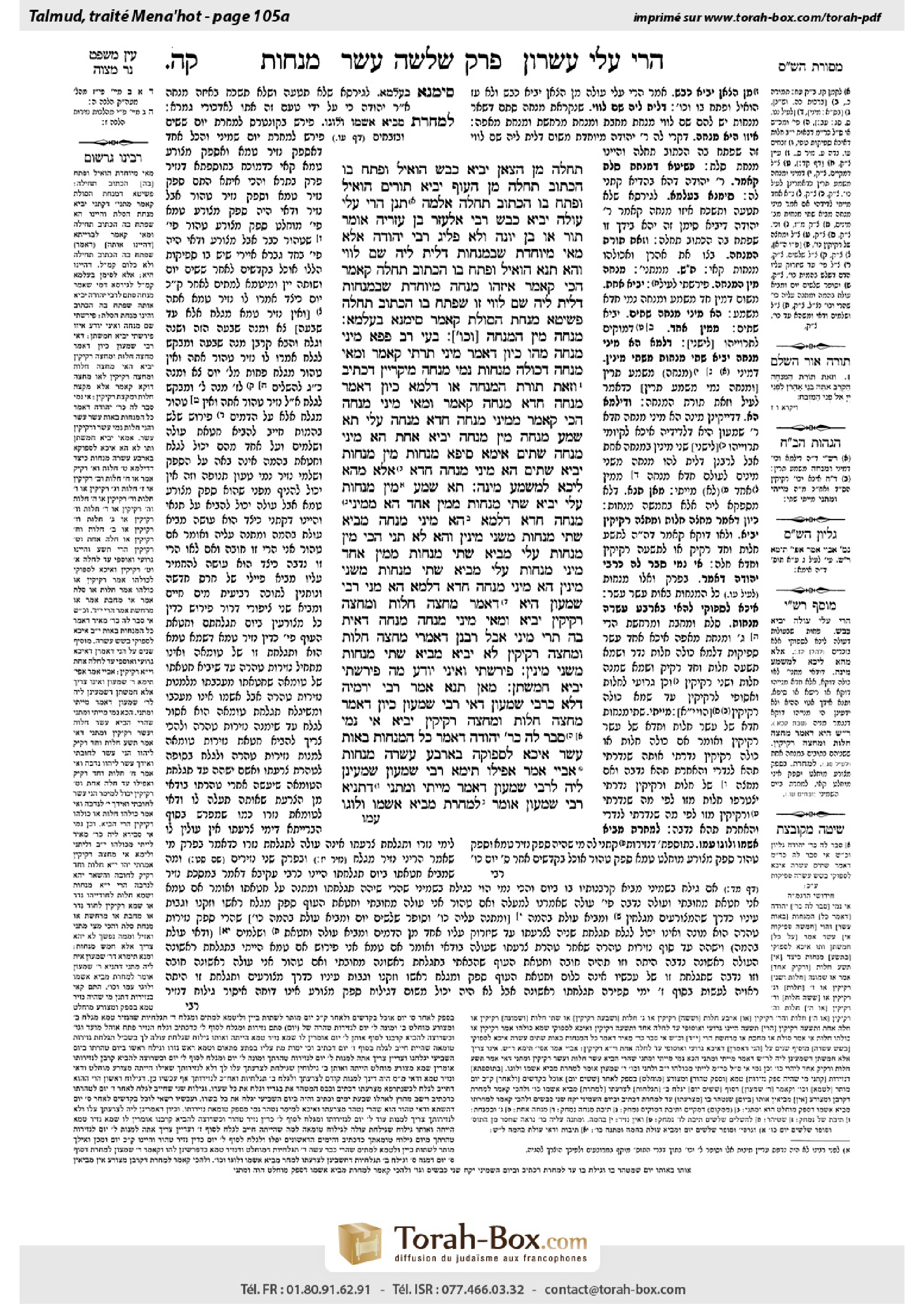
Menachot 105a: Talmud study for Daf Yomi
Daf Yomi is the daily study of one Talmud folio. Explore 37 tractates with scans, Hebrew text, Sefaria English and AI-generated French translations where annotated.
Passage selection and English or AI-generated French translation are available where the scan has annotations. Daf Study is independent of Torah-Box and Sefaria.
Browse Menachot · מנחות · All tractatesMenachot 105a text and translations
This page of Menachot includes the Aramaic text, an English translation and an AI-generated French translation, alongside the scan above.
מנחות ק״ה א · Aramaic and Hebrew text
תְּחִלָּה.
״מִן הַצֹּאן״ – יָבִיא כֶּבֶשׂ, הוֹאִיל וּפָתַח בּוֹ הַכָּתוּב תְּחִלָּה.
״מִן הָעוֹף״ – יָבִיא תּוֹרִים, הוֹאִיל וּפָתַח בּוֹ הַכָּתוּב תְּחִלָּה.
אַלְּמָה תְּנַן: הֲרֵי עָלַי עוֹלָה – יָבִיא כֶּבֶשׂ. רַבִּי אֶלְעָזָר בֶּן עֲזַרְיָה אוֹמֵר: תּוֹר אוֹ בֶּן יוֹנָה, וְלָא פְּלִיג רַבִּי יְהוּדָה.
אֶלָּא מַאי מְיוּחֶדֶת שֶׁבַּמְּנָחוֹת? דְּלֵית לֵיהּ שֵׁם לְוַוי.
וְהָא תָּנָא הוֹאִיל וּפָתַח בּוֹ הַכָּתוּב תְּחִלָּה קָאָמַר? הָכִי קָאָמַר: אֵיזֶהוּ מִנְחָה מְיוּחֶדֶת שֶׁבַּמְּנָחוֹת, דְּלֵית לֵיהּ שֵׁם לְוַוי? זוֹ שֶׁפָּתַח בּוֹ הַכָּתוּב תְּחִלָּה.
פְּשִׁיטָא, מִנְחַת הַסּוֹלֶת קָאָמַר, סִימָנָא בְּעָלְמָא.
״מִנְחָה״, ״מִין הַמִּנְחָה״ [וְכוּ׳]. בָּעֵי רַב פָּפָּא: ״מִינֵי מִנְחָה״ מַהוּ?
כֵּיוָן דְּאָמַר ״מִינֵי״, תַּרְתֵּי קָאָמַר, וּמַאי ״מִנְחָה״? (דְּכוּלַּהּ) מְנָחוֹת נָמֵי ״מִנְחָה״ מִיקַּרְיָין, דִּכְתִיב ״וְזֹאת תּוֹרַת הַמִּנְחָה״.
אוֹ דִלְמָא, כֵּיוָן דְּאָמַר ״מִנְחָה״, חֲדָא מִנְחָה קָאָמַר, וּמַאי ״מִינֵי מִנְחָה״? הָכִי קָאָמַר: ״מִמִּינֵי מִנְחָה חֲדָא מִנְחָה עֲלַי״.
תָּא שְׁמַע: ״מִנְחָה״ ״מִין מִנְחָה״ – יָבִיא אַחַת, הָא ״מִינֵי מִנְחָה״ – שְׁתַּיִם.
אֵימָא סֵיפָא: ״מְנָחוֹת״, ״מִין מְנָחוֹת״ – יָבִיא שְׁתַּיִם, הָא ״מִינֵי מִנְחָה״ – חֲדָא. אֶלָּא, מֵהָא לֵיכָּא לְמִשְׁמַע מִינַּהּ.
תָּא שְׁמַע: ״מִין מְנָחוֹת עָלַי״ – יָבִיא שְׁתֵּי מְנָחוֹת מִמִּין אֶחָד, הָא ״מִמִּינֵי מִנְחָה״ – חֲדָא.
דִּלְמָא: הָא ״מִינֵי מִנְחָה״ – מֵבִיא שְׁתֵּי מְנָחוֹת מִשְּׁנֵי מִינִין.
וְהָא לָא תָּנֵי הָכִי, ״מִין מְנָחוֹת עָלַי״ – מֵבִיא שְׁתֵּי מְנָחוֹת מִמִּין אֶחָד, ״מִינֵי מְנָחוֹת עָלַי״ – מֵבִיא שְׁתֵּי מְנָחוֹת מִשְּׁנֵי מִינִין, הָא ״מִינֵי מִנְחָה״ – חֲדָא.
דִּלְמָא הָא מַנִּי, רַבִּי שִׁמְעוֹן הִיא, דְּאָמַר: מֶחֱצָה חַלּוֹת וּמֶחֱצָה רְקִיקִין יָבִיא, וּמַאי ״מִינֵי מִנְחָה״? מִנְחָה דְּאִית בַּהּ תְּרֵי מִינֵי.
אֲבָל רַבָּנַן דְּאָמְרִי, מֶחֱצָה חַלּוֹת וּמֶחֱצָה רְקִיקִין – לֹא יָבִיא, מֵבִיא שְׁתֵּי מְנָחוֹת מִשְּׁנֵי מִינִין.
״פֵּירַשְׁתִּי וְאֵינִי יוֹדֵעַ מַה פֵּירַשְׁתִּי״ – יָבִיא חֲמִשְׁתָּן. מַאן תַּנָּא?
אָמַר רַבִּי יִרְמְיָה: דְּלָא כְּרַבִּי שִׁמְעוֹן, דְּאִי רַבִּי שִׁמְעוֹן – כֵּיוָן דְּאָמַר מֶחֱצָה חַלּוֹת וּמֶחֱצָה רְקִיקִין יָבִיא.
אִי נָמֵי סָבַר לַהּ כְּרַבִּי יְהוּדָה, דְּאָמַר כׇּל הַמְּנָחוֹת בָּאוֹת עֶשֶׂר, אִיכָּא לְסַפּוֹקַהּ בְּאַרְבַּע עֶשְׂרֵה מְנָחוֹת.
אַבָּיֵי אָמַר: אֲפִילּוּ תֵּימָא רַבִּי שִׁמְעוֹן, שָׁמְעִינַן לֵיהּ לְרַבִּי שִׁמְעוֹן דְּאָמַר: מַיְיתֵי וּמַתְנֵי.
דְּתַנְיָא: רַבִּי שִׁמְעוֹן אוֹמֵר, לַמׇּחֳרָת מֵבִיא אֲשָׁמוֹ וְלוּגּוֹ
Menachot 105a · English translation
first, in the passage discussing burnt offerings (see Leviticus 1:3).
Similarly, one who says: It is incumbent upon me to bring a burnt offering from the flock, must bring a lamb as his burnt offering, since the verse opens with it first in the passage discussing burnt offerings of the flock, as it is stated: “And if his offering is of the flock, whether of the lambs, or of the goats, for a burnt offering, he shall offer it a male without blemish” (Leviticus 1:10).
Similarly, one who says: It is incumbent upon me to bring a burnt offering from a type of bird, must bring doves as his burnt offering, since the verse opens with it first in the passage discussing burnt offerings of birds, as it is stated: “And if his offering to the Lord is a burnt offering of birds, then he shall bring his offering of doves or of pigeons” (Leviticus 1:14).
If so, why did we learn in a mishna (107a): One who says: It is incumbent upon me to bring a burnt offering, must bring a lamb, which is the least expensive land animal sacrificed as an offering. Rabbi Elazar ben Azarya says: He may bring either a dove or pigeon as a bird burnt offering. And Rabbi Yehuda does not disagree.
The Gemara provides a new interpretation: Rather, what does Rabbi Yehuda mean when he says that the fine-flour meal offering is the most notable of the meal offerings? He means that it has no modifier. Only a fine-flour offering is referred to simply as a meal offering, with no other qualification.
The Gemara challenges: But isn’t it taught in the baraita that Rabbi Yehuda says that one must bring a fine-flour meal offering since the verse opens with it first? The Gemara answers: This is what the baraita is saying: Which meal offering is the most notable of the meal offerings, as it has no modifier? It is this, i.e., the fine-flour meal offering, with which the verse opens first. The reason that Rabbi Yehuda holds that one must bring a fine-flour meal offering is not because the verse opens with it, but because it has no modifier.
The Gemara challenges: If so, the explanation of the baraita is unnecessary; isn’t it obvious that Rabbi Yehuda is referring to the fine-flour meal offering, as he says so explicitly? The Gemara answers: The baraita explains that the reference to the meal offering with which the passage opens merely serves as a mnemonic, so one should not forget which type of meal offering Rabbi Yehuda is referring to.
§ The mishna teaches that if one says: It is incumbent upon me to bring a meal offering, or: It is incumbent upon me to bring a type of meal offering, he must bring one meal offering. This is because he stated his intent in the singular. But if he says in the plural: It is incumbent upon me to bring meal offerings, or: Meal offerings of a certain type, he must bring two meal offerings. Rav Pappa raises a dilemma: If one said: It is incumbent upon me to bring types of a meal offering, using a combination of singular and plural forms, what is the halakha?
The Gemara explains the dilemma: Perhaps it should be reasoned that since he said: Types, in the plural, apparently he was saying that he intends to bring two meal offerings. And if so, what is the reason he used the singular word: Meal offering? He used it because the entire category of meal offerings is also referred to as: Meal offering, in the singular, as it is written in the verse: “And this is the law of the meal offering: The sons of Aaron shall offer it before the Lord, in front of the altar” (Leviticus 6:7).
Or perhaps it should be reasoned that since he said: Meal offering, in the singular, apparently he was saying that he intends to bring only one meal offering. And if so, what did he mean by using the plural phrase: Types of a meal offering? This is what he was saying: Of the various types of a meal offering, it is incumbent upon me to bring one.
The Gemara suggests: Come and hear a proof that his intent is to bring two meal offerings, from that which is stated in the mishna: If one says: It is incumbent upon me to bring a meal offering, or: It is incumbent upon me to bring a type of meal offering, he must bring one. This indicates that if he said: Types of a meal offering, he must bring two.
The Gemara rejects this proof. Say the latter clause: If one says: It is incumbent upon me to bring meal offerings, or: It is incumbent upon me to bring meal offerings of a certain type, he must bring two. This indicates that if he says: Types of a meal offering, he must bring only one. Rather, no inference is to be learned from this mishna, as the potential inferences are contradictory.
The Gemara suggests another resolution to Rav Pappa’s dilemma: Come and hear that which is taught in a baraita: If one says: It is incumbent upon me to bring meal offerings of a certain type, he must bring two meal offerings of one type. This indicates that if one says: It is incumbent upon me to bring of the various types of a meal offering, he is required to bring only one.
The Gemara rejects this inference: Perhaps the correct inference from the baraita is that this indicates that if one says: It is incumbent upon me to bring types of a meal offering, he must bring two meal offerings, of two different types.
The Gemara challenges the rejection. But this is not taught in the baraita, as the full baraita reads as follows: If one says: It is incumbent upon me to bring meal offerings of a certain type, he must bring two meal offerings of one type. If he says: It is incumbent upon me to bring types of meal offerings, he must bring two meal offerings, of two different types. This indicates that if he says: It is incumbent upon me to bring types of a meal offering, he brings only one.
The Gemara rejects this proof: Perhaps the baraita is not in accordance with all opinions; rather, in accordance with whose opinion is this baraita? It is in accordance with the opinion of Rabbi Shimon, who said with regard to one who vows to bring a meal offering baked in an oven that if he wants to bring half of the meal offering as loaves and half of it as wafers, he may bring it in that manner. And accordingly, what is the meaning of the phrase: Types of a meal offering? It means a meal offering that has two types of baked dough. Therefore, bringing one such meal offering is sufficient.
But according to the opinion of the Rabbis, who say that if one wishes to bring half of the meal offering as loaves and half of it as wafers, he may not bring it in this manner, as they hold that all of the baked items in a meal offering must be of the same type, he consequently must bring two meal offerings of two different types.
§ The mishna teaches that if one says: I specified a meal offering but I do not know what meal offering I specified, he must bring all five types of meal offerings. The Gemara asks: Who is the tanna who taught this halakha?
Rabbi Yirmeya said: This halakha is not in accordance with the opinion of Rabbi Shimon. As, if it were in accordance with the opinion of Rabbi Shimon, since he said that if one wants to bring half of his baked meal offering as loaves and half of it as wafers he may bring it in that manner, why does one have to bring only five meal offerings to cover all possible vows that he may have made? He should be required to bring several meal offerings baked in an oven to cover all the possible combinations of loaves and wafers.
Therefore, even if the tanna of the mishna holds in accordance with the opinion of Rabbi Yehuda, who said that all meal offerings are brought as ten items, as opposed to the opinion of Rabbi Meir that all meal offerings are brought as twelve items, there is cause for uncertainty, which renders fourteen different meal offerings necessary. In addition to the shallow-pan meal offering, the deep-pan meal offering, and the fine-flour meal offering, there are another eleven combinations of baked meal offering that he may have intended. He may have intended to bring ten loaves, or ten wafers, or one loaf and nine wafers, two loaves and eight wafers, three loaves and seven wafers, and so forth.
Abaye rejected Rabbi Yirmeya’s explanation and said: You may even say that the mishna is in accordance with the opinion of Rabbi Shimon. We have heard that Rabbi Shimon said: One who is uncertain whether he is obligated to bring a certain offering may bring the offering and stipulate that if he is obligated to bring an offering, this is his offering, and if he is not obligated, it is a voluntary offering. Therefore, in the case of the mishna, one can bring the five types of meal offerings, with his baked meal offering including ten loaves and ten wafers, and stipulate that whichever items were included in his vow serve as fulfillment of his obligation, and all the others are voluntary offerings.
As it is taught in a baraita (Tosefta, Nazir 6:1): How should one whose status as a leper is uncertain bring his guilt offering and log of oil on the eighth day of his purification? Rabbi Shimon says: On the following day, after his seven days of purification, he brings his guilt offering and his log of oil
Menachot 105a · Traduction française (IA)
d’abord, dans le passage consacré aux holocaustes (voir Lévitique 1:3).
De même, celui qui dit : « Je suis tenu d’apporter un holocauste provenant du petit bétail » doit apporter un agneau en holocauste, puisque le verset le mentionne en premier dans le passage consacré aux holocaustes provenant du petit bétail, comme il est dit : « Si son offrande provient du petit bétail, qu’il s’agisse d’agneaux ou de chèvres, pour un holocauste, il offrira un mâle sans défaut » (Lévitique 1:10).
De même, celui qui dit : « Je suis tenu d’apporter un holocauste d’une espèce d’oiseau » doit apporter des tourterelles en holocauste, puisque le verset les mentionne en premier dans le passage consacré aux holocaustes d’oiseaux, comme il est dit : « Si son offrande à l’Éternel est un holocauste d’oiseaux, il apportera son offrande, des tourterelles ou des pigeons » (Lévitique 1:14).
Dans ce cas, pourquoi avons-nous appris dans une Michna (107a) : Celui qui dit : « Je suis tenu d’apporter un holocauste » doit apporter un agneau, qui est l’animal terrestre le moins coûteux offert en sacrifice. Rabbi Elazar ben Azarya dit : Il peut apporter soit une tourterelle, soit un pigeon en holocauste d’oiseau. Et Rabbi Yehouda n’est pas en désaccord.
La Guemara propose une nouvelle interprétation : Que veut donc dire Rabbi Yehouda lorsqu’il affirme que l’offrande de farine fine est la plus remarquable des offrandes de farine ? Il veut dire qu’elle n’a aucun qualificatif. Seule l’offrande de farine fine est désignée simplement comme une offrande de farine, sans autre précision.
La Guemara objecte : Mais n’est-il pas enseigné dans la baraïta que Rabbi Yehouda dit qu’il faut apporter une offrande de farine fine, car le verset la mentionne en premier ? La Guemara répond : Voici ce que dit la baraïta : Quelle offrande de farine est la plus remarquable des offrandes de farine, puisqu’elle n’a aucun qualificatif ? C’est celle-ci, c’est-à-dire l’offrande de farine fine, que le verset mentionne en premier. Rabbi Yehouda estime qu’il faut apporter une offrande de farine fine, non pas parce que le verset la mentionne en premier, mais parce qu’elle n’a aucun qualificatif.
La Guemara objecte : Dans ce cas, l’explication de la baraïta est superflue ; n’est-il pas évident que Rabbi Yehouda parle de l’offrande de farine fine, puisqu’il le dit explicitement ? La Guemara répond : La baraïta explique que la mention de l’offrande de farine par laquelle s’ouvre le passage sert uniquement d’aide-mémoire, afin qu’on n’oublie pas de quel type d’offrande de farine parle Rabbi Yehouda.
§ La Michna enseigne que si quelqu’un dit : « Je suis tenu d’apporter une offrande de farine », ou : « Je suis tenu d’apporter un type d’offrande de farine », il doit apporter une seule offrande de farine. Cela tient au fait qu’il a exprimé son intention au singulier. Mais s’il dit au pluriel : « Je suis tenu d’apporter des offrandes de farine », ou : « Des offrandes de farine d’un certain type », il doit apporter deux offrandes de farine. Rav Pappa soulève une question : si quelqu’un dit : « Je suis tenu d’apporter des types d’offrande de farine », en combinant le singulier et le pluriel, quelle est la halakha ?
La Guemara expose la question : Peut-être faut-il raisonner ainsi : puisqu’il a dit « des types », au pluriel, il semble qu’il entende apporter deux offrandes de farine. Si tel est le cas, pourquoi a-t-il employé le singulier « offrande de farine » ? Parce que toute la catégorie des offrandes de farine est également désignée au singulier comme « offrande de farine », ainsi qu’il est écrit : « Voici la loi de l’offrande de farine : les fils d’Aaron la présenteront devant l’Éternel, devant l’autel » (Lévitique 6:7).
Ou peut-être faut-il raisonner ainsi : puisqu’il a dit « offrande de farine » au singulier, il semble qu’il entende n’en apporter qu’une seule. Si tel est le cas, que voulait-il dire en employant l’expression au pluriel « des types d’offrande de farine » ? Il voulait dire : parmi les différents types d’offrande de farine, je suis tenu d’en apporter une.
La Guemara suggère : Viens et entends une preuve qu’il entend apporter deux offrandes de farine, d’après ce qui est enseigné dans la Michna : si quelqu’un dit : « Je suis tenu d’apporter une offrande de farine », ou : « Je suis tenu d’apporter un type d’offrande de farine », il doit en apporter une. Cela indique que s’il a dit : « Des types d’offrande de farine », il doit en apporter deux.
La Guemara rejette cette preuve. Considère la dernière clause : si quelqu’un dit : « Je suis tenu d’apporter des offrandes de farine », ou : « Je suis tenu d’apporter des offrandes de farine d’un certain type », il doit en apporter deux. Cela indique que s’il dit : « Des types d’offrande de farine », il ne doit en apporter qu’une. Il ne faut donc rien déduire de cette Michna, car les déductions possibles se contredisent.
La Guemara propose une autre solution à la question de Rav Pappa : Viens et entends ce qui est enseigné dans une baraïta : si quelqu’un dit : « Je suis tenu d’apporter des offrandes de farine d’un certain type », il doit apporter deux offrandes de farine d’un seul type. Cela indique que si quelqu’un dit : « Je suis tenu d’apporter parmi les différents types d’offrande de farine », il ne doit en apporter qu’une.
La Guemara rejette cette déduction : peut-être faut-il plutôt déduire de la baraïta que si quelqu’un dit : « Je suis tenu d’apporter des types d’offrande de farine », il doit apporter deux offrandes de farine, de deux types différents.
La Guemara conteste ce rejet. Mais cela n’est pas enseigné dans la baraïta, dont le texte complet est le suivant : si quelqu’un dit : « Je suis tenu d’apporter des offrandes de farine d’un certain type », il doit apporter deux offrandes de farine d’un seul type. S’il dit : « Je suis tenu d’apporter des types d’offrandes de farine », il doit apporter deux offrandes de farine, de deux types différents. Cela indique que s’il dit : « Je suis tenu d’apporter des types d’offrande de farine », il n’en apporte qu’une.
La Guemara rejette cette preuve : peut-être la baraïta ne suit-elle pas toutes les opinions ; selon l’opinion de qui est-elle donc ? Selon celle de Rabbi Shimon, qui a dit, au sujet de celui qui fait le vœu d’apporter une offrande de farine cuite au four, que s’il veut en apporter la moitié sous forme de pains et l’autre moitié sous forme de galettes, il peut procéder ainsi. Dès lors, que signifie l’expression « des types d’offrande de farine » ? Elle désigne une offrande de farine comportant deux types de pâte cuite. Il suffit donc d’apporter une seule offrande de farine de ce genre.
Mais selon l’opinion des Rabbins, qui disent que s’il souhaite apporter la moitié de l’offrande de farine sous forme de pains et l’autre moitié sous forme de galettes, il ne peut pas procéder ainsi, car ils estiment que tous les produits cuits d’une offrande de farine doivent être du même type, il doit par conséquent apporter deux offrandes de farine de deux types différents.
§ La Michna enseigne que si quelqu’un dit : « J’ai précisé une offrande de farine, mais je ne sais pas quelle offrande de farine j’ai précisée », il doit apporter les cinq types d’offrande de farine. La Guemara demande : Qui est le tanna qui a enseigné cette halakha ?
Rabbi Yirmeya dit : Cette halakha ne suit pas l’opinion de Rabbi Shimon. En effet, si elle suivait son opinion, puisqu’il a dit que si quelqu’un veut apporter la moitié de son offrande de farine cuite au four sous forme de pains et l’autre moitié sous forme de galettes, il peut procéder ainsi, pourquoi devrait-il apporter seulement cinq offrandes de farine pour couvrir tous les vœux possibles qu’il a pu prononcer ? Il devrait apporter plusieurs offrandes de farine cuites au four afin de couvrir toutes les combinaisons possibles de pains et de galettes.
Par conséquent, même si le tanna de la Michna suit l’opinion de Rabbi Yehouda, qui dit que toutes les offrandes de farine sont apportées en dix pièces, contrairement à l’opinion de Rabbi Meïr, selon laquelle elles sont toutes apportées en douze pièces, l’incertitude impose d’en apporter quatorze. En plus de l’offrande de farine cuite dans une poêle plate, de celle cuite dans une poêle profonde et de l’offrande de farine fine, il y a onze autres combinaisons d’offrande de farine cuite qu’il a pu vouloir apporter. Il a pu vouloir apporter dix pains, ou dix galettes, ou un pain et neuf galettes, deux pains et huit galettes, trois pains et sept galettes, et ainsi de suite.
Abayé rejeta l’explication de Rabbi Yirmeya et dit : On peut même dire que la Michna suit l’opinion de Rabbi Shimon. Nous avons appris que Rabbi Shimon a dit : Celui qui doute d’être tenu d’apporter une certaine offrande peut apporter cette offrande en précisant que, s’il est tenu d’en apporter une, celle-ci sera son offrande, et que s’il n’y est pas tenu, elle sera une offrande volontaire. Par conséquent, dans le cas de la Michna, on peut apporter les cinq types d’offrande de farine, l’offrande cuite comprenant dix pains et dix galettes, et préciser que les éléments visés par son vœu serviront à s’acquitter de son obligation, tandis que tous les autres seront des offrandes volontaires.
Comme il est enseigné dans une baraïta (Tosefta, Nazir 6:1) : Comment celui dont le statut de lépreux est incertain doit-il apporter son sacrifice de culpabilité et son log d’huile le huitième jour de sa purification ? Rabbi Shimon dit : Le lendemain, après ses sept jours de purification, il apporte son sacrifice de culpabilité et son log d’huile
Traduction française générée par IA à partir de l’édition anglaise de Sefaria. Vérifie toujours un passage avec le texte source.
Text from Sefaria: William Davidson Edition - Vocalized Aramaic (unknown); William Davidson Edition - English (CC BY NC).