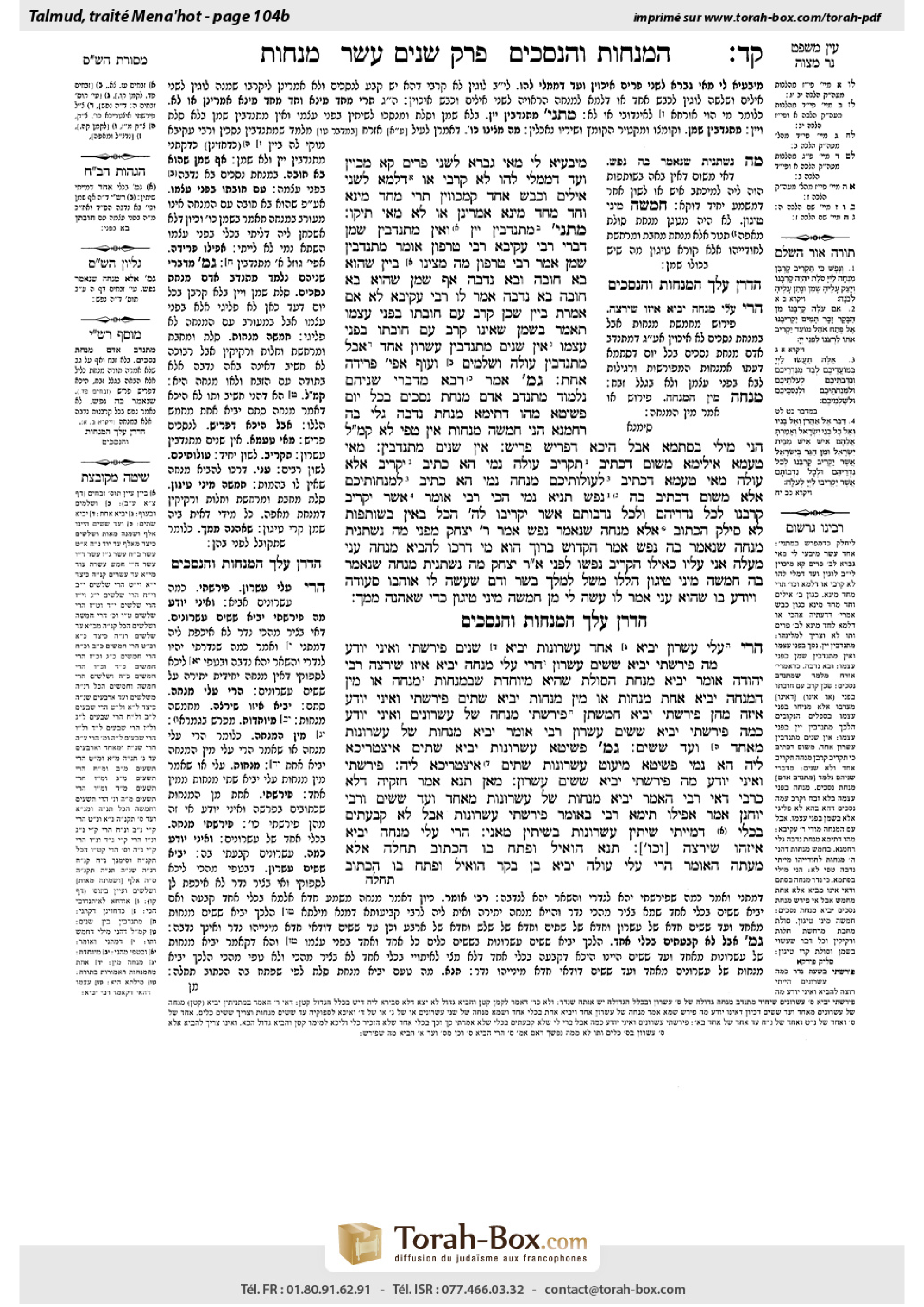
Menachot 104b: Talmud study for Daf Yomi
Daf Yomi is the daily study of one Talmud folio. Explore 37 tractates with scans, Hebrew text, Sefaria English and AI-generated French translations where annotated.
Passage selection and English or AI-generated French translation are available where the scan has annotations. Daf Study is independent of Torah-Box and Sefaria.
Browse Menachot · מנחות · All tractatesMenachot 104b text and translations
This page of Menachot includes the Aramaic text, an English translation and an AI-generated French translation, alongside the scan above.
מנחות ק״ד ב · Aramaic and Hebrew text
מִיבַּעְיָא לִי, מַאי: גַּבְרָא לִשְׁנֵי פָּרִים קָא מְכַוֵּין, וְעַד דִּמְמַלֵּי לְהוּ לָא קׇרְבִי, אוֹ דִלְמָא לִשְׁנֵי אֵילִים וְכֶבֶשׂ אֶחָד קָמְכַוֵּוין? תְּרֵי מֵחַד מִינָא וְחַד מֵחַד מִינָא אָמְרִינַן, אוֹ לָא? מַאי? תֵּיקוּ.
מַתְנִי׳ מִתְנַדְּבִין יַיִן, וְאֵין מִתְנַדְּבִין שֶׁמֶן, דִּבְרֵי רַבִּי עֲקִיבָא. רַבִּי טַרְפוֹן אוֹמֵר: מִתְנַדְּבִין שֶׁמֶן.
אָמַר רַבִּי טַרְפוֹן: מָה מָצִינוּ בְּיַיִן, שֶׁהוּא בָּא חוֹבָה וּבָא נְדָבָה, אַף שֶׁמֶן שֶׁהוּא בָּא חוֹבָה בָּא נְדָבָה. אָמַר לוֹ רַבִּי עֲקִיבָא: לֹא, אִם אָמַרְתָּ בְּיַיִן שֶׁכֵּן קָרֵב עִם חוֹבָתוֹ בִּפְנֵי עַצְמוֹ, תֹּאמַר בְּשֶׁמֶן שֶׁאֵינוֹ קָרֵב עִם חוֹבָתוֹ בִּפְנֵי עַצְמוֹ?
אֵין שְׁנַיִם מִתְנַדְּבִין עִשָּׂרוֹן אֶחָד, אֲבָל מִתְנַדְּבִין עוֹלָה וּשְׁלָמִים, וְעוֹף – אֲפִילּוּ פְּרֵידָה אַחַת.
גְּמָ׳ אָמַר רָבָא: מִדִּבְרֵי שְׁנֵיהֶם נִלְמוֹד, מִתְנַדֵּב אָדָם מִנְחַת נְסָכִים בְּכׇל יוֹם.
פְּשִׁיטָא? מַהוּ דְּתֵימָא: מִנְחַת נְדָבָה גַּלִּי בַּהּ רַחֲמָנָא – הָנֵי חֲמִשָּׁה מְנָחוֹת אִין, טְפֵי לָא! קָא מַשְׁמַע לַן: הָנֵי מִילֵּי בִּסְתָמָא, אֲבָל הֵיכָא דְּפָרֵישׁ – פָּרֵישׁ.
אֵין שְׁנַיִם מִתְנַדְּבִין. מַאי טַעְמָא? אִילֵּימָא מִשּׁוּם דִּכְתִיב ״תַּקְרִיב״, עוֹלָה נָמֵי הָא כְּתִיב ״יַקְרִיב״!
אֶלָּא עוֹלָה מַאי טַעְמָא, דִּכְתִיב ״לְעֹלֹתֵיכֶם״, מִנְחָה נָמֵי הָא כְּתִיב ״לְמִנְחֹתֵיכֶם״, אֶלָּא מִשּׁוּם דִּכְתִיב בָּהּ ״נֶפֶשׁ״.
תַּנְיָא נָמֵי הָכִי, רַבִּי אוֹמֵר: ״אֲשֶׁר יַקְרִיב קׇרְבָּנוֹ לְכׇל נִדְרֵיהֶם וּלְכׇל נִדְבוֹתָם אֲשֶׁר יַקְרִיבוּ לַה׳״ – הַכֹּל בָּאִין בְּשׁוּתָּפוּת, לֹא סִילֵּק הַכָּתוּב אֶלָּא מִנְחָה, שֶׁנֶּאֱמַר: ״נֶפֶשׁ״.
אָמַר רַבִּי יִצְחָק: מִפְּנֵי מָה נִשְׁתַּנֵּית מִנְחָה שֶׁנֶּאֱמַר בָהּ ״נֶפֶשׁ״? אָמַר הַקָּדוֹשׁ בָּרוּךְ הוּא: מִי דַּרְכּוֹ לְהָבִיא מִנְחָה? עָנִי, מַעֲלֶה אֲנִי עָלָיו כְּאִילּוּ הִקְרִיב נַפְשׁוֹ לְפָנַי.
אָמַר רַבִּי יִצְחָק: מָה נִשְׁתַּנֵּית מִנְחָה, (שנאמר) [שֶׁנֶּאֶמְרוּ] בָּהּ חֲמִשָּׁה מִינֵי טִיגּוּן הַלָּלוּ? מָשָׁל לְמֶלֶךְ בָּשָׂר וְדָם שֶׁעָשָׂה לוֹ אוֹהֲבוֹ סְעוּדָה, וְיוֹדֵעַ בּוֹ שֶׁהוּא עָנִי. אָמַר לוֹ: עֲשֵׂה לִי מִן חֲמִשָּׁה מִינֵי טִיגּוּן, כְּדֵי שֶׁאֵהָנֶה מִמְּךָ.
הֲדַרַן עֲלָךְ הַמְּנָחוֹת וְהַנְּסָכִים.
מַתְנִי׳ ״הֲרֵי עָלַי עִשָּׂרוֹן״ – יָבִיא אֶחָד, ״עֶשְׂרוֹנוֹת״ – יָבִיא שְׁנַיִם, ״פֵּירַשְׁתִּי וְאֵינִי יוֹדֵעַ מָה פֵּירַשְׁתִּי״ – יָבִיא שִׁשִּׁים עִשָּׂרוֹן.
״הֲרֵי עָלַי מִנְחָה״ – יָבִיא אֵיזוֹ שֶׁיִּרְצֶה. רַבִּי יְהוּדָה אוֹמֵר: יָבִיא מִנְחַת הַסּוֹלֶת, שֶׁהִיא מְיוּחֶדֶת שֶׁבַּמְּנָחוֹת.
״מִנְחָה״ אוֹ ״מִין הַמִּנְחָה״ – יָבִיא אַחַת. ״מְנָחוֹת״ אוֹ ״מִין מְנָחוֹת״ – יָבִיא שְׁתַּיִם. ״פֵּירַשְׁתִּי וְאֵינִי יוֹדֵעַ אֵיזֶה מֵהֶן פֵּירַשְׁתִּי״ – יָבִיא חֲמִשְׁתָּן.
פֵּירַשְׁתִּי מִנְחָה שֶׁל עֶשְׂרוֹנִים, וְאֵינִי יוֹדֵעַ כַּמָּה פֵּירַשְׁתִּי – יָבִיא שִׁשִּׁים עִשָּׂרוֹן. רַבִּי אוֹמֵר: יָבִיא מְנָחוֹת שֶׁל עֶשְׂרוֹנוֹת, מֵאֶחָד וְעַד שִׁשִּׁים.
גְּמָ׳ פְּשִׁיטָא! ״עֶשְׂרוֹנוֹת״ – יָבִיא שְׁתַּיִם אִיצְטְרִיכָא לֵיהּ. הָא נָמֵי פְּשִׁיטָא! מִיעוּט עֶשְׂרוֹנוֹת שְׁתַּיִם אִיצְטְרִיכָא לֵיהּ.
״פֵּירַשְׁתִּי, וְאֵינִי יוֹדֵעַ מָה פֵּירַשְׁתִּי״ – יָבִיא שִׁשִּׁים עִשָּׂרוֹן. מַאן תַּנָּא?
אָמַר חִזְקִיָּה: דְּלָא כְּרַבִּי, דְּאִי רַבִּי, הָאָמַר: יָבִיא מְנָחוֹת שֶׁל עֶשְׂרוֹנוֹת מֵאֶחָד וְעַד שִׁשִּׁים.
וְרַבִּי יוֹחָנָן אָמַר: אֲפִילּוּ תֵּימָא רַבִּי, בְּאוֹמֵר ״פֵּירַשְׁתִּי עֶשְׂרוֹנוֹת אֲבָל לֹא קְבַעְתִּים בִּכְלִי״, דְּמַיְיתֵי שִׁיתִּין עֶשְׂרוֹנוֹת בְּשִׁיתִּין מָאנֵי.
״הֲרֵי עָלַי מִנְחָה״ – יָבִיא אֵיזֶהוּ שֶׁיִּרְצֶה [וְכוּ׳]. תָּנָא: הוֹאִיל וּפָתַח בּוֹ הַכָּתוּב תְּחִלָּה.
אֶלָּא מֵעַתָּה, הָאוֹמֵר ״הֲרֵי עָלַי עוֹלָה״ – יָבִיא בֶּן בָּקָר, הוֹאִיל וּפָתַח בּוֹ הַכָּתוּב
Menachot 104b · English translation
I ask, what is the halakha? Does the man who vowed to bring eleven log intend to bring an amount of wine corresponding to that which is brought in association with an offering of two bulls, i.e., twelve log, and until he accumulates that amount, the libation is not brought? Or perhaps he intends to bring an amount equal to that associated with two rams and one lamb, i.e., four for each ram and three for the lamb, totaling eleven. Do we say that he intended to bring two libations associated with one type, i.e., a ram, and one libation associated with another type, i.e., a lamb, or not? What is the halakha? The Gemara concludes: The dilemma shall stand unresolved.
MISHNA: One may pledge to bring independent libations of wine, but one may not pledge oil alone; this is the statement of Rabbi Akiva. Rabbi Tarfon says: One may pledge oil as well.
Rabbi Tarfon said: Just as we found that wine comes as an obligation and comes as a gift offering independent of any offering, so too, we find that oil comes as an obligation and comes as a gift offering. Rabbi Akiva said to him: No, if you said that this is true with regard to wine, as it is sacrificed with its obligatory offering by itself, shall you also say that this is also the case with regard to oil, which is never sacrificed with its obligatory offering by itself but only mixed with the flour?
The mishna concludes with a ruling concerning a voluntary meal offering: Two people do not pledge a meal offering of a tenth of an ephah as partners, but they may pledge a burnt offering and a peace offering. And they may pledge to bring even an individual bird, not only a pair.
GEMARA: With regard to the dispute between Rabbi Tarfon and Rabbi Akiva about whether one can pledge oil, Rava said: From the statements of both of them, we learn that a person may pledge a meal offering like those brought with the libations that accompany animal offerings every day.
The Gemara asks: Isn’t that obvious? The Gemara explains: It needed to be said, lest you say that the Merciful One revealed the nature of a voluntary meal offering (see Leviticus, chapter 2). Perhaps only those five meal offerings detailed there are indeed brought as voluntary offerings, but any additional types, such as a meal offering brought with libations, are not. Rava therefore teaches us that these matters in the Torah apply only where his pledge of a meal offering was unspecified, but where he specified that the oil and flour about which he vows should be brought in the manner of a meal offering with libations, then he has specified, and the vow takes effect.
§ The mishna stated that two people do not pledge a tenth of an ephah together. The Gemara asks: What is the reason? If we say that it is because it is written: “And when an individual brings a meal offering” (Leviticus 2:1), in the singular, that is not a proof, as with regard to a burnt offering as well, it is written in the singular: “When any man of you brings an offering” (Leviticus 1:2). Nevertheless, two people may bring a burnt offering together, as stated in the mishna.
Rather, what is the reason that a burnt offering is brought by two people? The reason is that it is written in second person plural: “These you shall offer…beside your burnt offerings [le’oloteikhem], or your meal offerings, or your drink offerings, or your peace offerings” (Numbers 29:39). The Gemara points out: With regard to a meal offering, it is also written in the plural: “Your meal offerings [leminḥoteikhem].” Rather, the reason that one may not bring a meal offering as a partnership is because it is written: “And when an individual brings a meal offering” (Leviticus 2:1), indicating that only one individual may offer it, but not two together.
This is also taught in a baraita: Rabbi Yehuda HaNasi states an explanation of the following verse: “Anyone that brings his offering, whether it be any of their vows, or any of their free-will offerings that they sacrifice to the Lord” (Leviticus 22:18). It is evident from the use of the plural in the second part of the verse that any offering can be brought in a partnership, and the verse excludes only a meal offering from this principle, as it is stated: “And when an individual brings a meal offering.”
The Gemara cites another comment about the fact that the Torah introduces the voluntary meal offering by emphasizing that it is brought by an individual. Rabbi Yitzḥak says: For what reason is the meal offering different from other offerings in that the term “an individual [nefesh]” is stated with regard to it? The Holy One, Blessed be He, said: Whose practice is it to bring a meal offering? It is that of a poor individual; and I will ascribe him credit as if he offered up his soul [nafsho] in front of Me.
§ The Gemara cites another comment made by Rabbi Yitzḥak about meal offerings. Rabbi Yitzḥak says: What is the reason that the meal offering is differentiated from other offerings in that the Torah stated these five types of preparations with oil with regard to it? The five types of voluntary meal offerings are: A meal offering of fine flour, a meal offering in a shallow pan, a meal offering in a deep pan, a meal offering of loaves baked in an oven, and a meal offering of wafers baked in an oven. All are brought with oil. This can be explained by a parable of a flesh-and-blood king whose friend made a festive meal for him, but the king knows that the friend is poor. The king said to him: Make for me foods from five types of fried dishes, so that I may benefit from you.
MISHNA: One who says: It is incumbent upon me to bring a tenth of an ephah for a meal offering, must bring a meal offering of one-tenth. If he says: It is incumbent upon me to bring tenths of an ephah, he must bring two-tenths, as that is the minimum plural amount. If he says: I specified several tenths of an ephah but I do not know which number I specified, he must bring sixty-tenths, as that is the maximum amount of a meal offering. The flour beyond the amount that he actually specified is rendered a voluntary meal offering.
If one says: It is incumbent upon me to bring a meal offering, he may bring whichever meal offering that he wishes, i.e., the fine-flour meal offering, the shallow-pan or deep-pan meal offering, or the meal offering baked in an oven in the form of loaves or wafers. Rabbi Yehuda says: He must bring the fine-flour meal offering, as it is the most notable of the meal offerings.
If one says: It is incumbent upon me to bring a meal offering, or: It is incumbent upon me to bring a type of meal offering, he must bring one meal offering. If he says: It is incumbent upon me to bring meal offerings, or: It is incumbent upon me to bring meal offerings of a certain type, he must bring two. If he says: I specified a meal offering but I do not know which meal offering I specified, he must bring all five types of meal offerings.
If one says: I specified a meal offering of tenths of an ephah but I do not know how many tenths I specified, he must bring a meal offering of sixty-tenths of an ephah. Rabbi Yehuda HaNasi says: His obligation is satisfied only when he brings meal offerings of all sizes, in increments of tenths of an ephah, ranging from one-tenth of an ephah to sixty-tenths, for a total of sixty meal offerings with a total volume of 1,830 tenths of an ephah, or 183 ephahs. He fulfills his vow with one of the meal offerings, and the rest are rendered voluntary meal offerings.
GEMARA: The mishna teaches that one who says: It is incumbent upon me to bring a tenth of an ephah for a meal offering, must bring a meal offering of a tenth. The Gemara asks: Isn’t this obvious? Why is it necessary to teach this in the mishna? The Gemara answers that it was necessary for the mishna to mention this case as a preamble to the following halakha, that if one says: It is incumbent upon me to bring tenths of an ephah he must bring two-tenths. The Gemara asks: Isn’t this also obvious? The Gemara answers: It was necessary to teach that the minimum amount that the word tenths is used in reference to is two-tenths.
§ The mishna teaches that if one says: I specified several tenths of an ephah but I do not know what number I specified, he must bring sixty-tenths. The Gemara asks: Who is the tanna who taught this?
Ḥizkiyya said: This statement is not in accordance with the opinion of Rabbi Yehuda HaNasi mentioned at the end of the mishna. As if it was the opinion of Rabbi Yehuda HaNasi, didn’t he say that such a person must bring meal offerings of all sizes, in increments of tenths of an ephah, ranging from one-tenth of an ephah to sixty-tenths?
And Rabbi Yoḥanan disagreed and said: You may even say that this statement is in accordance with the opinion of Rabbi Yehuda HaNasi, because the case at the end of the mishna is a case where one specified that he would bring the tenths of an ephah in a single vessel. In such a case Rabbi Yehuda HaNasi holds that one must bring sixty different amounts in sixty different vessels. By contrast, the former case in the mishna is one where the person says: I specified several tenths of an ephah but I did not establish that they must be brought in one vessel. In such a case all agree that he must bring sixty-tenths of an ephah in sixty vessels, a tenth in each vessel.
§ The mishna teaches that if one says: It is incumbent upon me to bring a meal offering, the first tanna holds he may bring whichever meal offering he wishes, whereas Rabbi Yehuda maintains that he must bring the fine-flour meal offering, as it is the most notable of the meal offerings. It is taught in a baraita: Rabbi Yehuda says that he must bring the fine-flour meal offering, since in the passage of the Torah that discusses the meal offering (Leviticus, chapter 2) the verse opens with the fine-flour meal offering first, mentioning it before the other meal offerings.
The Gemara challenges: If that is so, one who says: It is incumbent upon me to bring a burnt offering, without specifying which type of animal, must bring a young bull as his burnt offering, since the verse opens with it
Menachot 104b · Traduction française (IA)
Je demande : quelle est la halakha ? L’homme qui a fait vœu d’apporter onze log entend-il apporter une quantité de vin correspondant à celle qui accompagne l’offrande de deux taureaux, soit douze log, et la libation n’est-elle apportée qu’une fois cette quantité réunie ? Ou bien entend-il apporter une quantité correspondant à celle qui accompagne deux béliers et un agneau, soit quatre log pour chaque bélier et trois pour l’agneau, au total onze log ? Dit-on qu’il avait l’intention d’apporter deux libations correspondant à un même type, celui du bélier, et une libation correspondant à un autre type, celui de l’agneau, ou non ? Quelle est la halakha ? La Guemara conclut : le dilemme reste sans réponse.
MICHNA : On peut faire vœu d’apporter des libations de vin indépendantes, mais on ne peut pas faire vœu d’apporter uniquement de l’huile ; telle est l’opinion de Rabbi Akiva. Rabbi Tarfon dit : On peut également faire vœu d’apporter de l’huile.
Rabbi Tarfon lui dit : De même que nous avons constaté que le vin est apporté à titre d’obligation et qu’il est apporté comme offrande volontaire indépendante de toute autre offrande, de même constatons-nous que l’huile est apportée à titre d’obligation et comme offrande volontaire. Rabbi Akiva lui dit : Non. Si tu affirmes que c’est vrai pour le vin, puisqu’il est offert seul avec l’offrande obligatoire qui l’accompagne, diras-tu aussi que c’est le cas de l’huile, qui n’est jamais offerte seule avec l’offrande obligatoire qui l’accompagne, mais uniquement mélangée à la farine ?
La Michna conclut par une décision concernant une oblation volontaire : deux personnes ne peuvent pas faire vœu ensemble d’apporter une oblation d’un dixième d’épha, mais elles peuvent faire vœu d’apporter un holocauste et un sacrifice de paix. Elles peuvent aussi faire vœu d’apporter un seul oiseau, et pas seulement une paire.
GUEMARA : Au sujet du désaccord entre Rabbi Tarfon et Rabbi Akiva sur la possibilité de faire vœu d’apporter de l’huile, Rava dit : des propos de l’un et de l’autre, nous apprenons qu’une personne peut faire vœu d’apporter une oblation comme celles qui accompagnent chaque jour les libations des sacrifices d’animaux.
La Guemara demande : cela n’est-il pas évident ? La Guemara explique : il fallait le préciser, de peur que tu ne dises que le Miséricordieux a révélé la nature des oblations volontaires (voir Lévitique, chapitre 2). Peut-être seules les cinq sortes d’oblations qui y sont détaillées sont-elles effectivement apportées comme offrandes volontaires, et aucune autre sorte, comme une oblation apportée avec des libations. Rava nous enseigne donc que ces dispositions de la Torah ne s’appliquent que lorsque le vœu d’apporter une oblation n’a pas été précisé. Mais si la personne précise que l’huile et la farine au sujet desquelles elle fait vœu doivent être apportées à la manière d’une oblation accompagnant des libations, alors son vœu est précis et prend effet.
§ La Michna a enseigné que deux personnes ne font pas vœu ensemble d’apporter un dixième d’épha. La Guemara demande : quelle en est la raison ? Si l’on répond que c’est parce qu’il est écrit : « Lorsqu’un individu apporte une oblation » (Lévitique 2, 1), au singulier, cela ne constitue pas une preuve, car, à propos d’un holocauste également, il est écrit au singulier : « Quand l’un de vous apporte une offrande » (Lévitique 1, 2). Pourtant, deux personnes peuvent apporter ensemble un holocauste, comme l’enseigne la Michna.
Mais alors, pour quelle raison un holocauste peut-il être apporté par deux personnes ? C’est parce qu’il est écrit à la deuxième personne du pluriel : « Vous offrirez ces sacrifices […] en plus de vos holocaustes [le’oloteikhem], de vos oblations, de vos libations ou de vos sacrifices de paix » (Nombres 29, 39). La Guemara relève : à propos d’une oblation aussi, il est écrit au pluriel : « vos oblations [leminḥoteikhem] ». La raison pour laquelle on ne peut pas apporter une oblation en partenariat est plutôt qu’il est écrit : « Lorsqu’un individu apporte une oblation » (Lévitique 2, 1), ce qui indique qu’un seul individu peut l’offrir, mais pas deux ensemble.
Cela est également enseigné dans une baraïta : Rabbi Yehouda HaNassi explique le verset suivant : « Quiconque présente son offrande, qu’il s’agisse de l’un de leurs vœux ou de l’une de leurs offrandes volontaires qu’ils offrent à l’Éternel » (Lévitique 22, 18). L’emploi du pluriel dans la seconde partie du verset montre que toute offrande peut être apportée en partenariat ; seule l’oblation est exclue de ce principe, puisqu’il est dit : « Lorsqu’un individu apporte une oblation. »
La Guemara cite un autre commentaire sur le fait que la Torah présente l’oblation volontaire en soulignant qu’elle est apportée par un individu. Rabbi Yitzḥak dit : Pourquoi l’oblation se distingue-t-elle des autres offrandes par l’emploi du terme « un individu [nefesh] » à son sujet ? Le Saint, béni soit-Il, a dit : Qui a coutume d’apporter une oblation ? Le pauvre. Je lui en tiendrai donc compte comme s’il avait offert son âme [nafsho] devant Moi.
§ La Guemara cite un autre commentaire de Rabbi Yitzḥak concernant les oblations. Rabbi Yitzḥak dit : Pourquoi l’oblation se distingue-t-elle des autres offrandes par le fait que la Torah mentionne à son sujet ces cinq préparations avec de l’huile ? Les cinq sortes d’oblations volontaires sont : l’oblation de fleur de farine, l’oblation cuite à la poêle plate, l’oblation cuite à la poêle creuse, l’oblation de pains cuits au four et l’oblation de galettes cuites au four. Toutes sont apportées avec de l’huile. On peut l’expliquer par la parabole d’un roi de chair et de sang dont l’ami a préparé un festin, alors que le roi sait que cet ami est pauvre. Le roi lui dit : « Prépare pour moi des mets de cinq sortes de fritures, afin que je puisse profiter de toi. »
MICHNA : Celui qui dit : « Je suis tenu d’apporter un dixième d’épha pour une oblation », doit apporter une oblation d’un dixième. S’il dit : « Je suis tenu d’apporter des dixièmes d’épha », il doit en apporter deux, car c’est le minimum que puisse désigner le pluriel. S’il dit : « J’ai précisé plusieurs dixièmes d’épha, mais je ne sais plus combien », il doit en apporter soixante, car c’est la quantité maximale d’une oblation. La farine excédant la quantité qu’il avait effectivement précisée devient une oblation volontaire.
Si quelqu’un dit : « Je suis tenu d’apporter une oblation », il peut apporter celle qu’il souhaite, c’est-à-dire l’oblation de fleur de farine, l’oblation cuite à la poêle plate ou à la poêle creuse, ou l’oblation cuite au four sous forme de pains ou de galettes. Rabbi Yehouda dit : il doit apporter l’oblation de fleur de farine, car c’est la plus importante des oblations.
Si quelqu’un dit : « Je suis tenu d’apporter une oblation », ou : « Je suis tenu d’apporter une sorte d’oblation », il doit apporter une oblation. S’il dit : « Je suis tenu d’apporter des oblations », ou : « Je suis tenu d’apporter des oblations d’une certaine sorte », il doit en apporter deux. S’il dit : « J’ai précisé une oblation, mais je ne sais plus laquelle », il doit apporter les cinq sortes d’oblations.
Si quelqu’un dit : « J’ai précisé une oblation composée de dixièmes d’épha, mais je ne sais plus combien de dixièmes j’ai précisé », il doit apporter une oblation de soixante dixièmes d’épha. Rabbi Yehouda HaNassi dit : il ne s’acquitte de son obligation qu’en apportant des oblations de toutes les dimensions, par incréments d’un dixième d’épha, d’un dixième à soixante dixièmes, soit au total soixante oblations, pour un volume cumulé de 1 830 dixièmes d’épha, ou 183 épha. Il accomplit son vœu avec l’une des oblations ; les autres deviennent des oblations volontaires.
GUEMARA : La Michna enseigne que celui qui dit : « Je suis tenu d’apporter un dixième d’épha pour une oblation », doit apporter une oblation d’un dixième. La Guemara demande : cela n’est-il pas évident ? Pourquoi la Michna doit-elle l’enseigner ? La Guemara répond qu’il fallait mentionner ce cas en prélude à la halakha suivante : si quelqu’un dit qu’il est tenu d’apporter des dixièmes d’épha, il doit en apporter deux. La Guemara demande : cela aussi n’est-il pas évident ? La Guemara répond : il fallait enseigner que la quantité minimale désignée par le mot « dixièmes » est de deux dixièmes.
§ La Michna enseigne que si quelqu’un dit : « J’ai précisé plusieurs dixièmes d’épha, mais je ne sais plus combien », il doit en apporter soixante. La Guemara demande : quel est le tanna qui a enseigné cela ?
Ḥizkiyya dit : cette déclaration n’est pas conforme à l’opinion de Rabbi Yehouda HaNassi, mentionné à la fin de la Michna. En effet, si elle était conforme à son opinion, n’a-t-il pas dit qu’une telle personne doit apporter des oblations de toutes les dimensions, par incréments d’un dixième d’épha, d’un dixième à soixante dixièmes ?
Rabbi Yoḥanan s’y oppose et dit : on peut même dire que cette déclaration est conforme à l’opinion de Rabbi Yehouda HaNassi, car le cas évoqué à la fin de la Michna est celui où la personne a précisé qu’elle apporterait les dixièmes d’épha dans un seul récipient. Dans un tel cas, Rabbi Yehouda HaNassi estime qu’elle doit apporter soixante quantités différentes dans soixante récipients différents. En revanche, dans le cas précédent de la Michna, la personne dit : « J’ai précisé plusieurs dixièmes d’épha », sans établir qu’ils doivent être apportés dans un seul récipient. Dans un tel cas, tous conviennent qu’elle doit apporter soixante dixièmes d’épha dans soixante récipients, un dixième dans chaque récipient.
§ La Michna enseigne que si quelqu’un dit : « Je suis tenu d’apporter une oblation », le premier tanna estime qu’il peut apporter celle qu’il souhaite, tandis que Rabbi Yehouda soutient qu’il doit apporter l’oblation de fleur de farine, car c’est la plus importante des oblations. Une baraïta enseigne que, selon Rabbi Yehouda, il doit apporter l’oblation de fleur de farine, car, dans le passage de la Torah consacré à l’oblation (Lévitique, chapitre 2), le verset commence par cette oblation et la mentionne avant les autres.
La Guemara objecte : dans ce cas, celui qui dit : « Je suis tenu d’apporter un holocauste », sans préciser de quel type d’animal il s’agit, doit apporter un jeune taureau comme holocauste, puisque le verset commence par lui.
Traduction française générée par IA à partir de l’édition anglaise de Sefaria. Vérifie toujours un passage avec le texte source.
Text from Sefaria: William Davidson Edition - Vocalized Aramaic (unknown); William Davidson Edition - English (CC BY NC).