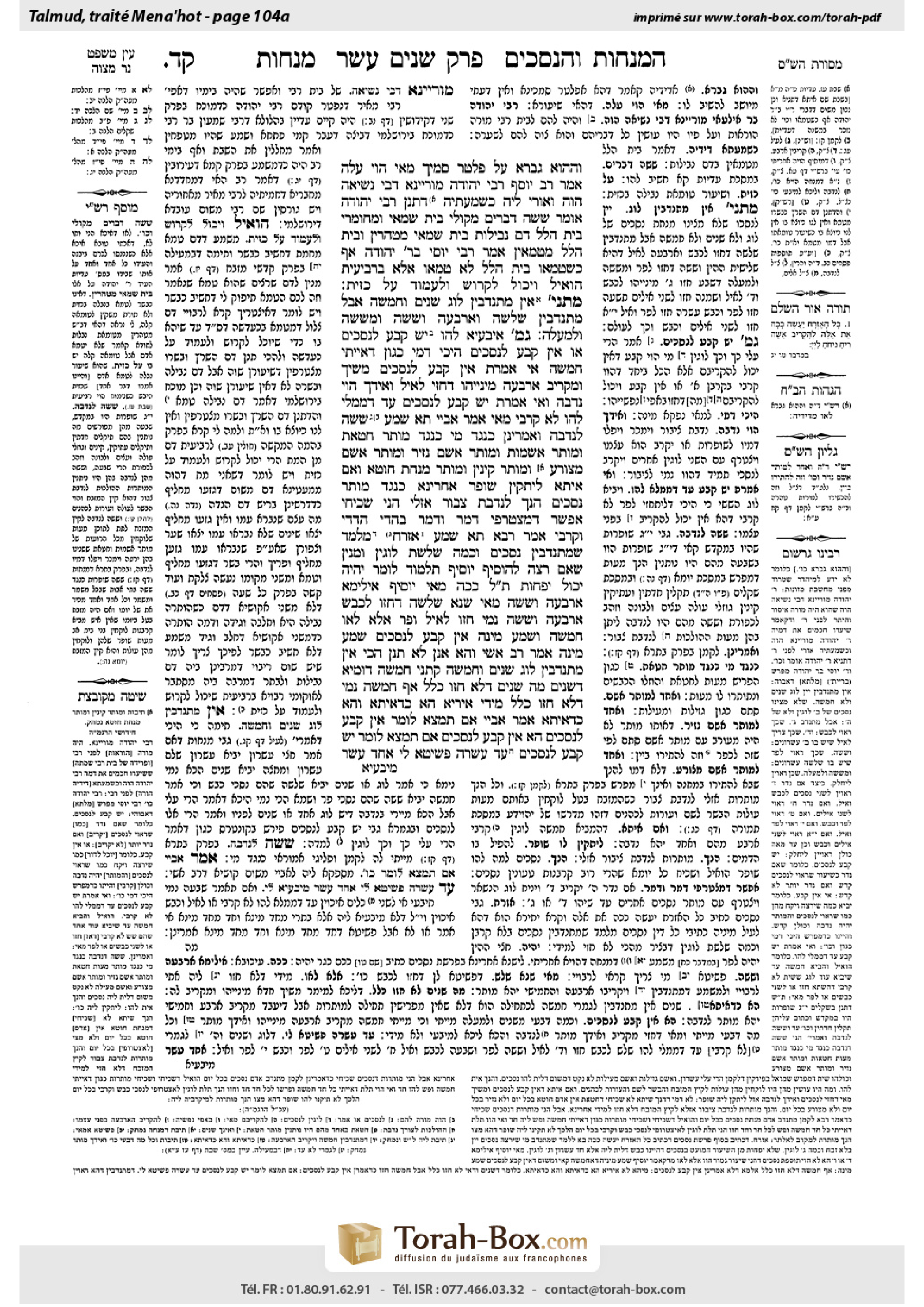
Menachot 104a: Talmud study for Daf Yomi
Daf Yomi is the daily study of one Talmud folio. Explore 37 tractates with scans, Hebrew text, Sefaria English and AI-generated French translations where annotated.
Passage selection and English or AI-generated French translation are available where the scan has annotations. Daf Study is independent of Torah-Box and Sefaria.
Browse Menachot · מנחות · All tractatesMenachot 104a text and translations
This page of Menachot includes the Aramaic text, an English translation and an AI-generated French translation, alongside the scan above.
מנחות ק״ד א · Aramaic and Hebrew text
וְהָהוּא גַּבְרָא עַל פַּלְטֵר סָמֵיךְ.
מַאי הָוֵי עֲלַהּ? אָמַר רַב יוֹסֵף: רַבִּי יְהוּדָה מוֹרְיָינָא דְּבֵי נְשִׂיאָה הֲוָה, וְאוֹרִי לֵיהּ כִּשְׁמַעְתֵּיהּ.
דִּתְנַן, רַבִּי יְהוּדָה אוֹמֵר: שִׁשָּׁה דְּבָרִים מִקּוּלֵּי בֵּית שַׁמַּאי וּמֵחוּמְרֵי בֵּית הִלֵּל. דַּם נְבֵילוֹת – בֵּית שַׁמַּאי מְטַהֲרִין, וּבֵית הִלֵּל מְטַמְּאִין. אָמַר רַבִּי יוֹסֵי בְּרַבִּי יְהוּדָה: אַף כְּשֶׁטִּמְּאוּ בֵּית הִלֵּל, לֹא טִמְּאוּ אֶלָּא בִּרְבִיעִית, הוֹאִיל וְיָכוֹל לִקְרוֹשׁ וְלַעֲמוֹד עַל כְּזַיִת.
מַתְנִי׳ אֵין מִתְנַדְּבִין לוֹג, שְׁנַיִם, וַחֲמִשָּׁה, אֲבָל מִתְנַדְּבִין שְׁלֹשָׁה, וְאַרְבָּעָה, וְשִׁשָּׁה, וּמִשִּׁשָּׁה וּלְמַעְלָה.
גְּמָ׳ אִיבַּעְיָא לְהוּ – יֵשׁ קֶבַע לִנְסָכִים, אוֹ אֵין קֶבַע לִנְסָכִים?
הֵיכִי דָּמֵי? כְּגוֹן דְּאַיְיתִי חַמְשָׁה. אִי אָמְרַתְּ אֵין קֶבַע לִנְסָכִים – מָשֵׁיךְ וּמַקְרֵיב אַרְבְּעָה מִינַּיְיהוּ, דַּחֲזֵי לְאַיִל, וְאִידַּךְ הָוֵי נְדָבָה. וְאִי אָמְרַתְּ יֵשׁ קֶבַע לִנְסָכִים – עַד דִּמְמַלֵּי לְהוּ לָא קׇרְבִי.
מַאי? אָמַר אַבָּיֵי: תָּא שְׁמַע, שִׁשָּׁה לִנְדָבָה, וְאָמְרִינַן: כְּנֶגֶד מִי? כְּנֶגֶד מוֹתַר חַטָּאת, וּמוֹתַר אֲשָׁמוֹת, וּמוֹתַר אֲשַׁם נָזִיר, וּמוֹתַר אֲשַׁם מְצוֹרָע, וּמוֹתַר קִינִּין, וּמוֹתַר מִנְחַת חוֹטֵא.
וְאִם אִיתָא, לִיתַקֵּין שׁוֹפָר אַחֲרִינָא כְּנֶגֶד מוֹתַר נְסָכִים!
הָנָךְ לְנִדְבַת צִבּוּר אָזְלִי, הָנֵי שְׁכִיחִי, אֶפְשָׁר דְּמִצְטָרְפִי דְּמָר וּדְמָר בַּהֲדֵי הֲדָדֵי, וְקָרְבִי.
אָמַר רָבָא: תָּא שְׁמַע, ״אֶזְרָח״ – מְלַמֵּד שֶׁמִּתְנַדְּבִין נְסָכִים, וְכַמָּה? שְׁלֹשֶׁת לוּגִּין.
וּמִנַּיִן שֶׁאִם רָצָה לְהוֹסִיף יוֹסִיף? תַּלְמוּד לוֹמַר ״יִהְיֶה״. יָכוֹל יִפְחוֹת? תַּלְמוּד לוֹמַר ״כָּכָה״.
מַאי ״יוֹסִיף״? אִילֵּימָא אַרְבָּעָה וְשִׁשָּׁה – מַאי שְׁנָא שְׁלֹשָׁה? דַּחֲזוּ לְכֶבֶשׂ – אַרְבָּעָה וְשִׁשָּׁה נָמֵי חֲזוּ לְאַיִל וּפַר! אֶלָּא לָאו, חֲמִשָּׁה, וּשְׁמַע מִינַּהּ אֵין קֶבַע לִנְסָכִים. שְׁמַע מִינַּהּ.
אָמַר רַב אָשֵׁי: וְהָא אֲנַן לָא תְּנַן הָכִי? אֵין מִתְנַדְּבִין לוֹג שְׁנַיִם וַחֲמִשָּׁה. קָתָנֵי חֲמִשָּׁה דּוּמְיָא דִּשְׁנַיִם, מָה שְׁנַיִם דְּלָא חֲזוּ כְּלָל, אַף חֲמִשָּׁה נָמֵי דְּלָא חֲזוּ כְּלָל.
מִידֵּי אִירְיָא? הָא כִּדְאִיתַהּ, וְהָא כִּדְאִיתַהּ.
אָמַר אַבָּיֵי: אִם תִּמְצָא לוֹמַר אֵין קֶבַע לִנְסָכִים – הָא אֵין קֶבַע לִנְסָכִים, אִם תִּמְצָא לוֹמַר יֵשׁ קֶבַע לִנְסָכִים – עַד עֲשָׂרָה פְּשִׁיטָא לִי, אַחַד עָשָׂר
Menachot 104a · English translation
Rabbi Beivai concludes: And that man, i.e., I, relies on a baker. Therefore, my mind is not sufficiently settled to answer the question properly.
The Gemara asks: What conclusion was reached about this question? Rav Yosef said: Rabbi Yehuda was the halakhic decisor of the house of the Nasi, and he instructed them according to his tradition that the blood of an animal carcass is impure.
As we learned in a baraita: Rabbi Yehuda says that six matters are among the leniencies of Beit Shammai and among the stringencies of Beit Hillel. They include the blood of a carcass, which Beit Shammai deem ritually pure, as in their opinion only the flesh of a carcass imparts impurity; and Beit Hillel deem it ritually impure. Rabbi Yosei, son of Rabbi Yehuda, said: Even when Beit Hillel deemed it impure, they deemed it impure only when it is in the quantity of at least a quarter-log, since that amount, were it to congeal, could constitute an olive-bulk, which is the minimum amount of the flesh of a carcass that is deemed impure.
MISHNA: One does not pledge a libation of one log, two log, or five log of wine, because there are no existing libations with those measures of wine. But one pledges a libation of three log, which is the measure of wine brought with a lamb, or four log, which is the measure of wine brought with a ram, or six log, which is the measure of wine brought with a bull. And one may pledge a libation of six log and beyond, as any greater amount can be composed of combinations of these three.
GEMARA: A dilemma was raised before the Sages: Is there a fixed amount for libations, in that when one vows to bring a certain number of log of wine they are not offered separately, or is there no fixed amount for libations, and it is permitted to divide them and offer them in smaller amounts?
The Gemara clarifies: What are the circumstances? It is a case where he brought five log of wine. If you say that there is no fixed amount for libations, then he removes and offers four of them, as those are suitable for the libations of a ram, and the other log, which is not of sufficient volume, is allocated for communal gift offerings. Either it itself is offered, or it is redeemed and the money is used to buy offerings for the repletion of the altar, i.e., for times when the altar is idle. But if you say that there is a fixed amount for libations and the wine may not be divided and offered separately, then it is not offered itself or redeemed with money and offered until he adds to the existing measurement such that the total number of log may be offered as an independent libation.
What is the halakha? Abaye said: Come and hear the answer from a mishna (Shekalim 6:5): There were six collection horns for communal gift offerings, and we say: For what were they designated? They were designated for funds left over from the purchase of sin offerings, for funds left over from the purchase of guilt offerings, for funds left over from the purchase of a guilt offering of a nazirite, for funds left over from the purchase of the guilt offering of a leper, for funds left over from the purchase of pairs of birds, and for funds left over from the purchase of the meal offering of a sinner.
And if it is so that there is no fixed amount for libations, and if one vowed to bring five log then four are offered as a ram’s libation and the fifth can be redeemed and its money used for a communal gift offering, then let them institute an additional collection horn in the Temple for funds left over from the purchase of libations.
The Gemara responds: These six horns are dedicated to funds that go to communal gift offerings, and these log of wine left over from libations are common, so there is no need to store them, since it is possible that the libation of this person will be combined with the libation of another person together in order to reach the desired amount, and then it is offered immediately. Therefore, no additional horn was necessary for the money from the redemption of libations.
Rava said: Come and hear a resolution to the dilemma from a baraita: The Torah states with regard to libations: “All that are home born shall do these things in this manner, in presenting an offering made by fire, of a pleasing aroma to the Lord” (Numbers 15:13). As this verse is superfluous, the various terms in it are used to derive halakhot. The term “home born” teaches that one may pledge libations even when they are not sacrificed together with an offering. And how much is the minimum volume that is offered? Three log, which is the smallest measurement of a libation in the Torah, i.e., the libation that is offered with a lamb.
And from where is it derived that if one desires to add to this amount he may add? The verse states with regard to libations associated with the additional offerings for the New Moon: “And their libations: Half a hin of wine shall be for the bull, and one-third of a hin for the ram, and one-quarter of a hin for the lamb” (Numbers 28:14). From the superfluous “shall be” one may understand that there are others, and derive that independent libations may also be brought. Can one decrease the amount of wine in a libation to less than three log? The verse states: “All that are home born shall do these things, in this manner” (Numbers 15:13), i.e., one may not bring less than three log of wine.
The Gemara clarifies: What does the baraita mean when it says that one may add to the minimum of three log for an independent libation? If we say it means that it is permitted to offer four or six log, then what is different about three log that it was specified? It is because it is suitable for the libations of a lamb. If so, then four or six log are also suitable, as four log is offered as the libation for a ram and six log is offered as the libation for a bull. Rather, in saying that one may add, isn’t the baraita referring to five log of wine, despite the fact that it is not a measurement used with any of the offerings? And learn from this baraita that there is no fixed amount for libations. The Gemara affirms: Indeed, learn from the baraita that this is so.
Rav Ashi said: But didn’t we learn this in the mishna: One does not pledge a libation of one log, two log, or five log of wine? Rav Ashi continues: In phrasing the mishna in this manner, the tanna teaches that the status of five log is similar to the status of two log: Just as two log are not suitable at all to be offered independently, so too, five log are also not suitable at all to offer, as there are no libations of this size. This demonstrates that there is a fixed amount to libations, and one may not divide them into two.
The Gemara responds: Are the cases comparable? This, two log, is as it is, and that, five log, is as it is, and there is no reason to compare them. Four of the five log are offered, with the fifth allocated for a communal gift offering.
Abaye said: If you say that there is no fixed amount for libations, then there is no fixed amount for libations, and no further discussion is necessary. If you say that there is a fixed amount for libations, then the halakha of up to ten log of wine is obvious to me. One log, two log, or five log may not be brought, since these amounts are not offered as standard libations, but three, four, or six log are brought, as their amount is equivalent to those of standard libations. Between six and ten log may also be brought, since these amounts can be composed of a combination of the various wine libations. With regard to eleven log,
Menachot 104a · Traduction française (IA)
Rabbi Beivai conclut : « Et cet homme », c’est-à-dire moi, dépend d’un boulanger. C’est pourquoi je ne suis pas assez serein pour répondre correctement à la question.
La Guemara demande : Quelle conclusion a-t-on tirée au sujet de cette question ? Rav Yosef dit : Rabbi Yehuda était le décisionnaire halakhique de la maison du Nassi, et il leur enseignait, selon sa tradition, que le sang d’une carcasse animale est impur.
Comme nous l’avons appris dans une baraïta : Rabbi Yehuda dit que six questions relèvent des positions indulgentes de Beit Shammaï et des positions rigoureuses de Beit Hillel. Parmi elles figure le sang d’une carcasse : Beit Shammaï le déclarent rituellement pur, car, selon eux, seule la chair d’une carcasse transmet l’impureté ; Beit Hillel le déclarent rituellement impur. Rabbi Yosei, fils de Rabbi Yehuda, dit : même lorsque Beit Hillel le déclaraient impur, ils ne le déclaraient impur qu’à partir d’un volume d’au moins un quart de log, car cette quantité, si elle se coagulait, pourrait constituer le volume d’une olive, qui est la quantité minimale de chair d’une carcasse considérée comme impure.
MICHNA : On ne fait pas vœu d’apporter une libation d’un log, de deux log ou de cinq log de vin, car il n’existe pas de libation de ces mesures. Mais on peut faire vœu d’apporter une libation de trois log, mesure de vin accompagnant un agneau, ou de quatre log, mesure de vin accompagnant un bélier, ou de six log, mesure de vin accompagnant un taureau. On peut aussi faire vœu d’apporter une libation de six log ou davantage, car toute quantité supérieure peut être composée d’une combinaison de ces trois mesures.
GUEMARA : Les Sages soulevèrent une question : Les libations ont-elles une mesure fixe, de sorte que, lorsqu’on fait vœu d’apporter un certain nombre de log de vin, celui-ci ne peut pas être offert en plusieurs parts, ou bien n’ont-elles pas de mesure fixe, auquel cas il est permis de les diviser et de les offrir en quantités plus petites ?
La Guemara précise : De quel cas s’agit-il ? D’un cas où il a apporté cinq log de vin. Si tu dis que les libations n’ont pas de mesure fixe, alors il en prélève quatre et les offre, car cette quantité convient à la libation d’un bélier, et le log restant, qui n’a pas un volume suffisant, est affecté aux offrandes volontaires communautaires. Il est soit offert en tant que tel, soit racheté, et l’argent sert à acheter des offrandes destinées à garnir l’autel, c’est-à-dire pour les périodes où l’autel est inoccupé. Mais si tu dis que les libations ont une mesure fixe et que le vin ne peut pas être divisé et offert séparément, alors il ne peut être ni offert en tant que tel ni racheté pour que l’argent serve à acheter des offrandes tant qu’on n’a pas augmenté la quantité initiale, de sorte que le nombre total de log puisse être offert comme une libation indépendante.
Quelle est la halakha ? Abaye dit : Viens et entends la réponse d’une Michna (Shekalim 6:5) : Il y avait six troncs de collecte pour les offrandes volontaires communautaires, et nous disons : À quoi étaient-ils destinés ? Ils étaient destinés aux fonds restants après l’achat de sacrifices expiatoires, aux fonds restants après l’achat de sacrifices de culpabilité, aux fonds restants après l’achat d’un sacrifice de culpabilité de nazir, aux fonds restants après l’achat du sacrifice de culpabilité d’un lépreux, aux fonds restants après l’achat de paires d’oiseaux, et aux fonds restants après l’achat de l’offrande de farine d’un pécheur.
Et s’il en est ainsi, si les libations n’ont pas de mesure fixe et que, lorsqu’on a fait vœu d’apporter cinq log, quatre sont offerts comme libation d’un bélier et que le cinquième peut être racheté, l’argent servant alors à une offrande volontaire communautaire, qu’ils instituent donc dans le Temple un tronc de collecte supplémentaire pour les fonds restants après l’achat de libations.
La Guemara répond : Ces six troncs sont destinés aux fonds affectés aux offrandes volontaires communautaires, tandis que les log de vin restant des libations sont courants. Il n’est donc pas nécessaire de les conserver, car il est possible de réunir la libation de cette personne à celle d’une autre afin d’atteindre la quantité requise, puis de les offrir immédiatement. Il n’était donc pas nécessaire d’ajouter un tronc pour l’argent provenant du rachat des libations.
Rava dit : Viens et entends la résolution de cette question à partir d’une baraïta : au sujet des libations, la Torah dit : « Tous ceux qui sont nés dans le pays agiront ainsi, en présentant une offrande consumée par le feu, d’odeur agréable pour le Seigneur » (Nombres 15:13). Comme ce verset est superflu, ses différents termes servent à déduire des halakhot. Le terme « nés dans le pays » enseigne qu’on peut faire vœu d’apporter des libations même lorsqu’elles ne sont pas offertes avec un sacrifice. Et quel est le volume minimal qui peut être offert ? Trois log, la plus petite mesure de libation dans la Torah, c’est-à-dire la libation accompagnant un agneau.
Et d’où déduit-on que celui qui souhaite ajouter à cette quantité peut le faire ? Le verset dit, au sujet des libations liées aux sacrifices supplémentaires de la nouvelle lune : « Et leurs libations : une demi-hîn de vin pour le taureau, un tiers de hîn pour le bélier et un quart de hîn pour l’agneau » (Nombres 28:14). Du terme superflu « sera », on peut comprendre qu’il en existe d’autres, et en déduire qu’on peut aussi apporter des libations indépendantes. Peut-on diminuer la quantité de vin d’une libation à moins de trois log ? Le verset dit : « Tous ceux qui sont nés dans le pays agiront ainsi, de cette manière » (Nombres 15:13), c’est-à-dire qu’on ne peut pas apporter moins de trois log de vin.
La Guemara précise : Que veut dire la baraïta lorsqu’elle dit qu’on peut ajouter au minimum de trois log pour une libation indépendante ? Si nous disons qu’elle veut dire qu’il est permis d’offrir quatre ou six log, en quoi les trois log se distinguent-ils pour avoir été mentionnés ? C’est parce qu’ils conviennent à la libation d’un agneau. Dans ce cas, quatre ou six log conviennent également, puisque quatre log sont offerts comme libation pour un bélier et six log comme libation pour un taureau. Au contraire, en disant qu’on peut ajouter, la baraïta ne fait-elle pas référence à cinq log de vin, bien que cette mesure ne soit utilisée pour aucune des offrandes ? Apprends donc de cette baraïta que les libations n’ont pas de mesure fixe. La Guemara confirme : En effet, apprends de la baraïta qu’il en est ainsi.
Rav Ashi dit : Mais n’avons-nous pas appris dans la Michna : « On ne fait pas vœu d’apporter une libation d’un log, de deux log ou de cinq log de vin » ? Rav Ashi poursuit : En formulant la Michna de cette manière, le tanna enseigne que le statut de cinq log est semblable à celui de deux log : de même que deux log ne conviennent absolument pas à une libation indépendante, cinq log ne conviennent absolument pas non plus à une libation, car il n’existe pas de libation de cette mesure. Cela démontre que les libations ont une mesure fixe et qu’on ne peut pas les diviser en deux.
La Guemara répond : Ces cas sont-ils comparables ? Les deux log sont ce qu’ils sont, et les cinq log sont ce qu’ils sont ; il n’y a aucune raison de les comparer. Quatre des cinq log sont offerts, et le cinquième est affecté à une offrande volontaire communautaire.
Abaye dit : Si tu dis que les libations n’ont pas de mesure fixe, alors elles n’ont effectivement pas de mesure fixe, et il n’y a pas lieu de poursuivre la discussion. Si tu dis qu’elles ont une mesure fixe, alors la halakha concernant les quantités allant jusqu’à dix log de vin m’est évidente. On ne peut pas apporter un log, deux log ou cinq log, car ces quantités ne sont pas offertes comme libations habituelles ; en revanche, on apporte trois, quatre ou six log, car ces quantités correspondent à celles des libations habituelles. On peut également apporter entre six et dix log, puisque ces quantités peuvent être composées d’une combinaison des différentes libations de vin. Quant à onze log,
Traduction française générée par IA à partir de l’édition anglaise de Sefaria. Vérifie toujours un passage avec le texte source.
Text from Sefaria: William Davidson Edition - Vocalized Aramaic (unknown); William Davidson Edition - English (CC BY NC).