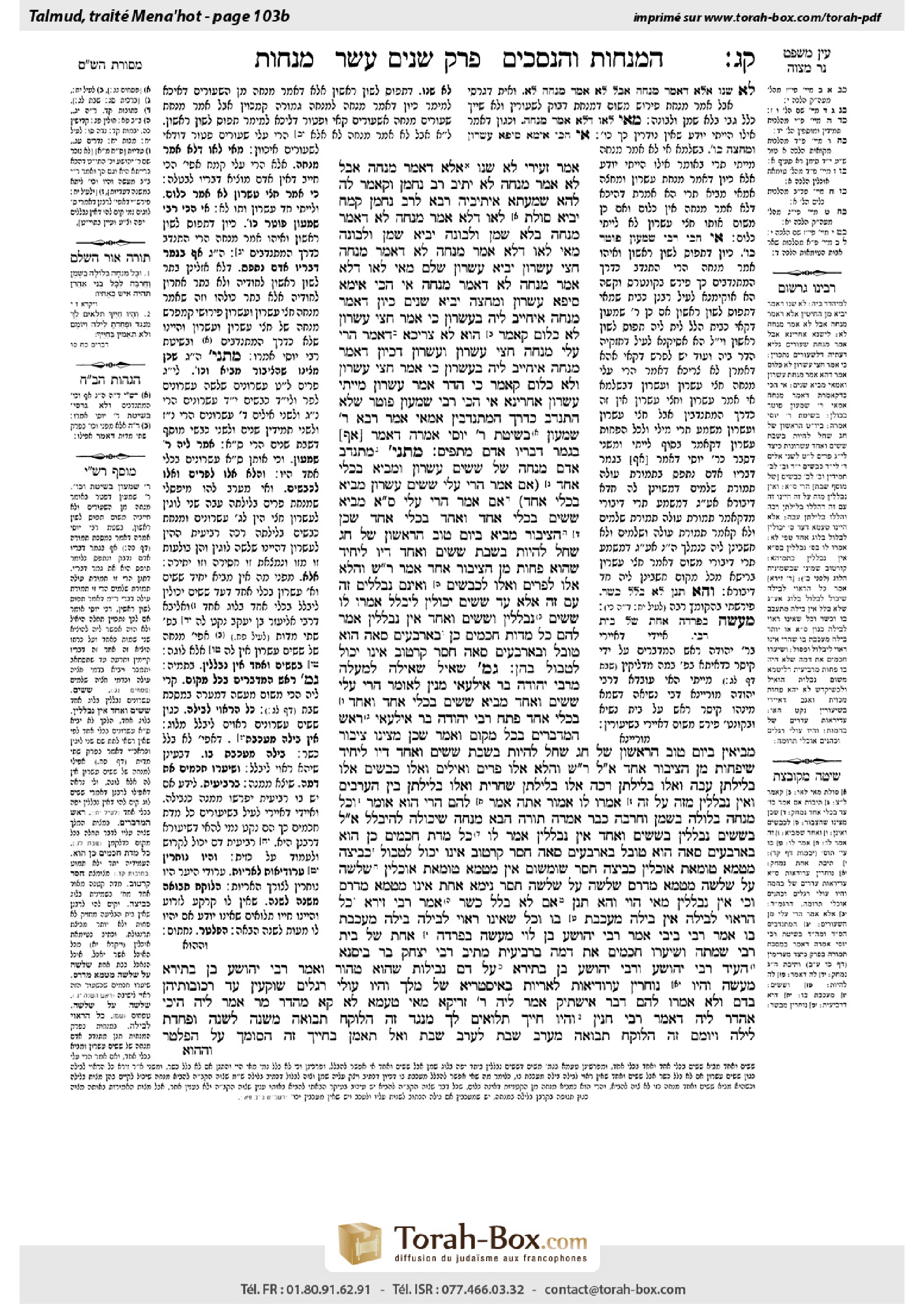
Menachot 103b: Talmud study for Daf Yomi
Daf Yomi is the daily study of one Talmud folio. Explore 37 tractates with scans, Hebrew text, Sefaria English and AI-generated French translations where annotated.
Passage selection and English or AI-generated French translation are available where the scan has annotations. Daf Study is independent of Torah-Box and Sefaria.
Browse Menachot · מנחות · All tractatesMenachot 103b text and translations
This page of Menachot includes the Aramaic text, an English translation and an AI-generated French translation, alongside the scan above.
מנחות ק״ג ב · Aramaic and Hebrew text
אָמַר זְעֵירִי: לֹא שָׁנוּ אֶלָּא דְּאָמַר ״מִנְחָה״, אֲבָל לָא אָמַר ״מִנְחָה״ – לָא.
יָתֵיב רַב נַחְמָן וְקָאָמַר לַהּ לְהָא שְׁמַעְתָּא. אֵיתִיבֵיהּ רָבָא לְרַב נַחְמָן: ״קֶמַח״ – יָבִיא סוֹלֶת, לָאו דְּלֹא אָמַר ״מִנְחָה״? לָא, דְּאָמַר ״מִנְחָה״.
״בְּלֹא שֶׁמֶן וּלְבוֹנָה״, יָבִיא שֶׁמֶן וּלְבוֹנָה. מַאי לָאו דְּלֹא אָמַר ״מִנְחָה״? לָא, דְּאָמַר ״מִנְחָה״.
״חֲצִי עִשָּׂרוֹן״ – יָבִיא עִשָּׂרוֹן שָׁלֵם, מַאי לָאו דְּלֹא אָמַר ״מִנְחָה״? לָא, דְּאָמַר ״מִנְחָה״.
אִי הָכִי, אֵימָא סֵיפָא: עִשָּׂרוֹן וּמֶחֱצָה – יָבִיא שְׁנַיִם, כֵּיוָן דְּאָמַר ״מִנְחָה״ אִיחַיַּיב לֵיהּ בְּעִשָּׂרוֹן, כִּי אָמַר ״חֲצִי עִשָּׂרוֹן״ לֹא כְּלוּם קָאָמַר הוּא.
לָא צְרִיכָא דְּאָמַר ״הֲרֵי עָלַי מִנְחָה חֲצִי עִשָּׂרוֹן וְעִשָּׂרוֹן״, דְּכֵיוָן דְּאָמַר ״מִנְחָה״ אִיחַיַּיב לֵיהּ בְּעִשָּׂרוֹן, כִּי אָמַר ״חֲצִי עִשָּׂרוֹן״ וְלֹא כְּלוּם קָאָמַר, כִּי הָדַר אָמַר ״עִשָּׂרוֹן״ מַיְיתֵי עִשָּׂרוֹן אַחֲרִינָא.
אִי הָכִי, רַבִּי שִׁמְעוֹן פּוֹטֵר שֶׁלֹּא הִתְנַדֵּב כְּדֶרֶךְ הַמִּתְנַדְּבִין, אַמַּאי? אָמַר רָבָא: רַבִּי שִׁמְעוֹן בְּשִׁיטַת רַבִּי יוֹסֵי אֲמָרָהּ, דְּאָמַר: אַף בִּגְמַר דְּבָרָיו אָדָם מַתְפִּיס.
מַתְנִי׳ מִתְנַדֵּב אָדָם מִנְחָה שֶׁל שִׁשִּׁים עִשָּׂרוֹן, וּמֵבִיא בִּכְלִי אֶחָד. (אִם אָמַר ״הֲרֵי עָלַי שִׁשִּׁים עִשָּׂרוֹן״ – מֵבִיא בִּכְלִי אֶחָד). אִם אָמַר ״הֲרֵי עָלַי שִׁשִּׁים וְאֶחָד״ – מֵבִיא שִׁשִּׁים בִּכְלִי אֶחָד, וְאֶחָד בִּכְלִי אֶחָד, שֶׁכֵּן הַצִּיבּוּר מֵבִיא בְּיוֹם טוֹב הָרִאשׁוֹן שֶׁל חַג שֶׁחָל לִהְיוֹת בַּשַּׁבָּת שִׁשִּׁים וְאֶחָד.
דַּיּוֹ לַיָּחִיד שֶׁהוּא פָּחוֹת מִן הַצִּיבּוּר אֶחָד.
אָמַר רַבִּי שִׁמְעוֹן: וַהֲלֹא אֵלּוּ לַפָּרִים, וְאֵלּוּ לַכְּבָשִׂים, וְאֵינָם נִבְלָלִים זֶה עִם זֶה! אֶלָּא עַד שִׁשִּׁים יְכוֹלִין לִיבָּלֵל.
אָמְרוּ לוֹ: שִׁשִּׁים נִבְלָלִין, וְשִׁשִּׁים וְאֶחָד אֵין נִבְלָלִין?! אָמַר לָהֶם: כׇּל מִדּוֹת חֲכָמִים כֵּן – בְּאַרְבָּעִים סְאָה הוּא טוֹבֵל, וּבְאַרְבָּעִים סְאָה חָסֵר קֻרְטוֹב אֵינוֹ יָכוֹל לִטְבּוֹל בָּהֶן.
גְּמָ׳ שְׁאִיל שְׁאֵילָה לְמַעְלָה מֵרַבִּי יְהוּדָה בַּר אִילְעַאי: מִנַּיִן לְאוֹמֵר ״הֲרֵי עָלַי שִׁשִּׁים וְאֶחָד״ מֵבִיא שִׁשִּׁים בִּכְלִי אֶחָד, וְאֶחָד בִּכְלִי אֶחָד?
פָּתַח רַבִּי יְהוּדָה בַּר אִילְעַאי, רֹאשׁ הַמְדַבְּרִים בְּכׇל מָקוֹם, וְאָמַר: שֶׁכֵּן מָצִינוּ צִיבּוּר מְבִיאִין בְּיוֹם טוֹב הָרִאשׁוֹן שֶׁל חַג שֶׁחָל לִהְיוֹת בַּשַּׁבָּת שִׁשִּׁים וְאֶחָד, דַּיּוֹ לַיָּחִיד שֶׁיִּפְחוֹת מִן הַצִּיבּוּר אֶחָד.
אָמַר לוֹ רַבִּי שִׁמְעוֹן: וַהֲלֹא אֵלּוּ פָּרִים וְאֵילִים, וְאֵלּוּ כְּבָשִׂים? אֵלּוּ בְּלִילָתָן עָבָה, וְאֵלּוּ בְּלִילָתָן רַכָּה, אֵלּוּ בְּלִילָתָן שַׁחֲרִית, וְאֵלּוּ בְּלִילָתָן בֵּין הָעַרְבַּיִם, וְאֵין נִבְלָלִין מִזֶּה עַל זֶה.
אָמְרוּ לוֹ: ״אֱמוֹר אַתָּה״. אָמַר לָהֶם: הֲרֵי הוּא אוֹמֵר ״וְכׇל מִנְחָה בְלוּלָה בַשֶּׁמֶן וַחֲרֵבָה״, כְּבָר אָמְרָה תּוֹרָה: הָבֵא מִנְחָה שֶׁיְּכוֹלָה לְהִיבָּלֵל.
אָמַר לוֹ: בְּשִׁשִּׁים נִבְלָלִין, בְּשִׁשִּׁים וְאֶחָד אֵין נִבְלָלִין?! אָמַר לוֹ: כׇּל מִדַּת חֲכָמִים כֵּן הוּא – בְּאַרְבָּעִים סְאָה הוּא טוֹבֵל, בְּאַרְבָּעִים סְאָה חָסֵר קֻרְטוֹב אֵינוֹ יָכוֹל לִטְבּוֹל.
כְּבֵיצָה – מְטַמֵּא טוּמְאַת אֳכָלִין, כְּבֵיצָה חָסֵר שׁוּמְשׁוּם – אֵין מְטַמֵּא טוּמְאַת אֳכָלִין. שְׁלֹשָׁה עַל שְׁלֹשָׁה – מְטַמֵּא מִדְרָס, שְׁלֹשָׁה עַל שְׁלֹשָׁה חָסֵר נִימָא אַחַת – אֵינוֹ מְטַמֵּא מִדְרָס.
וְכִי אֵין נִבְלָלִין, מַאי הָוֵי? וְהָא תְּנַן: אִם לֹא בָּלַל – כָּשֵׁר! אָמַר רַבִּי זֵירָא: כׇּל הָרָאוּי לְבִילָּה – אֵין בִּילָּה מְעַכֶּבֶת בּוֹ, וְכֹל שֶׁאֵינוֹ רָאוּי לְבִילָּה – בִּילָּה מְעַכֶּבֶת בּוֹ.
אָמַר רַבִּי בִּיבִי, אָמַר רַבִּי יְהוֹשֻׁעַ בֶּן לֵוִי: מַעֲשֶׂה בְּפִרְדָּה אַחַת שֶׁל בֵּית רַבִּי שֶׁמֵּתָה, וְשִׁיעֲרוּ חֲכָמִים אֶת דָּמָהּ בִּרְבִיעִית.
מֵתִיב רַבִּי יִצְחָק בַּר בִּיסְנָא: הֵעִיד רַבִּי יְהוֹשֻׁעַ וְרַבִּי יְהוֹשֻׁעַ בֶּן בְּתֵירָא עַל דַּם נְבֵילוֹת שֶׁהוּא טָהוֹר, וְאָמַר רַבִּי יְהוֹשֻׁעַ בֶּן בְּתֵירָא: מַעֲשֶׂה וְהָיוּ נוֹחֲרִין עֲרוֹדְיָאוֹת לַאֲרָיוֹת בְּאִיסְטַרְיָא שֶׁל מֶלֶךְ, וְהָיוּ עוֹלֵי רְגָלִים שׁוֹקְעִין עַד רְכוּבּוֹתֵיהֶן בַּדָּם, וְלֹא אָמְרוּ לָהֶם דָּבָר.
אִישְׁתִּיק, אֲמַר לֵיהּ רַבִּי זְרִיקָא: מַאי טַעְמָא לָא קָא מַהְדַּר מָר? אֲמַר לֵיהּ: הֵיכִי אַהְדַּר לֵיהּ, דְּאָמַר רַבִּי חָנִין: ״וְהָיוּ חַיֶּיךָ תְּלֻאִים לְךָ מִנֶּגֶד״ – זֶה הַלּוֹקֵחַ תְּבוּאָה מִשָּׁנָה לְשָׁנָה.
״וּפָחַדְתָּ לַיְלָה וְיוֹמָם״ – זֶה הַלּוֹקֵחַ תְּבוּאָה מֵעֶרֶב שַׁבָּת לְעֶרֶב שַׁבָּת, ״וְאַל תַּאֲמֵן בְּחַיֶּיךָ״ – זֶה הַסּוֹמֵךְ עַל הַפַּלְטֵר.
Menachot 103b · English translation
The Gemara cites another comment concerning the ruling in the mishna that a vow to bring a meal offering from barley takes effect: Ze’eiri said: The Sages taught that the first portion of one’s statement is accepted only where he said in his vow: Meal offering [minḥa], but not in the Hebrew construct where it is attached to the term: From barley [minḥat se’orim]. But if he did not say the word meal offering independently, but either said minḥat se’orim or said: It is incumbent upon me to bring barley, the vow does not take effect, and he does not bring a meal offering.
Rav Naḥman was sitting and reciting this halakha of Ze’eiri. Rava raised an objection to Rav Naḥman from the mishna: One who vows to bring a meal offering from regular flour, which is not used for a meal offering, should bring the meal offering from fine flour. Is it not referring to a case where he did not say: It is incumbent upon me to bring a meal offering, but rather said: It is incumbent upon me to bring regular flour? Apparently, the vow takes effect even if one did not state the term meal offering in an independent form. Rav Naḥman responded: No, it is referring to where he said: It is incumbent upon me to bring a meal offering of regular flour.
Rava raised another, similar objection from the continuation of the mishna: With regard to one who vows to bring a meal offering without oil and frankincense, his vow takes effect, and he shall bring it with oil and frankincense. What, is it not referring to a case where he did not say the word meal offering in his vow, and yet it still takes effect? Rav Naḥman responds: No, it is referring to a case where he said: It is incumbent upon me to bring a meal offering without oil or frankincense.
Rava asks again based on the mishna: If one vows to bring a meal offering of half a tenth of an ephah, he should bring a complete tenth of an ephah. What, is it not referring to a case where he did not say the term meal offering in his vow, and yet it still takes effect? Rav Naḥman responds: No, it is referring to a case where he said: It is incumbent upon me to bring a meal offering of half a tenth of an ephah.
Rava asks: If it is so that in all the cases in the mishna his vow included the term meal offering, say the last clause: If one vows to bring a meal offering of a tenth and a half of an ephah, he should bring two tenths. Once he said the term meal offering, he is obligated in bringing a tenth of an ephah of flour. Therefore, when he states the words: Half a tenth, he is not saying anything, as he did not say the term meal offering with it, and would not have to bring two tenths. In what case is the ruling in the latter clause relevant?
Rav Naḥman answers: No, it is necessary to teach the halakha in the case where he said: It is incumbent upon me to bring a meal offering of half a tenth and a tenth. Since he said the term meal offering, he is obligated in bringing a tenth of an ephah for it. When he said: Half a tenth, he is saying nothing, since a meal offering is not brought with that amount of flour. When he then said the word tenth, he therefore brings another tenth, totaling two tenths.
Rava asks: If so, then when the mishna continues: Rabbi Shimon deems one exempt from bringing a meal offering in all these cases, as he did not pledge in the manner of those who pledge, why is this his opinion? Once he said the term meal offering, the vow should be valid. Rava said in response: Rabbi Shimon stated his opinion according to the opinion of Rabbi Yosei, who said that the conclusion of a person’s statement is also accepted. Therefore, even when he said the term meal offering at the beginning of the vow, since at the end he also made declarations that do not apply to a voluntary meal offering, the vow does not take effect.
MISHNA: A person may pledge a meal offering of sixty tenths of an ephah of fine flour, and bring all sixty tenths in one vessel. If he says: It is incumbent upon me to bring sixty tenths of an ephah, he brings it in one vessel. If he says: It is incumbent upon me to bring sixty-one tenths of an ephah, he brings sixty tenths in one vessel and one tenth in another vessel, as the greatest number of tenths of an ephah that the community brings as meal offerings in one day is on the first festival day of Sukkot when it occurs on Shabbat, when sixty-one tenths of an ephah of fine flour are brought.
It is sufficient for an individual that the maximum amount he can bring at once is one tenth of an ephah less than that of the community. When the first day of Sukkot occurs on Shabbat, thirteen bulls, two goats, and fourteen lambs are sacrificed as the additional offerings of Sukkot, two lambs are sacrificed as the daily offerings, and two lambs are sacrificed as the additional offering of Shabbat. Three tenths of an ephah are brought for each bull, two tenths for each goat, and a tenth for each lamb. Altogether, that is sixty-one tenths of an ephah.
Rabbi Shimon says: What is the relevance of the tenths of an ephah sacrificed on Sukkot that occurs on Shabbat? Aren’t these meal offerings for bulls and those for lambs, and they are not mixed with each other (see 89a)? Rather, the reason that one may not bring more than sixty tenths of an ephah in one vessel is because up to sixty tenths of fine flour can be mixed with one log of oil.
The Rabbis said to him: Is it so that sixty tenths of flour can be mixed with a log of oil, but sixty-one tenths cannot be mixed? Rabbi Shimon said to them: All the measures of the Sages are so: For example, in a ritual bath containing forty se’a of water, one immerses for purification, and in a ritual bath with forty se’a less the small measure of a kortov, one cannot immerse in it for purification.
GEMARA: The Sages asked a question above, i.e., in front of, Rabbi Yehuda bar Elai: From where is it derived that one who says: It is incumbent upon me to bring a meal offering of sixty-one tenths, brings sixty tenths in one vessel and one tenth in another vessel?
Rabbi Yehuda bar Elai, the first speaker on every occasion, began his speech and said: Since we find that the greatest number of tenths of an ephah that the community brings in one day is on the first festival day of Sukkot when it occurs on Shabbat, when sixty-one tenths of fine flour are brought, it is therefore sufficient for an individual that the maximum amount he can bring at once is one tenth of an ephah less than that of the community.
Rabbi Shimon said to him: Aren’t these meal offerings brought with bulls and rams, and those brought with lambs? Don’t these, the meal offerings brought with the bulls, have a thick mixture, as six log of oil are mixed with three tenths of an ephah of flour, and those, the meal offerings brought with the lambs, have a thin mixture, as three log of oil are mixed with a tenth of an ephah of flour? Isn’t the mixture of these meal offerings, the daily offering and the additional offerings, performed in the morning, and the mixture of those meal offerings, brought with the afternoon daily offering, performed in the afternoon, and isn’t it the case that they are not mixed with one another? The communal offerings cannot serve as precedent because they never bring sixty-one tenths in one vessel.
The Sages said to him: You should state a reason why a meal offering of more than sixty tenths of an ephah must be brought in more than one vessel. Rabbi Shimon said to them: It says in the Torah: “And every meal offering, mixed with oil, or dry, shall all the sons of Aaron have, one as well as another” (Leviticus 7:10). The Torah has already stated here: Bring a meal offering that is capable of being mixed.
Rabbi Yehuda said to him: Is it so that if the mixture consists of sixty tenths of flour, it can be mixed with a log of oil, and if it consists of sixty-one tenths, it cannot be mixed? Rabbi Shimon said to Rabbi Yehuda: All the measures of the Sages are so: In a ritual bath containing forty se’a of water, one immerses for purification, and in a ritual bath with forty se’a less the small measure of a kortov, one cannot immerse and be purified.
Similarly, food in the volume of an egg-bulk transmits the ritual impurity of food, while food in the volume of an egg-bulk less a small amount equal to the volume of a sesame seed does not transmit impurity of food. Similarly, a garment that is three by three handbreadths is susceptible to ritual impurity imparted by treading if a man who experiences a gonorrhea-like discharge [zav] sits or lies on it, while if it is three by three handbreadths less one thread, a tiny measurement, it is not susceptible to ritual impurity imparted by treading.
The Gemara asks: Even if sixty tenths do not mix with one log of oil, what of it? But didn’t we learn in a mishna that although there is a mitzva to mix the oil with the flour in a meal offering, if he did not mix them, it is still valid? The Gemara answers that Rabbi Zeira says: For any measure of flour that is suitable for mixing with oil in a meal offering, the lack of mixing does not invalidate the meal offering. Although there is a mitzva to mix the oil and the flour ab initio, the meal offering is fit for sacrifice even if the oil and the flour are not mixed. And for any measure of flour that is not suitable for mixing with oil in a meal offering, the lack of mixing invalidates the meal offering.
The Gemara relates an incident involving halakhic measurements: Rabbi Beivai says that Rabbi Yehoshua ben Levi says: There was an incident involving a mule belonging to the house of Rabbi Yehuda HaNasi that died, and the Sages estimated the amount of its blood that emerged as a quarter-log, which is the minimum measurement for it to impart ritual impurity.
Rabbi Yitzḥak bar Bisna raises an objection: Rabbi Yehoshua and Rabbi Yehoshua ben Beteira testified that they had a tradition concerning the blood of unslaughtered animal carcasses that it is ritually pure. Similarly, Rabbi Yehoshua ben Beteira said: An incident occurred where people were killing wild donkeys in order to feed the meat to the lions that were in the king’s stadium [be’istarya], and those ascending to Jerusalem on the pilgrimage festival were wading up to their knees [rekhuboteihen] in the donkeys’ blood, and the Sages did not say anything to them about them becoming impure. Apparently, the blood of an animal carcass does not transmit ritual impurity, even though the carcass itself does.
Rabbi Beivai was silent and did not answer. Rabbi Zerika said to him: What is the reason that the Master does not respond to the question? Rabbi Beivai said to him: How can I respond to him? My circumstances can be described as Rabbi Ḥanin said in interpreting the verse: “And your life shall hang in doubt before you; and you shall fear night and day, and you shall have no assurance of your life” (Deuteronomy 28:66). “And your life shall hang in doubt before you”; this is referring to one who purchases grain from one year for the next, because he is not certain that he will find grain to eat in the next year.
“And you shall fear night and day”; this is referring to one who purchases grain from one Shabbat eve to another because he does not have the resources to provide for himself further. “And you shall have no assurance of your life”; this is referring to one who relies on the baker [hapalter] to give him bread because he has no grain of his own.
Menachot 103b · Traduction française (IA)
La Guemara cite un autre commentaire au sujet de la règle de la Michna selon laquelle le vœu d’apporter une offrande de farine d’orge prend effet. Ze’eiri a dit : Les Sages ont enseigné que seule la première partie de la déclaration d’une personne est retenue lorsqu’elle a dit dans son vœu : « Offrande de farine » [minḥa], mais pas lorsqu’elle a employé la forme construite, où le terme est lié à « d’orge » [minḥat se’orim]. En revanche, si elle n’a pas prononcé séparément les mots « offrande de farine », mais a dit soit minḥat se’orim, soit : « Je suis tenu d’apporter de l’orge », le vœu ne prend pas effet et elle n’apporte pas d’offrande de farine.
Rav Naḥman était assis et enseignait cette halakha de Ze’eiri. Rava objecta à Rav Naḥman en citant la Michna : Celui qui fait vœu d’apporter une offrande de farine à base de farine ordinaire, qui ne convient pas à une offrande de farine, doit apporter l’offrande de farine avec de la farine fine. N’est-ce pas le cas où il n’a pas dit : « Je suis tenu d’apporter une offrande de farine », mais plutôt : « Je suis tenu d’apporter de la farine ordinaire » ? Il semble donc que le vœu prenne effet même si le terme « offrande de farine » n’a pas été prononcé séparément. Rav Naḥman répondit : Non, il s’agit du cas où il a dit : « Je suis tenu d’apporter une offrande de farine à base de farine ordinaire. »
Rava souleva une autre objection similaire, tirée de la suite de la Michna : Celui qui fait vœu d’apporter une offrande de farine sans huile ni encens voit son vœu prendre effet et doit l’apporter avec de l’huile et de l’encens. N’est-ce pas le cas où il n’a pas prononcé les mots « offrande de farine » dans son vœu, et où celui-ci prend pourtant effet ? Rav Naḥman répondit : Non, il s’agit du cas où il a dit : « Je suis tenu d’apporter une offrande de farine sans huile ni encens. »
Rava interrogea encore en s’appuyant sur la Michna : Si quelqu’un fait vœu d’apporter une offrande de farine d’un demi-dixième d’épha, il doit en apporter un dixième d’épha entier. N’est-ce pas le cas où il n’a pas prononcé les mots « offrande de farine » dans son vœu, et où celui-ci prend pourtant effet ? Rav Naḥman répondit : Non, il s’agit du cas où il a dit : « Je suis tenu d’apporter une offrande de farine d’un demi-dixième d’épha. »
Rava demanda : S’il en est ainsi, c’est-à-dire que, dans tous les cas de la Michna, son vœu comportait les mots « offrande de farine », examinons la dernière clause : Si quelqu’un fait vœu d’apporter une offrande de farine d’un dixième et demi d’épha, il doit en apporter deux dixièmes. Dès lors qu’il a prononcé les mots « offrande de farine », il est tenu d’apporter un dixième d’épha de farine. Par conséquent, lorsqu’il dit « un demi-dixième », il ne dit rien, puisqu’il n’a pas associé ces mots à ceux d’« offrande de farine » ; il ne serait donc pas tenu d’apporter deux dixièmes. Dans quel cas la règle de la dernière clause s’applique-t-elle ?
Rav Naḥman répondit : Non, cette règle est nécessaire pour le cas où il a dit : « Je suis tenu d’apporter une offrande de farine d’un demi-dixième et d’un dixième. » Puisqu’il a prononcé les mots « offrande de farine », il est tenu d’en apporter un dixième d’épha. Lorsqu’il a dit « un demi-dixième », il ne dit rien, car une offrande de farine ne s’apporte pas avec cette quantité de farine. Lorsqu’il a ensuite prononcé le mot « dixième », il doit donc apporter un dixième supplémentaire, soit deux dixièmes au total.
Rava demanda : Dans ce cas, lorsque la Michna poursuit en disant que Rabbi Shimon le dispense d’apporter une offrande de farine dans tous ces cas, car il ne s’est pas engagé comme le font ceux qui s’engagent à apporter une offrande, pourquoi est-ce son avis ? Dès lors qu’il a prononcé les mots « offrande de farine », son vœu devrait être valide. Rava répondit : Rabbi Shimon a exprimé son avis conformément à celui de Rabbi Yosei, qui dit que la fin de la déclaration d’une personne est également prise en compte. Ainsi, même s’il a prononcé les mots « offrande de farine » au début de son vœu, le vœu ne prend pas effet puisqu’à la fin il a également formulé des déclarations qui ne s’appliquent pas à une offrande de farine volontaire.
MICHNA : Une personne peut s’engager à apporter une offrande de farine de soixante dixièmes d’épha de farine fine et apporter les soixante dixièmes dans un seul récipient. Si elle dit : « Je suis tenue d’apporter soixante dixièmes d’épha », elle les apporte dans un seul récipient. Si elle dit : « Je suis tenue d’apporter soixante et un dixièmes d’épha », elle apporte soixante dixièmes dans un récipient et un dixième dans un autre, car le plus grand nombre de dixièmes d’épha que la communauté apporte en offrandes de farine en un seul jour est atteint le premier jour de fête de Soukkot lorsqu’il tombe un Chabbat : soixante et un dixièmes d’épha de farine fine sont alors apportés.
Il suffit que le maximum qu’un particulier puisse apporter en une fois soit inférieur d’un dixième d’épha à celui de la communauté. Lorsque le premier jour de Soukkot tombe un Chabbat, treize taureaux, deux boucs et quatorze agneaux sont sacrifiés comme offrandes supplémentaires de Soukkot, deux agneaux sont sacrifiés comme offrandes quotidiennes et deux agneaux comme offrande supplémentaire du Chabbat. On apporte trois dixièmes d’épha pour chaque taureau, deux dixièmes pour chaque bouc et un dixième pour chaque agneau. Le total est de soixante et un dixièmes d’épha.
Rabbi Shimon dit : En quoi le nombre de dixièmes d’épha apportés à Soukkot lorsque la fête tombe un Chabbat est-il pertinent ? Ces offrandes de farine accompagnent les taureaux, et celles-là accompagnent les agneaux ; elles ne sont pas mélangées entre elles (voir 89a). La raison pour laquelle on ne peut pas apporter plus de soixante dixièmes d’épha dans un seul récipient est plutôt que l’on peut mélanger jusqu’à soixante dixièmes de farine fine avec un log d’huile.
Les Sages lui dirent : Est-il vrai que soixante dixièmes de farine peuvent être mélangés avec un log d’huile, mais que soixante et un dixièmes ne le peuvent pas ? Rabbi Shimon leur dit : Il en va ainsi pour toutes les mesures des Sages. Par exemple, dans un bain rituel contenant quarante sé’a d’eau, on peut s’immerger pour être purifié ; dans un bain rituel contenant quarante sé’a moins la petite mesure d’un kortov, on ne peut pas s’y immerger pour être purifié.
GUEMARA : Les Sages posèrent plus tôt, c’est-à-dire devant Rabbi Yehuda bar Elai, la question suivante : D’où déduit-on que celui qui dit : « Je suis tenu d’apporter une offrande de farine de soixante et un dixièmes », en apporte soixante dixièmes dans un récipient et un dixième dans un autre ?
Rabbi Yehuda bar Elai, qui prenait toujours la parole le premier, commença son discours en disant : Puisque nous constatons que le plus grand nombre de dixièmes d’épha que la communauté apporte en un jour est atteint le premier jour de fête de Soukkot lorsqu’il tombe un Chabbat, avec soixante et un dixièmes de farine fine, il suffit qu’un particulier ne puisse en apporter en une fois qu’un dixième d’épha de moins que la communauté.
Rabbi Shimon lui dit : Ces offrandes de farine n’accompagnent-elles pas les taureaux et les béliers, tandis que celles-là accompagnent les agneaux ? Celles-là, les offrandes de farine apportées avec les taureaux, ne donnent-elles pas un mélange épais, puisque six log d’huile sont mélangés à trois dixièmes d’épha de farine, tandis que celles-ci, les offrandes de farine apportées avec les agneaux, donnent un mélange fluide, puisque trois log d’huile sont mélangés à un dixième d’épha de farine ? Le mélange de ces offrandes de farine — l’offrande quotidienne et les offrandes supplémentaires — n’est-il pas effectué le matin, tandis que le mélange de celles-là, apportées avec l’offrande quotidienne de l’après-midi, est effectué l’après-midi ? Et ne sont-elles pas mélangées les unes avec les autres ? Les offrandes de la communauté ne peuvent servir de précédent, car on n’apporte jamais soixante et un dixièmes dans un seul récipient.
Les Sages lui dirent : Tu devrais donner une raison pour laquelle une offrande de farine de plus de soixante dixièmes d’épha doit être apportée dans plusieurs récipients. Rabbi Shimon leur dit : Il est écrit dans la Torah : « Et toute offrande de farine, pétrie avec de l’huile ou sèche, appartiendra aux fils d’Aaron, à chacun comme à l’autre » (Lévitique 7:10). La Torah a déjà indiqué ici qu’il faut apporter une offrande de farine qui puisse être mélangée.
Rabbi Yehuda lui dit : Est-il vrai que si le mélange comprend soixante dixièmes de farine, il peut être mélangé avec un log d’huile, mais que s’il comprend soixante et un dixièmes, il ne le peut pas ? Rabbi Shimon dit à Rabbi Yehuda : Il en va ainsi pour toutes les mesures des Sages. Dans un bain rituel contenant quarante sé’a d’eau, on peut s’immerger et être purifié ; dans un bain rituel contenant quarante sé’a moins la petite mesure d’un kortov, on ne peut pas s’immerger et être purifié.
De même, un aliment ayant le volume d’un œuf transmet l’impureté rituelle des aliments, tandis qu’un aliment ayant le volume d’un œuf moins une petite quantité égale au volume d’un grain de sésame ne transmet pas l’impureté des aliments. De même, un vêtement mesurant trois téfaḥim sur trois est susceptible de contracter l’impureté rituelle transmise par piétinement si un homme affecté d’un écoulement semblable à la gonorrhée [zav] s’assoit ou s’allonge dessus ; en revanche, s’il mesure trois téfaḥim sur trois moins un fil, une quantité infime, il n’est pas susceptible de contracter l’impureté rituelle transmise par piétinement.
La Guemara demande : À supposer que soixante dixièmes ne se mélangent pas avec un log d’huile, qu’est-ce que cela change ? N’avons-nous pas appris dans une Michna que, bien qu’il y ait une mitsva de mélanger l’huile à la farine d’une offrande de farine, si on ne les a pas mélangées, l’offrande reste valide ? La Guemara répond que Rabbi Zeira dit : Pour toute quantité de farine qui peut être mélangée à l’huile dans une offrande de farine, l’absence de mélange n’invalide pas l’offrande. Bien qu’il y ait une mitsva de mélanger l’huile et la farine a priori, l’offrande de farine peut être sacrifiée même si l’huile et la farine ne sont pas mélangées. En revanche, pour toute quantité de farine qui ne peut pas être mélangée à l’huile dans une offrande de farine, l’absence de mélange invalide l’offrande.
La Guemara rapporte un incident portant sur les mesures halakhiques : Rabbi Beivai dit au nom de Rabbi Yehoshua ben Levi : Une mule appartenant à la maison de Rabbi Yehuda HaNasi mourut, et les Sages estimèrent que la quantité de sang qui s’en était écoulée était d’un quart de log, la quantité minimale nécessaire pour transmettre l’impureté rituelle.
Rabbi Yitzḥak bar Bisna soulève une objection : Rabbi Yehoshua et Rabbi Yehoshua ben Beteira ont témoigné qu’ils tenaient une tradition selon laquelle le sang des carcasses d’animaux non abattus rituellement est rituellement pur. De même, Rabbi Yehoshua ben Beteira a dit : Un événement eut lieu : des gens tuaient des ânes sauvages afin de donner leur viande aux lions qui se trouvaient dans le stade du roi [be’istarya], et ceux qui montaient à Jérusalem pour le pèlerinage traversaient le sang des ânes jusqu’aux genoux [rekhuboteihen], sans que les Sages leur disent quoi que ce soit au sujet de leur impureté. Il semble donc que le sang d’une carcasse animale ne transmette pas l’impureté rituelle, contrairement à la carcasse elle-même.
Rabbi Beivai garda le silence et ne répondit pas. Rabbi Zerika lui dit : Pourquoi le Maître ne répond-il pas à la question ? Rabbi Beivai lui dit : Comment pourrais-je lui répondre ? Ma situation correspond à ce que Rabbi Ḥanin a dit en interprétant le verset : « Ta vie sera en suspens devant toi ; tu trembleras jour et nuit, et tu ne seras pas assuré de ta vie » (Deutéronome 28:66). « Ta vie sera en suspens devant toi » : cela désigne celui qui achète du grain d’une année pour l’année suivante, car il n’est pas certain de trouver du grain à manger l’année suivante.
« Tu trembleras jour et nuit » : cela désigne celui qui achète du grain d’une veille de Chabbat à l’autre, car il n’a pas les moyens de subvenir à ses besoins au-delà. « Et tu ne seras pas assuré de ta vie » : cela désigne celui qui compte sur le boulanger [hapalter] pour lui donner du pain, car il ne possède pas de grain.
Traduction française générée par IA à partir de l’édition anglaise de Sefaria. Vérifie toujours un passage avec le texte source.
Text from Sefaria: William Davidson Edition - Vocalized Aramaic (unknown); William Davidson Edition - English (CC BY NC).