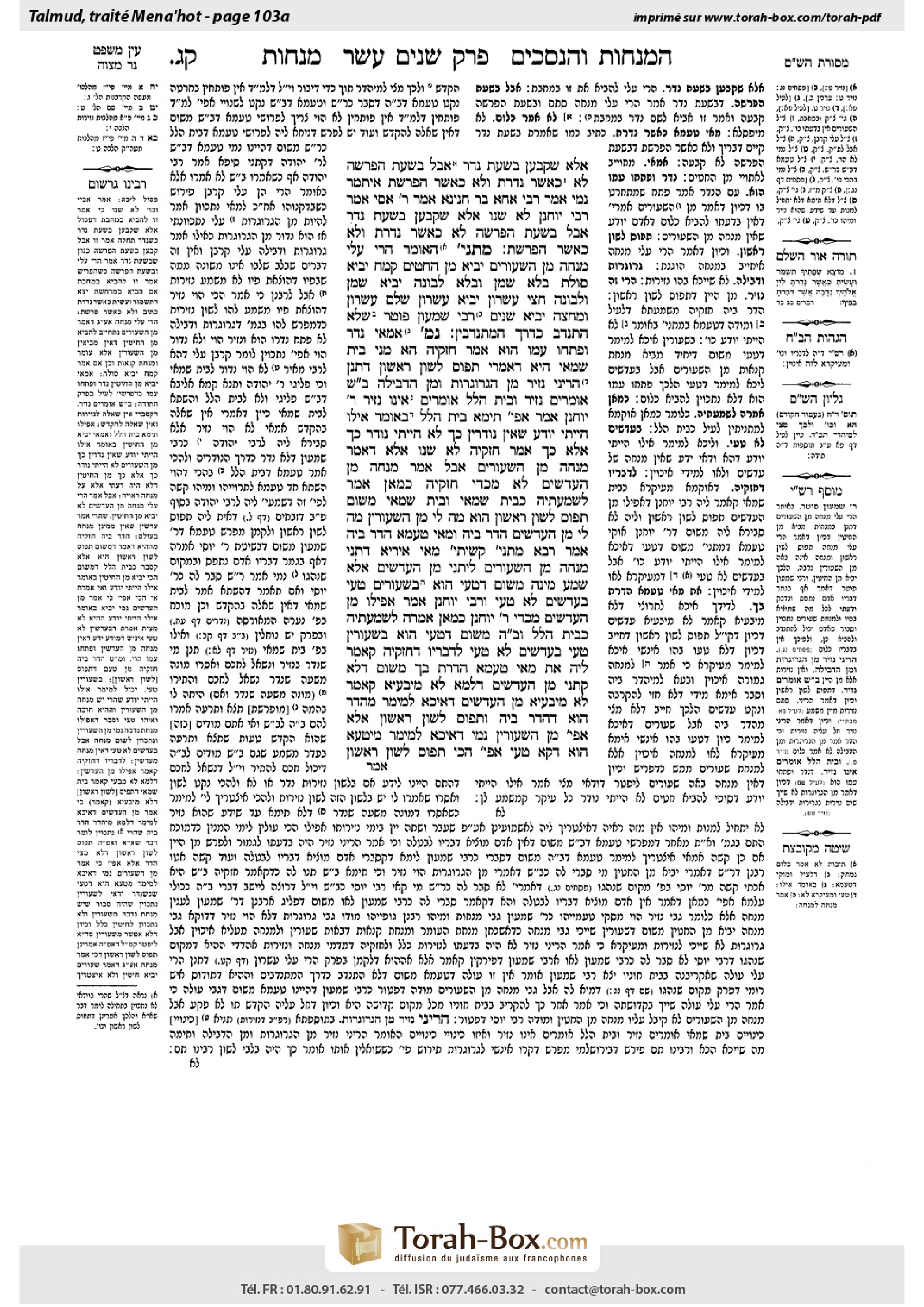
Menachot 103a: Talmud study for Daf Yomi
Daf Yomi is the daily study of one Talmud folio. Explore 37 tractates with scans, Hebrew text, Sefaria English and AI-generated French translations where annotated.
Passage selection and English or AI-generated French translation are available where the scan has annotations. Daf Study is independent of Torah-Box and Sefaria.
Browse Menachot · מנחות · All tractatesMenachot 103a text and translations
This page of Menachot includes the Aramaic text, an English translation and an AI-generated French translation, alongside the scan above.
מנחות ק״ג א · Aramaic and Hebrew text
אֶלָּא שֶׁקְּבָעָן בִּשְׁעַת נֶדֶר, אֲבָל בִּשְׁעַת הַפְרָשָׁה – לָא.
״כַּאֲשֶׁר נָדַרְתָּ״, וְלֹא ״כַּאֲשֶׁר הִפְרַשְׁתָּ״.
אִיתְּמַר נָמֵי: אָמַר רַבִּי אַחָא בַּר חֲנִינָא, אָמַר רַבִּי אַסִּי, אָמַר רַבִּי יוֹחָנָן: לֹא שָׁנוּ אֶלָּא שֶׁקְּבָעָן בִּשְׁעַת נֶדֶר, אֲבָל בִּשְׁעַת הַפְרָשָׁה – לֹא, ״כַּאֲשֶׁר נָדַרְתָּ״ וְלֹא ״כַּאֲשֶׁר הִפְרַשְׁתָּ״.
מַתְנִי׳ הָאוֹמֵר ״הֲרֵי עָלַי מִנְחָה מִן הַשְּׂעוֹרִים״ – יָבִיא מִן הַחִטִּים. ״קֶמַח״ – יָבִיא סוֹלֶת. ״בְּלֹא שֶׁמֶן וּבְלֹא לְבוֹנָה״ – יָבִיא שֶׁמֶן וּלְבוֹנָה.
״חֲצִי עִשָּׂרוֹן״ – יָבִיא עִשָּׂרוֹן שָׁלֵם, ״עִשָּׂרוֹן וּמֶחֱצָה״ – יָבִיא שְׁנַיִם, רַבִּי שִׁמְעוֹן פּוֹטֵר, שֶׁלֹּא הִתְנַדֵּב כְּדֶרֶךְ הַמִּתְנַדְּבִין.
גְּמָ׳ אַמַּאי? נֶדֶר וּפִתְחוֹ עִמּוֹ הוּא!
אָמַר חִזְקִיָּה: הָא מַנִּי? בֵּית שַׁמַּאי הִיא, דְּאָמְרִי תְּפוֹס לָשׁוֹן רִאשׁוֹן, דִּתְנַן: ״הֲרֵינִי נָזִיר מִן הַגְּרוֹגְרוֹת וּמִן הַדְּבֵילָה״ – בֵּית שַׁמַּאי אוֹמְרִים: נָזִיר, וּבֵית הִלֵּל אוֹמְרִים: אֵינוֹ נָזִיר.
רַבִּי יוֹחָנָן אָמַר: אֲפִילּוּ תֵּימָא בֵּית הִלֵּל, בְּאוֹמֵר ״אִילּוּ הָיִיתִי יוֹדֵעַ שֶׁאֵין נוֹדְרִין כָּךְ, לֹא הָיִיתִי נוֹדֵר כָּךְ אֶלָּא כָּךְ״.
אָמַר חִזְקִיָּה: לֹא שָׁנוּ אֶלָּא דְּאָמַר ״מִנְחָה מִן הַשְּׂעוֹרִים״, אֲבָל אָמַר ״מִנְחָה מִן הָעֲדָשִׁים״ – לָא.
מִכְּדִי חִזְקִיָּה כְּמַאן אָמַר לִשְׁמַעְתֵּיהּ? כְּבֵית שַׁמַּאי, וּבֵית שַׁמַּאי מִשּׁוּם תְּפוֹס לָשׁוֹן רִאשׁוֹן הוּא. מָה לִי מִן הַשְּׂעוֹרִין, מָה לִי מִן הָעֲדָשִׁים? הֲדַר בֵּיהּ.
וּמַאי טַעְמָא הֲדַר בֵּיהּ? אָמַר רָבָא: מַתְנִיתִין קְשִׁיתֵיהּ, מַאי אִירְיָא דְּתָנֵי ״מִנְחָה מִן הַשְּׂעוֹרִים״? לִיתְנֵי ״מִן הָעֲדָשִׁים״!
אֶלָּא שְׁמַע מִינַּהּ, מִשּׁוּם דְּטָעֵי הוּא, בִּשְׂעוֹרִים טָעֵי, בַּעֲדָשִׁים לָא טָעֵי.
וְרַבִּי יוֹחָנָן אָמַר: אֲפִילּוּ מִן הָעֲדָשִׁים. מִכְּדֵי, רַבִּי יוֹחָנָן כְּמַאן אַמְרַהּ לִשְׁמַעְתֵּיהּ? כְּבֵית הִלֵּל, וּבֵית הִלֵּל מִשּׁוּם דְּטָעֵי הוּא. בִּשְׂעוֹרִין – טָעֵי, בַּעֲדָשִׁים – לָא טָעֵי!
לִדְבָרָיו דְּחִזְקִיָּה קָאָמַר לֵיהּ, אַתְּ מַאי טַעְמָא הָדְרַתְּ בָּךְ מִשּׁוּם דְּלָא קָתָנֵי ״מִן הָעֲדָשִׁים״.
דִּלְמָא ״לָא מִיבַּעְיָא״ קָאָמַר, לָא מִיבַּעְיָא מִן הָעֲדָשִׁים, דְּאִיכָּא לְמֵימַר מִהְדָּר הוּא דְּהָדַר בֵּיהּ, וּתְפוֹס לָשׁוֹן רִאשׁוֹן, אֶלָּא אֲפִילּוּ מִן הַשְּׂעוֹרִין נָמֵי, דְּאִיכָּא לְמֵימַר מִיטְעָא הוּא דְּקָא טָעֵי, אֲפִילּוּ הָכִי תְּפוֹס לָשׁוֹן רִאשׁוֹן.
Menachot 103a · English translation
only when he assigned it at the time of the vow. But if at the time of the vow he simply said: It is incumbent upon me to bring a meal offering, and at the time of the designation of the fine flour as a meal offering he specified a particular type of meal offering, he is not obligated to bring that type, and if he brought a different type, he has still fulfilled his obligation.
The reason for this is that the Torah states: “That which has emerged from your lips you shall observe and do; according to what you have vowed freely to the Lord your God, even that which you have promised with your mouth” (Deuteronomy 23:24). Since it states: “According to what you have vowed,” and not: According to what you have designated to fulfill your vow, only matters specified as part of the vow are essential to its content.
It was also stated that Rabbi Aḥa bar Ḥanina says that Rabbi Asi says that Rabbi Yoḥanan says: The tanna’im taught in the mishna that meal offerings are not valid only when he established their type at the time of the vow and subsequently brought a different type of meal offering. But if he mentioned one type of meal offering at the time of the designation of the flour, and then brought it differently, it is not invalid, as the Torah states: “According to what you have vowed,” and not: According to what you have designated for your vow.
MISHNA: One who says: It is incumbent upon me to bring a meal offering from barley, should bring the meal offering from wheat, as voluntary meal offerings are brought exclusively from wheat. One who says: It is incumbent upon me to bring a meal offering from flour, should bring the meal offering from fine flour, as it is written: “His offering shall be of fine flour” (Leviticus 2:1). If one vows to bring a meal offering without oil and without frankincense, he should bring it with oil and frankincense, as voluntary meal offerings require oil and frankincense.
If one vows to bring as a meal offering half a tenth of an ephah, he should bring a complete tenth of an ephah, the minimum measure of a voluntary meal offering. If one vows to bring a meal offering of a tenth and a half an ephah, he should bring two tenths, as there are no partial tenths of an ephah brought in meal offerings. Rabbi Shimon deems one exempt from bringing a meal offering in all these cases. This is because the vow does not take effect, as he did not pledge in the manner of those who pledge.
GEMARA: The Gemara asks: Why is the vow to bring a meal offering from barley valid? It is seemingly a case of a vow and its extenuation together. The statement: It is incumbent upon me to bring a meal offering, is a valid vow, while the next term: From barley, constitutes a retraction, as the speaker knows that a meal offering may not be brought from barley.
Ḥizkiyya said: In accordance with whose opinion is this mishna? It is in accordance with the opinion of Beit Shammai, who say: In the case of one who stated a declaration comprising two contradictory statements, attend only to the first statement. As we learned in a mishna (Nazir 9a): If one says: I am hereby a nazirite from dried figs and from pressed figs, which is a contradictory statement, as figs are not prohibited to a nazirite, Beit Shammai say: He is a full-fledged nazirite, as one attends only to the first statement, i.e., I am hereby a nazirite, and the second part is discounted. And Beit Hillel say: The second part of his statement is not discounted, and therefore he is not a nazirite, as he did not accept naziriteship upon himself.
Rabbi Yoḥanan said: You may even say that the mishna here is in accordance with the opinion of Beit Hillel. It is referring to one who, upon being informed that such a vow is not effective, says: Had I known that one cannot vow in this manner to bring barley for a meal offering, I would not have vowed in this manner but rather in that manner, by vowing to bring wheat instead.
§ The Gemara cites another disagreement between Ḥizkiyya and Rabbi Yoḥanan about the mishna: Ḥizkiyya says that the Sages taught in the mishna only that where he says: It is incumbent upon me to bring a meal offering from barley, he can bring a meal offering from wheat instead, but if he says: It is incumbent upon me to bring a meal offering from lentils, the vow is not valid.
The Gemara asks: Now, Ḥizkiyya said that his tradition of interpreting the mishna is that it is in accordance with whose opinion? It is in accordance with Beit Shammai’s opinion, and Beit Shammai’s ruling is due to the principle that one should attend only to the first statement. If so, what is the difference to me whether he vowed to bring a meal offering from barley or from lentils? In either case, that principle should require him to bring a meal offering from wheat. The Gemara answers: Ḥizkiyya retracted his initial explanation that the mishna is in accordance with Beit Shammai, and subscribes to the explanation of Rabbi Yoḥanan.
The Gemara asks: And what is the reason that he retracted his explanation? Rava said: The mishna posed a difficulty for him: Why does the tanna specifically teach this halakha using the example of a meal offering from barley? Let it teach the halakha using the example of a meal offering from lentils, which is a greater novelty.
Rather, learn from it that the reason the vow takes effect is because one may err. With regard to barley, it is reasonable that one may err, since one of the individual meal offerings, the meal offering of a sota, comes from barley. But with regard to lentils, one would not err in thinking that one may bring a meal offering from them. Therefore, one can presume that by saying: Lentils, he intended to negate his initial statement.
Rabbi Yoḥanan says: According to the mishna, even if he vowed to bring a meal offering from lentils, the vow takes effect. The Gemara asks: Now, Rabbi Yoḥanan states that his tradition in interpreting the mishna is that it is in accordance with whose opinion? It is in accordance with the opinion of Beit Hillel, and Beit Hillel understand that the reason the meal offering takes effect is because one may reasonably err. One may err with regard to barley being fit for a meal offering, but with regard to lentils, he will not err that they are fit. Why then, does Rabbi Yoḥanan hold that the meal offering takes effect even if he said: Lentils?
The Gemara answers: Rabbi Yoḥanan does in fact hold that when he vows to bring a meal offering from lentils it is not valid. What he said was in response to the statement of Ḥizkiyya. Rabbi Yoḥanan is saying to him: What is the reason that you retracted your explanation of the mishna as being in accordance with the opinion of Beit Shammai? It is because the mishna does not teach using the example of one who vowed to bring a meal offering from lentils, which would have been a greater novelty.
Rabbi Yoḥanan questions this reasoning: Perhaps the mishna is speaking utilizing the style of: It is not necessary. It is not necessary to say that when one vows to bring a meal offering from lentils, the vow takes effect and he brings a meal offering from wheat. He brings it because one has reason to say that he in fact intended to vow and then retracted his initial statement, and yet the vow takes effect in accordance with the opinion of Beit Shammai that one should attend only to the initial statement and his retraction is disregarded. But even if he vowed to bring a meal offering from barley, where one has reason to say he made an error, and had he known that a meal offering is not brought from barley, he would not have vowed at all, nevertheless, the vow takes effect and he must bring a meal offering, due to the principle: Attend only to the first statement.
Menachot 103a · Traduction française (IA)
uniquement s’il en a fixé le type au moment du vœu. Mais si, au moment du vœu, il a simplement dit : « Je suis tenu d’apporter une offrande de farine », puis qu’au moment de désigner la farine fine comme offrande de farine, il a précisé un type particulier, il n’est pas tenu d’apporter ce type ; s’il en a apporté un autre, il s’est néanmoins acquitté de son obligation.
La raison en est que la Torah dit : « Ce qui est sorti de tes lèvres, tu l’observeras et l’accompliras ; selon ce que tu as voué volontairement à l’Éternel ton Dieu, selon ce que tu as promis de ta bouche » (Deutéronome 23:24). Puisqu’il est dit : « Selon ce que tu as voué », et non : « Selon ce que tu as désigné pour accomplir ton vœu », seuls les éléments précisés dans le cadre du vœu sont essentiels à son contenu.
Il a également été enseigné que Rabbi Aḥa bar Ḥanina dit au nom de Rabbi Asi, qui dit au nom de Rabbi Yoḥanan : Les tannaïm ont enseigné dans la Michna que les offrandes de farine ne sont pas valides uniquement dans le cas où celui qui a fait le vœu en a fixé le type au moment du vœu, puis en a apporté un autre. Mais s’il a mentionné un type d’offrande de farine au moment de désigner la farine, puis l’a apportée sous une autre forme, elle n’est pas invalide, car la Torah dit : « Selon ce que tu as voué », et non : « Selon ce que tu as désigné pour ton vœu ».
Michna : Celui qui dit : « Je suis tenu d’apporter une offrande de farine d’orge » doit apporter une offrande de farine de blé, car les offrandes de farine volontaires ne sont apportées qu’à partir de blé. Celui qui dit : « Je suis tenu d’apporter une offrande de farine », doit apporter une offrande de farine fine, comme il est écrit : « Son offrande sera de farine fine » (Lévitique 2:1). Si quelqu’un fait vœu d’apporter une offrande de farine sans huile ni encens, il doit l’apporter avec de l’huile et de l’encens, car les offrandes de farine volontaires requièrent de l’huile et de l’encens.
Si quelqu’un fait vœu d’apporter comme offrande de farine une demi-dixième d’épha, il doit en apporter une dixième entière, qui est la mesure minimale d’une offrande de farine volontaire. Si quelqu’un fait vœu d’apporter une offrande de farine d’une dixième et demie d’épha, il doit en apporter deux dixièmes, car on n’apporte pas d’offrandes de farine en fractions de dixième d’épha. Rabbi Shimon le dispense d’apporter une offrande de farine dans tous ces cas. En effet, le vœu ne prend pas effet, puisqu’il ne s’est pas engagé de la manière dont on prend habituellement un engagement.
Guemara : La Guemara demande : Pourquoi le vœu d’apporter une offrande de farine d’orge est-il valide ? Apparemment, c’est un cas où le vœu et sa rétractation sont formulés ensemble. La déclaration : « Je suis tenu d’apporter une offrande de farine » constitue un vœu valide, tandis que les mots qui suivent, « d’orge », constituent une rétractation, car celui qui parle sait qu’on ne peut pas apporter une offrande de farine à partir d’orge.
Ḥizkiyya a dit : Selon l’opinion de qui cette Michna est-elle formulée ? Selon celle de Beit Shammaï, qui disent que lorsqu’une personne prononce une déclaration comprenant deux affirmations contradictoires, on ne tient compte que de la première. En effet, nous avons appris dans une Michna (Nazir 9a) : Si quelqu’un dit : « Me voici naziréen à partir de figues sèches et de figues pressées », ce qui est contradictoire, puisque les figues ne sont pas interdites au naziréen, Beit Shammaï disent qu’il est pleinement naziréen, car on ne tient compte que de la première affirmation, à savoir : « Me voici naziréen », et la suite est écartée. Beit Hillel disent que la suite de sa déclaration n’est pas écartée ; il n’est donc pas naziréen, car il n’a pas accepté le naziréat.
Rabbi Yoḥanan a dit : On peut même dire que la Michna suit ici l’opinion de Beit Hillel. Elle parle de quelqu’un qui, après avoir été informé qu’un tel vœu n’est pas valide, dit : « Si j’avais su qu’on ne peut pas faire un vœu de cette manière, en apportant de l’orge pour une offrande de farine, je n’aurais pas fait ce vœu de cette manière, mais plutôt de cette autre manière, en faisant vœu d’apporter du blé. »
§ La Guemara cite une autre controverse entre Ḥizkiyya et Rabbi Yoḥanan au sujet de la Michna. Ḥizkiyya dit que les Sages n’ont enseigné dans la Michna que le cas où quelqu’un dit : « Je suis tenu d’apporter une offrande de farine d’orge » ; il peut alors apporter une offrande de farine de blé à la place. Mais s’il dit : « Je suis tenu d’apporter une offrande de farine de lentilles », le vœu n’est pas valide.
La Guemara demande : Or, selon la tradition de Ḥizkiyya concernant l’interprétation de la Michna, celle-ci suit l’opinion de qui ? Celle de Beit Shammaï, dont la décision repose sur le principe qu’on ne tient compte que de la première affirmation. Si c’est le cas, quelle différence cela fait-il qu’il ait fait vœu d’apporter une offrande de farine d’orge ou de lentilles ? Dans les deux cas, ce principe devrait exiger qu’il apporte une offrande de farine de blé. La Guemara répond : Ḥizkiyya a abandonné son explication initiale selon laquelle la Michna suit l’opinion de Beit Shammaï, et adopte l’explication de Rabbi Yoḥanan.
La Guemara demande : Pourquoi a-t-il abandonné son explication ? Rava a dit : La Michna lui posait une difficulté : Pourquoi le tanna enseigne-t-il précisément cette halakha à l’aide de l’exemple d’une offrande de farine d’orge ? Qu’il enseigne la halakha à l’aide de l’exemple d’une offrande de farine de lentilles, qui constituerait une nouveauté plus grande.
Il faut plutôt en déduire que le vœu prend effet parce qu’on peut se tromper. Dans le cas de l’orge, il est raisonnable qu’on puisse se tromper, puisque l’une des offrandes de farine particulières, celle de la sota, est faite à partir d’orge. Mais, pour les lentilles, personne ne se tromperait en pensant qu’on peut en faire une offrande de farine. On peut donc supposer qu’en disant « lentilles », il avait l’intention d’annuler sa déclaration initiale.
Rabbi Yoḥanan dit : Selon la Michna, même si quelqu’un a fait vœu d’apporter une offrande de farine de lentilles, le vœu prend effet. La Guemara demande : Or, selon la tradition de Rabbi Yoḥanan concernant l’interprétation de la Michna, celle-ci suit l’opinion de qui ? Celle de Beit Hillel. Or, Beit Hillel comprennent que le vœu prend effet parce qu’on peut raisonnablement se tromper. On peut se tromper en pensant que l’orge convient à une offrande de farine, mais on ne se tromperait pas en pensant que les lentilles conviennent. Pourquoi Rabbi Yoḥanan considère-t-il alors que le vœu prend effet même s’il a dit : « Lentilles » ?
La Guemara répond : Rabbi Yoḥanan considère bien que, lorsqu’il fait vœu d’apporter une offrande de farine de lentilles, celui-ci n’est pas valide. Ce qu’il a dit était une réponse à l’affirmation de Ḥizkiyya. Rabbi Yoḥanan lui dit : Pourquoi as-tu abandonné ton explication de la Michna selon laquelle elle suit l’opinion de Beit Shammaï ? Parce que la Michna ne prend pas pour exemple quelqu’un qui a fait vœu d’apporter une offrande de farine de lentilles, ce qui aurait constitué une nouveauté plus grande.
Rabbi Yoḥanan met en question ce raisonnement : Peut-être la Michna emploie-t-elle le procédé consistant à dire « il n’est pas nécessaire ». Il n’est pas nécessaire de dire que lorsque quelqu’un fait vœu d’apporter une offrande de farine de lentilles, le vœu prend effet et il apporte une offrande de farine de blé. Il l’apporte parce qu’on peut raisonnablement dire qu’il avait réellement l’intention de faire un vœu, puis qu’il s’est rétracté, et pourtant le vœu prend effet conformément à l’opinion de Beit Shammaï, selon laquelle on ne tient compte que de la première affirmation et l’on écarte sa rétractation. Mais même s’il a fait vœu d’apporter une offrande de farine d’orge, alors qu’on peut raisonnablement dire qu’il s’est trompé et que, s’il avait su qu’on n’apporte pas d’offrande de farine d’orge, il n’aurait pas fait de vœu du tout, le vœu prend néanmoins effet et il doit apporter une offrande de farine, en vertu du principe : on ne tient compte que de la première affirmation.
Traduction française générée par IA à partir de l’édition anglaise de Sefaria. Vérifie toujours un passage avec le texte source.
Text from Sefaria: William Davidson Edition - Vocalized Aramaic (unknown); William Davidson Edition - English (CC BY NC).