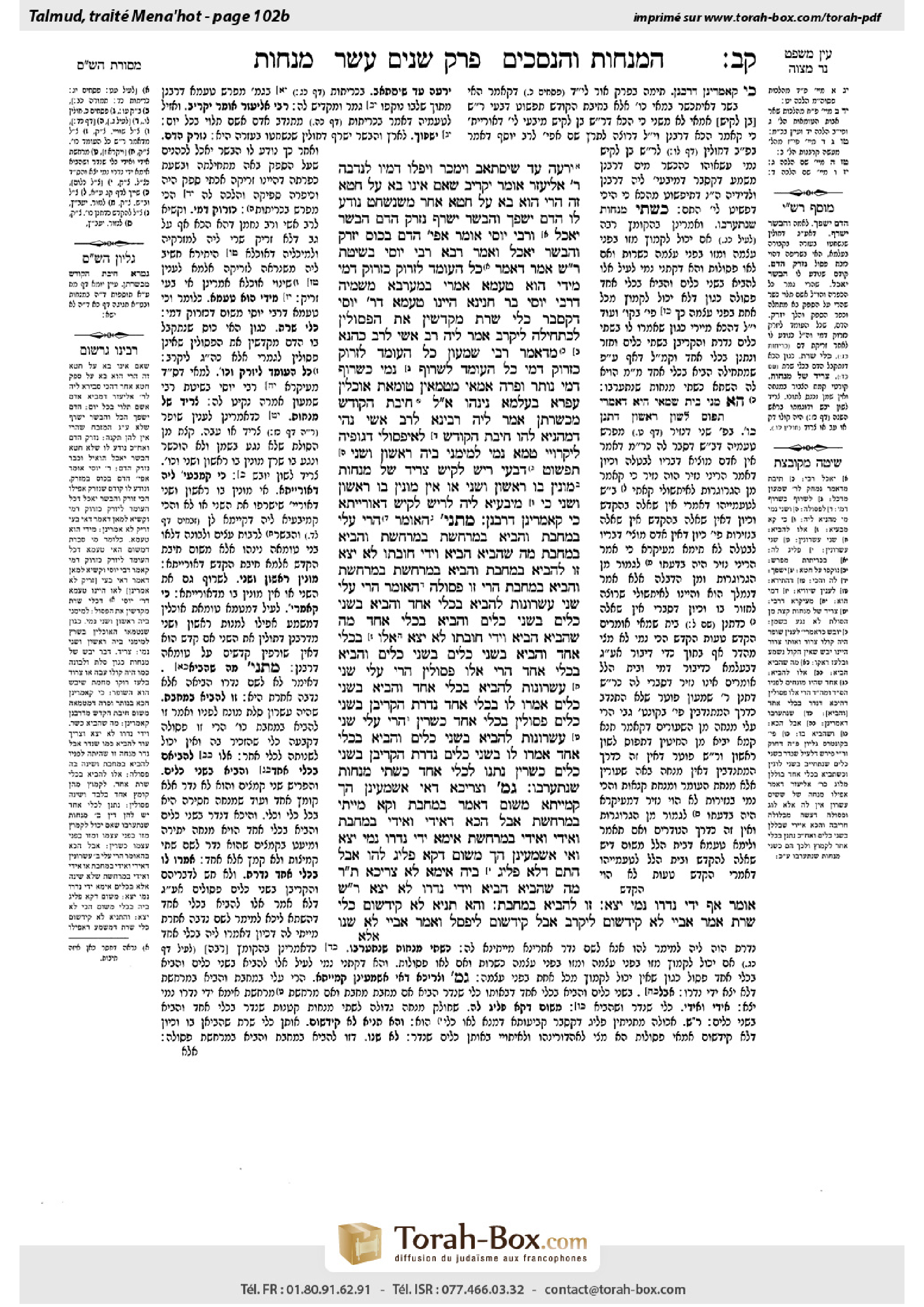
Menachot 102b: Talmud study for Daf Yomi
Daf Yomi is the daily study of one Talmud folio. Explore 37 tractates with scans, Hebrew text, Sefaria English and AI-generated French translations where annotated.
Passage selection and English or AI-generated French translation are available where the scan has annotations. Daf Study is independent of Torah-Box and Sefaria.
Browse Menachot · מנחות · All tractatesMenachot 102b text and translations
This page of Menachot includes the Aramaic text, an English translation and an AI-generated French translation, alongside the scan above.
מנחות ק״ב ב · Aramaic and Hebrew text
יִרְעֶה עַד שֶׁיִּסְתָּאֵב וְיִמָּכֵר וְיִפְּלוּ דָּמָיו לִנְדָבָה. רַבִּי אֱלִיעֶזֶר אוֹמֵר: יַקְרִיב, שֶׁאִם אֵינוֹ בָּא עַל חֵטְא זֶה הֲרֵי הוּא בָּא עַל חֵטְא אַחֵר.
מִשֶּׁנִּשְׁחַט, נוֹדַע לוֹ – הַדָּם יִשָּׁפֵךְ, וְהַבָּשָׂר יִשָּׂרֵף.
נִזְרַק הַדָּם – הַבָּשָׂר יֵאָכֵל, וְרַבִּי יוֹסֵי אוֹמֵר: אֲפִילּוּ הַדָּם בַּכּוֹס – יִזָּרֵק וְהַבָּשָׂר יֵאָכֵל.
וְאָמַר רָבָא: רַבִּי יוֹסֵי בְּשִׁיטַת רַבִּי שִׁמְעוֹן אֲמָרָהּ, דְּאָמַר: כׇּל הָעוֹמֵד לִזְרוֹק – כְּזָרוּק דָּמֵי.
מִידֵּי הוּא טַעְמָא? אָמְרִי בְּמַעְרְבָא מִשְּׁמֵיהּ דְּרַבִּי יוֹסֵי בַּר חֲנִינָא: הַיְינוּ טַעְמָא דְּרַבִּי יוֹסֵי, דְּקָסָבַר כְּלֵי שָׁרֵת מְקַדְּשִׁין אֶת הַפְּסוּלִין לְכַתְּחִילָּה לִיקְרַב.
אֲמַר לֵיהּ רַב אָשֵׁי לְרַב כָּהֲנָא: מִדְּאָמַר רַבִּי שִׁמְעוֹן כׇּל הָעוֹמֵד לִזְרוֹק כְּזָרוּק דָּמֵי, כׇּל הָעוֹמֵד לִשְׂרוֹף נָמֵי כְּשָׂרוּף דָּמֵי – נוֹתָר וּפָרָה אַמַּאי מִטַּמְּאִין טוּמְאַת אֳכָלִין? עַפְרָא בְּעָלְמָא נִינְהוּ! אֲמַר לֵיהּ: חִיבַּת הַקּוֹדֶשׁ מַכְשַׁרְתָּן.
אֲמַר לֵיהּ רָבִינָא לְרַב אָשֵׁי: נְהִי דְּמַהְנְיָא לְהוּ חִיבַּת הַקּוֹדֶשׁ לְאִיפְּסוֹלֵי דְּגוּפֵיהּ, לִיקְּרוֹיֵי טָמֵא נָמֵי, לְמִימְנֵי בֵּיהּ רִאשׁוֹן וְשֵׁנִי?
תִּפְשׁוֹט דְּבָעֵי רֵישׁ לָקִישׁ: צָרִיד שֶׁל מְנָחוֹת, מוֹנִין בּוֹ רִאשׁוֹן וְשֵׁנִי, אוֹ אֵין מוֹנִין בּוֹ רִאשׁוֹן וְשֵׁנִי?
כִּי מִיבַּעְיָא לֵיהּ לְרֵישׁ לָקִישׁ – דְּאוֹרָיְיתָא, כִּי קָאָמְרִינַן – דְּרַבָּנַן.
מַתְנִי׳ הָאוֹמֵר ״הֲרֵי עָלַי בְּמַחֲבַת״ וְהֵבִיא בְּמַרְחֶשֶׁת, ״בְּמַרְחֶשֶׁת״ וְהֵבִיא בְּמַחֲבַת – מַה שֶּׁהֵבִיא הֵבִיא, וִידֵי חוֹבָתוֹ לֹא יָצָא.
״זוֹ לְהָבִיא בְּמַחֲבַת״, וְהֵבִיא בְּמַרְחֶשֶׁת; ״בְּמַרְחֶשֶׁת״, וְהֵבִיא בְּמַחֲבַת – הֲרֵי זוֹ פְּסוּלָה.
הָאוֹמֵר: ״הֲרֵי עָלַי שְׁנֵי עֶשְׂרוֹנוֹת לְהָבִיא בִּכְלִי אֶחָד״, וְהֵבִיא בִּשְׁנֵי כֵּלִים, ״בִּשְׁנֵי כֵּלִים״, וְהֵבִיא בִּכְלִי אֶחָד – מַה שֶּׁהֵבִיא הֵבִיא, וִידֵי חוֹבָתוֹ לֹא יָצָא.
״אֵלּוּ בִּכְלִי אֶחָד״, וְהֵבִיא בִּשְׁנֵי כֵּלִים; ״בִּשְׁנֵי כֵּלִים״, וְהֵבִיא בִּכְלִי אֶחָד – הֲרֵי אֵלּוּ פְּסוּלִין.
״הֲרֵי עָלַי שְׁנֵי עֶשְׂרוֹנוֹת לְהָבִיא בִּכְלִי אֶחָד״, וְהֵבִיא בִּשְׁנֵי כֵּלִים, אָמְרוּ לוֹ: ״בִּכְלִי אֶחָד נָדַרְתָּ״. הִקְרִיבָן בִּשְׁנֵי כֵּלִים – פְּסוּלִין, בִּכְלִי אֶחָד – כְּשֵׁרִין.
״הֲרֵי עָלַי שְׁנֵי עֶשְׂרוֹנוֹת לְהָבִיא בִּשְׁנֵי כֵּלִים״, וְהֵבִיא בִּכְלִי אֶחָד, אָמְרוּ לוֹ: ״בִּשְׁנֵי כֵּלִים נָדַרְתָּ״. הִקְרִיבָן בִּשְׁנֵי כֵּלִים – כְּשֵׁרִין, נְתָנוֹ לִכְלִי אֶחָד – כִּשְׁתֵּי מְנָחוֹת שֶׁנִּתְעָרְבוּ.
גְּמָ׳ וּצְרִיכָא.
דְּאִי אַשְׁמְעִינַן הָךְ קַמַּיְיתָא, מִשּׁוּם דְּאָמַר ״בְּמַחֲבַת״ וְקָא מַיְיתֵי בְּמַרְחֶשֶׁת, אֲבָל הָכָא דְּאִידֵּי וְאִידֵּי בְּמַחֲבַת, וְאִידֵּי וְאִידֵּי בְּמַרְחֶשֶׁת, אֵימָא יְדֵי נִדְרוֹ נָמֵי יָצָא.
וְאִי אַשְׁמְעִינַן הָךְ, מִשּׁוּם דְּקָא פָּלֵיג לַהּוֹ, אֲבָל הָתָם דְּלָא פָּלֵיג בֵּיהּ – אֵימָא לָא. צְרִיכָא.
תָּנוּ רַבָּנַן: מַה שֶּׁהֵבִיא – הֵבִיא, וִידֵי נִדְרוֹ לֹא יָצָא. רַבִּי שִׁמְעוֹן אוֹמֵר: אַף יְדֵי נִדְרוֹ נָמֵי יָצָא.
זוֹ לְהָבִיא בְּמַחֲבַת – וְהָא תַּנְיָא: לֹא קִידְּשׁוּם כְּלֵי שָׁרֵת? אָמַר אַבָּיֵי: לֹא קִידְּשׁוּם לִיקְרַב, אֲבָל קִידְּשׁוּם לִיפָּסֵל.
וְאָמַר אַבָּיֵי: לֹא שָׁנוּ
Menachot 102b · English translation
it is treated as a guilt offering that was disqualified and it should graze until it becomes blemished, and then it is sold, and its money that is received from the sale is allocated for communal gift offerings. Rabbi Eliezer says: It should be sacrificed in its current state, since if it does not come to atone for this sin, it will come for a different sin, as he certainly committed some sin of which he is unaware.
If, after the provisional guilt offering was slaughtered, it became known to him that he had not sinned, the blood collected in a cup to sprinkle on the altar should be spilled into the Temple courtyard drain and the meat should be burned in the place of burning, in accordance with the halakhot of a disqualified offering.
If the blood was already sprinkled on the altar when it became known to him that he had not sinned, the meat of the offering is eaten by the priests in the normal manner. And Rabbi Yosei says: Even if he discovered that he had not sinned while the blood was still in the cup, it is sprinkled on the altar and the meat is eaten.
And Rava says in explanation of Rabbi Yosei’s opinion: Rabbi Yosei stated this ruling in accordance with the opinion of Rabbi Shimon, who says that for any blood that stands to be sprinkled on the altar, it is as if it has already been sprinkled. Therefore, once the blood is in the cup and is ready to be sprinkled, the meat is permitted as though the blood already had been sprinkled. This statement contradicts Rav Ashi’s opinion that with regard to the status of the meat as food, an offering whose blood stands to be sprinkled is not necessarily considered as though it has already been sprinkled.
The Gemara responds: Is that the reason for Rabbi Yosei’s opinion? They say in the West, Eretz Yisrael, in the name of Rabbi Yosei bar Ḥanina, that this is the reasoning of Rabbi Yosei: His reasoning is that he holds that a service vessel sanctifies disqualified offerings to be sacrificed on the altar ab initio, and in this case the blood was already in the service vessel.
Rav Ashi said to Rav Kahana: Since Rabbi Shimon said that for any blood that stands to be sprinkled on the altar it is as if it has already been sprinkled, and for any item that stands to be burned it is as if it is already burned, why does he hold, as the Gemara mentioned previously (101b), that meat from an offering that is leftover, and the meat of a red heifer that is not yet burned on its pyre, are both susceptible to the ritual impurity of food, since there was a time that they were fit for consumption by the priests? They are merely dust, as they stand to be burned, and therefore should no longer retain the status of food. Rav Kahana said to Rav Ashi in response: Nevertheless, regard for the sanctity of sacred property renders them susceptible to the impurity of food.
Ravina said to Rav Ashi: Granted that the regard for the sanctity of sacred property is effective in order to disqualify the meat itself if it becomes impure, but is it also considered impure to the extent that one counts first- and second-degree with regard to it, as indicated by the language: Susceptible to the ritual impurity of food? Accordingly, if the meat came into contact with a primary source of impurity, it would have first-degree impurity and it would subsequently transfer second-degree impurity to an item that comes into contact with it.
If that were the case, one could resolve the dilemma that Reish Lakish raises: With regard to a dry portion of flour taken from one of the meal offerings that has not come into contact with a liquid and is therefore susceptible to impurity due only to regard for its sanctity, does one count first- and second-degree impurity with it, or does one not count first- and second-degree impurity with it? Since Reish Lakish’s inquiry is unresolved, presumably the same uncertainty applies here.
The Gemara responds: When Reish Lakish raises the dilemma, it is with regard to the status of the dry mass of the meal offering by Torah law, as consecrated items are burned only when rendered impure by Torah law. When we said that leftover meat and the meat of the red heifer are susceptible to the impurity of food, we were inquiring about the status of the leftover meat and of the red heifer by rabbinic law, and therefore nothing can be derived from the dilemma raised by Reish Lakish.
MISHNA: In the case of one who says: It is incumbent upon me to bring a meal offering prepared in a shallow pan, and he brought a meal offering prepared in a deep pan instead; or if he said: It is incumbent upon me to bring a meal offering prepared in a deep pan, and he brought a meal offering prepared in a shallow pan instead, the meal offering that he brought, he brought as a voluntary meal offering, but he has not fulfilled his obligation that he undertook with his vow and he must therefore bring another meal offering.
If he said: This tenth of an ephah of flour is a meal offering to bring in a shallow pan, and he brought it prepared in a deep pan instead; or if he said: This tenth of an ephah of flour is a meal offering to bring in a deep pan, and he brought a meal offering prepared in a shallow pan, this offering is not valid, because he did not fulfill what he had stated concerning that tenth of an ephah of flour.
In the case of one who says: It is incumbent upon me to bring one meal offering of two tenths of an ephah in one vessel, and he divided it and brought it in two vessels, removing a handful from each; or if he says: It is incumbent upon me to bring two tenths of an ephah for two meal offerings in two vessels, and he brought one meal offering of two tenths of an ephah in one vessel and removed one handful from it, then the meal offering that he brought, he brought as a voluntary meal offering, but he has not fulfilled his obligation.
If he says: These two tenths of an ephah before me are a meal offering in one vessel, and he divided them and brought them in two vessels, removing a handful from each; or if he says: These tenths of an ephah are two meal offerings in two vessels, and he brought them in one vessel, both of these offerings are not valid, because in both cases he deviated from the number of handfuls that he vowed to remove.
In the case of one who says: It is incumbent upon me to bring a meal offering of two tenths of an ephah in one vessel, and he divided them and brought them in two vessels, and others said to him: You vowed to bring a meal offering in one vessel, then if he sacrificed the two tenths of an ephah in two vessels they are not valid even as voluntary meal offerings, and he must bring another meal offering to fulfill his obligation. His failure to respond and explain that it was not his intention to fulfill his vow with this offering indicates that he does intend to fulfill his vow with it. Since he deviated from his vow, the offering is not valid. If he sacrificed the two tenths of an ephah in one vessel after he was reminded, it is valid, as he fulfilled his vow.
Likewise, in a case where one says: It is incumbent upon me to bring two meal offerings totaling two tenths of an ephah in two vessels, and he brought it all in one vessel, and others said to him: You vowed to bring meal offerings in two vessels, then if he sacrificed the two tenths of an ephah in two vessels as he had originally vowed, they are valid. If he placed it all in one vessel, its halakhic status is like that of two meal offerings that were intermingled prior to removal of the handfuls. Therefore, if one can remove a handful from each meal offering in and of itself, they are valid. If not, they are not valid, as the Gemara explained on 23a.
GEMARA: The mishna cites cases where one vowed to bring a meal offering prepared in a shallow pan and instead brought one prepared in a deep pan and vice versa, as well as cases where one vowed to bring two tenths of an ephah in one vessel and instead brought them in two vessels and vice versa. In all these cases, the offering is accepted but he has not fulfilled his obligation. The Gemara comments: And it is necessary for the mishna to mention both types of changes from the initial vow.
It is necessary because had the tanna taught us only this first case, one might think that perhaps this individual does not fulfill his obligation because he said: In a shallow pan, and he brought it instead in a deep pan. But here, where he changes the number of offerings but both this, the offering specified in his vow, and that, the offering that he actually brought, are in a shallow pan, or both this and that are in a deep pan, I would say that he has indeed fulfilled his vow, as the difference in number of offerings brought is not significant. Therefore, the tanna taught the second case as well, to teach that the change in the number is in fact significant.
And conversely, had the tanna taught us only this case, where there was a discrepancy between the number of offerings he vowed to bring and the number he actually brought, one might think that he does not fulfill his obligation only because he divided the two tenths of an ephah that were supposed to be brought together. But there, where he changed the type of pan but did not divide the flour to be used, I would say that it is not a case where he failed to fulfill his obligation. Therefore, it was necessary for the tanna to teach that where he changes the type of pan, he does not, in fact, fulfill his obligation.
§ The Sages taught in a baraita a case similar to that of the mishna: If one brings a meal offering somewhat different from that which he vowed to bring, then the one that he brought, he brought as a voluntary meal offering, but he has not fulfilled his vow. Rabbi Shimon says: He has even fulfilled his vow, as Rabbi Shimon maintains that the type of pan or the number of offerings is not significant.
§ The mishna teaches that if he says: This tenth of an ephah of flour is a meal offering to bring in a shallow pan, and he brought a meal offering prepared in a deep pan instead, it is not valid. The Gemara asks: But isn’t it taught in a baraita that in this case the service vessel does not consecrate the flour, since he brought it in a different service vessel than he had vowed? Therefore, the meal offering is still non-sacred and can be used. The Gemara answers that the baraita should be understood according to that which Abaye says: Under such circumstances, the service vessel does not sanctify them with regard to being sacrificed on the altar, but it does sanctify them in order to become disqualified.
And Abaye says an additional comment about the previous case: The Sages taught in the mishna that in the case of a change in the type of meal offering, the meal offering is not valid
Menachot 102b · Traduction française (IA)
Elle est traitée comme un sacrifice de culpabilité invalidé : elle doit paître jusqu’à ce qu’elle soit atteinte d’un défaut, puis être vendue, et l’argent obtenu de la vente est affecté aux offrandes volontaires communautaires. Rabbi Eliezer dit : Elle doit être offerte en l’état, car si elle ne vient pas expier cette faute, elle en expiera une autre, puisqu’il a certainement commis une faute dont il n’a pas connaissance.
Si, après l’abattage du sacrifice de culpabilité provisoire, il apprend qu’il n’a pas péché, le sang recueilli dans un récipient en vue d’être aspergé sur l’autel doit être versé dans le conduit d’évacuation de la cour du Temple, et la viande doit être brûlée à l’endroit prévu à cet effet, conformément aux règles applicables à une offrande invalidée.
Si le sang a déjà été aspergé sur l’autel lorsqu’il apprend qu’il n’a pas péché, la viande de l’offrande est consommée par les prêtres de la manière habituelle. Rabbi Yosei dit : Même s’il découvre qu’il n’a pas péché alors que le sang se trouve encore dans le récipient, on l’asperge sur l’autel et la viande est consommée.
Rava explique l’opinion de Rabbi Yosei : Rabbi Yosei a énoncé cette règle conformément à l’opinion de Rabbi Shimon, qui dit que tout sang destiné à être aspergé sur l’autel est considéré comme s’il avait déjà été aspergé. Par conséquent, dès lors que le sang se trouve dans le récipient et est prêt à être aspergé, la viande est permise comme si le sang avait déjà été aspergé. Cette affirmation contredit l’opinion de Rav Ashi, selon laquelle, quant au statut de la viande en tant qu’aliment, une offrande dont le sang est destiné à être aspergé n’est pas nécessairement considérée comme si le sang avait déjà été aspergé.
La Guemara répond : Est-ce là la raison de l’opinion de Rabbi Yosei ? En Occident, c’est-à-dire en Erets Israël, on rapporte au nom de Rabbi Yosei bar Ḥanina que telle est la raison de Rabbi Yosei : il estime qu’un ustensile de service sanctifie les offrandes invalidées afin qu’elles puissent être offertes sur l’autel a priori ; dans ce cas, le sang se trouvait déjà dans l’ustensile de service.
Rav Ashi dit à Rav Kahana : Puisque Rabbi Shimon dit que tout sang destiné à être aspergé sur l’autel est considéré comme s’il avait déjà été aspergé, et que tout élément destiné à être brûlé est considéré comme s’il avait déjà été brûlé, pourquoi estime-t-il, comme la Guemara l’a mentionné précédemment (101b), que la viande d’une offrande restante et celle d’une vache rousse qui n’a pas encore été brûlée sur son bûcher sont toutes deux susceptibles de contracter l’impureté rituelle des aliments, puisqu’il fut un temps où elles étaient propres à la consommation des prêtres ? Elles ne sont que de la poussière, puisqu’elles sont destinées à être brûlées ; elles ne devraient donc plus avoir le statut d’aliments. Rav Kahana répond à Rav Ashi : Néanmoins, le respect dû à la sainteté des biens consacrés les rend susceptibles de contracter l’impureté rituelle des aliments.
Ravina dit à Rav Ashi : Il est entendu que le respect dû à la sainteté des biens consacrés a pour effet d’invalider la viande elle-même si elle devient impure. Mais est-elle également considérée comme impure au point qu’on lui attribue les degrés d’impureté de premier et de deuxième degré, comme le suggère l’expression « susceptible de contracter l’impureté rituelle des aliments » ? Ainsi, si la viande entrait en contact avec une source primaire d’impureté, elle serait impure au premier degré, puis transmettrait une impureté du deuxième degré à tout élément qui entrerait à son contact.
Si tel était le cas, on pourrait résoudre le dilemme soulevé par Reish Lakish : s’agissant d’une portion sèche de farine prélevée sur l’une des offrandes de farine, qui n’a pas été en contact avec un liquide et n’est donc susceptible de contracter l’impureté qu’en raison du respect dû à sa sainteté, lui attribue-t-on les degrés d’impureté de premier et de deuxième degré, ou ne les lui attribue-t-on pas ? Puisque la question de Reish Lakish demeure sans réponse, la même incertitude s’applique vraisemblablement ici.
La Guemara répond : Lorsque Reish Lakish soulève son dilemme, il s’agit du statut de la portion sèche de l’offrande de farine selon la Torah écrite, car les éléments consacrés ne sont brûlés que s’ils ont été rendus impurs selon la Torah écrite. Lorsque nous avons dit que la viande restante et celle de la vache rousse sont susceptibles de contracter l’impureté rituelle des aliments, nous interrogions leur statut selon le droit rabbinique ; on ne peut donc rien déduire du dilemme soulevé par Reish Lakish.
Michna : Dans le cas de celui qui dit : « Je suis tenu d’apporter une offrande de farine préparée dans une poêle plate », mais en apporte une préparée dans une poêle profonde ; ou de celui qui dit : « Je suis tenu d’apporter une offrande de farine préparée dans une poêle profonde », mais en apporte une préparée dans une poêle plate, l’offrande de farine qu’il a apportée est une offrande volontaire, mais il ne s’est pas acquitté de l’obligation contractée par son vœu et doit donc apporter une autre offrande de farine.
S’il dit : « Ce dixième d’épha de farine est une offrande de farine à apporter dans une poêle plate », mais qu’il l’apporte préparée dans une poêle profonde ; ou s’il dit : « Ce dixième d’épha de farine est une offrande de farine à apporter dans une poêle profonde », mais apporte une offrande de farine préparée dans une poêle plate, cette offrande n’est pas valide, car il n’a pas respecté ce qu’il avait déclaré au sujet de ce dixième d’épha de farine.
Dans le cas de celui qui dit : « Je suis tenu d’apporter une offrande de farine de deux dixièmes d’épha dans un seul ustensile », mais la divise et l’apporte dans deux ustensiles, en prélevant une poignée de chacun ; ou de celui qui dit : « Je suis tenu d’apporter deux dixièmes d’épha pour deux offrandes de farine dans deux ustensiles », mais apporte une seule offrande de farine de deux dixièmes d’épha dans un ustensile et en prélève une poignée, l’offrande de farine qu’il a apportée est une offrande volontaire, mais il ne s’est pas acquitté de son obligation.
S’il dit : « Ces deux dixièmes d’épha qui sont devant moi constituent une offrande de farine dans un seul ustensile », mais les divise et les apporte dans deux ustensiles, en prélevant une poignée de chacun ; ou s’il dit : « Ces dixièmes d’épha constituent deux offrandes de farine dans deux ustensiles », mais les apporte dans un seul ustensile, aucune de ces offrandes n’est valide, car, dans les deux cas, il s’est écarté du nombre de poignées qu’il avait promis de prélever.
Dans le cas de celui qui dit : « Je suis tenu d’apporter une offrande de farine de deux dixièmes d’épha dans un seul ustensile », mais les divise et les apporte dans deux ustensiles, et que d’autres lui disent : « Tu as fait le vœu d’apporter une offrande de farine dans un seul ustensile », s’il offre les deux dixièmes d’épha dans deux ustensiles, ces offrandes ne sont même pas valides comme offrandes volontaires, et il doit apporter une autre offrande de farine pour s’acquitter de son obligation. Le fait qu’il ne réponde pas et n’explique pas qu’il n’avait pas l’intention de s’acquitter de son vœu par cette offrande indique qu’il entend bien s’en acquitter. Comme il s’est écarté de son vœu, l’offrande n’est pas valide. S’il offre les deux dixièmes d’épha dans un seul ustensile après qu’on le lui a rappelé, l’offrande est valide, car il a accompli son vœu.
De même, dans le cas de celui qui dit : « Je suis tenu d’apporter deux offrandes de farine totalisant deux dixièmes d’épha dans deux ustensiles », mais apporte le tout dans un seul ustensile, et que d’autres lui disent : « Tu as fait le vœu d’apporter des offrandes de farine dans deux ustensiles », s’il offre les deux dixièmes d’épha dans deux ustensiles, comme il l’avait initialement promis, elles sont valides. S’il place le tout dans un seul ustensile, leur statut halakhique est celui de deux offrandes de farine mélangées avant le prélèvement des poignées. Par conséquent, si l’on peut prélever une poignée de chacune des offrandes séparément, elles sont valides. Sinon, elles ne le sont pas, comme la Guemara l’a expliqué en 23a.
Guemara : La Michna cite des cas où l’on a fait vœu d’apporter une offrande de farine préparée dans une poêle plate, mais où l’on en apporte une préparée dans une poêle profonde, et inversement ; elle cite aussi des cas où l’on a fait vœu d’apporter deux dixièmes d’épha dans un seul ustensile, mais où on les apporte dans deux ustensiles, et inversement. Dans tous ces cas, l’offrande est acceptée, mais l’intéressé ne s’est pas acquitté de son obligation. La Guemara fait remarquer : Il était nécessaire que la Michna mentionne les deux types d’écart par rapport au vœu initial.
C’était nécessaire, car si le tanna nous avait enseigné seulement ce premier cas, on aurait pu penser que cet homme ne s’acquitte pas de son obligation parce qu’il avait dit : « Dans une poêle plate », mais l’a apportée dans une poêle profonde. En revanche, dans le cas où il modifie le nombre d’offrandes, mais où celle-ci, l’offrande spécifiée dans son vœu, et celle-là, l’offrande qu’il a réellement apportée, sont toutes deux préparées dans une poêle plate, ou toutes deux dans une poêle profonde, on aurait pu dire qu’il a effectivement accompli son vœu, car la différence dans le nombre d’offrandes apportées n’est pas significative. Le tanna enseigne donc également le second cas, pour montrer que la modification du nombre est bel et bien significative.
Inversement, si le tanna nous avait enseigné seulement ce cas, où il y a un écart entre le nombre d’offrandes qu’il a promis d’apporter et celui qu’il a effectivement apporté, on aurait pu penser qu’il ne s’acquitte pas de son obligation uniquement parce qu’il a divisé les deux dixièmes d’épha qui devaient être apportés ensemble. En revanche, dans le cas où il a changé le type de poêle sans diviser la farine destinée à être utilisée, on aurait pu dire qu’il ne s’agit pas d’un cas où il ne s’est pas acquitté de son obligation. Il était donc nécessaire que le tanna enseigne que, lorsqu’il change le type de poêle, il ne s’acquitte effectivement pas de son obligation.
§ Les Sages ont enseigné dans une baraïta un cas semblable à celui de la Michna : si quelqu’un apporte une offrande de farine quelque peu différente de celle qu’il avait promis d’apporter, celle qu’il a apportée est une offrande volontaire, mais il n’a pas accompli son vœu. Rabbi Shimon dit : Il a même accompli son vœu, car Rabbi Shimon estime que le type de poêle ou le nombre d’offrandes n’a pas d’importance.
§ La Michna enseigne que s’il dit : « Ce dixième d’épha de farine est une offrande de farine à apporter dans une poêle plate », mais apporte une offrande de farine préparée dans une poêle profonde, celle-ci n’est pas valide. La Guemara demande : N’est-il pas enseigné dans une baraïta que, dans ce cas, l’ustensile de service ne consacre pas la farine, puisqu’il l’a apportée dans un ustensile de service différent de celui qu’il avait promis ? Par conséquent, l’offrande de farine n’est toujours pas consacrée et peut être utilisée. La Guemara répond que la baraïta doit être comprise conformément à ce qu’Abayé dit : dans de telles circonstances, l’ustensile de service ne les sanctifie pas en vue d’être offertes sur l’autel, mais les sanctifie de sorte qu’elles puissent être invalidées.
Abayé ajoute une remarque sur le cas précédent : les Sages ont enseigné dans la Michna que, lorsqu’on change le type d’offrande de farine, celle-ci n’est pas valide.
Traduction française générée par IA à partir de l’édition anglaise de Sefaria. Vérifie toujours un passage avec le texte source.
Text from Sefaria: William Davidson Edition - Vocalized Aramaic (unknown); William Davidson Edition - English (CC BY NC).