Menachot 102a: Talmud study for Daf Yomi
Daf Yomi is the daily study of one Talmud folio. Explore 37 tractates with scans, Hebrew text, Sefaria English and AI-generated French translations where annotated.
Passage selection and English or AI-generated French translation are available where the scan has annotations. Daf Study is independent of Torah-Box and Sefaria.
Browse Menachot · מנחות · All tractatesMenachot 102a text and translations
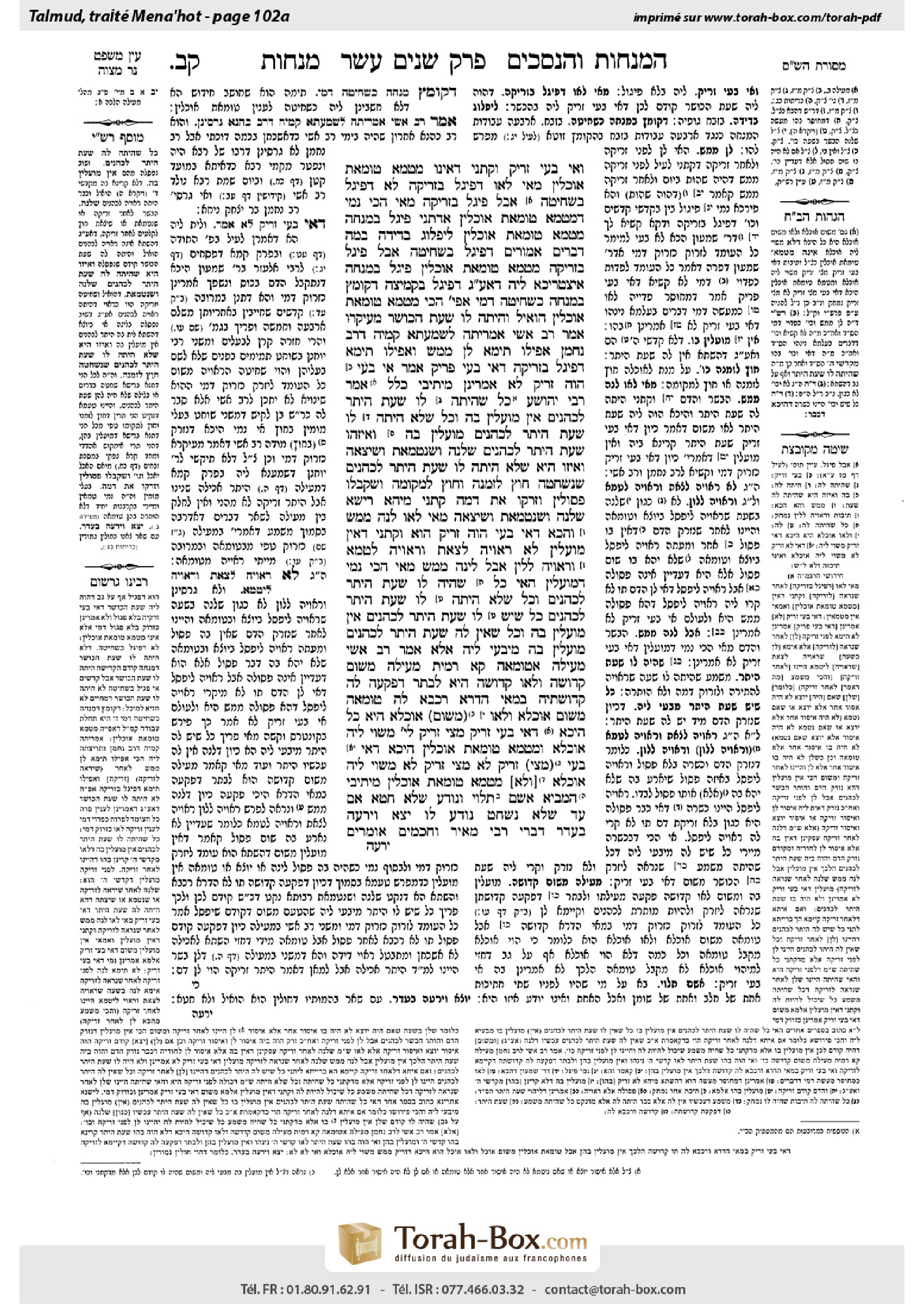
This page of Menachot includes the Aramaic text, an English translation and an AI-generated French translation, alongside the scan above.
מנחות ק״ב א · Aramaic and Hebrew text
וְאִי בָּעֵי זָרֵיק, וְקָתָנֵי דְּאֵינוֹ מְטַמֵּא טוּמְאַת אֳכָלִין. מַאי לָאו דְּפַיגֵּל בִּזְרִיקָה? לָא, דְּפַיגֵּל בִּשְׁחִיטָה.
אֲבָל פַּיגֵּל בִּזְרִיקָה, מַאי? הָכִי נָמֵי דִּמְטַמֵּא טוּמְאַת אֳכָלִין.
אַדְּתָנֵי פִּיגֵּל בְּמִנְחָה מְטַמֵּא טוּמְאַת אֳכָלִין, לִיפְלוֹג בְּדִידַהּ, בַּמֶּה דְּבָרִים אֲמוּרִים? דְּפַיגֵּל בִּשְׁחִיטָה, אֲבָל פַּיגֵּל בִּזְרִיקָה – מְטַמֵּא טוּמְאַת אֳכָלִין!
פִּיגֵּל בְּמִנְחָה אִיצְטְרִיכָא לֵיהּ, דְּאַף עַל גַּב דְּפַיגֵּל בִּקְמִיצָה, דְּקוֹמֶץ בְּמִנְחָה כִּשְׁחִיטָה דָּמֵי, אֲפִילּוּ הָכִי – מְטַמֵּא טוּמְאַת אֳכָלִין, הוֹאִיל וְהָיְתָה לוֹ שְׁעַת הַכּוֹשֶׁר מֵעִיקָּרוֹ.
אָמַר רַב אָשֵׁי: אַמְרִיתַהּ לִשְׁמַעְתָּא קַמֵּיהּ דְּרַב נַחְמָן, אֲפִילּוּ תֵּימָא לָן מַמָּשׁ, וַאֲפִילּוּ תֵּימָא דְּפַיגֵּל בִּזְרִיקָה.
דְּאִי בָּעֵי פָּרֵיק – אָמְרִינַן, אִי בָּעֵי הֲוָה זָרֵיק – לָא אָמְרִינַן.
מֵיתִיבִי, כְּלָל אָמַר רַבִּי יְהוֹשֻׁעַ: כֹּל שֶׁהָיְתָה לָהּ שְׁעַת הֶיתֵּר לַכֹּהֲנִים – אֵין מוֹעֲלִין בָּהּ, וְכֹל שֶׁלֹּא הָיְתָה לָהּ שְׁעַת הֶיתֵּר לַכֹּהֲנִים – מוֹעֲלִין בָּהּ.
וְאֵיזֶהוּ שְׁעַת הֶיתֵּר לַכֹּהֲנִים? שֶׁלָּנָה, וְשֶׁנִּטְמֵאת, וְשֶׁיָּצְאָה.
וְאֵיזוֹ הִיא שֶׁלֹּא הָיְתָה לָהּ שְׁעַת הֶיתֵּר לַכֹּהֲנִים? שֶׁנִּשְׁחֲטָה חוּץ לִזְמַנָּהּ, וְחוּץ לִמְקוֹמָהּ, וְשֶׁקִּבְּלוּ פְּסוּלִין וְזָרְקוּ אֶת דָּמָהּ.
קָתָנֵי מִיהָא רֵישָׁא שֶׁלָּנָה, וְשֶׁנִּטְמֵאת, וְשֶׁיָּצְאָה. מַאי לָאו לָנָה מַמָּשׁ, וְהָכָא דְּאִי בָּעֵי הֲוָה זָרֵיק הוּא, וְקָתָנֵי דְּאֵין מוֹעֲלִין.
לָא, רְאוּיָה לָצֵאת, וּרְאוּיָה לִטַּמֵּא, וּרְאוּיָה לָלִין.
אֲבָל לִינָה מַמָּשׁ, מַאי? הָכִי נָמֵי דְּמוֹעֲלִין! הַאי ״כׇּל (שהיה) [שֶׁהָיְתָה] לָהּ שְׁעַת הֶיתֵּר לַכֹּהֲנִים״ וְ״כֹל שֶׁלֹּא הָיְתָה לָהּ שְׁעַת הֶיתֵּר לַכֹּהֲנִים״?
״כֹּל שֶׁיֵּשׁ לָהּ שְׁעַת הֶיתֵּר לַכֹּהֲנִים אֵין מוֹעֲלִין בָּהּ״, וְ״כֹל שֶׁאֵין לָהּ שְׁעַת הֶיתֵּר לַכֹּהֲנִים מוֹעֲלִין בָּהּ״ מִיבְּעֵי לֵיהּ!
אֶלָּא אָמַר רַב אָשֵׁי: מְעִילָה אַטּוּמְאָה קָא רָמֵית?
מְעִילָה מִשּׁוּם קְדוּשָּׁה וְלָאו קְדוּשָּׁה הִיא, לְבָתַר דְּפָקְעָה לַהּ קְדוּשְּׁתֵיהּ, בְּמַאי הָדְרָא רָכְבָא לַהּ?
טוּמְאָה מִשּׁוּם אוּכְלָא וְלָאו (מִשּׁוּם) אוּכְלָא הִיא, כֹּל הֵיכָא דְּאִי בָּעֵי זָרֵיק מָצֵי זָרֵיק לֵיהּ – מְשַׁוֵּי לֵיהּ אוּכְלָא, וּמְטַמֵּא טוּמְאַת אֳכָלִין. הֵיכָא דְּאִי בָּעֵי (מָצֵי) זָרֵיק לָא מָצֵי זָרֵיק – לָא מְשַׁוֵּי לֵיהּ אוּכְלָא, [וְלָא] מְטַמֵּא טוּמְאַת אֳכָלִין.
מֵיתִיבִי: הַמֵּבִיא אָשָׁם תָּלוּי, וְנוֹדַע שֶׁלֹּא חָטָא – אִם עַד שֶׁלֹּא נִשְׁחַט נוֹדַע לוֹ, יֵצֵא וְיִרְעֶה בָּעֵדֶר, דִּבְרֵי רַבִּי מֵאִיר. וַחֲכָמִים אוֹמְרִים:
Menachot 102a · English translation
and if he had wanted, he could have sprinkled the blood of these offerings properly? Nevertheless, Rabbi Shimon teaches in the baraita that the meat of an offering that was rendered piggul is not susceptible to the ritual impurity of food. What, is it not referring to a case where he rendered it piggul during the rite of sprinkling? If so, since the offering stood to have its blood sprinkled, it is considered as though it has been sprinkled, and the offering was considered fit for consumption before he rendered it piggul; therefore, it should be susceptible to the impurity of food. The Gemara answers: No, the baraita is referring to a case where he rendered it piggul during the rite of slaughtering, and the blood never stood to be sprinkled.
The Gemara asks: But if he rendered it piggul during the rite of the sprinkling, what is the halakha? Is the halakha that the meat of the offering indeed becomes susceptible to the ritual impurity of food?
The Gemara challenges: If so, rather than continuing and teaching that if he rendered the meal offering piggul it is susceptible to the ritual impurity of food, i.e., instead of contrasting the animal offering case with a case involving an meal offering, let the tanna distinguish within the case of the animal offering itself in the following way: In what case is this statement, that if one renders an offering piggul the meat is not susceptible to the impurity of food, said? It is said in a case where he rendered it piggul during the rite of slaughtering, but if he rendered it piggul during the rite of sprinkling, it is susceptible to the impurity of food.
The Gemara answers: It was necessary for him to contrast it with a case of one who rendered a meal offering piggul in order to teach that even though he already rendered it piggul at the time of the removal of the handful, and the principle is that the removal of the handful of a meal offering is equivalent to the slaughtering of an animal offering, and an offering that was rendered piggul at the time of slaughtering is not susceptible to the impurity of food, even so, the meal offering is susceptible to the ritual impurity of food, since it initially had a time that was fit for consumption, when the flour was not yet consecrated as a meal offering.
Rav Ashi said: I related this discussion in the presence of Rav Naḥman and explained Rabbi Shimon’s opinion differently: Even if you say that the case in the baraita is one in which the meat was actually left overnight and there was time to sprinkle the blood during the day, and even if you say that he rendered the offering piggul at the time of the sprinkling of the blood rather than during the slaughtering, Rabbi Shimon does not consider those to be cases in which the offering had a time when it was fit for consumption.
Rabbi Shimon said only that if he had wanted, he would have redeemed it, and therefore an item that stands to be redeemed is treated as if it were already redeemed. Redemption is simple and requires only a verbal statement. According to Rabbi Shimon we do not say that if he had wanted, he would have sprinkled it, i.e., that the sprinkling of the blood and similar actions that stand to take place are treated as having taken place already.
The Gemara raises an objection to Rav Ashi’s opinion from a mishna (Me’ila 2a): Rabbi Yehoshua states a principle about the misuse of offerings that became disqualified: With regard to any offering that had a time that it was permitted for consumption by the priests before it became disqualified, one is not liable for misusing it, and with regard to any offering that did not have a time that it was permitted for consumption by the priests before it became disqualified, one is liable for misusing it. Misuse of consecrated property applies only to offerings that are considered fully reserved for God. Once the priests are permitted to partake of the offering it is no longer categorized as consecrated property.
Rabbi Yehoshua clarifies: And what is a disqualified offering that had a time that it was permitted for consumption by the priests? Examples of such a situation are as follows: When, after the blood was sprinkled, the meat of the offering was left overnight; or when the meat of an offering became ritually impure; or when an offering left the Temple courtyard. One is not liable for misuse in these cases, since the meat of these offerings became permitted to the priests once the blood was sprinkled and only subsequently was it disqualified.
And what is a disqualified offering that did not have a time that it was permitted for consumption by the priests? Examples of such a situation are as follows: When, at the time that it was slaughtered, he intended to eat it, sprinkle the blood, or burn the sacrificial potions on the altar beyond its designated time or outside its designated area; or when priests who were disqualified for Temple service collected or sprinkled its blood. In these cases, since there was never a time that it was permitted for the priests to consume the meat of the offering, one is liable for the misuse of consecrated property.
The Gemara addresses the objection to Rav Ashi’s opinion: In any event, the first clause teaches that meat of an offering that was left overnight, and meat that became impure, and meat that left the courtyard all had a time when they were permitted to the priests. What, is it not referring to a case where it was actually left overnight, i.e., both the blood and the meat of the offering, and here the case is an instance of: If he had wanted, he could have sprinkled the blood, and for that reason the mishna teaches that one is not liable for misusing it? It is considered as having had a time that it was permitted to the priests since he could have sprinkled the blood during the day, and therefore the offering is treated as if the sprinkling already happened, counter to Rav Ashi’s claim that such reasoning does not apply with regard to the sprinkling of the blood.
The Gemara answers: No, the mishna is referring to cases where the meat left the courtyard at a time when it was fit to leave, and the meat became impure when it was fit to become impure, and was left over when it was fit to be left over, i.e., the mishna is discussing cases where these occurred after the blood was sprinkled, rendering the meat fit to be consumed by the priests. For that reason it was not subject to the halakhot of misuse of consecrated property.
The Gemara again challenges Rav Ashi’s opinion: But according to this, what is the halakha with regard to a case where the whole offering, including the blood, was actually left overnight? Is that indeed a case where one is liable for misusing consecrated property, as the priests never had a time when it was permitted to consume the meat? If so, those statements in the mishna: Any offering that had a time that it was permitted for consumption by the priests, and any offering that did not have a time that it was permitted for consumption by the priests, are imprecise. They indicate that the critical factor is whether the meat had a time that it was potentially permitted, even if it was ultimately disqualified.
Instead, the mishna should have stated: With regard to any offering that has, in actuality, a time that it is permitted for consumption by the priests, one is not liable for misusing it. And, similarly, with regard to any offering that does not have a time that it is permitted for consumption by the priests, one is liable for misusing it.
It must be that Rav Ashi concedes that the mishna in Me’ila should be understood to include the case where both the blood and the meat were leftover, and that under such circumstances one is not liable for misuse of the offering due to the fact that once the blood could have been sprinkled, the offering is already considered permitted to the priests. Rav Ashi nevertheless claims that this mishna does not pose a difficulty to his understanding of Rabbi Shimon’s opinion with regard to an offering’s status as susceptible to the impurity of food. Rather, Rav Ashi says: Are you raising a contradiction between the halakhot of misuse of consecrated property and the halakhot of ritual impurity?
These cannot be compared, as liability for misuse of consecrated property is due to the sanctity or lack of sanctity of an item, i.e., on whether it is classified as fully reserved for God. Therefore, after the sanctity of the offering has lapsed, which occurs when the blood is ready to be sprinkled, as at that point it is already regarded as permitted to the priests, how can it return and be inured in it?
But with regard to impurity, the offering’s susceptibility to the impurity of food is due to whether it is considered food or not considered food. Therefore, in any case where if he wants to sprinkle the blood he could sprinkle it, it is only in sprinkling the blood that he grants the meat the status of food, and then it is susceptible to the ritual impurity of food. But in a case where if he wants to sprinkle the blood he cannot sprinkle it for some reason, and the offering is subsequently disqualified, he does not grant it the status of food, since it never became permitted to eat and it therefore is not susceptible to the impurity of food.
The Gemara raises another objection from a mishna (Karetot 23b) to Rav Ashi’s opinion that with regard to susceptibility to the impurity of food, blood that is ready to be sprinkled is not considered as if it were sprinkled: With regard to one who brings a provisional guilt offering to be sacrificed, because he is uncertain as to whether he committed a sin that requires a sin offering (see Leviticus 5:17–19), and later it becomes known to him that he has not sinned, the status of the offering is as follows: If it became known to him that he had not sinned before the offering was slaughtered, the consecrated ram should go out and graze in the flock as a non-sacred animal, as the consecration was performed in error. This is the statement of Rabbi Meir. And the Rabbis say
Menachot 102a · Traduction française (IA)
Et s’il l’avait voulu, il aurait pu asperger correctement le sang de ces sacrifices ? Pourtant, Rabbi Chimon enseigne dans la baraïta que la viande d’un sacrifice rendu piggoul n’est pas susceptible de contracter l’impureté rituelle des aliments. Ne s’agit-il pas d’un cas où il l’a rendu piggoul au moment de l’aspersion ? Si tel est le cas, puisque le sacrifice était destiné à ce que son sang soit aspergé, c’est comme si l’aspersion avait eu lieu, et le sacrifice était considéré comme apte à la consommation avant qu’il ne le rende piggoul ; il devrait donc être susceptible de contracter l’impureté des aliments. La Guemara répond : Non, la baraïta parle d’un cas où il l’a rendu piggoul au moment de l’abattage, et le sang n’était pas destiné à être aspergé.
La Guemara demande : Mais s’il l’a rendu piggoul au moment de l’aspersion, quelle est la halakha ? La viande du sacrifice devient-elle effectivement susceptible de contracter l’impureté rituelle des aliments ?
La Guemara objecte : Dans ce cas, au lieu de poursuivre en enseignant que si l’on rend l’offrande de farine piggoul, elle est susceptible de contracter l’impureté rituelle des aliments — autrement dit, au lieu d’opposer le cas du sacrifice animal à celui d’une offrande de farine —, que le tanna établisse une distinction à l’intérieur même du cas du sacrifice animal, de la manière suivante : Dans quel cas dit-on que si quelqu’un rend un sacrifice piggoul, sa viande n’est pas susceptible de contracter l’impureté des aliments ? Lorsqu’il l’a rendu piggoul au moment de l’abattage ; mais s’il l’a rendu piggoul au moment de l’aspersion, elle est susceptible de contracter l’impureté des aliments.
La Guemara répond : Il était nécessaire d’opposer ce cas à celui d’une personne qui a rendu une offrande de farine piggoul, afin d’enseigner que, même si elle l’a déjà rendue piggoul au moment du prélèvement de la poignée — alors que le principe veut que le prélèvement de la poignée d’une offrande de farine équivaille à l’abattage d’un sacrifice animal, et qu’un sacrifice rendu piggoul au moment de l’abattage n’est pas susceptible de contracter l’impureté des aliments —, l’offrande de farine reste susceptible de contracter l’impureté rituelle des aliments, puisqu’il y a eu au départ un moment où elle était apte à la consommation, lorsque la farine n’était pas encore consacrée comme offrande de farine.
Rav Achi dit : J’ai exposé cette discussion en présence de Rav Naḥman et j’ai expliqué autrement l’opinion de Rabbi Chimon : même si l’on dit que le cas de la baraïta est celui où la viande a effectivement été laissée toute la nuit et qu’il y avait le temps d’asperger le sang pendant la journée, et même si l’on dit qu’il a rendu le sacrifice piggoul au moment de l’aspersion du sang plutôt qu’au moment de l’abattage, Rabbi Chimon ne considère pas que le sacrifice ait connu un moment où il était apte à la consommation.
Rabbi Chimon a seulement dit que, s’il l’avait voulu, il l’aurait racheté et que, par conséquent, un objet destiné à être racheté est considéré comme déjà racheté. Le rachat est simple et ne nécessite qu’une déclaration verbale. Selon Rabbi Chimon, nous ne disons pas que, s’il l’avait voulu, il aurait aspergé le sang, c’est-à-dire que l’aspersion du sang et les actes similaires qui doivent avoir lieu sont considérés comme ayant déjà eu lieu.
La Guemara soulève une objection à l’opinion de Rav Achi à partir d’une Michna (Meïla 2a) : Rabbi Yehoshoua énonce un principe concernant le détournement de biens consacrés dans le cas de sacrifices devenus impropres : pour tout sacrifice qui a connu un moment où sa consommation par les prêtres était permise avant qu’il ne devienne impropre, on n’est pas passible de détournement ; et pour tout sacrifice qui n’a pas connu un tel moment, on est passible de détournement. Le détournement de biens consacrés ne s’applique qu’aux sacrifices considérés comme entièrement réservés à Dieu. Dès lors que les prêtres sont autorisés à consommer le sacrifice, celui-ci n’est plus considéré comme un bien consacré.
Rabbi Yehoshoua précise : Quel est le sacrifice devenu impropre qui a connu un moment où sa consommation par les prêtres était permise ? En voici des exemples : la viande du sacrifice a été laissée toute la nuit après l’aspersion du sang ; la viande d’un sacrifice est devenue rituellement impure ; ou un sacrifice a quitté la cour du Temple. On n’est pas passible de détournement dans ces cas, puisque la viande de ces sacrifices a été permise aux prêtres dès que le sang a été aspergé et n’est devenue impropre que par la suite.
Et quel est le sacrifice devenu impropre qui n’a pas connu de moment où sa consommation par les prêtres était permise ? En voici des exemples : au moment de l’abattage, il avait l’intention de manger le sacrifice, d’en asperger le sang ou d’en brûler les parties sacrificielles sur l’autel au-delà du délai fixé ou hors de l’aire prescrite ; ou des prêtres inaptes au service du Temple ont recueilli ou aspergé son sang. Dans ces cas, comme il n’y a jamais eu de moment où les prêtres étaient autorisés à consommer la viande du sacrifice, on est passible du détournement de biens consacrés.
La Guemara examine l’objection à l’opinion de Rav Achi : Quoi qu’il en soit, la première partie enseigne que la viande d’un sacrifice laissée toute la nuit, la viande devenue impure et la viande ayant quitté la cour ont toutes connu un moment où elles étaient permises aux prêtres. Ne s’agit-il pas d’un cas où le sacrifice a effectivement été laissé toute la nuit, c’est-à-dire où le sang et la viande ont été laissés toute la nuit, et où l’on considère que, s’il l’avait voulu, il aurait pu asperger le sang ? C’est pour cette raison que la Michna enseigne qu’on n’est pas passible de détournement. Le sacrifice est considéré comme ayant connu un moment où sa consommation par les prêtres était permise, puisqu’il aurait pu asperger le sang pendant la journée ; il est donc traité comme si l’aspersion avait déjà eu lieu. Cela contredit l’affirmation de Rav Achi selon laquelle ce raisonnement ne s’applique pas à l’aspersion du sang.
La Guemara répond : Non, la Michna parle de cas où la viande a quitté la cour à un moment où elle pouvait le faire, où elle est devenue impure à un moment où elle pouvait le devenir, ou a été laissée toute la nuit à un moment où elle pouvait l’être ; autrement dit, la Michna traite de cas où ces événements se sont produits après l’aspersion du sang, qui avait rendu la viande propre à être consommée par les prêtres. C’est pour cette raison qu’elle n’était pas soumise aux lois du détournement de biens consacrés.
La Guemara conteste de nouveau l’opinion de Rav Achi : Mais alors, quelle est la halakha dans le cas où le sacrifice entier, y compris le sang, a effectivement été laissé toute la nuit ? Est-ce bien un cas où l’on est passible de détournement de biens consacrés, puisque les prêtres n’ont jamais eu de moment où ils étaient autorisés à consommer la viande ? Si tel est le cas, les formulations de la Michna — tout sacrifice qui a connu un moment où sa consommation par les prêtres était permise, et tout sacrifice qui n’a pas connu de moment où sa consommation par les prêtres était permise — manquent de précision. Elles indiquent que le facteur déterminant est de savoir si la viande a connu un moment où sa consommation aurait pu être permise, même si elle est finalement devenue impropre.
La Michna aurait plutôt dû énoncer : Pour tout sacrifice qui a effectivement connu un moment où sa consommation par les prêtres était permise, on n’est pas passible de détournement. De même, pour tout sacrifice qui n’a pas connu un moment où sa consommation par les prêtres était permise, on est passible de détournement.
Il faut donc que Rav Achi admette que la Michna de Meïla doit être comprise comme incluant le cas où le sang et la viande ont tous deux été laissés toute la nuit et que, dans ces circonstances, on n’est pas passible de détournement du sacrifice, car dès lors que le sang aurait pu être aspergé, le sacrifice est déjà considéré comme permis aux prêtres. Rav Achi soutient néanmoins que cette Michna ne pose pas de difficulté à son interprétation de l’opinion de Rabbi Chimon concernant la capacité d’un sacrifice à contracter l’impureté des aliments. Rav Achi dit plutôt : Vous établissez une contradiction entre les lois du détournement de biens consacrés et celles de l’impureté rituelle ?
Ces deux domaines ne sont pas comparables, car la responsabilité pour détournement de biens consacrés dépend de la sainteté ou de l’absence de sainteté d’un objet, c’est-à-dire de la question de savoir s’il est considéré comme entièrement réservé à Dieu. Par conséquent, une fois que la sainteté du sacrifice a pris fin — ce qui se produit lorsque le sang est prêt à être aspergé, puisqu’à ce stade le sacrifice est déjà considéré comme permis aux prêtres —, comment pourrait-elle être rétablie et s’appliquer de nouveau ?
Mais, en ce qui concerne l’impureté, la capacité du sacrifice à contracter l’impureté des aliments dépend du fait qu’il soit ou non considéré comme un aliment. Par conséquent, dans tout cas où il peut asperger le sang s’il le veut, c’est seulement en aspergeant le sang qu’il confère à la viande le statut d’aliment ; elle devient alors susceptible de contracter l’impureté rituelle des aliments. Mais si, pour une raison quelconque, il ne peut pas asperger le sang, même s’il le veut, et que le sacrifice devient ensuite impropre, il ne lui confère pas le statut d’aliment, puisqu’il n’a jamais été permis à la consommation et n’est donc pas susceptible de contracter l’impureté des aliments.
La Guemara soulève une autre objection à l’opinion de Rav Achi — selon laquelle, quant à la capacité à contracter l’impureté des aliments, un sang prêt à être aspergé n’est pas considéré comme déjà aspergé — à partir d’une Michna (Karetot 23b) : celui qui apporte un sacrifice de culpabilité conditionnel pour qu’il soit offert, parce qu’il ne sait pas s’il a commis une faute exigeant un sacrifice expiatoire (voir Lévitique 5,17–19), puis apprend par la suite qu’il n’a pas péché, se trouve dans la situation suivante : s’il apprend qu’il n’a pas péché avant l’abattage du sacrifice, le bélier consacré doit sortir et paître parmi le troupeau comme animal non consacré, car il a été consacré par erreur. Telle est la déclaration de Rabbi Meïr. Et les Sages disent
Traduction française générée par IA à partir de l’édition anglaise de Sefaria. Vérifie toujours un passage avec le texte source.
Text from Sefaria: William Davidson Edition - Vocalized Aramaic (unknown); William Davidson Edition - English (CC BY NC).