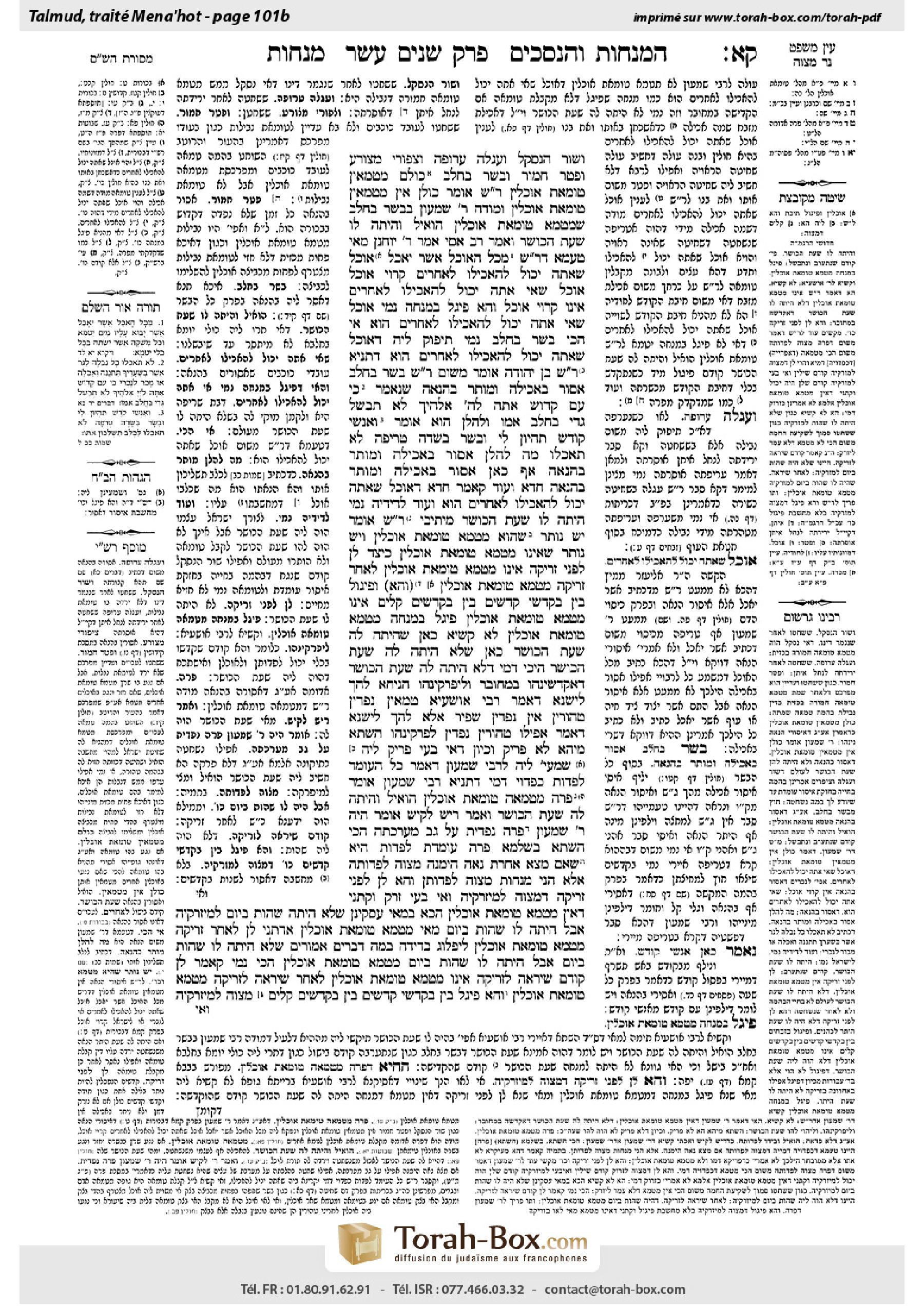
Menachot 101b: Talmud study for Daf Yomi
Daf Yomi is the daily study of one Talmud folio. Explore 37 tractates with scans, Hebrew text, Sefaria English and AI-generated French translations where annotated.
Passage selection and English or AI-generated French translation are available where the scan has annotations. Daf Study is independent of Torah-Box and Sefaria.
Browse Menachot · מנחות · All tractatesMenachot 101b text and translations
This page of Menachot includes the Aramaic text, an English translation and an AI-generated French translation, alongside the scan above.
מנחות ק״א ב · Aramaic and Hebrew text
וְשׁוֹר הַנִּסְקָל וְעֶגְלָה עֲרוּפָה וְצִפּוֹרֵי מְצוֹרָע וּפֶטֶר חֲמוֹר וּבָשָׂר בְּחָלָב כּוּלָּם מִטַּמְּאִין טוּמְאַת אֳכָלִין.
רַבִּי שִׁמְעוֹן אוֹמֵר: כּוּלָּן אֵין מִטַּמְּאִין טוּמְאַת אֳכָלִין, וּמוֹדֶה רַבִּי שִׁמְעוֹן בְּבָשָׂר בְּחָלָב שֶׁמְּטַמֵּא טוּמְאַת אֳכָלִין, הוֹאִיל וְהָיְתָה לוֹ שְׁעַת הַכּוֹשֶׁר.
וְאָמַר רַב אַסִּי, אָמַר רַבִּי יוֹחָנָן: מַאי טַעְמָא דְּרַבִּי שִׁמְעוֹן? ״מִכׇּל הָאֹכֶל אֲשֶׁר יֵאָכֵל״ – אוֹכֶל שֶׁאַתָּה יָכוֹל לְהַאֲכִילוֹ לַאֲחֵרִים קָרוּי אוֹכֶל, אוֹכֶל שֶׁאִי אַתָּה יָכוֹל לְהַאֲכִילוֹ לַאֲחֵרִים אֵינוֹ קָרוּי אוֹכֶל.
וְהָא פִּיגֵּל בְּמִנְחָה נָמֵי, אוֹכֶל שֶׁאִי אַתָּה יָכוֹל לְהַאֲכִילוֹ לַאֲחֵרִים הוּא.
אִי הָכִי, בָּשָׂר בְּחָלָב נָמֵי תִּיפּוֹק לֵיהּ, דְּאוֹכֶל שֶׁאַתָּה יָכוֹל לְהַאֲכִילוֹ לַאֲחֵרִים הוּא.
דְּתַנְיָא, רַבִּי שִׁמְעוֹן בֶּן יְהוּדָה אוֹמֵר מִשּׁוּם רַבִּי שִׁמְעוֹן: בָּשָׂר בְּחָלָב אָסוּר בַּאֲכִילָה וּמוּתָּר בַּהֲנָאָה, שֶׁנֶּאֱמַר ״כִּי עַם קָדוֹשׁ אַתָּה לַה׳ אֱלֹהֶיךָ לֹא תְבַשֵּׁל גְּדִי בַּחֲלֵב אִמּוֹ״, וּלְהַלָּן הוּא אוֹמֵר ״וְאַנְשֵׁי קֹדֶשׁ תִּהְיוּן לִי וּבָשָׂר בַּשָּׂדֶה טְרֵפָה לֹא תֹאכֵלוּ״, מָה לְהַלָּן אָסוּר בַּאֲכִילָה וּמוּתָּר בַּהֲנָאָה, אַף כָּאן אָסוּר בַּאֲכִילָה וּמוּתָּר בַּהֲנָאָה.
חֲדָא וְעוֹד קָאָמַר: חֲדָא, דְּאוֹכֶל שֶׁאַתָּה יָכוֹל לְהַאֲכִילוֹ לַאֲחֵרִים הוּא, וְעוֹד, לְדִידֵיהּ נָמֵי הָיְתָה לוֹ שְׁעַת הַכּוֹשֶׁר.
מֵיתִיבִי: רַבִּי שִׁמְעוֹן אוֹמֵר, יֵשׁ נוֹתָר שֶׁהוּא מְטַמֵּא טוּמְאַת אֳכָלִין, וְיֵשׁ נוֹתָר שֶׁאֵינוֹ מְטַמֵּא טוּמְאַת אֳכָלִין.
כֵּיצַד? לַן לִפְנֵי זְרִיקָה – אֵינוֹ מְטַמֵּא טוּמְאַת אֳכָלִין, לְאַחַר זְרִיקָה – מְטַמֵּא טוּמְאַת אֳכָלִין.
(וְהָא) וּפִיגּוּל, בֵּין בְּקׇדְשֵׁי קָדָשִׁים בֵּין בְּקָדָשִׁים קַלִּים – אֵינוֹ מְטַמֵּא טוּמְאַת אֳכָלִין. פִּיגֵּל בְּמִנְחָה – מְטַמֵּא טוּמְאַת אֳכָלִין.
לָא קַשְׁיָא, כָּאן – שֶׁהָיְתָה לָהּ שְׁעַת הַכּוֹשֶׁר, כָּאן – שֶׁלֹּא הָיְתָה לָהּ שְׁעַת הַכּוֹשֶׁר.
הֵיכִי דָּמֵי דְּלֹא הָיְתָה לָהּ שְׁעַת הַכּוֹשֶׁר? דְּאַקְדְּשִׁינְהוּ בִּמְחוּבָּר.
וְלִיפְרְקִינְהוּ! הָנִיחָא לְהָךְ לִישָּׁנָא דְּאָמַר רַבִּי אוֹשַׁעְיָא: טְמֵאִין – נִפְדִּין, טְהוֹרִין – אֵין נִפְדִּין, שַׁפִּיר.
אֶלָּא לְהָךְ לִישָּׁנָא דְּאָמַר, אֲפִילּוּ טְהוֹרִין נִפְדִּין, לִפְרְקִינְהוּ.
הַשְׁתָּא מִיהָא לָא פָּרֵיק.
וְכֵיוָן דְּאִי בָּעֵי פָּרֵיק לֵיהּ, שָׁמְעִינַן לֵיהּ לְרַבִּי שִׁמְעוֹן דְּאָמַר: כׇּל הָעוֹמֵד לִפְדּוֹת – כְּפָדוּי דָּמֵי.
דְּתַנְיָא, רַבִּי שִׁמְעוֹן אוֹמֵר: פָּרָה מְטַמְּאָה טוּמְאַת אֳכָלִין, הוֹאִיל וְהָיְתָה לָהּ שְׁעַת הַכּוֹשֶׁר. וְאָמַר רֵישׁ לָקִישׁ: אוֹמֵר הָיָה רַבִּי שִׁמְעוֹן, פָּרָה נִפְדֵּית עַל גַּב מַעֲרַכְתָּהּ.
הָכִי הַשְׁתָּא? בִּשְׁלָמָא פָּרָה, עוֹמֶדֶת לִפְדּוֹת הִיא, שֶׁאִם מָצָא אַחֶרֶת נָאָה הֵימֶנָּה – מִצְוָה לִפְדּוֹתָהּ. אֶלָּא הָנֵי מְנָחוֹת, מִצְוָה לִפְדּוֹתָן?!
וְהָא לָן לִפְנֵי זְרִיקָה, דְּמִצְוָה לְמִיזְרְקֵיהּ, וְאִי בָּעֵי זָרַק, וְקָתָנֵי דְּאֵין מִטַּמֵּא טוּמְאַת אֳכָלִין!
הָכָא בְּמַאי עָסְקִינַן – שֶׁלֹּא הָיְתָה שְׁהוּת בַּיּוֹם לְמִיזְרְקֵיהּ.
אֲבָל הָיְתָה לוֹ שְׁהוּת בְּיוֹם, מַאי? מְטַמֵּא טוּמְאַת אֳכָלִין.
אַדְּתָנֵי לָן לְאַחַר זְרִיקָה מְטַמֵּא טוּמְאַת אֳכָלִין – לִיפְלוֹג בְּדִידַהּ: בַּמֶּה דְּבָרִים אֲמוּרִים? שֶׁלֹּא הָיְתָה לוֹ שְׁהוּת בְּיוֹם, אֲבָל הָיְתָה לוֹ שְׁהוּת בַּיּוֹם – מְטַמֵּא טוּמְאַת אֳכָלִין!
הָכִי נָמֵי קָאָמַר: לָן, קוֹדֶם שֶׁיֵּרָאֶה לִזְרִיקָה – אֵינוֹ מְטַמֵּא טוּמְאַת אֳכָלִין, לְאַחַר שֶׁיֵּרָאֶה לִזְרִיקָה – מְטַמֵּא טוּמְאַת אֳכָלִין.
וְהָא פִּיגֵּל, בֵּין בְּקׇדְשֵׁי קָדָשִׁים בֵּין בְּקָדָשִׁים קַלִּים, מִצְוָה לְמִיזְרְקֵיהּ,
Menachot 101b · English translation
the flesh of an ox that is stoned, a heifer whose neck is broken,the birds sacrificed by a leper (see Leviticus 14:4–7), a firstborn donkey whose neck was broken, and meat cooked together with milk are all susceptible to the ritual impurity of food, despite the fact that they are forbidden for consumption.
Rabbi Shimon says: None of them are susceptible to the ritual impurity of food, since they are all items from which it is prohibited to derive benefit, and they are therefore not considered food. And Rabbi Shimon concedes with regard to meat cooked together with milk that it is susceptible to the ritual impurity of food since it, i.e., both the meat and the milk, had a time that it was fit for consumption before it was rendered forbidden.
And Rav Asi said that Rabbi Yoḥanan said: What is the reason for Rabbi Shimon’s opinion that an item from which it is prohibited to derive benefit is not susceptible to impurity of food? It is because it is stated: “All food which may be eaten [ha’okhel asher ye’akhel], that on which water comes, shall be impure” (Leviticus 11:34). The redundancy in the phrase “food which may be eaten” indicates that specifically food that you are able to feed to others, in this case, gentiles, is termed food for the purposes of susceptibility to the impurity of food, but food that you are not able to feed to others is not termed food. Therefore, items from which it is prohibited to derive benefit and which it is therefore prohibited to feed to others are not considered food in this context.
Rabbi Oshaya explains how this can be applied to piggul: A meal offering that one rendered piggul is also food that you are not able to feed to others, as it is prohibited to derive benefit from it. Consequently, it is not susceptible to the ritual impurity of food according to Rabbi Shimon.
The Gemara asks: If so, why doesn’t he also derive that meat cooked in milk is susceptible to impurity because it is food that you may feed to others, as Rabbi Shimon maintains that it is permitted to derive benefit from meat and milk cooked together?
As it is taught in a baraita: Rabbi Shimon ben Yehuda says in the name of Rabbi Shimon: With regard to meat cooked in milk, eating it is prohibited and deriving benefit from it is permitted, as it is stated: “For you are a holy people to the Lord your God; you shall not cook a kid in its mother’s milk” (Deuteronomy 14:21). And elsewhere the verse states: “And you shall be holy men to Me; therefore you shall not eat any flesh that is torn by animals [tereifa] in the field” (Exodus 22:30). Just as there, with regard to an animal torn by animals, which is forbidden as a tereifa, i.e., an animal possessing a wound that will cause it to die within twelve months, eating it is prohibited but deriving benefit from it is permitted, so too here, with regard to meat cooked in milk, where being a holy people is also mentioned, eating it is forbidden but deriving benefit from it is permitted.
The Gemara answers: The baraita that cites Rabbi Shimon’s opinion states one reason why meat cooked in milk is susceptible to impurity and adds another. One reason is that it is food that you can feed to others. Therefore, it is called food for the purpose of being susceptible to impurity. And another reason is that even for him, i.e., a Jew, although it is currently prohibited to eat the milk and meat, it had a time when each was fit to be eaten, i.e., before they were cooked together; therefore, they remain susceptible to impurity.
The Gemara raises an objection to the opinion of Rabbi Oshaya from a baraita: Rabbi Shimon says that there is a case of the leftover of an offering that is susceptible to the ritual impurity of food, but there is also a case of the leftover of an offering that is not susceptible to the impurity of food.
How so? If it was left overnight before the sprinkling of the blood on the altar, it is not susceptible to the ritual impurity of food, as it never became fit for consumption. But if it was left overnight after the sprinkling of the blood, it is susceptible to the ritual impurity of food, since from after the sprinkling of the blood until it was left overnight, it was fit for consumption.
The baraita continues: And with regard to piggul, both in cases of offerings of the most sacred order as well as in cases of offerings of lesser sanctity, the meat of the offering is not susceptible to the impurity of food. This is because it was rendered forbidden for consumption at the beginning of the sacrificial rite, and was never fit for consumption. If the priest rendered a meal offering piggul, it is susceptible to the impurity of food, since it did have a period of time when it was acceptable, i.e., when it was still flour before it was consecrated as a meal offering. This ruling contradicts Rabbi Oshaya’s understanding that according to Rabbi Shimon, a meal offering that became piggul is not susceptible to the impurity of food.
The Gemara answers: That is not difficult, as here, in the baraita where Rabbi Shimon ruled that the meal offering that became piggul is susceptible to the impurity of food, it is referring to a case where it had a time in which it was fit for consumption. There, where it is not susceptible to the impurity of food, it is referring to a case where it did not have a time in which it was fit for consumption.
The Gemara asks: What are the circumstances where it did not have a time in which it was fit for consumption? Before the flour was consecrated as a meal offering, it was certainly permitted for consumption. The Gemara answers: This would occur where he consecrated the wheat while it was still attached to the ground and was therefore not yet susceptible to impurity. Once harvested, it was already prohibited for consumption.
The Gemara raises a difficulty: The flour may still have a time in which it was fit. Let him redeem it before it is placed in a service vessel. Why is it regarded as not having a time in which it was fit for consumption? The Gemara qualifies the question: This distinction, between flour that came from wheat that was consecrated before it was harvested and wheat or flour that was consecrated at a later point, works out well according to this version of that which Rabbi Oshaya said: Impure meal offerings and libations that have not been consecrated in a service vessel are redeemed; if they are pure, they are not redeemed. Accordingly, it works out well that the flour does not have a time in which it was fit for consumption when it came from wheat that was consecrated before being harvested. It could not be redeemed and made fit for consumption.
But according to this version of what Rabbi Oshaya said: Even pure meal offerings and libations are redeemed, there remains the possibility of letting him redeem the meal offering while it is pure and before it is consecrated in a service vessel. Therefore, it should be considered as having a time in which it is fit for consumption.
The Gemara answers: In any event, now he has not redeemed it. Therefore, it is not considered to have had a time in which it is fit for consumption.
The Gemara asks: How can the flour be considered as not having a time in which it is fit for consumption merely because he has not redeemed it, even though he could have redeemed it? Since in a case where if he wants, he may redeem it, don’t we attribute to Rabbi Shimon that he said that for any item that stands to be redeemed, it is as if it already is redeemed?
The Gemara cites a source for this assertion: As it is taught in a baraita that Rabbi Shimon says: A red heifer, even if it has been slaughtered and it is therefore prohibited to derive benefit from it, is susceptible to the ritual impurity of food, since it had a time in which it was fit. And Reish Lakish said, explaining how it is possible to derive from this halakha that any item that could be redeemed is considered as though it has been redeemed: Rabbi Shimon would say that a red heifer is redeemed with money even when it has already been slaughtered and placed upon its pyre in preparation for being burned. If so, a meal offering that could be redeemed should also be considered fit for consumption, as it is considered as though it has been redeemed.
The Gemara answers: How can these cases be compared? Granted, with regard to the red heifer, it is considered to be an item that stands to be redeemed, since if he found another animal choicer than it, there is a mitzva to redeem the first one and purchase the choicer one with the money. But is there a mitzva to redeem these meal offerings?
The Gemara challenges: But there is a case where sacrificial meat remained overnight before the sprinkling of the blood occurred, where there was a mitzva to sprinkle the blood the day before, and if he had wanted he could have sprinkled it, and the offering would not have been disqualified. And yet, Rabbi Shimon teaches in the baraita that sacrificial meat that remained overnight is not susceptible to the ritual impurity of food, even though it should have been considered fit for consumption on the day the offering was slaughtered, as the blood stood to be sprinkled and there was a mitzva to sprinkle it.
The Gemara answers: Here, we are dealing with a case where there was not sufficient time remaining in the day to sprinkle the blood, as the offering was slaughtered close to sunset. Therefore, the blood did not stand to be sprinkled and the meat was therefore never fit for consumption.
The Gemara asks: But in a case where the offering was slaughtered when there was sufficient time remaining in the day to sprinkle the blood, what would then be the halakha according to Rabbi Shimon? Would meat left overnight be susceptible to the ritual impurity of food?
If so, rather than Rabbi Shimon teaching the following: Sacrificial meat that was left overnight before the blood was sprinkled is not susceptible to the ritual impurity of food, but if left overnight after the sprinkling of the blood it is susceptible to the ritual impurity of food, instead let him distinguish within the case itself: In what case is this statement said? When is sacrificial meat left overnight without the blood of the offering having been sprinkled not susceptible to the ritual impurity of food? It is in a case where there was not sufficient time remaining in the day to sprinkle the blood; but if there was sufficient time remaining in the day to sprinkle the blood, it is susceptible to the ritual impurity of food.
The Gemara answers: That is indeed what he is saying in the baraita, that if the offering was left overnight before it was available for sprinkling, i.e., if it was slaughtered so late in the day that there was no time left to sprinkle the blood, it is not susceptible to the ritual impurity of food. By contrast, if it was left overnight after it was available for sprinkling, i.e., there was still time to sprinkle the blood, then it is susceptible to the ritual impurity of food.
The Gemara asks: Does Rabbi Shimon in fact hold that an item that stands to be redeemed is treated as though it has already been redeemed, and is therefore considered to have had a time in which it is fit, even if it was never actually redeemed? But isn’t it so that when one renders either offerings of the most sacred order or offerings of lesser sanctity piggul, there was a mitzva to sprinkle the blood once the offering was slaughtered,
Menachot 101b · Traduction française (IA)
La chair d’un bœuf condamné à être lapidé, d’une génisse dont la nuque a été brisée, des oiseaux sacrifiés pour un lépreux (voir Lévitique 14, 4–7), d’un ânon premier-né dont la nuque a été brisée et la viande cuite avec du lait sont tous susceptibles de contracter l’impureté rituelle des aliments, bien qu’il soit interdit de les consommer.
Rabbi Shimon dit : Aucun d’eux n’est susceptible de contracter l’impureté rituelle des aliments, puisqu’il s’agit dans tous les cas de choses dont il est interdit de tirer profit et qui ne sont donc pas considérées comme des aliments. Rabbi Shimon reconnaît toutefois que la viande cuite avec du lait est susceptible de contracter l’impureté rituelle des aliments, car elle — c’est-à-dire la viande comme le lait — a été à un moment propre à la consommation, avant de devenir interdite.
Rav Asi a dit au nom de Rabbi Yoḥanan : Quelle est la raison de l’opinion de Rabbi Shimon selon laquelle une chose dont il est interdit de tirer profit n’est pas susceptible de contracter l’impureté des aliments ? C’est parce qu’il est écrit : « Tout aliment qui peut être mangé [ha’okhel asher ye’akhel], sur lequel vient de l’eau, sera impur » (Lévitique 11, 34). La redondance de l’expression « aliment qui peut être mangé » indique que seul un aliment que l’on peut donner à manger à d’autres — en l’occurrence, des non-Juifs — est qualifié d’aliment aux fins de l’impureté des aliments ; un aliment que l’on ne peut pas leur donner à manger n’est pas ainsi qualifié. Par conséquent, les choses dont il est interdit de tirer profit et qu’il est donc interdit de donner à manger à d’autres ne sont pas considérées comme des aliments dans ce contexte.
Rabbi Oshaya explique comment cela s’applique au piggoul : une offrande de farine que l’on a rendue piggoul est également un aliment que l’on ne peut pas donner à manger à d’autres, car il est interdit d’en tirer profit. Elle n’est donc pas susceptible de contracter l’impureté rituelle des aliments selon Rabbi Shimon.
La Guemara demande : Dans ce cas, pourquoi ne déduit-il pas aussi que la viande cuite dans du lait est susceptible de contracter l’impureté, puisqu’il s’agit d’un aliment que l’on peut donner à manger à d’autres, étant donné que Rabbi Shimon estime qu’il est permis de tirer profit de la viande et du lait cuits ensemble ?
Comme il est enseigné dans une baraïta : Rabbi Shimon ben Yehuda dit au nom de Rabbi Shimon : Pour la viande cuite dans du lait, il est interdit d’en manger, mais il est permis d’en tirer profit, comme il est écrit : « Car tu es un peuple saint pour le Seigneur ton Dieu ; tu ne feras pas cuire un chevreau dans le lait de sa mère » (Deutéronome 14, 21). Et ailleurs, le verset dit : « Vous serez pour Moi des hommes saints ; c’est pourquoi vous ne mangerez d’aucune chair déchirée par les bêtes [tereifa] dans les champs » (Exode 22, 30). De même que dans ce cas, celui d’un animal déchiré par les bêtes et interdit comme tereifa — c’est-à-dire un animal présentant une blessure qui entraînera sa mort dans les douze mois —, il est interdit d’en manger, mais permis d’en tirer profit, de même ici, pour la viande cuite dans du lait, où il est également question d’être un peuple saint, il est interdit d’en manger, mais permis d’en tirer profit.
La Guemara répond : La baraïta qui cite l’opinion de Rabbi Shimon donne une raison pour laquelle la viande cuite dans du lait est susceptible de contracter l’impureté, puis en ajoute une autre. La première raison est qu’il s’agit d’un aliment que l’on peut donner à manger à d’autres. Elle est donc qualifiée d’aliment aux fins de l’impureté. L’autre raison est que, même pour lui, c’est-à-dire un Juif, bien qu’il soit actuellement interdit de manger le lait et la viande, chacun d’eux a été à un moment propre à la consommation, avant qu’ils ne soient cuits ensemble ; ils restent donc susceptibles de contracter l’impureté.
La Guemara soulève une objection à l’opinion de Rabbi Oshaya à partir d’une baraïta : Rabbi Shimon dit qu’il existe un cas où le reste d’une offrande est susceptible de contracter l’impureté rituelle des aliments, mais aussi un cas où il ne l’est pas.
Dans quelles circonstances ? Si le reste a passé la nuit avant l’aspersion du sang sur l’autel, il n’est pas susceptible de contracter l’impureté rituelle des aliments, puisqu’il n’a jamais été propre à la consommation. Mais s’il a passé la nuit après l’aspersion du sang, il est susceptible de la contracter, car, depuis l’aspersion du sang jusqu’au moment où il a passé la nuit, il était propre à la consommation.
La baraïta poursuit : Quant au piggoul, qu’il s’agisse d’offrandes de très haute sainteté ou d’offrandes de moindre sainteté, la viande de l’offrande n’est pas susceptible de contracter l’impureté des aliments. En effet, elle est devenue interdite à la consommation dès le début du rite sacrificiel et n’a jamais été propre à la consommation. Si le prêtre a rendu piggoul une offrande de farine, celle-ci est susceptible de contracter l’impureté des aliments, puisqu’elle a connu une période où elle était propre à la consommation, lorsqu’elle était encore de la farine, avant d’être consacrée comme offrande de farine. Cette décision contredit la compréhension de Rabbi Oshaya selon laquelle, d’après Rabbi Shimon, une offrande de farine devenue piggoul n’est pas susceptible de contracter l’impureté des aliments.
La Guemara répond : Il n’y a pas de difficulté, car ici, dans la baraïta où Rabbi Shimon statue que l’offrande de farine devenue piggoul est susceptible de contracter l’impureté des aliments, il s’agit d’un cas où elle a été, à un moment donné, propre à la consommation. Là, où elle n’est pas susceptible de contracter l’impureté des aliments, il s’agit d’un cas où elle n’a jamais été propre à la consommation.
La Guemara demande : Dans quelles circonstances n’a-t-elle jamais été propre à la consommation ? Avant que la farine soit consacrée comme offrande de farine, elle était certainement permise à la consommation. La Guemara répond : Cela se produirait si l’on avait consacré le blé alors qu’il était encore attaché au sol et n’était donc pas encore susceptible de contracter l’impureté. Une fois récolté, il était déjà interdit à la consommation.
La Guemara soulève une difficulté : La farine a tout de même pu connaître un moment où elle était propre à la consommation. Qu’il la rachète avant qu’elle ne soit placée dans un ustensile de service. Pourquoi considère-t-on qu’elle n’a jamais été propre à la consommation ? La Guemara précise la question : Cette distinction, entre la farine issue du blé consacré avant sa récolte et le blé ou la farine consacrés plus tard, fonctionne bien selon cette version de l’enseignement de Rabbi Oshaya : les offrandes de farine impures et les libations qui n’ont pas été consacrées dans un ustensile de service sont rachetées ; si elles sont pures, elles ne sont pas rachetées. Il est donc cohérent que la farine issue du blé consacré avant sa récolte n’ait jamais été propre à la consommation : elle ne pouvait pas être rachetée pour redevenir propre à la consommation.
Mais selon cette version de l’enseignement de Rabbi Oshaya, selon laquelle même les offrandes de farine et les libations pures sont rachetées, il reste possible de racheter l’offrande de farine tant qu’elle est pure et avant qu’elle ne soit consacrée dans un ustensile de service. Il faudrait donc considérer qu’elle a connu un moment où elle était propre à la consommation.
La Guemara répond : Quoi qu’il en soit, à présent, il ne l’a pas rachetée. On ne considère donc pas qu’elle ait connu un moment où elle était propre à la consommation.
La Guemara demande : Comment peut-on considérer que la farine n’a jamais été propre à la consommation simplement parce qu’il ne l’a pas rachetée, alors qu’il aurait pu le faire ? Puisqu’il s’agit d’un cas où, s’il le souhaite, il peut la racheter, n’attribuons-nous pas à Rabbi Shimon l’opinion selon laquelle toute chose destinée à être rachetée est considérée comme si elle avait déjà été rachetée ?
La Guemara cite une source à l’appui de cette affirmation : Il est enseigné dans une baraïta que Rabbi Shimon dit : Une vache rousse, même si elle a été abattue et qu’il est donc interdit d’en tirer profit, est susceptible de contracter l’impureté rituelle des aliments, car elle a connu un moment où elle était propre à la consommation. Reish Lakish a expliqué comment déduire de cette halakha que toute chose susceptible d’être rachetée est considérée comme déjà rachetée : Rabbi Shimon aurait dit qu’une vache rousse peut être rachetée contre de l’argent même après avoir été abattue et déposée sur son bûcher en vue d’être brûlée. Dans ce cas, une offrande de farine qui pourrait être rachetée devrait également être considérée comme propre à la consommation, puisqu’on la tient pour déjà rachetée.
La Guemara répond : Comment comparer ces cas ? Certes, pour la vache rousse, on considère qu’il s’agit d’une chose destinée à être rachetée, car si l’on trouvait un autre animal plus beau qu’elle, il y aurait une mitsva de racheter la première et d’acheter l’animal plus beau avec l’argent. Mais y a-t-il une mitsva de racheter ces offrandes de farine ?
La Guemara objecte : Mais il existe un cas où la viande sacrificielle a passé la nuit avant l’aspersion du sang : il y avait une mitsva d’asperger le sang la veille, et s’il l’avait voulu, il aurait pu le faire, de sorte que l’offrande n’aurait pas été disqualifiée. Pourtant, Rabbi Shimon enseigne dans la baraïta que la viande sacrificielle ayant passé la nuit n’est pas susceptible de contracter l’impureté rituelle des aliments, alors qu’elle aurait dû être considérée comme propre à la consommation le jour de l’abattage de l’offrande, puisque le sang était destiné à être aspergé et qu’il y avait une mitsva de l’asperger.
La Guemara répond : Ici, il s’agit d’un cas où il ne restait pas assez de temps dans la journée pour asperger le sang, car l’offrande a été abattue peu avant le coucher du soleil. Le sang n’était donc pas destiné à être aspergé et la viande n’a par conséquent jamais été propre à la consommation.
La Guemara demande : Mais dans le cas où l’offrande a été abattue alors qu’il restait assez de temps dans la journée pour asperger le sang, quelle serait alors la halakha selon Rabbi Shimon ? La viande ayant passé la nuit serait-elle susceptible de contracter l’impureté rituelle des aliments ?
Dans ce cas, plutôt que Rabbi Shimon enseigne ceci : la viande sacrificielle ayant passé la nuit avant l’aspersion du sang n’est pas susceptible de contracter l’impureté rituelle des aliments, mais si elle a passé la nuit après l’aspersion du sang, elle y est susceptible ; qu’il distingue plutôt à l’intérieur du cas même : dans quelles circonstances cette affirmation est-elle énoncée ? Quand la viande sacrificielle ayant passé la nuit sans que le sang de l’offrande ait été aspergé n’est-elle pas susceptible de contracter l’impureté rituelle des aliments ? Lorsqu’il ne restait pas assez de temps dans la journée pour asperger le sang ; mais s’il restait assez de temps, elle est susceptible de contracter l’impureté rituelle des aliments.
La Guemara répond : C’est bien ce qu’il dit dans la baraïta : si l’offrande a passé la nuit avant d’être en mesure de subir l’aspersion — c’est-à-dire si elle a été abattue si tard dans la journée qu’il ne restait plus de temps pour asperger le sang —, elle n’est pas susceptible de contracter l’impureté rituelle des aliments. En revanche, si elle a passé la nuit après avoir été en mesure de subir l’aspersion — c’est-à-dire s’il restait encore du temps pour asperger le sang —, elle est susceptible de contracter l’impureté rituelle des aliments.
La Guemara demande : Rabbi Shimon estime-t-il réellement qu’une chose destinée à être rachetée est considérée comme si elle avait déjà été rachetée, et qu’elle est donc réputée avoir connu un moment où elle était propre, même si elle n’a jamais été effectivement rachetée ? Pourtant, lorsqu’on rend piggoul une offrande de très haute sainteté ou une offrande de moindre sainteté, il y avait une mitsva d’asperger le sang une fois l’offrande abattue,
Traduction française générée par IA à partir de l’édition anglaise de Sefaria. Vérifie toujours un passage avec le texte source.
Text from Sefaria: William Davidson Edition - Vocalized Aramaic (unknown); William Davidson Edition - English (CC BY NC).