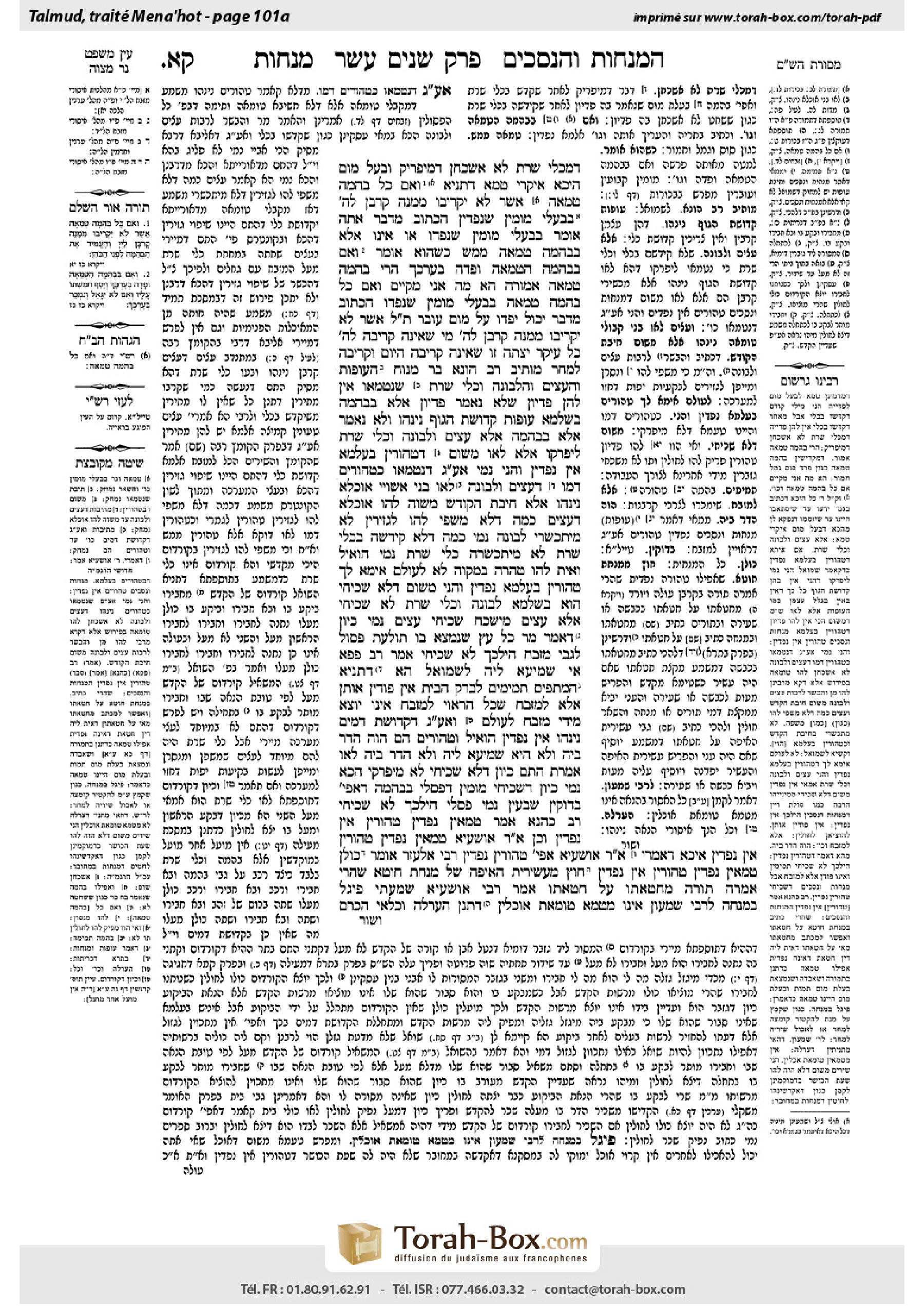
Menachot 101a: Talmud study for Daf Yomi
Daf Yomi is the daily study of one Talmud folio. Explore 37 tractates with scans, Hebrew text, Sefaria English and AI-generated French translations where annotated.
Passage selection and English or AI-generated French translation are available where the scan has annotations. Daf Study is independent of Torah-Box and Sefaria.
Browse Menachot · מנחות · All tractatesMenachot 101a text and translations
This page of Menachot includes the Aramaic text, an English translation and an AI-generated French translation, alongside the scan above.
מנחות ק״א א · Aramaic and Hebrew text
דְּמִכְּלֵי שָׁרֵת לָא אַשְׁכְּחַן דְּמִיפְּרִיק.
וּבַעַל מוּם הֵיכָא אִיקְּרִי ״טָמֵא״? דְּתַנְיָא: ״וְאִם כׇּל בְּהֵמָה טְמֵאָה אֲשֶׁר לֹא יַקְרִיבוּ מִמֶּנָּה קׇרְבָּן לַה׳״ – בְּבַעֲלֵי מוּמִין שֶׁנִּפְדִּין הַכָּתוּב מְדַבֵּר.
אַתָּה אוֹמֵר בְּבַעֲלֵי מוּמִין שֶׁנִּפְדּוּ, אוֹ אֵינוֹ אֶלָּא בִּבְהֵמָה טְמֵאָה מַמָּשׁ? כְּשֶׁהוּא אוֹמֵר ״וְאִם בַּבְּהֵמָה הַטְּמֵאָה וּפָדָה בְעֶרְכֶּךָ״, הֲרֵי בְּהֵמָה טְמֵאָה אֲמוּרָה. הָא מָה אֲנִי מְקַיֵּים ״וְאִם כׇּל בְּהֵמָה טְמֵאָה״? בְּבַעֲלֵי מוּמִין שֶׁנִּפְדּוּ הַכָּתוּב מְדַבֵּר.
יָכוֹל יִפָּדוּ עַל מוּם עוֹבֵר? תַּלְמוּד לוֹמַר ״אֲשֶׁר לֹא יַקְרִיבוּ מִמֶּנָּה קׇרְבָּן לַה׳״ – מִי שֶׁאֵינָהּ קְרֵיבָה לַה׳ כׇּל עִיקָּר, יָצְתָה זוֹ שֶׁאֵינָהּ קְרֵיבָה הַיּוֹם וּקְרֵיבָה לְמָחָר.
מוֹתֵיב רַב הוּנָא בַּר מָנוֹחַ: הָעוֹפוֹת וְהָעֵצִים וְהַלְּבוֹנָה וּכְלֵי שָׁרֵת שֶׁנִּטְמְאוּ, אֵין לָהֶן פִּדְיוֹן, שֶׁלֹּא נֶאֱמַר פִּדְיוֹן אֶלָּא בִּבְהֵמָה. בִּשְׁלָמָא עוֹפוֹת – קְדוּשַּׁת הַגּוּף נִינְהוּ, וְלֹא נֶאֱמַר אֶלָּא בִּבְהֵמָה.
אֶלָּא עֵצִים וּלְבוֹנָה וּכְלֵי שָׁרֵת – לִיפַּרְקוּ? אֶלָּא לָאו מִשּׁוּם דִּטְהוֹרִין בְּעָלְמָא אֵין נִפְדִּין.
וְהָנֵי נָמֵי, אַף עַל גַּב דְּנִטְמְאוּ – כִּטְהוֹרִים דָּמוּ, דְּעֵצִים וּלְבוֹנָה לָאו בְּנֵי אַשְׁוֹיֵי אוּכְלָא נִינְהוּ, אֶלָּא חִיבַּת הַקּוֹדֶשׁ מַשְׁוֵה לְהוּ אוּכְלָא.
דְּעֵצִים, כַּמָּה דְּלָא מְשַׁפֵּי לְהוּ לִגְזִירִין – לָא מִיתַּכְשְׁרִי. לְבוֹנָה נָמֵי, כַּמָּה דְּלָא קָידְשָׁה בִּכְלִי שָׁרֵת – לָא מִיתַּכְשְׁרָה. כְּלֵי שָׁרֵת נָמֵי, הוֹאִיל וְאִית לְהוּ טׇהֳרָה בְּמִקְוֶה.
לָא, לְעוֹלָם אֵימָא לָךְ: טְהוֹרִין בְּעָלְמָא נִפְדִּין, וְהָנֵי – מִשּׁוּם דְּלָא שְׁכִיחִי הוּא.
בִּשְׁלָמָא לְבוֹנָה וּכְלֵי שָׁרֵת – לָא שְׁכִיחִי, אֶלָּא עֵצִים – מִישְׁכָּח שְׁכִיחִי! עֵצִים נָמֵי, כֵּיוָן דְּאָמַר מָר: כׇּל עֵץ שֶׁנִּמְצָא בּוֹ תּוֹלַעַת פָּסוּל לְגַבֵּי מִזְבֵּחַ, הִילְכָּךְ לָא שְׁכִיחִי.
אָמַר רַב פָּפָּא: אִי שְׁמִיעָא לֵיהּ לִשְׁמוּאֵל הָא דְּתַנְיָא, הַמַּתְפִּיס תְּמִימִים לְבֶדֶק הַבַּיִת – אֵין פּוֹדִין אוֹתָן אֶלָּא לַמִּזְבֵּחַ, שֶׁכׇּל הָרָאוּי לַמִּזְבֵּחַ אֵינוֹ יוֹצֵא מִידֵי מִזְבֵּחַ לְעוֹלָם, וְאַף עַל גַּב דִּקְדוּשַּׁת דָּמִים נִינְהוּ – אֵין נִפְדִּין הוֹאִיל וּטְהוֹרִים הֵם, הֲוָה הָדַר בֵּיהּ.
וְלָא הִיא, שְׁמִיעָא לֵיהּ וְלָא הֲדַר בֵּיהּ. לָאו אָמְרַתְּ הָתָם: כֵּיוָן דְּלָא שְׁכִיחִי – לָא מִיפַּרְקִי.
הָכָא נָמֵי, כֵּיוָן דִּשְׁכִיחִי מוּמִין דְּפָסְלִי בִּבְהֵמָה, דַּאֲפִילּוּ בְּדוּקִּין שֶׁבָּעַיִן נָמֵי פָּסְלִי, הִילְכָּךְ לָא שְׁכִיחִי.
רַב כָּהֲנָא אָמַר: טְמֵאִין – נִפְדִּין, טְהוֹרִין – אֵין נִפְדִּין. וְכֵן אָמַר רַבִּי אוֹשַׁעְיָא: טְמֵאִין – נִפְדִּין, טְהוֹרִין – אֵין נִפְדִּין. אִיכָּא דְאָמְרִי אָמַר רַבִּי אוֹשַׁעְיָא: אֲפִילּוּ טְהוֹרִין – נִפְדִּין.
רַבִּי אֶלְעָזָר אוֹמֵר: כּוּלָּן טְמֵאִין – נִפְדִּין, טְהוֹרִין – אֵין נִפְדִּין, חוּץ מֵעֲשִׂירִית הָאֵיפָה שֶׁל מִנְחַת חוֹטֵא.
שֶׁהֲרֵי אָמְרָה תּוֹרָה: ״מֵחַטָּאתוֹ״ ״עַל חַטָּאתוֹ״.
אָמַר רַבִּי אוֹשַׁעְיָא: שָׁמַעְתִּי פִּיגֵּל בְּמִנְחָה לְרַבִּי שִׁמְעוֹן אֵינוֹ מְטַמֵּא טוּמְאַת אֳכָלִין, דִּתְנַן: הָעׇרְלָה וְכִלְאֵי הַכֶּרֶם
Menachot 101a · English translation
One cannot draw the conclusion that these substances can be redeemed, since we do not find a case where an item that has been consecrated in a service vessel is redeemed.
The Gemara asks: And where is a blemished animal called “impure” in the Torah? The Gemara answers: As it is taught in a baraita with regard to redeeming an offering, that the Torah states: “And if it be any impure animal, of which they may not bring an offering to the Lord, then he shall set the animal before the priest. And the priest shall value it, whether it is good or bad; as you the priest values it, so shall it be. But if he will indeed redeem it, then he shall add the fifth part thereof to your valuation” (Leviticus 27:11–13). The verse is speaking of blemished animals that are redeemed, and they are referred to as impure because they are not fit to serve as offerings.
The Gemara clarifies: Do you say that the verse is referring to blemished animals that were redeemed, or is it referring only to an actual non-kosher [tamei] animal, as the plain sense of the verse indicates? The Gemara responds: When the verse states later in that section: “And if it be of an impure [tamei] animal, then he shall redeem it according to your valuation, and shall add to it the fifth part thereof” (Leviticus 27:27), an actual non-kosher animal is mentioned as being subject to redemption. How do I realize the meaning of the verse: “And if it be any impure [tamei] animal” (Leviticus 27:11)? The verse is speaking of blemished animals that were redeemed, i.e., that have the possibility of being redeemed.
The Gemara continues to discuss this halakha: One might have thought that offerings are redeemed even due to the presence of a temporary blemish. Therefore, the continuation of the verse states: “Of which they may not bring an offering to the Lord,” which is referring to an animal that is not sacrificed to God at all. The verse serves to exclude this animal with a temporary blemish, which is not sacrificed today, while it remains blemished, but is sacrificed tomorrow, after the blemish disappears.
Rav Huna bar Manoaḥ raises an objection to Shmuel’s opinion that even meal offerings and libations that are pure may be redeemed if they have not yet been consecrated in a service vessel. The mishna states: With regard to consecrated birds, wood for the altar, frankincense, and service vessels, once they became ritually impure, they have no possibility of redemption, as redemption of consecrated items is stated only with regard to an animal consecrated for the altar that became blemished. Granted, birds are not redeemed, since they are imbued with inherent sanctity, and the Torah stated that only with regard to blemished animals, not birds, is redemption possible for items of inherent sanctity.
But with regard to wood, and frankincense that is not consecrated with inherent sanctity until it is placed in a service vessel, and service vessels themselves that became impure, since none of these possess inherent sanctity, let them be redeemed. Rather, is it not that these items are not redeemed because pure sacrificial items in general are not redeemed, even when they do not possess inherent sanctity?
And these items too, i.e., the wood, frankincense, and service vessels, even though they became impure, they are treated like they are pure. Their impurity is incomplete because wood and frankincense are not capable of becoming food, and consequently they should not be susceptible to impurity at all. Rather, the regard for the sanctity of sacred property transforms their status into that of food, which renders them susceptible to ritual impurity.
With regard to wood, as long as one does not trim it into logs, it does not become susceptible to impurity. With regard to frankincense as well, as long as it is not consecrated in a service vessel, it does not become susceptible to impurity. With regard to service vessels also, since they have the capacity to attain purity in a ritual bath, their impurity is revocable. Apparently, the reason the mishna teaches that these items are not redeemed is because they are in some sense still regarded as pure, and consecrated items that are considered ritually pure are not redeemed, contrary to the opinion of Shmuel.
The Gemara responds: No, actually, I will say to you that in general, pure items are redeemed; and these items are not redeemed, despite the fact that they are not imbued with inherent sanctity, because they are not readily available. If these items can be redeemed when they are pure, then they may not be available for the Temple service.
The Gemara challenges: Granted, frankincense and service vessels are not readily available, but wood is readily available. Why, then, may it not be redeemed? The Gemara answers: Wood usable for the Temple service is also difficult to procure. This is apparent since the Master said that any wood in which a worm is found is disqualified for use on the altar. Consequently, wood suitable for the altar is not readily available.
The Gemara continues to discuss the opinion of Shmuel that libations and the flour for meal offerings are redeemed even when pure, as long as they have not been consecrated in a service vessel. Rav Pappa said that if Shmuel had heard that which is taught in the following baraita, he would have retracted his opinion. The baraita teaches: In the case of one who consecrates unblemished animals for Temple maintenance rather than for the altar, they are redeemed only for use on the altar. They may not be redeemed for any other use, in accordance with the principle that any consecrated item that is fit to be sacrificed on the altar may never leave the altar. And even though these animals possess only sanctity that inheres in their value, they are not redeemed, since they are ritually pure and fit for the altar. Had Shmuel known this baraita, he would have retracted his opinion.
The Gemara responds: But that is not so; this baraita was heard by him, and he still did not retract his opinion. Rather, he explained it as follows: Didn’t you say there, i.e., earlier in the discussion of the mishna, that the reason one may not redeem wood, frankincense, and service vessels that were consecrated for Temple maintenance is that since they are not readily available, the Sages decreed that they are not redeemed?
Here, too, with regard to an unblemished animal that was consecrated for Temple maintenance, since blemishes that disqualify an animal as an offering are common, as even a blemish as insignificant as one on the cornea of the eye also disqualifies the animal, therefore, unblemished animals that are fit to be sacrificed on the altar are not readily available. That is why the Sages decreed that unblemished animals, even when consecrated for Temple maintenance, may be redeemed only for use as an offering on the altar. By contrast, meal offerings and libations, which were the subject of Shmuel’s statement, are readily available, and may be redeemed even when they are still pure.
§ After analyzing Shmuel’s opinion permitting the redemption of meal offerings and libations that are pure and have not yet been consecrated in a service vessel, the Gemara now cites a dissenting opinion: Rav Kahana said that only meal offerings and libations that are impure are redeemed, but those that are pure are not redeemed. And Rabbi Oshaya similarly said that those meal offerings and libations that are impure are redeemed, but those that are pure are not redeemed. There are those who say that Rabbi Oshaya says: Even pure ones are redeemed.
Rabbi Elazar says: With regard to all meal offerings, if they are impure they are redeemed, and if they are pure, they are not redeemed, except for the tenth of an ephah of fine flour of a meal offering of a sinner, which is redeemed even if it is pure.
The reason for this is that the Torah stated with regard to an extremely destitute individual who brings a tenth of an ephah of fine flour: “And the priest shall effect atonement for him for his sin [meḥattato] that he has sinned of one of these, and it shall be forgiven for him” (Leviticus 5:13). By contrast, with regard to a wealthy person who brings a lamb as a sliding-scale offering, the verse states: “And the priest shall effect atonement for him from his sin [al ḥattato] that he has sinned” (Leviticus 5:6). The word “al,” which can also mean on, indicates that if an extremely destitute individual designates a tenth of an ephah for his meal offering and then becomes wealthy, he redeems his meal offering and adds money on to the original sum in order to purchase an offering that is appropriate for his current financial status. In that case, the meal offering is redeemed even if it is pure.
§ The Gemara cites another statement that Rabbi Oshaya says: I heard that according to Rabbi Shimon, when one rendered a meal offering piggul by sacrificing it with the intent to consume it beyond its designated time, it is not susceptible to the ritual impurity of food. As we learned in a baraita (Tosefta, Okatzin 3:12): Orla, diverse kinds in a vineyard,
Menachot 101a · Traduction française (IA)
On ne peut pas en conclure que ces substances peuvent être rachetées, car nous ne trouvons aucun cas où un objet consacré dans un ustensile de service soit racheté.
La Guemara demande : Où la Torah qualifie-t-elle d’« impure » une bête présentant un défaut ? La Guemara répond : Comme l’enseigne une baraïta à propos du rachat d’une offrande, la Torah dit : « Et si c’est un animal impur, dont on ne peut apporter une offrande au Seigneur, on présentera l’animal au prêtre. Le prêtre en fixera la valeur, qu’il soit bon ou mauvais ; selon l’estimation que tu en fais, prêtre, telle sera sa valeur. Mais s’il veut effectivement le racheter, il ajoutera à ton estimation un cinquième de sa valeur » (Lévitique 27, 11-13). Le verset parle d’animaux présentant un défaut qui sont rachetés ; il les qualifie d’impurs parce qu’ils ne peuvent pas servir d’offrandes.
La Guemara précise : Peut-on dire que le verset se rapporte aux animaux présentant un défaut qui ont été rachetés, ou bien parle-t-il uniquement d’un animal réellement non cachère [tamei], comme l’indique le sens littéral du verset ? La Guemara répond : Lorsque le verset dit plus loin dans ce passage : « Et si c’est un animal impur [tamei], il le rachètera selon ton estimation et y ajoutera un cinquième de sa valeur » (Lévitique 27, 27), il est question d’un animal réellement non cachère pouvant être racheté. Comment faut-il donc comprendre le verset : « Et si c’est un animal impur [tamei] » (Lévitique 27, 11) ? Il parle d’animaux présentant un défaut qui sont rachetés, c’est-à-dire qui peuvent être rachetés.
La Guemara poursuit l’examen de cette halakha : On aurait pu penser que les offrandes sont rachetées même lorsqu’elles présentent un défaut temporaire. C’est pourquoi la suite du verset dit : « dont on ne peut apporter une offrande au Seigneur », ce qui désigne un animal qui n’est jamais sacrifié à Dieu. Le verset exclut ainsi l’animal présentant un défaut temporaire : il n’est pas sacrifié aujourd’hui, tant qu’il porte ce défaut, mais il le sera demain, une fois le défaut disparu.
Rav Houna bar Manoaḥ soulève une objection contre l’avis de Chmouel selon lequel même les offrandes de farine et les libations pures peuvent être rachetées si elles n’ont pas encore été consacrées dans un ustensile de service. La Michna dit : Les oiseaux consacrés, le bois destiné à l’autel, l’encens et les ustensiles de service, une fois devenus rituellement impurs, ne peuvent pas être rachetés, car le rachat des objets consacrés n’est mentionné qu’à propos d’un animal consacré à l’autel qui a présenté un défaut. Il est compréhensible que les oiseaux ne soient pas rachetés, puisqu’ils possèdent une sainteté intrinsèque et que la Torah n’a prévu le rachat des objets dotés d’une sainteté intrinsèque qu’à propos des animaux présentant un défaut, et non des oiseaux.
Mais en ce qui concerne le bois, l’encens, qui n’acquiert une sainteté intrinsèque qu’une fois placé dans un ustensile de service, et les ustensiles de service eux-mêmes, devenus impurs, puisqu’aucun de ces éléments ne possède de sainteté intrinsèque, qu’ils soient rachetés ! N’est-ce donc pas plutôt parce que, de manière générale, les objets sacrificiels purs ne sont pas rachetés, même s’ils ne possèdent pas de sainteté intrinsèque ?
Ces éléments aussi, c’est-à-dire le bois, l’encens et les ustensiles de service, bien qu’ils soient devenus impurs, sont considérés comme purs. Leur impureté est incomplète, car le bois et l’encens ne peuvent pas devenir des aliments et ne devraient donc pas être susceptibles d’impureté. C’est plutôt le respect dû à la sainteté des biens sacrés qui leur confère le statut d’aliments et les rend ainsi susceptibles d’impureté rituelle.
Pour ce qui est du bois, tant qu’on ne l’a pas débité en bûches, il n’est pas susceptible d’impureté. De même, l’encens n’est pas susceptible d’impureté tant qu’il n’a pas été consacré dans un ustensile de service. Quant aux ustensiles de service, puisqu’ils peuvent retrouver leur pureté dans un bain rituel, leur impureté est réversible. Il semble donc que la raison pour laquelle la Michna enseigne que ces éléments ne sont pas rachetés soit qu’ils sont encore considérés, d’une certaine manière, comme purs ; or les objets consacrés considérés comme rituellement purs ne sont pas rachetés, contrairement à l’avis de Chmouel.
La Guemara répond : Non, en réalité, je te dirai qu’en règle générale les objets purs sont rachetés. Ces éléments, eux, ne sont pas rachetés, bien qu’ils ne soient pas dotés d’une sainteté intrinsèque, parce qu’ils sont difficiles à se procurer. S’ils pouvaient être rachetés lorsqu’ils sont purs, ils risqueraient de ne plus être disponibles pour le service du Temple.
La Guemara objecte : Il est compréhensible que l’encens et les ustensiles de service soient difficiles à se procurer, mais le bois, lui, est facile à trouver. Pourquoi ne peut-il donc pas être racheté ? La Guemara répond : Le bois utilisable pour le service du Temple est lui aussi difficile à se procurer. Cela ressort de ce qu’a dit le Maître : tout bois où l’on trouve un ver est disqualifié pour l’autel. Par conséquent, le bois convenant à l’autel n’est pas facile à trouver.
La Guemara poursuit l’examen de l’avis de Chmouel selon lequel les libations et la farine destinée aux offrandes de farine sont rachetées même lorsqu’elles sont pures, tant qu’elles n’ont pas été consacrées dans un ustensile de service. Rav Pappa dit que si Chmouel avait entendu l’enseignement de la baraïta suivante, il serait revenu sur son avis. La baraïta enseigne : Lorsqu’on consacre des animaux sans défaut à l’entretien du Temple, plutôt qu’à l’autel, ils ne sont rachetés que pour être utilisés sur l’autel. Ils ne peuvent être rachetés pour aucun autre usage, conformément au principe selon lequel tout objet consacré qui peut être sacrifié sur l’autel ne peut jamais quitter l’autel. Et bien que ces animaux ne possèdent qu’une sainteté inhérente à leur valeur, ils ne sont pas rachetés, puisqu’ils sont rituellement purs et aptes à être offerts sur l’autel. Si Chmouel avait connu cette baraïta, il serait revenu sur son avis.
La Guemara répond : Mais ce n’est pas le cas ; il avait entendu cette baraïta et n’est pourtant pas revenu sur son avis. Il l’a plutôt expliquée ainsi : N’avez-vous pas dit là-bas, c’est-à-dire plus tôt dans l’examen de la Michna, que si l’on ne peut pas racheter le bois, l’encens et les ustensiles de service consacrés à l’entretien du Temple, c’est parce que, du fait qu’ils sont difficiles à se procurer, les Sages ont décrété qu’ils ne seraient pas rachetés ?
Ici aussi, dans le cas d’un animal sans défaut consacré à l’entretien du Temple, les défauts qui disqualifient un animal comme offrande sont fréquents, puisque même un défaut aussi insignifiant que celui de la cornée de l’œil le disqualifie. Les animaux sans défaut, aptes à être sacrifiés sur l’autel, sont donc difficiles à se procurer. C’est pourquoi les Sages ont décrété que les animaux sans défaut, même consacrés à l’entretien du Temple, ne peuvent être rachetés que pour servir d’offrande sur l’autel. À l’inverse, les offrandes de farine et les libations, dont parlait Chmouel, sont faciles à se procurer et peuvent être rachetées même lorsqu’elles sont encore pures.
§ Après avoir analysé l’avis de Chmouel autorisant le rachat des offrandes de farine et des libations pures qui n’ont pas encore été consacrées dans un ustensile de service, la Guemara cite à présent un avis divergent : Rav Kahana dit que seules les offrandes de farine et les libations impures sont rachetées, tandis que les pures ne le sont pas. Rabbi Ochaya dit de même que les offrandes de farine et les libations impures sont rachetées, mais que les pures ne le sont pas. Selon certains, Rabbi Ochaya dit : Même les pures sont rachetées.
Rabbi Eléazar dit : Pour toutes les offrandes de farine, si elles sont impures, elles sont rachetées ; si elles sont pures, elles ne le sont pas, à l’exception du dixième d’épha de farine fine de l’offrande de farine du pécheur, qui est racheté même s’il est pur.
La raison en est que la Torah dit, au sujet d’une personne extrêmement pauvre qui apporte un dixième d’épha de farine fine : « Le prêtre fera expiation pour lui concernant son péché [meḥattato], celui par lequel il a péché dans l’une de ces situations, et il lui sera pardonné » (Lévitique 5, 13). En revanche, au sujet d’une personne aisée qui apporte un agneau comme offrande à échelle variable, le verset dit : « Le prêtre fera expiation pour lui de son péché [al ḥattato], celui par lequel il a péché » (Lévitique 5, 6). Le mot « al », qui peut aussi signifier « sur », indique que si une personne extrêmement pauvre désigne un dixième d’épha pour son offrande de farine puis devient riche, elle rachète son offrande de farine et ajoute de l’argent à la somme initiale afin d’acheter une offrande correspondant à sa situation financière actuelle. Dans ce cas, l’offrande de farine est rachetée même si elle est pure.
§ La Guemara cite une autre déclaration de Rabbi Ochaya : J’ai entendu que, selon Rabbi Chimon, lorsqu’on rend une offrande de farine piggoul en la sacrifiant avec l’intention de la consommer après le délai qui lui est imparti, elle n’est pas susceptible de l’impureté rituelle des aliments. Comme nous l’avons appris dans une baraïta (Tossefta, Ouktsin 3, 12) : Orla, les espèces mélangées dans une vigne,
Traduction française générée par IA à partir de l’édition anglaise de Sefaria. Vérifie toujours un passage avec le texte source.
Text from Sefaria: William Davidson Edition - Vocalized Aramaic (unknown); William Davidson Edition - English (CC BY NC).