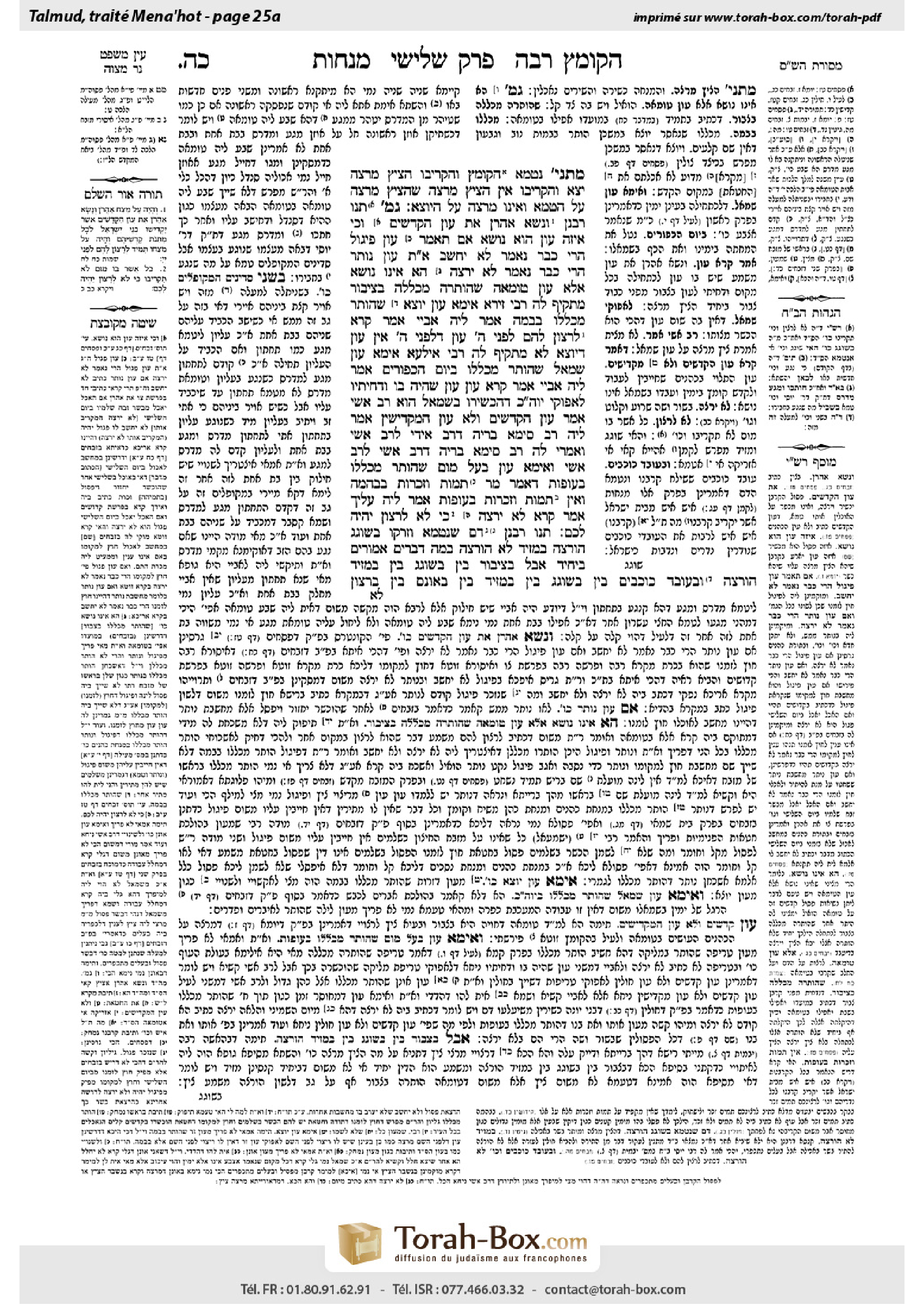
Menachot 25a: Talmud study for Daf Yomi
Daf Yomi is the daily study of one Talmud folio. Explore 37 tractates with scans, Hebrew text, Sefaria English and AI-generated French translations where annotated.
Passage selection and English or AI-generated French translation are available where the scan has annotations. Daf Study is independent of Torah-Box and Sefaria.
Browse Menachot · מנחות · All tractatesMenachot 25a text and translations
This page of Menachot includes the Aramaic text, an English translation and an AI-generated French translation, alongside the scan above.
מנחות כ״ה א · Aramaic and Hebrew text
מַתְנִי׳ נִטְמָא הַקּוֹמֶץ וְהִקְרִיבוֹ – הַצִּיץ מְרַצֶּה, יָצָא וְהִקְרִיבוֹ – אֵין הַצִּיץ מְרַצֶּה, שֶׁהַצִּיץ מְרַצֶּה עַל הַטָּמֵא וְאֵינוֹ מְרַצֶּה עַל הַיּוֹצֵא.
גְּמָ׳ תָּנוּ רַבָּנַן: ״וְנָשָׂא אַהֲרֹן אֶת עֲוֹן הַקֳּדָשִׁים״ – וְכִי אֵיזֶה עָוֹן הוּא נוֹשֵׂא? אִם תֹּאמַר עֲוֹן פִּיגּוּל – הֲרֵי כְּבָר נֶאֱמַר ״לֹא יֵחָשֵׁב״! אִם תֹּאמַר עֲוֹן נוֹתָר – הֲרֵי כְּבָר נֶאֱמַר ״לֹא יֵרָצֶה״!
הָא אֵינוֹ נוֹשֵׂא אֶלָּא עֲוֹן טוּמְאָה, שֶׁהוּתְּרָה מִכְּלָלָהּ בְּצִיבּוּר.
מַתְקֵיף לַהּ רַבִּי זֵירָא: אֵימָא עֲוֹן יוֹצֵא, שֶׁהוּתַּר מִכְּלָלוֹ בְּבָמָה.
אֲמַר לֵיהּ אַבָּיֵי, אָמַר קְרָא: ״לְרָצוֹן לָהֶם לִפְנֵי ה׳״, עָוֹן דְּלִפְנֵי ה׳ – אִין, עָוֹן דְּיוֹצֵא – לָא.
מַתְקֵיף לַהּ רַבִּי אִילְעָא: אֵימָא עֲוֹן שְׂמֹאל, שֶׁהוּתַּר מִכְּלָלוֹ בְּיוֹם הַכִּפּוּרִים.
אֲמַר לֵיהּ אַבָּיֵי: אָמַר קְרָא ״עָוֹן״ – עָוֹן שֶׁהָיָה בּוֹ וּדְחִיתִיו, לְאַפּוֹקֵי יוֹם הַכִּפּוּרִים דְּהֶכְשֵׁירוֹ בִּשְׂמֹאל הוּא.
רַב אָשֵׁי אָמַר: ״עֲוֹן הַקֳּדָשִׁים״, וְלֹא ״עֲוֹן הַמַּקְדִּישִׁין״.
אֲמַר לֵיהּ רַב סִימָא בְּרֵיהּ דְּרַב אִידִי לְרַב אָשֵׁי, וְאָמְרִי לַהּ רַב סִימָא בְּרֵיהּ דְּרַב אָשֵׁי לְרַב אָשֵׁי: וְאֵימָא עֲוֹן בַּעַל מוּם שֶׁהוּתַּר מִכְּלָלוֹ בְּעוֹפוֹת, דְּאָמַר מָר: תַּמּוּת וְזַכְרוּת בִּבְהֵמָה, וְאֵין תַּמּוּת וְזַכְרוּת בְּעוֹפוֹת!
אֲמַר לֵיהּ: עָלֶיךָ אָמַר קְרָא, ״לֹא יֵרָצֶה״, ״כִּי לֹא לְרָצוֹן יִהְיֶה לָכֶם״.
תָּנוּ רַבָּנַן: דָּם שֶׁנִּטְמָא וּזְרָקוֹ בְּשׁוֹגֵג – הוּרְצָה, בְּמֵזִיד – לֹא הוּרְצָה. בַּמֶּה דְּבָרִים אֲמוּרִים? בְּיָחִיד, אֲבָל בְּצִיבּוּר, בֵּין בְּשׁוֹגֵג בֵּין בְּמֵזִיד – הוּרְצָה, וּבְגוֹי, בֵּין בְּשׁוֹגֵג בֵּין בְּמֵזִיד, בֵּין בְּאוֹנֶס בֵּין בְּרָצוֹן –
Menachot 25a · English translation
MISHNA: If the handful became ritually impure and despite this the priest sacrificed it, the frontplate worn by the High Priest effects acceptance of the meal offering, and the remainder is eaten by the priests. If the handful left its designated area and despite this the priest then sacrificed it, the frontplate does not effect acceptance. The reason is that the frontplate effects acceptance for offerings sacrificed when ritually impure and does not effect acceptance for offerings that leave their designated areas.
GEMARA: The Sages taught in a baraita: It is written with regard to the frontplate: “And it shall be upon Aaron’s forehead, and Aaron shall bear the sin committed with the sacred items, which the children of Israel shall hallow, even all their sacred gifts; and it shall be always upon his forehead, that they may be accepted before the Lord” (Exodus 28:38). The Sages expounded: But which sin does he bear? If you say he atones for the sin of piggul, it is already stated: “It shall not be credited to him” (Leviticus 7:18). If you say he atones for the sin of notar, it is already stated in the same verse: “It shall not be accepted.”
Evidently, the High Priest wearing the frontplate bears only the sin of impurity in the offering of an individual. The frontplate is understood to atone for the sin of sacrificing an impure offering, as its general prohibition was permitted in certain circumstances, specifically in the case of the community, since in a situation where the entire community is impure it is permitted to sacrifice impure communal offerings ab initio.
Rabbi Zeira objects to this: Why not say that the frontplate atones for the sin of sacrificing offerings that leave the courtyard and are thereby disqualified, as its general prohibition was permitted in certain circumstances, specifically in the case of an offering sacrificed on a private altar during the period after the Jewish people had entered Eretz Yisrael and before there was an established location for the Tabernacle?
Abaye said to him: The verse states with regard to the frontplate: “And it shall be always upon his forehead, that they may be accepted before the Lord” (Exodus 28:38), teaching that in the case of a sin whose general prohibition is permitted before the Lord, i.e., in the Temple, yes, the frontplate atones for it. But in the case of the sin of offerings that leave the courtyard, whose general prohibition is not permitted before the Lord, the frontplate does not atone for it.
Rabbi Ile’a objects to this: Why not say that the frontplate atones for the sin of performing the service using one’s left hand instead of one’s right, as its general prohibition was permitted in certain circumstances, specifically in the case of Yom Kippur, when the High Priest carries the spoon bearing the incense into the Holy of Holies with his left hand?
Abaye said to him: The verse states: “And Aaron shall bear the sin committed with the sacred items” (Exodus 28:38), to say that the frontplate atones for a sin that was committed with the offering and I deferred it. This serves to exclude the spoon bearing the incense of Yom Kippur, where there is no sin that was deferred, since its proper performance is for the High Priest to hold it with his left hand, as he must hold both the coal pan and the spoon of incense.
Rav Ashi said: The frontplate does not atone for the sin of sacrificing an offering with the left hand for a different reason: The verse states: “And Aaron shall bear the sin committed with the sacred items [hakodashim],” demonstrating that the frontplate atones for a sin inherent in the offering itself, and not for a sin committed by those who bring the offering [hamakdishin].
Rav Sima, son of Rav Idi, said to Rav Ashi; and some say that it was Rav Sima, son of Rav Ashi, who said to Rav Ashi: But why not say that the frontplate atones for the sin of a blemished animal that is sacrificed, as its general prohibition was permitted in certain circumstances, specifically in the case of birds? As the Master says: The halakha that an offering must be unblemished and the halakha that a burnt offering must be male are taught with regard to animal offerings, but there is no requirement that an offering must be unblemished and male with regard to birds.
Rav Ashi said to him: With regard to your claim, the verse states about blemished animals: “It shall not be accepted” (Leviticus 22:23), and: “But whatsoever has a blemish that you shall not bring; for it shall not be acceptable for you” (Leviticus 22:20), teaching that in no case are blemished animals accepted as offerings, even due to the frontplate.
§ The Sages taught in a baraita: In the case of blood of an offering that became impure and a priest sprinkled it on the altar, if he did so unwittingly, the offering is accepted and effects atonement for the owner of the offering. If he sprinkled the blood intentionally, the offering is not accepted. In what case is this statement said? In the case of the offering of an individual. But in the case of a communal offering, whether he sprinkled the blood unwittingly or whether he did so intentionally, the offering is accepted. And in the case of an offering of a gentile where the blood of the offering became impure, whether the priest sprinkled the blood unwittingly or whether he did so intentionally, whether he did so due to circumstances beyond his control or whether he did so willingly,
Menachot 25a · Traduction française (IA)
MICHNA : Si la poignée est devenue rituellement impure et que, malgré cela, le prêtre l’a offerte, le tsits porté par le grand prêtre rend l’offrande agréée, et le reste est mangé par les prêtres. Si la poignée a quitté l’endroit qui lui était assigné et que, malgré cela, le prêtre l’a ensuite offerte, le tsits ne la rend pas agréée. En effet, le tsits rend agréées les offrandes offertes alors qu’elles sont rituellement impures, mais pas celles qui quittent l’endroit qui leur est assigné.
GUEMARA : Les Sages ont enseigné dans une baraïta : À propos du tsits, il est écrit : « Il sera sur le front d’Aaron, et Aaron portera la faute commise avec les choses saintes que les enfants d’Israël consacreront, tous leurs dons sacrés ; il sera toujours sur son front, afin qu’elles soient agréées devant le Seigneur » (Exode 28, 38). Les Sages ont interprété : Mais quelle faute porte-t-il ? Si tu dis qu’il expie la faute de piggoul, il est déjà écrit : « Elle ne lui sera pas imputée » (Lévitique 7, 18). Si tu dis qu’il expie la faute de notar, il est déjà écrit dans le même verset : « Elle ne sera pas agréée. »
Il apparaît donc que le grand prêtre portant le tsits ne porte que la faute d’impureté dans le cas de l’offrande d’un particulier. On comprend que le tsits expie la faute consistant à offrir une offrande impure, car l’interdiction générale à cet égard a été levée dans certaines circonstances, précisément dans le cas de la collectivité : lorsque toute la collectivité est impure, il est permis d’offrir d’emblée des offrandes collectives impures.
Rabbi Zeïra objecte : Pourquoi ne pas dire que le tsits expie la faute consistant à offrir des offrandes qui quittent la cour et sont ainsi disqualifiées, puisque l’interdiction générale à cet égard a été levée dans certaines circonstances, précisément dans le cas d’une offrande offerte sur un autel privé durant la période qui suivit l’entrée du peuple juif en Eretz Israël et précéda l’établissement d’un lieu fixe pour le Tabernacle ?
Abayé lui dit : Le verset dit à propos du tsits : « Il sera toujours sur son front, afin qu’elles soient agréées devant le Seigneur » (Exode 28, 38). Cela enseigne que, pour une faute dont l’interdiction générale est levée devant le Seigneur, c’est-à-dire dans le Temple, oui, le tsits l’expie. Mais pour la faute liée aux offrandes qui quittent la cour, dont l’interdiction générale n’est pas levée devant le Seigneur, le tsits ne l’expie pas.
Rabbi Il’a objecte : Pourquoi ne pas dire que le tsits expie la faute consistant à accomplir le service de la main gauche au lieu de la main droite, puisque l’interdiction générale à cet égard a été levée dans certaines circonstances, précisément à Yom Kippour, lorsque le grand prêtre porte de la main gauche la cuillère contenant l’encens dans le Saint des Saints ?
Abayé lui dit : Le verset dit : « Aaron portera la faute commise avec les choses saintes » (Exode 28, 38), pour enseigner que le tsits expie une faute commise avec l’offrande et que j’ai différée. Cela exclut la cuillère contenant l’encens de Yom Kippour, où aucune faute n’a été différée, puisque la manière correcte d’accomplir ce service est que le grand prêtre la tienne de la main gauche, car il doit tenir à la fois le brasier et la cuillère d’encens.
Rav Achi dit : Le tsits n’expie pas la faute consistant à offrir une offrande de la main gauche, pour une autre raison : le verset dit : « Aaron portera la faute commise avec les choses saintes [hakodashim] », ce qui montre que le tsits expie une faute inhérente à l’offrande elle-même, et non une faute commise par ceux qui apportent l’offrande [hamakdishin].
Rav Sima, fils de Rav Idi, dit à Rav Achi — et certains disent que c’est Rav Sima, fils de Rav Achi, qui dit à Rav Achi : Mais pourquoi ne pas dire que le tsits expie la faute consistant à offrir un animal atteint d’un défaut, puisque l’interdiction générale à cet égard a été levée dans certaines circonstances, précisément dans le cas des oiseaux ? Comme le dit le Maître : l’exigence qu’une offrande soit sans défaut et celle qu’un holocauste soit mâle concernent les offrandes animales, mais, pour les oiseaux, il n’est pas exigé que l’offrande soit sans défaut ni qu’elle soit mâle.
Rav Achi lui dit : Au sujet de ce que tu avances, le verset dit à propos des animaux atteints d’un défaut : « Elle ne sera pas agréée » (Lévitique 22, 23), et : « Tout animal qui a un défaut, vous ne l’offrirez pas, car il ne sera pas agréé en votre faveur » (Lévitique 22, 20). Cela enseigne que les animaux atteints d’un défaut ne sont en aucun cas agréés comme offrandes, pas même grâce au tsits.
§ Les Sages ont enseigné dans une baraïta : Dans le cas du sang d’une offrande devenu rituellement impur, si un prêtre l’a aspergé sur l’autel par inadvertance, l’offrande est agréée et expie pour son propriétaire. Si le prêtre a aspergé le sang intentionnellement, l’offrande n’est pas agréée. Dans quel cas cette déclaration s’applique-t-elle ? Dans le cas de l’offrande d’un particulier. Mais dans le cas d’une offrande collective, que le prêtre ait aspergé le sang par inadvertance ou intentionnellement, l’offrande est agréée. Et dans le cas d’une offrande d’un non-Juif dont le sang est devenu rituellement impur, que le prêtre ait aspergé le sang par inadvertance ou intentionnellement, qu’il l’ait fait en raison de circonstances indépendantes de sa volonté ou de son plein gré,
Traduction française générée par IA à partir de l’édition anglaise de Sefaria. Vérifie toujours un passage avec le texte source.
Text from Sefaria: William Davidson Edition - Vocalized Aramaic (unknown); William Davidson Edition - English (CC BY NC).