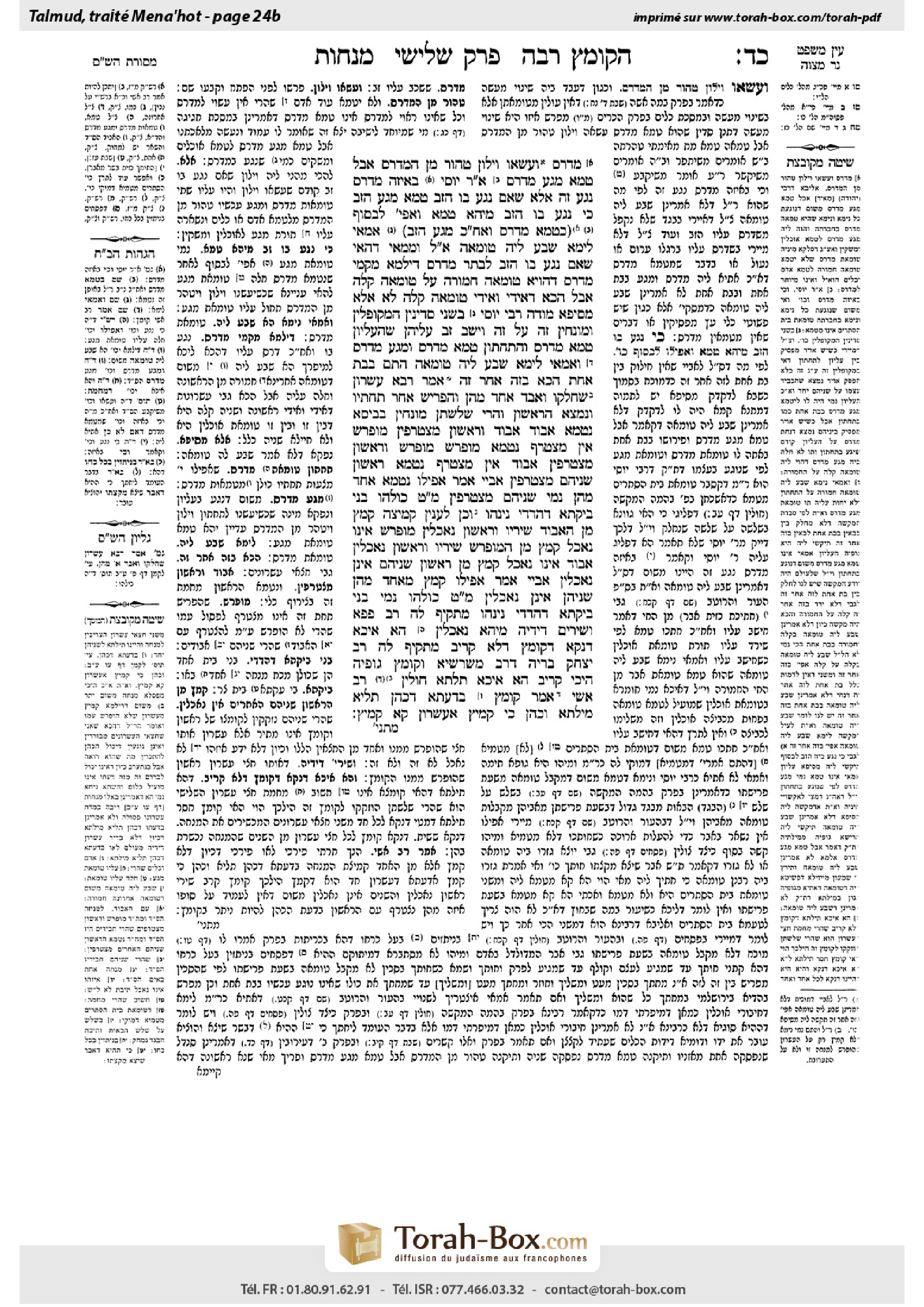
Menachot 24b: Talmud study for Daf Yomi
Daf Yomi is the daily study of one Talmud folio. Explore 37 tractates with scans, Hebrew text, Sefaria English and AI-generated French translations where annotated.
Passage selection and English or AI-generated French translation are available where the scan has annotations. Daf Study is independent of Torah-Box and Sefaria.
Browse Menachot · מנחות · All tractatesMenachot 24b text and translations
This page of Menachot includes the Aramaic text, an English translation and an AI-generated French translation, alongside the scan above.
מנחות כ״ד ב · Aramaic and Hebrew text
מִדְרָס וַעֲשָׂאוֹ וִילוֹן – טָהוֹר מִן הַמִּדְרָס, אֲבָל טָמֵא מַגַּע מִדְרָס.
אָמַר רַבִּי יוֹסֵי: בְּאֵיזֶה מִדְרָס נָגַע זֶה? אֶלָּא שֶׁאִם נָגַע בּוֹ הַזָּב, טָמֵא מַגַּע הַזָּב.
כִּי נָגַע בּוֹ הַזָּב מִיהָא טָמֵא, וַאֲפִילּוּ לְבַסּוֹף כְּטָמֵא מִדְרָס, וְאַחַר כָּךְ מַגַּע הַזָּב, אַמַּאי? לֵימָא: שְׂבַע לֵיהּ טוּמְאָה!
אֲמַר לֵיהּ: וּמִמַּאי דְּהַאי ״שֶׁאִם נָגַע בּוֹ הַזָּב״ לְבָתַר מִדְרָס? דִּילְמָא מִקַּמֵּי מִדְרָס, דְּהָוְיָא טוּמְאָה חֲמוּרָה עַל טוּמְאָה קַלָּה.
אֲבָל הָכָא, דְּאִידֵּי וְאִידֵּי טוּמְאָה קַלָּה – לָא.
אֶלָּא מִסֵּיפָא, מוֹדֶה רַבִּי יוֹסֵי בִּשְׁנֵי סְדִינִין הַמְקוּפָּלִין וּמוּנָּחִין זֶה עַל זֶה וְיָשַׁב זָב עֲלֵיהֶן, שֶׁהָעֶלְיוֹן טָמֵא מִדְרָס, וְהַתַּחְתּוֹן טָמֵא מִדְרָס וּמַגַּע מִדְרָס. וְאַמַּאי? לֵימָא: שְׂבַע לֵיהּ טוּמְאָה!
הָתָם בְּבַת אַחַת, הָכָא בְּזֶה אַחַר זֶה.
אָמַר רָבָא: עִשָּׂרוֹן שֶׁחִלְּקוֹ, וְאָבַד אֶחָד מֵהֶן, וְהִפְרִישׁ אַחֵר תַּחְתָּיו, וְנִמְצָא הָרִאשׁוֹן, וַהֲרֵי שְׁלָשְׁתָּן מוּנָּחִין בְּבִיסָא – נִטְמָא אָבוּד, אָבוּד וְרִאשׁוֹן מִצְטָרְפִין, מוּפְרָשׁ אֵין מִצְטָרֵף.
נִטְמָא מוּפְרָשׁ – מוּפְרָשׁ וְרִאשׁוֹן מִצְטָרְפִין, אָבוּד אֵין מִצְטָרֵף; נִטְמָא רִאשׁוֹן – שְׁנֵיהֶם מִצְטָרְפִין.
אַבָּיֵי אָמַר: אֲפִילּוּ נִטְמָא אֶחָד מֵהֶן נָמֵי – שְׁנֵיהֶם מִצְטָרְפִין, מַאי טַעְמָא? כּוּלְּהוּ בְּנֵי בִיקְתָּא דַּהֲדָדֵי נִינְהוּ.
וְכֵן לְעִנְיַן קְמִיצָה, קָמַץ מִן הָאָבוּד – שְׁיָרָיו וְרִאשׁוֹן נֶאֱכָלִין, מוּפְרָשׁ אֵינוֹ נֶאֱכָל; קָמַץ מִן הַמּוּפְרָשׁ – שְׁיָרָיו וְרִאשׁוֹן נֶאֱכָלִין, אָבוּד אֵינוֹ נֶאֱכָל.
קָמַץ מִן רִאשׁוֹן – שְׁנֵיהֶם אֵינָן נֶאֱכָלִין.
אַבָּיֵי אָמַר: אֲפִילּוּ קָמַץ מֵאֶחָד מֵהֶן, שְׁנֵיהֶן אֵינָן נֶאֱכָלִין. מַאי טַעְמָא? כּוּלְּהוּ נָמֵי בְּנֵי בִיקְתָּא דַּהֲדָדֵי נִינְהוּ.
מַתְקֵיף לַהּ רַב פָּפָּא: וְשִׁירַיִם דִּידֵיהּ מִיהָא נֶאֱכָלִין? הָא אִיכָּא דַּנְקָא דְּקוֹמֶץ דְּלָא קָרֵיב!
מַתְקֵיף לַהּ רַב יִצְחָק בְּרֵיהּ דְּרַב מְשַׁרְשְׁיָא: וְקוֹמֶץ גּוּפֵיהּ הֵיכִי קָרֵיב? הָא אִיכָּא תְּלָתָא חוּלִּין.
רַב אָשֵׁי אָמַר: קוֹמֶץ בְּדַעְתָּא דְּכֹהֵן תַּלְיָא מִילְּתָא, וְכֹהֵן כִּי קָמֵיץ – אַעִשָּׂרוֹן קָא קָמֵיץ.
Menachot 24b · English translation
imparted by treading, e.g., if a man who experiences a gonorrhea-like discharge [zav] lay down on it and transferred to it this severe impurity, and afterward one made a curtain [villon] of it, it is pure with regard to ritual impurity imparted by treading, as it is no longer fit for sitting or lying down. But it is impure due to having been in contact with an item that became ritually impure with impurity imparted by treading, as it is viewed as having been in contact with itself, and therefore it can impart impurity to food and drink.
The mishna continues: Rabbi Yosei said: What source of impurity imparted by treading did this curtain touch? Rather, the halakha is that if a zav touched the sheet itself before it was made into a curtain, and did not only lie on it without touching it directly, then although the curtain is pure with regard to ritual impurity imparted by treading, it is nevertheless impure due to contact with a zav. This is because the impurity transmitted by contact with a zav applies in the case of a curtain, which is not the halakha with regard to impurity imparted by treading.
Abaye comments: When a zav touched the sheet, in any event it was rendered impure, even if he touched it after he lay on the sheet, thereby rendering it impure with impurity imparted by treading. In this manner, it was rendered impure with the ritual impurity imparted by treading, and afterward it was again rendered impure due to contact with a zav. According to the statement of Rava, why would this be the halakha? Let us say that the item is already saturated with impurity and cannot be rendered impure a second time.
Rava said to him in response: And from where do you know that this statement of Rabbi Yosei: That if a zav touched the sheet it is nevertheless impure due to contact with a zav, is referring to a case where a zav touched the sheet after it was rendered impure with the ritual impurity imparted by treading? Perhaps he was referring to a case where a zav touched the sheet, rendering it impure due to contact with a zav, before he lay on it and rendered it impure with the ritual impurity imparted by treading. In that case, the severe form of ritual impurity imparted by the treading of the zav, which is a primary source of ritual impurity that imparts impurity to all people and items, takes effect in addition to the lesser form of impurity imparted by contact with a zav, which imparts impurity only to food and drink.
But here, in the case of part of a meal offering that was touched by one who immersed that day after having already become impure due to the touch of one who immersed that day, where both this and that are lesser forms of impurity, perhaps the impurity does not take effect a second time, as it is already impure.
The Gemara suggests: Rather, the proof against the existence of a principle that an item can be saturated with impurity and not susceptible to becoming impure a second time is from the last clause of a baraita that corresponds to the mishna: Rabbi Yosei concedes that in a case of two sheets that are folded and placed on top of one another, and a zav sat upon them, the top sheet is rendered impure with the ritual impurity imparted by treading, and the bottom sheet is rendered impure with the ritual impurity imparted by treading and due to contact with the top sheet that has become ritually impure with impurity imparted by treading. The Gemara explains: But according to the opinion advanced in Rava’s dilemma, why would this be the case? Let us say that the bottom sheet is already saturated with impurity and cannot be rendered impure a second time.
The Gemara rejects this proof: There, with regard to the bottom sheet, the two types of impurity take effect simultaneously, whereas here, with regard to the impure meal offering, the two forms of impurity take effect one after the other. It is only in the latter case that Rava suggests that the second type of impurity does not take effect. Therefore, there is no conclusive proof, and the question raised by Rava remains unresolved.
§ Rava says: In a case where one divided a tenth of an ephah of a meal offering into two halves, and one half was lost and he separated another half in its stead, and afterward the first lost half was found, and all three are placed in a receptacle together, if the one that had been lost became impure, the previously lost half-tenth of an ephah and the first half-tenth of an ephah join together and become impure, in accordance with the mishna cited earlier (Ḥagiga 20b) that a vessel joins the two together with regard to ritual impurity. But the half-tenth of an ephah that was separated to replace the lost half-tenth does not join together with the other half-tenths, and it remains pure.
If the one that had been separated to replace the lost half-tenth became impure, then the separated half-tenth and the first half-tenth join together and become impure, since the former was separated in order to complete the tenth together with the first half-tenth, while the previously lost half-tenth does not join together with them. If the first half-tenth became impure, then both the previously lost half-tenth as well as the half-tenth that was separated as its replacement join together and become ritually impure, as each of them had at one point been part of the same tenth as the first half-tenth.
Abaye says: Even if any one of the half-tenths became impure, both remaining half-tenths join together and become impure as well. What is the reason? They are all residents of one cabin, i.e., they were meant to be part of the same meal offering.
And similarly, according to Rava, with regard to the removal of the handful, if one removed the handful from the previously lost half-tenth, its remainder and the remainder of the first half-tenth of an ephah are eaten by the priests, while the half-tenth of an ephah that was separated in its stead is not eaten. Since it was not meant to join together with this other half-tenth, the removal of the handful does not permit its consumption. If one removed the handful from the one that had been separated in place of the lost half-tenth, then its remainder and the first half-tenth of an ephah are eaten, while the previously lost half-tenth is not eaten.
If one removed the handful from the first half-tenth, then both the previously lost half-tenth as well as the half-tenth that had been separated in its stead are not eaten. This is because the removal of the handful allows the remainder of only one tenth to be eaten, and it is not known whether the consumption of the previously lost half-tenth or the replacement half-tenth has now been permitted.
Abaye says: Even if one removed the handful from any one of them, both remaining half-tenths are not eaten. What is the reason? They are all residents of one cabin, and it is not possible to know whether the consumption of one or of the other has been permitted.
Rav Pappa objects to this ruling of Abaye: And is that to say that in any event the remainder of the half-tenth itself from which the handful was taken is eaten? But one-sixth [danka] of the handful that was removed was not sacrificed to permit this remainder. The handful was removed to permit the consumption of the remainders of all three half-tenths of an ephah in the receptacle. Since the handful included one-third that was removed to account for the half-tenth that is not needed, it turns out that each of the two actual half-tenths should have had an additional one-sixth removed to render them permitted.
Rav Yitzḥak, son of Rav Mesharshiyya, also objects to this ruling of Abaye: And with regard to the handful itself, how can it be sacrificed? But one-third of it, i.e., the portion separated to permit the extraneous half-tenth of an ephah, is non-sacred.
Rav Ashi said: These questions present no difficulty, since with regard to the removal of the handful, the matter is dependent on the intention of the priest. And when the priest removes the handful, he removes it to permit the remainder of the tenth of an ephah, and not the remainder of the extraneous half-tenth. Still, the other two halves may not be eaten because it is not possible to know whether the consumption of one or of the other has been permitted.
Menachot 24b · Traduction française (IA)
par foulage, par exemple si un homme atteint d’un écoulement semblable à la gonorrhée [zav] s’est couché dessus et lui a transmis cette grave impureté, puis qu’on en a fait un rideau [villon] : celui-ci est pur au regard de l’impureté transmise par foulage, puisqu’il ne convient plus pour s’asseoir ou s’allonger dessus. Mais il est impur parce qu’il a été en contact avec un objet devenu rituellement impur par foulage : il est considéré comme ayant été en contact avec lui-même et peut donc transmettre l’impureté aux aliments et aux boissons.
La Michna poursuit : Rabbi Yossei dit : Quelle source d’impureté transmise par foulage ce rideau a-t-il touchée ? Il faut plutôt dire que si un zav a touché le drap lui-même avant qu’on en fasse un rideau, et qu’il ne s’est pas contenté de s’y coucher sans le toucher directement, alors, bien que le rideau soit pur au regard de l’impureté transmise par foulage, il est néanmoins impur du fait du contact avec un zav. En effet, l’impureté transmise par le contact avec un zav s’applique dans le cas d’un rideau, contrairement à l’impureté transmise par foulage.
Abayé commente : Lorsque le zav a touché le drap, celui-ci a de toute façon été rendu impur, même s’il l’a touché après s’y être couché, le rendant ainsi impur par foulage. Il a donc d’abord été rendu impur par l’impureté rituelle transmise par foulage, puis il a de nouveau été rendu impur par contact avec un zav. Selon la déclaration de Rava, pourquoi en serait-il ainsi ? Ne devrions-nous pas dire que l’objet est déjà saturé d’impureté et ne peut pas être rendu impur une seconde fois ?
Rava lui répondit : Et d’où sais-tu que cette déclaration de Rabbi Yossei — selon laquelle, si un zav a touché le drap, celui-ci est néanmoins impur du fait du contact avec un zav — se rapporte à un cas où le zav a touché le drap après que celui-ci a été rendu impur par l’impureté rituelle transmise par foulage ? Peut-être parlait-il d’un cas où le zav a touché le drap et l’a rendu impur par contact avec un zav avant de s’y coucher et de le rendre impur par l’impureté rituelle transmise par foulage. Dans ce cas, la forme grave d’impureté rituelle transmise par le foulage du zav, qui est une source première d’impureté rituelle transmettant l’impureté à toutes les personnes et à tous les objets, s’applique en plus de la forme moindre d’impureté transmise par le contact avec un zav, qui ne transmet l’impureté qu’aux aliments et aux boissons.
Mais ici, dans le cas d’une partie d’une offrande de farine touchée par une personne qui s’est immergée ce jour-là, après qu’elle est déjà devenue impure au contact d’une personne qui s’est immergée ce jour-là, où les deux formes d’impureté sont de degré moindre, peut-être l’impureté ne s’applique-t-elle pas une seconde fois, puisque la partie en question est déjà impure.
La Guemara propose : La preuve qu’il n’existe pas de principe selon lequel un objet peut être saturé d’impureté et ne plus être susceptible de devenir impur une seconde fois viendrait plutôt de la dernière clause d’une baraïta correspondant à la Michna : Rabbi Yossei reconnaît que, dans le cas de deux draps pliés et posés l’un sur l’autre, sur lesquels un zav s’est assis, le drap supérieur est rendu impur par l’impureté rituelle transmise par foulage, et le drap inférieur est rendu impur par l’impureté rituelle transmise par foulage ainsi que par le contact avec le drap supérieur, devenu rituellement impur par foulage. La Guemara explique : Mais selon l’opinion avancée dans le dilemme de Rava, pourquoi en serait-il ainsi ? Ne devrions-nous pas dire que le drap inférieur est déjà saturé d’impureté et ne peut pas être rendu impur une seconde fois ?
La Guemara rejette cette preuve : dans ce cas, concernant le drap inférieur, les deux types d’impureté s’appliquent simultanément, tandis qu’ici, concernant l’offrande de farine impure, les deux formes d’impureté s’appliquent l’une après l’autre. C’est seulement dans ce dernier cas que Rava avance que le second type d’impureté ne s’applique pas. Il n’y a donc pas de preuve concluante, et la question soulevée par Rava reste sans réponse.
§ Rava dit : Dans le cas où quelqu’un a divisé un dixième d’épha d’une offrande de farine en deux moitiés, qu’une moitié a été perdue et qu’il en a prélevé une autre à sa place, puis que la première moitié perdue a été retrouvée et que les trois moitiés sont placées ensemble dans un récipient, si celle qui avait été perdue est devenue impure, la moitié de dixième d’épha précédemment perdue et la première moitié de dixième d’épha s’associent et deviennent impures, conformément à la Michna citée plus haut (Haguiga 20b), selon laquelle un récipient les associe toutes deux en matière d’impureté rituelle. Mais la moitié de dixième d’épha prélevée pour remplacer la moitié perdue ne s’associe pas aux deux autres et reste pure.
Si la moitié de dixième prélevée pour remplacer la moitié perdue est devenue impure, la moitié de dixième prélevée et la première moitié de dixième s’associent et deviennent impures, puisque la première a été prélevée afin de compléter le dixième avec la première moitié de dixième, tandis que la moitié de dixième précédemment perdue ne s’associe pas à elles. Si la première moitié de dixième est devenue impure, alors la moitié de dixième précédemment perdue ainsi que celle qui a été prélevée pour la remplacer s’associent et deviennent rituellement impures, car chacune d’elles a, à un moment donné, fait partie du même dixième que la première moitié de dixième.
Abayé dit : Même si l’une quelconque des moitiés de dixième est devenue impure, les deux autres moitiés de dixième s’associent et deviennent elles aussi impures. Pourquoi ? Elles sont toutes destinées à faire partie d’une même offrande de farine.
De même, selon Rava, en ce qui concerne le prélèvement de la poignée : si l’on a prélevé la poignée de la moitié de dixième précédemment perdue, le reste de celle-ci et le reste de la première moitié de dixième d’épha sont consommés par les prêtres, tandis que la moitié de dixième d’épha prélevée à sa place n’est pas consommée. Puisqu’elle n’était pas destinée à s’associer à cette autre moitié de dixième, le prélèvement de la poignée n’en autorise pas la consommation. Si l’on a prélevé la poignée de celle qui avait été prélevée en remplacement de la moitié de dixième perdue, son reste et la première moitié de dixième d’épha sont consommés, tandis que la moitié de dixième précédemment perdue ne l’est pas.
Si l’on a prélevé la poignée de la première moitié de dixième, alors ni la moitié de dixième précédemment perdue ni celle qui avait été prélevée à sa place ne sont consommées. En effet, le prélèvement de la poignée n’autorise la consommation que du reste d’un seul dixième, et on ne sait pas si c’est la consommation de la moitié de dixième précédemment perdue ou de celle qui l’a remplacée qui a ainsi été autorisée.
Abayé dit : Même si l’on a prélevé la poignée de l’une quelconque d’entre elles, les deux autres moitiés de dixième ne sont pas consommées. Pourquoi ? Elles sont toutes destinées à faire partie d’une même offrande de farine, et il est impossible de savoir si la consommation de l’une ou de l’autre a été autorisée.
Rav Pappa conteste cette décision d’Abayé : Cela signifie-t-il que, dans tous les cas, le reste de la moitié de dixième elle-même sur laquelle la poignée a été prélevée est consommé ? Pourtant, un sixième [danka] de la poignée prélevée n’a pas été sacrifié pour autoriser ce reste. La poignée a été prélevée afin d’autoriser la consommation des restes des trois moitiés de dixième d’épha dans le récipient. Puisque la poignée comprenait un tiers prélevé pour tenir compte de la moitié de dixième dont on n’a pas besoin, il s’ensuit qu’il aurait fallu prélever un sixième supplémentaire de chacune des deux moitiés de dixième proprement dites afin d’en autoriser la consommation.
Rav Yitsḥak, fils de Rav Mesharshiyya, conteste lui aussi cette décision d’Abayé : Et quant à la poignée elle-même, comment peut-elle être sacrifiée ? Un tiers de celle-ci, c’est-à-dire la partie prélevée pour autoriser la moitié de dixième d’épha superflue, est pourtant profane.
Rav Ashi dit : Ces questions ne posent aucune difficulté, car le prélèvement de la poignée dépend de l’intention du prêtre. Lorsque le prêtre prélève la poignée, il le fait pour autoriser le reste du dixième d’épha, et non le reste de la moitié de dixième superflue. Toutefois, les deux autres moitiés ne peuvent pas être consommées, car il est impossible de savoir si la consommation de l’une ou de l’autre a été autorisée.
Traduction française générée par IA à partir de l’édition anglaise de Sefaria. Vérifie toujours un passage avec le texte source.
Text from Sefaria: William Davidson Edition - Vocalized Aramaic (unknown); William Davidson Edition - English (CC BY NC).