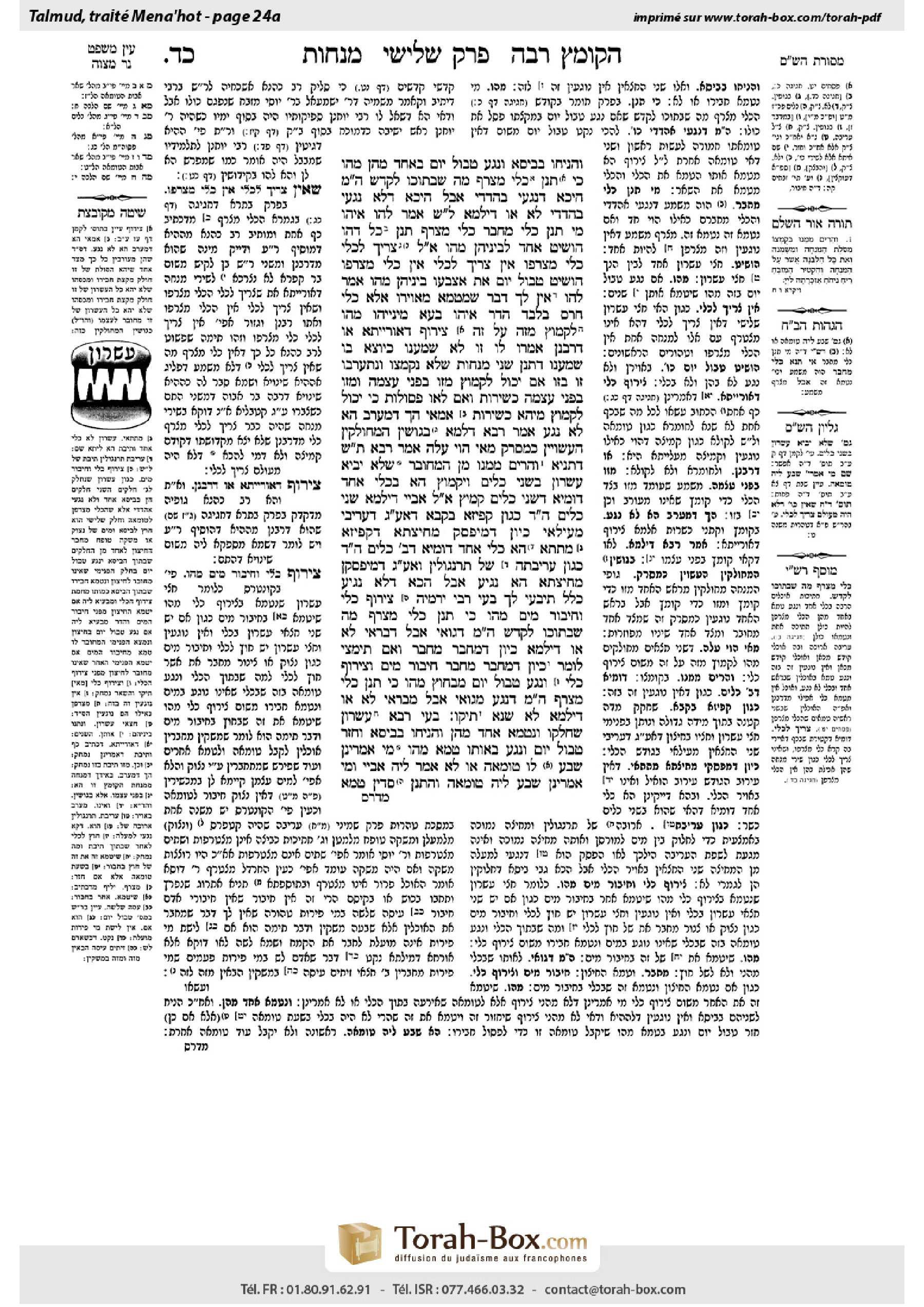
Menachot 24a: Talmud study for Daf Yomi
Daf Yomi is the daily study of one Talmud folio. Explore 37 tractates with scans, Hebrew text, Sefaria English and AI-generated French translations where annotated.
Passage selection and English or AI-generated French translation are available where the scan has annotations. Daf Study is independent of Torah-Box and Sefaria.
Browse Menachot · מנחות · All tractatesMenachot 24a text and translations
This page of Menachot includes the Aramaic text, an English translation and an AI-generated French translation, alongside the scan above.
מנחות כ״ד א · Aramaic and Hebrew text
וְהִנִּיחוֹ בְּבִיסָא, וְנָגַע טְבוּל יוֹם בְּאֶחָד מֵהֶן, מַהוּ? כִּי תְּנַן: כְּלִי מְצָרֵף מַה שֶּׁבְּתוֹכוֹ לַקֹּדֶשׁ, הָנֵי מִילֵּי הֵיכָא דְּנָגְעִי בַּהֲדָדֵי, אֲבָל הֵיכָא דְּלָא נָגְעִי בַּהֲדָדֵי – לָא, אוֹ דִילְמָא לָא שְׁנָא?
אֲמַר לְהוּ אִיהוּ: מִי תְּנַן ״כְּלִי מְחַבֵּר״? ״כְּלִי מְצָרֵף״ תְּנַן, כֹּל דְּהוּ. הוֹשִׁיט אֶחָד לְבֵינֵיהֶן – מַהוּ?
אֲמַר לְהוּ: צָרִיךְ לִכְלִי – כְּלִי מְצָרְפוֹ, אֵין צָרִיךְ לִכְלִי – אֵין כְּלִי מְצָרְפוֹ.
הוֹשִׁיט טְבוּל יוֹם אֶת אֶצְבָּעוֹ בֵּינֵיהֶן, מַהוּ? אֲמַר לְהוּ: אֵין לְךָ דָּבָר שֶׁמְּטַמֵּא מֵאֲוִירוֹ אֶלָּא כְּלִי חֶרֶס בִּלְבַד.
הֲדַר אִיהוּ בְּעָא מִינַּיְיהוּ: מַהוּ לִקְמוֹץ מִזֶּה עַל זֶה? צֵירוּף דְּאוֹרָיְיתָא אוֹ דְּרַבָּנַן?
אָמְרוּ לוֹ: זוֹ לֹא שָׁמַעְנוּ, כַּיּוֹצֵא בּוֹ שָׁמַעְנוּ, דִּתְנַן: שְׁתֵּי מְנָחוֹת שֶׁלֹּא נִקְמְצוּ וְנִתְעָרְבוּ זוֹ בָּזוֹ, אִם יָכוֹל לִקְמוֹץ מִזּוֹ בִּפְנֵי עַצְמָהּ וּמִזּוֹ בִּפְנֵי עַצְמָהּ – כְּשֵׁירוֹת, וְאִם לָאו – פְּסוּלוֹת.
כִּי יָכוֹל לִקְמוֹץ מִיהָא כְּשֵׁירוֹת, אַמַּאי? הָךְ דִּמְעָרַב הָא לָא נָגַע!
אָמַר רָבָא: דִּלְמָא בְּגוּשִּׁין הַמְחוּלָּקִין הָעֲשׂוּיִין כְּמַסְרֵק.
מַאי הָוֵי עֲלַהּ? אָמַר רָבָא: תָּא שְׁמַע, דְּתַנְיָא: ״וְהֵרִים מִמֶּנּוּ״ – מִן הַמְחוּבָּר, שֶׁלֹּא יָבִיא עִשָּׂרוֹן בִּשְׁנֵי כֵּלִים וְיִקְמוֹץ. הָא בִּכְלִי אֶחָד דּוּמְיָא דִּשְׁנֵי כֵּלִים – קָמֵיץ.
אֲמַר לֵיהּ אַבָּיֵי: דִּילְמָא שְׁנֵי כֵּלִים הֵיכִי דָּמֵי? כְּגוֹן קְפִיזָא בְּקַבָּא, דְּאַף עַל גַּב דַּעֲרִיבִי מֵעִילַּאי, כֵּיוָן דְּמִיפַּסְקָן מְחִיצָתָא דִּקְפִיזָא מִתַּתָּא.
הָא כְּלִי אֶחָד דּוּמְיָא דִּשְׁנֵי כֵּלִים, הֵיכִי דָּמֵי? כְּגוֹן עֲרֵיבַת תַּרְנְגוֹלִין, וְאַף עַל גַּב דְּמִיפַּסְקָן מְחִיצָתָא הָא נְגִיעַ, אֲבָל הָכָא דְּלָא נְגִיעַ כְּלָל – תִּיבְּעֵי לָךְ.
בָּעֵי רַבִּי יִרְמְיָה: צֵירוּף כְּלִי וְחִיבּוּר מַיִם, מַהוּ?
כִּי תְּנַן כְּלִי מְצָרֵף מַה שֶּׁבְּתוֹכוֹ לַקֹּדֶשׁ, הָנֵי מִילֵּי דְּגַוַּאי, אֲבָל דְּבָרַאי – לָא, אוֹ דִילְמָא, כֵּיוָן דִּמְחַבַּר – מְחַבַּר.
וְאִם תִּימְצֵי לוֹמַר: כֵּיוָן דִּמְחַבַּר מְחַבַּר, חִיבּוּר מַיִם וְצֵירוּף כְּלִי, וְנָגַע טְבוּל יוֹם מִבַּחוּץ – מַהוּ?
כִּי תְּנַן ״כְּלִי מְצָרֵף״, הָנֵי מִילֵּי דְּנָגַע מִגַּוַּאי, אֲבָל מִבָּרַאי – לָא, אוֹ דִילְמָא לָא שְׁנָא? תֵּיקוּ.
בָּעֵי רָבָא: עִשָּׂרוֹן שֶׁחִלְּקוֹ, וְנִטְמָא אֶחָד מֵהֶן, וְהִנִּיחוֹ בְּבִיסָא, וְחָזַר טְבוּל יוֹם וְנָגַע בְּאוֹתוֹ טָמֵא – מַהוּ? מִי אָמְרִינַן שְׂבַע לוֹ טוּמְאָה, אוֹ לָא?
אֲמַר לֵיהּ אַבָּיֵי: וּמִי אָמְרִינַן שְׂבַע לֵיהּ טוּמְאָה? וְהָתְנַן: סָדִין טָמֵא
Menachot 24a · English translation
and placed in a receptacle such that the flour of the measure was in two places, not in contact with each other, and one who was ritually impure who immersed that day and is waiting for nightfall for the purification process to be completed touched one of the portions of the meal offering, what is the halakha? Does he disqualify only the part of the meal offering that he touched, or the other part as well? When we learned in a mishna (Ḥagiga 20b) that a vessel joins all the food that is in it with regard to sacrificial food, meaning that if some of the contents become impure all the contents become impure as well, does this matter apply only where the contents are touching each other, but where the contents are not touching each other the ritual impurity is not imparted to the other contents? Or perhaps there is no difference.
Rav Kahana said to the sons of Rabbi Ḥiyya: Did we learn in the mishna that a vessel connects the contents within it? We learned that a vessel joins the contents within it, indicating that it does so in any case, whether or not the contents are in contact with one another. The sons of Rabbi Ḥiyya then asked Rav Kahana: If one inserted another one half-tenth of an ephah between them, and one who was ritually impure who immersed that day touched it, what is the halakha? Are the first two half-tenths rendered impure?
Rav Kahana said to them: Only when an item requires a vessel in order for it to be sanctified, e.g., in the case of the two half-tenths of an ephah of a meal offering, does the vessel join it together. In the case of an item that does not require a vessel, such as this half-tenth that was placed between them, the vessel does not join it.
The sons of Rabbi Ḥiyya then asked: If one who immersed that day inserted his finger between the two half-tenths of the ephah that were placed in the receptacle, without touching either one, what is the halakha? Are the two half-tenths rendered impure? Rav Kahana said to them in response: The only item you have that transmits impurity through its airspace is an earthenware vessel alone.
Rav Kahana himself then asked the sons of Rabbi Ḥiyya: If two half-tenths of an ephah of a meal offering are placed in one vessel but are not in contact with each other, what is the halakha? Can one remove a handful from this half-tenth of an ephah on behalf of that half-tenth of an ephah? Is the joining of the contents of the vessel effective by Torah law or by rabbinic law? If it is effective by Torah law, then the removal of the handful is valid. If it is effective by rabbinic law, then the removal of the handful was not performed correctly, since it was not taken from the entire tenth of an ephah of the meal offering.
They said to Rav Kahana: We did not hear the halakha with regard to this case explicitly, but we heard the halakha with regard to a case similar to this. As we learned in the mishna: In the case of two meal offerings from which a handful was not removed and which were intermingled with each other, if the priest can remove a handful from this meal offering by itself and from that meal offering by itself, they are fit meal offerings, but if not, they are unfit, as the handful of each meal offering must be taken from its original source.
They explain: In any event, the mishna teaches that in a case when he can remove a handful from each meal offering, the meal offerings are fit. Why is this considered a valid removal of the handful? But this part of the meal offering that is intermingled with the other meal offering does not touch the part of the meal offering from which the handful is removed. Evidently, the vessel joins the different parts of the meal offering together, and one can remove the handful from any part of its contents, even if they are not touching.
Rava said: This cannot be inferred from the mishna, as perhaps the ruling of the mishna is stated with regard to a case where the clumps of the meal offering are divided like the teeth of a comb, so that although the handful is removed from a clump of the meal offering that is separate from the clump that is intermingled with the other offering, all parts of the meal offering are still in contact with one another. It may still be that in the case presented by Rav Kahana, where the parts are truly separated from one another, it is possible that one cannot remove the handful from one part on behalf of the other.
The Gemara asks: Since this question was not resolved, what halakhic conclusion was reached about this matter? Rava said: Come and hear a proof, as it is taught in a baraita: The verse states: “And he shall take up from it his handful” (Leviticus 6:8), meaning that he shall take the handful from the meal offering that is connected. This teaches that one shall not bring a tenth of an ephah divided in two vessels and remove the handful from one on behalf of the other. It can therefore be inferred that in the case of one vessel that is similar to two vessels, as the entirety of the meal offering is brought in one vessel although the different parts are not touching, one may remove the handful from one part on behalf of the other part.
Abaye said to Rava: Perhaps one could say: What are the circumstances when the baraita states that one may not bring a tenth of an ephah in two vessels? The circumstances are, for example, if one hollowed out the area of a smaller kefiza measure within the area of a larger kav measure, so that within the one receptacle there were two cavities divided by a partition that did not reach the top of the receptacle. In this case, even though the two are intermingled on top, above the partition, since the partition of the kefiza measure divides them below, they are still separated and not joined together.
Abaye continues: What are the circumstances of one vessel that is similar to two vessels, with regard to which you inferred that one may remove the handful from one part on behalf of the other part? The circumstances are, for example, a hen trough that is filled with water or fodder, and even though a partition divides the top of the trough, the contents are touching below. But here, in the case of two half-tenths of an ephah that are placed in a receptacle that are not touching each other at all, you should raise the dilemma as to whether the handful may be removed from one part on behalf of the other.
Rabbi Yirmeya raises a dilemma: In a scenario where a vessel joins the two half-tenths of an ephah that are inside the vessel but not touching, and there is a connection by means of water between one of the half-tenths of the ephah inside the vessel and another half-tenth of an ephah that is outside the vessel, and one who immersed that day touched the other half-tenth of an ephah that is inside the vessel, what is the halakha? Does he also disqualify the half-tenth of an ephah that is outside the vessel?
When we learned in a mishna (Ḥagiga 20b) that a vessel joins all the food that is in it with regard to sacrificial food, meaning that if some of the contents become impure all the contents become impure as well, does this matter apply only to that which is inside the vessel, but not to that which is outside of it, despite the fact that the outer item is connected to an item inside the vessel? Or perhaps, since the half-tenth of an ephah found outside the vessel is connected to an impure item, it is connected and becomes impure.
Rabbi Yirmeya continues: And if you say that since the half-tenth of an ephah found outside the vessel is connected to an impure item, it is connected and becomes impure, one can raise another dilemma. In a case where there is a connection by means of water between a half-tenth of an ephah outside a vessel and another half-tenth of an ephah that is inside the vessel, and the vessel joins two half-tenths of an ephah that are inside the vessel, and one who immersed that day touched the half-tenth of an ephah that is outside the vessel, what is the halakha?
When we learned in a mishna that a vessel joins all the food that is in it with regard to sacrificial food, meaning that if some of the contents become impure all the contents become impure as well, does this matter apply only in a case where the one who immersed that day touched that which is inside the vessel, thereby transmitting impurity to all of the contents of the vessel, and due to the connection by means of water the impurity is then transmitted to that which is outside the vessel, but it does not apply in a case where the one who immersed that day touched that which is outside of the vessel, and only the half-tenth of an ephah that is connected to the outer item becomes impure? Or perhaps this case is no different, and the vessel joins all of its contents with regard to ritual impurity. The Gemara comments: The dilemma shall stand unresolved.
§ It has been demonstrated that a vessel joins the contents that are found in it, even if they are not touching one another, with regard to ritual impurity, such that if some of the contents become impure, all of the contents are rendered impure. Rava raised a dilemma: With regard to a tenth of an ephah of a meal offering that one divided and then placed the two halves in different vessels, and one of them became impure and afterward he placed it in a receptacle along with the second half-tenth of an ephah, and then one who immersed that day touched that one that was already rendered impure, what is the halakha? Do we say that the item is already saturated with impurity and cannot be rendered impure a second time, and therefore the second half-tenth of the ephah is not rendered impure even though it is joined in the same receptacle, or not?
Abaye said to him: And do we say that an item that is already saturated with impurity cannot be rendered impure a second time? But didn’t we learn in a mishna (Kelim 27:9): With regard to a sheet that is impure due to ritual impurity
Menachot 24a · Traduction française (IA)
et placées dans un récipient de sorte que la farine de la mesure se trouve en deux endroits distincts, sans être en contact, et qu’une personne rituellement impure qui s’est immergée ce jour-là et attend la tombée de la nuit pour que le processus de purification soit achevé touche l’une des portions de l’offrande de farine, quel est le statut ? Disqualifie-t-elle seulement la partie de l’offrande de farine qu’elle a touchée, ou également l’autre partie ? Lorsque nous avons appris dans une Michna (Ḥagiga 20b) qu’un récipient réunit tous les aliments qu’il contient en matière d’aliments consacrés, c’est-à-dire que si une partie de son contenu devient impure, tout le contenu le devient également, cela ne s’applique-t-il que lorsque les aliments se touchent, tandis que, lorsqu’ils ne se touchent pas, l’impureté rituelle ne se transmet pas aux autres aliments ? Ou bien n’y a-t-il aucune différence ?
Rav Kahana dit aux fils de Rabbi Ḥiyya : Avons-nous appris dans la Michna qu’un récipient relie ce qu’il contient ? Nous avons appris qu’un récipient réunit ce qu’il contient, ce qui indique qu’il le fait dans tous les cas, que les aliments soient ou non en contact les uns avec les autres. Les fils de Rabbi Ḥiyya demandèrent alors à Rav Kahana : Si l’on en insère entre les deux une autre demi-mesure d’un dixième d’épha, et qu’une personne rituellement impure qui s’est immergée ce jour-là la touche, quel est le statut ? Les deux premières demi-mesures d’un dixième d’épha deviennent-elles impures ?
Rav Kahana leur dit : Le récipient ne les réunit que lorsqu’un objet a besoin d’un récipient pour être consacré, comme dans le cas des deux demi-mesures d’un dixième d’épha d’une offrande de farine. Pour un objet qui n’a pas besoin d’un récipient, comme cette demi-mesure d’un dixième d’épha placée entre elles, le récipient ne le réunit pas.
Les fils de Rabbi Ḥiyya demandèrent ensuite : Si une personne qui s’est immergée ce jour-là insère son doigt entre les deux demi-mesures d’un dixième d’épha placées dans le récipient, sans toucher ni l’une ni l’autre, quel est le statut ? Les deux demi-mesures d’un dixième d’épha deviennent-elles impures ? Rav Kahana leur répondit : Le seul objet que vous connaissiez qui transmette l’impureté par son espace intérieur est le récipient en terre cuite.
Rav Kahana demanda alors à son tour aux fils de Rabbi Ḥiyya : Si deux demi-mesures d’un dixième d’épha d’une offrande de farine sont placées dans un même récipient sans être en contact, quel est le statut ? Peut-on prélever une poignée de cette demi-mesure d’un dixième d’épha pour cette autre demi-mesure d’un dixième d’épha ? Le fait que le récipient réunisse son contenu a-t-il effet selon la Torah ou selon la loi rabbinique ? Si cela a effet selon la Torah, le prélèvement de la poignée est valide. Si cela a effet selon la loi rabbinique, le prélèvement de la poignée n’a pas été effectué correctement, puisqu’elle n’a pas été prélevée sur le dixième d’épha entier de l’offrande de farine.
Ils dirent à Rav Kahana : Nous n’avons pas entendu explicitement la halakha concernant ce cas, mais nous avons entendu celle d’un cas semblable. En effet, nous avons appris dans la Michna : Dans le cas de deux offrandes de farine dont on n’a pas prélevé la poignée et qui se sont mélangées, si le prêtre peut prélever une poignée de cette offrande de farine séparément et de l’autre séparément, elles sont aptes ; sinon, elles sont inaptes, car la poignée de chaque offrande de farine doit être prélevée de sa matière d’origine.
Ils expliquent : Quoi qu’il en soit, la Michna enseigne que si le prêtre peut prélever une poignée de chaque offrande de farine, les offrandes sont aptes. Pourquoi ce prélèvement de la poignée est-il considéré comme valide ? Or, cette partie de l’offrande de farine, mêlée à l’autre offrande, ne touche pas la partie de l’offrande de farine dont on prélève la poignée. Il apparaît donc que le récipient réunit les différentes parties de l’offrande de farine et que l’on peut prélever la poignée de n’importe quelle partie de son contenu, même si les parties ne se touchent pas.
Rava dit : On ne peut pas le déduire de la Michna, car la décision de la Michna est peut-être énoncée à propos d’un cas où les mottes de l’offrande de farine sont disposées comme les dents d’un peigne, de sorte que, bien que la poignée soit prélevée sur une motte distincte de celle qui est mêlée à l’autre offrande, toutes les parties de l’offrande de farine restent en contact les unes avec les autres. Il se peut donc que, dans le cas présenté par Rav Kahana, où les parties sont véritablement séparées, on ne puisse pas prélever la poignée d’une partie pour l’autre.
La Guemara demande : Puisque cette question n’a pas été tranchée, quelle conclusion halakhique a-t-on tirée à ce sujet ? Rava dit : Viens et entends une preuve, car il est enseigné dans une baraïta : Le verset dit : « Et il en prélèvera une poignée » (Lévitique 6:8), ce qui signifie qu’il doit prélever la poignée sur l’offrande de farine qui est réunie. Cela enseigne qu’on ne doit pas apporter un dixième d’épha réparti dans deux récipients et prélever la poignée de l’un pour l’autre. On peut donc en déduire que, dans le cas d’un seul récipient semblable à deux récipients — puisque l’offrande de farine entière est apportée dans un seul récipient, bien que ses différentes parties ne se touchent pas — on peut prélever la poignée d’une partie pour l’autre.
Abayé dit à Rava : Peut-être peut-on dire que la baraïta enseigne qu’on ne peut pas apporter un dixième d’épha dans deux récipients dans les circonstances suivantes : par exemple, si l’on a creusé l’espace d’une mesure de kefiza plus petite à l’intérieur de celui d’une mesure de kav plus grande, de sorte qu’il y a dans un seul récipient deux cavités séparées par une cloison qui n’atteint pas le bord supérieur du récipient. Dans ce cas, bien qu’elles se rejoignent au-dessus de la cloison, les deux masses restent séparées et ne sont pas réunies, puisque la cloison de la mesure de kefiza les sépare en dessous.
Abayé poursuit : Dans quelles circonstances s’agit-il d’un seul récipient semblable à deux récipients, cas dont tu as déduit que l’on peut prélever la poignée d’une partie pour l’autre ? Par exemple, une auge pour les poules remplie d’eau ou de fourrage, où, bien qu’une cloison divise le haut de l’auge, le contenu se touche en dessous. Mais ici, dans le cas de deux demi-mesures d’un dixième d’épha placées dans un récipient sans être le moins du monde en contact, il faut soulever la question de savoir si l’on peut prélever la poignée d’une partie pour l’autre.
Rabbi Yirmeya soulève une question : Dans un cas où un récipient réunit les deux demi-mesures d’un dixième d’épha qui s’y trouvent sans se toucher, et où de l’eau relie l’une des demi-mesures d’un dixième d’épha à l’intérieur du récipient à une autre demi-mesure d’un dixième d’épha qui se trouve à l’extérieur, si une personne qui s’est immergée ce jour-là touche l’autre demi-mesure d’un dixième d’épha qui se trouve dans le récipient, quel est le statut ? Disqualifie-t-elle également la demi-mesure d’un dixième d’épha qui se trouve à l’extérieur du récipient ?
Lorsque nous avons appris dans une Michna (Ḥagiga 20b) qu’un récipient réunit tous les aliments qu’il contient en matière d’aliments consacrés, c’est-à-dire que si une partie de son contenu devient impure, tout le contenu le devient également, cela s’applique-t-il uniquement à ce qui se trouve à l’intérieur du récipient, mais pas à ce qui se trouve à l’extérieur, malgré le fait que l’objet extérieur soit relié à un objet situé à l’intérieur du récipient ? Ou bien, puisque la demi-mesure d’un dixième d’épha qui se trouve à l’extérieur du récipient est reliée à un objet impur, est-elle elle aussi reliée et devient-elle impure ?
Rabbi Yirmeya poursuit : Et si tu dis que, puisque la demi-mesure d’un dixième d’épha qui se trouve à l’extérieur du récipient est reliée à un objet impur, elle est reliée et devient impure, on peut soulever une autre question. Dans un cas où de l’eau relie une demi-mesure d’un dixième d’épha située à l’extérieur d’un récipient à une autre demi-mesure d’un dixième d’épha située à l’intérieur, où le récipient réunit deux demi-mesures d’un dixième d’épha qui se trouvent à l’intérieur, et où une personne qui s’est immergée ce jour-là touche la demi-mesure d’un dixième d’épha située à l’extérieur, quel est le statut ?
Lorsque nous avons appris dans une Michna qu’un récipient réunit tous les aliments qu’il contient en matière d’aliments consacrés, c’est-à-dire que si une partie de son contenu devient impure, tout le contenu le devient également, cela s’applique-t-il uniquement dans le cas où la personne qui s’est immergée ce jour-là touche ce qui se trouve à l’intérieur du récipient, transmettant ainsi l’impureté à tout son contenu, puis où, par la liaison due à l’eau, l’impureté se transmet à ce qui se trouve à l’extérieur du récipient, mais pas dans le cas où la personne qui s’est immergée ce jour-là touche ce qui se trouve à l’extérieur du récipient, auquel cas seule la demi-mesure d’un dixième d’épha reliée à l’objet extérieur devient impure ? Ou bien ce cas ne diffère-t-il pas, et le récipient réunit-il tout son contenu en matière d’impureté rituelle ? La Guemara commente : La question reste sans réponse.
§ Il a été établi qu’en matière d’impureté rituelle, un récipient réunit les éléments qui s’y trouvent, même s’ils ne se touchent pas, de sorte que si une partie de son contenu devient impure, tout le contenu devient impur. Rava soulève une question : Concernant un dixième d’épha d’une offrande de farine qu’on a divisé puis dont on a placé les deux moitiés dans des récipients différents, si l’une d’elles est devenue impure et qu’on l’a ensuite placée dans un récipient avec l’autre demi-mesure d’un dixième d’épha, puis qu’une personne qui s’est immergée ce jour-là touche celle qui avait déjà été rendue impure, quel est le statut ? Disons-nous que cet élément est déjà saturé d’impureté et ne peut donc pas devenir impur une seconde fois, de sorte que l’autre demi-mesure d’un dixième d’épha ne devient pas impure, bien qu’elle soit réunie dans le même récipient, ou non ?
Abayé lui dit : Disons-nous qu’un élément déjà saturé d’impureté ne peut pas devenir impur une seconde fois ? N’avons-nous pas appris dans une Michna (Kelim 27:9) : À propos d’un drap qui est impur en raison de l’impureté rituelle
Traduction française générée par IA à partir de l’édition anglaise de Sefaria. Vérifie toujours un passage avec le texte source.
Text from Sefaria: William Davidson Edition - Vocalized Aramaic (unknown); William Davidson Edition - English (CC BY NC).