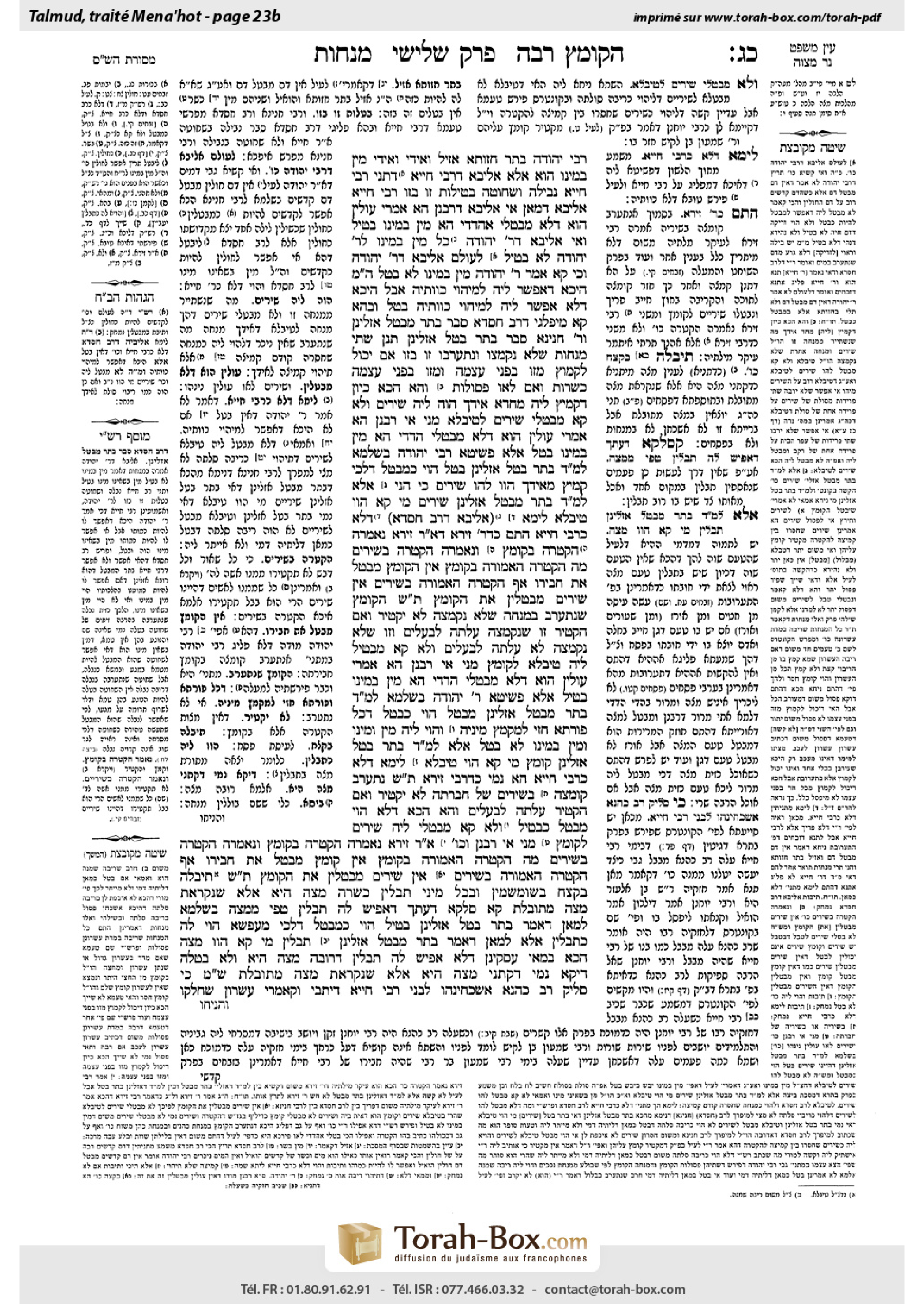
Menachot 23b: Talmud study for Daf Yomi
Daf Yomi is the daily study of one Talmud folio. Explore 37 tractates with scans, Hebrew text, Sefaria English and AI-generated French translations where annotated.
Passage selection and English or AI-generated French translation are available where the scan has annotations. Daf Study is independent of Torah-Box and Sefaria.
Browse Menachot · מנחות · All tractatesMenachot 23b text and translations
This page of Menachot includes the Aramaic text, an English translation and an AI-generated French translation, alongside the scan above.
מנחות כ״ג ב · Aramaic and Hebrew text
רַבִּי יְהוּדָה בָּתַר חֲזוּתָא אָזֵיל, וְאִידֵּי וְאִידֵּי מִין בְּמִינוֹ הוּא.
אֶלָּא, אַלִּיבָּא דְּרַבִּי חִיָּיא, דְּתָנֵי רַבִּי חִיָּיא: נְבֵילָה וּשְׁחוּטָה בְּטֵילוֹת זוֹ בָּזוֹ.
רַבִּי חִיָּיא אַלִּיבָּא דְּמַאן? אִי אַלִּיבָּא דְּרַבָּנַן – הָא אָמְרִי: עוֹלִין הוּא דְּלָא מְבַטְּלִי אַהֲדָדֵי, הָא מִין בְּמִינוֹ בָּטֵיל! וְאִי אַלִּיבָּא דְּרַבִּי יְהוּדָה – כׇּל מִין בְּמִינוֹ לְרַבִּי יְהוּדָה לֹא בָּטֵיל!
לְעוֹלָם אַלִּיבָּא דְּרַבִּי יְהוּדָה, וְכִי קָא אָמַר רַבִּי יְהוּדָה: מִין בְּמִינוֹ לֹא בָּטֵל – הָנֵי מִילֵּי הֵיכָא דְּאֶפְשָׁר לֵיהּ לְמִיהְוֵי כְּוָותֵיהּ, אֲבָל הֵיכָא דְּלָא אֶפְשָׁר לֵיהּ לְמִיהְוֵי כְּוָותֵיהּ – בָּטֵל.
וּבְהָא קָא מִיפַּלְגִי, דְּרַב חִסְדָּא סָבַר: בָּתַר מְבַטֵּל אָזְלִינַן.
וְרַבִּי חֲנִינָא סָבַר: בָּתַר בָּטֵל אָזְלִינַן.
תְּנַן: שְׁתֵּי מְנָחוֹת שֶׁלֹּא נִקְמְצוּ וְנִתְעָרְבוּ זוֹ בְּזוֹ, אִם יָכוֹל לִקְמוֹץ מִזּוֹ בִּפְנֵי עַצְמָהּ וּמִזּוֹ בִּפְנֵי עַצְמָהּ – כְּשֵׁרוֹת, וְאִם לָאו – פְּסוּלוֹת. וְהָא הָכָא, כֵּיוָן דְּקָמֵיץ לֵיהּ מֵחֲדָא – אִידַּךְ הֲוָה לֵיהּ שִׁירַיִם, וְלָא קָא מְבַטְּלִי שִׁירַיִם לְטִיבְלָא.
מַנִּי? אִי רַבָּנַן – הָא אָמְרִי: עוֹלִין הוּא דְּלָא מְבַטְּלִי הֲדָדֵי, הָא מִין בְּמִינוֹ בָּטֵל! אֶלָּא פְּשִׁיטָא – רַבִּי יְהוּדָה.
בִּשְׁלָמָא לְמַאן דְּאָמַר: בָּתַר בָּטֵל אָזְלִינַן, בָּטֵל הָוֵי כִּמְבַטֵּל, דִּלְכִי קָמֵיץ מֵאִידַּךְ – הָווּ לְהוּ שִׁירַיִם כִּי הָנֵי.
אֶלָּא לְמַאן דְּאָמַר בָּתַר מְבַטֵּל אָזְלִינַן, שִׁירַיִם מִי קָא הָווּ טִיבְלָא? לֵימָא אַלִּיבָּא דְּרַב חִסְדָּא, דְּלָא כְּרַבִּי חִיָּיא.
הָתָם, כִּדְרַבִּי זֵירָא, דְּאָמַר רַבִּי זֵירָא: נֶאֶמְרָה הַקְטָרָה בְּקוֹמֶץ, וְנֶאֶמְרָה הַקְטָרָה בְּשִׁירַיִם.
מָה הַקְטָרָה הָאֲמוּרָה בַּקּוֹמֶץ – אֵין הַקּוֹמֶץ מְבַטֵּל אֶת חֲבֵירוֹ, אַף הַקְטָרָה הָאֲמוּרָה בַּשִּׁירַיִם – אֵין שִׁירַיִם מְבַטְּלִין אֶת הַקּוֹמֶץ.
תָּא שְׁמַע: הַקּוֹמֶץ שֶׁנִּתְעָרֵב בְּמִנְחָה שֶׁלֹּא נִקְמְצָה – לֹא יַקְטִיר, וְאִם הִקְטִיר – זוֹ שֶׁנִּקְמְצָה עָלְתָה לַבְּעָלִים, וְזוֹ שֶׁלֹּא נִקְמְצָה לֹא עָלְתָה לַבְּעָלִים, וְלָא קָא מְבַטֵּיל לֵיהּ טִיבְלָא לְקוֹמֶץ.
מַנִּי? אִי רַבָּנַן – הָא אָמְרִי: עוֹלִין הוּא דְּלָא מְבַטְּלִי הֲדָדֵי, הָא מִין בְּמִינוֹ בְּטִיל! אֶלָּא פְּשִׁיטָא – רַבִּי יְהוּדָה.
בִּשְׁלָמָא לְמַאן דְּאָמַר: בָּתַר מְבַטֵּל אָזְלִינַן, מְבַטֵּל הָוֵי כְּבָטֵל, דְּכֹל פּוּרְתָּא חֲזֵי לְמִקְמַץ מִינֵּיהּ, וְהָוֵי לֵיהּ מִין וּמִינוֹ, וּמִין בְּמִינוֹ לֹא בָּטֵל.
אֶלָּא לְמַאן דְּאָמַר בָּתַר בָּטֵל אָזְלִינַן, קוֹמֶץ מִי קָא הָוֵי טִיבְלָא? לֵימָא דְּלָא כְּרַבִּי חִיָּיא? הָא נָמֵי כִּדְרַבִּי זֵירָא.
תָּא שְׁמַע: נִתְעָרֵב קוּמְצָהּ בְּשִׁירַיִם שֶׁל חֲבֶרְתָּהּ – לֹא יַקְטִיר, וְאִם הִקְטִיר – עָלְתָה לַבְּעָלִים. וְהָא הָכָא דְּלָא הָוֵי מְבַטֵּל כְּבָטֵיל, וְלָא קָא מְבַטְּלִי לֵיהּ שִׁירַיִם לְקוֹמֶץ.
מַנִּי? אִי רַבָּנַן וְכוּ׳.
אָמַר רַבִּי זֵירָא: נֶאֶמְרָה הַקְטָרָה בַּקּוֹמֶץ, וְנֶאֶמְרָה הַקְטָרָה בַּשִּׁירַיִם, מָה הַקְטָרָה הָאֲמוּרָה בַּקּוֹמֶץ – אֵין קוֹמֶץ מְבַטֵּל אֶת חֲבֵירוֹ, אַף הַקְטָרָה הָאֲמוּרָה בַּשִּׁירַיִם – אֵין שִׁירַיִם מְבַטְּלִין אֶת הַקּוֹמֶץ.
תָּא שְׁמַע: תִּיבְּלָהּ בְּקֶצַח, בְּשׁוּמְשְׁמִין, וּבְכׇל מִינֵי תַּבְלִין – כְּשֵׁרָה. מַצָּה הִיא, אֶלָּא שֶׁנִּקְרֵאת מַצָּה מְתוּבֶּלֶת. קָא סָלְקָא דַּעְתָּךְ דְּאַפֵּישׁ לַהּ תַּבְלִין טְפֵי מִמַּצָּה.
בִּשְׁלָמָא לְמַאן דְּאָמַר בָּתַר בָּטֵל אָזְלִינַן, בָּטֵיל הָוֵי כִּמְבַטֵּל, דִּלְכִי מִעַפְּשָׁא (הוי) [הָוְיָא] לַהּ כְּתַבְלִין. אֶלָּא לְמַאן דְּאָמַר בָּתַר מְבַטֵּל אָזְלִינַן, תַּבְלִין מִי קָא הֲווֹ מַצָּה?
הָכָא בְּמַאי עָסְקִינַן? דְּלָא אַפִּישׁ לַהּ תַּבְלִין, דְּרוּבַּהּ מַצָּה הִיא, וְלָא בָּטְלָה. דַּיְקָא נָמֵי, דְּקָתָנֵי: מַצָּה הִיא, אֶלָּא שֶׁנִּקְרֵאת מַצָּה מְתוּבֶּלֶת, שְׁמַע מִינַּהּ.
כִּי סְלֵיק רַב כָּהֲנָא, אַשְׁכְּחִינְהוּ לִבְנֵי רַבִּי חִיָּיא דְּיָתְבִי וְקָאָמְרִי: עִשָּׂרוֹן שֶׁחִלְּקוֹ
Menachot 23b · English translation
Rabbi Yehuda follows the appearance of the item in determining whether the two items are the same type of substance. And therefore, this meat of a slaughtered animal and that meat of an unslaughtered carcass are viewed as a substance in contact with the same type of substance, since their appearances are identical, and neither one nullifies the other.
Rather, it must be explained that the opinions of Rav Ḥisda and Rabbi Ḥanina are in accordance with the opinion of Rabbi Ḥiyya. As Rabbi Ḥiyya teaches: The meat of an unslaughtered animal carcass and the meat of a slaughtered animal are nullified one in the other. Rav Ḥisda understands this statement to mean that the meat of an animal carcass is nullified in a larger quantity of meat of a slaughtered animal, whereas Rabbi Ḥanina understands the statement to be referring to meat of a slaughtered animal that is nullified in a larger quantity of meat of an unslaughtered animal carcass.
The Gemara asks: But then in accordance with whose opinion did Rabbi Ḥiyya himself state his opinion? If his opinion is in accordance with the opinion of the Rabbis, that is difficult: Didn’t the Rabbis say that it is in the case of a mixture of items that ascend to the altar that the different components of the mixture do not nullify one another, but in general, a substance in contact with the same type of substance is nullified? And if his statement is in accordance with the opinion of Rabbi Yehuda, that is difficult: According to the opinion of Rabbi Yehuda any substance in contact with the same type of substance is not nullified.
The Gemara answers: Actually, the statement of Rabbi Ḥiyya is in accordance with the opinion of Rabbi Yehuda, and Rabbi Ḥiyya holds that when Rabbi Yehuda says that a substance in contact with the same type of substance is not nullified, this statement applies only where it is possible for one to become like the other. But where it is not possible for one to become like the other, it is nullified, since the two are not considered the same substance.
And Rav Ḥisda and Rabbi Ḥanina disagree with regard to this, as Rav Ḥisda holds that we follow the potentially nullifying substance, i.e., the larger quantity, and if it can attain the status of the smaller quantity, the two are considered identical substances and the smaller quantity is not nullified in the larger quantity. Therefore, if meat of a slaughtered animal became mingled with a larger quantity of meat of an animal carcass, the meat of the slaughtered animal is not nullified, as it is possible for a carcass to attain the status of a slaughtered animal with regard to ritual impurity, as when a carcass rots it loses its impure status.
And Rabbi Ḥanina holds that we follow the potentially nullified substance, i.e., the smaller quantity, and only if it can attain the status of the larger quantity, e.g., in the case of meat of an animal carcass that was intermingled with a larger quantity of meat of a slaughtered animal, the two are considered identical substances and the smaller quantity is not nullified in the larger quantity.
The Gemara offers support for the opinion of Rabbi Ḥanina: We learned in the mishna: In the case of two meal offerings from which a handful was not removed and which were intermingled with each other, if the priest can remove a handful from this meal offering by itself and from that meal offering by itself, they are fit meal offerings, but if not, they are unfit, as the handful of each meal offering must be taken from its original source. And here, once he removes a handful from one, the rest of it becomes the remainder, which is designated for the priests, and this remainder does not nullify the other meal offering from which a handful has not yet been removed.
In accordance with whose opinion is the mishna? If it is in accordance with the opinion of the Rabbis, that is difficult: Didn’t the Rabbis say that it is in the case of a mixture of items that ascend to the altar that the different components of the mixture do not nullify one another, but in general, a substance in contact with the same type of substance is nullified? Therefore, the remainder of the first meal offering should nullify the second meal offering, as both consist of the same substances, flour and oil. Rather, it is obvious that the mishna is in accordance with the opinion of Rabbi Yehuda, who holds that the meal offering is not nullified in the remainder, as any substance in contact with the same type of substance is not nullified.
Now, granted, according to Rabbi Ḥanina, who is the one who says that we follow the potentially nullified substance, in the mishna’s case the potentially nullified substance can become like the potentially nullifying substance, as when the priest removes the handful from the other meal offering, the intermingled offering will become a remainder that is designated for the priests, just like that of the first meal offering. Therefore, the intermingled second meal offering is not nullified in the remainder of the first meal offering.
But according to Rav Ḥisda, who is the one who says that we follow the potentially nullifying substance, can the remainder of the first meal offering become a meal offering from which a handful has not yet been removed? Therefore, shall we say that according to Rav Ḥisda the mishna here is not in accordance with the opinion of Rabbi Ḥiyya with regard to Rabbi Yehuda’s opinion?
The Gemara answers: There, the halakha of the mishna is in accordance with the opinion of Rabbi Zeira, as Rabbi Zeira says that the verse teaches that nullification does not take place when remainders are intermingled with handfuls. He explains: The term burning is stated with regard to the handful removed from the meal offering (see Leviticus 2:2), as it is a mitzva to burn the handful, and the term burning is stated with regard to the remainder of the meal offering (see Leviticus 2:11), as it is taught that it is prohibited to burn the remainder.
This verbal analogy teaches that just as in the case of the burning that is stated with regard to the handful, if two handfuls are mixed together one handful does not nullify the other and all agree that the two are burned on the altar, so too, in the case of the burning that is stated with regard to the remainder of the meal offering, if the remainder of one offering is intermingled with another meal offering, the remainder of the meal offering does not nullify the handful or the remainder of the second meal offering.
The Gemara suggests: Come and hear a proof from the mishna here: In the case of the handful that was intermingled with a meal offering from which a handful was not removed, the priest should not burn the mixture on the altar, and if he burned it, this meal offering from which the handful was taken satisfied the obligation of the owner and that meal offering from which the handful was not taken did not satisfy the obligation of the owner. This is a case of a mixture of identical substances, and the meal offering from which a handful has not yet been removed does not nullify the handful, since after the fact if the mixture is burned on the altar the meal offering from which the handful was taken satisfies the obligation of the owner.
The Gemara explains the proof: In accordance with whose opinion is the mishna? If it is in accordance with the opinion of the Rabbis, that is difficult: Didn’t the Rabbis say that it is in the case of a mixture of items that ascend to the altar that the different components of the mixture do not nullify one another, but in general, a substance in contact with the same type of substance is nullified? Rather, it is obvious that the mishna is in accordance with the opinion of Rabbi Yehuda, who holds that any substance in contact with the same type of substance is not nullified.
Now, granted, according to Rav Ḥisda, who is the one who says that we follow the potentially nullifying substance, in the mishna’s case the potentially nullifying substance can become like the potentially nullified substance, since every bit of the meal offering is fit to have the handful taken from it. And therefore, the mixture is considered to be one that consists of a substance in contact with the same type of substance, and a substance in contact with the same type of substance is not nullified.
But according to Rabbi Ḥanina, who is the one who says that we follow the potentially nullified substance, can the handful become a meal offering from which a handful has not yet been removed, so that it would not be nullified by the other meal offering whose handful was not removed? Therefore, shall we say that according to Rabbi Ḥanina the mishna here is not in accordance with the opinion of Rabbi Ḥiyya with regard to Rabbi Yehuda’s opinion? The Gemara answers: This mishna as well is in accordance with the opinion of Rabbi Zeira, who explains that a Torah edict establishes that the remainder does not nullify the handful, and similarly, a meal offering from which a handful has not yet been removed does not nullify the handful.
The Gemara suggests: Come and hear a proof from the mishna here: If, after it was removed, its handful was intermingled with the remainder of another meal offering, the priest should not burn the mixture on the altar, and if he burned it, it satisfied the obligation of the owner. The Gemara explains the proof: But here, the potentially nullifying substance cannot become like the potentially nullified substance, since the remainder of the meal offering cannot become like the handful, and the potentially nullified substance cannot become like the potentially nullifying substance, since the handful cannot become like the remainder of the meal offering; and the mishna teaches that the remainder of the meal offering does not nullify the handful.
In accordance with whose opinion is the mishna? If it is in accordance with the opinion of the Rabbis, that is difficult: Didn’t the Rabbis say that it is in the case of a mixture of items that ascend to the altar that the different components of the mixture do not nullify one another, but in general, a substance in contact with the same type of substance is nullified? Rather, it is obvious that the mishna is in accordance with the opinion of Rabbi Yehuda, who holds that any substance in contact with the same type of substance is not nullified. But in contrast to Rabbi Ḥiyya’s statement, Rabbi Yehuda apparently holds that nullification takes place even if the nullifying substance cannot become like the nullified substance, or if the nullified substance cannot become like the nullifying substance.
Rabbi Zeira said: This mishna is an independent halakha, based on a Torah edict that nullification does not take place when remainders are intermingled with handfuls. He explains: The term burning is stated with regard to the handful removed from the meal offering, and the term burning is stated with regard to the remainder of the meal offering. This verbal analogy teaches that just as in the case of the burning that is stated with regard to the handful, if two handfuls are mixed together one handful does not nullify the other and all agree that the two are burned on the altar, so too, in the case of the burning that is stated with regard to the remainder of the meal offering, if the remainder of one offering is intermingled with another meal offering, the remainder of the meal offering does not nullify the handful or the remainder of the second meal offering.
The Gemara suggests another proof from a baraita (Tosefta, Pesaḥim 2:21): Come and hear: In the case of matza that one seasoned with black cumin, with sesame, or with any type of spice, it is fit to be eaten during the festival of Passover, as it is considered matza, but it is called seasoned matza. The Gemara comments: It enters your mind to explain that this is a case where there were more spices than the matza itself.
Now, granted, according to Rabbi Ḥanina, who is the one who says that we follow the potentially nullified substance, in the case here the potentially nullified substance can become like the potentially nullifying substance, as when the matza becomes moldy it becomes like the spices, as it is no longer fit to be used to fulfill the mitzva of eating matza. Therefore, the smaller quantity of matza is not nullified by the larger quantity of spices. But according to Rav Ḥisda, who is the one who says that we follow the potentially nullifying substance, can the spices become like the matza?
The Gemara answers: What are we dealing with here? We are dealing with a case where there are not more spices than matza, but rather the majority is matza and therefore the matza is not nullified. The Gemara notes: According to this explanation, the language of the baraita is also precise, as it teaches: It is considered matza, but it is called seasoned matza. Learn from here that the baraita is referring to an entity whose majority is matza, and therefore it is referred to as seasoned matza.
§ The Gemara relates: When Rav Kahana ascended from Babylonia to Eretz Yisrael, he found the sons of Rabbi Ḥiyya, who were sitting and saying the following: In the case of a tenth of an ephah of a meal offering that one divided
Menachot 23b · Traduction française (IA)
Rabbi Yehuda se fonde sur l’apparence de l’élément pour déterminer si les deux éléments sont de même nature. Ainsi, la viande de cet animal abattu et celle de cette carcasse d’animal non abattu sont considérées comme des substances de même nature en contact, puisque leur apparence est identique ; aucune des deux n’annule l’autre.
Il faut plutôt expliquer que les avis de Rav Ḥisda et de Rabbi Ḥanina concordent avec celui de Rabbi Ḥiyya. En effet, Rabbi Ḥiyya enseigne : la viande d’une carcasse d’animal non abattu et celle d’un animal abattu s’annulent l’une dans l’autre. Rav Ḥisda comprend cette déclaration comme signifiant que la viande d’une carcasse d’animal est annulée dans une plus grande quantité de viande d’un animal abattu, tandis que Rabbi Ḥanina comprend qu’il s’agit de viande d’un animal abattu annulée dans une plus grande quantité de viande d’une carcasse d’animal non abattu.
La Guemara demande : Mais selon l’avis de qui Rabbi Ḥiyya a-t-il lui-même formulé son opinion ? S’il partage l’avis des Rabbins, cela pose une difficulté : les Rabbins n’ont-ils pas dit que c’est dans le cas d’un mélange d’éléments qui montent sur l’autel que les différents composants ne s’annulent pas, tandis qu’en général, une substance en contact avec une substance de même nature est annulée ? Et si sa déclaration concorde avec l’avis de Rabbi Yehuda, cela pose également une difficulté : selon Rabbi Yehuda, aucune substance en contact avec une substance de même nature n’est annulée.
La Guemara répond : En réalité, la déclaration de Rabbi Ḥiyya concorde avec l’avis de Rabbi Yehuda, et Rabbi Ḥiyya considère que lorsque Rabbi Yehuda dit qu’une substance en contact avec une substance de même nature n’est pas annulée, cela ne s’applique que lorsque l’une peut devenir semblable à l’autre. En revanche, lorsque l’une ne peut pas devenir semblable à l’autre, elle est annulée, car les deux ne sont pas considérées comme une même substance.
Rav Ḥisda et Rabbi Ḥanina sont en désaccord sur ce point : Rav Ḥisda considère que l’on se fonde sur la substance susceptible d’annuler, c’est-à-dire la plus grande quantité ; si elle peut acquérir le statut de la plus petite quantité, les deux sont considérées comme des substances identiques et la plus petite quantité n’est pas annulée dans la plus grande. Par conséquent, si de la viande d’un animal abattu s’est mêlée à une plus grande quantité de viande d’une carcasse d’animal, la viande de l’animal abattu n’est pas annulée, car une carcasse peut acquérir le statut d’un animal abattu en matière d’impureté rituelle : lorsqu’une carcasse pourrit, elle perd son statut d’impureté.
Rabbi Ḥanina considère que l’on se fonde sur la substance susceptible d’être annulée, c’est-à-dire la plus petite quantité, et que les deux ne sont considérées comme des substances identiques que si celle-ci peut acquérir le statut de la plus grande quantité. C’est le cas, par exemple, de la viande d’une carcasse d’animal mêlée à une plus grande quantité de viande d’un animal abattu : la plus petite quantité n’est pas annulée dans la plus grande.
La Guemara apporte un appui à l’avis de Rabbi Ḥanina. Nous avons appris dans la Michna : dans le cas de deux offrandes de farine dont on n’a pas prélevé la poignée et qui se sont mêlées, si le prêtre peut prélever séparément une poignée de cette offrande et une poignée de l’autre, elles sont valides ; sinon, elles sont invalides, car la poignée de chaque offrande doit être prélevée de sa source d’origine. Or, ici, dès qu’il prélève une poignée de l’une, le reste devient le reste de l’offrande, destiné aux prêtres, et ce reste n’annule pas l’autre offrande de farine, dont on n’a pas encore prélevé la poignée.
Selon l’avis de qui la Michna a-t-elle été enseignée ? Si elle concorde avec l’avis des Rabbins, cela pose une difficulté : les Rabbins n’ont-ils pas dit que c’est dans le cas d’un mélange d’éléments qui montent sur l’autel que les différents composants ne s’annulent pas, tandis qu’en général, une substance en contact avec une substance de même nature est annulée ? Le reste de la première offrande de farine devrait donc annuler la seconde offrande, puisque toutes deux sont composées des mêmes substances, de farine et d’huile. Il est donc évident que la Michna concorde avec l’avis de Rabbi Yehuda, qui considère que l’offrande de farine n’est pas annulée dans le reste, car aucune substance en contact avec une substance de même nature n’est annulée.
Or, il est compréhensible que, selon Rabbi Ḥanina, qui dit que l’on se fonde sur la substance susceptible d’être annulée, dans le cas de la Michna, cette substance puisse devenir semblable à la substance susceptible d’annuler : lorsque le prêtre prélèvera la poignée de l’autre offrande de farine, l’offrande mêlée deviendra un reste destiné aux prêtres, comme celui de la première offrande. Par conséquent, la seconde offrande de farine mêlée n’est pas annulée dans le reste de la première offrande.
Mais selon Rav Ḥisda, qui dit que l’on se fonde sur la substance susceptible d’annuler, le reste de la première offrande de farine peut-il devenir une offrande de farine dont on n’a pas encore prélevé la poignée ? Faudrait-il donc dire que, selon Rav Ḥisda, la Michna ici ne concorde pas avec l’avis de Rabbi Ḥiyya concernant l’opinion de Rabbi Yehuda ?
La Guemara répond : dans ce cas, la halakha de la Michna concorde avec l’avis de Rabbi Zeira, qui dit que le verset enseigne qu’il n’y a pas d’annulation lorsque des restes sont mêlés à des poignées. Il explique : le terme « brûler » est employé à propos de la poignée prélevée de l’offrande de farine (voir Lévitique 2,2), car la mitsva consiste à brûler la poignée ; le terme « brûler » est également employé à propos du reste de l’offrande de farine (voir Lévitique 2,11), puisqu’il est enseigné qu’il est interdit de brûler le reste.
Cette analogie verbale enseigne que, de même que, dans le cas de la combustion mentionnée à propos de la poignée, si deux poignées sont mêlées, l’une n’annule pas l’autre et tous conviennent que les deux sont brûlées sur l’autel, de même, dans le cas de la combustion mentionnée à propos du reste de l’offrande de farine, si le reste d’une offrande est mêlé à une autre offrande de farine, le reste de la première offrande n’annule ni la poignée ni le reste de la seconde offrande de farine.
La Guemara propose : Viens et entends une preuve tirée de la Michna ici : dans le cas d’une poignée mêlée à une offrande de farine dont on n’a pas prélevé la poignée, le prêtre ne doit pas brûler le mélange sur l’autel ; s’il l’a brûlé, l’offrande de farine dont la poignée a été prélevée a satisfait à l’obligation du propriétaire, tandis que celle dont la poignée n’a pas été prélevée ne l’a pas satisfaite. Il s’agit d’un mélange de substances identiques, et l’offrande de farine dont on n’a pas encore prélevé la poignée n’annule pas la poignée, puisque, après coup, si le mélange est brûlé sur l’autel, l’offrande de farine dont la poignée a été prélevée satisfait à l’obligation du propriétaire.
La Guemara explique la preuve : selon l’avis de qui la Michna a-t-elle été enseignée ? Si elle concorde avec l’avis des Rabbins, cela pose une difficulté : les Rabbins n’ont-ils pas dit que c’est dans le cas d’un mélange d’éléments qui montent sur l’autel que les différents composants ne s’annulent pas, tandis qu’en général, une substance en contact avec une substance de même nature est annulée ? Il est donc évident que la Michna concorde avec l’avis de Rabbi Yehuda, qui considère qu’aucune substance en contact avec une substance de même nature n’est annulée.
Or, il est compréhensible que, selon Rav Ḥisda, qui dit que l’on se fonde sur la substance susceptible d’annuler, dans le cas de la Michna, cette substance puisse devenir semblable à la substance susceptible d’être annulée, puisque chaque partie de l’offrande de farine peut être prélevée pour en prendre la poignée. Par conséquent, le mélange est considéré comme constitué de substances de même nature en contact, et une substance en contact avec une substance de même nature n’est pas annulée.
Mais selon Rabbi Ḥanina, qui dit que l’on se fonde sur la substance susceptible d’être annulée, la poignée peut-elle devenir une offrande de farine dont on n’a pas encore prélevé la poignée, de sorte qu’elle ne serait pas annulée par l’autre offrande de farine dont la poignée n’a pas été prélevée ? Faudrait-il donc dire que, selon Rabbi Ḥanina, la Michna ici ne concorde pas avec l’avis de Rabbi Ḥiyya concernant l’opinion de Rabbi Yehuda ? La Guemara répond : cette Michna également concorde avec l’avis de Rabbi Zeira, qui explique qu’un décret de la Torah établit que le reste n’annule pas la poignée ; de même, une offrande de farine dont on n’a pas encore prélevé la poignée n’annule pas la poignée.
La Guemara propose : Viens et entends une preuve tirée de la Michna ici : si, après avoir été prélevée, sa poignée s’est mêlée au reste d’une autre offrande de farine, le prêtre ne doit pas brûler le mélange sur l’autel ; s’il l’a brûlé, l’obligation du propriétaire a été satisfaite. La Guemara explique la preuve : ici, la substance susceptible d’annuler ne peut pas devenir semblable à la substance susceptible d’être annulée, puisque le reste de l’offrande de farine ne peut pas devenir semblable à la poignée ; et la substance susceptible d’être annulée ne peut pas devenir semblable à la substance susceptible d’annuler, puisque la poignée ne peut pas devenir semblable au reste de l’offrande de farine. Pourtant, la Michna enseigne que le reste de l’offrande de farine n’annule pas la poignée.
Selon l’avis de qui la Michna a-t-elle été enseignée ? Si elle concorde avec l’avis des Rabbins, cela pose une difficulté : les Rabbins n’ont-ils pas dit que c’est dans le cas d’un mélange d’éléments qui montent sur l’autel que les différents composants ne s’annulent pas, tandis qu’en général, une substance en contact avec une substance de même nature est annulée ? Il est donc évident que la Michna concorde avec l’avis de Rabbi Yehuda, qui considère qu’aucune substance en contact avec une substance de même nature n’est annulée. Mais, contrairement à ce qu’affirme Rabbi Ḥiyya, Rabbi Yehuda semble considérer qu’une annulation a lieu même si la substance susceptible d’annuler ne peut pas devenir semblable à la substance susceptible d’être annulée, ou si la substance susceptible d’être annulée ne peut pas devenir semblable à la substance susceptible d’annuler.
Rabbi Zeira a dit : cette Michna constitue une halakha indépendante, fondée sur un décret de la Torah selon lequel il n’y a pas d’annulation lorsque des restes sont mêlés à des poignées. Il explique : le terme « brûler » est employé à propos de la poignée prélevée de l’offrande de farine, et le terme « brûler » est également employé à propos du reste de l’offrande de farine. Cette analogie verbale enseigne que, de même que, dans le cas de la combustion mentionnée à propos de la poignée, si deux poignées sont mêlées, l’une n’annule pas l’autre et tous conviennent que les deux sont brûlées sur l’autel, de même, dans le cas de la combustion mentionnée à propos du reste de l’offrande de farine, si le reste d’une offrande est mêlé à une autre offrande de farine, le reste de la première offrande n’annule ni la poignée ni le reste de la seconde offrande de farine.
La Guemara propose une autre preuve tirée d’une baraïta (Tossefta, Pessaḥim 2,21) : Viens et entends : dans le cas d’une matsa assaisonnée de cumin noir, de sésame ou de toute autre épice, elle peut être consommée pendant la fête de Pessaḥ, car elle est considérée comme de la matsa, mais on l’appelle « matsa assaisonnée ». La Guemara commente : on pourrait penser qu’il s’agit d’un cas où la quantité d’épices dépasse celle de la matsa elle-même.
Or, il est compréhensible que, selon Rabbi Ḥanina, qui dit que l’on se fonde sur la substance susceptible d’être annulée, dans ce cas, cette substance puisse devenir semblable à la substance susceptible d’annuler : lorsque la matsa moisit, elle devient semblable aux épices, puisqu’elle n’est alors plus apte à servir à accomplir la mitsva de manger de la matsa. La plus petite quantité de matsa n’est donc pas annulée par la plus grande quantité d’épices. Mais selon Rav Ḥisda, qui dit que l’on se fonde sur la substance susceptible d’annuler, les épices peuvent-elles devenir semblables à la matsa ?
La Guemara répond : de quoi s’agit-il ici ? D’un cas où la quantité d’épices ne dépasse pas celle de la matsa ; la majorité est plutôt constituée de matsa, et celle-ci n’est donc pas annulée. La Guemara relève : selon cette explication, la formulation de la baraïta est également précise, puisqu’elle enseigne : « Elle est considérée comme de la matsa, mais on l’appelle matsa assaisonnée. » Apprends de là que la baraïta parle d’un mélange dont la majorité est constituée de matsa, raison pour laquelle on l’appelle matsa assaisonnée.
§ La Guemara rapporte : lorsque Rav Kahana monta de Babylonie en Eretz Israël, il trouva les fils de Rabbi Ḥiyya assis et disant ce qui suit : dans le cas d’un dixième d’épha d’une offrande de farine que l’on a divisé
Traduction française générée par IA à partir de l’édition anglaise de Sefaria. Vérifie toujours un passage avec le texte source.
Text from Sefaria: William Davidson Edition - Vocalized Aramaic (unknown); William Davidson Edition - English (CC BY NC).