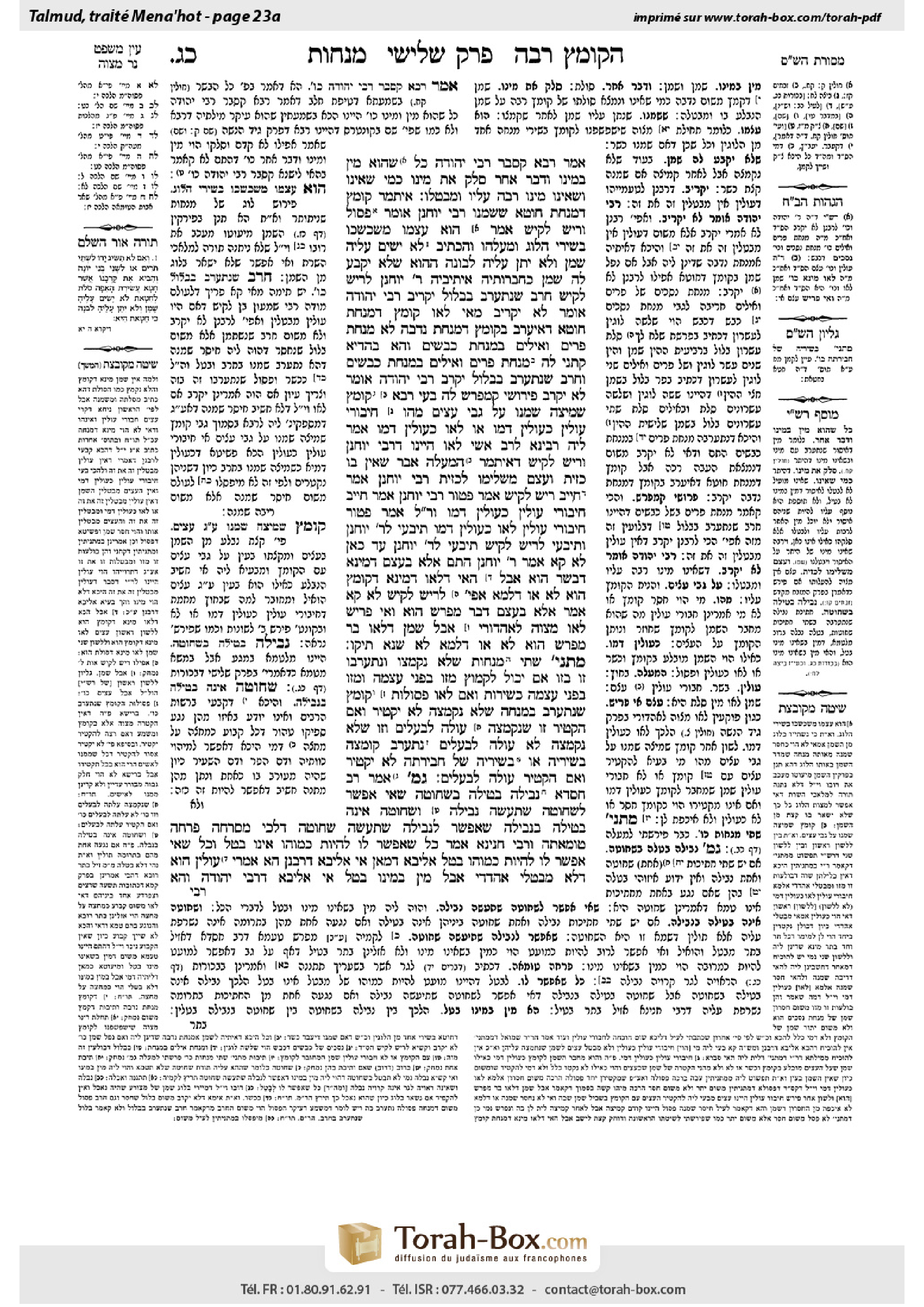
Menachot 23a: Talmud study for Daf Yomi
Daf Yomi is the daily study of one Talmud folio. Explore 37 tractates with scans, Hebrew text, Sefaria English and AI-generated French translations where annotated.
Passage selection and English or AI-generated French translation are available where the scan has annotations. Daf Study is independent of Torah-Box and Sefaria.
Browse Menachot · מנחות · All tractatesMenachot 23a text and translations
This page of Menachot includes the Aramaic text, an English translation and an AI-generated French translation, alongside the scan above.
מנחות כ״ג א · Aramaic and Hebrew text
אָמַר רָבָא: קָסָבַר רַבִּי יְהוּדָה, כׇּל שֶׁהוּא מִין בְּמִינוֹ וְדָבָר אַחֵר – סַלֵּק אֶת מִינוֹ כְּמִי שֶׁאֵינוֹ, וְשֶׁאֵינוֹ מִינוֹ רָבֶה עָלָיו וּמְבַטְּלוֹ.
אִיתְּמַר: קוֹמֶץ דְּמִנְחַת חוֹטֵא שֶׁשִּׁמְּנוֹ, רַבִּי יוֹחָנָן אוֹמֵר: פָּסוּל, וְרֵישׁ לָקִישׁ אָמַר: הוּא עַצְמוֹ מְשַׁכְשְׁכוֹ בִּשְׁיָרֵי הַלּוֹג וּמַעֲלֵהוּ.
וְהָכְתִיב: ״לֹא יָשִׂים עָלֶיהָ שֶׁמֶן וְלֹא יִתֵּן עָלֶיהָ לְבוֹנָה״? הַהוּא שֶׁלֹּא יִקְבַּע לָהּ שֶׁמֶן כְּחַבְרוֹתֶיהָ.
אֵיתִיבֵיהּ רַבִּי יוֹחָנָן לְרֵישׁ לָקִישׁ: חָרֵב שֶׁנִּתְעָרֵב בְּבָלוּל – יַקְרִיב, רַבִּי יְהוּדָה אוֹמֵר: לֹא יַקְרִיב. מַאי לָאו, קוֹמֶץ דְּמִנְחַת חוֹטֵא דְּאִיעָרַב בְּקוֹמֶץ דְּמִנְחַת נְדָבָה?
לֹא, מִנְחַת פָּרִים וְאֵילִים בְּמִנְחַת כְּבָשִׂים.
וְהָא בְּהֶדְיָא קָתָנֵי לַהּ: מִנְחַת פָּרִים וְאֵילִים בְּמִנְחַת כְּבָשִׂים, וְחָרֵב שֶׁנִּתְעָרֵב בְּבָלוּל – יִקְרַב, רַבִּי יְהוּדָה אוֹמֵר: לֹא יִקְרַב. פָּרוּשֵׁי קָמְפָרֵשׁ לַהּ.
בָּעֵי רָבָא: קוֹמֶץ שֶׁמִּיצָּה שַׁמְנוֹ עַל גַּבֵּי עֵצִים, מַהוּ? חִיבּוּרֵי עוֹלִין כְּעוֹלִין דָּמוּ, אוֹ לָאו כְּעוֹלִין דָּמוּ? אֲמַר לֵיהּ רָבִינָא לְרַב אָשֵׁי: לָאו הַיְינוּ דְּרַבִּי יוֹחָנָן וְרֵישׁ לָקִישׁ?
דְּאִיתְּמַר: הַמַּעֲלֶה אֵבֶר שֶׁאֵין בּוֹ כְּזַיִת, וְעֶצֶם מַשְׁלִימוֹ לִכְזַיִת – רַבִּי יוֹחָנָן אָמַר: חַיָּיב, רֵישׁ לָקִישׁ אָמַר: פָּטוּר.
רַבִּי יוֹחָנָן אָמַר חַיָּיב, חִיבּוּרֵי עוֹלִין כְּעוֹלִין דָּמוּ, וְרֵישׁ לָקִישׁ אָמַר פָּטוּר, חִיבּוּרֵי עוֹלִין לָאו כְּעוֹלִין דָּמוּ.
תִּיבְּעֵי לְרַבִּי יוֹחָנָן, וְתִיבְּעֵי לְרֵישׁ לָקִישׁ. תִּיבְּעֵי לְרַבִּי יוֹחָנָן: עַד כָּאן לָא קָא אָמַר רַבִּי יוֹחָנָן הָתָם, אֶלָּא בְּעֶצֶם, דְּמִינָא דְּבָשָׂר הוּא, אֲבָל הַאי דְּלָאו דְּמִינָא דְּקוֹמֶץ הוּא – לָא.
אוֹ דִלְמָא, אֲפִילּוּ לְרֵישׁ לָקִישׁ לָא קָא אָמַר אֶלָּא בְּעֶצֶם, דְּבַר מִפְרַשׁ הוּא, וְאִי פָּרֵישׁ – לָאו מִצְוָה לְאַהְדּוֹרֵי, אֲבָל שֶׁמֶן דְּלָאו בַּר מִפְרַשׁ הוּא – לָא, אוֹ דִּלְמָא לָא שְׁנָא. תֵּיקוּ.
מַתְנִי׳ שְׁתֵּי מְנָחוֹת שֶׁלֹּא נִקְמְצוּ וְנִתְעָרְבוּ זוֹ בָּזוֹ, אִם יָכוֹל לִקְמוֹץ מִזּוֹ בִּפְנֵי עַצְמָהּ וּמִזּוֹ בִּפְנֵי עַצְמָהּ – כְּשֵׁירוֹת, וְאִם לָאו – פְּסוּלוֹת.
קוֹמֶץ שֶׁנִּתְעָרֵב בְּמִנְחָה שֶׁלֹּא נִקְמְצָה – לֹא יַקְטִיר, וְאִם הִקְטִיר – זוֹ שֶׁנִּקְמְצָה עָלַת לַבְּעָלִים, וְזוֹ שֶׁלֹּא נִקְמְצָה לֹא עָלַת לַבְּעָלִים.
נִתְעָרֵב קוּמְצָהּ בִּשְׁיָרֶיהָ, אוֹ בִּשְׁיָרֶיהָ שֶׁל חֲבֶירְתָּהּ – לֹא יַקְטִיר, וְאִם הִקְטִיר – עָלַת לַבְּעָלִים.
גְּמָ׳ אָמַר רַב חִסְדָּא: נְבֵילָה בְּטֵילָה בִּשְׁחוּטָה, שֶׁאִי אֶפְשָׁר לִשְׁחוּטָה שֶׁתֵּעָשֶׂה נְבֵילָה.
וּשְׁחוּטָה אֵינָהּ בְּטֵילָה בִּנְבֵילָה, שֶׁאֶפְשָׁר לִנְבֵילָה שֶׁתֵּעָשֶׂה שְׁחוּטָה, דִּלְכִי מַסְרְחָה פָּרְחָה טוּמְאָתָהּ.
וְרַבִּי חֲנִינָא אָמַר: כׇּל שֶׁאֶפְשָׁר לוֹ לִהְיוֹת כָּמוֹהוּ – אֵינוֹ בָּטֵל, וְכֹל שֶׁאִי אֶפְשָׁר לוֹ לִהְיוֹת כָּמוֹהוּ – בָּטֵל.
אַלִּיבָּא דְּמַאן? אִי אַלִּיבָּא דְּרַבָּנַן, הָא אָמְרִי: עוֹלִין הוּא דְּלָא מְבַטְּלִי אַהֲדָדֵי, אֲבָל מִין בְּמִינוֹ – בָּטֵל.
אִי אַלִּיבָּא דְּרַבִּי יְהוּדָה, וְהָא
Menachot 23a · English translation
Rava said: Rabbi Yehuda holds that in the case of any mixture that consists of a substance in contact with the same type of substance as well as another type of substance, the halakha is to disregard the same substance, considering it as though it were not there, and in the event that the different type of substance is more than the first substance, the different substance nullifies the first substance. In the case of the mishna here, the handful of the meal offering is mixed with other types of meal offerings that comprise greater quantities of oil. The oil of the handful is disregarded, and the flour of the handful, which is present in greater quantities than the oil of the other meal offering that is absorbed in it, nullifies this oil of the other meal offering. That oil is now considered to be one with the oil of the handful, and therefore the oil of the handful is increased, and the handful is unfit.
§ It was stated that the amora’im disagreed with regard to the halakha where one added oil to the handful that is removed from the meal offering of a sinner, which does not include oil. Rabbi Yoḥanan says: It is unfit, and Reish Lakish says: The halakha of the meal offering itself is to wipe it, ab initio, in the remainder of the log of oil that remains in the vessels that were used previously for other meal offerings, and the priest then brings it up and burns it on the altar. This is done so that the meal offering will not be completely dry.
The Gemara asks: But isn’t it written with regard to the meal offering of a sinner: “He shall put no oil upon it, neither shall he put any frankincense on it” (Leviticus 5:11)? How, then, can any oil be added? The Gemara answers: That verse teaches that one should not designate oil for it as one designates oil for the other meal offerings, but the meal offering of a sinner is not rendered unfit by the addition of a small amount of oil.
Rabbi Yoḥanan raised an objection to Reish Lakish from a baraita (Tosefta 4:4): In the case of a dry meal offering that was intermingled with a meal offering that was mixed with oil, the priest shall sacrifice it. Rabbi Yehuda says: The priest shall not sacrifice it. What, is the baraita not referring to a handful of the meal offering of a sinner that was intermingled with a handful of a voluntary meal offering, demonstrating that the oil invalidates the handful of a meal offering of a sinner?
Reish Lakish responded: No, the baraita is referring to the meal offering that accompanies the libations brought with the offerings of bulls or rams, for which two log of oil is mixed with a tenth of an ephah of flour, that became intermingled with the meal offering that accompanies the libations brought with the offering of sheep, for which three log of oil is mixed with a tenth of an ephah of flour, as the former is considered dry relative to the latter.
Rabbi Yoḥanan objected: But another baraita teaches this explicitly as a separate halakha: With regard to the meal offering that accompanies the offerings of bulls or rams that became intermingled with the meal offering that accompanies the offering of sheep, and a dry meal offering that was intermingled with a meal offering that was mixed with oil, the meal offering shall be sacrificed. Rabbi Yehuda says: It shall not be sacrificed. Therefore, the latter case must be referring to other meal offerings. Reish Lakish responded: The latter clause is explaining the first clause of the baraita, teaching that the reason one may not offer a meal offering that accompanies bulls and rams that was intermingled with the meal offering that accompanies sheep is because one may not offer a dry offering that was intermingled with one that is mixed with oil.
§ Rava raises a dilemma: In the case of a handful whose oil the priest squeezed onto the wood and only afterward he placed the handful on the wood to be burned, what is the halakha? Are substances that are contiguous to items that ascend upon the altar considered to be as part of the items that ascend upon the altar, in which case the oil that was absorbed into the wood and is contiguous to the handful of the meal offering is considered part of the handful? Or are they not considered to be as part of the items that ascend upon the altar, and the oil is not viewed as part of the handful, and therefore the handful is missing oil? Ravina said to Rav Ashi: Is this not the same disagreement as the dispute between Rabbi Yoḥanan and Reish Lakish?
As it was stated: With regard to one who offers up, outside the Temple courtyard, a limb that contains less than an olive-bulk of meat, but the offering’s bone completes the measure of the offering to an olive-bulk, Rabbi Yoḥanan says: He is liable, and Reish Lakish says: He is exempt.
Rabbi Yoḥanan says that one is liable because he holds that substances that are contiguous to items that ascend upon the altar are considered to be as part of the items that ascend upon the altar. Therefore, the measure of the bone is added to the measure of the meat, resulting in a total measure of an olive-bulk, which is the measure that determines liability. And Reish Lakish says that one is exempt because he holds that substances that are contiguous to items that ascend upon the altar are not considered to be as part of the items that ascend upon the altar. Since less than an olive-bulk of meat was sacrificed, he is not liable.
Rav Ashi responded: Rava’s dilemma can be raised according to Rabbi Yoḥanan, and Rava’s dilemma can be raised according to Reish Lakish. The circumstances in their dispute are not the same as in Rava’s dilemma, so their opinions in that case may not be applicable to this one. Rav Ashi elaborates: The dilemma can be raised according to Rabbi Yoḥanan, even though he holds that the bone is considered to be part of the meat to complete the measure of an olive-bulk. Perhaps Rabbi Yoḥanan says his opinion only there, in the case of a bone, because the bone is the same type as the meat, i.e., it is from the same animal, and is therefore considered to be part of the sacrificial meat. But in this case of oil, which is not the same type as the handful, it is not considered to be a part of the handful even if it is contiguous to it.
Or perhaps, even according to Reish Lakish, he says his ruling only in the case of the bone, teaching that it does not add to the quantity of the meat. The reason is that the bone is able to be separated from the meat, and if it separated, there is no mitzva to return it to the fire. Therefore, he views it as distinct from the meat. But in this case of oil, which is not able to be separated from the handful of the meal offering, as it must be burned together with the handful, he will not hold that the oil is viewed as separate from the handful. Or perhaps there is no difference between the case of the bone and the case of the oil, and Rabbi Yoḥanan and Reish Lakish would have the same opinions, respectively, in both cases. The Gemara comments: The dilemma shall stand unresolved.
MISHNA: In the case of two meal offerings from which a handful was not removed and that were intermingled with each other, if the priest can remove a handful from this meal offering by itself and from that meal offering by itself, they are fit meal offerings, but if not, they are unfit, as the handful of each meal offering must be taken from its original source.
In the case of a handful that was intermingled with a meal offering from which a handful was not removed, the priest should not burn the mixture on the altar. And if he burned it, this meal offering from which the handful was taken satisfies the obligation of the owner and that meal offering from which the handful was not taken does not satisfy the obligation of the owner.
If, after it was removed, its handful was intermingled with its remainder or with the remainder of another meal offering, the priest should not burn the mixture on the altar, but if he burned it, it satisfies the obligation of the owner.
GEMARA: Rav Ḥisda says: The meat of an unslaughtered animal carcass is nullified in a larger quantity of meat of a slaughtered animal. Although meat from a carcass generally imparts impurity, if one touches the mixture of the two meats he does not become ritually impure, as the carcass meat is considered a different type of substance from the slaughtered animal and is therefore nullified. This is not considered a mixture that comprises a substance in contact with the same type of substance, because meat from a slaughtered animal cannot attain the status of a carcass, and it is therefore viewed as a different type of substance.
By contrast, if meat of a slaughtered animal became intermingled with a larger quantity of meat of animal carcass, the meat of the slaughtered animal is not nullified in the larger quantity of meat of the carcass, as it is possible for a carcass to attain the status of a slaughtered animal with regard to the halakhot of ritual impurity, as it can lose its ability to transmit ritual impurity. This is because when a carcass rots to the extent that it is no longer edible, it loses its impure status. The halakha that the carcass meat has the ability to attain the ritually pure status of meat of a slaughtered animal renders the two meats as the same type of substance, and the mixture retains its status of intermingled carcass meat and meat of a slaughtered animal.
And Rabbi Ḥanina says the opposite: Any small quantity of an item that can possibly become like the item that is present in larger quantities is not nullified when the two are intermingled, but any small quantity of an item that cannot possibly become like the item that is present in larger quantities is nullified in the larger quantity. Accordingly, a small quantity of meat of a slaughtered animal is nullified in a larger quantity of unslaughtered animal carcass meat, since the meat of a slaughtered animal cannot become like the animal carcass meat; but a small quantity of animal carcass meat is not nullified in a larger quantity of meat of a slaughtered animal, since it can lose its impure status and become akin to the meat of a slaughtered animal.
The Gemara asks: In accordance with whose opinion do Rabbi Ḥanina and Rav Ḥisda state their opinions? If their opinions are in accordance with the opinion of the Rabbis, this is difficult: Didn’t the Rabbis say that it is in the case of a mixture of items that ascend to the altar that the different components of the mixture do not nullify one another, but otherwise, a substance in contact with the same type of substance is nullified? Therefore, in any case where meat of a slaughtered animal becomes intermingled with unslaughtered animal carcass meat, the smaller quantity is nullified in the larger quantity.
If their opinions are in accordance with the opinion of Rabbi Yehuda, who holds that the blood of an offering is not nullified in the blood of a non-sacred animal because the two are the same type of substance, this is difficult: But
Menachot 23a · Traduction française (IA)
Rava dit : Rabbi Yehouda considère que, dans tout mélange où une substance est en contact à la fois avec une substance du même type et avec une substance d’un autre type, on ne tient pas compte de la substance du même type, comme si elle n’existait pas ; si la substance d’un autre type est en quantité supérieure à la première, elle annule cette dernière. Dans le cas de notre Michna, la poignée de l’oblation est mélangée à d’autres oblations qui contiennent davantage d’huile. On ne tient pas compte de l’huile de la poignée, et la farine de la poignée, présente en quantité supérieure à l’huile de l’autre oblation absorbée en elle, annule cette huile. Cette huile est désormais considérée comme faisant corps avec l’huile de la poignée ; la quantité d’huile de la poignée s’en trouve donc augmentée, et la poignée est impropre.
§ Les amoraïm ont divergé sur la halakha dans le cas où l’on a ajouté de l’huile à la poignée prélevée sur l’oblation du pécheur, qui ne contient pas d’huile. Rabbi Yoḥanan dit : Elle est impropre. Reish Lakish dit : La halakha est que l’on enduit délibérément l’oblation elle-même avec le reste du log d’huile demeurant dans les récipients qui ont servi auparavant pour d’autres oblations ; le prêtre la présente ensuite et la brûle sur l’autel. On procède ainsi afin que l’oblation ne soit pas complètement sèche.
La Guemara demande : N’est-il pas écrit au sujet de l’oblation du pécheur : « Il n’y mettra pas d’huile et n’y mettra pas non plus d’encens » (Lévitique 5, 11) ? Comment peut-on donc y ajouter de l’huile ? La Guemara répond : Ce verset enseigne qu’on ne doit pas lui réserver d’huile comme on le fait pour les autres oblations ; toutefois, l’oblation du pécheur n’est pas rendue impropre par l’ajout d’une petite quantité d’huile.
Rabbi Yoḥanan soulève une objection contre Reish Lakish à partir d’une baraïta (Tosefta 4, 4) : Dans le cas d’une oblation sèche mélangée à une oblation mêlée d’huile, le prêtre la sacrifie. Rabbi Yehouda dit : Le prêtre ne la sacrifie pas. La baraïta ne parle-t-elle pas d’une poignée de l’oblation du pécheur mélangée à la poignée d’une oblation volontaire, ce qui montrerait que l’huile rend impropre la poignée de l’oblation du pécheur ?
Reish Lakish répondit : Non, la baraïta parle de l’oblation accompagnant les libations offertes avec les sacrifices de taureaux ou de béliers, pour lesquels deux log d’huile sont mélangés à un dixième d’épha de farine, mélangée à l’oblation accompagnant les libations offertes avec le sacrifice de moutons, pour lequel trois log d’huile sont mélangés à un dixième d’épha de farine ; la première est considérée comme sèche par rapport à la seconde.
Rabbi Yoḥanan objecta : Mais une autre baraïta enseigne explicitement cette règle comme une halakha distincte : Si l’oblation accompagnant les sacrifices de taureaux ou de béliers a été mélangée à l’oblation accompagnant le sacrifice de moutons, et si une oblation sèche a été mélangée à une oblation mêlée d’huile, l’oblation doit être sacrifiée. Rabbi Yehouda dit : Elle ne doit pas être sacrifiée. Par conséquent, le second cas doit porter sur d’autres oblations. Reish Lakish répondit : La dernière clause explique la première clause de la baraïta : elle enseigne que si l’on ne peut pas offrir l’oblation accompagnant les taureaux et les béliers lorsqu’elle a été mélangée à celle accompagnant les moutons, c’est parce qu’on ne peut pas offrir une oblation sèche lorsqu’elle a été mélangée à une oblation mêlée d’huile.
§ Rava soulève un dilemme : Dans le cas d’une poignée dont le prêtre a pressé l’huile sur le bois, puis qu’il a placée sur le bois pour la brûler, quelle est la halakha ? Les substances contiguës aux éléments qui montent sur l’autel sont-elles considérées comme faisant partie de ces éléments ? Dans ce cas, l’huile absorbée par le bois et contiguë à la poignée de l’oblation est considérée comme faisant partie de la poignée. Ou bien ne sont-elles pas considérées comme faisant partie des éléments qui montent sur l’autel, de sorte que l’huile n’est pas considérée comme faisant partie de la poignée, et que celle-ci manque donc d’huile ? Ravina dit à Rav Ashi : N’est-ce pas le même désaccord que celui entre Rabbi Yoḥanan et Reish Lakish ?
En effet, il a été enseigné : Celui qui offre hors de la cour du Temple un membre contenant moins que le volume d’une olive de chair, mais dont l’os complète la quantité nécessaire pour atteindre le volume d’une olive, quelle est sa responsabilité ? Rabbi Yoḥanan dit : Il est passible. Reish Lakish dit : Il est exempt.
Rabbi Yoḥanan dit que l’homme est passible, car il considère que les substances contiguës aux éléments qui montent sur l’autel sont tenues pour en faire partie. La quantité de l’os s’ajoute donc à celle de la chair, pour atteindre au total le volume d’une olive, qui est la quantité déterminant la responsabilité. Reish Lakish dit que l’homme est exempt, car il considère que les substances contiguës aux éléments qui montent sur l’autel ne sont pas tenues pour en faire partie. Puisque moins que le volume d’une olive de chair a été offert, il n’est pas passible.
Rav Ashi répondit : Le dilemme de Rava peut être soulevé selon l’opinion de Rabbi Yoḥanan aussi bien que selon celle de Reish Lakish. Les circonstances de leur désaccord ne sont pas les mêmes que celles du dilemme de Rava ; leurs opinions dans ce cas ne s’appliquent donc pas nécessairement à celui-ci. Rav Ashi précise : On peut soulever le dilemme selon Rabbi Yoḥanan, bien qu’il considère que l’os est tenu pour faire partie de la chair afin de compléter le volume d’une olive. Peut-être Rabbi Yoḥanan ne donne-t-il son avis que dans ce cas, celui de l’os, parce que l’os est du même type que la chair, c’est-à-dire qu’il provient du même animal, et qu’il est donc considéré comme faisant partie de la chair du sacrifice. Mais dans le cas présent, celui de l’huile, qui n’est pas du même type que la poignée, elle n’est pas considérée comme faisant partie de la poignée, même si elle lui est contiguë.
Ou peut-être que, même selon Reish Lakish, sa règle ne vaut que dans le cas de l’os : celui-ci n’augmente pas la quantité de chair, car il peut être séparé de la chair et, s’il en était séparé, il n’y aurait pas de mitsva de le remettre au feu. Il le considère donc comme distinct de la chair. Mais dans le cas présent, celui de l’huile, qui ne peut pas être séparée de la poignée de l’oblation puisqu’elle doit être brûlée avec elle, il ne considérera pas l’huile comme distincte de la poignée. Ou peut-être n’y a-t-il aucune différence entre le cas de l’os et celui de l’huile, et Rabbi Yoḥanan et Reish Lakish auraient respectivement la même opinion dans les deux cas. La Guemara conclut : Le dilemme reste sans réponse.
MICHNA : Dans le cas de deux oblations dont aucune poignée n’a été prélevée et qui ont été mélangées l’une à l’autre, si le prêtre peut prélever séparément une poignée de chacune, elles sont aptes ; sinon, elles sont impropres, car la poignée de chaque oblation doit être prélevée de sa source d’origine.
Dans le cas d’une poignée mélangée à une oblation dont aucune poignée n’a été prélevée, le prêtre ne doit pas brûler le mélange sur l’autel. S’il l’a brûlé, l’oblation dont la poignée a été prélevée acquitte son propriétaire, tandis que celle dont la poignée n’a pas été prélevée ne l’acquitte pas.
Si, après avoir été prélevée, sa poignée a été mélangée à son reste ou au reste d’une autre oblation, le prêtre ne doit pas brûler le mélange sur l’autel ; toutefois, s’il l’a brûlé, cela acquitte le propriétaire.
GUEMARA : Rav Ḥisda dit : La chair d’une carcasse d’animal non abattu rituellement est annulée dans une quantité supérieure de chair d’un animal abattu rituellement. Bien que la chair d’une carcasse transmette généralement l’impureté, celui qui touche le mélange des deux chairs ne devient pas rituellement impur, car la chair de la carcasse est considérée comme une substance d’un type différent de celle de l’animal abattu rituellement et est donc annulée. Il ne s’agit pas d’un mélange où une substance est en contact avec une substance du même type, car la chair d’un animal abattu rituellement ne peut pas acquérir le statut de chair de carcasse ; elle est donc considérée comme une substance d’un type différent.
En revanche, si la chair d’un animal abattu rituellement a été mélangée à une quantité supérieure de chair de carcasse, la chair de l’animal abattu rituellement n’est pas annulée dans la quantité supérieure de chair de carcasse. En effet, une carcasse peut acquérir le statut d’un animal abattu rituellement en ce qui concerne les halakhot de l’impureté rituelle, puisqu’elle peut perdre sa capacité à transmettre l’impureté. Lorsqu’une carcasse se décompose au point de ne plus être comestible, elle perd son statut d’impureté. La possibilité que la chair de carcasse acquière le statut de pureté rituelle de la chair d’un animal abattu rituellement fait que les deux chairs sont considérées comme des substances du même type ; le mélange conserve donc son statut de mélange de chair de carcasse et de chair d’un animal abattu rituellement.
Et Rabbi Ḥanina dit le contraire : Toute petite quantité d’un élément qui peut éventuellement devenir semblable à l’élément présent en plus grande quantité n’est pas annulée lorsque les deux sont mélangés ; mais toute petite quantité d’un élément qui ne peut pas devenir semblable à l’élément présent en plus grande quantité est annulée dans cette quantité supérieure. Par conséquent, une petite quantité de chair d’un animal abattu rituellement est annulée dans une quantité supérieure de chair de carcasse, puisque la chair d’un animal abattu rituellement ne peut pas devenir semblable à la chair de carcasse ; mais une petite quantité de chair de carcasse n’est pas annulée dans une quantité supérieure de chair d’un animal abattu rituellement, puisqu’elle peut perdre son statut d’impureté et devenir semblable à la chair d’un animal abattu rituellement.
La Guemara demande : Selon l’opinion de qui Rabbi Ḥanina et Rav Ḥisda exposent-ils leurs avis ? Si leurs avis sont conformes à celui des Sages, une difficulté se pose : les Sages n’ont-ils pas dit que c’est dans le cas d’un mélange d’éléments qui montent sur l’autel que les différentes composantes du mélange ne s’annulent pas les unes les autres, mais que, dans les autres cas, une substance en contact avec une substance du même type est annulée ? Par conséquent, dans tout cas où la chair d’un animal abattu rituellement est mélangée à de la chair de carcasse, la quantité la plus faible est annulée dans la quantité la plus grande.
Si leurs avis sont conformes à celui de Rabbi Yehouda, qui considère que le sang d’un sacrifice n’est pas annulé dans le sang d’un animal non consacré, car les deux sont du même type, une difficulté se pose : mais
Traduction française générée par IA à partir de l’édition anglaise de Sefaria. Vérifie toujours un passage avec le texte source.
Text from Sefaria: William Davidson Edition - Vocalized Aramaic (unknown); William Davidson Edition - English (CC BY NC).